
Erbil Polytechnic University
Technical Engineering College
Civil Engineering Department
Engineering Surveying
Plane and Applied surveying 2
1
Trigonometry
Report number(3)
Report name :
Apparatus
Theodolite instruments 1 No.
Range poles 1 No.
Tripod 2 Nos.
Surveyors’ pins 4 Nos.
Hammer 1 No.
Tape 1 No.
Object: The object is to measure the height of an inaccessible and accessible
building using theodolite and measuring angles for the following cases:
1. Base of object is accessible.
2. Base of object is not accessible and the three points are on same vertical plane.
3. Base of object is not accessible and the three points are not on same vertical
plane.
Procedure:
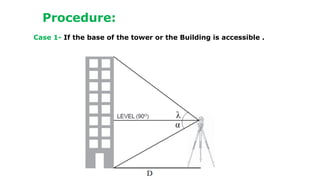
Case 1- If the base of the tower or the Building is accessible .
STEP 1
Set up the theodolite over a ground mark and take the angle to the top of the building
and an angle to the bottom of the building.
STEP 2
Measure the horizontal distance from the building to the ground mark.
STEP 3
Calculate the vertical angles. It is required to break the
formula down in to two right angle triangles.
As shown in the figure 1.
STEP 4
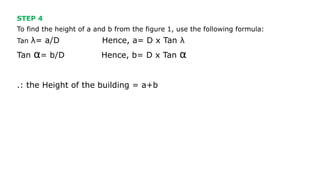
To find the height of a and b from the figure 1, use the following formula:
Tan λ= a/D Hence, a= D x Tan λ
Tan α= b/D Hence, b= D x Tan α
.: the Height of the building = a+b
Procedure for case 2
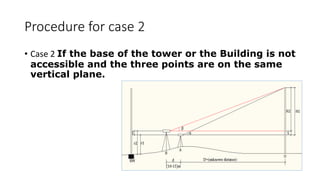
• Case 2 If the base of the tower or the Building is not
accessible and the three points are on the same
vertical plane.
STEP 1
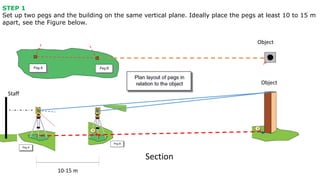
Set up two pegs and the building on the same vertical plane. Ideally place the pegs at least 10 to 15 m
apart, see the Figure below.
Object
Object
Section
10-15 m
Staff
STEP 2
Set up and level the instrument (theodolite) over peg A.
STEP 3
Target the top and the bottom of the building in order to
vertical angle to be measured and book the readings on the
booking sheet. Then take a reading on staff (r1)
STEP 4
Move the instrument and set up the second over peg B.
Measure the vertical angle of the top and the bottom of the
building. Book the reading. Continue by taking and booking
the readings. Then take a reading on staff (r2)
Procedure for case 3
Case 3- If the base of the tower or the Building is not accessible and the three
points are not on the same vertical plane.
Procedure Case 3
STEP 1
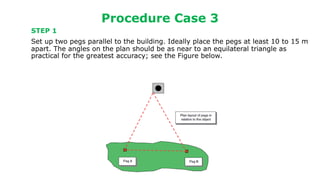
Set up two pegs parallel to the building. Ideally place the pegs at least 10 to 15 m
apart. The angles on the plan should be as near to an equilateral triangle as
practical for the greatest accuracy; see the Figure below.
STEP 2
Set up and level the instrument (theodolite) over peg A. Take staff reading (r1)
STEP 3
Target the top and the bottom of the building in order to vertical angle to be
measured and book the readings on the booking sheet
STEP 4
Set the horizontal angel to zero (0 set) and target peg B. Book the horizontal reading.
As shown in the figure.
STEP 5
Move the instrument and set up the
second over peg B and target peg A.
measure the vertical angle of the top
and the bottom of the building. Book
the reading. Continue by taking and
booking the readings. Take staff
reading (r2)
STEP 6
Set the horizontal angel to zero (0 set) and
target peg B. Book the horizontal reading.
Staff
Object
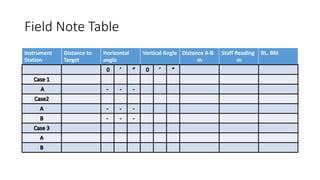
Field Note Table
Instrument
Station
Distance to
Target
Horizontal
angle
Vertical Angle Distance A-B
m
Staff Reading
m
RL. BM
Calculation For Case 1
I- If base of the object is accessible:
¨ 𝑆1 = 𝐷 tan ∝
¨ 𝑆2 = 𝐷 tan 𝛽
¨ ℎ = 𝑆1 + 𝑆2
¨ ℎ = 𝐷 (tan ∝ + tan 𝛽) BM
¨ figure 1
¨ RL of the object = RL of BM + S
Staff
S
h
Calculation For Case 2
𝑆 = 𝑟2 − 𝑟1 = 𝐻1 − 𝐻2
𝐻1 = 𝐷 tan ∝ ……………… (1)
𝐻2 = (𝑑 + 𝐷) tan 𝛽 ……… (2)
Subtract equation 1 and 2
𝐻1 − 𝐻2 = 𝐷 tan ∝ − 𝑑 tan 𝛽 − 𝐷 tan 𝛽
𝑆 + 𝑑 tan 𝛽 = 𝐷 (tan ∝ − tan 𝛽)
𝐷 =
𝑆 + 𝑑 tan 𝛽
tan ∝ − tan 𝛽
14
Case 2. The three points (A, B, and O) are on the same vertical plane.
B A O
Calculations For case 3
1- Calculate the horizontal angles in order to find the distance between the
instrument.
2-Calculate the angle for point C (angle A and B measured by theodolite)
Angle C= 180- (angle A + angle B )
3- To find the distance between the building and
The instrument we should use sine rule, As there
are no right angles.
The first objective is to calculate the length
of AB therefore use that part
of the formula and note the known data.
The first objective is to calculate the length of AC therefore use that part of the
formula and note the known data.
length AB is known
Hence, AC= x AB =D1 (AC is the length between the building and the instrument A)
Hence, BC= x AB = D2 (BC is the length between the building and the instrument B)
A
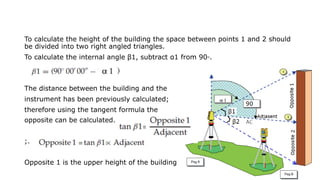
To calculate the height of the building the space between points 1 and 2 should
be divided into two right angled triangles.
To calculate the internal angle β1, subtract α1 from 90◦.
The distance between the building and the
instrument has been previously calculated;
therefore using the tangent formula the
opposite can be calculated.
;.
Opposite 1 is the upper height of the building
To Calculate the opposite on the lower of the building. To calculate the internal
angle β2 subtract 90◦ from α2:
To calculate the lower height of the building:
Add both Opposite 1 and Opposite 2
to calculate the overall height of the
building.
Opposite 1 + Opposite 2 = Overall height of building.
Find D1, and D2
𝐻1 = 𝐷1 tan ∝ ……………… (1)
𝐻2 = 𝐷2 tan 𝛽 ……… (2)
𝑅𝐿5 = 𝐻. 𝐼8 + 𝐻9
To check: 𝐻. 𝐼8 = 𝑅𝐿:.; + 𝑟9
𝑅𝐿5 = 𝐻. 𝐼: + 𝐻<𝐻. 𝐼: = 𝑅𝐿:.; + 𝑟<

Trigonometric Levelling Practical Part

  • 1.
    Erbil Polytechnic University TechnicalEngineering College Civil Engineering Department Engineering Surveying Plane and Applied surveying 2 1
  • 2.
    Trigonometry Report number(3) Report name: Apparatus Theodolite instruments 1 No. Range poles 1 No. Tripod 2 Nos. Surveyors’ pins 4 Nos. Hammer 1 No. Tape 1 No. Object: The object is to measure the height of an inaccessible and accessible building using theodolite and measuring angles for the following cases: 1. Base of object is accessible. 2. Base of object is not accessible and the three points are on same vertical plane. 3. Base of object is not accessible and the three points are not on same vertical plane.
  • 3.
    Procedure: Case 1- Ifthe base of the tower or the Building is accessible .
  • 4.
    STEP 1 Set upthe theodolite over a ground mark and take the angle to the top of the building and an angle to the bottom of the building. STEP 2 Measure the horizontal distance from the building to the ground mark. STEP 3 Calculate the vertical angles. It is required to break the formula down in to two right angle triangles. As shown in the figure 1.
  • 5.
    STEP 4 To findthe height of a and b from the figure 1, use the following formula: Tan λ= a/D Hence, a= D x Tan λ Tan α= b/D Hence, b= D x Tan α .: the Height of the building = a+b
  • 6.
    Procedure for case2 • Case 2 If the base of the tower or the Building is not accessible and the three points are on the same vertical plane.
  • 7.
    STEP 1 Set uptwo pegs and the building on the same vertical plane. Ideally place the pegs at least 10 to 15 m apart, see the Figure below. Object Object Section 10-15 m Staff
  • 8.
    STEP 2 Set upand level the instrument (theodolite) over peg A. STEP 3 Target the top and the bottom of the building in order to vertical angle to be measured and book the readings on the booking sheet. Then take a reading on staff (r1) STEP 4 Move the instrument and set up the second over peg B. Measure the vertical angle of the top and the bottom of the building. Book the reading. Continue by taking and booking the readings. Then take a reading on staff (r2)
  • 9.
    Procedure for case3 Case 3- If the base of the tower or the Building is not accessible and the three points are not on the same vertical plane.
  • 10.
    Procedure Case 3 STEP1 Set up two pegs parallel to the building. Ideally place the pegs at least 10 to 15 m apart. The angles on the plan should be as near to an equilateral triangle as practical for the greatest accuracy; see the Figure below.
  • 11.
    STEP 2 Set upand level the instrument (theodolite) over peg A. Take staff reading (r1) STEP 3 Target the top and the bottom of the building in order to vertical angle to be measured and book the readings on the booking sheet STEP 4 Set the horizontal angel to zero (0 set) and target peg B. Book the horizontal reading. As shown in the figure. STEP 5 Move the instrument and set up the second over peg B and target peg A. measure the vertical angle of the top and the bottom of the building. Book the reading. Continue by taking and booking the readings. Take staff reading (r2) STEP 6 Set the horizontal angel to zero (0 set) and target peg B. Book the horizontal reading. Staff Object
  • 12.
    Field Note Table Instrument Station Distanceto Target Horizontal angle Vertical Angle Distance A-B m Staff Reading m RL. BM
  • 13.
    Calculation For Case1 I- If base of the object is accessible: ¨ 𝑆1 = 𝐷 tan ∝ ¨ 𝑆2 = 𝐷 tan 𝛽 ¨ ℎ = 𝑆1 + 𝑆2 ¨ ℎ = 𝐷 (tan ∝ + tan 𝛽) BM ¨ figure 1 ¨ RL of the object = RL of BM + S Staff S h
  • 14.
    Calculation For Case2 𝑆 = 𝑟2 − 𝑟1 = 𝐻1 − 𝐻2 𝐻1 = 𝐷 tan ∝ ……………… (1) 𝐻2 = (𝑑 + 𝐷) tan 𝛽 ……… (2) Subtract equation 1 and 2 𝐻1 − 𝐻2 = 𝐷 tan ∝ − 𝑑 tan 𝛽 − 𝐷 tan 𝛽 𝑆 + 𝑑 tan 𝛽 = 𝐷 (tan ∝ − tan 𝛽) 𝐷 = 𝑆 + 𝑑 tan 𝛽 tan ∝ − tan 𝛽 14 Case 2. The three points (A, B, and O) are on the same vertical plane. B A O
  • 15.
    Calculations For case3 1- Calculate the horizontal angles in order to find the distance between the instrument. 2-Calculate the angle for point C (angle A and B measured by theodolite) Angle C= 180- (angle A + angle B ) 3- To find the distance between the building and The instrument we should use sine rule, As there are no right angles. The first objective is to calculate the length of AB therefore use that part of the formula and note the known data.
  • 16.
    The first objectiveis to calculate the length of AC therefore use that part of the formula and note the known data. length AB is known Hence, AC= x AB =D1 (AC is the length between the building and the instrument A) Hence, BC= x AB = D2 (BC is the length between the building and the instrument B) A
  • 17.
    To calculate theheight of the building the space between points 1 and 2 should be divided into two right angled triangles. To calculate the internal angle β1, subtract α1 from 90◦. The distance between the building and the instrument has been previously calculated; therefore using the tangent formula the opposite can be calculated. ;. Opposite 1 is the upper height of the building
  • 18.
    To Calculate theopposite on the lower of the building. To calculate the internal angle β2 subtract 90◦ from α2: To calculate the lower height of the building: Add both Opposite 1 and Opposite 2 to calculate the overall height of the building. Opposite 1 + Opposite 2 = Overall height of building.
  • 19.
    Find D1, andD2 𝐻1 = 𝐷1 tan ∝ ……………… (1) 𝐻2 = 𝐷2 tan 𝛽 ……… (2) 𝑅𝐿5 = 𝐻. 𝐼8 + 𝐻9 To check: 𝐻. 𝐼8 = 𝑅𝐿:.; + 𝑟9 𝑅𝐿5 = 𝐻. 𝐼: + 𝐻<𝐻. 𝐼: = 𝑅𝐿:.; + 𝑟<