1
Practical No: 1
Object:
Introduction to different parts and their function of digital or electronic theodolite.
Theory:
The theodolite is the most intricate and accurate instrument designed for the measurementof horizontal and
vertical angles up to 10” or 20”, depending upon the least count of the instrument. It is also known as
“universal instrument”, due to its various uses. The traditional use has been for land surveying, but they are
also used extensively for building and infrastructure construction. It consists of a
moveable telescope mounted so it can rotate around horizontal and vertical axes and provide angular
readouts.These indicate the orientation of the telescope,and are used to relate the first point sighted through
the telescope to subsequent sightings of other points from the same theodolite position.
Uses:
The following are the different purposes for which the theodolite is used:
▪ Measuring horizontal and vertical angles
▪ Measuring deflection angles
▪ Measuring magnetic bearings
▪ Measuring the horizontal distance between two points
▪ finding the vertical height of an object
▪ finding the difference of elevation between various points
▪ For ranging a line
▪ prolonging survey lines
▪ Establishing grades
▪ setting out curves.
Fig:01.1 Digital theodolite
2
Types of theodolite:
There are two types of theodolite:
A. Transit theodolite:
It is the theodolite in which the line of sight can be reversed by revolving the telescope through 180˚ in the
vertical plane.
B. Non-transit theodolite:
In this type of theodolite, the telescope cannot be resolved through a complete revolution in the vertical
plane but can be revolved to a certain extent in the vertical plane, in order to measure the angle of elevation
or depression.
Fig: 01.2 different parts of digital or electronic theodolite
3
Different parts of theodolite and their functions are describedbellow:
Telescope:
A telescope is a focusing instrument which has object piece at one end and eye piece at the other end. It
rotates about horizontal axis in vertical plane. The graduations are up to an accuracy of 20’.
Targetor sight:
The telescope has a sight on the top of it that is used to align the target.
Eye piece:
The telescope contains an eye piece that the user looks through to find the target being sighted.
Objective lens:
The objective lens is used to sight the object and with the help of mirrors inside the telescope, allows the
object to be magnified.
Cross hair Focusing screw and Telescopic focusing screw:
Both screws are used to remove parallax. Parallax is a condition arising when the image formed by the
objective is not in the plane of the cross-hairs. Unless parallax is removed, accurate sighting is
impossible.
Horizontal clamp or horizontal screw:
Horizontal clamp is used to stop horizontal motion of theodolite. For more precise reading Horizontal
screw is used, which move slowly and gradually to set instrument at accurate horizontal angle.
Vertical clamp and vertical screw:
Vertical clamp is used to stop vertical motion of telescope. For more precise reading vertical screw is
used, which move slowly and gradually to set instrument at accurate verticalangle.
Tribatch:
It consists of Base Plate,leveling head, and leveling screw. It is used for leveling the theodolite.
Optical Plummet:
Optical plummet is used for centering the theodolite at a station.
Display screen:
Display screen shows readings (Horizontal angle And Vertical Angle) which are taken by theodolite.
4
Tripod:
Tripod is nothing but a stand on which theodolite is mounted. It should place in such a way that theodolite
should be in exact leveled position. The tripod has legs with steel shoes at their ends. These hold the
ground strongly without any movement when placed. Tripod has an external screw which helps to attach
the theodolite by tribratch plate in fixed position.
Plumb bob:
Plumb bob is tool having a cone shaped weight attached to a long thread. The weight is hanged using
thread from the center of tripod stand and centering of theodolite is done.
5
Practical No: 2
Object:
Temporary adjustment of Digital or Electronic Theodolite.
Procedure:
Temporary adjustments of theodolite:
Temporary adjustments or station adjustment are those which are
taken over the station at the time of taking observation or those
which are taken at everyinstrument setting and preparing to taking
observations with the instrument.
Such adjustments include the following steps:
Setting the theodolite over the station:
1. It consists of placing of the instrument over the required
station by a plumb bob or by optical plummet. Fig: 2.1 Digital theodolite
2. The tripod stand is placed over the required station and the theodolite is lifted from the box and fixed on
top of the stand by means of a wing nut or according to the fixing arrangement provided along the
instrument.
Approximate levelling by tripod stand:
1. The approximate levelling is done with the help of tripod legs either with reference to a small circular
bubble provided on tribrach is done by eye judgment.
2. The tripod legs are placed well apart and firmly fixed on the ground.
3. Two legs of the tripod stand are kept firmly on the ground and third is moved in or out, clockwise or
anticlockwise, so that the bubble is approximately at the center of its run.
Centering:
1. Centering is the process of setting the instrument exactly over the station.
2. It should be confirmed at the time of approximate levelling that the plumb bob suspended from the hook
under the vertical axis lies almost over the station peg.
6
3. After then, with the help of shifting head (moveable capstan nut), the centering is done accurately so that
the plumb bob exactly over the nail of the station peg.
Levelling:
1. After having centered and approximately leveled the instrument, accurate levelling is done with the help
of foot screws and with reference to the plate levels.
2. Its purpose is to make the vertical axis truly vertical.
3. The manner of levelling the instrument by the plate levels depends upon whether there are three levelling
screws or four levelling screws.
Three screw head:
4. Turn the upper plate until the longitudinal axis of the plate level is roughly parallel to a line joining any
two (such as a and b) of the levelling screws.
5. Hold these two levelling screwsbetweenthe thumb and first finger of eachhand and turn them uniformly
so that the thumbs move either towards each other or away from each other until the bubble is central. It
should be noted that the bubble will move in the direction of movement of the left thumb.
6. Turn the upper plate through 90˚, i.e. until the axis of the level passes over the position of the third
levelling screw c.
7. Turn this levelling screw until the bubble is central.
8. Return the upper plate through 90˚ to its original position and repeat step (2) till the bubble is central.
9. Turn back again through 90˚ and repeat step 4.
10. Repeat steps (2) and (4) till the bubble is central in both the positions.
11. Now rotate the instrument through 180˚. The bubble should remain the center of its run, provided it is
in correct adjustment. The vertical axis will then be truly vertical. If not, it needs permanent adjustment.
Elimination of parallax:
Parallax is a condition arising when the image formed by the objective is not in the plane of the cross-hairs.
Unless parallax is removed, accurate sighting is impossible. Its elimination is done by two steps:
i. Focusing the eye-piece:
1. In order to focus the eye-piece for distinct vision of the cross-hairs, point the telescope towards the sky
(or hold the sheet of white paper in front of the objective).
7
2. Move the eye-piece in or out till the cross-hairs are seen sharp and distinct.
ii. Focusing the objective:
1. The telescope is then directed towards the object to be sighted and the focusing screw is turned till the
image appears clear and sharp.
2. The image so formed is in the plane of cross-hairs.
8
Practical No: 3
Object:
To determine the vertical and horizontal angle of a line, also the bearing of line with the help of digital or
electronic theodolite.
Equipment:
Digital theodolite, tripod stand, leveling staff, ranging rods, plum bob, prismatic compass and tape.
Theory:
Angle:
An angle is the figure formed by two lines, called the sides of the angle, sharing a common endpoint.
Horizontal Angle:
An angle between two lines, which are on the horizontal plane, called horizontal angle.
Vertical Angle:
An angle formed by two lines, which are on the vertical plane, called vertical angle.
Bearing:
Bearing is defined as direction of line measured with respect to meridian.
Magnetic Bearing: Magnetic Bearing is defined as direction of line measured with respect to magnetic
north.
Fig: 03.1 Measurement of horizontal angle
9
Procedure:
Measuring the horizontal angle BAC
1. Mark station A and set up the instrument at station A and level it accurately.
2. Then mark two more stations B and C at some distance from station A.
3. Horizontal clamp is kept fixed and vertical clamp loosened, then set telescope at 90˚ with the help of
vertical clamp and vertical screw.
4. Now the vertical clamp is tightly fixed and horizontal clamp is loosened and telescope is directed
towards B and bisect the ranging rod at B.
5. Horizontal clamp is fixed and set horizontal angle as 0˚ by using reset button.
6. Now loose the horizontal clamp and telescope is directed towards C and bisect the ranging rod at C.
7. Finally note the horizontal angle from display screen.
Measuring the vertical angle:
1. Set up the instrument at any station from
building is visible and level it accurately.
2. After setting, set the vertical angle as
zero degree and lock the vertical clamp
screw.
3. Till the telescope of theodolite to the top
of building.
4. Note the vertical angle which is display
on digital screen name it as ϕ.
5. Calculate vertical angle θ by using
formula “ θ = ϕ - 90˚ ”.
Fig: 03.1 Measurement of vertical angle
Measuring the Magnetic bearing of a line:
In order to measure the magnetic bearing of a line, the theodolite should be provided with prismatic
compass.
The following are the steps:
1. Mark station A then mark North with help of prismatic compass at station A.
10
2. Then mark two more stations B and C at some distance from station A.
3. Set up the instrument at station A and level it accurately.
4. Horizontal clamp is kept fixed and vertical clamp loosened, then set telescope at 90˚ with the help of
vertical clamp and vertical screw.
5. Now the vertical clamp is tightly fixed and horizontal clamp is loosened and telescope is directed
towards north and bisect the ranging rod.
6. Horizontal clamp is fixed and set horizontal angle as 0˚ by using reset button.
7. Now loose the horizontal clamp and telescope is directed towards B and bisect the ranging rod at B.
8. Note the H.A. displayed at display screen,which is the bearing of line AB.
9. Again telescope is directed towards north and bisect the ranging rod then Horizontal clamp is fixed
and set horizontal angle as 0˚ by using reset button.
10. Loose the horizontal clamp and telescope is directed towards C and bisect the ranging rod at C.
11. Note the H.A. displayed at display screen,which is the bearing of line AC.
12. And also measure distances of AB and AC with the help of tape.
Fig: 03.1 Measurement of Magnetic bearing angle
11
Observation:
Group Line Length (ft.) Bearing(R.C.B) True bearing Horizontal
angle
12
AutoCAD Graph:
13
Practical No: 4
Object: To determine the latitude, departure and coordinates of point/line.
Equipment:
Digital theodolite, tripod stand, leveling staff, ranging rods, plum bob, prismatic compass and tape.
Theory:
The theodolite traverse is not plotted according angles or bearings. It is plotted by computing the latitude
and departure of the points (consecutive coordinates) and then finding the independent coordinates of the
points.
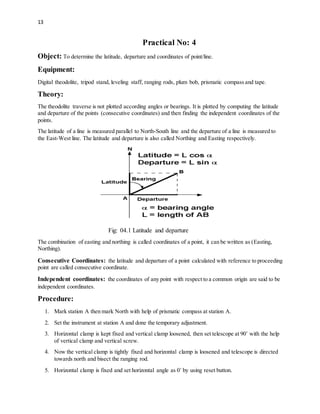
The latitude of a line is measured parallel to North-South line and the departure of a line is measured to
the East-West line. The latitude and departure is also called Northing and Easting respectively.
Fig: 04.1 Latitude and departure
The combination of easting and northing is called coordinates of a point, it can be written as (Easting,
Northing).
Consecutive Coordinates: the latitude and departure of a point calculated with reference to proceeding
point are called consecutive coordinate.
Independent coordinates: the coordinates of any point with respect to a common origin are said to be
independent coordinates.
Procedure:
1. Mark station A then mark North with help of prismatic compass at station A.
2. Set the instrument at station A and done the temporary adjustment.
3. Horizontal clamp is kept fixed and vertical clamp loosened, then set telescope at 90˚ with the help
of vertical clamp and vertical screw.
4. Now the vertical clamp is tightly fixed and horizontal clamp is loosened and telescope is directed
towards north and bisect the ranging rod.
5. Horizontal clamp is fixed and set horizontal angle as 0˚ by using reset button.
14
6. Now loose the horizontal clamp and telescope is directed towards B and bisect the ranging rod at
B.
7. Note the H.A. displayed at display screen,which is the bearing of line AB.
8. Then measure the distance from station A to B with help of tape and note it in observation table.
9. Repeat the above process for bearings and distances of lines BD, DC and CA.
10. Find the latitude by using LCosθ and departure by using LSineθ (where L is distance of line and θ
is bearing of that line).
11. Let the coordinates of point A as (12960.2ft, 85654.98ft).
12. And find the coordinates of other stations by adding latitudes and departures in coordinates of
station A.
Observations:
Line Length (ft) Bearing Latitude Departure Coordinates
15
85630
85635
85640
85645
85650
85655
85660
85665
85670
12950 12960 12970 12980 12990 13000 13010
Latitude(ft)
Departure (ft)
16
Practical No: 5
Object:To determine the area of traverse by coordinate method.
Equipment:
Digital theodolite, tripod stand, leveling staff, ranging rods, plum bob, prismatic compass and tape.
Procedure:
1. Mark station A then mark North with help of prismatic compass at station A.
2. Set the instrument at station A and done the temporary adjustment.
3. Horizontal clamp is kept fixed and vertical clamp loosened, then set telescope at 90˚ with the help
of vertical clamp and vertical screw.
4. Now the vertical clamp is tightly fixed and horizontal clamp is loosened and telescope is directed
towards north and bisect the ranging rod.
5. Horizontal clamp is fixed and set horizontal angle as 0˚ by using reset button.
6. Now loose the horizontal clamp and telescope is directed towards B and bisect the ranging rod at
B.
7. Note the H.A. displayed at display screen,which is the bearing of line AB.
8. Then measure the distance from station A to B with help of tape and note it in observation table.
9. Repeat the above process for bearings and distances of lines BC, CD, DE and EA.
10. Find the latitude by using LCosθ and departure by using LSineθ (where L is distance of line and θ
is bearing of that line).
11. Let the coordinates of point A as (0, 0).
12. And find the coordinates of other stations by adding latitudes and departures in coordinates of
station A.
13. The coordinates are arranged in determinant form as follows.
Station A B C D E A
Latitude Y1 Y2 Y3 Y4 Y5 Y1
Departure X1 X2 X3 X4 X5 X1
14. Sum of products along the solid line,
∑P = (Y1.X2+Y2.X3+Y3.X4+Y4.X5+Y5.X1)
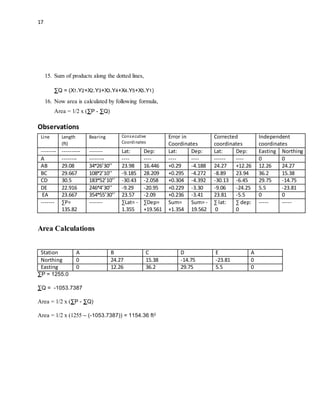
17
15. Sum of products along the dotted lines,
∑Q = (X1.Y2+X2.Y3+X3.Y4+X4.Y5+X5.Y1)
16. Now area is calculated by following formula,
Area = 1/2 x (∑P - ∑Q)
Observations
Area Calculations
∑P = 1255.0
∑Q = -1053.7387
Area = 1/2 x (∑P - ∑Q)
Area = 1/2 x (1255 – (-1053.7387)) = 1154.36 ft2
Line Length
(ft)
Bearing Consecutive
Coordinates
Error in
Coordinates
Corrected
coordinates
Independent
coordinates
-------- ---------- ------- Lat: Dep: Lat: Dep: Lat: Dep: Easting Northing
A -------- -------- ---- ---- ---- ---- ------ ---- 0 0
AB 29.08 34ᶱ26’30’’ 23.98 16.446 +0.29 -4.188 24.27 +12.26 12.26 24.27
BC 29.667 108ᶱ2’10’’ -9.185 28.209 +0.295 -4.272 -8.89 23.94 36.2 15.38
CD 30.5 183ᶱ52’10’’ -30.43 -2.058 +0.304 -4.392 -30.13 -6.45 29.75 -14.75
DE 22.916 246ᶱ4’30’’ -9.29 -20.95 +0.229 -3.30 -9.06 -24.25 5.5 -23.81
EA 23.667 354ᶱ55’30’’ 23.57 -2.09 +0.236 -3.41 23.81 -5.5 0 0
------- ∑P=
135.82
------- ∑Lat= -
1.355
∑Dep=
+19.561
Sum=
+1.354
Sum= -
19.562
∑ lat:
0
∑ dep:
0
----- -----
Station A B C D E A
Northing 0 24.27 15.38 -14.75 -23.81 0
Easting 0 12.26 36.2 29.75 5.5 0
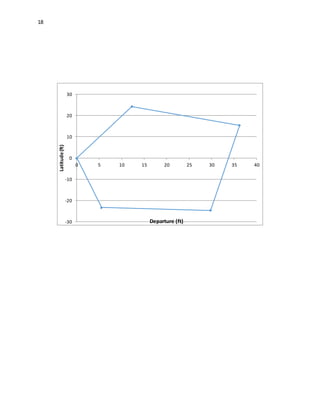
18
-30
-20
-10
0
10
20
30
0 5 10 15 20 25 30 35 40
Latitude(ft)
Departure (ft)
19
Practical No: 6
Object:To determine the horizontal distance bytacheometricsurveyingwhenthe line of sightis
horizontal.
Equipment:
Digital theodolite, tripod stand, leveling staff, prismatic compass, ranging rods, and plum bob.
Theory:
Tacheometric Surveying (Tacheometry):
It is the branch of surveying in which horizontal and vertical distances are determine by taking angular
observations and stadia readings with help of an instrument known as tacheometer. In this survey
chaining operation is completely eliminated.
Tacheometer:
It is a transit theodolite, fitted with stadia lines (or stadia diaphragm) and an additional convex lens in the
telescope of a tacheometer.
Lens formula is 1/f = 1/p + 1/q
From figure
1/f = 1/u + 1/v
Since, i/s = v/u => v = iu/s
1/f = 1/u + s/iu
1/f = 1/u(1 + s/i)
u= f(1 + s/i)
u+d = f(1 + s/i) + d
D = (f/i)s + (f+d)
Procedure:
1. Mark station A then mark North with help of prismatic compass at station A.
2. Set the instrument at station A and done the temporary adjustment.
3. Horizontal clamp is kept fixed and vertical clamp loosened, then set telescope at 90˚ with the help
of vertical clamp and vertical screw.
4. Now the vertical clamp is tightly fixed and horizontal clamp is loosened and telescope is directed
towards north and bisect the ranging rod.
5. Horizontal clamp is fixed and set horizontal angle as 0˚ by using reset button.
20
6. Now loose the horizontal clamp and telescope is directed towards B and bisect the ranging rod at
B.
7. Note the H.A. displayed at display screen,which is the bearing of line AB.
8. Now hold the staff rod on station B and note the stadia readings that is uppers stadia, lower stadia
and centralstadia readings.
9. Horizontal distance of AB is calculated by using distance formula ( D = (f/i)s + (f+d) ).
10. Repeat the above process for bearings and distances of lines BC, CD, DE, EF and FA.
11. Find the latitude by using LCosθ and departure by using LSinθ (where L is distance of line and θ is
bearing of that line).
12. Let the coordinates of point A as (0, 0).
13. And find the coordinates of other stations by adding latitudes and departures in coordinates of
station A.
14. The coordinates are arranged in determinant form as follows.
Station A B C D E A
Latitude Y1 Y2 Y3 Y4 Y5 Y1
Departure X1 X2 X3 X4 X5 X1
15. Sum of products along the solid line,
∑P = (Y1.X2+Y2.X3+Y3.X4+Y4.X5+Y5.X1)
16. Sum of products along the dotted lines,
∑Q = (X1.Y2+X2.Y3+X3.Y4+X4.Y5+X5.Y1)
17. Now area is calculated by following formula,
Area = 1/2 x (∑P - ∑Q)
Observations:
Line Instrument
station
Stadia readings Vertical angle Horizontal
angle
Distance
u/s c/s l/s
21
Area Calculations:
Station A B C D E F A
Latitude
Departure
∑P = …………………………...
∑Q = …………………………..
Area = 1/2 x (∑P - ∑Q)
Area = 1/2 x (……………. - ……………..) = ………………
22
-40
-30
-20
-10
0
10
20
30
40
50
-20 -10 0 10 20 30 40
Latitude(ft)
Departure (ft)
23
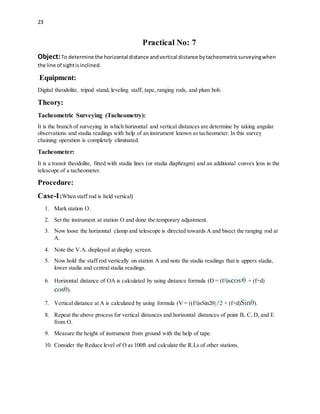
Practical No: 7
Object:To determine the horizontal distance andvertical distance bytacheometricsurveyingwhen
the line of sightisinclined.
Equipment:
Digital theodolite, tripod stand, leveling staff, tape, ranging rods, and plum bob.
Theory:
Tacheometric Surveying (Tacheometry):
It is the branch of surveying in which horizontal and vertical distances are determine by taking angular
observations and stadia readings with help of an instrument known as tacheometer. In this survey
chaining operation is completely eliminated.
Tacheometer:
It is a transit theodolite, fitted with stadia lines (or stadia diaphragm) and an additional convex lens in the
telescope of a tacheometer.
Procedure:
Case-I(When staff rod is held vertical)
1. Mark station O.
2. Set the instrument at station O and done the temporary adjustment.
3. Now loose the horizontal clamp and telescope is directed towards A and bisect the ranging rod at
A.
4. Note the V.A. displayed at display screen.
5. Now hold the staff rod vertically on station A and note the stadia readings that is uppers stadia,
lower stadia and centralstadia readings.
6. Horizontal distance of OA is calculated by using distance formula (D = (f/i)scos2θ + (f+d)
cosθ).
7. Vertical distance at A is calculated by using formula (V = ((f/i)sSin2θ)/2 + (f+d)Sinθ).
8. Repeat the above process for vertical distances and horizontal distances of point B, C, D, and E
from O.
9. Measure the height of instrument from ground with the help of tape.
10. Consider the Reduce level of O as 100ft and calculate the R.Ls of other stations.
24
Case-II(When staff rod is held perpendicular to the ground)
1. Mark station O.
2. Set the instrument at station O and done the temporary adjustment.
3. Now loose the horizontal clamp and telescope is directed towards A and bisect the ranging rod at
A.
4. Note the V.A. displayed at display screen.
5. Now hold the staff rod perpendicular to the ground on station A and note the stadia readings that is
uppers stadia, lower stadia and central stadia readings.
6. Horizontal distance of OA is calculated by using distance formula (D = (f/i)scos2θ + (f+d)
cosθ).
7. Vertical distance at A is calculated by using formula (V = ((f/i)sSin2θ)/2 + (f+d)Sinθ).
8. Repeat the above process for vertical distances and horizontal distances of point B, C, D, and E
from O.
9. Measure the height of instrument from ground with the help of tape.
10. Consider the Reduce level of O as 100ft and calculate the R.Ls of other stations.
Observations:
Case-I
Line Instrument
station
Stadia readings Vertical angle Distance R.Ls.
u/s c/s l/s
Instrument Height = …………….
25
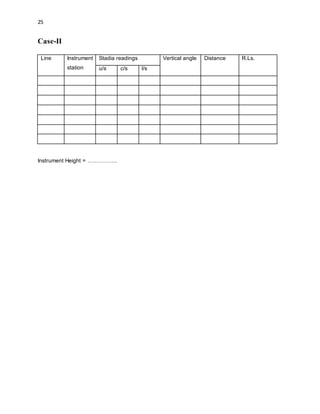
Case-II
Line Instrument
station
Stadia readings Vertical angle Distance R.Ls.
u/s c/s l/s
Instrument Height = …………….
26
Case-I
Case-II
98
100
102
104
106
108
110
0 20 40 60 80 100 120 140
R.Ls.(ft)
Distance(ft)
Profileof Ground
99
100
101
102
103
104
105
106
107
108
109
0 20 40 60 80 100 120
R.Ls.(ft)
Distance(ft)
Profileof Ground
27
Practical No: 8
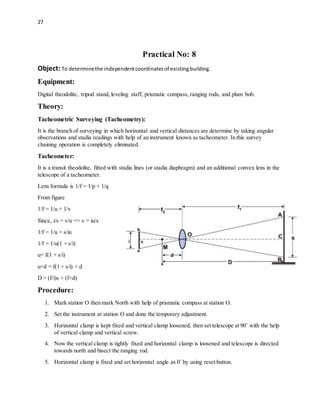
Object: To determinethe independentcoordinatesof existingbuilding.
Equipment:
Digital theodolite, tripod stand, leveling staff, prismatic compass, ranging rods, and plum bob.
Theory:
Tacheometric Surveying (Tacheometry):
It is the branch of surveying in which horizontal and vertical distances are determine by taking angular
observations and stadia readings with help of an instrument known as tacheometer. In this survey
chaining operation is completely eliminated.
Tacheometer:
It is a transit theodolite, fitted with stadia lines (or stadia diaphragm) and an additional convex lens in the
telescope of a tacheometer.
Lens formula is 1/f = 1/p + 1/q
From figure
1/f = 1/u + 1/v
Since, i/s = v/u => v = iu/s
1/f = 1/u + s/iu
1/f = 1/u(1 + s/i)
u= f(1 + s/i)
u+d = f(1 + s/i) + d
D = (f/i)s + (f+d)
Procedure:
1. Mark station O then mark North with help of prismatic compass at station O.
2. Set the instrument at station O and done the temporary adjustment.
3. Horizontal clamp is kept fixed and vertical clamp loosened, then set telescope at 90˚ with the help
of vertical clamp and vertical screw.
4. Now the vertical clamp is tightly fixed and horizontal clamp is loosened and telescope is directed
towards north and bisect the ranging rod.
5. Horizontal clamp is fixed and set horizontal angle as 0˚ by using reset button.
28
6. Now loose the horizontal clamp and vertical clamp then telescope is directed towards A and bisect
the ranging rod at A.
7. Note the H.A. displayed at display screen, which is the bearing of line OA and vertical angle also.
8. Now hold the staff rod on station A and note the stadia readings that is uppers stadia, lower stadia
and centralstadia readings.
9. Horizontal distance of OA is calculated by using distance formula ( D = (f/i)scos2θ + (f+d)
cosθ).
10. Repeat the above process for bearings and distances of other points of building which are visible
from station O.
11. To calculate bearings and distances of other points of building which are not visible from station
O, Mark another station O1 in such a way it is visible from station O.
12. Take the bearing and distance of O1 from O by above process.
13. Now shift the instrument and take bearings and distances of other points of building which are
visible from station O1.
14. Take all readings of points of building by above process.
15. Find the latitude by using LCosθ and departure by using LSinθ (where L is distance of line and θ is
bearing of that line).
16. Let the coordinates of point O as (1000, 1000).
17. And find the coordinates of other stations by adding latitudes and departures in coordinates of
station A.
29
Observations:
Line Stadia readings Vertical Angle Bearing Distance
U/S C/S L/S
30
31
32
CalculationforCoordinatesof Building;
S. No. line Length Bearing Latitude Departure Coordinates
33
34
35
36
Practical No: 9
Object: To drawthe planof existingbuildingbyplottingthe coordinates usingAutoCADsoftware /
MicrosoftExcel.
Apparatus : Auto cad /Microsoft Excel
THEORY:
Auto cad: AutoCAD is a computer-aided drafting software program used to create blueprints for
buildings, bridges, and computer chips, among other things.
Auto cad is a computer aided design software for the 2D and 3D design of certain objects or places.
It is widely used in civil engineering field because of its ability to plan sites a lot easier than hand
drawing, it can help design a lot of engineering supplies.
Microsoft Excel: Microsoft Excel is a software program produced by Microsoft that allows users to
organize, format and calculate data with formulas using a spreadsheet system.it is also used to make
graphs.
Procedure:
Method to Plot layout on Microsoft Excel
1. Enter Northing and Southing in adjacent columns
2. Select all Northings and southings.
3. Go to Insert Tab then Charts and then Selects a graph layout from given scatters.
Method to Plot layout on AutoCAD
1. Set the units from format tab or simply press un and enter.
2. Set the Dimensions from dimension tab or just press D and enter.
3. Select the Polyline
4. Enter Northing , Easting.
5. Continue to enter northing and easting values to define the line segments. Or press
ESC to return to the Line command prompt where you can use additional options to
define the line.
37
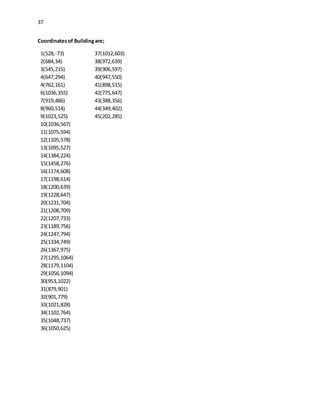
Coordinatesof Buildingare;
1(528,-73) 37(1012,603)
2(684,34) 38(972,639)
3(545,215) 39(906,597)
4(647,294) 40(947,550)
4(762,161) 41(898,515)
6(1036,355) 42(775,647)
7(919,486) 43(388,356)
8(960,514) 44(349,402)
9(1023,525) 45(202,285)
10(1036,567)
11(1075,594)
12(1105,578)
13(1095,527)
14(1384,224)
15(1458,276)
16(1174,608)
17(1198,614)
18(1200,639)
19(1228,647)
20(1231,704)
21(1208,709)
22(1207,733)
23(1189,756)
24(1247,794)
25(1334,749)
26(1367,975)
27(1295,1064)
28(1179,1104)
29(1056,1094)
30(953,1022)
31(879,901)
32(901,779)
33(1021,828)
34(1102,764)
35(1048,737)
36(1050,625)
38
The plan of existingbuildingbyplottingthe coordinatesusing MicrosoftExcel
The plan of existingbuildingbyplottingthe coordinatesusing AutoCAD software
-200
0
200
400
600
800
1000
1200
0 200 400 600 800 1000 1200 1400 1600
39
PRACTICAL # 10:
Object:To set out the simple curve by deflection angle method.
Theory:
Highway Curves:
 During the survey of the alignment of a project involving roads or railways, the direction of a line of
track may change due to unavoidable circumstances i.e. it may change towards right or left or up or
bottom.
 In such case,to ensure the vehicle to run easily and smoothly along a track, the two straight lines (the
original line and the changed line) are connected by an arc which is known as the “Curve” or more
correctly “Highway curve”.
 Thus a curve may be defined as “the arc provided where it is necessary to change the direction of the
motion from right to left and vice versa or from up to down and vice versa”.
Objectives:
The main objectives of providing highway curves are:
1. Two connect two lines (tangents) in different directions.
2. To maintain speed of vehicles.
3. For safe turnings to avoid accidents etc.
Types of Highway Curves:
There are following two main types of highway curves.
1. Horizontal Curves:
 The curve which is provided in the horizontal plane i.e. from right to left and vice versa.
2. Vertical Curves:
 The curve which is provided in the vertical plane i.e. from up to down and vice versa.
Highway Curves
Horizontal Curve Vertical Curve
1. Simple Curve 4. Transition Curve 1.Crest Curve
2. Compound Curve 5. Lamniscate Curve 2.Sag Curve
3. Reverse Curve
40
We shall discuss here only simple curve.
Definition of Simple Curve:
 It is the curve which consists of single arc of circle to connect two straight lines.
 This curve is tangential to both lines.
 It has constant radius.
Definitions and Notations for Simple Curve:
1. Back Tangent:
 The tangent AT1 previous to the curve is called the back tangent or original straight line or first
tangent.
2. Forward Tangent:
 The tangent T2B following the curve id called the forward tangent or second tangent or deflected line.
3. Point Of Intersection:
 If the two tangents are produced, they will meet at a point, called the point of intersection PI or vertex
V.
4. Point Of Curve:
 It is the beginning of the curve where the alignment changes from a tangent to the curve.
5. Point Of Tangency:
 It is the end of the curve where the alignment changes from a curve to tangent.
6. Intersection Angle or External Deflection Angle:
 The angle AVB between the tangent lines AV and VB produced is called intersection angle.
7. Deflection Angle:
 The angle V’VB i.e. the angle by which the forward tangent deflects from the rear tangent is called
deflection angle.
8. Tangent Distance:
 It is the distance from the point of intersection to the tangent point i.e. between PC to P.I or vice versa
9. Apex Distance:
 It is the distance from midpoint of the curve to PI
10. Length of Curve:
41
 It is the total length of the curve from PC to PI.
11. Long Chord:
 It is the chord joining PC to PT.
12. Mid Ordinate:
 It is the distance or ordinate from the midpoint of the long chord to the midpoint of the curve.
13. Normal Chord:
 A chord between two successive regular stations on a curve.
14. Sub-Chord:
 It is any chord shorter than the normal chord.
Parameters or Elements of Simple Curve:
1. Length Of Curve:
L=⊼ R⏀/180˚
2. Deflection Angle:
⏀=180◦-I
3. Radius:
R=1719/D D=Degree of curve
4. Tangent Length:
T=R x tan (⏀/2)
5. Length Of Long Chord:
LC=2RSin (⏀/2)
6. Apex Distance:
E=R Sec [(⏀/2)-1]
7. Mid Ordinate:
M=R [1- Cos (⏀/2)]
8. Chainages:
 Chainage of first tangent point (PC) = Chainage of intersection point (PI) – back tangent( T1)
 Chainage of second tangent point (PT) = Chainage of first tangent point + curve length.
42
V’
B V (P.I)
⏀
E
T1 (P.C) M T2 (P.T)
A C
R R
Setting out of Simple Curve by Deflection Angle or Rankin’s Method:
 Rankin’s method is based on the principle that the deflection angle to any point on a circular curve is
measured by one-half the angle subtended by the arc from PC to that point.
 The curve is set by the deflection angles (tangential angles) with the help of theodolite or total station.
 This method is used for large radius curves and high speed roads.
Methods:
There are two methods of setting out simple curve by deflection angle:
1. By one theodolite method
2. By two theodolite method
Procedure:
1. Office Work:
 In both the methods, office work is common.
 First of all, calculate all the setting out parameters of a simple curve.
 Divide the length of curve into a number of small sub-chords at regular peg interval.
 Calculate initial sub-chord, final sub-chord and number of full sub-chords.
 Calculate small deflection angles for small sub-chords by using formula:
δ= 90 x L/⊼R
43
 Apply arithmetical check.
 Prepare setting out table.
Field Procedure of Setting out Curve by Deflection Angle by One Theodolite:
 Let AB and BC be the two tangents intersecting at point at point B.
 The points T1 and T2 are marked by intersecting pegs on the ground.
 In this method, one surveyor and three helpers are needed.
 The surveyor stands with the theodolite and one of the three helpers will hold the staff and the other
two will hold the tape.
 The theodolite is centered over T1 and properly levelled.
 By setting the horizontal angle at 0˚ and fixing the upper clamp, direct the theodolite to bisect the
ranging rod at the intersection point B.
 Set the first deflection angle thus, the line of sight is directed along chord T1P.
 Now, the zero end of the tape is held is T1 and the distance T1P1 is measured equal to the length of
initial sub-chord in such a way that that the ranging rod at P1 is also bisected by the telescope. Thus,
the first point P1 is fixed.
 Set the second deflection angle on the scale so that the line of sight is directed along T1P2.
 With the zero end of the tape pinned at P1 and swing the other end around P1 until the arrow held at
the other end is bisected by the line of sight, thus locating the second point on the curve (P2).
 Repeat the process until the last point T2 is reached.
V’
B V (P.I)
⏀
δ2
δ1 P1 P2
T1 (P.C) T2 (P.T)
A C
Check:
 The last point so located must coincide with the point of tangency (T2) fixed independently by
measurements from the point of intersection.
44
 If the discrepancy is small, last few pegs may be adjusted. If it is more, the whole curve should be
reset.
Field Procedure of Setting out Curve by Deflection Angle by Two-Theodolite Method:
 This method is employed in railway curve setting, as it gives the correct location of points.
 In this method, no chain or tape is required to fix the points on the curve.
 It is mostly suitable when the ground surface is not favourable for chaining along the curve due to
undulations,
 First of all, all the necessary data for setting out the curve is calculated in the usual manner, and
setting out table is prepared.
 Tangents points T1 and T2 are marked on the ground by inserting pegs.
 This method consists of two theodolites. A theodolite is centered over T2 and levelled properly.
 Set the horizontal angle at 0˚ and the upper clamp is tightened.
 Direct the line of sight of the instrument at T2 towards T1 when the reading is zero, till the ranging
rod at T1 is perfectly bisected.
 The ranging rod at T1 is taken off and another theodolite is centered over this point T1 and levelled.
 The horizontal angle is set at 0˚ and the upper clamp is tightened.
 The line of sight of theodolite is directed towards B and the ranging rod at B is perfectly bisected.
 Set the reading of each of the instruments to the deflection angle for the first point P1. The line of
sight of both the theodolites is thus directed towards P1 along T1P1 and T2P1 respectively.
 Move a ranging rod or an arrow in such a way that it bisected simultaneously by cross-hairs of both
the instruments. Thus, point is fixed.
 To fix the point P2, set the reading of both the instruments to the second deflection angle and bisect
the ranging rod.
 This process is repeated until all the deflection angles are set out and all the points are marked.
 Finally, when the total deflection angle (δn) is set out in both the instrument, the line of sight of the
theodolite at T1 should bisect T2 and that of the theodolite at T2 should bisect B.
V’
B V (P.I)
⏀
δ2
δ1
P1 P2
T1 (P.C) T2 (P.T)
A δ2 δ1 C
45
 This method is expensive since two instruments and two surveyors are required.
 However,it is most accurate since each point is fixed independently of the others. An error in setting
out one point is not carried right through the curve as in the method of tangential angles.
46
PI
T=67 E=8.82
PC M=8.85 PT
L
47
PRACTICAL # 11
Object: Measuring the height of a building by trigonometric levelling.
Introduction.
 Trigonometric levelling is the process of determining the differences of elevations of stations by
means of observed vertical angles and known distances, which are assumed to be either horizontal or
geodetic lengths at mean sea level.
 The vertical angles may be measured by means of an accurate theodolite and the horizontal distances
by means of tacheometer.
CASES:
1. There are following two cases of Trigonometric levelling of our discussion.
1. Determination of height of elevated object when base of the object is accessible(reachable)
2. Determination of the height of the object when its base and top are visible but not accessible
(reachable).
CASE 1: DETERMINATION OF HEIGHT OF ELEVATED OBJECT WHEN BASE OF
THE OBJECT IS ACCESSIBLE:
Let:
A = instrument station
P = point to be observed
C = center of the object
P’ = projection of P on horizontal plane through C
D = horizontal distance CP’ between A and P
h’ = height of the instrument at A
h = height in between P and P’ i.e. PP’
θ = angle of elevation from A to P
2. From triangle CPP’,
h = D tan θ
48
P
θ h
C P’
h’
A
D
PROCEDURE:
3. Set up the theodolite at A and level it accurately with respect to the bubble.
4. Direct the telescope towards P and bisect it accurately.
5. With the horizontal angle 0˚, read the vertical angle θ.
6. Find the stadia readings to measure the distance D which should be same as that of distance measured
by the help of tape in between A to p’.
7. Put the values in formula and calculate the height.
8. This method is usually employed when the distance is small.
CASE 2: DFETERMINATION OF HEIGHT OF ELEVATED OBJECT WHEN ITS
BASE AND TOP ARE VISIBLE BUT NOT ACCESSIBLE:
Let:
P = point to be observed
P’ = projection of P on horizontal plane.
A = first instrument station
θ = angle of elevation from A to P
B = second instrument station
α = horizontal angle from A to B
β = angle of elevation from B to P’
h = height of the instrument at A
h’ = height of instrument from P to P’ ( PP’)
b = distance between A and P’
D = distance from A to B
49
P
θ h
A
h1
P’
α β
B
b
PROCEDURE:
1. Set the instrument at the station A and level it accurately.
2. Direct the telescope towards P and bisect it.
3. By keeping the horizontal angle at 0˚, measure the vertical angle θ
4. Choose another station B in such a way that ABP forms a triangle.
5. Rotate the telescope towards B and note the horizontal angle α.
6. Put the staff rod at B and find the stadia readings.
7. Measure the distance D from A to B by tape which should be same as that measured by the
instrument.
8. Now, set the instrument at B and level it properly.
9. Direct the instrument towards P and bisect it.
10. Set the horizontal angle to 0˚ and measure the vertical angle β.
11. Find out the height by using formula:
h = b tan θ
Where b = D sin β/sin (180˚ - α – β)
I.e. By sin rule
b/sin β = D/sin(180˚ - α – β)
50
Practical No: 12
Object:
To determine the elevation (reduced level) of an object at all the certain height.
Instruments:
Plumbob, tripod stand, theodolite, staff rod, ranging rods, tape.
Theory:
(i) Distance of an object is inaccessible & the instrument is in same level.
Theory: if the horizontal distance between the instrument and object cannot be measured directly due
to the obstacle (hindrance), so twice the instrument is set at the two different points in such a way that
instrument axes are at same level.
Procedure:
(i) Set up the theodolite at station O1 and its all temporary adjustment is done.
(ii) Set up the horizontal angle zero and rotate the theodolite towards the point O2 in such a way
that the central reading touch the selected point on the top of selected object.
(iii) Clamp both the pates and read the vertical angle
(iv) Set the second point behind the station O1 namely O2 and repeat all the procedure that we done
at the station O1.
(v) Read the vertical angle
(vi) Measure the distance between O1 and O2 with help of tape.
(vii) Now all readings are done, measure the distance between object and first station O1 i.e D, with
the help of formula given as under:
∆FO1A’
h=DtanӨ1
∆FO2A’
h=(d+D)tanӨ2
(d+D)tanӨ2= DtanӨ1
DtanӨ2+ dtanӨ2= DtanӨ1
D=
ℎ𝑡𝑎𝑛Ө2
𝑡𝑎𝑛Ө1−𝑡𝑎𝑛Ө2
51
(b ) Instrument axis are not in same level
Theory: if the horizontal distance between the instrument and object cannot be measured directly due to
the obstacle (hindrance), so twice the instrument is set at the two different points in such a way that
instrument axes are not at same level.
(i) Instrument near to the object is at lower position.
Procedure:
(i) Theodolite is set over an instrument station (O1) exactly and all the temporary adjustments
are done.
(ii) Set up the horizontal angle zero and rotate the theodolite towards in the vertical plane to sigh
the top of the selected object.
(iii) Clamp both the pates and read the vertical angle Ө1
(iv) Set the second point behind the station O1 namely O2 and repeat all the procedure that we
done at the station O1.
(v) Read the vertical angle Ө2
(vi) Now all readings are done, measure the distance between object and first station O1 i.e D,
with the help of formula given as under:
∆FO’1A’’:
h1=DtanӨ1
∆FO’2A’:
h2= (d+D)tanӨ2
∆h=h1-h2
∆h= DtanӨ1-(d+D)tanӨ2
∆h= DtanӨ1-d tanӨ2-DtanӨ2
D=
∆ℎ+ℎ𝑡𝑎𝑛Ө2
𝑡𝑎𝑛Ө1−𝑡𝑎𝑛Ө2
52
(ii) Instrument near to the object is at higher position.
Procedure:
(i) Theodolite is set over an instrument station (O1) exactly and all the temporary adjustments
are done.
(ii) Set up the horizontal angle zero and rotate the theodolite towards in the vertical plane to sigh
the top of the selected object.
(iii) Clamp both the pates and read the vertical angle Ө1
(iv) Set the second point behind the station O1 namely O2 and repeat all the procedure that we
done at the station O1.
(v) Read the vertical angle Ө2
(vi) Now all readings are done, measure the distance between object and first station O1 i.e D.
(vii) By considering two triangles, (∆FO’1A’’ & ∆FO’2A’), following formula is obtained to
measure D.
D=
∆ℎ−ℎ𝑡𝑎𝑛Ө2
𝑡𝑎𝑛Ө2−𝑡𝑎𝑛Ө1
53
Calculation:
54
Practical No: 13
Object:
Introduction to GPS, base camp software and Google earth:
GPS:
Introduction:
 The global positioning system (GPS), is a satellite based radio navigation system owned by the
United States government and operated by the United States air force.
 The GPS project was launched by the U.S department of Defense in 1973 for use by the United States
military and became fully operational in 1995 and was allowed for civilian use in 1980s.
Definition:
 GPS is a global navigation satellite system that provides geolocation and time information to a GPS
receiver anywhere or near the earth.
 OR GPS is a system of satellites, computers and receivers that is able to determine the latitude and
longitude of a receiver on Earth by calculating the time difference for signals from different satellites
to reach the receiver.
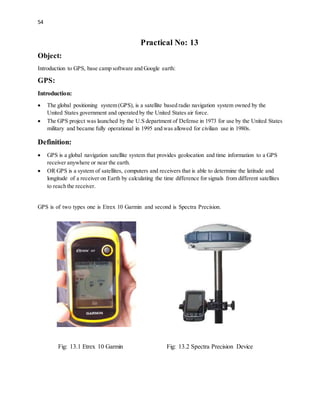
GPS is of two types one is Etrex 10 Garmin and second is Spectra Precision.
Fig: 13.1 Etrex 10 Garmin Fig: 13.2 Spectra Precision Device
55
BasecampSoftware:
 BASECAMP is software from GARMIN for viewing maps, waypoints, routes and tracks and
transferring them to form a Garmin GPSS device.
Google Earth:
 Google earth is a computer program that renders a 3D representation of Earth based on satellite
imagery
 This program maps the earth by superimposing satellite images, aerial photography, and GIS data on
to a 3D globe, allowing users to see cities and landscapes from various angles.
Fig: 13.3 Google Earth
56
Practical No: 14
Object:
To record world geographic coordinates system/angular coordinates of points in field by GPS.
Apparatus:
Global positioning system device.
Introduction:
A geographic coordinate system is a coordinate system that enables every location on Earth to be
specified by a set of numbers, letters or symbols. The coordinates are often chosen such that one of the
numbers represents a vertical position and two or three of the numbers represent a horizontal position;
alternatively, a geographic position may be expressed in a combined three-dimensional Cartesian vector.
A common choice of coordinates is latitude, longitude and elevation. To specify a location on a plane
requires a map projection.
Fig: 14.1 world geographic coordinates system/angular coordinates of point by GPS (Garmin)
Procedure:
1. Insert the batteries and power on the GPS
2. Double Click on the Menu button
3. For Mark the way point go to the setup.
57
4. Move to tracks. In track select-(record,show on map, more often)
5. Double click on back button
6. Go to the track manager in main menu
7. Select current track
8. Click on clear current track and click on yes.
9. Now go to way point manager and select created way point.
10. Now GPS will show world geographic coordinates system/angular coordinates of that point.
11. Finally note the readings in note book.
12. Take the world geographic coordinates system/angular coordinates of each point and record it in note
book.
58
Practical No: 15
Object:
To measure the area of a traverse and existing building using GPS
Apparatus: Global positioning system device.
Theory:
In this practical, we measure the area of a traverse and also area of existing building (civil dept.)
by GPS and GPS is a navigation system for measuring a position by receiving information from
GPS satellites. It’s a constellation of 24 satellite orbiting at a distance of 20,000 km from the
surface of the earth.
Application of GPS:
1. The location of an shortest route show on map by providing angular coordinates
2. Calculate the area of an existing building
3. Find the angular coordinates of any point.
Benefit of GPS:
● Location determine a basic position
● mapping creating map
● Area calculate area of plot
Uses ofGPS:
I. Location -Determine a basic position.
II. Mapping - Creating maps.
III. Area - Calculate area of plot.
Procedure:
1. Insert the batteries and power on the GPS
2. Double Click on the Menu button
3. For Mark the way point go to the setup.
4. Move to tracks. In track select-(record, show on map, more often)
59
5. Double click on back button
6. Go to the track manager in main menu
7. Select current track
8. Click on clear current track and click on yes.
9. Now go to way point manager and select created way point and click go button.
10. Go to the area calculation by double clicking menu button
11. Click start
12. Walk around the perimeter of plot/area you to calculate.
13. When you stop click on calculate.
14. Save track and change into desired which you want.
15. After calculating the area show plot on the map.
Observation:
60
Areaof Civil Department Traverse of Civil
Department
Precautions:
I. To start GPS power button should be pressed for 1 to 2 seconds
II. To change brightness level press the power button once.
III. Before starting Area Calculation, current track must be deleted by going to the Track
manager option.
IV. Before saving area details of farmer must be saved in note box.

Surveying practical work book

  • 1.
    1 Practical No: 1 Object: Introductionto different parts and their function of digital or electronic theodolite. Theory: The theodolite is the most intricate and accurate instrument designed for the measurementof horizontal and vertical angles up to 10” or 20”, depending upon the least count of the instrument. It is also known as “universal instrument”, due to its various uses. The traditional use has been for land surveying, but they are also used extensively for building and infrastructure construction. It consists of a moveable telescope mounted so it can rotate around horizontal and vertical axes and provide angular readouts.These indicate the orientation of the telescope,and are used to relate the first point sighted through the telescope to subsequent sightings of other points from the same theodolite position. Uses: The following are the different purposes for which the theodolite is used: ▪ Measuring horizontal and vertical angles ▪ Measuring deflection angles ▪ Measuring magnetic bearings ▪ Measuring the horizontal distance between two points ▪ finding the vertical height of an object ▪ finding the difference of elevation between various points ▪ For ranging a line ▪ prolonging survey lines ▪ Establishing grades ▪ setting out curves. Fig:01.1 Digital theodolite
  • 2.
    2 Types of theodolite: Thereare two types of theodolite: A. Transit theodolite: It is the theodolite in which the line of sight can be reversed by revolving the telescope through 180˚ in the vertical plane. B. Non-transit theodolite: In this type of theodolite, the telescope cannot be resolved through a complete revolution in the vertical plane but can be revolved to a certain extent in the vertical plane, in order to measure the angle of elevation or depression. Fig: 01.2 different parts of digital or electronic theodolite
  • 3.
    3 Different parts oftheodolite and their functions are describedbellow: Telescope: A telescope is a focusing instrument which has object piece at one end and eye piece at the other end. It rotates about horizontal axis in vertical plane. The graduations are up to an accuracy of 20’. Targetor sight: The telescope has a sight on the top of it that is used to align the target. Eye piece: The telescope contains an eye piece that the user looks through to find the target being sighted. Objective lens: The objective lens is used to sight the object and with the help of mirrors inside the telescope, allows the object to be magnified. Cross hair Focusing screw and Telescopic focusing screw: Both screws are used to remove parallax. Parallax is a condition arising when the image formed by the objective is not in the plane of the cross-hairs. Unless parallax is removed, accurate sighting is impossible. Horizontal clamp or horizontal screw: Horizontal clamp is used to stop horizontal motion of theodolite. For more precise reading Horizontal screw is used, which move slowly and gradually to set instrument at accurate horizontal angle. Vertical clamp and vertical screw: Vertical clamp is used to stop vertical motion of telescope. For more precise reading vertical screw is used, which move slowly and gradually to set instrument at accurate verticalangle. Tribatch: It consists of Base Plate,leveling head, and leveling screw. It is used for leveling the theodolite. Optical Plummet: Optical plummet is used for centering the theodolite at a station. Display screen: Display screen shows readings (Horizontal angle And Vertical Angle) which are taken by theodolite.
  • 4.
    4 Tripod: Tripod is nothingbut a stand on which theodolite is mounted. It should place in such a way that theodolite should be in exact leveled position. The tripod has legs with steel shoes at their ends. These hold the ground strongly without any movement when placed. Tripod has an external screw which helps to attach the theodolite by tribratch plate in fixed position. Plumb bob: Plumb bob is tool having a cone shaped weight attached to a long thread. The weight is hanged using thread from the center of tripod stand and centering of theodolite is done.
  • 5.
    5 Practical No: 2 Object: Temporaryadjustment of Digital or Electronic Theodolite. Procedure: Temporary adjustments of theodolite: Temporary adjustments or station adjustment are those which are taken over the station at the time of taking observation or those which are taken at everyinstrument setting and preparing to taking observations with the instrument. Such adjustments include the following steps: Setting the theodolite over the station: 1. It consists of placing of the instrument over the required station by a plumb bob or by optical plummet. Fig: 2.1 Digital theodolite 2. The tripod stand is placed over the required station and the theodolite is lifted from the box and fixed on top of the stand by means of a wing nut or according to the fixing arrangement provided along the instrument. Approximate levelling by tripod stand: 1. The approximate levelling is done with the help of tripod legs either with reference to a small circular bubble provided on tribrach is done by eye judgment. 2. The tripod legs are placed well apart and firmly fixed on the ground. 3. Two legs of the tripod stand are kept firmly on the ground and third is moved in or out, clockwise or anticlockwise, so that the bubble is approximately at the center of its run. Centering: 1. Centering is the process of setting the instrument exactly over the station. 2. It should be confirmed at the time of approximate levelling that the plumb bob suspended from the hook under the vertical axis lies almost over the station peg.
  • 6.
    6 3. After then,with the help of shifting head (moveable capstan nut), the centering is done accurately so that the plumb bob exactly over the nail of the station peg. Levelling: 1. After having centered and approximately leveled the instrument, accurate levelling is done with the help of foot screws and with reference to the plate levels. 2. Its purpose is to make the vertical axis truly vertical. 3. The manner of levelling the instrument by the plate levels depends upon whether there are three levelling screws or four levelling screws. Three screw head: 4. Turn the upper plate until the longitudinal axis of the plate level is roughly parallel to a line joining any two (such as a and b) of the levelling screws. 5. Hold these two levelling screwsbetweenthe thumb and first finger of eachhand and turn them uniformly so that the thumbs move either towards each other or away from each other until the bubble is central. It should be noted that the bubble will move in the direction of movement of the left thumb. 6. Turn the upper plate through 90˚, i.e. until the axis of the level passes over the position of the third levelling screw c. 7. Turn this levelling screw until the bubble is central. 8. Return the upper plate through 90˚ to its original position and repeat step (2) till the bubble is central. 9. Turn back again through 90˚ and repeat step 4. 10. Repeat steps (2) and (4) till the bubble is central in both the positions. 11. Now rotate the instrument through 180˚. The bubble should remain the center of its run, provided it is in correct adjustment. The vertical axis will then be truly vertical. If not, it needs permanent adjustment. Elimination of parallax: Parallax is a condition arising when the image formed by the objective is not in the plane of the cross-hairs. Unless parallax is removed, accurate sighting is impossible. Its elimination is done by two steps: i. Focusing the eye-piece: 1. In order to focus the eye-piece for distinct vision of the cross-hairs, point the telescope towards the sky (or hold the sheet of white paper in front of the objective).
  • 7.
    7 2. Move theeye-piece in or out till the cross-hairs are seen sharp and distinct. ii. Focusing the objective: 1. The telescope is then directed towards the object to be sighted and the focusing screw is turned till the image appears clear and sharp. 2. The image so formed is in the plane of cross-hairs.
  • 8.
    8 Practical No: 3 Object: Todetermine the vertical and horizontal angle of a line, also the bearing of line with the help of digital or electronic theodolite. Equipment: Digital theodolite, tripod stand, leveling staff, ranging rods, plum bob, prismatic compass and tape. Theory: Angle: An angle is the figure formed by two lines, called the sides of the angle, sharing a common endpoint. Horizontal Angle: An angle between two lines, which are on the horizontal plane, called horizontal angle. Vertical Angle: An angle formed by two lines, which are on the vertical plane, called vertical angle. Bearing: Bearing is defined as direction of line measured with respect to meridian. Magnetic Bearing: Magnetic Bearing is defined as direction of line measured with respect to magnetic north. Fig: 03.1 Measurement of horizontal angle
  • 9.
    9 Procedure: Measuring the horizontalangle BAC 1. Mark station A and set up the instrument at station A and level it accurately. 2. Then mark two more stations B and C at some distance from station A. 3. Horizontal clamp is kept fixed and vertical clamp loosened, then set telescope at 90˚ with the help of vertical clamp and vertical screw. 4. Now the vertical clamp is tightly fixed and horizontal clamp is loosened and telescope is directed towards B and bisect the ranging rod at B. 5. Horizontal clamp is fixed and set horizontal angle as 0˚ by using reset button. 6. Now loose the horizontal clamp and telescope is directed towards C and bisect the ranging rod at C. 7. Finally note the horizontal angle from display screen. Measuring the vertical angle: 1. Set up the instrument at any station from building is visible and level it accurately. 2. After setting, set the vertical angle as zero degree and lock the vertical clamp screw. 3. Till the telescope of theodolite to the top of building. 4. Note the vertical angle which is display on digital screen name it as ϕ. 5. Calculate vertical angle θ by using formula “ θ = ϕ - 90˚ ”. Fig: 03.1 Measurement of vertical angle Measuring the Magnetic bearing of a line: In order to measure the magnetic bearing of a line, the theodolite should be provided with prismatic compass. The following are the steps: 1. Mark station A then mark North with help of prismatic compass at station A.
  • 10.
    10 2. Then marktwo more stations B and C at some distance from station A. 3. Set up the instrument at station A and level it accurately. 4. Horizontal clamp is kept fixed and vertical clamp loosened, then set telescope at 90˚ with the help of vertical clamp and vertical screw. 5. Now the vertical clamp is tightly fixed and horizontal clamp is loosened and telescope is directed towards north and bisect the ranging rod. 6. Horizontal clamp is fixed and set horizontal angle as 0˚ by using reset button. 7. Now loose the horizontal clamp and telescope is directed towards B and bisect the ranging rod at B. 8. Note the H.A. displayed at display screen,which is the bearing of line AB. 9. Again telescope is directed towards north and bisect the ranging rod then Horizontal clamp is fixed and set horizontal angle as 0˚ by using reset button. 10. Loose the horizontal clamp and telescope is directed towards C and bisect the ranging rod at C. 11. Note the H.A. displayed at display screen,which is the bearing of line AC. 12. And also measure distances of AB and AC with the help of tape. Fig: 03.1 Measurement of Magnetic bearing angle
  • 11.
    11 Observation: Group Line Length(ft.) Bearing(R.C.B) True bearing Horizontal angle
  • 12.
  • 13.
    13 Practical No: 4 Object:To determine the latitude, departure and coordinates of point/line. Equipment: Digital theodolite, tripod stand, leveling staff, ranging rods, plum bob, prismatic compass and tape. Theory: The theodolite traverse is not plotted according angles or bearings. It is plotted by computing the latitude and departure of the points (consecutive coordinates) and then finding the independent coordinates of the points. The latitude of a line is measured parallel to North-South line and the departure of a line is measured to the East-West line. The latitude and departure is also called Northing and Easting respectively. Fig: 04.1 Latitude and departure The combination of easting and northing is called coordinates of a point, it can be written as (Easting, Northing). Consecutive Coordinates: the latitude and departure of a point calculated with reference to proceeding point are called consecutive coordinate. Independent coordinates: the coordinates of any point with respect to a common origin are said to be independent coordinates. Procedure: 1. Mark station A then mark North with help of prismatic compass at station A. 2. Set the instrument at station A and done the temporary adjustment. 3. Horizontal clamp is kept fixed and vertical clamp loosened, then set telescope at 90˚ with the help of vertical clamp and vertical screw. 4. Now the vertical clamp is tightly fixed and horizontal clamp is loosened and telescope is directed towards north and bisect the ranging rod. 5. Horizontal clamp is fixed and set horizontal angle as 0˚ by using reset button.
  • 14.
    14 6. Now loosethe horizontal clamp and telescope is directed towards B and bisect the ranging rod at B. 7. Note the H.A. displayed at display screen,which is the bearing of line AB. 8. Then measure the distance from station A to B with help of tape and note it in observation table. 9. Repeat the above process for bearings and distances of lines BD, DC and CA. 10. Find the latitude by using LCosθ and departure by using LSineθ (where L is distance of line and θ is bearing of that line). 11. Let the coordinates of point A as (12960.2ft, 85654.98ft). 12. And find the coordinates of other stations by adding latitudes and departures in coordinates of station A. Observations: Line Length (ft) Bearing Latitude Departure Coordinates
  • 15.
    15 85630 85635 85640 85645 85650 85655 85660 85665 85670 12950 12960 1297012980 12990 13000 13010 Latitude(ft) Departure (ft)
  • 16.
    16 Practical No: 5 Object:Todetermine the area of traverse by coordinate method. Equipment: Digital theodolite, tripod stand, leveling staff, ranging rods, plum bob, prismatic compass and tape. Procedure: 1. Mark station A then mark North with help of prismatic compass at station A. 2. Set the instrument at station A and done the temporary adjustment. 3. Horizontal clamp is kept fixed and vertical clamp loosened, then set telescope at 90˚ with the help of vertical clamp and vertical screw. 4. Now the vertical clamp is tightly fixed and horizontal clamp is loosened and telescope is directed towards north and bisect the ranging rod. 5. Horizontal clamp is fixed and set horizontal angle as 0˚ by using reset button. 6. Now loose the horizontal clamp and telescope is directed towards B and bisect the ranging rod at B. 7. Note the H.A. displayed at display screen,which is the bearing of line AB. 8. Then measure the distance from station A to B with help of tape and note it in observation table. 9. Repeat the above process for bearings and distances of lines BC, CD, DE and EA. 10. Find the latitude by using LCosθ and departure by using LSineθ (where L is distance of line and θ is bearing of that line). 11. Let the coordinates of point A as (0, 0). 12. And find the coordinates of other stations by adding latitudes and departures in coordinates of station A. 13. The coordinates are arranged in determinant form as follows. Station A B C D E A Latitude Y1 Y2 Y3 Y4 Y5 Y1 Departure X1 X2 X3 X4 X5 X1 14. Sum of products along the solid line, ∑P = (Y1.X2+Y2.X3+Y3.X4+Y4.X5+Y5.X1)
  • 17.
    17 15. Sum ofproducts along the dotted lines, ∑Q = (X1.Y2+X2.Y3+X3.Y4+X4.Y5+X5.Y1) 16. Now area is calculated by following formula, Area = 1/2 x (∑P - ∑Q) Observations Area Calculations ∑P = 1255.0 ∑Q = -1053.7387 Area = 1/2 x (∑P - ∑Q) Area = 1/2 x (1255 – (-1053.7387)) = 1154.36 ft2 Line Length (ft) Bearing Consecutive Coordinates Error in Coordinates Corrected coordinates Independent coordinates -------- ---------- ------- Lat: Dep: Lat: Dep: Lat: Dep: Easting Northing A -------- -------- ---- ---- ---- ---- ------ ---- 0 0 AB 29.08 34ᶱ26’30’’ 23.98 16.446 +0.29 -4.188 24.27 +12.26 12.26 24.27 BC 29.667 108ᶱ2’10’’ -9.185 28.209 +0.295 -4.272 -8.89 23.94 36.2 15.38 CD 30.5 183ᶱ52’10’’ -30.43 -2.058 +0.304 -4.392 -30.13 -6.45 29.75 -14.75 DE 22.916 246ᶱ4’30’’ -9.29 -20.95 +0.229 -3.30 -9.06 -24.25 5.5 -23.81 EA 23.667 354ᶱ55’30’’ 23.57 -2.09 +0.236 -3.41 23.81 -5.5 0 0 ------- ∑P= 135.82 ------- ∑Lat= - 1.355 ∑Dep= +19.561 Sum= +1.354 Sum= - 19.562 ∑ lat: 0 ∑ dep: 0 ----- ----- Station A B C D E A Northing 0 24.27 15.38 -14.75 -23.81 0 Easting 0 12.26 36.2 29.75 5.5 0
  • 18.
    18 -30 -20 -10 0 10 20 30 0 5 1015 20 25 30 35 40 Latitude(ft) Departure (ft)
  • 19.
    19 Practical No: 6 Object:Todetermine the horizontal distance bytacheometricsurveyingwhenthe line of sightis horizontal. Equipment: Digital theodolite, tripod stand, leveling staff, prismatic compass, ranging rods, and plum bob. Theory: Tacheometric Surveying (Tacheometry): It is the branch of surveying in which horizontal and vertical distances are determine by taking angular observations and stadia readings with help of an instrument known as tacheometer. In this survey chaining operation is completely eliminated. Tacheometer: It is a transit theodolite, fitted with stadia lines (or stadia diaphragm) and an additional convex lens in the telescope of a tacheometer. Lens formula is 1/f = 1/p + 1/q From figure 1/f = 1/u + 1/v Since, i/s = v/u => v = iu/s 1/f = 1/u + s/iu 1/f = 1/u(1 + s/i) u= f(1 + s/i) u+d = f(1 + s/i) + d D = (f/i)s + (f+d) Procedure: 1. Mark station A then mark North with help of prismatic compass at station A. 2. Set the instrument at station A and done the temporary adjustment. 3. Horizontal clamp is kept fixed and vertical clamp loosened, then set telescope at 90˚ with the help of vertical clamp and vertical screw. 4. Now the vertical clamp is tightly fixed and horizontal clamp is loosened and telescope is directed towards north and bisect the ranging rod. 5. Horizontal clamp is fixed and set horizontal angle as 0˚ by using reset button.
  • 20.
    20 6. Now loosethe horizontal clamp and telescope is directed towards B and bisect the ranging rod at B. 7. Note the H.A. displayed at display screen,which is the bearing of line AB. 8. Now hold the staff rod on station B and note the stadia readings that is uppers stadia, lower stadia and centralstadia readings. 9. Horizontal distance of AB is calculated by using distance formula ( D = (f/i)s + (f+d) ). 10. Repeat the above process for bearings and distances of lines BC, CD, DE, EF and FA. 11. Find the latitude by using LCosθ and departure by using LSinθ (where L is distance of line and θ is bearing of that line). 12. Let the coordinates of point A as (0, 0). 13. And find the coordinates of other stations by adding latitudes and departures in coordinates of station A. 14. The coordinates are arranged in determinant form as follows. Station A B C D E A Latitude Y1 Y2 Y3 Y4 Y5 Y1 Departure X1 X2 X3 X4 X5 X1 15. Sum of products along the solid line, ∑P = (Y1.X2+Y2.X3+Y3.X4+Y4.X5+Y5.X1) 16. Sum of products along the dotted lines, ∑Q = (X1.Y2+X2.Y3+X3.Y4+X4.Y5+X5.Y1) 17. Now area is calculated by following formula, Area = 1/2 x (∑P - ∑Q) Observations: Line Instrument station Stadia readings Vertical angle Horizontal angle Distance u/s c/s l/s
  • 21.
    21 Area Calculations: Station AB C D E F A Latitude Departure ∑P = …………………………... ∑Q = ………………………….. Area = 1/2 x (∑P - ∑Q) Area = 1/2 x (……………. - ……………..) = ………………
  • 22.
    22 -40 -30 -20 -10 0 10 20 30 40 50 -20 -10 010 20 30 40 Latitude(ft) Departure (ft)
  • 23.
    23 Practical No: 7 Object:Todetermine the horizontal distance andvertical distance bytacheometricsurveyingwhen the line of sightisinclined. Equipment: Digital theodolite, tripod stand, leveling staff, tape, ranging rods, and plum bob. Theory: Tacheometric Surveying (Tacheometry): It is the branch of surveying in which horizontal and vertical distances are determine by taking angular observations and stadia readings with help of an instrument known as tacheometer. In this survey chaining operation is completely eliminated. Tacheometer: It is a transit theodolite, fitted with stadia lines (or stadia diaphragm) and an additional convex lens in the telescope of a tacheometer. Procedure: Case-I(When staff rod is held vertical) 1. Mark station O. 2. Set the instrument at station O and done the temporary adjustment. 3. Now loose the horizontal clamp and telescope is directed towards A and bisect the ranging rod at A. 4. Note the V.A. displayed at display screen. 5. Now hold the staff rod vertically on station A and note the stadia readings that is uppers stadia, lower stadia and centralstadia readings. 6. Horizontal distance of OA is calculated by using distance formula (D = (f/i)scos2θ + (f+d) cosθ). 7. Vertical distance at A is calculated by using formula (V = ((f/i)sSin2θ)/2 + (f+d)Sinθ). 8. Repeat the above process for vertical distances and horizontal distances of point B, C, D, and E from O. 9. Measure the height of instrument from ground with the help of tape. 10. Consider the Reduce level of O as 100ft and calculate the R.Ls of other stations.
  • 24.
    24 Case-II(When staff rodis held perpendicular to the ground) 1. Mark station O. 2. Set the instrument at station O and done the temporary adjustment. 3. Now loose the horizontal clamp and telescope is directed towards A and bisect the ranging rod at A. 4. Note the V.A. displayed at display screen. 5. Now hold the staff rod perpendicular to the ground on station A and note the stadia readings that is uppers stadia, lower stadia and central stadia readings. 6. Horizontal distance of OA is calculated by using distance formula (D = (f/i)scos2θ + (f+d) cosθ). 7. Vertical distance at A is calculated by using formula (V = ((f/i)sSin2θ)/2 + (f+d)Sinθ). 8. Repeat the above process for vertical distances and horizontal distances of point B, C, D, and E from O. 9. Measure the height of instrument from ground with the help of tape. 10. Consider the Reduce level of O as 100ft and calculate the R.Ls of other stations. Observations: Case-I Line Instrument station Stadia readings Vertical angle Distance R.Ls. u/s c/s l/s Instrument Height = …………….
  • 25.
    25 Case-II Line Instrument station Stadia readingsVertical angle Distance R.Ls. u/s c/s l/s Instrument Height = …………….
  • 26.
    26 Case-I Case-II 98 100 102 104 106 108 110 0 20 4060 80 100 120 140 R.Ls.(ft) Distance(ft) Profileof Ground 99 100 101 102 103 104 105 106 107 108 109 0 20 40 60 80 100 120 R.Ls.(ft) Distance(ft) Profileof Ground
  • 27.
    27 Practical No: 8 Object:To determinethe independentcoordinatesof existingbuilding. Equipment: Digital theodolite, tripod stand, leveling staff, prismatic compass, ranging rods, and plum bob. Theory: Tacheometric Surveying (Tacheometry): It is the branch of surveying in which horizontal and vertical distances are determine by taking angular observations and stadia readings with help of an instrument known as tacheometer. In this survey chaining operation is completely eliminated. Tacheometer: It is a transit theodolite, fitted with stadia lines (or stadia diaphragm) and an additional convex lens in the telescope of a tacheometer. Lens formula is 1/f = 1/p + 1/q From figure 1/f = 1/u + 1/v Since, i/s = v/u => v = iu/s 1/f = 1/u + s/iu 1/f = 1/u(1 + s/i) u= f(1 + s/i) u+d = f(1 + s/i) + d D = (f/i)s + (f+d) Procedure: 1. Mark station O then mark North with help of prismatic compass at station O. 2. Set the instrument at station O and done the temporary adjustment. 3. Horizontal clamp is kept fixed and vertical clamp loosened, then set telescope at 90˚ with the help of vertical clamp and vertical screw. 4. Now the vertical clamp is tightly fixed and horizontal clamp is loosened and telescope is directed towards north and bisect the ranging rod. 5. Horizontal clamp is fixed and set horizontal angle as 0˚ by using reset button.
  • 28.
    28 6. Now loosethe horizontal clamp and vertical clamp then telescope is directed towards A and bisect the ranging rod at A. 7. Note the H.A. displayed at display screen, which is the bearing of line OA and vertical angle also. 8. Now hold the staff rod on station A and note the stadia readings that is uppers stadia, lower stadia and centralstadia readings. 9. Horizontal distance of OA is calculated by using distance formula ( D = (f/i)scos2θ + (f+d) cosθ). 10. Repeat the above process for bearings and distances of other points of building which are visible from station O. 11. To calculate bearings and distances of other points of building which are not visible from station O, Mark another station O1 in such a way it is visible from station O. 12. Take the bearing and distance of O1 from O by above process. 13. Now shift the instrument and take bearings and distances of other points of building which are visible from station O1. 14. Take all readings of points of building by above process. 15. Find the latitude by using LCosθ and departure by using LSinθ (where L is distance of line and θ is bearing of that line). 16. Let the coordinates of point O as (1000, 1000). 17. And find the coordinates of other stations by adding latitudes and departures in coordinates of station A.
  • 29.
    29 Observations: Line Stadia readingsVertical Angle Bearing Distance U/S C/S L/S
  • 30.
  • 31.
  • 32.
    32 CalculationforCoordinatesof Building; S. No.line Length Bearing Latitude Departure Coordinates
  • 33.
  • 34.
  • 35.
  • 36.
    36 Practical No: 9 Object:To drawthe planof existingbuildingbyplottingthe coordinates usingAutoCADsoftware / MicrosoftExcel. Apparatus : Auto cad /Microsoft Excel THEORY: Auto cad: AutoCAD is a computer-aided drafting software program used to create blueprints for buildings, bridges, and computer chips, among other things. Auto cad is a computer aided design software for the 2D and 3D design of certain objects or places. It is widely used in civil engineering field because of its ability to plan sites a lot easier than hand drawing, it can help design a lot of engineering supplies. Microsoft Excel: Microsoft Excel is a software program produced by Microsoft that allows users to organize, format and calculate data with formulas using a spreadsheet system.it is also used to make graphs. Procedure: Method to Plot layout on Microsoft Excel 1. Enter Northing and Southing in adjacent columns 2. Select all Northings and southings. 3. Go to Insert Tab then Charts and then Selects a graph layout from given scatters. Method to Plot layout on AutoCAD 1. Set the units from format tab or simply press un and enter. 2. Set the Dimensions from dimension tab or just press D and enter. 3. Select the Polyline 4. Enter Northing , Easting. 5. Continue to enter northing and easting values to define the line segments. Or press ESC to return to the Line command prompt where you can use additional options to define the line.
  • 37.
    37 Coordinatesof Buildingare; 1(528,-73) 37(1012,603) 2(684,34)38(972,639) 3(545,215) 39(906,597) 4(647,294) 40(947,550) 4(762,161) 41(898,515) 6(1036,355) 42(775,647) 7(919,486) 43(388,356) 8(960,514) 44(349,402) 9(1023,525) 45(202,285) 10(1036,567) 11(1075,594) 12(1105,578) 13(1095,527) 14(1384,224) 15(1458,276) 16(1174,608) 17(1198,614) 18(1200,639) 19(1228,647) 20(1231,704) 21(1208,709) 22(1207,733) 23(1189,756) 24(1247,794) 25(1334,749) 26(1367,975) 27(1295,1064) 28(1179,1104) 29(1056,1094) 30(953,1022) 31(879,901) 32(901,779) 33(1021,828) 34(1102,764) 35(1048,737) 36(1050,625)
  • 38.
    38 The plan ofexistingbuildingbyplottingthe coordinatesusing MicrosoftExcel The plan of existingbuildingbyplottingthe coordinatesusing AutoCAD software -200 0 200 400 600 800 1000 1200 0 200 400 600 800 1000 1200 1400 1600
  • 39.
    39 PRACTICAL # 10: Object:Toset out the simple curve by deflection angle method. Theory: Highway Curves:  During the survey of the alignment of a project involving roads or railways, the direction of a line of track may change due to unavoidable circumstances i.e. it may change towards right or left or up or bottom.  In such case,to ensure the vehicle to run easily and smoothly along a track, the two straight lines (the original line and the changed line) are connected by an arc which is known as the “Curve” or more correctly “Highway curve”.  Thus a curve may be defined as “the arc provided where it is necessary to change the direction of the motion from right to left and vice versa or from up to down and vice versa”. Objectives: The main objectives of providing highway curves are: 1. Two connect two lines (tangents) in different directions. 2. To maintain speed of vehicles. 3. For safe turnings to avoid accidents etc. Types of Highway Curves: There are following two main types of highway curves. 1. Horizontal Curves:  The curve which is provided in the horizontal plane i.e. from right to left and vice versa. 2. Vertical Curves:  The curve which is provided in the vertical plane i.e. from up to down and vice versa. Highway Curves Horizontal Curve Vertical Curve 1. Simple Curve 4. Transition Curve 1.Crest Curve 2. Compound Curve 5. Lamniscate Curve 2.Sag Curve 3. Reverse Curve
  • 40.
    40 We shall discusshere only simple curve. Definition of Simple Curve:  It is the curve which consists of single arc of circle to connect two straight lines.  This curve is tangential to both lines.  It has constant radius. Definitions and Notations for Simple Curve: 1. Back Tangent:  The tangent AT1 previous to the curve is called the back tangent or original straight line or first tangent. 2. Forward Tangent:  The tangent T2B following the curve id called the forward tangent or second tangent or deflected line. 3. Point Of Intersection:  If the two tangents are produced, they will meet at a point, called the point of intersection PI or vertex V. 4. Point Of Curve:  It is the beginning of the curve where the alignment changes from a tangent to the curve. 5. Point Of Tangency:  It is the end of the curve where the alignment changes from a curve to tangent. 6. Intersection Angle or External Deflection Angle:  The angle AVB between the tangent lines AV and VB produced is called intersection angle. 7. Deflection Angle:  The angle V’VB i.e. the angle by which the forward tangent deflects from the rear tangent is called deflection angle. 8. Tangent Distance:  It is the distance from the point of intersection to the tangent point i.e. between PC to P.I or vice versa 9. Apex Distance:  It is the distance from midpoint of the curve to PI 10. Length of Curve:
  • 41.
    41  It isthe total length of the curve from PC to PI. 11. Long Chord:  It is the chord joining PC to PT. 12. Mid Ordinate:  It is the distance or ordinate from the midpoint of the long chord to the midpoint of the curve. 13. Normal Chord:  A chord between two successive regular stations on a curve. 14. Sub-Chord:  It is any chord shorter than the normal chord. Parameters or Elements of Simple Curve: 1. Length Of Curve: L=⊼ R⏀/180˚ 2. Deflection Angle: ⏀=180◦-I 3. Radius: R=1719/D D=Degree of curve 4. Tangent Length: T=R x tan (⏀/2) 5. Length Of Long Chord: LC=2RSin (⏀/2) 6. Apex Distance: E=R Sec [(⏀/2)-1] 7. Mid Ordinate: M=R [1- Cos (⏀/2)] 8. Chainages:  Chainage of first tangent point (PC) = Chainage of intersection point (PI) – back tangent( T1)  Chainage of second tangent point (PT) = Chainage of first tangent point + curve length.
  • 42.
    42 V’ B V (P.I) ⏀ E T1(P.C) M T2 (P.T) A C R R Setting out of Simple Curve by Deflection Angle or Rankin’s Method:  Rankin’s method is based on the principle that the deflection angle to any point on a circular curve is measured by one-half the angle subtended by the arc from PC to that point.  The curve is set by the deflection angles (tangential angles) with the help of theodolite or total station.  This method is used for large radius curves and high speed roads. Methods: There are two methods of setting out simple curve by deflection angle: 1. By one theodolite method 2. By two theodolite method Procedure: 1. Office Work:  In both the methods, office work is common.  First of all, calculate all the setting out parameters of a simple curve.  Divide the length of curve into a number of small sub-chords at regular peg interval.  Calculate initial sub-chord, final sub-chord and number of full sub-chords.  Calculate small deflection angles for small sub-chords by using formula: δ= 90 x L/⊼R
  • 43.
    43  Apply arithmeticalcheck.  Prepare setting out table. Field Procedure of Setting out Curve by Deflection Angle by One Theodolite:  Let AB and BC be the two tangents intersecting at point at point B.  The points T1 and T2 are marked by intersecting pegs on the ground.  In this method, one surveyor and three helpers are needed.  The surveyor stands with the theodolite and one of the three helpers will hold the staff and the other two will hold the tape.  The theodolite is centered over T1 and properly levelled.  By setting the horizontal angle at 0˚ and fixing the upper clamp, direct the theodolite to bisect the ranging rod at the intersection point B.  Set the first deflection angle thus, the line of sight is directed along chord T1P.  Now, the zero end of the tape is held is T1 and the distance T1P1 is measured equal to the length of initial sub-chord in such a way that that the ranging rod at P1 is also bisected by the telescope. Thus, the first point P1 is fixed.  Set the second deflection angle on the scale so that the line of sight is directed along T1P2.  With the zero end of the tape pinned at P1 and swing the other end around P1 until the arrow held at the other end is bisected by the line of sight, thus locating the second point on the curve (P2).  Repeat the process until the last point T2 is reached. V’ B V (P.I) ⏀ δ2 δ1 P1 P2 T1 (P.C) T2 (P.T) A C Check:  The last point so located must coincide with the point of tangency (T2) fixed independently by measurements from the point of intersection.
  • 44.
    44  If thediscrepancy is small, last few pegs may be adjusted. If it is more, the whole curve should be reset. Field Procedure of Setting out Curve by Deflection Angle by Two-Theodolite Method:  This method is employed in railway curve setting, as it gives the correct location of points.  In this method, no chain or tape is required to fix the points on the curve.  It is mostly suitable when the ground surface is not favourable for chaining along the curve due to undulations,  First of all, all the necessary data for setting out the curve is calculated in the usual manner, and setting out table is prepared.  Tangents points T1 and T2 are marked on the ground by inserting pegs.  This method consists of two theodolites. A theodolite is centered over T2 and levelled properly.  Set the horizontal angle at 0˚ and the upper clamp is tightened.  Direct the line of sight of the instrument at T2 towards T1 when the reading is zero, till the ranging rod at T1 is perfectly bisected.  The ranging rod at T1 is taken off and another theodolite is centered over this point T1 and levelled.  The horizontal angle is set at 0˚ and the upper clamp is tightened.  The line of sight of theodolite is directed towards B and the ranging rod at B is perfectly bisected.  Set the reading of each of the instruments to the deflection angle for the first point P1. The line of sight of both the theodolites is thus directed towards P1 along T1P1 and T2P1 respectively.  Move a ranging rod or an arrow in such a way that it bisected simultaneously by cross-hairs of both the instruments. Thus, point is fixed.  To fix the point P2, set the reading of both the instruments to the second deflection angle and bisect the ranging rod.  This process is repeated until all the deflection angles are set out and all the points are marked.  Finally, when the total deflection angle (δn) is set out in both the instrument, the line of sight of the theodolite at T1 should bisect T2 and that of the theodolite at T2 should bisect B. V’ B V (P.I) ⏀ δ2 δ1 P1 P2 T1 (P.C) T2 (P.T) A δ2 δ1 C
  • 45.
    45  This methodis expensive since two instruments and two surveyors are required.  However,it is most accurate since each point is fixed independently of the others. An error in setting out one point is not carried right through the curve as in the method of tangential angles.
  • 46.
  • 47.
    47 PRACTICAL # 11 Object:Measuring the height of a building by trigonometric levelling. Introduction.  Trigonometric levelling is the process of determining the differences of elevations of stations by means of observed vertical angles and known distances, which are assumed to be either horizontal or geodetic lengths at mean sea level.  The vertical angles may be measured by means of an accurate theodolite and the horizontal distances by means of tacheometer. CASES: 1. There are following two cases of Trigonometric levelling of our discussion. 1. Determination of height of elevated object when base of the object is accessible(reachable) 2. Determination of the height of the object when its base and top are visible but not accessible (reachable). CASE 1: DETERMINATION OF HEIGHT OF ELEVATED OBJECT WHEN BASE OF THE OBJECT IS ACCESSIBLE: Let: A = instrument station P = point to be observed C = center of the object P’ = projection of P on horizontal plane through C D = horizontal distance CP’ between A and P h’ = height of the instrument at A h = height in between P and P’ i.e. PP’ θ = angle of elevation from A to P 2. From triangle CPP’, h = D tan θ
  • 48.
    48 P θ h C P’ h’ A D PROCEDURE: 3.Set up the theodolite at A and level it accurately with respect to the bubble. 4. Direct the telescope towards P and bisect it accurately. 5. With the horizontal angle 0˚, read the vertical angle θ. 6. Find the stadia readings to measure the distance D which should be same as that of distance measured by the help of tape in between A to p’. 7. Put the values in formula and calculate the height. 8. This method is usually employed when the distance is small. CASE 2: DFETERMINATION OF HEIGHT OF ELEVATED OBJECT WHEN ITS BASE AND TOP ARE VISIBLE BUT NOT ACCESSIBLE: Let: P = point to be observed P’ = projection of P on horizontal plane. A = first instrument station θ = angle of elevation from A to P B = second instrument station α = horizontal angle from A to B β = angle of elevation from B to P’ h = height of the instrument at A h’ = height of instrument from P to P’ ( PP’) b = distance between A and P’ D = distance from A to B
  • 49.
    49 P θ h A h1 P’ α β B b PROCEDURE: 1.Set the instrument at the station A and level it accurately. 2. Direct the telescope towards P and bisect it. 3. By keeping the horizontal angle at 0˚, measure the vertical angle θ 4. Choose another station B in such a way that ABP forms a triangle. 5. Rotate the telescope towards B and note the horizontal angle α. 6. Put the staff rod at B and find the stadia readings. 7. Measure the distance D from A to B by tape which should be same as that measured by the instrument. 8. Now, set the instrument at B and level it properly. 9. Direct the instrument towards P and bisect it. 10. Set the horizontal angle to 0˚ and measure the vertical angle β. 11. Find out the height by using formula: h = b tan θ Where b = D sin β/sin (180˚ - α – β) I.e. By sin rule b/sin β = D/sin(180˚ - α – β)
  • 50.
    50 Practical No: 12 Object: Todetermine the elevation (reduced level) of an object at all the certain height. Instruments: Plumbob, tripod stand, theodolite, staff rod, ranging rods, tape. Theory: (i) Distance of an object is inaccessible & the instrument is in same level. Theory: if the horizontal distance between the instrument and object cannot be measured directly due to the obstacle (hindrance), so twice the instrument is set at the two different points in such a way that instrument axes are at same level. Procedure: (i) Set up the theodolite at station O1 and its all temporary adjustment is done. (ii) Set up the horizontal angle zero and rotate the theodolite towards the point O2 in such a way that the central reading touch the selected point on the top of selected object. (iii) Clamp both the pates and read the vertical angle (iv) Set the second point behind the station O1 namely O2 and repeat all the procedure that we done at the station O1. (v) Read the vertical angle (vi) Measure the distance between O1 and O2 with help of tape. (vii) Now all readings are done, measure the distance between object and first station O1 i.e D, with the help of formula given as under: ∆FO1A’ h=DtanӨ1 ∆FO2A’ h=(d+D)tanӨ2 (d+D)tanӨ2= DtanӨ1 DtanӨ2+ dtanӨ2= DtanӨ1 D= ℎ𝑡𝑎𝑛Ө2 𝑡𝑎𝑛Ө1−𝑡𝑎𝑛Ө2
  • 51.
    51 (b ) Instrumentaxis are not in same level Theory: if the horizontal distance between the instrument and object cannot be measured directly due to the obstacle (hindrance), so twice the instrument is set at the two different points in such a way that instrument axes are not at same level. (i) Instrument near to the object is at lower position. Procedure: (i) Theodolite is set over an instrument station (O1) exactly and all the temporary adjustments are done. (ii) Set up the horizontal angle zero and rotate the theodolite towards in the vertical plane to sigh the top of the selected object. (iii) Clamp both the pates and read the vertical angle Ө1 (iv) Set the second point behind the station O1 namely O2 and repeat all the procedure that we done at the station O1. (v) Read the vertical angle Ө2 (vi) Now all readings are done, measure the distance between object and first station O1 i.e D, with the help of formula given as under: ∆FO’1A’’: h1=DtanӨ1 ∆FO’2A’: h2= (d+D)tanӨ2 ∆h=h1-h2 ∆h= DtanӨ1-(d+D)tanӨ2 ∆h= DtanӨ1-d tanӨ2-DtanӨ2 D= ∆ℎ+ℎ𝑡𝑎𝑛Ө2 𝑡𝑎𝑛Ө1−𝑡𝑎𝑛Ө2
  • 52.
    52 (ii) Instrument nearto the object is at higher position. Procedure: (i) Theodolite is set over an instrument station (O1) exactly and all the temporary adjustments are done. (ii) Set up the horizontal angle zero and rotate the theodolite towards in the vertical plane to sigh the top of the selected object. (iii) Clamp both the pates and read the vertical angle Ө1 (iv) Set the second point behind the station O1 namely O2 and repeat all the procedure that we done at the station O1. (v) Read the vertical angle Ө2 (vi) Now all readings are done, measure the distance between object and first station O1 i.e D. (vii) By considering two triangles, (∆FO’1A’’ & ∆FO’2A’), following formula is obtained to measure D. D= ∆ℎ−ℎ𝑡𝑎𝑛Ө2 𝑡𝑎𝑛Ө2−𝑡𝑎𝑛Ө1
  • 53.
  • 54.
    54 Practical No: 13 Object: Introductionto GPS, base camp software and Google earth: GPS: Introduction:  The global positioning system (GPS), is a satellite based radio navigation system owned by the United States government and operated by the United States air force.  The GPS project was launched by the U.S department of Defense in 1973 for use by the United States military and became fully operational in 1995 and was allowed for civilian use in 1980s. Definition:  GPS is a global navigation satellite system that provides geolocation and time information to a GPS receiver anywhere or near the earth.  OR GPS is a system of satellites, computers and receivers that is able to determine the latitude and longitude of a receiver on Earth by calculating the time difference for signals from different satellites to reach the receiver. GPS is of two types one is Etrex 10 Garmin and second is Spectra Precision. Fig: 13.1 Etrex 10 Garmin Fig: 13.2 Spectra Precision Device
  • 55.
    55 BasecampSoftware:  BASECAMP issoftware from GARMIN for viewing maps, waypoints, routes and tracks and transferring them to form a Garmin GPSS device. Google Earth:  Google earth is a computer program that renders a 3D representation of Earth based on satellite imagery  This program maps the earth by superimposing satellite images, aerial photography, and GIS data on to a 3D globe, allowing users to see cities and landscapes from various angles. Fig: 13.3 Google Earth
  • 56.
    56 Practical No: 14 Object: Torecord world geographic coordinates system/angular coordinates of points in field by GPS. Apparatus: Global positioning system device. Introduction: A geographic coordinate system is a coordinate system that enables every location on Earth to be specified by a set of numbers, letters or symbols. The coordinates are often chosen such that one of the numbers represents a vertical position and two or three of the numbers represent a horizontal position; alternatively, a geographic position may be expressed in a combined three-dimensional Cartesian vector. A common choice of coordinates is latitude, longitude and elevation. To specify a location on a plane requires a map projection. Fig: 14.1 world geographic coordinates system/angular coordinates of point by GPS (Garmin) Procedure: 1. Insert the batteries and power on the GPS 2. Double Click on the Menu button 3. For Mark the way point go to the setup.
  • 57.
    57 4. Move totracks. In track select-(record,show on map, more often) 5. Double click on back button 6. Go to the track manager in main menu 7. Select current track 8. Click on clear current track and click on yes. 9. Now go to way point manager and select created way point. 10. Now GPS will show world geographic coordinates system/angular coordinates of that point. 11. Finally note the readings in note book. 12. Take the world geographic coordinates system/angular coordinates of each point and record it in note book.
  • 58.
    58 Practical No: 15 Object: Tomeasure the area of a traverse and existing building using GPS Apparatus: Global positioning system device. Theory: In this practical, we measure the area of a traverse and also area of existing building (civil dept.) by GPS and GPS is a navigation system for measuring a position by receiving information from GPS satellites. It’s a constellation of 24 satellite orbiting at a distance of 20,000 km from the surface of the earth. Application of GPS: 1. The location of an shortest route show on map by providing angular coordinates 2. Calculate the area of an existing building 3. Find the angular coordinates of any point. Benefit of GPS: ● Location determine a basic position ● mapping creating map ● Area calculate area of plot Uses ofGPS: I. Location -Determine a basic position. II. Mapping - Creating maps. III. Area - Calculate area of plot. Procedure: 1. Insert the batteries and power on the GPS 2. Double Click on the Menu button 3. For Mark the way point go to the setup. 4. Move to tracks. In track select-(record, show on map, more often)
  • 59.
    59 5. Double clickon back button 6. Go to the track manager in main menu 7. Select current track 8. Click on clear current track and click on yes. 9. Now go to way point manager and select created way point and click go button. 10. Go to the area calculation by double clicking menu button 11. Click start 12. Walk around the perimeter of plot/area you to calculate. 13. When you stop click on calculate. 14. Save track and change into desired which you want. 15. After calculating the area show plot on the map. Observation:
  • 60.
    60 Areaof Civil DepartmentTraverse of Civil Department Precautions: I. To start GPS power button should be pressed for 1 to 2 seconds II. To change brightness level press the power button once. III. Before starting Area Calculation, current track must be deleted by going to the Track manager option. IV. Before saving area details of farmer must be saved in note box.