Engineering Technical College
highway Engineering Dept.
Engineering Survey-2
BASICS OF THEODOLITE
AND ANGLE MEASUREMENTS
Prepared by
Lecturer: Razhan Sherwan
1
WHAT IS ANGLE
 An angle is defined as the amount of turn
between two straight lines that share a common
end point. Angles are measured in degrees.
 The symbol used for degrees is a little circle °
2
TERMS ASSOCIATED WITH ANGLES
VERTEX - The vertex of an angle is the common point
where the two lines meet.
ARM - The arms of an angle or sides are the lines that
make up the angle.
DEGREES - The size of the angle is measured in degrees
and usually denoted with the ° symbol. For example, an
angle may measure 45°.
PROTRACTOR - A tool that is used to measure angles.
3
NAMING ANGLE
To name an angle, we name any point on one ray,
then the vertex, and then any point on the other ray
We may also name this angle only by the single letter of the
vertex, for example <B.
4
5
TYPE OF ANGLE
If the angle is not exactly to the next degree it can be expressed
as a decimal (most common in math) or in degrees, minutes and
seconds (common in surveying and some navigation).
1 degree = 60 minutes 1 minute = 60 seconds
 = 25°48'30"
degrees
minutes
seconds
Let's convert the
seconds to
minutes
30"
"
60
'
1
 = 0.5'
6
Angle measurements
 = 25°48'30"
48.5'
'
60
1
 = .808°
= 25°48.5'
= 25.808°

initial side
radius of circle is r
r
r
arc length is
also r
r
This angle measures
1 radian
Given a circle of radius r with the vertex of an angle as the
center of the circle, if the arc length formed by intercepting the
circle with the sides of the angle is the same length as the
radius r, the angle measures one radian.
ANOTHER WAY TO MEASURE ANGLES IS USING
WHAT IS CALLED RADIANS.
7
arc length radius measure of angle
important: angle measure
must be in radians to use
formula!
Find the arc length if we have a circle with a radius of 3
meters and central angle of 0.52 radian.
3
 = 0.52
arc length to find is in black
s = r
3 0.52 = 1.56 m
What if we have the measure of the angle in degrees? We
can't use the formula until we convert to radians, but how?
s = r
ARC LENGTH S OF A CIRCLE IS FOUND WITH THE
FOLLOWING FORMULA:
8
conversion from degrees to radians
Let's start with
the arc length
formula
s = r
If we look at one revolution
around the circle, the arc
length would be the
circumference. Recall that
circumference of a circle is
2r
2r = r
cancel the r's
This tells us that the
radian measure all the
way around is 2. All the
way around in degrees is
360°.
2 = 
2  radians = 360°
9
𝑅𝑎𝑑𝑖𝑎𝑛 = 𝐷𝑒𝑔𝑟𝑒𝑒 𝑥
𝜋 radians
180°
To convert degree to radian:
It is customary to use small letters in the Greek alphabet
to symbolize angle measurement.
 




alpha beta gamma
theta
phi delta
GREEK SIGNS
10
Introduction
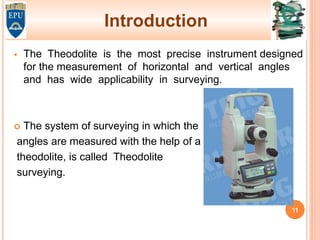
▪ The Theodolite is the most precise instrument designed
for the measurement of horizontal and vertical angles
and has wide applicability in surveying.
 The system of surveying in which the
angles are measured with the help of a
theodolite, is called Theodolite
surveying.
11
The Purposes of theodolite
The Theodolite is a most accurate surveying instrument
mainly used for :
➢ Directing horizontal and vertical angles.
➢ Locating points on a line.
➢ Finding difference of level.
➢ Finding the vertical height of an object.
➢ Measuring the horizontal distance between two points.
➢ Setting out grades
➢ Ranging curves
➢ Tachometric Survey
12
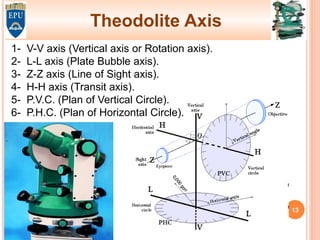
Theodolite Axis
1- V-V axis (Vertical axis or Rotation axis).
2- L-L axis (Plate Bubble axis).
3- Z-Z axis (Line of Sight axis).
4- H-H axis (Transit axis).
5- P.V.C. (Plan of Vertical Circle).
6- P.H.C. (Plan of Horizontal Circle).
13
Components of theodolite
14
Components of theodolite
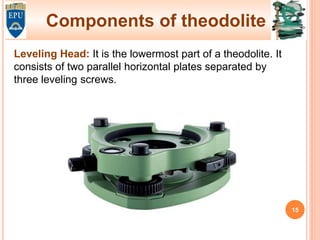
Leveling Head: It is the lowermost part of a theodolite. It
consists of two parallel horizontal plates separated by
three leveling screws.
15
Components of theodolite
Trivet
It is a circular plate having a central, threaded hole for fixing
the theodolite on the tripod stand by a wing nut. It is also
called the base plate.
Tribrach
It is a triangular plate carrying three foot screws at its ends.
Trivet
Tribrach
16
Components of theodolite
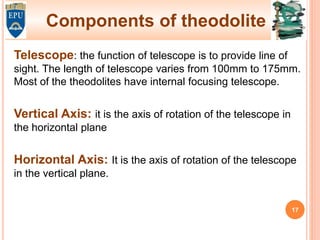
Telescope: the function of telescope is to provide line of
sight. The length of telescope varies from 100mm to 175mm.
Most of the theodolites have internal focusing telescope.
Vertical Axis: it is the axis of rotation of the telescope in
the horizontal plane
Horizontal Axis: It is the axis of rotation of the telescope
in the vertical plane.
17
Components of theodolite
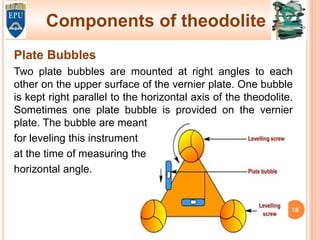
Plate Bubbles
Two plate bubbles are mounted at right angles to each
other on the upper surface of the vernier plate. One bubble
is kept right parallel to the horizontal axis of the theodolite.
Sometimes one plate bubble is provided on the vernier
plate. The bubble are meant
for leveling this instrument
at the time of measuring the
horizontal angle.
18
Components of theodolite
Screws:
A theodolite instrument has number of screws as its
component parts. These are classified into different types
depending on their functions.
 Levelling Screws
 Clamp Screws
 Tangent Screws
19
Components of theodolite
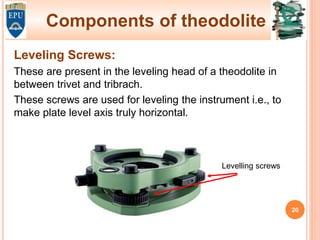
Leveling Screws:
These are present in the leveling head of a theodolite in
between trivet and tribrach.
These screws are used for leveling the instrument i.e., to
make plate level axis truly horizontal.
Levelling screws
20
Components of theodolite
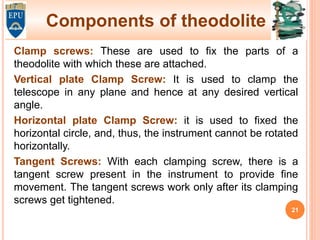
Clamp screws: These are used to fix the parts of a
theodolite with which these are attached.
Vertical plate Clamp Screw: It is used to clamp the
telescope in any plane and hence at any desired vertical
angle.
Horizontal plate Clamp Screw: it is used to fixed the
horizontal circle, and, thus, the instrument cannot be rotated
horizontally.
Tangent Screws: With each clamping screw, there is a
tangent screw present in the instrument to provide fine
movement. The tangent screws work only after its clamping
screws get tightened.
21
Components of theodolite
Levelling screws
Horizontal plate Clamp Screw
Tangent Screws
Vertical plate Clamp Screw
22
Components of theodolite
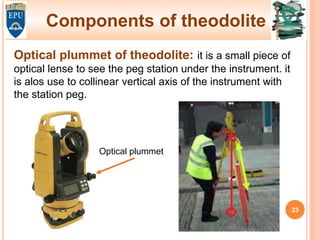
Optical plummet of theodolite: it is a small piece of
optical lense to see the peg station under the instrument. it
is alos use to collinear vertical axis of the instrument with
the station peg.
Optical plummet
23
Temporary Adjustment
 At each station point, before taking any observation, it is
required to carry out some operations in sequence. The
set of operations those are required to be done on an
instrument in order to make it ready for taking
observation is known as temporary adjustment.
 Temporary adjustment of a vernier theodolite consists of
following operations:
➢ Setting,
➢ Centring,
➢ Leveling
➢ Focussing. 24
Definitions
Face left:
Face left observation while taking the reading if the vertical
circle is towards the left of the observer, it is called face left
observation.
Face Right:
Face right observation – while taking
readings if the vertical circle is towards the
right of the observer then it is called face
right observation (this condition is also
called telescope inverted condition)
25
Definitions
Changing the face
The operation of bringing the vertical circle from left to right
or vice versa is called changing the face.
Swinging the telescope:
The process of rotating the telescope about vertical axis is
called swinging telescope.
A set of observations:
Finding of horizontal observation once with face right
observation and other with face left observation is called
one set of observation.
26
Measuring Horizontal Angle
There are three methods of measuring
horizontal angles:
i) Ordinary Method.
ii) Repetition Method.
iii) Reiteration Method.
27
Measuring Horizontal Angle
i)Ordinary Method. To measure horizontal angle:
1-Set up the theodolite at station point O.
Direct telescope to point A and set the horizontal angle to the
zero or 360°. Tighten the upper clamp.
2-Turn the instrument clockwise and direct the telescope
towards B and read the horizontal B and record both the
readings.
3-The reading angles at B gives the
value of the angle AOB directly.
A B
O
28
Measuring Horizontal Angle
4-Change the face of the instrument and repeat the whole
process. The mean of the two readings gives the second
value of the angle AOB which should be approximately or
exactly equal to the previous value.
5-The mean of the two values of the angle AOB ,one with
face left and the other with face right ,gives the required
angle free from all instrumental errors.
A B
O
HORIZONTAL ANGLE AOB
29
Measuring Horizontal Angle
ii) Repetition Method.
 This method is used for very accurate work.
 The No. of repetitions made usually in this method is
six, three with the face left and three with the face right
.In this way ,angles can be measured to a finer degree of
accuracy than that obtainable with the least count of the
Vernier.
30
Measuring Horizontal Angle
To measure horizontal angle by repetitions:-
1-Set up the theodolite at starting point O .
2-Measure The horizontal angle AOB.
3-Loosen the lower clamp and turn the telescope clock-wise
until the object (A) is sighted again. Bisect B accurately by
using the upper tangent screw.
Angle AOB=
Accumulated Angle
No of Reading
31
Measuring Horizontal Angle
iii) Reiteration Method
 It is generally preferred when several angles are to be
measured at a particular station.
This method consists in measuring several
angles successively and finally closing the
Horizon at the starting point.
The final reading of the point A
should be same as its initial reading.
32
Measuring Horizontal Angle
Procedure
Suppose it is required to measure the angles AOB,BOC
and COD. Then to measure these angles by repetition
method :
1-Set up the instrument over station point O.
2-Direct the telescope towards point A
which is known as referring object.
Bisect it accurately and check the
reading as 0 or 360 .
Loosen the lower clamp and turn the telescope clockwise
to sight point B exactly and read the angle.
33
Measuring Horizontal Angle
3-Similarly bisect C & D successively and read both. each
bisection, find the value of the angle BOC and COD.
4-Finally close the horizon by sighting towards the
referring object (point A).
5-The direction A should now read 360°. If not note down
the error .This error occurs due to slip etc.
6-If the error is small, it is equally distributed among the
several angles .If large the readings should be discarded
and a new set of readings be taken.
34
Measuring Vertical Angle
Vertical Angle :
A vertical angle is an angle between the inclined line of
sight and the horizontal. It may be an angle of elevation or
depression according as the object is above or below the
horizontal plane.
35
Measuring Vertical Angle
Measuring Vertical angles
Face Left
V-angle= 90- Zenith angle
Face Right
V-angle= Zenith angle-270
36

Theodolite seting up.pdf

  • 1.
    Engineering Technical College highwayEngineering Dept. Engineering Survey-2 BASICS OF THEODOLITE AND ANGLE MEASUREMENTS Prepared by Lecturer: Razhan Sherwan 1
  • 2.
    WHAT IS ANGLE An angle is defined as the amount of turn between two straight lines that share a common end point. Angles are measured in degrees.  The symbol used for degrees is a little circle ° 2
  • 3.
    TERMS ASSOCIATED WITHANGLES VERTEX - The vertex of an angle is the common point where the two lines meet. ARM - The arms of an angle or sides are the lines that make up the angle. DEGREES - The size of the angle is measured in degrees and usually denoted with the ° symbol. For example, an angle may measure 45°. PROTRACTOR - A tool that is used to measure angles. 3
  • 4.
    NAMING ANGLE To namean angle, we name any point on one ray, then the vertex, and then any point on the other ray We may also name this angle only by the single letter of the vertex, for example <B. 4
  • 5.
  • 6.
    If the angleis not exactly to the next degree it can be expressed as a decimal (most common in math) or in degrees, minutes and seconds (common in surveying and some navigation). 1 degree = 60 minutes 1 minute = 60 seconds  = 25°48'30" degrees minutes seconds Let's convert the seconds to minutes 30" " 60 ' 1  = 0.5' 6 Angle measurements  = 25°48'30" 48.5' ' 60 1  = .808° = 25°48.5' = 25.808° 
  • 7.
    initial side radius ofcircle is r r r arc length is also r r This angle measures 1 radian Given a circle of radius r with the vertex of an angle as the center of the circle, if the arc length formed by intercepting the circle with the sides of the angle is the same length as the radius r, the angle measures one radian. ANOTHER WAY TO MEASURE ANGLES IS USING WHAT IS CALLED RADIANS. 7
  • 8.
    arc length radiusmeasure of angle important: angle measure must be in radians to use formula! Find the arc length if we have a circle with a radius of 3 meters and central angle of 0.52 radian. 3  = 0.52 arc length to find is in black s = r 3 0.52 = 1.56 m What if we have the measure of the angle in degrees? We can't use the formula until we convert to radians, but how? s = r ARC LENGTH S OF A CIRCLE IS FOUND WITH THE FOLLOWING FORMULA: 8
  • 9.
    conversion from degreesto radians Let's start with the arc length formula s = r If we look at one revolution around the circle, the arc length would be the circumference. Recall that circumference of a circle is 2r 2r = r cancel the r's This tells us that the radian measure all the way around is 2. All the way around in degrees is 360°. 2 =  2  radians = 360° 9 𝑅𝑎𝑑𝑖𝑎𝑛 = 𝐷𝑒𝑔𝑟𝑒𝑒 𝑥 𝜋 radians 180° To convert degree to radian:
  • 10.
    It is customaryto use small letters in the Greek alphabet to symbolize angle measurement.       alpha beta gamma theta phi delta GREEK SIGNS 10
  • 11.
    Introduction ▪ The Theodoliteis the most precise instrument designed for the measurement of horizontal and vertical angles and has wide applicability in surveying.  The system of surveying in which the angles are measured with the help of a theodolite, is called Theodolite surveying. 11
  • 12.
    The Purposes oftheodolite The Theodolite is a most accurate surveying instrument mainly used for : ➢ Directing horizontal and vertical angles. ➢ Locating points on a line. ➢ Finding difference of level. ➢ Finding the vertical height of an object. ➢ Measuring the horizontal distance between two points. ➢ Setting out grades ➢ Ranging curves ➢ Tachometric Survey 12
  • 13.
    Theodolite Axis 1- V-Vaxis (Vertical axis or Rotation axis). 2- L-L axis (Plate Bubble axis). 3- Z-Z axis (Line of Sight axis). 4- H-H axis (Transit axis). 5- P.V.C. (Plan of Vertical Circle). 6- P.H.C. (Plan of Horizontal Circle). 13
  • 14.
  • 15.
    Components of theodolite LevelingHead: It is the lowermost part of a theodolite. It consists of two parallel horizontal plates separated by three leveling screws. 15
  • 16.
    Components of theodolite Trivet Itis a circular plate having a central, threaded hole for fixing the theodolite on the tripod stand by a wing nut. It is also called the base plate. Tribrach It is a triangular plate carrying three foot screws at its ends. Trivet Tribrach 16
  • 17.
    Components of theodolite Telescope:the function of telescope is to provide line of sight. The length of telescope varies from 100mm to 175mm. Most of the theodolites have internal focusing telescope. Vertical Axis: it is the axis of rotation of the telescope in the horizontal plane Horizontal Axis: It is the axis of rotation of the telescope in the vertical plane. 17
  • 18.
    Components of theodolite PlateBubbles Two plate bubbles are mounted at right angles to each other on the upper surface of the vernier plate. One bubble is kept right parallel to the horizontal axis of the theodolite. Sometimes one plate bubble is provided on the vernier plate. The bubble are meant for leveling this instrument at the time of measuring the horizontal angle. 18
  • 19.
    Components of theodolite Screws: Atheodolite instrument has number of screws as its component parts. These are classified into different types depending on their functions.  Levelling Screws  Clamp Screws  Tangent Screws 19
  • 20.
    Components of theodolite LevelingScrews: These are present in the leveling head of a theodolite in between trivet and tribrach. These screws are used for leveling the instrument i.e., to make plate level axis truly horizontal. Levelling screws 20
  • 21.
    Components of theodolite Clampscrews: These are used to fix the parts of a theodolite with which these are attached. Vertical plate Clamp Screw: It is used to clamp the telescope in any plane and hence at any desired vertical angle. Horizontal plate Clamp Screw: it is used to fixed the horizontal circle, and, thus, the instrument cannot be rotated horizontally. Tangent Screws: With each clamping screw, there is a tangent screw present in the instrument to provide fine movement. The tangent screws work only after its clamping screws get tightened. 21
  • 22.
    Components of theodolite Levellingscrews Horizontal plate Clamp Screw Tangent Screws Vertical plate Clamp Screw 22
  • 23.
    Components of theodolite Opticalplummet of theodolite: it is a small piece of optical lense to see the peg station under the instrument. it is alos use to collinear vertical axis of the instrument with the station peg. Optical plummet 23
  • 24.
    Temporary Adjustment Temporary Adjustment At each station point, before taking any observation, it is required to carry out some operations in sequence. The set of operations those are required to be done on an instrument in order to make it ready for taking observation is known as temporary adjustment.  Temporary adjustment of a vernier theodolite consists of following operations: ➢ Setting, ➢ Centring, ➢ Leveling ➢ Focussing. 24
  • 25.
    Definitions Face left: Face leftobservation while taking the reading if the vertical circle is towards the left of the observer, it is called face left observation. Face Right: Face right observation – while taking readings if the vertical circle is towards the right of the observer then it is called face right observation (this condition is also called telescope inverted condition) 25
  • 26.
    Definitions Changing the face Theoperation of bringing the vertical circle from left to right or vice versa is called changing the face. Swinging the telescope: The process of rotating the telescope about vertical axis is called swinging telescope. A set of observations: Finding of horizontal observation once with face right observation and other with face left observation is called one set of observation. 26
  • 27.
    Measuring Horizontal Angle Thereare three methods of measuring horizontal angles: i) Ordinary Method. ii) Repetition Method. iii) Reiteration Method. 27
  • 28.
    Measuring Horizontal Angle i)OrdinaryMethod. To measure horizontal angle: 1-Set up the theodolite at station point O. Direct telescope to point A and set the horizontal angle to the zero or 360°. Tighten the upper clamp. 2-Turn the instrument clockwise and direct the telescope towards B and read the horizontal B and record both the readings. 3-The reading angles at B gives the value of the angle AOB directly. A B O 28
  • 29.
    Measuring Horizontal Angle 4-Changethe face of the instrument and repeat the whole process. The mean of the two readings gives the second value of the angle AOB which should be approximately or exactly equal to the previous value. 5-The mean of the two values of the angle AOB ,one with face left and the other with face right ,gives the required angle free from all instrumental errors. A B O HORIZONTAL ANGLE AOB 29
  • 30.
    Measuring Horizontal Angle ii)Repetition Method.  This method is used for very accurate work.  The No. of repetitions made usually in this method is six, three with the face left and three with the face right .In this way ,angles can be measured to a finer degree of accuracy than that obtainable with the least count of the Vernier. 30
  • 31.
    Measuring Horizontal Angle Tomeasure horizontal angle by repetitions:- 1-Set up the theodolite at starting point O . 2-Measure The horizontal angle AOB. 3-Loosen the lower clamp and turn the telescope clock-wise until the object (A) is sighted again. Bisect B accurately by using the upper tangent screw. Angle AOB= Accumulated Angle No of Reading 31
  • 32.
    Measuring Horizontal Angle iii)Reiteration Method  It is generally preferred when several angles are to be measured at a particular station. This method consists in measuring several angles successively and finally closing the Horizon at the starting point. The final reading of the point A should be same as its initial reading. 32
  • 33.
    Measuring Horizontal Angle Procedure Supposeit is required to measure the angles AOB,BOC and COD. Then to measure these angles by repetition method : 1-Set up the instrument over station point O. 2-Direct the telescope towards point A which is known as referring object. Bisect it accurately and check the reading as 0 or 360 . Loosen the lower clamp and turn the telescope clockwise to sight point B exactly and read the angle. 33
  • 34.
    Measuring Horizontal Angle 3-Similarlybisect C & D successively and read both. each bisection, find the value of the angle BOC and COD. 4-Finally close the horizon by sighting towards the referring object (point A). 5-The direction A should now read 360°. If not note down the error .This error occurs due to slip etc. 6-If the error is small, it is equally distributed among the several angles .If large the readings should be discarded and a new set of readings be taken. 34
  • 35.
    Measuring Vertical Angle VerticalAngle : A vertical angle is an angle between the inclined line of sight and the horizontal. It may be an angle of elevation or depression according as the object is above or below the horizontal plane. 35
  • 36.
    Measuring Vertical Angle MeasuringVertical angles Face Left V-angle= 90- Zenith angle Face Right V-angle= Zenith angle-270 36