Trigeminal nerve
Department of Oral & Maxillofacial Surgery
New Horizon Dental College & Research Institute
Presented By: Dr Kamini Dadsena
Guided By:
Dr. R. S. Madan
Dr. V. Kharsan
Dr.Akshay Daga
Dr. Abhishek Balani
Dr. Sumit Tiwari
introduction:
 Trigeminal nerve is largest cranial nerve, it contains both sensory and motor fiber.
 It was described by Fallopius and again by Meckel in 1748. The name trigeminal was given by
Winslow on account of its three divisions.
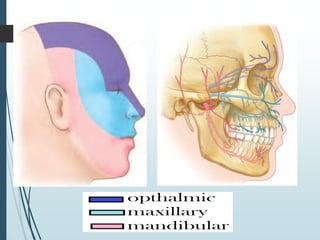
 It has 3 branches:
1. Opthalmic – sensory
2. Maxillary – sensory
3. Mandibular - mixed
 General somatic afferent fibers contain both exteroceptive and proprioseptive impulses.
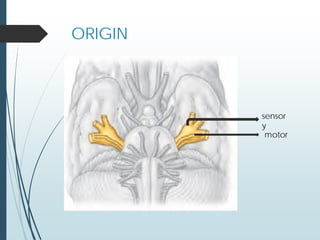
 It attached to the lateral part of the pons by its two roots, motor and sensory
ORIGIN
sensor
y
motor
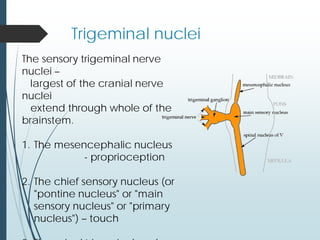
Trigeminal nuclei
The sensory trigeminal nerve
nuclei –
largest of the cranial nerve
nuclei
extend through whole of the
brainstem.
1. The mesencephalic nucleus
- proprioception
2. The chief sensory nucleus (or
"pontine nucleus" or "main
sensory nucleus" or "primary
nucleus") – touch
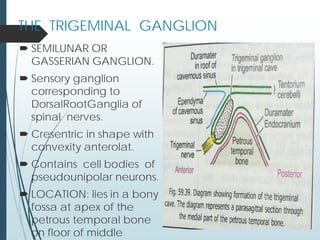
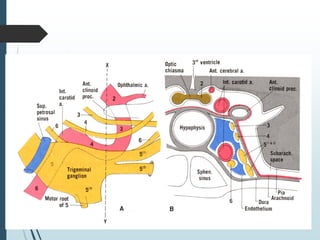
 SEMILUNAR OR
GASSERIAN GANGLION.
 Sensory ganglion
corresponding to
DorsalRootGanglia of
spinal nerves.
 Cresentric in shape with
convexity anterolat.
 Contains cell bodies of
pseudounipolar neurons.
 LOCATION: lies in a bony
fossa at apex of the
petrous temporal bone
on floor of middle
THE TRIGEMINAL GANGLION
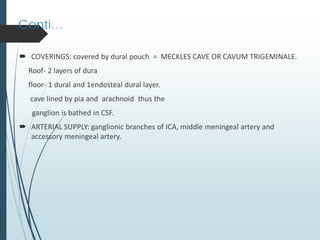
 COVERINGS: covered by dural pouch = MECKLES CAVE OR CAVUM TRIGEMINALE.
Roof- 2 layers of dura
floor- 1 dural and 1endosteal dural layer.
cave lined by pia and arachnoid thus the
ganglion is bathed in CSF.
 ARTERIAL SUPPLY: ganglionic branches of ICA, middle meningeal artery and
accessory meningeal artery.
Conti…
Ganglia associated with
trigeminal nerve
 Associated with the three divisions of the trigeminal
nerve are four small ganglia.
 The ciliary ganglion is connected with the ophthalmic
nerve.
 The sphenopalatine ganglion with the maxillary nerve.
 And the otic and submaxillary ganglia with the
mandibular nerve.
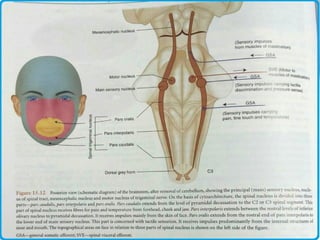
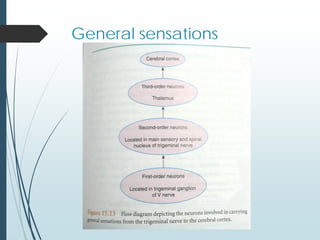
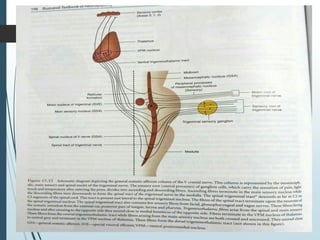
General sensations
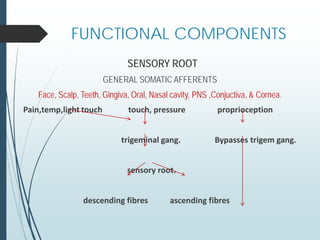
SENSORY ROOT
GENERAL SOMATIC AFFERENTS
Face, Scalp, Teeth, Gingiva, Oral, Nasal cavity, PNS ,Conjuctiva, & Cornea.
Pain,temp,light touch touch, pressure proprioception
trigeminal gang. Bypasses trigem gang.
sensory root.
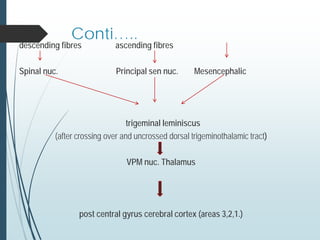
descending fibres ascending fibres
FUNCTIONAL COMPONENTS
descending fibres ascending fibres
Spinal nuc. Principal sen nuc. Mesencephalic
trigeminal leminiscus
(after crossing over and uncrossed dorsal trigeminothalamic tract)
VPM nuc. Thalamus
post central gyrus cerebral cortex (areas 3,2,1.)
Conti…..
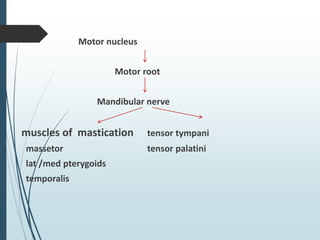
Motor nucleus
Motor root
Mandibular nerve
muscles of mastication tensor tympani
massetor tensor palatini
lat /med pterygoids
temporalis
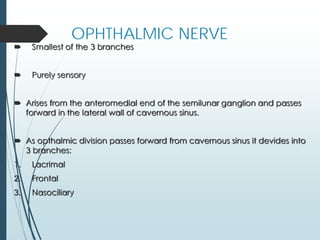
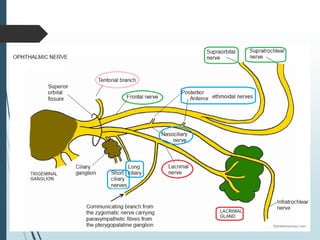
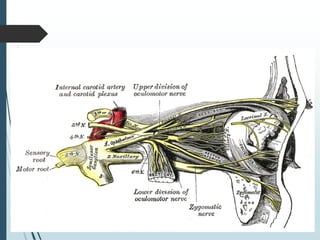
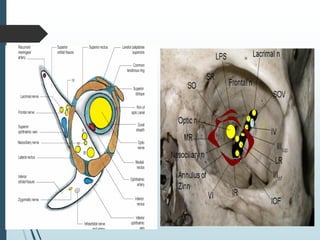
OPHTHALMIC NERVE
 Smallest of the 3 branches
 Purely sensory
 Arises from the anteromedial end of the semilunar ganglion and passes
forward in the lateral wall of cavernous sinus.
 As opthalmic division passes forward from cavernous sinus it devides into
3 branches:
1. Lacrimal
2. Frontal
3. Nasociliary
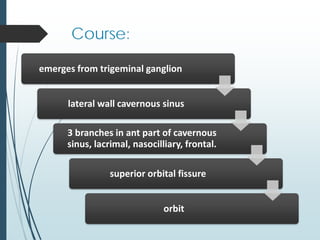
Course:
emerges from trigeminal ganglion
lateral wall cavernous sinus
3 branches in ant part of cavernous
sinus, lacrimal, nasocilliary, frontal.
superior orbital fissure
orbit
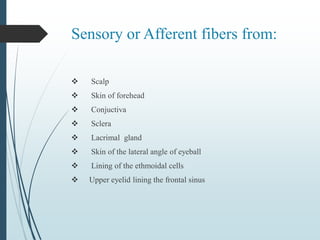
Sensory or Afferent fibers from:
 Scalp
 Skin of forehead
 Conjuctiva
 Sclera
 Lacrimal gland
 Skin of the lateral angle of eyeball
 Lining of the ethmoidal cells
 Upper eyelid lining the frontal sinus
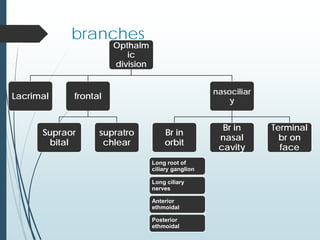
branches
Opthalm
ic
division
Lacrimal frontal
Supraor
bital
supratro
chlear
nasociliar
y
Br in
orbit
Br in
nasal
cavity
Terminal
br on
face
Long root of
ciliary ganglion
Long ciliary
nerves
Anterior
ethmoidal
Posterior
ethmoidal
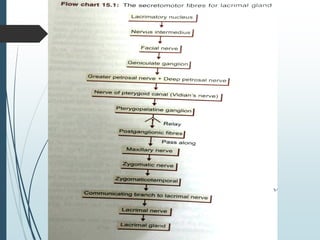
Lacrimal nerve
 smallest of the three branches
 Passes into orbit at the lateral angle of SOF
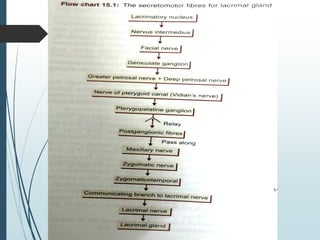
 It runs forward on the upper border of the lateral rectus muscle It is joined by the
zygomaticotemporal branch of the maxillary nerve, which contains the parasympathetic
secretomotor fibers to the lacrimal gland.
 The lacrimal nerve then enters the lacrimal gland and gives branches to the conjunctiva and the
skin of the upper eyelid.
 Occasionally it is absent, in which case it is replaced by thezygomaticotemporal nerve: the
relationship is reciprocal
 Receives communicating branch from trochlear nerve
Frontal nerve
 Largest of three branches
 It enter the orbit by the way of SOF
 The frontal nerve runs forward on the upper surface of
the levator palpebrae superioris muscle and divides
into the supraorbital and supratrochlear nerves
 These nerves leave the orbital cavity and supply the
frontal air sinus and the skin of the forehead and the
scalp.
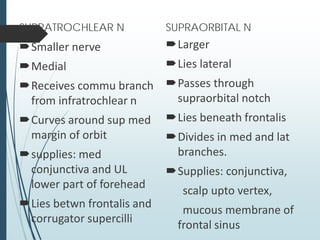
SUPRATROCHLEAR N
Smaller nerve
Medial
Receives commu branch
from infratrochlear n
Curves around sup med
margin of orbit
supplies: med
conjunctiva and UL
lower part of forehead
Lies betwn frontalis and
corrugator supercilli
Larger
Lies lateral
Passes through
supraorbital notch
Lies beneath frontalis
Divides in med and lat
branches.
Supplies: conjunctiva,
scalp upto vertex,
mucous membrane of
frontal sinus
SUPRAORBITAL N
 Passes through med part of sup. Orbital fissure within the tendenious
ring betwn the two div of occulomotor nerve.
 Runs along med wall of orbit betwn SO and MR
 Divides into terminal branches ANT ETHMOIDAL NERVE and
INFRATROCHLEAR NERVE
 branches in orbit.
NASOCILLIARY NERVE
1. Sensory root of the ciliary ganglion:
the long or sensory root arises from nasociliary nerve.
2. Long cilliary nerve: 2 or 3.
run along med side of the ON
pierce sclera and supply cornea, iris, cilliary body.
carry pain temp and touch.
sympathetic motor supply to dilator pupillae.
3. Posterior ethmoidal branch:
passes thru post ethmoidal foramen to supply the ethmoid and sphenoid PNS.
conti
4. Infratrochlear Nerve
smaller terminal branch
emerges below trochlea
appears on face above med angle the eye.
supplies: upper half of external nose
skin of med most part of UL andLL
medial conjunctiva
lacrimal sac
caruncle
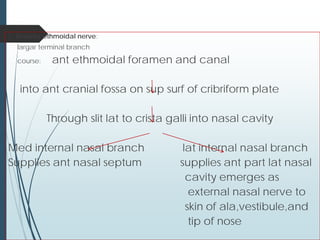
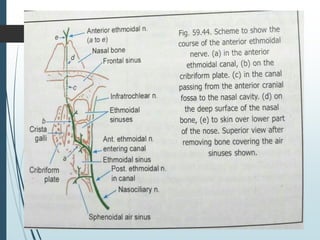
5. Anterior ethmoidal nerve:
largar terminal branch
course: ant ethmoidal foramen and canal
into ant cranial fossa on sup surf of cribriform plate
Through slit lat to crista galli into nasal cavity
Med internal nasal branch lat internal nasal branch
Supplies ant nasal septum supplies ant part lat nasal
cavity emerges as
external nasal nerve to
skin of ala,vestibule,and
tip of nose
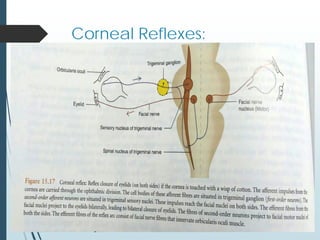
Corneal Reflexes:
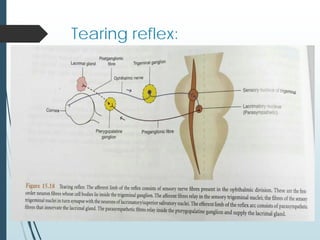
Tearing reflex:
CLINICAL APPLICATION OF TRIGEMINAL
GANGLION
Shingles and varicella-zoster: The trigeminal
ganglion, as any sensory ganglion, may be the
site of infection by the herpes zoster virus
causing shingles, a painful vesicular eruption in
the sensory distribution of the nerve.
Trigeminal neuralgia (tic douloureux): This is
severe pain in the distribution of the trigeminal
nerve or one of its branches, the cause often
being unknown. It may require partial
destruction of the ganglion.
34
CLINICAL APPLICATION
 Ethmoid tumours
Malignant tumours of the mucous lining of the
ethmoid air cells may expand into the orbits,
damaging branches of opthalmic nerve. This may
lead to displacement of the orbital contents
causing proptosis and squint, and sensory loss over
the anterior nasal skin.
 Nasal fractures
Trauma to the nose may damage the nasociliary
nerve. Sensory loss of the skin down to the tip of the
nose may result.
35
 Corneal reflex: When the cornea is touched, usually with a wisp of
cotton, the subject blinks. This tests V and VII. The nerve impulses pass
through cornea and then through nasociliary nerve to the brain.
 Supraorbital injuries
Trauma to the supraorbital margin may damage the supraorbital
and supratrochlear nerves causing sensory loss in the scalp.
36
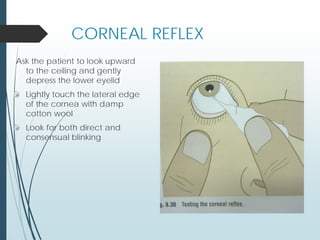
CORNEAL REFLEX
Ask the patient to look upward
to the ceiling and gently
depress the lower eyelid
Lightly touch the lateral edge
of the cornea with damp
cotton wool
Look for both direct and
consensual blinking
Maxillary nerve
MAXILLARY NERVE
 Second division of trigeminal nerve
 Pure sensory
 Supplies derivatives of maxillary process and frontonasal process.
i
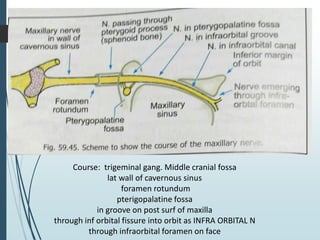
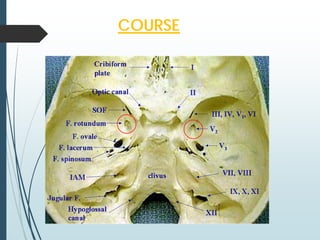
Course: trigeminal gang. Middle cranial fossa
lat wall of cavernous sinus
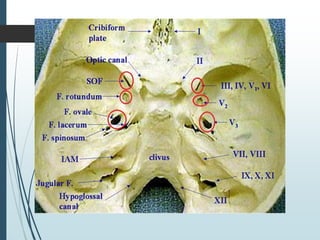
foramen rotundum
pterigopalatine fossa
in groove on post surf of maxilla
through inf orbital fissure into orbit as INFRA ORBITAL N
through infraorbital foramen on face
COURSE
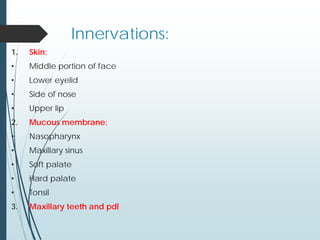
Innervations:
1. Skin:
• Middle portion of face
• Lower eyelid
• Side of nose
• Upper lip
2. Mucous membrane:
• Nasopharynx
• Maxillary sinus
• Soft palate
• Hard palate
• Tonsil
3. Maxillary teeth and pdl
MAXILLARY NERVE
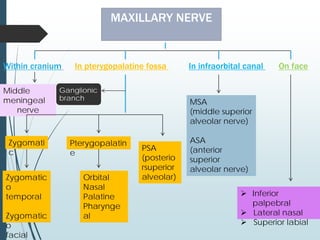
Within cranium In pterygopalatine fossa In infraorbital canal On face
Middle
meningeal
nerve
 Inferior
palpebral
 Lateral nasal
 Superior labial
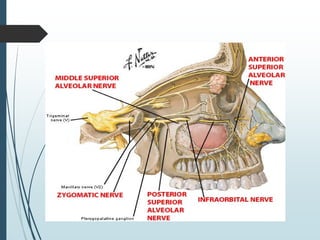
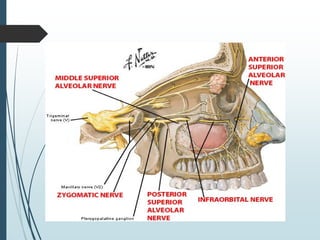
MSA
(middle superior
alveolar nerve)
ASA
(anterior
superior
alveolar nerve)
Zygomati
c
PSA
(posterio
rsuperior
alveolar)
Pterygopalatin
e
Zygomatic
o
temporal
Zygomatic
o
facial
Orbital
Nasal
Palatine
Pharynge
al
Ganglionic
branch
WITHIN CRANIUM
Middle meningeal nerve
 It leaves the maxillary nerve near the foramen rotundum.
 It runs along with the middle menigeal artery to supply the
duramater in the middle cranial fossa
IN PTERYGOPALATINE FOSSA
1. Ganglionic branches-
related to pterigopalatine ganglion
Carry sensations from orbital periosteum, nose, pharynx,palate
Carry post ganglionic parasymp. Secretomotor fibres to lacrimal
gland
Zygomatic Nerve:
 Starts in the pterygopalatine fossa
 Enters the orbit through the infraorbital fissure along its
lateral border where it divides into 2 branches :
 Zygomatictemporal
 Zygomaticfacial
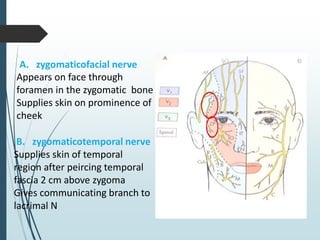
A. zygomaticofacial nerve
Appears on face through
foramen in the zygomatic bone
Supplies skin on prominence of
cheek
B. zygomaticotemporal nerve
Supplies skin of temporal
region after peircing temporal
fascia 2 cm above zygoma
Gives communicating branch to
lacrimal N
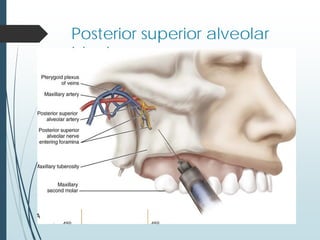
Posterior superior alveolar
nerve:
• It supply Maxillary molars & their gingivae
• Pass through the apical foramen of the roots of the molars except the
mesiobuccal root of the first molar.
• Mucous membrane of the maxillary sinus
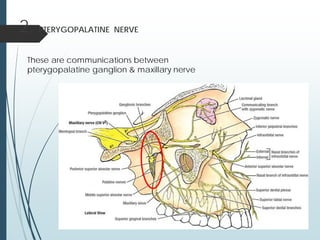
2. PTERYGOPALATINE NERVE
These are communications between
pterygopalatine ganglion & maxillary nerve
orbital branch
 Supply the periosteum of orbit.
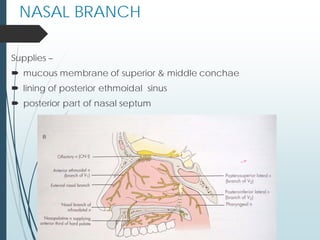
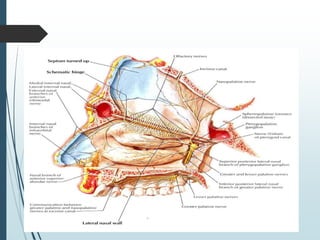
NASAL BRANCH
Supplies –
 mucous membrane of superior & middle conchae
 lining of posterior ethmoidal sinus
 posterior part of nasal septum
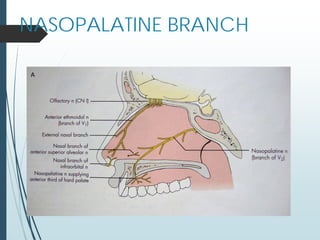
NASOPALATINE BRANCH
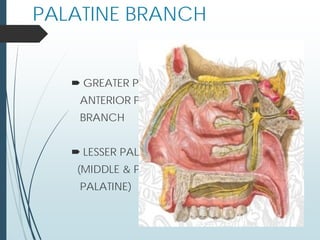
PALATINE BRANCH
 GREATER PALATINE /
ANTERIOR PALATINE
BRANCH
 LESSER PALATINE
(MIDDLE & POSTERIOR
PALATINE)
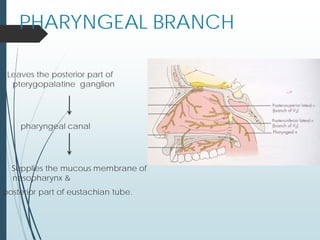
PHARYNGEAL BRANCH
Leaves the posterior part of
pterygopalatine ganglion
pharyngeal canal
Supplies the mucous membrane of
nasopharynx &
posterior part of eustachian tube.
In infraorbital canal
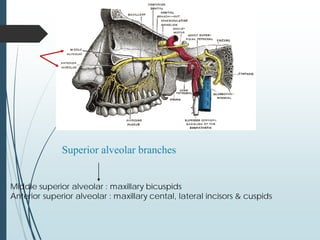
Superior alveolar branches
Middle superior alveolar : maxillary bicuspids
Anterior superior alveolar : maxillary cental, lateral incisors & cuspids
 Middle superior alveolar br : form the superior dental plexus
of nerves within the maxillary sinus
: as a direct branch of infraorbital n.
the middle superior alveolar n. may be missing and that the maxillary
bicuspids receive their sensory innervation from the
superior dental plexus.
.
Terminal branches
The palpebral branch ascend deep to the orbicularis
oculi, piercing the muscle to supply the skin in the
lower eyelid.
The nasal branches supplies the skin of the side of
the nose and of the movable part of the nasal septum.
Superior labial branch supply the skin of anterior
part of cheek, upper lip, oral mucosa and labial
glands.
Applied anatomy:
Causes of injury to Maxillary nerve –
1. Maxillofacial surgical procedures
Orthognathic surgeries
head & neck preprosthetic surgeries
Treatment of benign & malignent lesions
2. Trauma & facial fractures
3. Dental implant placement
4. Endodontic therapy
5. Tratment of pathology (specially periapical)
6. During administration of local anesthesia
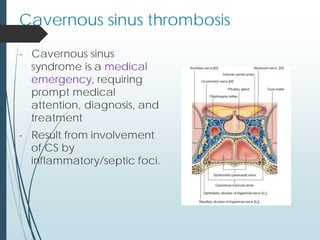
Cavernous sinus thrombosis
- Cavernous sinus
syndrome is a medical
emergency, requiring
prompt medical
attention, diagnosis, and
treatment
- Result from involvement
of CS by
inflammatory/septic foci.
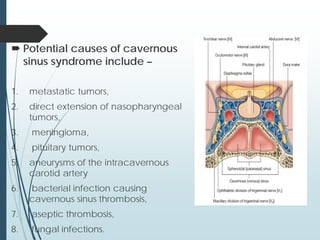
 Potential causes of cavernous
sinus syndrome include –
1. metastatic tumors,
2. direct extension of nasopharyngeal
tumors,
3. meningioma,
4. pituitary tumors,
5. aneurysms of the intracavernous
carotid artery
6. bacterial infection causing
cavernous sinus thrombosis,
7. aseptic thrombosis,
8. fungal infections.
Clinical features:
• High grade fever
• Altered consciousness
• Severe infection in danger area of face
• Chemosis
• Proptosis
• Opthalmoplagia
multiple cranial neuropathies.
- exophthalmos
- sensory loss in V1 and / or V2.
Treatment:
 early and aggressive Broad spectrum parentral
antibiotic administration for 3-4 weeks.
 IV mannitol toreduce intracrainial pressure.
 Anticoagulant to prevent ext. of thrombosis. Heparin
20,000 unit in 1500 ml of D5 or 200mg dicumarol orally
followed by 100mg daily.
 Corticosteroid reduced intra cranial tension but there
is risk of spread of infection.
 Neurosurgical intervention is mandatory.
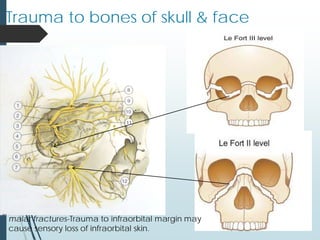
Trauma to bones of skull & face
malar fractures-Trauma to infraorbital margin may
cause sensory loss of infraorbital skin.
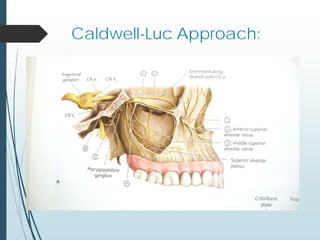
Caldwell-Luc Approach:
Posterior superior alveolar
block:
 Making Nasopalatine Blocks Comfortable: A Randomised Prospective
Clinical Comparison of Pain Associated with the Injection Using an Insulin
Syringe and a Standard Disposable 3 mL Syringe
 Sundararaman Prabhu, Syed Faizel, Vedant Pahlajani, and Shweta Jha
Prabhu
 J Maxillofac Oral Surg. 2013 December; 12(4): 436–439.
Making Nasopalatine Blocks Comfortable: A Randomised
Prospective Clinical Comparison of Pain Associated with the Injection
Using an Insulin Syringe and a Standard Disposable 3 mL Syringe
 J Maxillofac Oral Surg. 2013 December; 12(4): 436–439.
 Published online 2012 August 1. doi: 10.1007/s12663-012-0412-4
 PMCID: PMC3847027
 Making Nasopalatine Blocks Comfortable: A Randomised Prospective Clinical Comparison of Pain
Associated with the Injection Using an Insulin Syringe and a Standard Disposable 3 mL Syringe
 Sundararaman Prabhu, Syed Faizel, Vedant Pahlajani, and Shweta Jha Prabhu
Aim:
This study was conducted to compare and evaluate the pain associated with
administration of Nasopalatine blocks using a disposable insulin syringe and
the conventional disposable 3 mL syringe.
Conclusion
Pain associated with administration of the nasopalatine blocks may be
significantly mitigated by using the Insulin syringe
MAXILLARY SINUS
INFECTIONS
Infections of the maxillary sinus may cause
infraorbital pain or may cause referred pain
to other structures supplied by Vb (e.g.
upper teeth).
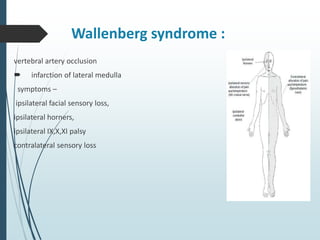
Wallenberg syndrome :
vertebral artery occlusion
 infarction of lateral medulla
symptoms –
ipsilateral facial sensory loss,
ipsilateral horners,
ipsilateral IX,X,XI palsy
contralateral sensory loss
Gradenigo’s syndrome:
 first described in 1904 by Guiseppe Gradenigo.
 It is defined as a clinical triad of otitis media, severe pain originating from
the trigeminal nerve, and ipsilateral sixth cranial nerve palsy.
J Med Case Rep. 2014; 8: 217.
Published online 2014 June 23. doi: 10.1186/1752-1947-8-217
PMCID: PMC4086707
Gradenigo’s syndrome secondary to chronic otitis media on a
background of previous radical mastoidectomy: a case report
Yuvatiya Plodpai,1 Siriporn Hirunpat,2 and Weerawat Kiddee3
Author information ► Article notes ► Copyright and License
information ►
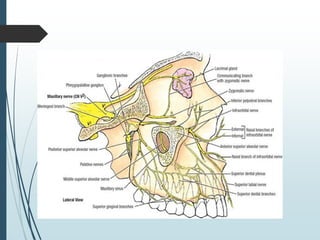
Pterygopalatine Ganglion:
 Sphenopalatine ganglion is the largest
parasympathetic ganglion, suspended by two roots of
maxillary nerve.
 Functionaly it is related to facial nerve.
 It is also the ganglion of hay fever.
 Roots:
 Sensory, sympathetic and secreatomotor or
parasympathetic roots.
 Sensory roots is from maxillary nerve
 Sympathetic roots is from postganglionic plexus
around ICA. The nerve is called deep petrosal. It unites
with greater petrosal to form the nerve of pterygoid
canal. The fibres of deep petrosal nerve do not relay
on ganglion.
Clinical examination of
maxillary nerve:
 Sensory: apply gentle touch, pinpricks, or warm or cold
objects to areas supplied by the nerve and note
responses;
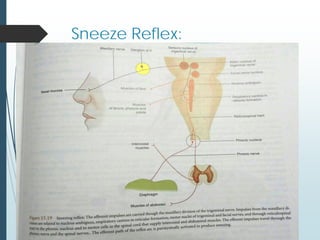
 Reflex: sneeze reflex.
Sneeze Reflex:
Mandibular nerve
Department of Oral & Maxillofacial Surgery
New Horizon Dental College & Research Institute
Presented By: Dr. Kamini Dadsena
Outline:
 Introduction
 Innervation
 Branches there courses & innervation:
1. Undivided nerve
2. Ant. Division
3. Post. Division
 Clinical applied part:
1. Mandibular Nerve block
2. Lingual nerve injury
3. Frey syndrome
4. Trigeminal neuralgia
5. Inferior alveolar canal & impacted mand. 3rd molar
6. Bifid mandibular canal
7. Mandibular orthognathic surgery complication
8. Traumatic neuroma
9. Trotter syndrome
 Clinical examination of fifth nerve
 Ganglia- otic & submandibular
 Conclusion
Introduction:
 Mandibular nerve is the largest branch of the
trigeminal nerve.
 Mixed nerve with two roots:
1. Large sensory : from inferior angle of TGG
2. Small motor : Motor cells located in pons & medulla
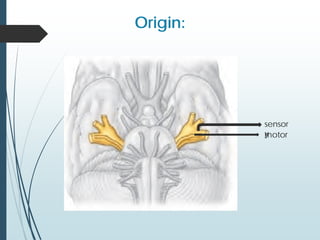
Origin:
sensor
ymotor
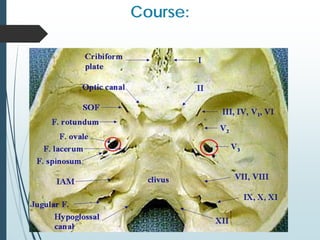
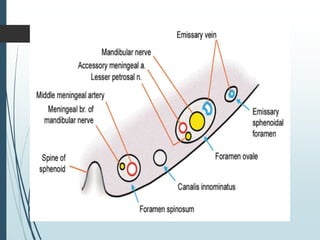
Course:
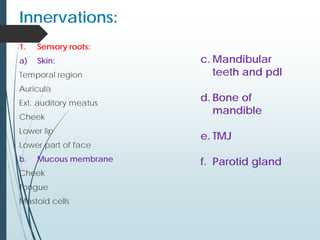
Innervations:
1. Sensory roots:
a) Skin:
Temporal region
Auricula
Ext. auditory meatus
Cheek
Lower lip
Lower part of face
b. Mucous membrane
Cheek
Tongue
Mastoid cells
c. Mandibular
teeth and pdl
d. Bone of
mandible
e. TMJ
f. Parotid gland
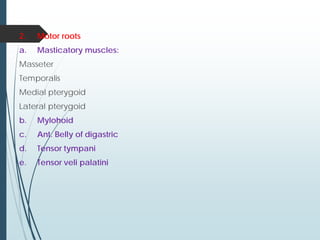
2. Motor roots
a. Masticatory muscles:
Masseter
Temporalis
Medial pterygoid
Lateral pterygoid
b. Mylohoid
c. Ant. Belly of digastric
d. Tensor tympani
e. Tensor veli palatini
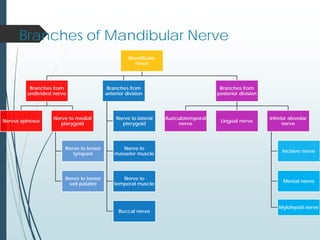
Branches of Mandibular Nerve
Mandibular
nerve
Branches from
undivided nerve
Nervus spinosus
Nerve to medial
pterygoid
Nerve to tensor
tympani
Nerve to tensor
veli palatini
Branches from
anterior division
Nerve to lateral
pterygoid
Nerve to
masseter muscle
Nerve to
temporal muscle
Buccal nerve
Branches from
posterior division
Auriculotemporal
nerve
Lingual nerve
Inferior alveolar
nerve
Incisive nerve
Mental nerve
Mylohyoid nerve
Branches from undivided nerve:
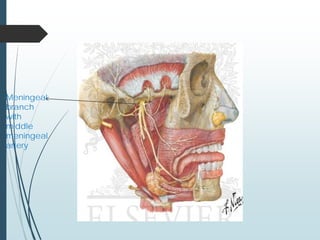
Nervus spinosus:
 Reenter the crainium through foramen spinosum along
with middle meningeal art..
 Supply:
1. Duramater
2. Mastoid air cells
Meningeal
branch
with
middle
meningeal
artery
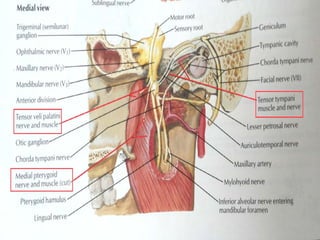
Nerve to medial pterygoid:
 Motor nerve to medial pterygoid
 It gives small branches to tensor veli palatini and
tensor tympani.
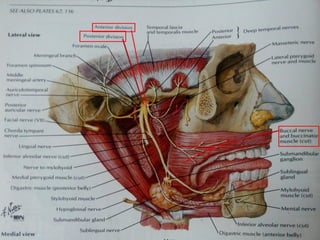
Branches from anterior division:
Branches from anterior
division:
 Smaller than post. Division.
 Runs forward under lateral pterygoid.
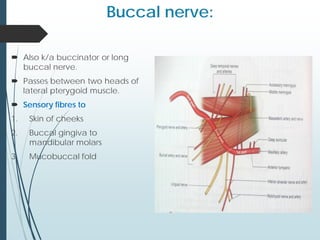
Buccal nerve:
 Also k/a buccinator or long
buccal nerve.
 Passes between two heads of
lateral pterygoid muscle.
 Sensory fibres to
1. Skin of cheeks
2. Buccal gingiva to
mandibular molars
3. Mucobuccal fold
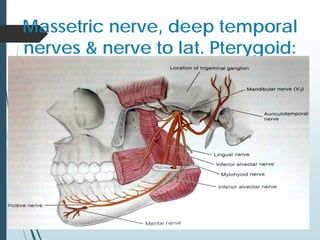
Massetric nerve, deep temporal
nerves & nerve to lat. Pterygoid:
Branches of the posterior division:
Auriculotemporal nerve:
Arises by a medial & lateral root.
Communications:
Each root receives communicating fibers from the otic
ganglion;
which are sensory & secretomotor to parotid gland.
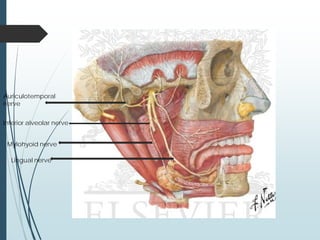
Auriculotemporal
nerve
Inferior alveolar nerve
Mylohyoid nerve
Lingual nerve
Branches :
Communication to facial:
Otic gang.: sensory, secretory and
vasomotor to parotid
Articular : posterior part of TMJ
Ant. Auricular : skin over the helix & tragus of
ear
Ext. auditory Meatal : skin lining the meatus
& tympanic membrane
Superficial temporal branch : skin over the
temporal region
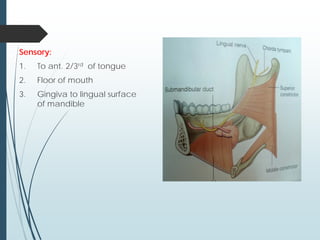
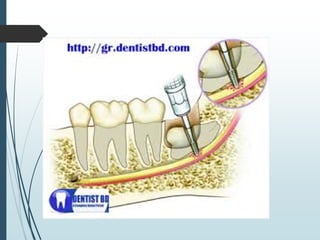
Lingual nerve
 Passes downward medial to lat. Pterygoid
 In pterygopalatine space, between ramus and medial
pterygoid
 Runs parallel to inf. Alveolar nerve
 Lies below and behind lower 3rd molar.
 Proceeds ant. In muscle of tongue
Sensory:
1. To ant. 2/3rd of tongue
2. Floor of mouth
3. Gingiva to lingual surface
of mandible
Inferior alveolar nerve:
 Largest br. Of post. Division.
 Lies medial to lateral pterygoid
 Enter mandibular canal.
 Throughout the path it accompany with IAA & IAV.
Mylohyoid nerve
 Br. From IAN before it enter in mandibular canal.
 Runs downward & forward in mylohyid groove
 It is mixed nerve.
Supply:
1. Motor to mylohyid muscle & ABD
2. Sensory to skin on the ant & inf. Surface of mental
protuberance
3. Sensory innervation to mandi. Incisors and mesial
roots of mandibular 1st molar.
Terminal branches
 IAN divided into mental and insive nerve.
 Incisive nerve remains in mand. Canal and supply
mandi. 1st PM, C & I.
 Mental nerve: exit the canal through mental foram.
And divided into 3 branches to that innervate the skin
of the chin, skin & mucous membrane of lower lip.
Clinical applied part:
Nerve block:
Complication of Inferior alveolar nerve block:
1. Failure of anesthesia: due to accesory sensory
innervation to mandibular teeth esp. mylohyoid
nerve.
2. Hematoma:
3. trismus
4. Transient facial paralysis
Complication of mandibular nerve block:
1. Gow – gate tech.:
 hematoma
 Trismus
 temporary paralysis of 3rd, 4th, & 6th nerve complete paralysis of eye
for 20 min.
1. Vazirani- akinosi closed mouth tech:
 failure to anesthesia
 Hematoma
 Trismus
 Transient facial paralysis
Mental nerve block complication:
 Hematoma
 Paresthesia to lip &/or chin
Complication of Incisive nerve block:
 Failure of anesthesia:
 Hematoma
 Paresthesia to lip&/or chin
Lingual nerve injury
Surgical trauma :
1. Complication of the regional blocking of nerve
2. Extraction of the mandibular 3rd molars
3. Jaw fracture
4. Stone in the submandibular gland duct
5. Probing or removing such stones
6. Accidental laceration of the ventral surface of
tongue during dental restoration
7. Rarely TUMOUR in this region
EFFECTS: various sensation of pain, numbness,
burning, altered gustatory function
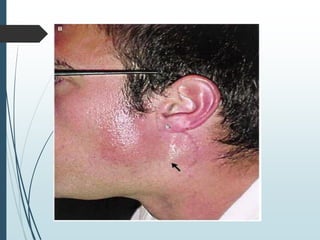
Frey syndrome:
 1st described by frey.
 It is localised gustatory sweating in the area supplied by
auriculotemporal nerve.
 Cause:
 Congenital or acquired
 Surgery of parotid gland, TMJ , parotid abscess, facial wound.
 Clinical feature:
1. Pain in area supplied by ATN
2. Gustatory sweating
3. Erythema & flushing
4. Positive iodine starch test
 Treatment:
1. Antiperspirants
2. Anticholinergic prepn: glycopyrolate
3. Botulinum toxin A inj.
4. Radiation therapy: 50 Gy
5. Surgical:
i. Skin excision: for localise & small area
ii. ATN section: not permanent
iii. Tympanic neurectomy: safe procedure
Trigeminal neuralgia:
Tic douloureux; Trifacial neuralgia;
Fothergill’s disease
 Definition: paroxymal episode of sudden, usually
unilateral, severe recurrent pain of shearing, stabbing
or lancinating type in distribution of one or more
branches of 5th cranial nerve, accompanied by
spasmodic contraction of facial muscles, often
initiated by ‘trigger zone’.
British journal of anesthesia(2001)
Etiology of TN:
 Mostly idiopathic
 Peripheral cause:
1. Nerve compression, trauma,
2. Herpes zoster infection
3. Aneurysm around nerve
4. Demyelination around the nerve
 Central cause:
1. Microaneurysm around nerve
2. Cerebro pontine angle tumors
3. Multiple sclerosis
4. Demyelination of the nerve
5. Pulsation of basillar artery
6. High petrous ridge
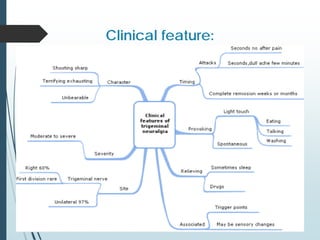
Clinical feature:
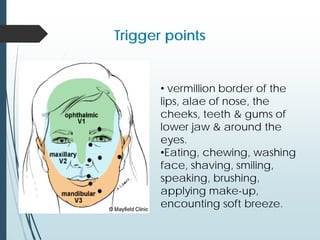
Trigger points
• vermillion border of the
lips, alae of nose, the
cheeks, teeth & gums of
lower jaw & around the
eyes.
•Eating, chewing, washing
face, shaving, smiling,
speaking, brushing,
applying make-up,
encounting soft breeze.
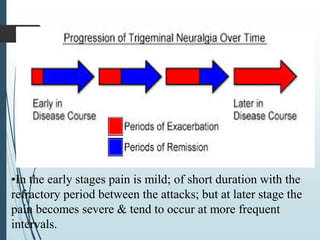
•In the early stages pain is mild; of short duration with the
refractory period between the attacks; but at later stage the
pain becomes severe & tend to occur at more frequent
intervals.
Treatment:
 MEDICAL
Anti-convulsants: Carbamazepine ( initial dose 200 mg three times a day &
tritated over 1 to 5 weeks period; eventually increasing to 800- 1200 mg)
Phenytoin
Baclofen ( GABA inhibitor )
Sodium Valproate ( 600 mg ) Clonazepam ( 1.5 mg/day )
Newer Anti- convulsants : Gabapentin, Lamotrigine, Vigabatrin
Corticosteroids
Tricyclic anti-depressants : Amitryptyline
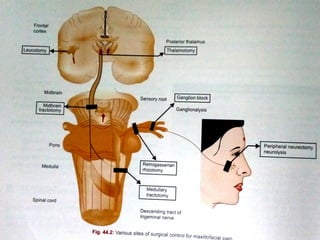
 SURGICAL:
Extracranial : Alcohol block in peripheral n.
Nerve section & avulsion
Electrosurgery
Cryosurgery
Selective radio frequency thermocoagulation
Peripheral neurectomy : Supraoribtal
Infraorbital
Lingual
Inferior alveolar
Intracranial : Alcohol blockade at gasserian ganglion
RFTC at gasserian ganglion
Retrogasserian rhizotomy
Medullary tractotomy
Midbrain tractotomy
Intracranial nerve decompression
Microvascular decompression (MVD)
• Newer approaches:
a) Physiologic inhibition of pain by transcutaneous neural stimulation
b) Acupuncture
• Psychologic approaches :
a) Biofeedback
b)Psychiatric counseling
c) Hypnosis
IAN injury
 Third molar surgery-
1 Upto 25% pts may not exp. spontaneous recovery of
sensation within one year.
2 Greater than 1 yr> microsurgery to be performed.
3. Mesioangular impactions greatest risk for nerve
damage followed by horizontal.
4. 0.33% reported cases of paresthesia & 0.184% with
permanent damage
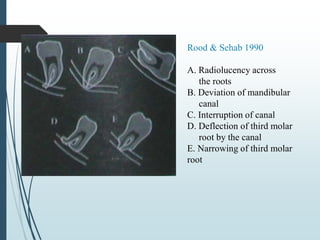
# 2005 OOOE – RADIOGRAPHIC PROXIMITY OF MAND THIRD MOLAR TO INF. ALV N.
Rood & Sehab 1990
A. Radiolucency across
the roots
B. Deviation of mandibular
canal
C. Interruption of canal
D. Deflection of third molar
root by the canal
E. Narrowing of third molar
root
Orthognathic surgery1. BSSO highest incidencce of neurosensory disturbances.
2. Injuries most common at mandibular foramen during osteotomies.
3. Mand. advancement result in stretch injury & application of rigid fixation
cause mechanical & compression type of injury
4. As IAN appr. mental foramen increase risk during implant placement or
genioplasty
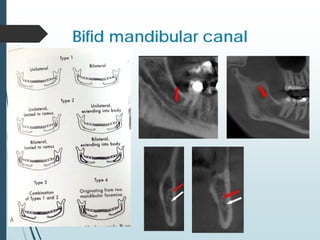
Bifid mandibular canal
Dental implants
1. It is suspect to post. Region of
mandible & ant. To mental
foramen
2. Placement of endosseus
implants result in 100% transient
hypoesthesia & 16% permanent
sensory loss
 Preauricular surgical approaches to
the mandible condyle or neck will
routinely expose the terminal
auriculotemporal n. trunk along with
superficial temporal artery.
 Trauma
Nerve impingement sec. to fracture
displacement
Traumatic Neuroma
 Benign tumor
 Exuberant attempt at repair of the damaged nerve
trunk
 Following accidental or purposeful sectioning of a
nerve , difficult extraction
 Oral traumatic neuroma: small nodule or swelling of
the mucosa typically near mental foramen, on the
alveolar ridge in edentulous areas or on the lips or
tongue.
 Treatment: surgical excision of the nodule.
Trotter syndrome:
 In nasopharyngeal carcinoma, the tumor may extend
laterally and involve the sinus of Morgagni sinus
involving the mandibular nerve.
 This produces a triad of symptoms known asTrotter's
Triad. These symptoms are:
 1) Conductive deafness (due to eustachian
tube involvement)
 2) Ipsilateral immobility of the soft palate
 3) Trigeminal neuralgia
Ganglia associated by mandi.
nerve
Submandibular ganglia:
 Sensory roots from lingual nerve. And it suspended by
two roots of lingual nerve.
 sympathetic plexus is from the sympathetic flexus
around the facial artery. This plexus contains post
ganglionic fibres from superior cervical ganglion of
sympathetic trunk. These fibre vasomotor to the gland.
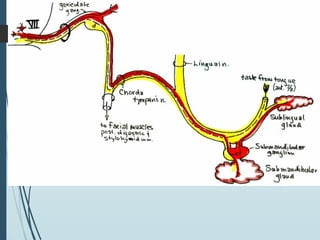
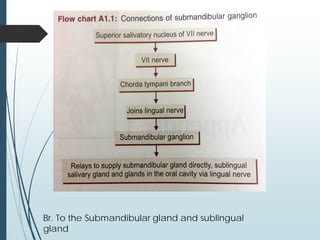
 Secreatomotor roots is from superior salivatory nucleus
through nervus intermedius via chorda tympani. CT
joins lingual nerve. Parasympathetic fibre get relayed
in submandibular ganglion.
 related to lingual nerve,
 rests on hyoglossus muscle
 supplies post ganglionic Parasympethetic
secretomotor fibres to submandibular and sublingual
gland.
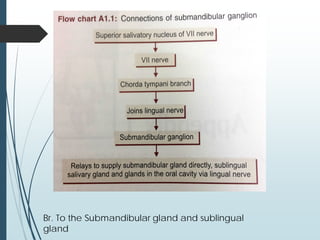
Br. To the Submandibular gland and sublingual
gland
Otic ganglion:
 The otic ganglion lies deep to the trunk of mandibular
nerve, between nerve and tensor veli palatini muscle
in infra temporal fossa, just distal to foramen ovale.
 Topographicaly it is related to mandibular nerve bt
functionaly it is related to glossopharyngeal nerve.
 Roots:
1. Sensory roots from auriculotemporal nerve.
2. Sympathetic roots from plexus around middle
meningeal artery.
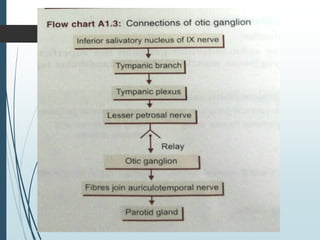
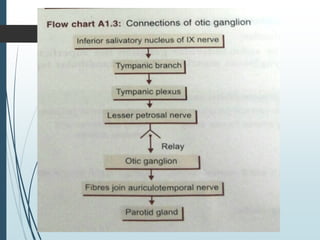
3. Secretomotor roots is by lesser petrosal nerve from
the tympanic plexus formed by tympanic branch of
glossopharyngeal nerve. Fibres of lesser petrosal
nerve relay in otic ganglion. Postganglionic fibres
reaches the gland through auriculotemporal nerve.
Cont….
 Branches:
1. Post ganglionic branches of ganglion pass through
auriculotemporal nerve to supply parotid gland
2. Motor branches to supplytwo muscle tensor
tympani and tensor veli palatini.
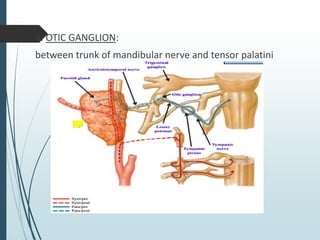
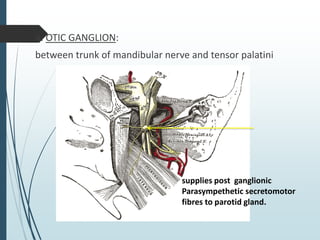
4. OTIC GANGLION:
between trunk of mandibular nerve and tensor palatini
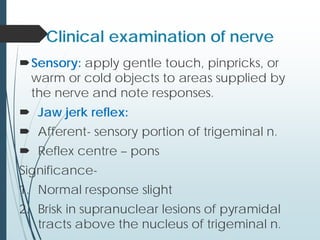
Clinical examination of nerve
Sensory: apply gentle touch, pinpricks, or
warm or cold objects to areas supplied by
the nerve and note responses.
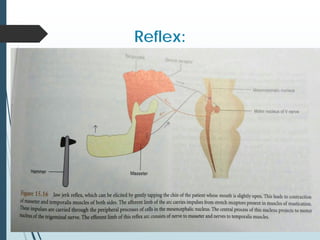
 Jaw jerk reflex:
 Afferent- sensory portion of trigeminal n.
 Reflex centre – pons
Significance-
1. Normal response slight
2. Brisk in supranuclear lesions of pyramidal
tracts above the nucleus of trigeminal n.
Reflex:
Ganglia associated
with trigeminal nerve
Ganglion:
 Ganglia are aggregations of neuronal somata and are of varying form
and size.
 They occur in
1. the dorsal roots of spinal nerves
2. Sensory roots of cranial nerves ie trigeminal, facial, glossopharyngeal,
vagal and vestibulocochlear
3. autonomic nerves
4. enteric nervous system.
 Each ganglion is enclosed within a capsule of fibrous connective tissue
and contains neuronal somata and neuronal processes
 Some ganglia, particularly in the ANS, contain fibres from cell bodies that
lie elsewhere in the nervous system and that either pass through, or
terminate within, the ganglia.
Submandibular Ganglia
 The submandibular ganglia lies superficial to
hyoglossus muscle in submandibular region.
 Functionally submandibular ganglion is connected to
facial nerve, while topologically it is connected to
lingual nerve.
Roots:
 It has sensory, sympathetic and secreatomotor or
parasympathetic roots.
 Sensory roots from lingual nerve. And it suspended by two roots of
lingual nerve.
 sympathetic plexus is from the sympathetic flexus around the facial
artery. This plexus contains post ganglionic fibres from superior
cervical ganglion of sympathetic trunk. These fibre vasomotor to the
gland.
 Secreatomotor roots is from superior salivatory nucleus through nervus
intermedius via chorda tympani. CT joins lingual nerve.
Parasympathetic fibre get relayed in submandibular ganglion.
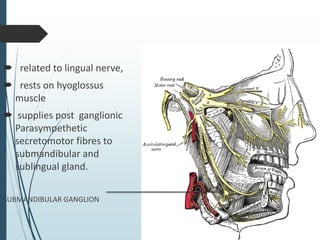
 related to lingual nerve,
 rests on hyoglossus
muscle
 supplies post ganglionic
Parasympethetic
secretomotor fibres to
submandibular and
sublingual gland.
SUBMANDIBULAR GANGLION
Br. To the Submandibular gland and sublingual
gland
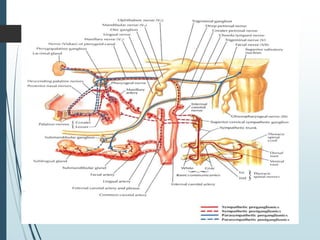
Pterygopalatine Ganglion:
 Sphenopalatine ganglion is the largest
parasympathetic ganglion, suspended by two roots of
maxillary nerve.
 Functionaly it is related to facial nerve.
 It is also the ganglion of hay fever.
 Roots:
 Sensory, sympathetic and secreatomotor or
parasympathetic roots.
 Sensory roots is from maxillary nerve
 Sympathetic roots is from postganglionic plexus
around ICA. The nerve is called deep petrosal. It unites
with greater petrosal to form the nerve of pterygoid
canal. The fibres of deep petrosal nerve do not relay
on ga
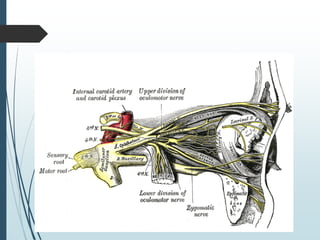
Cilliary ganglion:
 Very small gangliom present in orbit.
 Topographically, it is related to nasociliary nerve but
functionaly it is related to occulomotor nerve .
 Roots:
1. Sensory from long ciliary nerve
2. Sympathetic roots from long ciliary nerve from
plexus around opthalmic artery.
3. Parasympathetic root is from a branch to inferior
oblique muscle.
Cont……
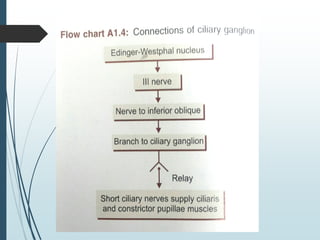
 Parasymph. Fibres arises from Edinger-westphal
nucleus, join occulomotor nerve and leave it via nerve
to IO
 Branches:
1. Gang.gives 10-12 short ciliary nerve containing post
ganglionic fibres for the supply of constrictor or
sphinctor pupillae for narrowing the size of pupil
and ciliary muscles for increasing curvature of ant.
Surface of lens during accomodation of eye.
Otic ganglion:
 The otic ganglion lies deep to the trunk of mandibular
nerve, between nerve and tensor veli palatini muscle
in infra temporal fossa, just distal to foramen ovale.
 Topographicaly it is related to mandibular nerve bt
functionaly it is related to glossopharyngeal nerve.
 Roots:
1. Sensory roots from auriculotemporal nerve.
2. Sympathetic roots from plexus around middle
meningeal artery.
3. Secretomotor roots is by lesser petrosal nerve from
the tympanic plexus formed by tympanic branch of
glossopharyngeal nerve. Fibres of lesser petrosal
nerve relay in otic ganglion. Postganglionic fibres
reaches the gland through auriculotemporal nerve.
4. Motor root is by branch from nerve to medial
pterygoid. This branches underlying through the
ganglion and devided into two branches to supply
tensor tympani and tensor veli palatini
Cont….
 Branches:
1. Post ganglionic branches of ganglion pass through
auriculotemporal nerve to supply parotid gland
2. Motor branches to supplytwo muscle tensor
tympani and tensor veli palatini.
4. OTIC GANGLION:
between trunk of mandibular nerve and tensor palatini
supplies post ganglionic
Parasympethetic secretomotor
fibres to parotid gland.
Conclusion:
 Mandibular nerve is one of the imp. Nerve of head &
neck.
 It is nerve of 1st brachial arch.
 Most commonly invoved in TN
 Lingual nerve is most commonly involve in minor
surgical procedure of 3rd molar area
 Injury to lingual, mental & IAN can be avoided by
proper tech.
 Auriculotemporal nerve injury can be prevented by
modification of incision line.
Trigeminal nerve

Trigeminal nerve

  • 1.
    Trigeminal nerve Department ofOral & Maxillofacial Surgery New Horizon Dental College & Research Institute Presented By: Dr Kamini Dadsena Guided By: Dr. R. S. Madan Dr. V. Kharsan Dr.Akshay Daga Dr. Abhishek Balani Dr. Sumit Tiwari
  • 2.
    introduction:  Trigeminal nerveis largest cranial nerve, it contains both sensory and motor fiber.  It was described by Fallopius and again by Meckel in 1748. The name trigeminal was given by Winslow on account of its three divisions.  It has 3 branches: 1. Opthalmic – sensory 2. Maxillary – sensory 3. Mandibular - mixed  General somatic afferent fibers contain both exteroceptive and proprioseptive impulses.  It attached to the lateral part of the pons by its two roots, motor and sensory
  • 3.
  • 4.
    Trigeminal nuclei The sensorytrigeminal nerve nuclei – largest of the cranial nerve nuclei extend through whole of the brainstem. 1. The mesencephalic nucleus - proprioception 2. The chief sensory nucleus (or "pontine nucleus" or "main sensory nucleus" or "primary nucleus") – touch
  • 6.
     SEMILUNAR OR GASSERIANGANGLION.  Sensory ganglion corresponding to DorsalRootGanglia of spinal nerves.  Cresentric in shape with convexity anterolat.  Contains cell bodies of pseudounipolar neurons.  LOCATION: lies in a bony fossa at apex of the petrous temporal bone on floor of middle THE TRIGEMINAL GANGLION
  • 7.
     COVERINGS: coveredby dural pouch = MECKLES CAVE OR CAVUM TRIGEMINALE. Roof- 2 layers of dura floor- 1 dural and 1endosteal dural layer. cave lined by pia and arachnoid thus the ganglion is bathed in CSF.  ARTERIAL SUPPLY: ganglionic branches of ICA, middle meningeal artery and accessory meningeal artery. Conti…
  • 8.
    Ganglia associated with trigeminalnerve  Associated with the three divisions of the trigeminal nerve are four small ganglia.  The ciliary ganglion is connected with the ophthalmic nerve.  The sphenopalatine ganglion with the maxillary nerve.  And the otic and submaxillary ganglia with the mandibular nerve.
  • 9.
  • 11.
    SENSORY ROOT GENERAL SOMATICAFFERENTS Face, Scalp, Teeth, Gingiva, Oral, Nasal cavity, PNS ,Conjuctiva, & Cornea. Pain,temp,light touch touch, pressure proprioception trigeminal gang. Bypasses trigem gang. sensory root. descending fibres ascending fibres FUNCTIONAL COMPONENTS
  • 12.
    descending fibres ascendingfibres Spinal nuc. Principal sen nuc. Mesencephalic trigeminal leminiscus (after crossing over and uncrossed dorsal trigeminothalamic tract) VPM nuc. Thalamus post central gyrus cerebral cortex (areas 3,2,1.) Conti…..
  • 13.
    Motor nucleus Motor root Mandibularnerve muscles of mastication tensor tympani massetor tensor palatini lat /med pterygoids temporalis
  • 16.
    OPHTHALMIC NERVE  Smallestof the 3 branches  Purely sensory  Arises from the anteromedial end of the semilunar ganglion and passes forward in the lateral wall of cavernous sinus.  As opthalmic division passes forward from cavernous sinus it devides into 3 branches: 1. Lacrimal 2. Frontal 3. Nasociliary
  • 17.
    Course: emerges from trigeminalganglion lateral wall cavernous sinus 3 branches in ant part of cavernous sinus, lacrimal, nasocilliary, frontal. superior orbital fissure orbit
  • 18.
    Sensory or Afferentfibers from:  Scalp  Skin of forehead  Conjuctiva  Sclera  Lacrimal gland  Skin of the lateral angle of eyeball  Lining of the ethmoidal cells  Upper eyelid lining the frontal sinus
  • 19.
    branches Opthalm ic division Lacrimal frontal Supraor bital supratro chlear nasociliar y Br in orbit Brin nasal cavity Terminal br on face Long root of ciliary ganglion Long ciliary nerves Anterior ethmoidal Posterior ethmoidal
  • 24.
    Lacrimal nerve  smallestof the three branches  Passes into orbit at the lateral angle of SOF  It runs forward on the upper border of the lateral rectus muscle It is joined by the zygomaticotemporal branch of the maxillary nerve, which contains the parasympathetic secretomotor fibers to the lacrimal gland.  The lacrimal nerve then enters the lacrimal gland and gives branches to the conjunctiva and the skin of the upper eyelid.  Occasionally it is absent, in which case it is replaced by thezygomaticotemporal nerve: the relationship is reciprocal  Receives communicating branch from trochlear nerve
  • 25.
    Frontal nerve  Largestof three branches  It enter the orbit by the way of SOF  The frontal nerve runs forward on the upper surface of the levator palpebrae superioris muscle and divides into the supraorbital and supratrochlear nerves  These nerves leave the orbital cavity and supply the frontal air sinus and the skin of the forehead and the scalp.
  • 26.
    SUPRATROCHLEAR N Smaller nerve Medial Receivescommu branch from infratrochlear n Curves around sup med margin of orbit supplies: med conjunctiva and UL lower part of forehead Lies betwn frontalis and corrugator supercilli Larger Lies lateral Passes through supraorbital notch Lies beneath frontalis Divides in med and lat branches. Supplies: conjunctiva, scalp upto vertex, mucous membrane of frontal sinus SUPRAORBITAL N
  • 27.
     Passes throughmed part of sup. Orbital fissure within the tendenious ring betwn the two div of occulomotor nerve.  Runs along med wall of orbit betwn SO and MR  Divides into terminal branches ANT ETHMOIDAL NERVE and INFRATROCHLEAR NERVE  branches in orbit. NASOCILLIARY NERVE
  • 28.
    1. Sensory rootof the ciliary ganglion: the long or sensory root arises from nasociliary nerve. 2. Long cilliary nerve: 2 or 3. run along med side of the ON pierce sclera and supply cornea, iris, cilliary body. carry pain temp and touch. sympathetic motor supply to dilator pupillae. 3. Posterior ethmoidal branch: passes thru post ethmoidal foramen to supply the ethmoid and sphenoid PNS. conti
  • 29.
    4. Infratrochlear Nerve smallerterminal branch emerges below trochlea appears on face above med angle the eye. supplies: upper half of external nose skin of med most part of UL andLL medial conjunctiva lacrimal sac caruncle
  • 30.
    5. Anterior ethmoidalnerve: largar terminal branch course: ant ethmoidal foramen and canal into ant cranial fossa on sup surf of cribriform plate Through slit lat to crista galli into nasal cavity Med internal nasal branch lat internal nasal branch Supplies ant nasal septum supplies ant part lat nasal cavity emerges as external nasal nerve to skin of ala,vestibule,and tip of nose
  • 32.
  • 33.
  • 34.
    CLINICAL APPLICATION OFTRIGEMINAL GANGLION Shingles and varicella-zoster: The trigeminal ganglion, as any sensory ganglion, may be the site of infection by the herpes zoster virus causing shingles, a painful vesicular eruption in the sensory distribution of the nerve. Trigeminal neuralgia (tic douloureux): This is severe pain in the distribution of the trigeminal nerve or one of its branches, the cause often being unknown. It may require partial destruction of the ganglion. 34
  • 35.
    CLINICAL APPLICATION  Ethmoidtumours Malignant tumours of the mucous lining of the ethmoid air cells may expand into the orbits, damaging branches of opthalmic nerve. This may lead to displacement of the orbital contents causing proptosis and squint, and sensory loss over the anterior nasal skin.  Nasal fractures Trauma to the nose may damage the nasociliary nerve. Sensory loss of the skin down to the tip of the nose may result. 35
  • 36.
     Corneal reflex:When the cornea is touched, usually with a wisp of cotton, the subject blinks. This tests V and VII. The nerve impulses pass through cornea and then through nasociliary nerve to the brain.  Supraorbital injuries Trauma to the supraorbital margin may damage the supraorbital and supratrochlear nerves causing sensory loss in the scalp. 36
  • 37.
    CORNEAL REFLEX Ask thepatient to look upward to the ceiling and gently depress the lower eyelid Lightly touch the lateral edge of the cornea with damp cotton wool Look for both direct and consensual blinking
  • 38.
  • 39.
    MAXILLARY NERVE  Seconddivision of trigeminal nerve  Pure sensory  Supplies derivatives of maxillary process and frontonasal process.
  • 40.
    i Course: trigeminal gang.Middle cranial fossa lat wall of cavernous sinus foramen rotundum pterigopalatine fossa in groove on post surf of maxilla through inf orbital fissure into orbit as INFRA ORBITAL N through infraorbital foramen on face
  • 41.
  • 42.
    Innervations: 1. Skin: • Middleportion of face • Lower eyelid • Side of nose • Upper lip 2. Mucous membrane: • Nasopharynx • Maxillary sinus • Soft palate • Hard palate • Tonsil 3. Maxillary teeth and pdl
  • 43.
    MAXILLARY NERVE Within craniumIn pterygopalatine fossa In infraorbital canal On face Middle meningeal nerve  Inferior palpebral  Lateral nasal  Superior labial MSA (middle superior alveolar nerve) ASA (anterior superior alveolar nerve) Zygomati c PSA (posterio rsuperior alveolar) Pterygopalatin e Zygomatic o temporal Zygomatic o facial Orbital Nasal Palatine Pharynge al Ganglionic branch
  • 44.
    WITHIN CRANIUM Middle meningealnerve  It leaves the maxillary nerve near the foramen rotundum.  It runs along with the middle menigeal artery to supply the duramater in the middle cranial fossa
  • 45.
    IN PTERYGOPALATINE FOSSA 1.Ganglionic branches- related to pterigopalatine ganglion Carry sensations from orbital periosteum, nose, pharynx,palate Carry post ganglionic parasymp. Secretomotor fibres to lacrimal gland
  • 46.
    Zygomatic Nerve:  Startsin the pterygopalatine fossa  Enters the orbit through the infraorbital fissure along its lateral border where it divides into 2 branches :  Zygomatictemporal  Zygomaticfacial
  • 47.
    A. zygomaticofacial nerve Appearson face through foramen in the zygomatic bone Supplies skin on prominence of cheek B. zygomaticotemporal nerve Supplies skin of temporal region after peircing temporal fascia 2 cm above zygoma Gives communicating branch to lacrimal N
  • 49.
    Posterior superior alveolar nerve: •It supply Maxillary molars & their gingivae • Pass through the apical foramen of the roots of the molars except the mesiobuccal root of the first molar. • Mucous membrane of the maxillary sinus
  • 51.
    2. PTERYGOPALATINE NERVE Theseare communications between pterygopalatine ganglion & maxillary nerve
  • 52.
    orbital branch  Supplythe periosteum of orbit.
  • 53.
    NASAL BRANCH Supplies – mucous membrane of superior & middle conchae  lining of posterior ethmoidal sinus  posterior part of nasal septum
  • 54.
  • 55.
    PALATINE BRANCH  GREATERPALATINE / ANTERIOR PALATINE BRANCH  LESSER PALATINE (MIDDLE & POSTERIOR PALATINE)
  • 56.
    PHARYNGEAL BRANCH Leaves theposterior part of pterygopalatine ganglion pharyngeal canal Supplies the mucous membrane of nasopharynx & posterior part of eustachian tube.
  • 57.
  • 58.
    Superior alveolar branches Middlesuperior alveolar : maxillary bicuspids Anterior superior alveolar : maxillary cental, lateral incisors & cuspids
  • 59.
     Middle superioralveolar br : form the superior dental plexus of nerves within the maxillary sinus : as a direct branch of infraorbital n. the middle superior alveolar n. may be missing and that the maxillary bicuspids receive their sensory innervation from the superior dental plexus. .
  • 60.
    Terminal branches The palpebralbranch ascend deep to the orbicularis oculi, piercing the muscle to supply the skin in the lower eyelid. The nasal branches supplies the skin of the side of the nose and of the movable part of the nasal septum. Superior labial branch supply the skin of anterior part of cheek, upper lip, oral mucosa and labial glands.
  • 61.
    Applied anatomy: Causes ofinjury to Maxillary nerve – 1. Maxillofacial surgical procedures Orthognathic surgeries head & neck preprosthetic surgeries Treatment of benign & malignent lesions 2. Trauma & facial fractures 3. Dental implant placement 4. Endodontic therapy 5. Tratment of pathology (specially periapical) 6. During administration of local anesthesia
  • 62.
    Cavernous sinus thrombosis -Cavernous sinus syndrome is a medical emergency, requiring prompt medical attention, diagnosis, and treatment - Result from involvement of CS by inflammatory/septic foci.
  • 63.
     Potential causesof cavernous sinus syndrome include – 1. metastatic tumors, 2. direct extension of nasopharyngeal tumors, 3. meningioma, 4. pituitary tumors, 5. aneurysms of the intracavernous carotid artery 6. bacterial infection causing cavernous sinus thrombosis, 7. aseptic thrombosis, 8. fungal infections.
  • 64.
    Clinical features: • Highgrade fever • Altered consciousness • Severe infection in danger area of face • Chemosis • Proptosis • Opthalmoplagia multiple cranial neuropathies. - exophthalmos - sensory loss in V1 and / or V2.
  • 65.
    Treatment:  early andaggressive Broad spectrum parentral antibiotic administration for 3-4 weeks.  IV mannitol toreduce intracrainial pressure.  Anticoagulant to prevent ext. of thrombosis. Heparin 20,000 unit in 1500 ml of D5 or 200mg dicumarol orally followed by 100mg daily.  Corticosteroid reduced intra cranial tension but there is risk of spread of infection.  Neurosurgical intervention is mandatory.
  • 66.
    Trauma to bonesof skull & face malar fractures-Trauma to infraorbital margin may cause sensory loss of infraorbital skin.
  • 67.
  • 68.
  • 69.
     Making NasopalatineBlocks Comfortable: A Randomised Prospective Clinical Comparison of Pain Associated with the Injection Using an Insulin Syringe and a Standard Disposable 3 mL Syringe  Sundararaman Prabhu, Syed Faizel, Vedant Pahlajani, and Shweta Jha Prabhu  J Maxillofac Oral Surg. 2013 December; 12(4): 436–439.
  • 70.
    Making Nasopalatine BlocksComfortable: A Randomised Prospective Clinical Comparison of Pain Associated with the Injection Using an Insulin Syringe and a Standard Disposable 3 mL Syringe  J Maxillofac Oral Surg. 2013 December; 12(4): 436–439.  Published online 2012 August 1. doi: 10.1007/s12663-012-0412-4  PMCID: PMC3847027  Making Nasopalatine Blocks Comfortable: A Randomised Prospective Clinical Comparison of Pain Associated with the Injection Using an Insulin Syringe and a Standard Disposable 3 mL Syringe  Sundararaman Prabhu, Syed Faizel, Vedant Pahlajani, and Shweta Jha Prabhu Aim: This study was conducted to compare and evaluate the pain associated with administration of Nasopalatine blocks using a disposable insulin syringe and the conventional disposable 3 mL syringe. Conclusion Pain associated with administration of the nasopalatine blocks may be significantly mitigated by using the Insulin syringe
  • 71.
    MAXILLARY SINUS INFECTIONS Infections ofthe maxillary sinus may cause infraorbital pain or may cause referred pain to other structures supplied by Vb (e.g. upper teeth).
  • 72.
    Wallenberg syndrome : vertebralartery occlusion  infarction of lateral medulla symptoms – ipsilateral facial sensory loss, ipsilateral horners, ipsilateral IX,X,XI palsy contralateral sensory loss
  • 73.
    Gradenigo’s syndrome:  firstdescribed in 1904 by Guiseppe Gradenigo.  It is defined as a clinical triad of otitis media, severe pain originating from the trigeminal nerve, and ipsilateral sixth cranial nerve palsy. J Med Case Rep. 2014; 8: 217. Published online 2014 June 23. doi: 10.1186/1752-1947-8-217 PMCID: PMC4086707 Gradenigo’s syndrome secondary to chronic otitis media on a background of previous radical mastoidectomy: a case report Yuvatiya Plodpai,1 Siriporn Hirunpat,2 and Weerawat Kiddee3 Author information ► Article notes ► Copyright and License information ►
  • 74.
    Pterygopalatine Ganglion:  Sphenopalatineganglion is the largest parasympathetic ganglion, suspended by two roots of maxillary nerve.  Functionaly it is related to facial nerve.  It is also the ganglion of hay fever.  Roots:  Sensory, sympathetic and secreatomotor or parasympathetic roots.
  • 75.
     Sensory rootsis from maxillary nerve  Sympathetic roots is from postganglionic plexus around ICA. The nerve is called deep petrosal. It unites with greater petrosal to form the nerve of pterygoid canal. The fibres of deep petrosal nerve do not relay on ganglion.
  • 79.
    Clinical examination of maxillarynerve:  Sensory: apply gentle touch, pinpricks, or warm or cold objects to areas supplied by the nerve and note responses;  Reflex: sneeze reflex.
  • 80.
  • 81.
    Mandibular nerve Department ofOral & Maxillofacial Surgery New Horizon Dental College & Research Institute Presented By: Dr. Kamini Dadsena
  • 82.
    Outline:  Introduction  Innervation Branches there courses & innervation: 1. Undivided nerve 2. Ant. Division 3. Post. Division  Clinical applied part: 1. Mandibular Nerve block 2. Lingual nerve injury 3. Frey syndrome
  • 83.
    4. Trigeminal neuralgia 5.Inferior alveolar canal & impacted mand. 3rd molar 6. Bifid mandibular canal 7. Mandibular orthognathic surgery complication 8. Traumatic neuroma 9. Trotter syndrome  Clinical examination of fifth nerve  Ganglia- otic & submandibular  Conclusion
  • 84.
    Introduction:  Mandibular nerveis the largest branch of the trigeminal nerve.  Mixed nerve with two roots: 1. Large sensory : from inferior angle of TGG 2. Small motor : Motor cells located in pons & medulla
  • 85.
  • 86.
  • 88.
    Innervations: 1. Sensory roots: a)Skin: Temporal region Auricula Ext. auditory meatus Cheek Lower lip Lower part of face b. Mucous membrane Cheek Tongue Mastoid cells c. Mandibular teeth and pdl d. Bone of mandible e. TMJ f. Parotid gland
  • 89.
    2. Motor roots a.Masticatory muscles: Masseter Temporalis Medial pterygoid Lateral pterygoid b. Mylohoid c. Ant. Belly of digastric d. Tensor tympani e. Tensor veli palatini
  • 90.
    Branches of MandibularNerve Mandibular nerve Branches from undivided nerve Nervus spinosus Nerve to medial pterygoid Nerve to tensor tympani Nerve to tensor veli palatini Branches from anterior division Nerve to lateral pterygoid Nerve to masseter muscle Nerve to temporal muscle Buccal nerve Branches from posterior division Auriculotemporal nerve Lingual nerve Inferior alveolar nerve Incisive nerve Mental nerve Mylohyoid nerve
  • 91.
  • 92.
    Nervus spinosus:  Reenterthe crainium through foramen spinosum along with middle meningeal art..  Supply: 1. Duramater 2. Mastoid air cells
  • 93.
  • 94.
    Nerve to medialpterygoid:  Motor nerve to medial pterygoid  It gives small branches to tensor veli palatini and tensor tympani.
  • 96.
  • 97.
    Branches from anterior division: Smaller than post. Division.  Runs forward under lateral pterygoid.
  • 98.
    Buccal nerve:  Alsok/a buccinator or long buccal nerve.  Passes between two heads of lateral pterygoid muscle.  Sensory fibres to 1. Skin of cheeks 2. Buccal gingiva to mandibular molars 3. Mucobuccal fold
  • 100.
    Massetric nerve, deeptemporal nerves & nerve to lat. Pterygoid:
  • 101.
    Branches of theposterior division:
  • 102.
    Auriculotemporal nerve: Arises bya medial & lateral root. Communications: Each root receives communicating fibers from the otic ganglion; which are sensory & secretomotor to parotid gland.
  • 103.
  • 104.
    Branches : Communication tofacial: Otic gang.: sensory, secretory and vasomotor to parotid Articular : posterior part of TMJ Ant. Auricular : skin over the helix & tragus of ear Ext. auditory Meatal : skin lining the meatus & tympanic membrane Superficial temporal branch : skin over the temporal region
  • 105.
    Lingual nerve  Passesdownward medial to lat. Pterygoid  In pterygopalatine space, between ramus and medial pterygoid  Runs parallel to inf. Alveolar nerve  Lies below and behind lower 3rd molar.  Proceeds ant. In muscle of tongue
  • 106.
    Sensory: 1. To ant.2/3rd of tongue 2. Floor of mouth 3. Gingiva to lingual surface of mandible
  • 107.
    Inferior alveolar nerve: Largest br. Of post. Division.  Lies medial to lateral pterygoid  Enter mandibular canal.  Throughout the path it accompany with IAA & IAV.
  • 108.
    Mylohyoid nerve  Br.From IAN before it enter in mandibular canal.  Runs downward & forward in mylohyid groove  It is mixed nerve. Supply: 1. Motor to mylohyid muscle & ABD 2. Sensory to skin on the ant & inf. Surface of mental protuberance 3. Sensory innervation to mandi. Incisors and mesial roots of mandibular 1st molar.
  • 109.
    Terminal branches  IANdivided into mental and insive nerve.  Incisive nerve remains in mand. Canal and supply mandi. 1st PM, C & I.  Mental nerve: exit the canal through mental foram. And divided into 3 branches to that innervate the skin of the chin, skin & mucous membrane of lower lip.
  • 110.
  • 111.
    Nerve block: Complication ofInferior alveolar nerve block: 1. Failure of anesthesia: due to accesory sensory innervation to mandibular teeth esp. mylohyoid nerve. 2. Hematoma: 3. trismus 4. Transient facial paralysis
  • 112.
    Complication of mandibularnerve block: 1. Gow – gate tech.:  hematoma  Trismus  temporary paralysis of 3rd, 4th, & 6th nerve complete paralysis of eye for 20 min. 1. Vazirani- akinosi closed mouth tech:  failure to anesthesia  Hematoma  Trismus  Transient facial paralysis
  • 113.
    Mental nerve blockcomplication:  Hematoma  Paresthesia to lip &/or chin Complication of Incisive nerve block:  Failure of anesthesia:  Hematoma  Paresthesia to lip&/or chin
  • 114.
    Lingual nerve injury Surgicaltrauma : 1. Complication of the regional blocking of nerve 2. Extraction of the mandibular 3rd molars 3. Jaw fracture 4. Stone in the submandibular gland duct 5. Probing or removing such stones 6. Accidental laceration of the ventral surface of tongue during dental restoration 7. Rarely TUMOUR in this region EFFECTS: various sensation of pain, numbness, burning, altered gustatory function
  • 116.
    Frey syndrome:  1stdescribed by frey.  It is localised gustatory sweating in the area supplied by auriculotemporal nerve.  Cause:  Congenital or acquired  Surgery of parotid gland, TMJ , parotid abscess, facial wound.  Clinical feature: 1. Pain in area supplied by ATN 2. Gustatory sweating 3. Erythema & flushing 4. Positive iodine starch test
  • 118.
     Treatment: 1. Antiperspirants 2.Anticholinergic prepn: glycopyrolate 3. Botulinum toxin A inj. 4. Radiation therapy: 50 Gy 5. Surgical: i. Skin excision: for localise & small area ii. ATN section: not permanent iii. Tympanic neurectomy: safe procedure
  • 119.
    Trigeminal neuralgia: Tic douloureux;Trifacial neuralgia; Fothergill’s disease  Definition: paroxymal episode of sudden, usually unilateral, severe recurrent pain of shearing, stabbing or lancinating type in distribution of one or more branches of 5th cranial nerve, accompanied by spasmodic contraction of facial muscles, often initiated by ‘trigger zone’. British journal of anesthesia(2001)
  • 120.
    Etiology of TN: Mostly idiopathic  Peripheral cause: 1. Nerve compression, trauma, 2. Herpes zoster infection 3. Aneurysm around nerve 4. Demyelination around the nerve  Central cause: 1. Microaneurysm around nerve 2. Cerebro pontine angle tumors 3. Multiple sclerosis 4. Demyelination of the nerve 5. Pulsation of basillar artery 6. High petrous ridge
  • 121.
  • 122.
    Trigger points • vermillionborder of the lips, alae of nose, the cheeks, teeth & gums of lower jaw & around the eyes. •Eating, chewing, washing face, shaving, smiling, speaking, brushing, applying make-up, encounting soft breeze.
  • 123.
    •In the earlystages pain is mild; of short duration with the refractory period between the attacks; but at later stage the pain becomes severe & tend to occur at more frequent intervals.
  • 124.
    Treatment:  MEDICAL Anti-convulsants: Carbamazepine( initial dose 200 mg three times a day & tritated over 1 to 5 weeks period; eventually increasing to 800- 1200 mg) Phenytoin Baclofen ( GABA inhibitor ) Sodium Valproate ( 600 mg ) Clonazepam ( 1.5 mg/day ) Newer Anti- convulsants : Gabapentin, Lamotrigine, Vigabatrin Corticosteroids Tricyclic anti-depressants : Amitryptyline
  • 125.
     SURGICAL: Extracranial :Alcohol block in peripheral n. Nerve section & avulsion Electrosurgery Cryosurgery Selective radio frequency thermocoagulation Peripheral neurectomy : Supraoribtal Infraorbital Lingual Inferior alveolar
  • 126.
    Intracranial : Alcoholblockade at gasserian ganglion RFTC at gasserian ganglion Retrogasserian rhizotomy Medullary tractotomy Midbrain tractotomy Intracranial nerve decompression Microvascular decompression (MVD)
  • 128.
    • Newer approaches: a)Physiologic inhibition of pain by transcutaneous neural stimulation b) Acupuncture • Psychologic approaches : a) Biofeedback b)Psychiatric counseling c) Hypnosis
  • 129.
    IAN injury  Thirdmolar surgery- 1 Upto 25% pts may not exp. spontaneous recovery of sensation within one year. 2 Greater than 1 yr> microsurgery to be performed. 3. Mesioangular impactions greatest risk for nerve damage followed by horizontal. 4. 0.33% reported cases of paresthesia & 0.184% with permanent damage # 2005 OOOE – RADIOGRAPHIC PROXIMITY OF MAND THIRD MOLAR TO INF. ALV N.
  • 130.
    Rood & Sehab1990 A. Radiolucency across the roots B. Deviation of mandibular canal C. Interruption of canal D. Deflection of third molar root by the canal E. Narrowing of third molar root
  • 131.
    Orthognathic surgery1. BSSOhighest incidencce of neurosensory disturbances. 2. Injuries most common at mandibular foramen during osteotomies. 3. Mand. advancement result in stretch injury & application of rigid fixation cause mechanical & compression type of injury 4. As IAN appr. mental foramen increase risk during implant placement or genioplasty
  • 132.
  • 133.
    Dental implants 1. Itis suspect to post. Region of mandible & ant. To mental foramen 2. Placement of endosseus implants result in 100% transient hypoesthesia & 16% permanent sensory loss
  • 134.
     Preauricular surgicalapproaches to the mandible condyle or neck will routinely expose the terminal auriculotemporal n. trunk along with superficial temporal artery.  Trauma Nerve impingement sec. to fracture displacement
  • 135.
    Traumatic Neuroma  Benigntumor  Exuberant attempt at repair of the damaged nerve trunk  Following accidental or purposeful sectioning of a nerve , difficult extraction  Oral traumatic neuroma: small nodule or swelling of the mucosa typically near mental foramen, on the alveolar ridge in edentulous areas or on the lips or tongue.  Treatment: surgical excision of the nodule.
  • 136.
    Trotter syndrome:  Innasopharyngeal carcinoma, the tumor may extend laterally and involve the sinus of Morgagni sinus involving the mandibular nerve.  This produces a triad of symptoms known asTrotter's Triad. These symptoms are:  1) Conductive deafness (due to eustachian tube involvement)  2) Ipsilateral immobility of the soft palate  3) Trigeminal neuralgia
  • 137.
  • 138.
    Submandibular ganglia:  Sensoryroots from lingual nerve. And it suspended by two roots of lingual nerve.  sympathetic plexus is from the sympathetic flexus around the facial artery. This plexus contains post ganglionic fibres from superior cervical ganglion of sympathetic trunk. These fibre vasomotor to the gland.  Secreatomotor roots is from superior salivatory nucleus through nervus intermedius via chorda tympani. CT joins lingual nerve. Parasympathetic fibre get relayed in submandibular ganglion.
  • 139.
     related tolingual nerve,  rests on hyoglossus muscle  supplies post ganglionic Parasympethetic secretomotor fibres to submandibular and sublingual gland.
  • 141.
    Br. To theSubmandibular gland and sublingual gland
  • 142.
    Otic ganglion:  Theotic ganglion lies deep to the trunk of mandibular nerve, between nerve and tensor veli palatini muscle in infra temporal fossa, just distal to foramen ovale.  Topographicaly it is related to mandibular nerve bt functionaly it is related to glossopharyngeal nerve.  Roots: 1. Sensory roots from auriculotemporal nerve.
  • 143.
    2. Sympathetic rootsfrom plexus around middle meningeal artery. 3. Secretomotor roots is by lesser petrosal nerve from the tympanic plexus formed by tympanic branch of glossopharyngeal nerve. Fibres of lesser petrosal nerve relay in otic ganglion. Postganglionic fibres reaches the gland through auriculotemporal nerve.
  • 144.
    Cont….  Branches: 1. Postganglionic branches of ganglion pass through auriculotemporal nerve to supply parotid gland 2. Motor branches to supplytwo muscle tensor tympani and tensor veli palatini.
  • 145.
    4. OTIC GANGLION: betweentrunk of mandibular nerve and tensor palatini
  • 147.
    Clinical examination ofnerve Sensory: apply gentle touch, pinpricks, or warm or cold objects to areas supplied by the nerve and note responses.  Jaw jerk reflex:  Afferent- sensory portion of trigeminal n.  Reflex centre – pons Significance- 1. Normal response slight 2. Brisk in supranuclear lesions of pyramidal tracts above the nucleus of trigeminal n.
  • 148.
  • 149.
  • 150.
    Ganglion:  Ganglia areaggregations of neuronal somata and are of varying form and size.  They occur in 1. the dorsal roots of spinal nerves 2. Sensory roots of cranial nerves ie trigeminal, facial, glossopharyngeal, vagal and vestibulocochlear 3. autonomic nerves 4. enteric nervous system.  Each ganglion is enclosed within a capsule of fibrous connective tissue and contains neuronal somata and neuronal processes  Some ganglia, particularly in the ANS, contain fibres from cell bodies that lie elsewhere in the nervous system and that either pass through, or terminate within, the ganglia.
  • 151.
    Submandibular Ganglia  Thesubmandibular ganglia lies superficial to hyoglossus muscle in submandibular region.  Functionally submandibular ganglion is connected to facial nerve, while topologically it is connected to lingual nerve. Roots:  It has sensory, sympathetic and secreatomotor or parasympathetic roots.
  • 152.
     Sensory rootsfrom lingual nerve. And it suspended by two roots of lingual nerve.  sympathetic plexus is from the sympathetic flexus around the facial artery. This plexus contains post ganglionic fibres from superior cervical ganglion of sympathetic trunk. These fibre vasomotor to the gland.  Secreatomotor roots is from superior salivatory nucleus through nervus intermedius via chorda tympani. CT joins lingual nerve. Parasympathetic fibre get relayed in submandibular ganglion.
  • 153.
     related tolingual nerve,  rests on hyoglossus muscle  supplies post ganglionic Parasympethetic secretomotor fibres to submandibular and sublingual gland. SUBMANDIBULAR GANGLION
  • 154.
    Br. To theSubmandibular gland and sublingual gland
  • 155.
    Pterygopalatine Ganglion:  Sphenopalatineganglion is the largest parasympathetic ganglion, suspended by two roots of maxillary nerve.  Functionaly it is related to facial nerve.  It is also the ganglion of hay fever.  Roots:  Sensory, sympathetic and secreatomotor or parasympathetic roots.
  • 156.
     Sensory rootsis from maxillary nerve  Sympathetic roots is from postganglionic plexus around ICA. The nerve is called deep petrosal. It unites with greater petrosal to form the nerve of pterygoid canal. The fibres of deep petrosal nerve do not relay on ga
  • 159.
    Cilliary ganglion:  Verysmall gangliom present in orbit.  Topographically, it is related to nasociliary nerve but functionaly it is related to occulomotor nerve .  Roots: 1. Sensory from long ciliary nerve 2. Sympathetic roots from long ciliary nerve from plexus around opthalmic artery. 3. Parasympathetic root is from a branch to inferior oblique muscle.
  • 160.
    Cont……  Parasymph. Fibresarises from Edinger-westphal nucleus, join occulomotor nerve and leave it via nerve to IO  Branches: 1. Gang.gives 10-12 short ciliary nerve containing post ganglionic fibres for the supply of constrictor or sphinctor pupillae for narrowing the size of pupil and ciliary muscles for increasing curvature of ant. Surface of lens during accomodation of eye.
  • 163.
    Otic ganglion:  Theotic ganglion lies deep to the trunk of mandibular nerve, between nerve and tensor veli palatini muscle in infra temporal fossa, just distal to foramen ovale.  Topographicaly it is related to mandibular nerve bt functionaly it is related to glossopharyngeal nerve.  Roots: 1. Sensory roots from auriculotemporal nerve.
  • 164.
    2. Sympathetic rootsfrom plexus around middle meningeal artery. 3. Secretomotor roots is by lesser petrosal nerve from the tympanic plexus formed by tympanic branch of glossopharyngeal nerve. Fibres of lesser petrosal nerve relay in otic ganglion. Postganglionic fibres reaches the gland through auriculotemporal nerve. 4. Motor root is by branch from nerve to medial pterygoid. This branches underlying through the ganglion and devided into two branches to supply tensor tympani and tensor veli palatini
  • 165.
    Cont….  Branches: 1. Postganglionic branches of ganglion pass through auriculotemporal nerve to supply parotid gland 2. Motor branches to supplytwo muscle tensor tympani and tensor veli palatini.
  • 166.
    4. OTIC GANGLION: betweentrunk of mandibular nerve and tensor palatini supplies post ganglionic Parasympethetic secretomotor fibres to parotid gland.
  • 168.
    Conclusion:  Mandibular nerveis one of the imp. Nerve of head & neck.  It is nerve of 1st brachial arch.  Most commonly invoved in TN  Lingual nerve is most commonly involve in minor surgical procedure of 3rd molar area  Injury to lingual, mental & IAN can be avoided by proper tech.  Auriculotemporal nerve injury can be prevented by modification of incision line.