


GOOD MORNING
Journal club presentation
DEPARTMENT OF ORAL & MAXILLOFACIAL SURGERY
PRESENTED BY:
DR. KAMINI DASENA
Journal club presentation
DEPARTMENT OF ORAL & MAXILLOFACIAL SURGERY
GUIDED BY:
DR. RAMNIK SINGH MADAN DR. VINAY KHARSAN
DR. AKSHAY DAGA DR. ABHISHEK BALANI
DR. SUMIT TIWARI DR. GAZAL PARVEEN
Neck
Dissection: Nomenclature,
Classification, and Technique
JON D. HOLMES, DMD, MD, FACS
ORAL AND FACIAL SURGERY OF ALABAMA, 1500 19TH STREET SOUTH, BIRMINGHAM, AL 35205, USA
UNIVERSITY OF ALABAMA AT BIRMINGHAM, BIRMINGHAM, AL, USA
Oral Maxillofacial Surg Clin N Am 20 (2008) 459–475
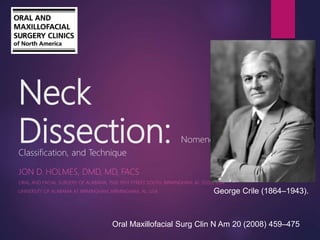
George Crile (1864–1943).
Outline:
1. Introduction
2. Lymph node levels: anatomy and nomenclature
3. Evolution of neck dissection in the management of
head and neck cancer
4. Classification of neck dissections
5. Technique
6. Sentinel node biopsy
7. Complications
8. Conclusion
9. References
Oral Maxillofacial Surg Clin N Am 20 (2008) 459–475
Introduction
 Unfortunately, approximately 40% of patients with oral
cancer will harbor cervical lymph node metastasis at
presentation
W.M. Mendenhall, R.R. Million, N.J. Cassisi Elective neck irradiation in squamous cell
carcinoma of the head and neck Head Neck Surg, 3 (1980), pp. 15–19
Introduction
 Removal of the at-risk lymphatic basins serves two
important purposes.
 First, it allows the removal and identification of occult
metastasis in patients in whom cervical metastasis are a
risk, - Elective neck dissection.
 Secondly, it allows the removal of disease in patients in
whom metastasis are highly suspected based on imaging,
clinical examination or fine needle aspiration, -
Therapeutic neck dissection.
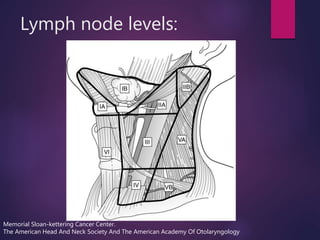
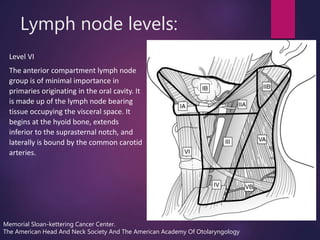
Lymph node levels:
Memorial Sloan-kettering Cancer Center.
The American Head And Neck Society And The American Academy Of Otolaryngology
Lymph node levels:
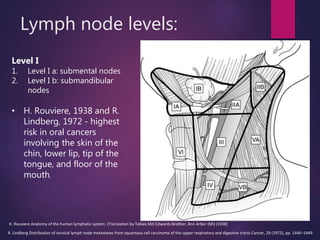
Level I
1. Level I a: submental nodes
2. Level I b: submandibular
nodes
• H. Rouviere, 1938 and R.
Lindberg, 1972 - highest
risk in oral cancers
involving the skin of the
chin, lower lip, tip of the
tongue, and floor of the
mouth.
H. Rouviere Anatomy of the human lymphatic system. (Translation by Tobies MJ) Edwards Brother, Ann Arbor (MI) (1938)
R. Lindberg Distribution of cervical lymph node metastases from squamous cell carcinoma of the upper respiratory and digestive tracts Cancer, 29 (1972), pp. 1446–1449
Lymph node levels:
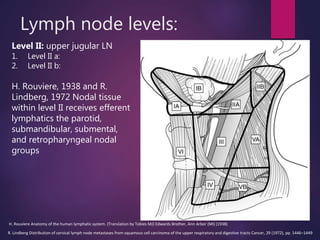
Level II: upper jugular LN
1. Level II a:
2. Level II b:
H. Rouviere, 1938 and R.
Lindberg, 1972 Nodal tissue
within level II receives efferent
lymphatics the parotid,
submandibular, submental,
and retropharyngeal nodal
groups
H. Rouviere Anatomy of the human lymphatic system. (Translation by Tobies MJ) Edwards Brother, Ann Arbor (MI) (1938)
R. Lindberg Distribution of cervical lymph node metastases from squamous cell carcinoma of the upper respiratory and digestive tracts Cancer, 29 (1972), pp. 1446–1449
Lymph node levels:
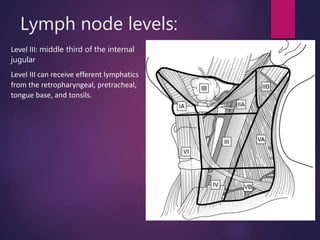
Level III: middle third of the internal
jugular
Level III can receive efferent lymphatics
from the retropharyngeal, pretracheal,
tongue base, and tonsils.
Lymph node levels:
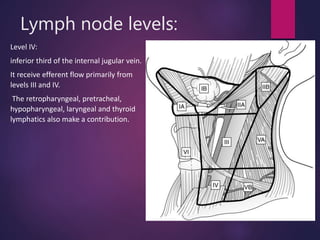
Level IV:
inferior third of the internal jugular vein.
It receive efferent flow primarily from
levels III and IV.
The retropharyngeal, pretracheal,
hypopharyngeal, laryngeal and thyroid
lymphatics also make a contribution.
Lymph node levels:
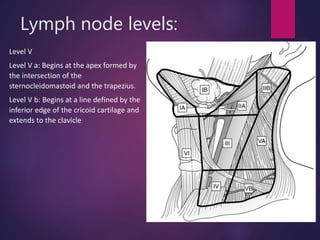
Level V
Level V a: Begins at the apex formed by
the intersection of the
sternocleidomastoid and the trapezius.
Level V b: Begins at a line defined by the
inferior edge of the cricoid cartilage and
extends to the clavicle
Lymph node levels:
Memorial Sloan-kettering Cancer Center.
The American Head And Neck Society And The American Academy Of Otolaryngology
Level VI
The anterior compartment lymph node
group is of minimal importance in
primaries originating in the oral cavity. It
is made up of the lymph node bearing
tissue occupying the visceral space. It
begins at the hyoid bone, extends
inferior to the suprasternal notch, and
laterally is bound by the common carotid
arteries.
EVOLUTION OF NECK
DISSECTION
Evolution of neck dissection
 Chelius and Kocher - seperately recommended
removal of regional lymph nodes in the treatment of H
& N cancer in the mid-nineteenth century
 George Crile – Receives credit for his systematic
description of management of cervical lymphatics in H
& N cancer
 1905 - The Transactions of the Southern Surgical and
Gynecological Association and
 1906 - JAMA.
J.P. Shah Foreward J. Gavilan, J. Herranz, L.W. DeSanto (Eds.), Functional and neck dissection, Thieme, New York (2002), p. vii
Evolution of neck dissection
 Crile was strongly influenced by Halsted's work in
breast cancer.
 Although Crile suggested in his early publications that
the spinal accessory nerve could be preserved if not
directly involved with cancer,
 Later surgeons recommended its removal in all cases.
[G.W. Crile Excision of cancer of the head and neck with special reference to the plan of dissection based upon one hundred thirty-
two operations JAMA, 47 (1906), pp. 1780–1786
G.W. Crile On the surgical treatment of cancer of the head and neck Transactions Southern Surgical Gynecological Association, 18
(1905), pp. 109–127
G.W. Crile Carcinoma of the jaws, tongue, cheek and lips Surg Gynecol Obstet, 36 (1923), pp. 159–162
Evolution of neck dissection
 Martin and colleagues stated that any attempt to
preserve the spinal accessory nerve should be
“condemned unequivocally.” Other structures, such as
the submandibular gland were also preserved in some
cases presented by Crile
 Martin in 1951 summarized his indications, technique,
and outcomes with the radical neck dissection
H. Martin, B. Delvalle, H. Ehrlich, et al. Neck dissection Cancer, 4 (1951), pp. 441–499
Evolution of neck dissection
 In 1967, Bocca and Gavilian, Following technique of
“functional neck dissection” which preserved non-
lymphatic cervical structures, and in cases without
direct involvement, the submandibular gland, thereby
sparing morbidity without sacrificing loco-regional
control.
C.V. Calearo, G. Teatini Functional neck dissection: anatomical grounds, surgical technique clinical observations Ann Otol Rhinol
Laryngol, 92 (1983), pp. 215–222
E. Bocca Supraglottic laryngectomy and functional neck dissection J Laryngol Otol, 80 (1966), pp. 831–838
J. Gavilan, A. Monux, J. Herranz, et al.Functional neck dissection: surgical technique Operative Techniques in Otolaryngology-Head
and Neck Surgery, 4 (1993), pp. 258–265
Evolution of neck dissection
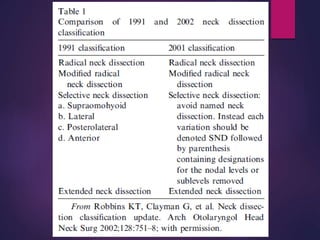
 Terminology of neck dissection was standardized by
the American Academy of Otolaryngology's
Committee for Head and Neck Surgery and Oncology
in 1991
 An update, published in 2002
K.T. Robbins, J.E. Medina, G.T. Wolfe, et al. Standardizing neck dissection terminology. Official report of the Academy's Committee
for Head and Neck Surgery and Oncology Arch Otolaryngol Head Neck Surg, 117 (1991), pp. 601–605
K.T. Robbins, G. Clayman, P.A. Levine, et al. Neck dissection classification update Arch Otolaryngol Head Neck Surg, 128 (2002), pp.
751–758
Classification of neck
dissections
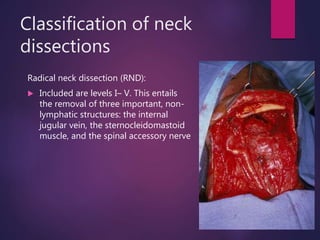
Radical neck dissection (RND):
 Included are levels I– V. This entails
the removal of three important, non-
lymphatic structures: the internal
jugular vein, the sternocleidomastoid
muscle, and the spinal accessory nerve
Classification of neck
dissections
Modified radical neck dissection (MRND):
 three types:
 type I preserves the spinal accessory nerve;
 type II preserves the spinal accessory nerve and the
sternocleidomastoid muscle; and
 type III preserves the spinal accessory nerve, the
sternocleidomastoid muscle, and the internal jugular
vein;
Classification of neck
dissections
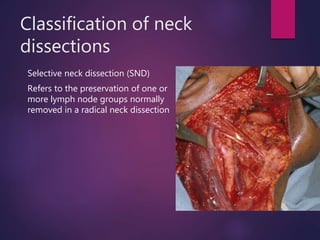
Selective neck dissection (SND)
Refers to the preservation of one or
more lymph node groups normally
removed in a radical neck dissection
Classification of neck
dissections
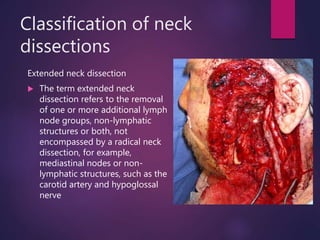
Extended neck dissection
 The term extended neck
dissection refers to the removal
of one or more additional lymph
node groups, non-lymphatic
structures or both, not
encompassed by a radical neck
dissection, for example,
mediastinal nodes or non-
lymphatic structures, such as the
carotid artery and hypoglossal
nerve
Technique
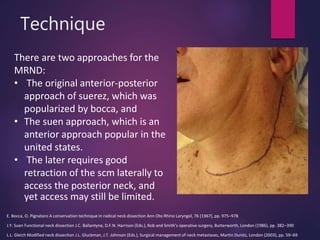
There are two approaches for the
MRND:
• The original anterior-posterior
approach of suerez, which was
popularized by bocca, and
• The suen approach, which is an
anterior approach popular in the
united states.
• The later requires good
retraction of the scm laterally to
access the posterior neck, and
yet access may still be limited.
E. Bocca, O. Pignataro A conservation technique in radical neck dissection Ann Oto Rhino Laryngol, 76 (1967), pp. 975–978
J.Y. Suen Functional neck dissection J.C. Ballantyne, D.F.N. Harrison (Eds.), Rob and Smith's operative surgery, Butterworth, London (1986), pp. 382–390
L.L. Gleich Modified neck dissection J.L. Gluckman, J.T. Johnson (Eds.), Surgical management of neck metastases, Martin Dunitz, London (2003), pp. 59–69
Technique
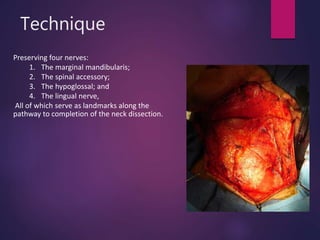
Preserving four nerves:
1. The marginal mandibularis;
2. The spinal accessory;
3. The hypoglossal; and
4. The lingual nerve,
All of which serve as landmarks along the
pathway to completion of the neck dissection.
Technique
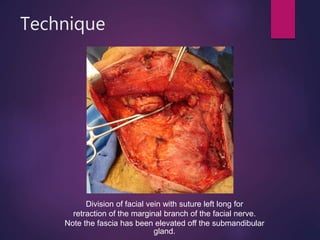
Division of facial vein with suture left long for
retraction of the marginal branch of the facial nerve.
Note the fascia has been elevated off the submandibular
gland.
Technique
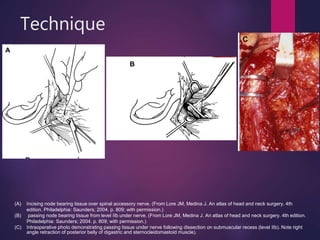
(A) Incising node bearing tissue over spinal accessory nerve. (From Lore JM, Medina J. An atlas of head and neck surgery. 4th
edition. Philadelphia: Saunders; 2004. p. 809; with permission.)
(B) passing node bearing tissue from level IIb under nerve. (From Lore JM, Medina J. An atlas of head and neck surgery. 4th edition.
Philadelphia: Saunders; 2004. p. 809; with permission.)
(C) Intraoperative photo demonstrating passing tissue under nerve following dissection on submuscular recess (level IIb). Note right
angle retraction of posterior belly of digastric and sternocleidomastoid muscle).
Technique
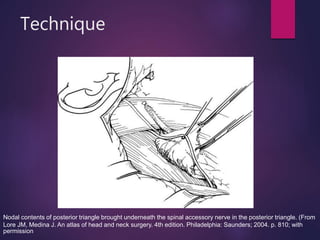
Nodal contents of posterior triangle brought underneath the spinal accessory nerve in the posterior triangle. (From
Lore JM, Medina J. An atlas of head and neck surgery. 4th edition. Philadelphia: Saunders; 2004. p. 810; with
permission
Technique
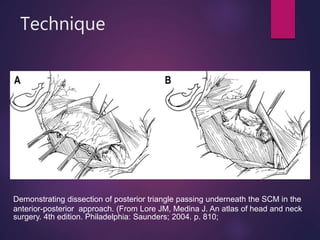
Demonstrating dissection of posterior triangle passing underneath the SCM in the
anterior-posterior approach. (From Lore JM, Medina J. An atlas of head and neck
surgery. 4th edition. Philadelphia: Saunders; 2004. p. 810;
Technique
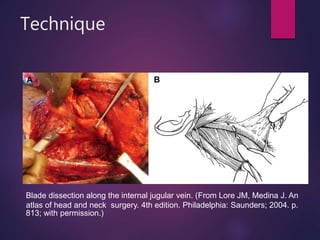
Blade dissection along the internal jugular vein. (From Lore JM, Medina J. An
atlas of head and neck surgery. 4th edition. Philadelphia: Saunders; 2004. p.
813; with permission.)
Technique
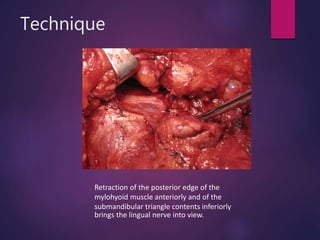
Retraction of the posterior edge of the
mylohyoid muscle anteriorly and of the
submandibular triangle contents inferiorly
brings the lingual nerve into view.
Technique
Sentinel node biopsy
 The sentinel node technique, first popularized for
melanoma.
 It allows the identification and removal of the lymph
node (“sentinel node”) that would first receive
metastases from a given site.
 D.N. Krag et al in 1995 and L.F. Glass et al in 1996, In
melanoma, sentinel node biopsy has a reported
sensitivity of 82%–100%, and very few false negatives
D.L. Morton, D.R. Wen, J.H. Wong, et al. Technical details of intraoperative lymphatic mapping for early stage melanoma Arch Surg, 127 (1992), pp. 392–399
D.L. Morton, D.R. Wen, L.J. Foshag, et al. Intraoperative lymphatic mapping and selective cervical lymphadenectomy for early stage melanomas of the head
and neck J Clin Oncol, 11 (1993), pp. 1751–1756
D.N. Krag, S.J. Meijer, D.L. Weaver, et al. Minimal access surgery for staging of malignant melanoma Arch Surg, 130 (1995), p. 654–658
L.F. Glass, J.L. Messina, W. Cruse, et al. The use of intraoperative radiolymphoscintigraphy for sentinel node biopsy in patients with malignant
melanoma Dermatol Surg, 22 (1996), pp. 715–720
Sentinel node biopsy
 Problems with applying the sentinel node
technique to the oral cavity relate to
1. The rich lymphatic drainage pattern with possible
bilateral drainage, and
2. The complex anatomy in the cervical region.
Sentinel node biopsy
 In the future, the SNB as the ultimate evolution of
selective neck dissection may become the operative
procedure of choice for dealing with the N0 neck.
 Pitman and her colleagues concluded, that SNB
remains an experimental technique in head and neck
cancers and has not become a standard of care
K.T. Pitman, A. Ferlito, K.O. Devaney, et al. Sentinal lymph node biopsy in head and neck cancer Oral Oncol, 39 (2003), pp.
343–349
Complications
 Neurologic injury
 Vascular injury
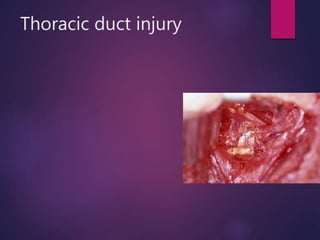
 Thoracic duct injury (chyle leak)
 Wound infection.
Neurologic injury
1. Spinal accessory nerve
2. Facial nerve
3. Hypoglossal nerve
4. Phrenic nerve
5. Brachial plexus injury
6. Cervical sympathetic trunk
7. Vagus nerve
8. Lingual nerve
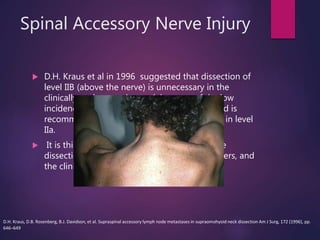
Spinal Accessory Nerve Injury
 D.H. Kraus et al in 1996 suggested that dissection of
level IIB (above the nerve) is unnecessary in the
clinically node-negative neck because of the low
incidence of metastases in this area (1.6%), and is
recommended only if bulky disease is present in level
IIa.
 It is this author's practice to exclude extensive
dissection of this area in most oral cavity cancers, and
the clinically N0 neck.
D.H. Kraus, D.B. Rosenberg, B.J. Davidson, et al. Supraspinal accessory lymph node metastases in supraomohyoid neck dissection Am J Surg, 172 (1996), pp.
646–649
facial nerve injury
1. Marginal mandibular branch – more common
2. cervicofacial division
3. main trunk
 Injury recognized intraoperatively or in the early
postoperative period should be repaired
Hypoglossal nerve injury
 In addition, bulky nodal disease in the area can lead to
nerve transection while trying to obtain adequate
margins.
 Immediate repair can be considered, but results are
unsatisfying in most cases.
 Fortunately, unilateral injury to the hypoglossal nerve
is fairly well tolerated by most patients
Phrenic nerve injury
 A.A. de Jong et al in 1991, incidence is as high as 8%
 Incidence in modified and selective neck dissections is
much lower .
 Injury is usually manifested by elevation of the hemi-
diaphragm noted on postoperative chest radiographs;
bilateral injury can lead to respiratory failure.
A.A. de Jong, J.J. Manni Phrenic nerve paralysis following neck dissection Eur Arch Otorhinolaryngol, 248 (1991), pp. 132–134
Brachial plexus injury
 Injury to the brachial plexus can similarly occur when
dissection is inadvertently performed deep to the
prevertebral fascia low in the neck.
 It is a devastating injury, and early recognition should
lead to appropriate consultation and consideration of
repair
Cervical Sympathetic Trunk Injury
 Horner's syndrome (ie, ptosis, miosis, and anhydrosis)
results from injury to the cervical sympathetic trunk,
which lies posterior to the carotid sheath.
Vagus nerve injury
 Damage results in unilateral vocal cord paralysis, which
is manifested by a “breathy,” weak voice.
 If the injury is high in the neck before the branch of
the superior laryngeal nerve, then laryngeal sensation
is impaired and aspiration becomes a risk.
 Vocal cord augmentation or medialization procedures
may be helpful
Lingual Nerve Injury
 This is especially true when the lingual nerve has been
mobilized aggressively during the extirpation of the
primary.
 In addition, blind clamping of lingual vessels can lead
to its injury.
 The attachments between the nerve and
submandibular gland should be carefully transected
while keeping the nerve in view.
Vascular injury
 Intraoperative
1. Carotid sinus sensitivity
2. Vessels laceratins
3. Thorasic duct injury
 Late
1. Post operative hemorrhage
Carotid sinus sensitivity
 Results from manipulation of the carotid body,
 typically manifests as acute bradycardia and decreased
cardiac output.
 Atropine
 small amount (<1 cc) of plain 1% lidocaine
Intraoperative hemorrhage
 This can make the dissection much more tedious,
leading to injury and ligation of unintended vessels,
such as the internal carotid artery.
 Laceration of the common or internal carotid arteries
should be promptly repaired if a preoperative
assessment to establish the presence of collateral
cerebral circulation (carotid occlusion test) has not
been done
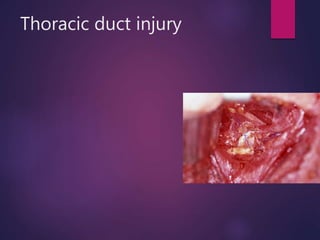
Thoracic duct injury
Late vascular complications
Carotid Blowout
 Loss of free tissue transfers with avulsion of the arterial
pedicle can also result in late hemorrhage.
 Leaving failed flaps in place for a period of time,
caution should be exercised as the vascular pedicle can
break down resulting in significant haemorrhage.
M.J. Wheatley, T.R. Meltzer The management of unsalvageable free flaps J Reconstr Microsurg, 12 (1996), pp. 227–229
Late vascular complications
Prevention strategies include:
1. appropriate use of prophylactic antibiotics;
2. importation of vascularized tissue in compromised
situations; and
3. optimization of the patient's ability to heal
through careful handling of tissues, maximizing
nutrition, and confirming adequate thyroid
function in the previously irradiated patient.
M.J. Wheatley, T.R. Meltzer The management of unsalvageable free flaps J Reconstr Microsurg, 12 (1996), pp. 227–229
Wound infection
 Several well-controlled studies have demonstrated that
antibiotics started before the incision and continued for
no more that 24 hours serve to minimize perioperative
infections and the emergence of resistant strains.
 Continuation beyond 24 hours should be considered in
patients at increased risk or those with ongoing
contamination.
 First generation cephalosporins and clindamycin
represent the most commonly used prophylactic
antibiotics in oral cancer surgery.
 Topical antimicrobials, such as chlorhexidine and
clindamycin rinses, have also been shown to successfully
reduce the incidence of infections.
G.D. Becker, G.J. Parell Cefazolin prophylaxis in head and neck cancer surgery Ann Otol Rhinol Laryngol, 88 (1979), pp. 183–186
G. Mombelli, L. Coppens, P. Dor, et al. Antibiotic prophylaxis in surgery for head and neck cancer: comparative study of short and prolonged administration of
carbencillin J Antimicrob Chemother, 7 (1981), pp. 665–671
Summary
 Surgical management of cervical lymph node
metastasis, both occult and evident, continues to
evolve. It is clear that metastases are an indication of
aggressiveness, and that they portend a poorer
prognosis.
 Blake Cady MD, FACS referred to “lymph node
metastases as the speedometers of the oncologic
vehicle, not the engine. Indicators, not governors of
survival”
 the role for the radical neck dissection has diminished
greatly as less invasive surgical techniques for dealing
with the cervical lymphatics have gained popularity.
References
[1] W.M. Mendenhall, R.R. Million, N.J. Cassisi Elective neck irradiation in squamous cell carcinoma of the head and neck Head Neck Surg, 3
(1980), pp. 15–19
[2] E.R. Carlson, I. Miller Surgical management of the neck in oral cancer Oral Maxillofac Surg Clin North Am, 18 (2006), pp. 533–546
[3] H. Rouviere Anatomy of the human lymphatic system. (Translation by Tobies MJ) Edwards Brother, Ann Arbor (MI) (1938)
[4] R. Lindberg Distribution of cervical lymph node metastases from squamous cell carcinoma of the upper respiratory and digestive tracts
Cancer, 29 (1972), pp. 1446–1449
[5] P. Strauli The lymphatic system and cancer localization R.W. Wiser, Tl Ado, S. Wood (Eds.), Endogenous factors influencing host-tumor
balance, University of Chicago Press, Chicago (1967), pp. 249–254
[6] K.T. Robbins, J.L. Atkinson, R.M. Byers, et al. The use and misuse of neck dissection for head and neck cancer J Am Coll Surg, 193 (2001), pp.
91–102
[7] H.C. Pillsbury, M. Clark A rationale for therapy of the N0 neck. Joseph H. Ogura Lecture Laryngoscope, 107 (1997), pp. 1294–1315
[8] K.T. Robbins, G. Clayman, P.A. Levine, et al. Neck dissection classification update Arch Otolaryngol Head Neck Surg, 128 (2002), pp. 751–758
[9] J.P. Shah Foreward J. Gavilan, J. Herranz, L.W. DeSanto (Eds.), Functional and neck dissection, Thieme, New York (2002), p. vii
[10] G.W. Crile Excision of cancer of the head and neck with special reference to the plan of dissection based upon one hundred thirty-two
operations JAMA, 47 (1906), pp. 1780–1786
[11] G.W. Crile On the surgical treatment of cancer of the head and neck Transactions Southern Surgical Gynecological Association, 18 (1905), pp.
109–127
[12] G.W. Crile Carcinoma of the jaws, tongue, cheek and lips Surg Gynecol Obstet, 36 (1923), pp. 159–162
[13] H. Martin, B. Delvalle, H. Ehrlich, et al. Neck dissection Cancer, 4 (1951), pp. 441–499
[14] G.E. Ward, J.O. Robben A composite operation for radical neck dissection and removal of cancer of the mouth Cancer, 4 (1951), pp. 98–109
[15] C.V. Calearo, G. Teatini Functional neck dissection: anatomical grounds, surgical technique clinical observations Ann Otol Rhinol Laryngol, 92
(1983), pp. 215–222
References
[16] E. Bocca Supraglottic laryngectomy and functional neck dissection J Laryngol Otol, 80 (1966), pp. 831–838
[17] J. Gavilan, A. Monux, J. Herranz, et al.Functional neck dissection: surgical technique Operative Techniques in Otolaryngology-Head and Neck
Surgery, 4 (1993), pp. 258–265
[18] O. Suarez El problema de las metastasis linfaticas y alejades del cancer de laringe e hipofaringe Rev Otorrinolaringol Santiago, 23 (1963), pp.
83–99
[19] K.T. Robbins, J.E. Medina, G.T. Wolfe, et al. Standardizing neck dissection terminology. Official report of the Academy's Committee for Head
and Neck Surgery and Oncology Arch Otolaryngol Head Neck Surg, 117 (1991), pp. 601–605
[20] J.E. Medina A rational classification of neck dissections Otolaryngol Head Neck Surg, 100 (1989), pp. 169–176
[21] J.P. Shah, F.C. Candela, A.K. Poddar The patterns of cervical lymph node metastases from squamous cell carcinoma of the oral cavity Cancer,
66 (1990), pp. 109–113
[22] R.H. Spiro, E.W. Strong Discontinuous partial glossectomy and radical neck dissection in selected patients with epidermoid carcinoma of the
mobile tongue Am J Surg, 126 (1973), pp. 544–546
[23] C.R. Leemans, R. Tiwari, J.J. Nauta, et al. Discontinuous versus in-continuity neck dissection in carcinoma of the oral cavity Arch Otolaryngol
Head Neck Surg, 117 (1991), pp. 1003–1006
[24] J.P. Shah Head and neck surgery and oncology (3rd edition)Elsivier, New York (2003)
[25] D. Kademani, E.J. Dierks A straight-line incision for neck dissection: technical note J Oral Maxillofac Surg, 63 (2005), pp. 563–565
[26] E. Bocca, O. Pignataro A conservation technique in radical neck dissection Ann Oto Rhino Laryngol, 76 (1967), pp. 975–978
[27] J.Y. Suen Functional neck dissection J.C. Ballantyne, D.F.N. Harrison (Eds.), Rob and Smith's operative surgery, Butterworth, London (1986), pp.
382–390
[28] L.L. Gleich Modified neck dissection J.L. Gluckman, J.T. Johnson (Eds.), Surgical management of neck metastases, Martin Dunitz, London
(2003), pp. 59–69
[29] J. Yoel, C.A. Linares The Schobinger incision: Its advantages in radical neck dissections Am J Surg, 108 (1964), pp. 526–528
[30] J.E. Medina, J.M. Loré The neck J.M. Loré, J.E. Medina (Eds.), An atlas of head and neck surgery (4th edition. Chapter 24), Elsevier, Philadelphia
(2005), p. 804
References
[31] R.M. Byers, R.S. Weber, T. Andrews, et al. Frequency and therapeutic implications of “skip metastasis” in the neck from squamous carcinoma
of the tongue Head Neck, 19 (1997), pp. 14–19
[32] J.P. Shah, F.C. Candela, A.K. Poddar The pattern of cervical lymph node metastases from squamous carcinoma of the oral cavity Cancer, 66
(1990), pp. 109–113
[33] D.L. Morton, D.R. Wen, J.H. Wong, et al. Technical details of intraoperative lymphatic mapping for early stage melanoma Arch Surg, 127
(1992), pp. 392–399
[34] D.L. Morton, D.R. Wen, L.J. Foshag, et al. Intraoperative lymphatic mapping and selective cervical lymphadenectomy for early stage
melanomas of the head and neck J Clin Oncol, 11 (1993), pp. 1751–1756
[35] T.D. Schellenberger Sentinal lymph node biopsy in the staging of oral cancer Oral Maxillofac Surg Clin North Am, 18 (2006), pp. 547–563
[36] D.N. Krag, S.J. Meijer, D.L. Weaver, et al. Minimal access surgery for staging of malignant melanoma Arch Surg, 130 (1995), pp. 654–658
[37] L.F. Glass, J.L. Messina, W. Cruse, et al. The use of intraoperative radiolymphoscintigraphy for sentinel node biopsy in patients with malignant
melanoma Dermatol Surg, 22 (1996), pp. 715–720
[38] F.J. Civantos, C. Gomez, C. Duque, et al. Sentinal node biopsy in oral cavity cancer: correlation with PET scan and immunohistochemistry Head
Neck, 25 (2003), pp. 1–9
[39] K.T. Pitman, J.T. Johnson, M.L. Brown, et al. Sentinal lymph node biopsy in head and neck squamous cell carcinoma Laryngoscope, 112 (2002),
pp. 2101–2113 Am, 18 (2006), pp. 547–563
[36] D.N. Krag, S.J. Meijer, D.L. Weaver, et al. Minimal access surgery for staging of malignant melanoma Arch Surg, 130 (1995), pp. 654–658
[37] L.F. Glass, J.L. Messina, W. Cruse, et al. The use of intraoperative radiolymphoscintigraphy for sentinel node biopsy in patients with malignant
melanoma Dermatol Surg, 22 (1996), pp. 715–720
[38] F.J. Civantos, C. Gomez, C. Duque, et al. Sentinal node biopsy in oral cavity cancer: correlation with PET scan and immunohistochemistry Head
Neck, 25 (2003), pp. 1–9
[39] K.T. Pitman, J.T. Johnson, M.L. Brown, et al. Sentinal lymph node biopsy in head and neck squamous cell carcinoma Laryngoscope, 112 (2002),
pp. 2101–2113
References
[[40] N.C. Hyde, E. Prvulovich, L. Newman, et al. A new approach to pre-treatment assessment of the N0 neck in oral squamous cell carcinoma: the
role of sentinel node biopsy and positron emission tomography Oral Oncol, 39 (2003), pp. 350–360
[41] K.T. Pitman, A. Ferlito, K.O. Devaney, et al. Sentinal lymph node biopsy in head and neck cancer Oral Oncol, 39 (2003), pp. 343–349
[42] P.E. Anderson, F. Warren, J. Spiro, et al. Results of selective neck dissection in management of the node positive neck Arch Otolaryngol Head
Neck Surg, 128 (2002), pp. 1180–1184
[43] S.A. McHam, D.J. Adelstein, L.A. Rybicki, et al. Who merits a neck dissection after definitive chemoradiotherapy for N2-N3 sqaumous cell head
and neck cancer? Head Neck, 25 (2003), pp. 791–797
[44] D.H. Kraus, D.B. Rosenberg, B.J. Davidson, et al. Supraspinal accessory lymph node metastases in supraomohyoid neck dissection Am J Surg,
172 (1996), pp. 646–649
[45] A.A. de Jong, J.J. Manni Phrenic nerve paralysis following neck dissection Eur Arch Otorhinolaryngol, 248 (1991), pp. 132–134
[46] R.W. Babin, W.R. Panje The incidence of vasovagal reflex activity during radical neck dissection
Laryngoscope, 90 (1980), pp. 1321–1323
[47] M.J. Wheatley, T.R. Meltzer The management of unsalvageable free flaps J Reconstr Microsurg, 12 (1996), pp. 227–229
[48] G.D. Becker, G.J. Parell Cefazolin prophylaxis in head and neck cancer surgery Ann Otol Rhinol Laryngol, 88 (1979), pp. 183–186
[49] G. Mombelli, L. Coppens, P. Dor, et al. Antibiotic prophylaxis in surgery for head and neck cancer: comparative study of short and prolonged
administration of carbencillin J Antimicrob Chemother, 7 (1981), pp. 665–671
[50] B. Cady Lymph node metastases: indicators but not governors of survival Arch Surg, 119 (1984), pp. 1067–1072
[51] A. Ferlito, A. Rinaldo, K.T. Robbins, et al. Changing concepts in the surgical management of cervical node metastasis Oral Oncol, 39 (2003), pp.
429–435
[52] L.P. Kowalski, J. Magrin, F. Waksman, et al. Supraomohyoid neck dissection in the treatment of head and neck tumors: survival results in 212
cases Arch Otolaryngol Head Neck Surg, 119 (1993), pp. 958–963
[53] G.E. Ghali, B.D.L. Li, E.A. Minnard Management of the neck relative to oral malignancy Selected Readings in Oral and Maxillofacial Surgery, 6 (2)
(1998), pp. 1–36
Thank you

Neck Dissection: Nomenclature, Classification, and Technique

  • 1.
  • 2.
    Journal club presentation DEPARTMENTOF ORAL & MAXILLOFACIAL SURGERY PRESENTED BY: DR. KAMINI DASENA
  • 3.
    Journal club presentation DEPARTMENTOF ORAL & MAXILLOFACIAL SURGERY GUIDED BY: DR. RAMNIK SINGH MADAN DR. VINAY KHARSAN DR. AKSHAY DAGA DR. ABHISHEK BALANI DR. SUMIT TIWARI DR. GAZAL PARVEEN
  • 4.
    Neck Dissection: Nomenclature, Classification, andTechnique JON D. HOLMES, DMD, MD, FACS ORAL AND FACIAL SURGERY OF ALABAMA, 1500 19TH STREET SOUTH, BIRMINGHAM, AL 35205, USA UNIVERSITY OF ALABAMA AT BIRMINGHAM, BIRMINGHAM, AL, USA Oral Maxillofacial Surg Clin N Am 20 (2008) 459–475 George Crile (1864–1943).
  • 5.
    Outline: 1. Introduction 2. Lymphnode levels: anatomy and nomenclature 3. Evolution of neck dissection in the management of head and neck cancer 4. Classification of neck dissections 5. Technique 6. Sentinel node biopsy 7. Complications 8. Conclusion 9. References Oral Maxillofacial Surg Clin N Am 20 (2008) 459–475
  • 6.
    Introduction  Unfortunately, approximately40% of patients with oral cancer will harbor cervical lymph node metastasis at presentation W.M. Mendenhall, R.R. Million, N.J. Cassisi Elective neck irradiation in squamous cell carcinoma of the head and neck Head Neck Surg, 3 (1980), pp. 15–19
  • 7.
    Introduction  Removal ofthe at-risk lymphatic basins serves two important purposes.  First, it allows the removal and identification of occult metastasis in patients in whom cervical metastasis are a risk, - Elective neck dissection.  Secondly, it allows the removal of disease in patients in whom metastasis are highly suspected based on imaging, clinical examination or fine needle aspiration, - Therapeutic neck dissection.
  • 8.
    Lymph node levels: MemorialSloan-kettering Cancer Center. The American Head And Neck Society And The American Academy Of Otolaryngology
  • 9.
    Lymph node levels: LevelI 1. Level I a: submental nodes 2. Level I b: submandibular nodes • H. Rouviere, 1938 and R. Lindberg, 1972 - highest risk in oral cancers involving the skin of the chin, lower lip, tip of the tongue, and floor of the mouth. H. Rouviere Anatomy of the human lymphatic system. (Translation by Tobies MJ) Edwards Brother, Ann Arbor (MI) (1938) R. Lindberg Distribution of cervical lymph node metastases from squamous cell carcinoma of the upper respiratory and digestive tracts Cancer, 29 (1972), pp. 1446–1449
  • 10.
    Lymph node levels: LevelII: upper jugular LN 1. Level II a: 2. Level II b: H. Rouviere, 1938 and R. Lindberg, 1972 Nodal tissue within level II receives efferent lymphatics the parotid, submandibular, submental, and retropharyngeal nodal groups H. Rouviere Anatomy of the human lymphatic system. (Translation by Tobies MJ) Edwards Brother, Ann Arbor (MI) (1938) R. Lindberg Distribution of cervical lymph node metastases from squamous cell carcinoma of the upper respiratory and digestive tracts Cancer, 29 (1972), pp. 1446–1449
  • 11.
    Lymph node levels: LevelIII: middle third of the internal jugular Level III can receive efferent lymphatics from the retropharyngeal, pretracheal, tongue base, and tonsils.
  • 12.
    Lymph node levels: LevelIV: inferior third of the internal jugular vein. It receive efferent flow primarily from levels III and IV. The retropharyngeal, pretracheal, hypopharyngeal, laryngeal and thyroid lymphatics also make a contribution.
  • 13.
    Lymph node levels: LevelV Level V a: Begins at the apex formed by the intersection of the sternocleidomastoid and the trapezius. Level V b: Begins at a line defined by the inferior edge of the cricoid cartilage and extends to the clavicle
  • 14.
    Lymph node levels: MemorialSloan-kettering Cancer Center. The American Head And Neck Society And The American Academy Of Otolaryngology Level VI The anterior compartment lymph node group is of minimal importance in primaries originating in the oral cavity. It is made up of the lymph node bearing tissue occupying the visceral space. It begins at the hyoid bone, extends inferior to the suprasternal notch, and laterally is bound by the common carotid arteries.
  • 15.
  • 16.
    Evolution of neckdissection  Chelius and Kocher - seperately recommended removal of regional lymph nodes in the treatment of H & N cancer in the mid-nineteenth century  George Crile – Receives credit for his systematic description of management of cervical lymphatics in H & N cancer  1905 - The Transactions of the Southern Surgical and Gynecological Association and  1906 - JAMA. J.P. Shah Foreward J. Gavilan, J. Herranz, L.W. DeSanto (Eds.), Functional and neck dissection, Thieme, New York (2002), p. vii
  • 17.
    Evolution of neckdissection  Crile was strongly influenced by Halsted's work in breast cancer.  Although Crile suggested in his early publications that the spinal accessory nerve could be preserved if not directly involved with cancer,  Later surgeons recommended its removal in all cases. [G.W. Crile Excision of cancer of the head and neck with special reference to the plan of dissection based upon one hundred thirty- two operations JAMA, 47 (1906), pp. 1780–1786 G.W. Crile On the surgical treatment of cancer of the head and neck Transactions Southern Surgical Gynecological Association, 18 (1905), pp. 109–127 G.W. Crile Carcinoma of the jaws, tongue, cheek and lips Surg Gynecol Obstet, 36 (1923), pp. 159–162
  • 18.
    Evolution of neckdissection  Martin and colleagues stated that any attempt to preserve the spinal accessory nerve should be “condemned unequivocally.” Other structures, such as the submandibular gland were also preserved in some cases presented by Crile  Martin in 1951 summarized his indications, technique, and outcomes with the radical neck dissection H. Martin, B. Delvalle, H. Ehrlich, et al. Neck dissection Cancer, 4 (1951), pp. 441–499
  • 19.
    Evolution of neckdissection  In 1967, Bocca and Gavilian, Following technique of “functional neck dissection” which preserved non- lymphatic cervical structures, and in cases without direct involvement, the submandibular gland, thereby sparing morbidity without sacrificing loco-regional control. C.V. Calearo, G. Teatini Functional neck dissection: anatomical grounds, surgical technique clinical observations Ann Otol Rhinol Laryngol, 92 (1983), pp. 215–222 E. Bocca Supraglottic laryngectomy and functional neck dissection J Laryngol Otol, 80 (1966), pp. 831–838 J. Gavilan, A. Monux, J. Herranz, et al.Functional neck dissection: surgical technique Operative Techniques in Otolaryngology-Head and Neck Surgery, 4 (1993), pp. 258–265
  • 20.
    Evolution of neckdissection  Terminology of neck dissection was standardized by the American Academy of Otolaryngology's Committee for Head and Neck Surgery and Oncology in 1991  An update, published in 2002 K.T. Robbins, J.E. Medina, G.T. Wolfe, et al. Standardizing neck dissection terminology. Official report of the Academy's Committee for Head and Neck Surgery and Oncology Arch Otolaryngol Head Neck Surg, 117 (1991), pp. 601–605 K.T. Robbins, G. Clayman, P.A. Levine, et al. Neck dissection classification update Arch Otolaryngol Head Neck Surg, 128 (2002), pp. 751–758
  • 21.
    Classification of neck dissections Radicalneck dissection (RND):  Included are levels I– V. This entails the removal of three important, non- lymphatic structures: the internal jugular vein, the sternocleidomastoid muscle, and the spinal accessory nerve
  • 22.
    Classification of neck dissections Modifiedradical neck dissection (MRND):  three types:  type I preserves the spinal accessory nerve;  type II preserves the spinal accessory nerve and the sternocleidomastoid muscle; and  type III preserves the spinal accessory nerve, the sternocleidomastoid muscle, and the internal jugular vein;
  • 23.
    Classification of neck dissections Selectiveneck dissection (SND) Refers to the preservation of one or more lymph node groups normally removed in a radical neck dissection
  • 24.
    Classification of neck dissections Extendedneck dissection  The term extended neck dissection refers to the removal of one or more additional lymph node groups, non-lymphatic structures or both, not encompassed by a radical neck dissection, for example, mediastinal nodes or non- lymphatic structures, such as the carotid artery and hypoglossal nerve
  • 26.
    Technique There are twoapproaches for the MRND: • The original anterior-posterior approach of suerez, which was popularized by bocca, and • The suen approach, which is an anterior approach popular in the united states. • The later requires good retraction of the scm laterally to access the posterior neck, and yet access may still be limited. E. Bocca, O. Pignataro A conservation technique in radical neck dissection Ann Oto Rhino Laryngol, 76 (1967), pp. 975–978 J.Y. Suen Functional neck dissection J.C. Ballantyne, D.F.N. Harrison (Eds.), Rob and Smith's operative surgery, Butterworth, London (1986), pp. 382–390 L.L. Gleich Modified neck dissection J.L. Gluckman, J.T. Johnson (Eds.), Surgical management of neck metastases, Martin Dunitz, London (2003), pp. 59–69
  • 27.
    Technique Preserving four nerves: 1.The marginal mandibularis; 2. The spinal accessory; 3. The hypoglossal; and 4. The lingual nerve, All of which serve as landmarks along the pathway to completion of the neck dissection.
  • 28.
    Technique Division of facialvein with suture left long for retraction of the marginal branch of the facial nerve. Note the fascia has been elevated off the submandibular gland.
  • 29.
    Technique (A) Incising nodebearing tissue over spinal accessory nerve. (From Lore JM, Medina J. An atlas of head and neck surgery. 4th edition. Philadelphia: Saunders; 2004. p. 809; with permission.) (B) passing node bearing tissue from level IIb under nerve. (From Lore JM, Medina J. An atlas of head and neck surgery. 4th edition. Philadelphia: Saunders; 2004. p. 809; with permission.) (C) Intraoperative photo demonstrating passing tissue under nerve following dissection on submuscular recess (level IIb). Note right angle retraction of posterior belly of digastric and sternocleidomastoid muscle).
  • 30.
    Technique Nodal contents ofposterior triangle brought underneath the spinal accessory nerve in the posterior triangle. (From Lore JM, Medina J. An atlas of head and neck surgery. 4th edition. Philadelphia: Saunders; 2004. p. 810; with permission
  • 31.
    Technique Demonstrating dissection ofposterior triangle passing underneath the SCM in the anterior-posterior approach. (From Lore JM, Medina J. An atlas of head and neck surgery. 4th edition. Philadelphia: Saunders; 2004. p. 810;
  • 32.
    Technique Blade dissection alongthe internal jugular vein. (From Lore JM, Medina J. An atlas of head and neck surgery. 4th edition. Philadelphia: Saunders; 2004. p. 813; with permission.)
  • 33.
    Technique Retraction of theposterior edge of the mylohyoid muscle anteriorly and of the submandibular triangle contents inferiorly brings the lingual nerve into view.
  • 34.
  • 35.
    Sentinel node biopsy The sentinel node technique, first popularized for melanoma.  It allows the identification and removal of the lymph node (“sentinel node”) that would first receive metastases from a given site.  D.N. Krag et al in 1995 and L.F. Glass et al in 1996, In melanoma, sentinel node biopsy has a reported sensitivity of 82%–100%, and very few false negatives D.L. Morton, D.R. Wen, J.H. Wong, et al. Technical details of intraoperative lymphatic mapping for early stage melanoma Arch Surg, 127 (1992), pp. 392–399 D.L. Morton, D.R. Wen, L.J. Foshag, et al. Intraoperative lymphatic mapping and selective cervical lymphadenectomy for early stage melanomas of the head and neck J Clin Oncol, 11 (1993), pp. 1751–1756 D.N. Krag, S.J. Meijer, D.L. Weaver, et al. Minimal access surgery for staging of malignant melanoma Arch Surg, 130 (1995), p. 654–658 L.F. Glass, J.L. Messina, W. Cruse, et al. The use of intraoperative radiolymphoscintigraphy for sentinel node biopsy in patients with malignant melanoma Dermatol Surg, 22 (1996), pp. 715–720
  • 36.
    Sentinel node biopsy Problems with applying the sentinel node technique to the oral cavity relate to 1. The rich lymphatic drainage pattern with possible bilateral drainage, and 2. The complex anatomy in the cervical region.
  • 37.
    Sentinel node biopsy In the future, the SNB as the ultimate evolution of selective neck dissection may become the operative procedure of choice for dealing with the N0 neck.  Pitman and her colleagues concluded, that SNB remains an experimental technique in head and neck cancers and has not become a standard of care K.T. Pitman, A. Ferlito, K.O. Devaney, et al. Sentinal lymph node biopsy in head and neck cancer Oral Oncol, 39 (2003), pp. 343–349
  • 38.
    Complications  Neurologic injury Vascular injury  Thoracic duct injury (chyle leak)  Wound infection.
  • 39.
    Neurologic injury 1. Spinalaccessory nerve 2. Facial nerve 3. Hypoglossal nerve 4. Phrenic nerve 5. Brachial plexus injury 6. Cervical sympathetic trunk 7. Vagus nerve 8. Lingual nerve
  • 40.
    Spinal Accessory NerveInjury  D.H. Kraus et al in 1996 suggested that dissection of level IIB (above the nerve) is unnecessary in the clinically node-negative neck because of the low incidence of metastases in this area (1.6%), and is recommended only if bulky disease is present in level IIa.  It is this author's practice to exclude extensive dissection of this area in most oral cavity cancers, and the clinically N0 neck. D.H. Kraus, D.B. Rosenberg, B.J. Davidson, et al. Supraspinal accessory lymph node metastases in supraomohyoid neck dissection Am J Surg, 172 (1996), pp. 646–649
  • 41.
    facial nerve injury 1.Marginal mandibular branch – more common 2. cervicofacial division 3. main trunk  Injury recognized intraoperatively or in the early postoperative period should be repaired
  • 42.
    Hypoglossal nerve injury In addition, bulky nodal disease in the area can lead to nerve transection while trying to obtain adequate margins.  Immediate repair can be considered, but results are unsatisfying in most cases.  Fortunately, unilateral injury to the hypoglossal nerve is fairly well tolerated by most patients
  • 43.
    Phrenic nerve injury A.A. de Jong et al in 1991, incidence is as high as 8%  Incidence in modified and selective neck dissections is much lower .  Injury is usually manifested by elevation of the hemi- diaphragm noted on postoperative chest radiographs; bilateral injury can lead to respiratory failure. A.A. de Jong, J.J. Manni Phrenic nerve paralysis following neck dissection Eur Arch Otorhinolaryngol, 248 (1991), pp. 132–134
  • 44.
    Brachial plexus injury Injury to the brachial plexus can similarly occur when dissection is inadvertently performed deep to the prevertebral fascia low in the neck.  It is a devastating injury, and early recognition should lead to appropriate consultation and consideration of repair
  • 45.
    Cervical Sympathetic TrunkInjury  Horner's syndrome (ie, ptosis, miosis, and anhydrosis) results from injury to the cervical sympathetic trunk, which lies posterior to the carotid sheath.
  • 46.
    Vagus nerve injury Damage results in unilateral vocal cord paralysis, which is manifested by a “breathy,” weak voice.  If the injury is high in the neck before the branch of the superior laryngeal nerve, then laryngeal sensation is impaired and aspiration becomes a risk.  Vocal cord augmentation or medialization procedures may be helpful
  • 47.
    Lingual Nerve Injury This is especially true when the lingual nerve has been mobilized aggressively during the extirpation of the primary.  In addition, blind clamping of lingual vessels can lead to its injury.  The attachments between the nerve and submandibular gland should be carefully transected while keeping the nerve in view.
  • 48.
    Vascular injury  Intraoperative 1.Carotid sinus sensitivity 2. Vessels laceratins 3. Thorasic duct injury  Late 1. Post operative hemorrhage
  • 49.
    Carotid sinus sensitivity Results from manipulation of the carotid body,  typically manifests as acute bradycardia and decreased cardiac output.  Atropine  small amount (<1 cc) of plain 1% lidocaine
  • 50.
    Intraoperative hemorrhage  Thiscan make the dissection much more tedious, leading to injury and ligation of unintended vessels, such as the internal carotid artery.  Laceration of the common or internal carotid arteries should be promptly repaired if a preoperative assessment to establish the presence of collateral cerebral circulation (carotid occlusion test) has not been done
  • 51.
  • 52.
  • 53.
    Late vascular complications CarotidBlowout  Loss of free tissue transfers with avulsion of the arterial pedicle can also result in late hemorrhage.  Leaving failed flaps in place for a period of time, caution should be exercised as the vascular pedicle can break down resulting in significant haemorrhage. M.J. Wheatley, T.R. Meltzer The management of unsalvageable free flaps J Reconstr Microsurg, 12 (1996), pp. 227–229
  • 54.
    Late vascular complications Preventionstrategies include: 1. appropriate use of prophylactic antibiotics; 2. importation of vascularized tissue in compromised situations; and 3. optimization of the patient's ability to heal through careful handling of tissues, maximizing nutrition, and confirming adequate thyroid function in the previously irradiated patient. M.J. Wheatley, T.R. Meltzer The management of unsalvageable free flaps J Reconstr Microsurg, 12 (1996), pp. 227–229
  • 55.
    Wound infection  Severalwell-controlled studies have demonstrated that antibiotics started before the incision and continued for no more that 24 hours serve to minimize perioperative infections and the emergence of resistant strains.  Continuation beyond 24 hours should be considered in patients at increased risk or those with ongoing contamination.  First generation cephalosporins and clindamycin represent the most commonly used prophylactic antibiotics in oral cancer surgery.  Topical antimicrobials, such as chlorhexidine and clindamycin rinses, have also been shown to successfully reduce the incidence of infections. G.D. Becker, G.J. Parell Cefazolin prophylaxis in head and neck cancer surgery Ann Otol Rhinol Laryngol, 88 (1979), pp. 183–186 G. Mombelli, L. Coppens, P. Dor, et al. Antibiotic prophylaxis in surgery for head and neck cancer: comparative study of short and prolonged administration of carbencillin J Antimicrob Chemother, 7 (1981), pp. 665–671
  • 56.
    Summary  Surgical managementof cervical lymph node metastasis, both occult and evident, continues to evolve. It is clear that metastases are an indication of aggressiveness, and that they portend a poorer prognosis.  Blake Cady MD, FACS referred to “lymph node metastases as the speedometers of the oncologic vehicle, not the engine. Indicators, not governors of survival”  the role for the radical neck dissection has diminished greatly as less invasive surgical techniques for dealing with the cervical lymphatics have gained popularity.
  • 57.
    References [1] W.M. Mendenhall,R.R. Million, N.J. Cassisi Elective neck irradiation in squamous cell carcinoma of the head and neck Head Neck Surg, 3 (1980), pp. 15–19 [2] E.R. Carlson, I. Miller Surgical management of the neck in oral cancer Oral Maxillofac Surg Clin North Am, 18 (2006), pp. 533–546 [3] H. Rouviere Anatomy of the human lymphatic system. (Translation by Tobies MJ) Edwards Brother, Ann Arbor (MI) (1938) [4] R. Lindberg Distribution of cervical lymph node metastases from squamous cell carcinoma of the upper respiratory and digestive tracts Cancer, 29 (1972), pp. 1446–1449 [5] P. Strauli The lymphatic system and cancer localization R.W. Wiser, Tl Ado, S. Wood (Eds.), Endogenous factors influencing host-tumor balance, University of Chicago Press, Chicago (1967), pp. 249–254 [6] K.T. Robbins, J.L. Atkinson, R.M. Byers, et al. The use and misuse of neck dissection for head and neck cancer J Am Coll Surg, 193 (2001), pp. 91–102 [7] H.C. Pillsbury, M. Clark A rationale for therapy of the N0 neck. Joseph H. Ogura Lecture Laryngoscope, 107 (1997), pp. 1294–1315 [8] K.T. Robbins, G. Clayman, P.A. Levine, et al. Neck dissection classification update Arch Otolaryngol Head Neck Surg, 128 (2002), pp. 751–758 [9] J.P. Shah Foreward J. Gavilan, J. Herranz, L.W. DeSanto (Eds.), Functional and neck dissection, Thieme, New York (2002), p. vii [10] G.W. Crile Excision of cancer of the head and neck with special reference to the plan of dissection based upon one hundred thirty-two operations JAMA, 47 (1906), pp. 1780–1786 [11] G.W. Crile On the surgical treatment of cancer of the head and neck Transactions Southern Surgical Gynecological Association, 18 (1905), pp. 109–127 [12] G.W. Crile Carcinoma of the jaws, tongue, cheek and lips Surg Gynecol Obstet, 36 (1923), pp. 159–162 [13] H. Martin, B. Delvalle, H. Ehrlich, et al. Neck dissection Cancer, 4 (1951), pp. 441–499 [14] G.E. Ward, J.O. Robben A composite operation for radical neck dissection and removal of cancer of the mouth Cancer, 4 (1951), pp. 98–109 [15] C.V. Calearo, G. Teatini Functional neck dissection: anatomical grounds, surgical technique clinical observations Ann Otol Rhinol Laryngol, 92 (1983), pp. 215–222
  • 58.
    References [16] E. BoccaSupraglottic laryngectomy and functional neck dissection J Laryngol Otol, 80 (1966), pp. 831–838 [17] J. Gavilan, A. Monux, J. Herranz, et al.Functional neck dissection: surgical technique Operative Techniques in Otolaryngology-Head and Neck Surgery, 4 (1993), pp. 258–265 [18] O. Suarez El problema de las metastasis linfaticas y alejades del cancer de laringe e hipofaringe Rev Otorrinolaringol Santiago, 23 (1963), pp. 83–99 [19] K.T. Robbins, J.E. Medina, G.T. Wolfe, et al. Standardizing neck dissection terminology. Official report of the Academy's Committee for Head and Neck Surgery and Oncology Arch Otolaryngol Head Neck Surg, 117 (1991), pp. 601–605 [20] J.E. Medina A rational classification of neck dissections Otolaryngol Head Neck Surg, 100 (1989), pp. 169–176 [21] J.P. Shah, F.C. Candela, A.K. Poddar The patterns of cervical lymph node metastases from squamous cell carcinoma of the oral cavity Cancer, 66 (1990), pp. 109–113 [22] R.H. Spiro, E.W. Strong Discontinuous partial glossectomy and radical neck dissection in selected patients with epidermoid carcinoma of the mobile tongue Am J Surg, 126 (1973), pp. 544–546 [23] C.R. Leemans, R. Tiwari, J.J. Nauta, et al. Discontinuous versus in-continuity neck dissection in carcinoma of the oral cavity Arch Otolaryngol Head Neck Surg, 117 (1991), pp. 1003–1006 [24] J.P. Shah Head and neck surgery and oncology (3rd edition)Elsivier, New York (2003) [25] D. Kademani, E.J. Dierks A straight-line incision for neck dissection: technical note J Oral Maxillofac Surg, 63 (2005), pp. 563–565 [26] E. Bocca, O. Pignataro A conservation technique in radical neck dissection Ann Oto Rhino Laryngol, 76 (1967), pp. 975–978 [27] J.Y. Suen Functional neck dissection J.C. Ballantyne, D.F.N. Harrison (Eds.), Rob and Smith's operative surgery, Butterworth, London (1986), pp. 382–390 [28] L.L. Gleich Modified neck dissection J.L. Gluckman, J.T. Johnson (Eds.), Surgical management of neck metastases, Martin Dunitz, London (2003), pp. 59–69 [29] J. Yoel, C.A. Linares The Schobinger incision: Its advantages in radical neck dissections Am J Surg, 108 (1964), pp. 526–528 [30] J.E. Medina, J.M. Loré The neck J.M. Loré, J.E. Medina (Eds.), An atlas of head and neck surgery (4th edition. Chapter 24), Elsevier, Philadelphia (2005), p. 804
  • 59.
    References [31] R.M. Byers,R.S. Weber, T. Andrews, et al. Frequency and therapeutic implications of “skip metastasis” in the neck from squamous carcinoma of the tongue Head Neck, 19 (1997), pp. 14–19 [32] J.P. Shah, F.C. Candela, A.K. Poddar The pattern of cervical lymph node metastases from squamous carcinoma of the oral cavity Cancer, 66 (1990), pp. 109–113 [33] D.L. Morton, D.R. Wen, J.H. Wong, et al. Technical details of intraoperative lymphatic mapping for early stage melanoma Arch Surg, 127 (1992), pp. 392–399 [34] D.L. Morton, D.R. Wen, L.J. Foshag, et al. Intraoperative lymphatic mapping and selective cervical lymphadenectomy for early stage melanomas of the head and neck J Clin Oncol, 11 (1993), pp. 1751–1756 [35] T.D. Schellenberger Sentinal lymph node biopsy in the staging of oral cancer Oral Maxillofac Surg Clin North Am, 18 (2006), pp. 547–563 [36] D.N. Krag, S.J. Meijer, D.L. Weaver, et al. Minimal access surgery for staging of malignant melanoma Arch Surg, 130 (1995), pp. 654–658 [37] L.F. Glass, J.L. Messina, W. Cruse, et al. The use of intraoperative radiolymphoscintigraphy for sentinel node biopsy in patients with malignant melanoma Dermatol Surg, 22 (1996), pp. 715–720 [38] F.J. Civantos, C. Gomez, C. Duque, et al. Sentinal node biopsy in oral cavity cancer: correlation with PET scan and immunohistochemistry Head Neck, 25 (2003), pp. 1–9 [39] K.T. Pitman, J.T. Johnson, M.L. Brown, et al. Sentinal lymph node biopsy in head and neck squamous cell carcinoma Laryngoscope, 112 (2002), pp. 2101–2113 Am, 18 (2006), pp. 547–563 [36] D.N. Krag, S.J. Meijer, D.L. Weaver, et al. Minimal access surgery for staging of malignant melanoma Arch Surg, 130 (1995), pp. 654–658 [37] L.F. Glass, J.L. Messina, W. Cruse, et al. The use of intraoperative radiolymphoscintigraphy for sentinel node biopsy in patients with malignant melanoma Dermatol Surg, 22 (1996), pp. 715–720 [38] F.J. Civantos, C. Gomez, C. Duque, et al. Sentinal node biopsy in oral cavity cancer: correlation with PET scan and immunohistochemistry Head Neck, 25 (2003), pp. 1–9 [39] K.T. Pitman, J.T. Johnson, M.L. Brown, et al. Sentinal lymph node biopsy in head and neck squamous cell carcinoma Laryngoscope, 112 (2002), pp. 2101–2113
  • 60.
    References [[40] N.C. Hyde,E. Prvulovich, L. Newman, et al. A new approach to pre-treatment assessment of the N0 neck in oral squamous cell carcinoma: the role of sentinel node biopsy and positron emission tomography Oral Oncol, 39 (2003), pp. 350–360 [41] K.T. Pitman, A. Ferlito, K.O. Devaney, et al. Sentinal lymph node biopsy in head and neck cancer Oral Oncol, 39 (2003), pp. 343–349 [42] P.E. Anderson, F. Warren, J. Spiro, et al. Results of selective neck dissection in management of the node positive neck Arch Otolaryngol Head Neck Surg, 128 (2002), pp. 1180–1184 [43] S.A. McHam, D.J. Adelstein, L.A. Rybicki, et al. Who merits a neck dissection after definitive chemoradiotherapy for N2-N3 sqaumous cell head and neck cancer? Head Neck, 25 (2003), pp. 791–797 [44] D.H. Kraus, D.B. Rosenberg, B.J. Davidson, et al. Supraspinal accessory lymph node metastases in supraomohyoid neck dissection Am J Surg, 172 (1996), pp. 646–649 [45] A.A. de Jong, J.J. Manni Phrenic nerve paralysis following neck dissection Eur Arch Otorhinolaryngol, 248 (1991), pp. 132–134 [46] R.W. Babin, W.R. Panje The incidence of vasovagal reflex activity during radical neck dissection Laryngoscope, 90 (1980), pp. 1321–1323 [47] M.J. Wheatley, T.R. Meltzer The management of unsalvageable free flaps J Reconstr Microsurg, 12 (1996), pp. 227–229 [48] G.D. Becker, G.J. Parell Cefazolin prophylaxis in head and neck cancer surgery Ann Otol Rhinol Laryngol, 88 (1979), pp. 183–186 [49] G. Mombelli, L. Coppens, P. Dor, et al. Antibiotic prophylaxis in surgery for head and neck cancer: comparative study of short and prolonged administration of carbencillin J Antimicrob Chemother, 7 (1981), pp. 665–671 [50] B. Cady Lymph node metastases: indicators but not governors of survival Arch Surg, 119 (1984), pp. 1067–1072 [51] A. Ferlito, A. Rinaldo, K.T. Robbins, et al. Changing concepts in the surgical management of cervical node metastasis Oral Oncol, 39 (2003), pp. 429–435 [52] L.P. Kowalski, J. Magrin, F. Waksman, et al. Supraomohyoid neck dissection in the treatment of head and neck tumors: survival results in 212 cases Arch Otolaryngol Head Neck Surg, 119 (1993), pp. 958–963 [53] G.E. Ghali, B.D.L. Li, E.A. Minnard Management of the neck relative to oral malignancy Selected Readings in Oral and Maxillofacial Surgery, 6 (2) (1998), pp. 1–36
  • 61.

Editor's Notes

  • #6 The purpose of this article is to present the history and evolution of neck dissections, including an update on the current state of nomenclature and current neck dissection classification, describe the technique of the most common neck dissection applicable to oral cavity cancers, and discuss some of the complications associated with neck dissection. Finally, a brief review of sentinel lymph node biopsy will be presented.
  • #7 The ability of a cancer to metastasize most commonly manifests itself by growth in regional lymph nodes. Lymph node status is the single most important prognostic factor in head and neck cancer because lymph node involvement basically decreases overall survival by 50%. Unfortunately, [1]. Appropriate management of the regional lymphatics, therefore, plays a central role in the treatment of the head and neck cancer patients
  • #8 Removal of the at-risk lymphatic basins serves two important purposes. First, it allows the removal and identification of occult metastasis in patients in whom cervical metastasis are a risk, - Elective neck dissection. Secondly, it allows the removal of disease in patients in whom metastasis are highly suspected based on imaging, clinical examination or fine needle aspiration, - Therapeutic neck dissection.
  • #9 For better communication among researchers and clinicians, a division of cervical lymph nodes into levels defined by clinical and radiographic landmarks was proposed by clinicians at Memorial Sloan-Kettering Cancer Center. Subsequent modifications suggested by the Head and Neck Service at M.D. Anderson resulted in the generally accepted levels endorsed by the American Head and Neck Society and the American Academy of Otolaryngology and defined below [6], [7] and [8].
  • #10 Level I Level I includes the submandibular and submental nodes. It extends from the inferior border of the mandible superiorly to the hyoid inferiorly, and is bounded by the digastric muscle. It may be subdivided: Level I a: The submental group. Lies between the anterior bellies of the digastric muscles. Bounded superiorly by the symphysis and inferiorly by the hyoid; Level I b: The submandibular group. Bounded by the body of the mandible superiorly, the posterior belly of the digastric muscle inferiorly, the stylohyoid muscle posteriorly, and the anterior belly of the digastric anteriorly. It includes the pre- and postvascular nodes that are related to the facial artery. H. Rouviere, 1938 and R. Lindberg, 1972 Lymph nodes contained within level I are at highest risk in oral cancers involving the skin of the chin, lower lip, tip of the tongue, and floor of the mouth.
  • #11 Level II Level II contains the upper jugular lymph nodes that surround the upper third of the internal jugular vein and the spinal accessory nerve. It includes the jugulodigastric node (also known as the principle node of Kuttner) which is the most common node containing metastases in oral cancer. It is also frequently subdivided based on the course of the spinal accessory nerve. Level II a: Bounded superiorly by the skull base, inferiorly by the hyoid bone radiographically and the carotid bifurcation surgically, anteriorly by the stylohyoid muscle and posteriorly by a vertical plane defined by the spinal accessory nerve. Level II b: Bounded superiorly by the skull base, inferiorly by the hyoid bone radiographically and the carotid bifurcation surgically, anteriorly by a vertical plane defined by the spinal accessory nerve and posteriorly by the lateral aspect of the sternocleidomastoid muscle. It also is at risk for metastases from cancers arising in many oral and extra-oral sites, including, the nasal cavity, pharynx, middle ear, tongue, hard and soft palate, and tonsils
  • #12 Level III Level III encompasses node-bearing tissue surrounding the middle third of the internal jugular vein. It is bounded superiorly by the inferior border of level II (hyoid radiographically and carotid bifurcation surgically), inferiorly by the omohyoid muscle surgically and the cricoid cartilage radiographically, anteriorly by the sternohyoid muscle and posteriorly by the lateral border of the sternocleidomastoid muscle.
  • #13 Level IV Level IV contains the nodal tissue surrounding the inferior third of the internal jugular vein. It extends from the inferior border of level III to the clavicle. Anteriorly, it is bounded by the lateral border of the sternohyoid muscle; and posteriorly, by the lateral border of the sternocleidomastoid muscle..
  • #14 Level V Level V makes up the posterior triangle. Level V a: Begins at the apex formed by the intersection of the sternocleidomastoid and the trapezius. The inferior border is established by a horizontal line defined by the lower edge of the cricoid cartilage. Medially, the posterior edge of the sternocleidomastoid forms the anterior edge and the anterior border of the trapezius forms the posterior (lateral) border. Level V b: Begins at a line defined by the inferior edge of the cricoid cartilage and extends to the clavicle. It shares the same medial and lateral borders as level Va. Level V receives efferent flow from the occipital and post auricular nodes. Its importance in primary oral cavity cancers is limited except when lymph flow is redirected by metastases in the higher levels. Oropharyngeal cancers, however, such as tongue base and tonsillar primaries can spread to level V nodes.
  • #15 Level VI The anterior compartment lymph node group is of minimal importance in primaries originating in the oral cavity. It is made up of the lymph node bearing tissue occupying the visceral space. It begins at the hyoid bone, extends inferior to the suprasternal notch, and laterally is bound by the common carotid arteries.
  • #17 Evolution of neck dissection in the management of H & N cancer Both articles presented his justification of and technique for addressing the cervical lymphatics in a systematic fashion in H & N cancer
  • #18 and he drew parallels to the management of head and neck cancers recommending the en bloc removal of non-lymphatic structures along with the regional lymphatics similar to the method of mastectomy of the day (ie, the sternocleidomastoid muscle was removed similar to the pectoralis muscle and the internal jugular vein was sacrificed similar to the axillary vein).
  • #19 .; and cemented his place in head and neck surgical history
  • #21 , attempted to answer some of the criticisms of the original system.
  • #22 Refers to the removal of all ipsilateral cervical lymph node groups extending from the inferior border of the mandible to the clavicle, from the lateral border of the sternohyoid muscle, hyoid bone, and contralateral anterior belly of the digastric muscle medially, to the anterior border of the trapezius.
  • #23 Refers to removal of the same lymph node levels (I–V) as the radical neck dissection, but with preservation of the spinal accessory nerve, the internal jugular vein, or the sternocleidomastoid muscle. The structures preserved should be named. but the standard is to name the preserved structure following the MRND abbreviation, instead of using subtypes.
  • #24 In the 1991 classification scheme, there were several “named” selective neck dissections. For example, the supraomohyoid neck dissection removed the lymph nodes from levels I–III. 2001, eliminate these named dissections. The committee proposed that selective neck dissections be named for the cancer that the surgeon was treating and to name the node groups removed. SND (I–III) a
  • #27 In this article tech of MRND is describe Positioning the patient with a shoulder roll or on a Mayfield headholder with slight extension makes dissection easier. The choice of incision design in MRND is guided by the need for access to the cervical lymphatic basins contained in levels I–V For an anterior approach to the MRND, an oblique incision extending from the mastoid inferiorly and crossing the sternocleidomastoid muscle then extending across the neck in a natural neck crease at approximately the level of the cricoid cartilage allows adequate access in most cases (the so-called “hockey stick” incision) For access to level I, the incision must be carried across the midline enough to allow retraction superiorly. Alternatively, an apron type flap with the horizontal component placed higher combined with a releasing incision trailing posterior-inferior (Schobinger) [29] can be used. If needed, the author of this article prefers a modification with the trifurcation placed lower in the neck (Lahey) [30], which is more important in cases of RND where the sternocleidomastoid muscle is sacrificed and the carotid at increased risk
  • #28 Elevation of superior and inferior flaps in a subplatysmal plane above the superficial layer of the deep cervical fascia is accomplished to the level of the inferior border of the mandible and clavicle respectively The external jugular vein serves as an excellent guide to keep this dissection at the appropriate level because the dissection should be superficial to it A good tip is to keep the flaps under good tension perpendicular to the neck to aid in their elevation. The spinal accessory nerve courses in a subcutaneous plane as it exits from the posterior aspect of the SCM, and care must be taken to identify and protect this nerve as flaps are developed here in the anterior-posterior approach. This author's preference is an anterior approach in most cases: the nerve will be identified early in the dissection and followed posterior and inferior through the posterior triangle.
  • #29 First, the marginal mandibular nerve is protected. Often it can be identified along its course through the superficial layer of the deep cervical fascia following elevation of the subplatysmal flaps. Otherwise, it can be preserved by dividing the superficial layer of the deep cervical fascia two centimeters below the inferior border of the mandible. The facial vein can be divided and retracted superiorly to protect the nerve as the fascia over the submandibular gland is dissected. The vein can be sutured superiorly to retract and protect the nerve during the remaining dissection This author's preference is to dissect the nodes associated with the facial vessels (ie, prevascular nodes) in most cases at this point. It is often difficult to keep these nodes in continuity with the remainder of the neck dissection while protecting the marginal nerve, and if separated, the nerves should be labeled and submitted separately so that they are not lost. Dissection then frees the attachments along the length of the inferior border of the mandible. Subsequently, attention is directed to identifying the spinal accessory nerve, the defining point of the modified neck dissection.
  • #30 An incision is made through fascia along the anterior edge of the SCM. The external jugular vein will be ligated at this point. Authors disagree on the need for removal of the fascia overlying the lateral aspect of the SCM, with some authors reporting less morbidity if it is preserved. This author's preference in most cases is to incise the fascia approximately 1 cm posterior to the anterior edge, and then elevate it around the edge and onto the medial surface. Alternatively, the entire fascia can be elevated from the SCM. Attempting to dissect directly to the spinal accessory nerve at this time should be avoided as there is a tendency to be working within a hole, and injury to small vessels associated with the nerve can make visibility difficult. The dissection is carried down to the level of the posterior belly of the digastric, which can be retracted superiorly with a right angle retractor. An assistant using right angle retractors at right angles to each other can effectively retract the SCM laterally and the posterior belly of the digastric superiorly, offering an excellent view of the operative field. The spinal accessory nerve will become visible with careful dissection, spreading in the direction of the nerve's course anterior-superior to posterior-inferior. Once identified, a decision must be made regarding level IIb (submuscular recess), which in many cases can be left (see discussion of nerve injuries in complications below). If it is to be removed, the spinal accessory must be mobilized by splitting the fibroadipose node-bearing tissue above it and dissecting it free. The nerve should be handled carefully since manipulation alone can lead to long-term dysfunction. Using a vein retractor to protect the nerve, cautery and blunt dissection are used to dissect the node-bearing tissue from level IIB. Also, care must be taken not to injure the internal jugular vein at this level as control of the subsequent bleeding can be troublesome. The fibroadipose node-bearing tissue is then passed under the spinal accessory nerve and kept in continuity with the remainder of the neck dissection.
  • #31 Dissection then proceeds posteriorly while keeping the spinal accessory nerve in view. The posterior limit of the dissection superiorly usually corresponds to the posterior edge of the SCM. Inferiorly, the spinal accessory nerve is identified as it exits the posterior edge of the SCM. Using an anterior approach, retraction for dissection of the posterior triangle can be difficult. If an anterior-posterior approach is used with a releasing incision (Schobinger or Lahey) [30], the spinal accessory nerve can be identified exiting the posterior edge of the SCM, and then the skin flaps can be elevated keeping the nerve in view (Fig. 9). This approach allows a more comprehensive removal of level V in most cases and it is more likely to be used in the presence of bulky, clinical neck disease. Again, dissection of the posterior triangle should be kept superficial to the deep cervical fascia. Often, blunt dissection with a finger covered with gauze can aid sweeping the node-bearing tissue in this area.
  • #32 Subsequently, the nodal contents are brought underneath the SCM while retracting it superiorly (Fig. 10A, B) Retracting the contents anteriorly, the contents are then sharply dissected across the internal jugular vein. Blade dissection combined with good traction on the specimen and counter-traction on the vein is helpful here. (Fig. 11A, B)
  • #33 Alternatively, blunt dissection with a fine hemostat combined with cautery can be used. Tributaries to the internal jugular vein are ligated and divided. Rarely, the internal jugular vein will be entered accidentally during this part of the operation. If so, the opening should be immediately occluded to prevent air entrainment into the vein. A helpful maneuver is to place one finger above the rent and one below, and then retract one superiorly and the other inferiorly expressing the blood from that portion of the vein and exposing the rent for suture repair. As the node bearing tissue is dissected from the inferior portion of the vein, the omohyoid muscle will typically be divided. Dissection continues across the carotid artery. The hypoglossal nerve is identified typically 1–2 cm above the carotid bifurcation. Once the hypoglossal nerve has been identified, dissection can proceed anteriorly up to the submental area following the anterior belly of the omohyoid to the hyoid then clearing the nodal tissue along the anterior belly of the digastric.
  • #34 Level I is cleared by dissecting to the level of the mylohyoid. This is best performed with cautery to control troublesome bleeding from the arterial branch to the mylohyoid muscle. Once the posterior edge of the mylohyoid is identified, a right angle retractor is placed and the muscle is distracted anteriorly exposing the lingual nerve as the contents of the submandibular triangle, whose attachments were previously freed from the inferior border of the mandible are distracted inferiorly
  • #35 The submandibular duct is ligated and transected. The attachments of the lingual nerve to the submandibular gland are then divided. Finally, the facial artery is encountered again and divided which allows the specimen to be delivered
  • #36 The technique involves injecting the area surrounding the primary site with a radioactive-labeled colloid: 99mTc-sulfur colloid. .) A radiograph can be taken to localize the sentinel node, which is the first node that receives lymph flow from the area of the tumor. The patient is then taken to the operating room where the surgeon may inject isosulfan blue, a dye, around the tumor. This will also drain to the first echelon node and stain it blue, assisting the surgeon in its identification during surgery. Also, the surgeon will use a gamma detection probe counter probe to identify the node with the highest concentration of radioactive colloid. The node is then removed and if it is histologically positive, further treatment such as completion of neck dissection and/or radiation may be indicated
  • #37 , which can lead to difficulty in dissecting a single node from the neck. In addition, close proximity of the sentinel node to the primary, for example, a FOM primary and submental node, can lead to the accumulation of colloid around the primary which can obscure the sentinel node. The rich lymphovascular network can also lead to drainage to several nodes.
  • #41 Most modifications of neck dissections have been made in an attempt to prevent the morbidity of radical neck dissection. Specifically, the painful shoulder syndrome associated with sacrifice of the spinal accessory nerve lead many (including Crile himself) to preserve the nerve, and paved the way for modified neck dissections Interestingly, not all patients in whom the nerve is intentionally sacrificed develop shoulder weakness, and while preservation of the spinal accessory nerve decreases the incidence of painful shoulder syndrome, it does not eliminate it. Extensive skeletonization of the nerve performed during modified neck dissections including level IIB can result in significant dysfunction even if the nerve is preserved. Patients with signs of shoulder dysfunction should be referred for physical therapy
  • #42 The facial nerve is also at risk during neck dissection. Retraction can temporarily disrupt function, and patients should be counseled that while most will recover, some will not Higher dissection in the area of the tail of the parotid in an attempt to clear bulky disease can result in injury to the cervicofacial division of the facial nerve or even the main trunk, but this is rare
  • #43 The procedure is especially problematic in the patient who has previously undergone radiation therapy leading to scarring and fibrosis in the neck A confluence of veins around the nerve just anterior to the carotid artery can lead to troublesome bleeding and inadvertent injury to the nerve.
  • #44 The nerve lies under the deep cervical fascia over the anterior scalene muscles and this fascia should be preserved. Again, difficulty may be encountered dissecting in the post irradiated field or in cases of bulky disease.
  • #45 . Unfortunately, repairs are associated with less than satisfactory results in most cases.
  • #46 Horner's syndrome (ie, ptosis, miosis, and anhydrosis) The cervical sympathetic trunk is at risk when dissection is carried posterior to the carotid, which is rarely indicated.
  • #47 The vagus nerve is at greatest risk during ligation of the internal jugular vein.
  • #48 Injury to the lingual nerve can occur during removal of the primary, but the lingual nerve is also at risk when it is distracted along with the contents of the submandibular triangle.
  • #50 can be given, but the best results are usually obtained by subadventitial administration of a
  • #51 Intraoperative hemorrhage is controlled with pressure and appropriate ligature, either suture or clips. In the postradiated setting hemorrhage can become more of an issue as fibrotic tissue prevents the collapse of veins as well as the normal retraction and constriction of arteries.
  • #52 Injury to the thoracic duct usually occurs during manipulation of the internal jugular vein deep in the left neck were it lies posterior to the vein. Prevention is the best policy. When dividing the lymphatic tissue low in the left neck, especially in cases were the internal jugular vein is divided, the tissue should be clamped and suture-ligated. Injury is manifested by appearance of milky fluid in the surgical field (Fig. 15). Outcomes are improved if the injury is recognized intraoperatively. If injury is suspected or to confirm the repair, the anesthesiologist can hold a positive pressure breath to increase intrathoracic pressure. Injuries recognized intraoperatively should be managed by oversewing the duct with multiple nonabsorbable sutures under loupe magnification, if possible. Injury in usually heralded in the postoperative setting by unexpectedly high drain output from the left neck or by the appearance of milky fluid in the suction drains It can be confirmed by testing the triglyceride content of the drainage and comparing them to serum values. Many of these leaks can be controlled by conservative measures: medium triglyceride diet (questioned by some authors); pressure; and suction drainage.
  • #53 Surgical exploration is indicated in leaks greater than 300–400 mL/day or leaks persisting more than 4–5 days. Chylous leaks can lead to significant electrolyte disturbances and malnutrition; consideration should be given to total parenteral nutrition (TPN) in the short-term. Surgical exploration of leaks can be a frustrating exercise and requires patience. The patient can be fed a rich milk or cream product preoperatively in an attempt to increase chyle production and aid intraoperative identification of the leak.. Use of sclerosing agents, such as doxycycline, or fibrin glue has been advocated. Oversewing the area and consideration of importation of vascularized tissue, such as a myofascial free or pedicled flap, probably offers the best chance at successful resolution.
  • #54 these are almost always a result of previously irradiated tissue breakdown and/or infection.
  • #57 Most importantly, during this time of evolution, clinicians must be able to accurately communicate amongst each other what surgery was performed; what structures were sacrificed and which were preserved; and specifically, what lymph node basins were addressed. Avoidance of nonstandard, named neck dissections and the use of more accurate descriptions are important in this regard.