• It is the 5th cranial
nerve
• Largest cranial nerve
• It is the main sensory
nerve of the face and
head
• It was described by
Fallopius & Meckle in
1748
4
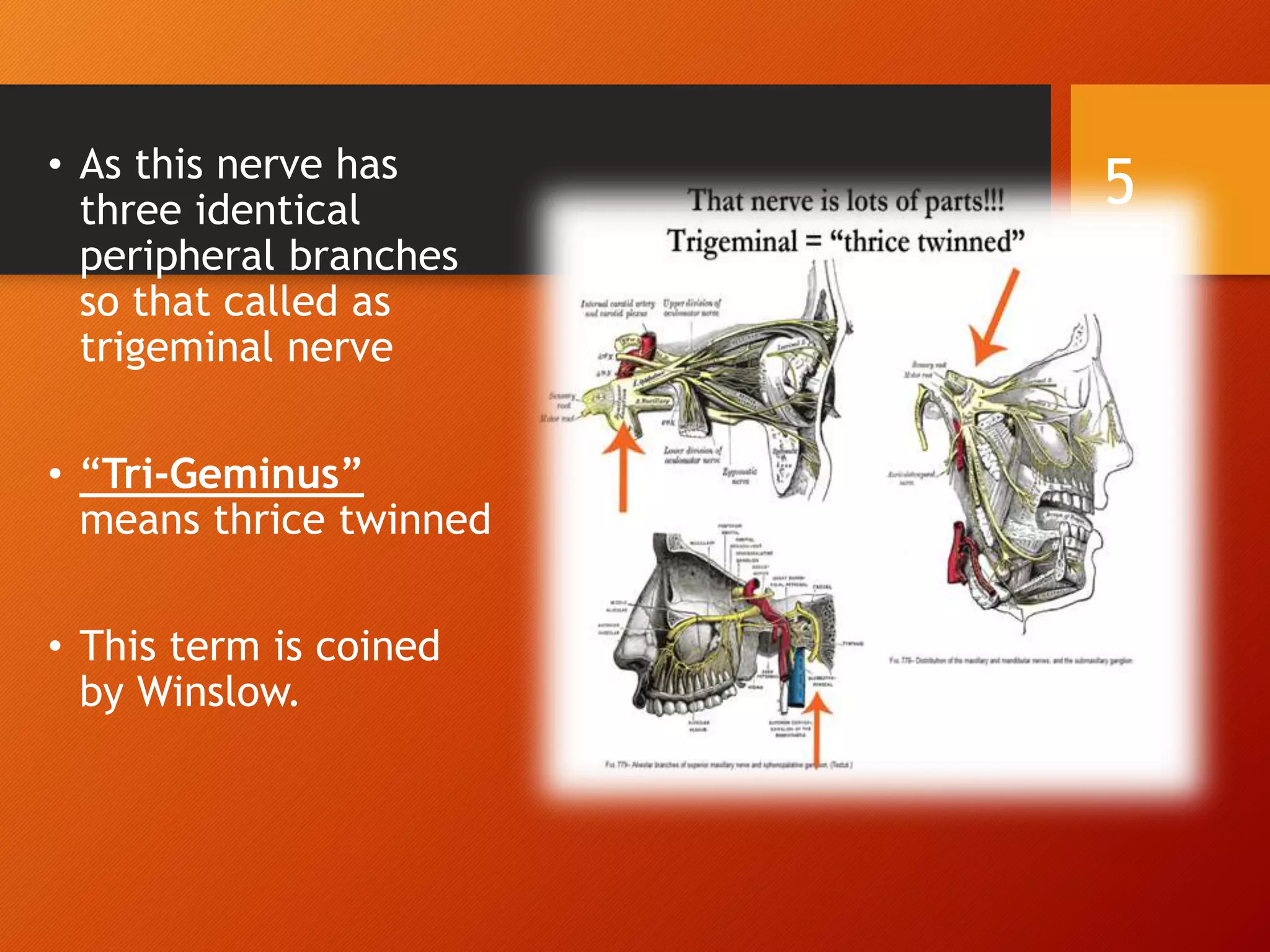
• As this nerve has
three identical
peripheral branches
so that called as
trigeminal nerve
• “Tri-Geminus”
means thrice twinned
• This term is coined
by Winslow.
5
Basic components
• This three roots are basically sensory by nature
• Along with this sensory branch their is a motor root of
this trigeminal nerve
• It is mixed nerve.
• Contains 170,000 sensory fibres
7,700 motor fibres
• The 3 divisions have approx ophthalmic 26,000
maxillary 50,000
mandibular 78,000
7
• 2 Roots:
Larger Sensory Root
Smaller Motor Root
3 primary divisions:
Ophthalmic ( V1) - sensory
- innervates the upper portion of the face
Maxillary (V2)- sensory – innervates the mid face
region
Mandibular (V3) -sensory+motor – innervates the
lower facial region
8
Nucleus of trigeminal nerve
• Sensory nuclei
• Motor nucleus
10
Sensory nuclei
• Main sensory nuclei
• Bulbospinal nuclei
• Mesenchephalic nuclei
11
Principle sensory nuclei
• lies in pons lat to motor nucleus
• relays discriminitive touch
12
 continuous superiorly with main
sensory nucleus and extends
inferiorly through medulla
oblongata and into upper part
of spinal cord as far as second
cervical segment.
 where its continuous with
sub.Gelatinosa.
• PARS ORALIS
• associated with the
transmission of discriminative
(fine) tactile sense from the
orofacial region
• PARS INTERPOLARIS
• associated with the
transmission of tactile sense,
as well as dental pain
• PARS CAUDALIS
• associated with the
transmission of nociception
and thermal sensations from
the head
13
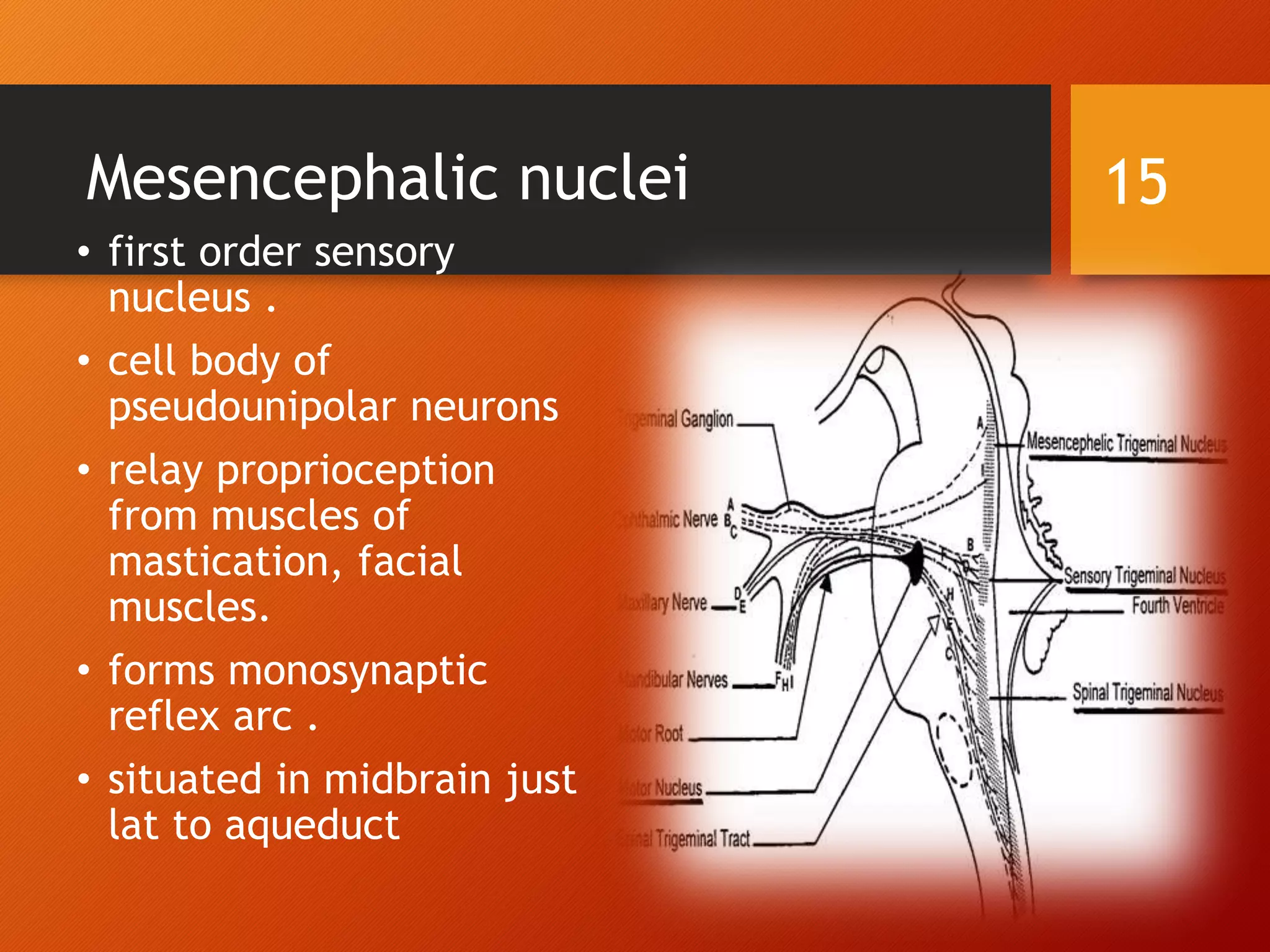
Mesencephalic nuclei
• first order sensory
nucleus .
• cell body of
pseudounipolar neurons
• relay proprioception
from muscles of
mastication, facial
muscles.
• forms monosynaptic
reflex arc .
• situated in midbrain just
lat to aqueduct
15
Motor nucleus
• Innervates muscles of
mastication and
tensor tympani and
tensor palatini
• Located in pons med.
to princi sen. Nucleus
16
ganglions
• Semilunar ganglion
• Cilliary ganglion
• Sphenopalatine ganglion
• Otic ganglion
• Submaxillary ganglion
17
Trigeminal ganglion
• SEMILUNAR OR GASSERIAN GANGLION.
• Sensory ganglion corresponding to DRG of spinal nerves.
• Cresentric in shape with convexity anterolat.
• Contains cell bodies of pseudounipolar neurons.
• LOCATION: lies in a bony fossa at apex of the petrous
temporal bone on floor of middle cranial fossa , just lat
to post. Part of lat wall of the cavernous sinus.
5 cm deep to the preauricular point
18
• Give off minute branches -
tentorium cerebelli and to dura
mater in the middle cranial
fossa.
• From its convex border three
large nerves arises
Ophthalmic
Maxillary
Mandibular.
• Ophthalmic and Maxillary -
exclusively of sensory fibers.
• Mandibular is joined outside
the cranium by the motor root.
21
Opthalmic branch
• Smallest div.
• Only sensory
• Supplies : cornea,conjuctiva,upper
lid,forehead,ant part of scalp,nose.
• Course:
emerges from trigeminal ganglion
lat wall cavernous sinus
3 branches in ant part of cavernous sinus
nasocilliary, frontal, lacrimal
superior orbital fissure
orbit
23
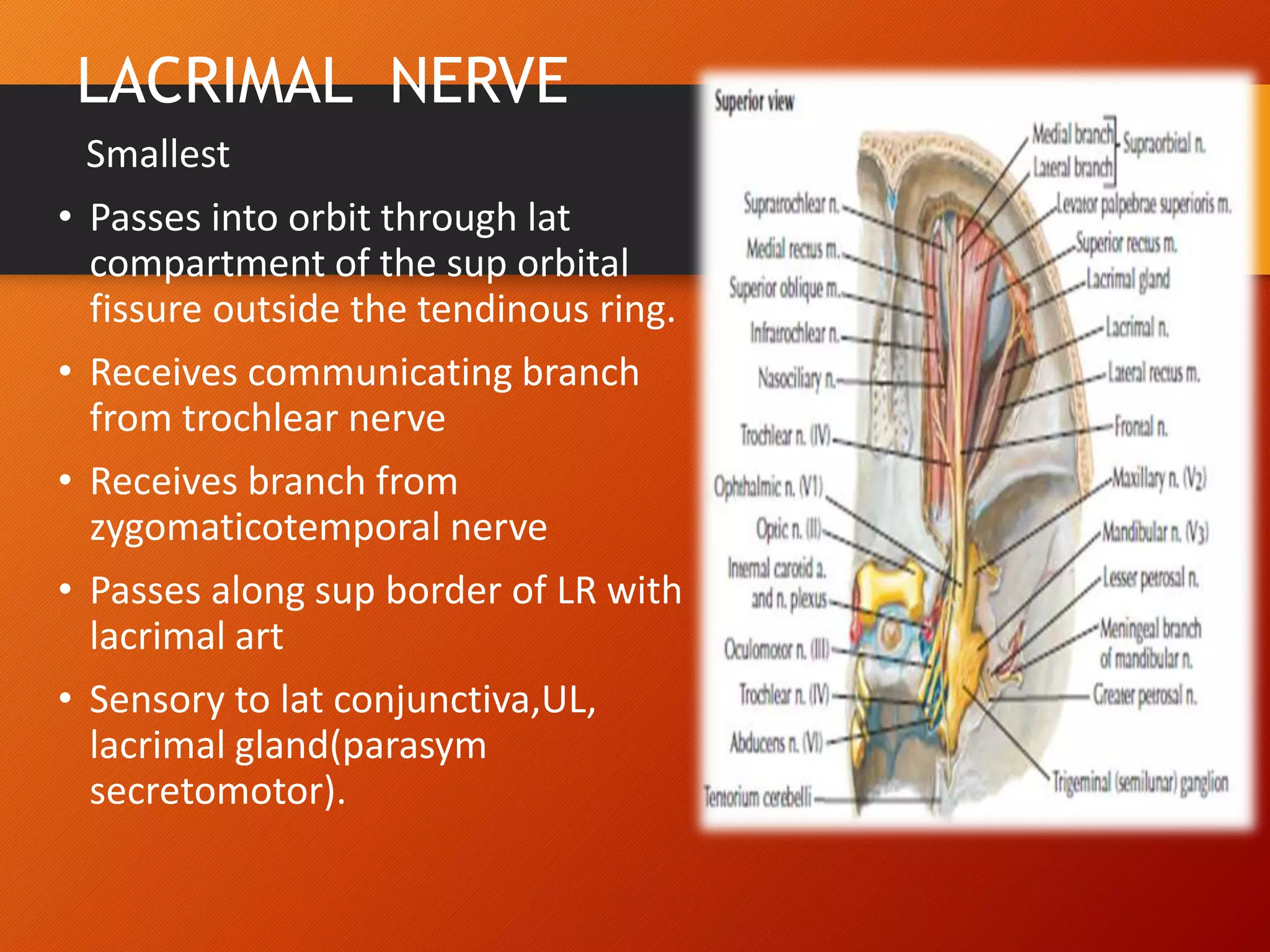
LACRIMAL NERVE
Smallest
• Passes into orbit through lat
compartment of the sup orbital
fissure outside the tendinous ring.
• Receives communicating branch
from trochlear nerve
• Receives branch from
zygomaticotemporal nerve
• Passes along sup border of LR with
lacrimal art
• Sensory to lat conjunctiva,UL,
lacrimal gland(parasym
secretomotor).
24
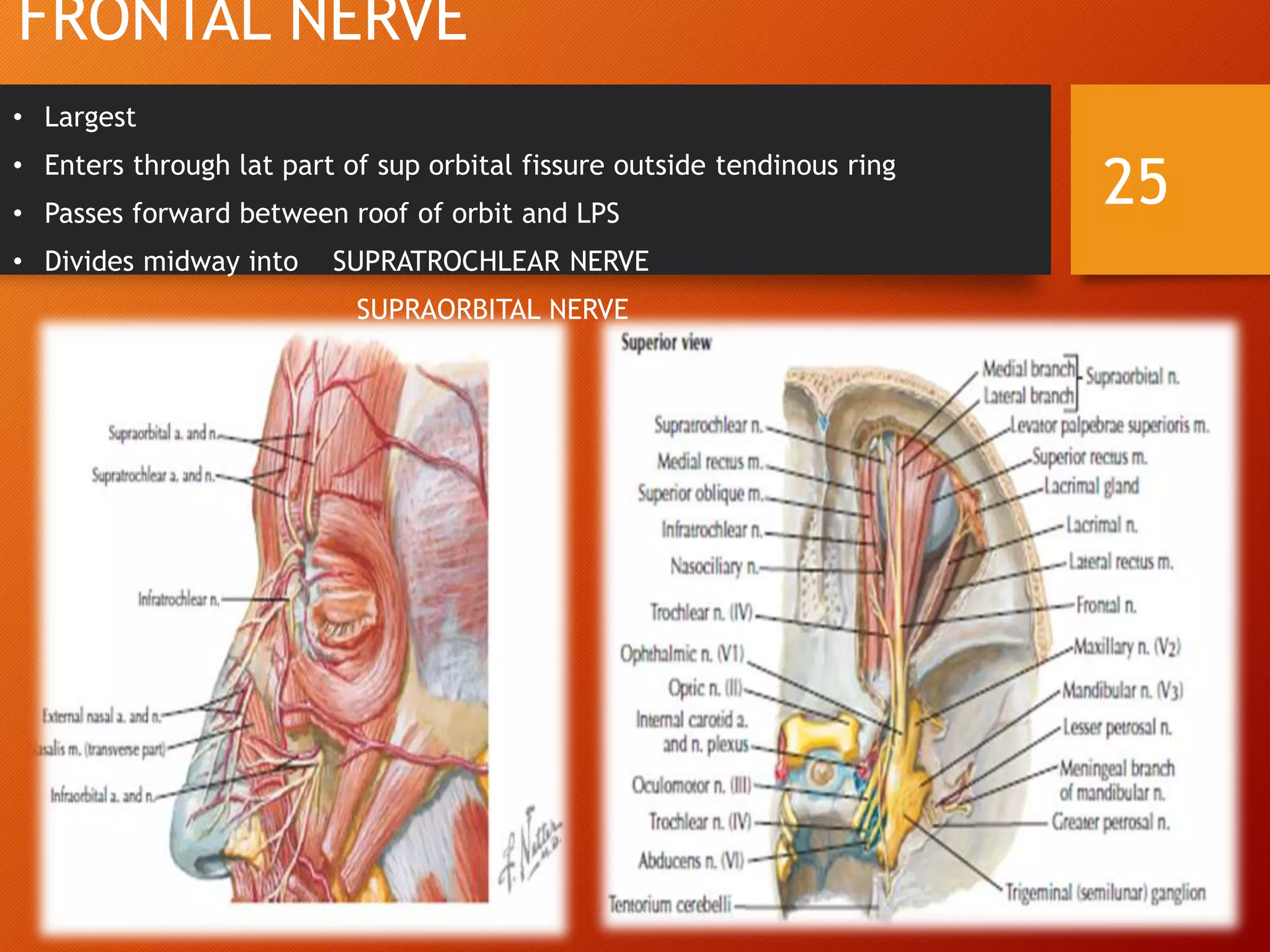
FRONTAL NERVE
• Largest
• Enters through lat part of sup orbital fissure outside tendinous ring
• Passes forward between roof of orbit and LPS
• Divides midway into SUPRATROCHLEAR NERVE
SUPRAORBITAL NERVE
25
 SUPRATROCHLEAR N  SUPRAORBITAL N
• Smaller nerve
• Medial
• Receives commu
branch from
infratrochlear n
• Curves around sup med
margin of orbit
• supplies: med
conjunctiva and UL
lower part of forehead
• Lies betwn frontalis and
corrugator supercilli
26
• Larger
• Lies lateral
• Passes through
supraorbital notch
• Lies beneath frontalis
• Divides in med and lat
branches.
• Supplies: conjunctiva,
scalp upto vertex,
mucous membrane of
frontal sinus
NASOCILLIARY NERVE
• Sensory only
• Passes through med part of sup. Orbital
fissure within the tendenious ring betwn
the two div of occulomotor nerve.
• Crosses from lat to med above Optic
Nerve with ophthalmic art
• Runs along med wall of orbit betwn SO
and MR
• Divides into terminal branches ANT
ETHMOIDAL NERVE and
INFRATROCHLEAR NERVE
• 5 branches in orbit.
27
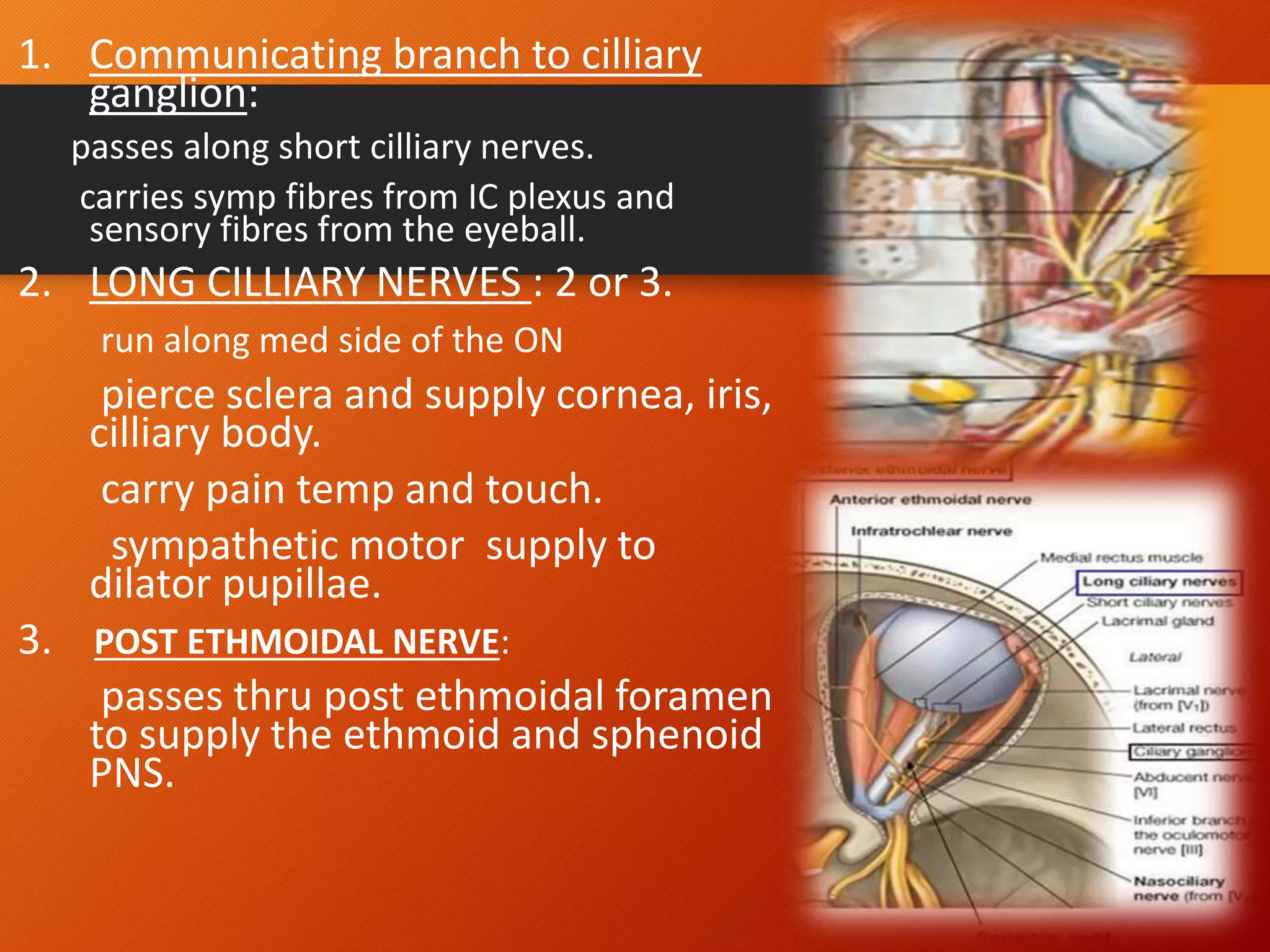
1. Communicating branch to cilliary
ganglion:
passes along short cilliary nerves.
carries symp fibres from IC plexus and
sensory fibres from the eyeball.
2. LONG CILLIARY NERVES : 2 or 3.
run along med side of the ON
pierce sclera and supply cornea, iris,
cilliary body.
carry pain temp and touch.
sympathetic motor supply to
dilator pupillae.
3. POST ETHMOIDAL NERVE:
passes thru post ethmoidal foramen
to supply the ethmoid and sphenoid
PNS.
28
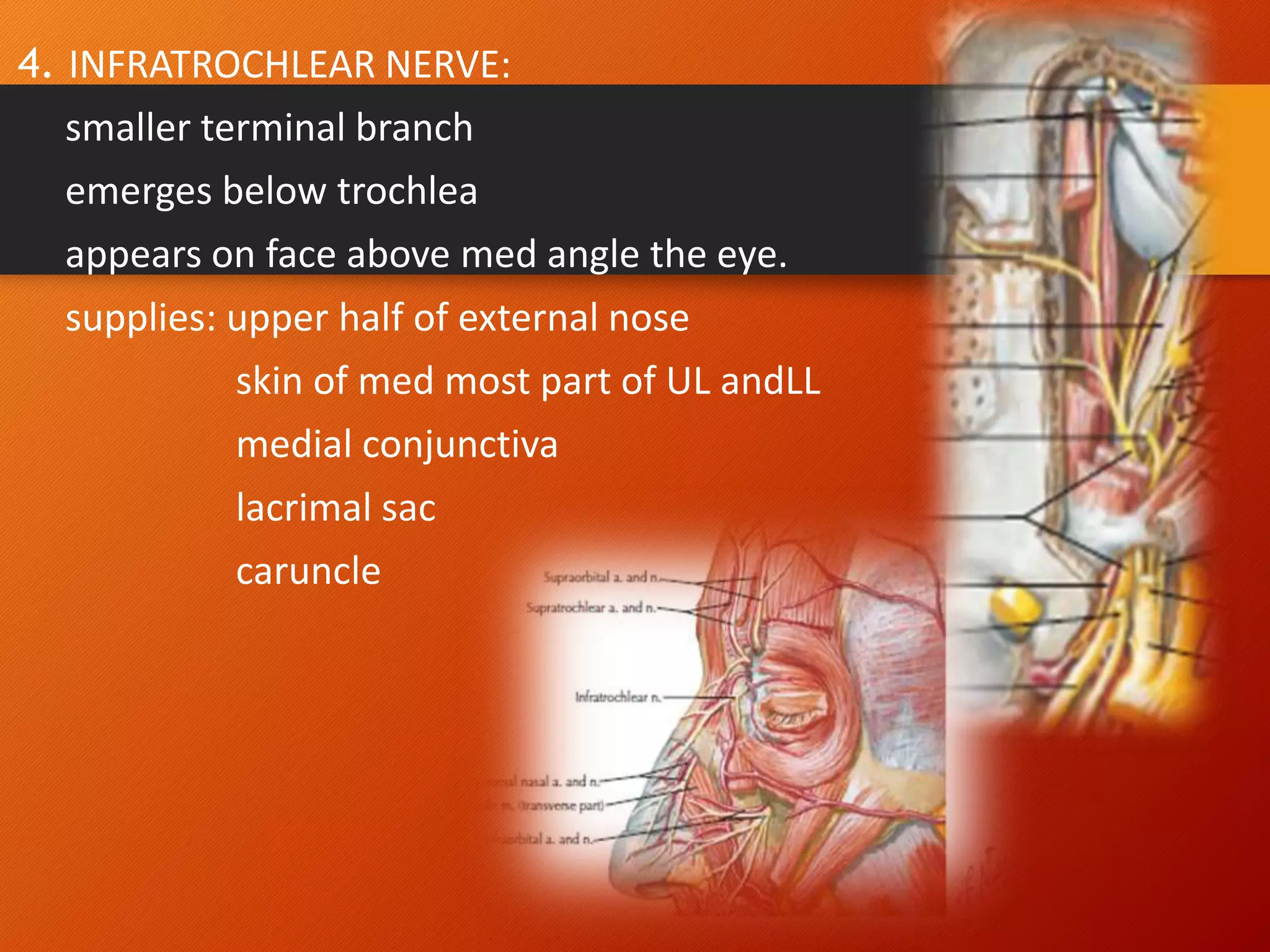
4. INFRATROCHLEAR NERVE:
smaller terminal branch
emerges below trochlea
appears on face above med angle the eye.
supplies: upper half of external nose
skin of med most part of UL andLL
medial conjunctiva
lacrimal sac
caruncle
29
5. ANT ETHMOIDAL NERVE:
larger terminal branch
course: ant ethmoidal foramen and canal
into ant cranial fossa on sup surf of cribriform plate
Through slit lat to crista galli into nasal cavity
Med internal nasal branch lat internal nasal branch
Supplies ant nasal septum supplies ant part lat
nasal
cavity emerges as
external nasal nerve to
skin of ala,vestibule,and
tip of nose
30
Maxillary division
• Second division of the trigeminal nerve.
• Is a sensory nerve.
• It begins - middle of semilunar ganglion as a flattened plexiform band,
passing horizontally forward - leaves the skull , foramen rotundum.
• Then crosses - pterygopalatine fossa - enters the orbit through the
inferior orbital fissure - it traverses the infraorbital groove and canal in
the floor of the orbit and appears on the face - infraorbital foramen
32
33
In the cranium Middle Meningeal Nerve
In the Pterygopalatine
fossa
Zygomatic
Sphenopalatine
Posterior Superior
Alveolar
In the Infraorbital Canal Anterior Superior
Alveolar
Middle Superior Alveolar
On the Face Inferior Palpebral
External Nasal
Superior Labial
Branches of Maxillary Nerve
From middle of the gasserion ganglion it travels
anteriorly & downwards
Branch Within cranium –Middle minengial nerve
Run along with middle minengial artery,
-- sensory innervation to dura matter.
Exit cranium from foramen rotundum
34
Within pterigopalatine fossa
• Zygomatic nerve
• Lies within inferior orbital
fissure
• Give two branches
• Zygomaticotemporal
• Supplies skin of
temporal region after
peircing temporal
fascia 2 cm above
zygoma
• Gives communicating
branch to lacrimal N
suppling parasymp.
Secretomotor fibres
to lacrimal gland
• Zygomaticofacial
• Supply skin of face
35
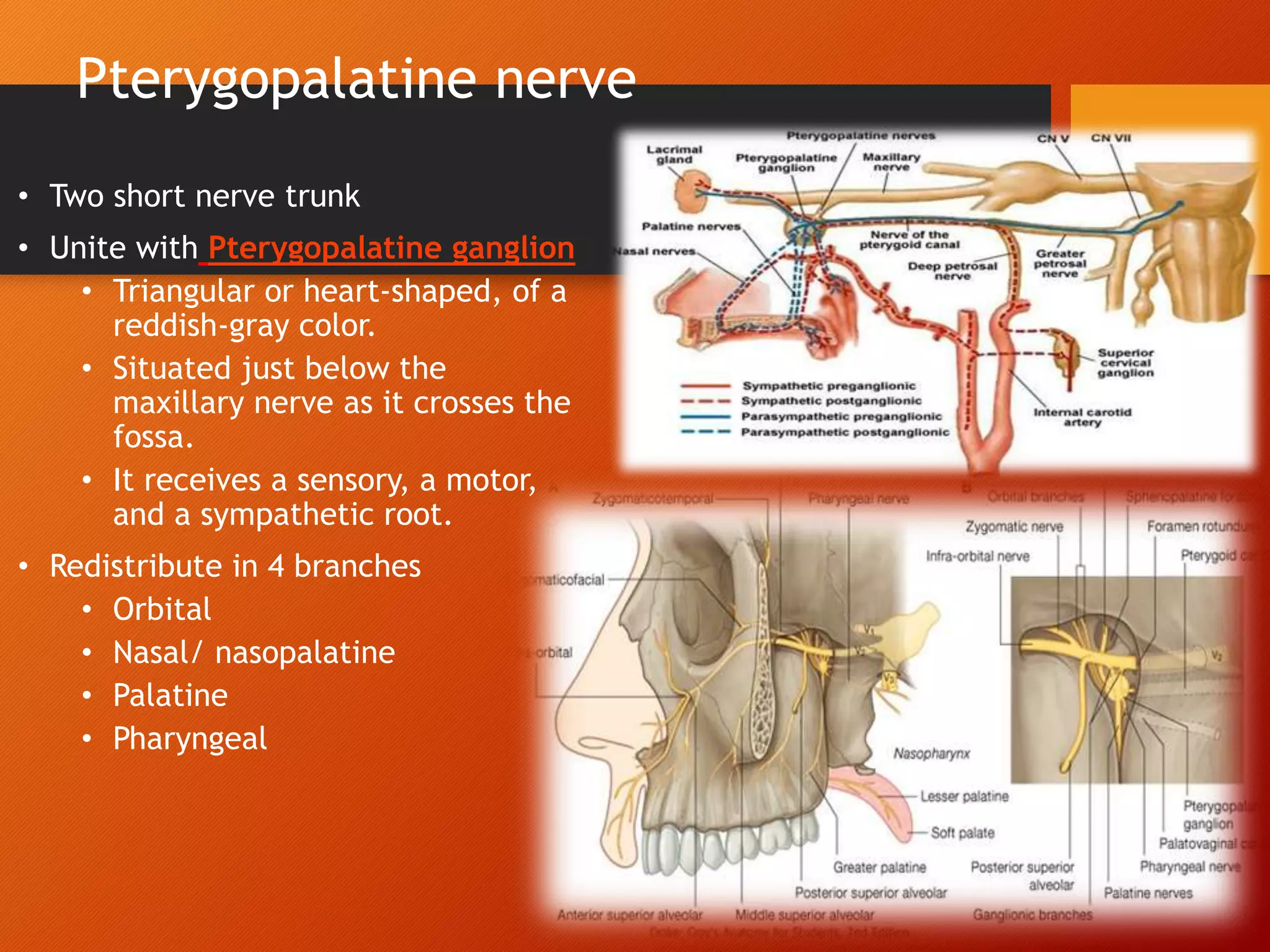
Pterygopalatine nerve
• Two short nerve trunk
• Unite with Pterygopalatine ganglion
• Triangular or heart-shaped, of a
reddish-gray color.
• Situated just below the
maxillary nerve as it crosses the
fossa.
• It receives a sensory, a motor,
and a sympathetic root.
• Redistribute in 4 branches
• Orbital
• Nasal/ nasopalatine
• Palatine
• Pharyngeal
36
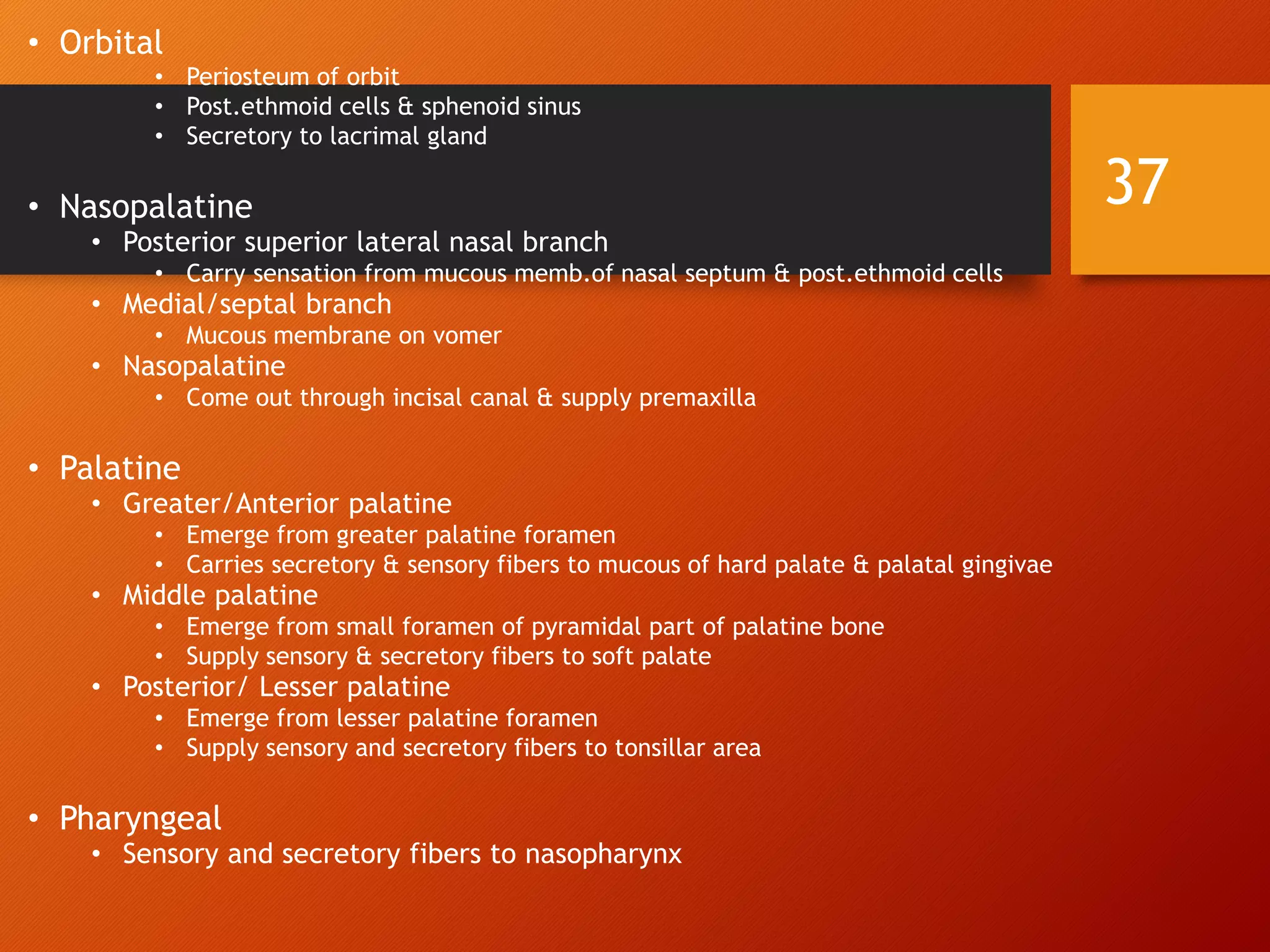
• Orbital
• Periosteum of orbit
• Post.ethmoid cells & sphenoid sinus
• Secretory to lacrimal gland
• Nasopalatine
• Posterior superior lateral nasal branch
• Carry sensation from mucous memb.of nasal septum & post.ethmoid cells
• Medial/septal branch
• Mucous membrane on vomer
• Nasopalatine
• Come out through incisal canal & supply premaxilla
• Palatine
• Greater/Anterior palatine
• Emerge from greater palatine foramen
• Carries secretory & sensory fibers to mucous of hard palate & palatal gingivae
• Middle palatine
• Emerge from small foramen of pyramidal part of palatine bone
• Supply sensory & secretory fibers to soft palate
• Posterior/ Lesser palatine
• Emerge from lesser palatine foramen
• Supply sensory and secretory fibers to tonsillar area
• Pharyngeal
• Sensory and secretory fibers to nasopharynx
37
Post. Superior alveolar nv
• 1st Trunk
• External to bone
• Buccal gingiva of maxillary molar
• 2nd Trunk
• Enters into maxilla
• Sensory to maxillary sinus, maxillary
molar (except mesio buccal root of 1st
max.molar)
38
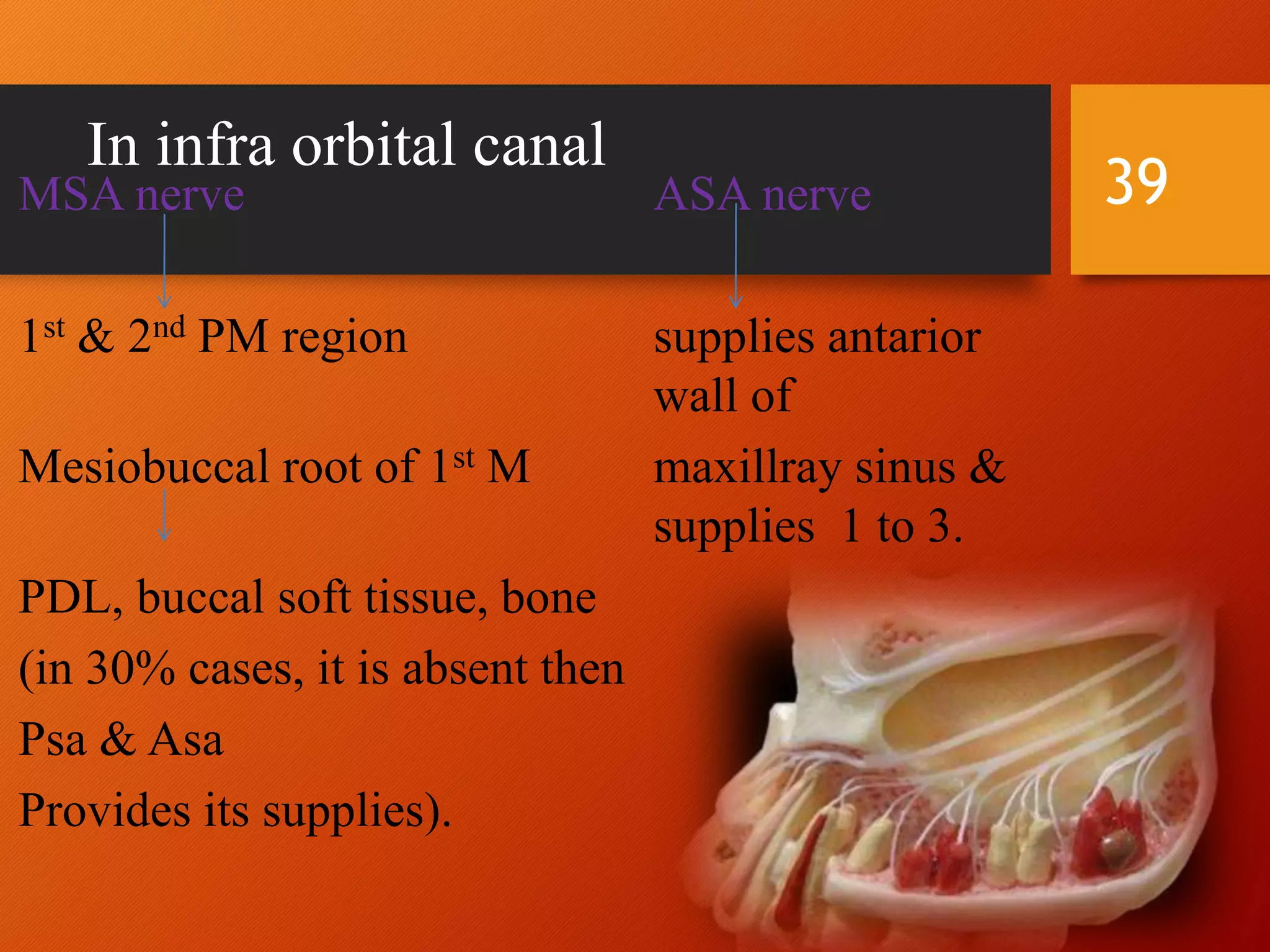
In infra orbital canal
39MSA nerve ASA nerve
1st & 2nd PM region supplies antarior
wall of
Mesiobuccal root of 1st M maxillray sinus &
supplies 1 to 3.
PDL, buccal soft tissue, bone
(in 30% cases, it is absent then
Psa & Asa
Provides its supplies).
Terminal branches on face
40In the face (emerge through inferior orbital foramen)
Inferior pulpaberal external nasal sup. Labial
Skin of lower eyelid skin of lateral skin,mucous
aspect of nose memb.,upper
lip.
Mandibular division
41
 Largest
 Mixed
 Motor root- from motor sensory root- gasserian ganglion
nucleus in pons
exit through foramen ovale in grt. Wing of shenoid
from trunk in infratemporal fossa
travels between lat. Pterygoid and otic ganglion laterally and
tensor palatine medially anteriorly to med. Meningeal A.
small ant. Division large post. division
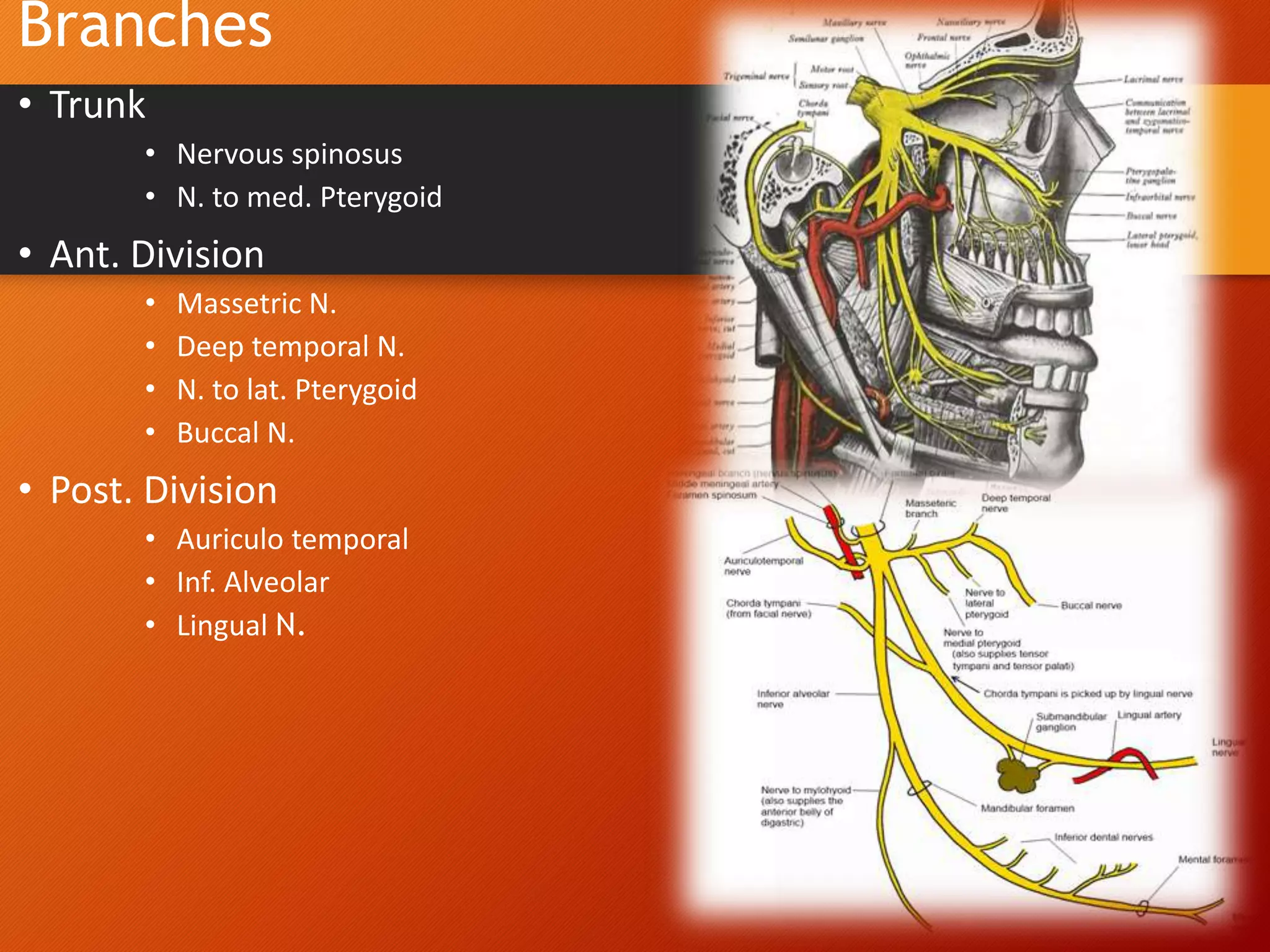
Branches
• Trunk
• Nervous spinosus
• N. to med. Pterygoid
• Ant. Division
• Massetric N.
• Deep temporal N.
• N. to lat. Pterygoid
• Buccal N.
• Post. Division
• Auriculo temporal
• Inf. Alveolar
• Lingual N.
42
Branches from trunk
• Nervous spinosus
• Through foramen spinosus
• Dura mid cranial fossa
• Nerve to med. Pterygoid
• Supplies medial pterygoid
• Through otic ganglion without interruption to
Tensor tympani
Tensor palatini
43
Branches from the anterior division
• Nerve to lat pterygoid
• Massetric nerve- lies sup to lat pterygoid,inf to
temporalis tendon and ant to TMJ. supplies
masseter and TMJ
• Buccal nerve-is the only sensory branch of ant div.
travels betwn 2 heads of lat pterygoid and emerges in
cheek at ant border of masseter. Supplies skin and mm
of cheek.
• Deep temporal nerve -the 2 nerves ascend deep to lat
pterygoid and supply temporalis.
44
Branches from the posterior division
1.Auriculotemporal nerve-
Arises from 2 roots which encircle the middle
meningeal art
The trunk passes post to lat pterygoid betwn neck of
mandible and sphenomandibular lig sup to 1st part of
maxillary art.
Lies behind the TMJ close to the parotid
Ascends behind sup temporal vessels and then in
temporal region divides into superficial temporal
branches.
45
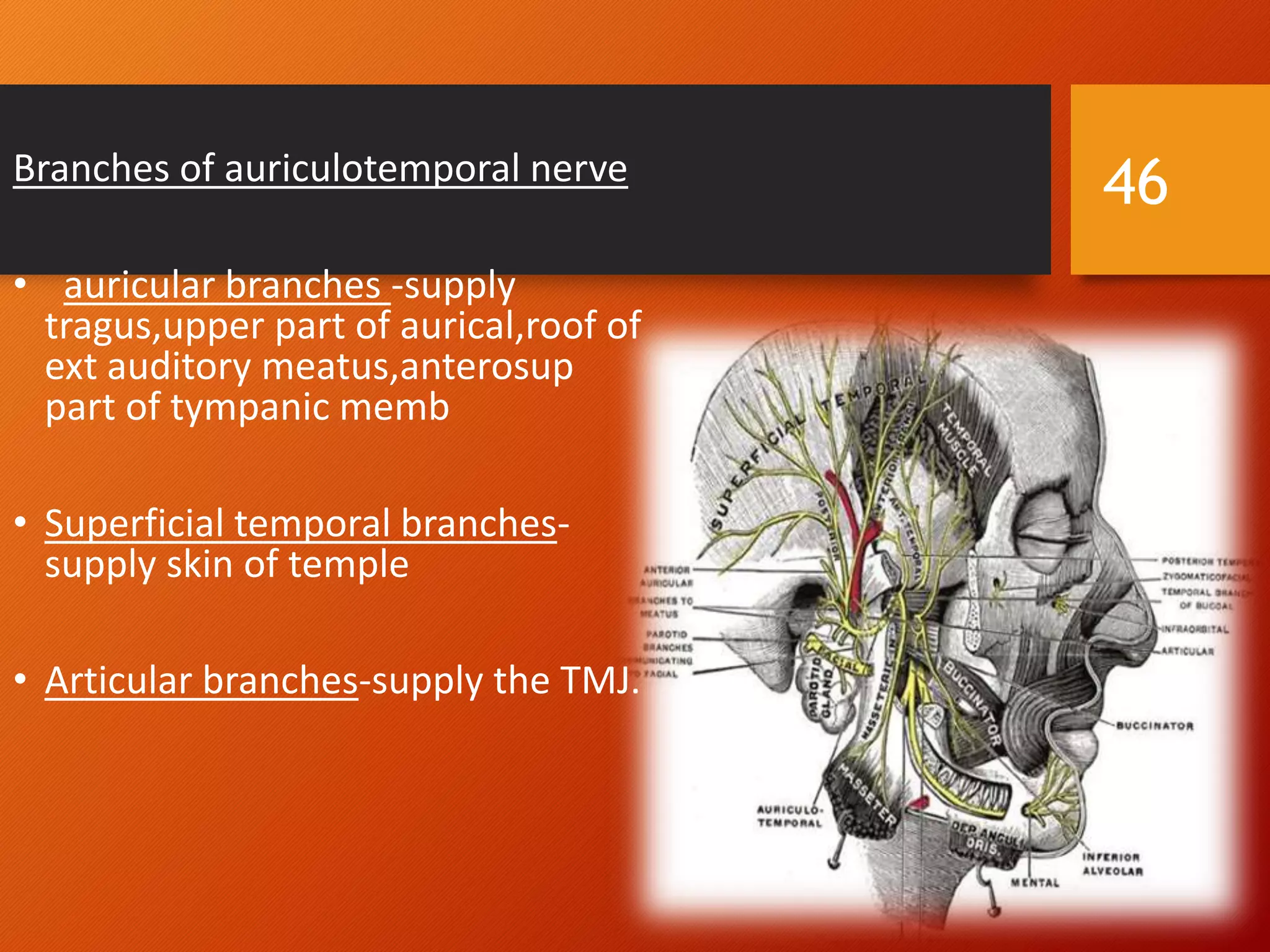
Branches of auriculotemporal nerve
• auricular branches -supply
tragus,upper part of aurical,roof of
ext auditory meatus,anterosup
part of tympanic memb
• Superficial temporal branches-
supply skin of temple
• Articular branches-supply the TMJ.
46
2. Inferior alveolar nerve:
Is mixed nerve
Passes between mandible and sphenomandibular lig inf to lat
pterygoid,
Enters mandible through mandibular foramen to run in a
bony canal below the teeth
Branches: to molars and premolars
incisive nerve
mental nerve
mylohyoid nerve-mylohyoid and ant belly
of diagastric
communicating nerve to lingual nerve
47
3.Lingual nerve: lies ant to inf. alveolar n between lat
pterygoid and tensor palatini
receives chorda tympani (SVA)
Emerges from inf border of lat pterygoid to lie betwn ramus
and med pterygoid
Between origins of sup constrictir and mylohyoid
1 cm below and behind 3rd molar in gingiva
Rests on hypoglossus lat to the tongue where it is
related to the submandibular ganglion
Gives sensory supply to presulcal tongue ,floor of mouth,
mandibular gums,and carries proprioception from tongue.
48
Branches of lingual nerve and its communications:
1.Chorda tympani
2.Communications with submandibular ganglion
3.Hypoglossal nerve
49
Ganglions in relation to
mandibular nerve
• Submandibular/ Submaxillary
ganglion
• Otic ganglion
50
SUBMAXILLARY / SUBMANDIBULAR GANGLION:
• Small size & fusiform in shape.
• Situated above the deep portion of the submaxillary /
Submandibular gland.
DISTRIBUTION:
• Arise - from the lower part of the ganglion.
• Supply - mucous membrane of the mouth and the duct
of the submaxillary gland.
51
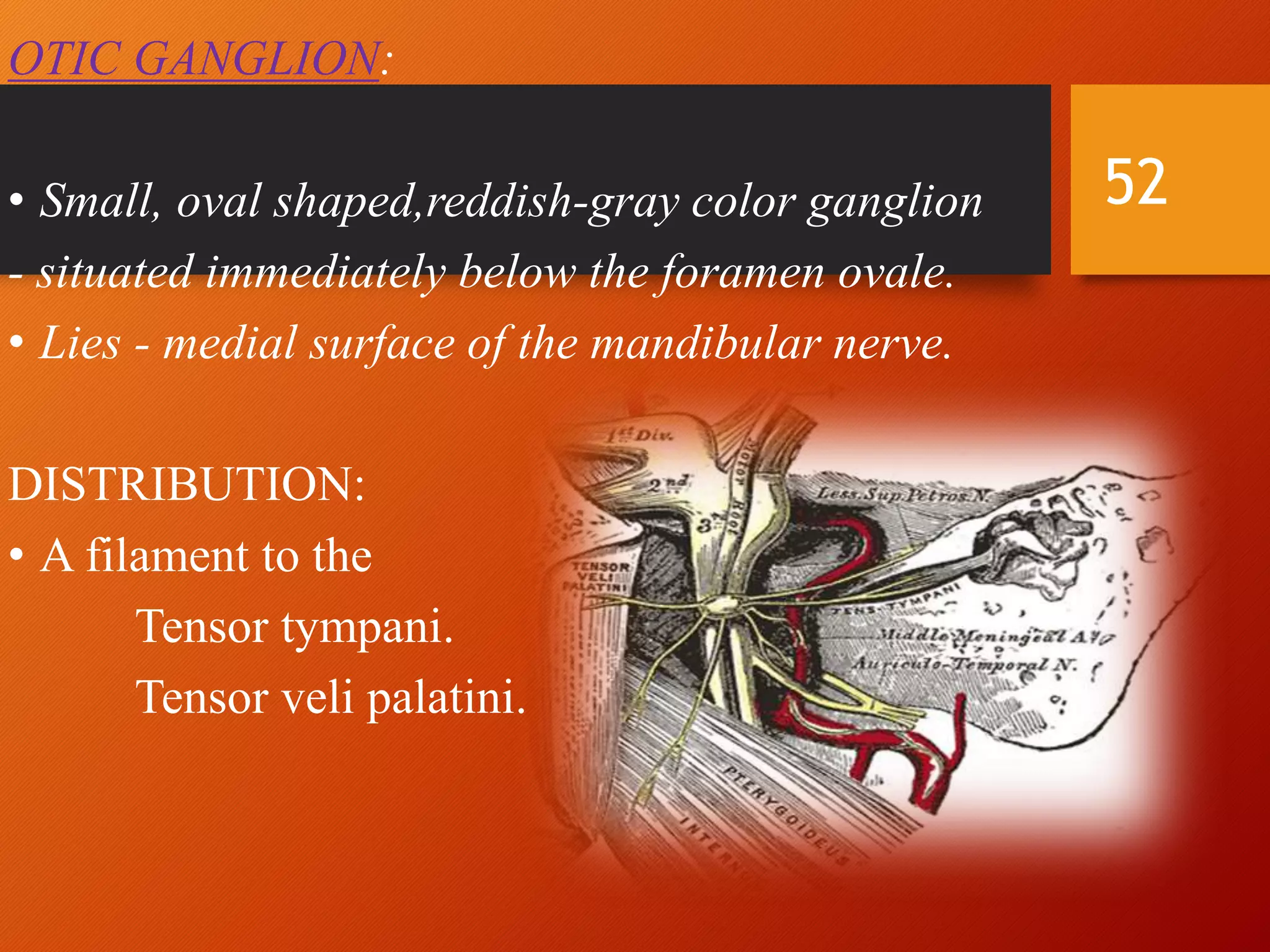
OTIC GANGLION:
• Small, oval shaped,reddish-gray color ganglion
- situated immediately below the foramen ovale.
• Lies - medial surface of the mandibular nerve.
DISTRIBUTION:
• A filament to the
Tensor tympani.
Tensor veli palatini.
52
58
59
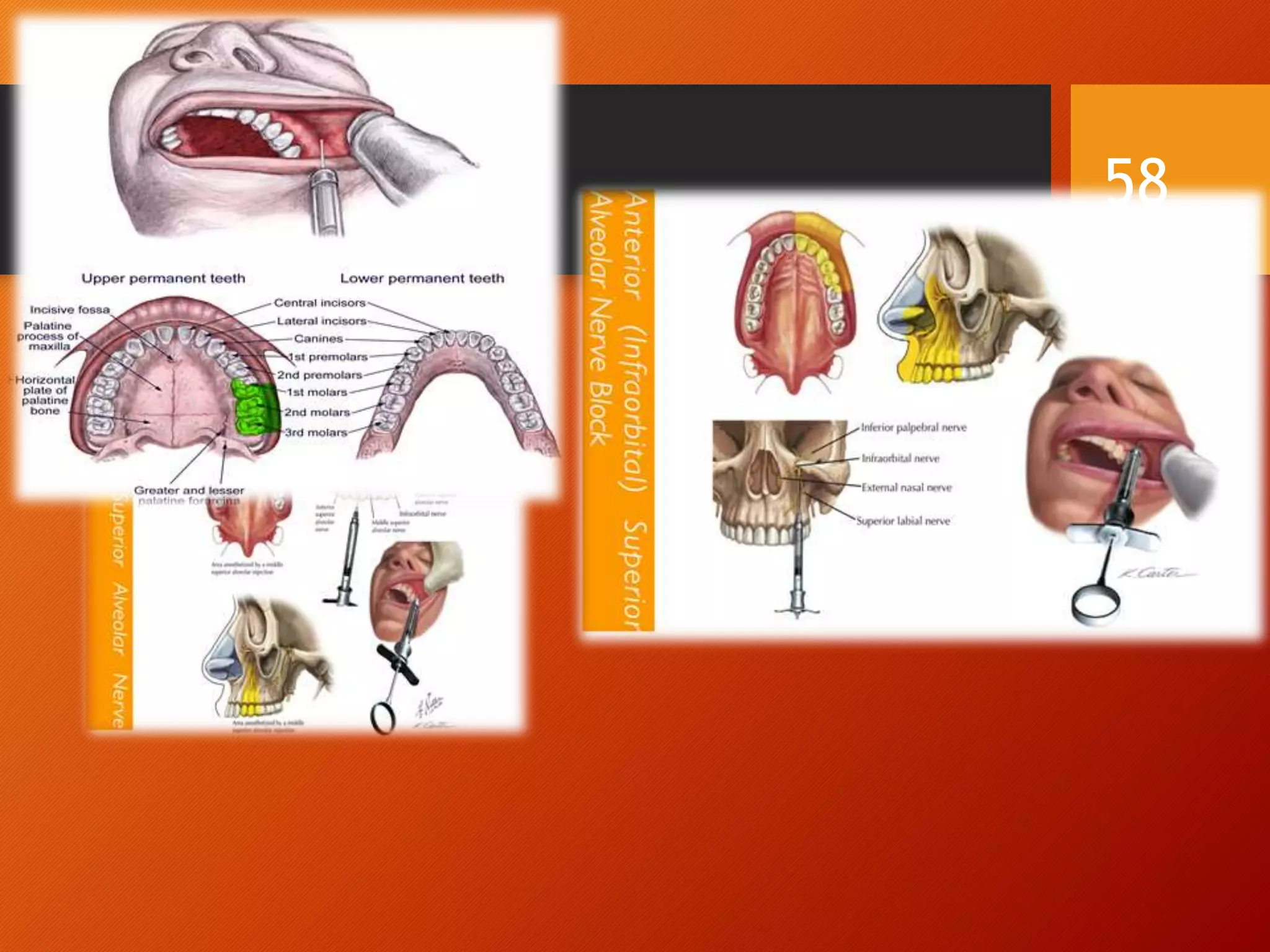
Technique of mandibular
anaesthesia
• Inferior alveolar nerve block
• Lingual nerve block
• Mental nerve block
• PDL infiltration
• Local infiltration (occasionally)
60
61
CLINICAL APPLICATION OF TRIGEMINAL
GANGLION
• Shingles and varicella-zoster: The trigeminal
ganglion, as any sensory ganglion, may be the site
of infection by the herpes zoster virus causing
shingles, a painful vesicular eruption in the sensory
distribution of the nerve.
• Trigeminal neuralgia (tic douloureux): This is severe
pain in the distribution of the trigeminal nerve or
one of its branches, the cause often being
unknown. It may require partial destruction of the
ganglion.
62
CLINICAL APPLICATION of opthalmic division
• Ethmoid tumours
Malignant tumours of the mucous lining of the ethmoid
air cells may expand into the orbits, damaging branches
of opthalmic nerve. This may lead to displacement of
the orbital contents causing proptosis and squint, and
sensory loss over the anterior nasal skin.
• Nasal fractures
Trauma to the nose may damage the nasociliary nerve.
Sensory loss of the skin down to the tip of the nose may
result.
63
• Corneal reflex: When the cornea is touched, usually
with a wisp of cotton, the subject blinks. This tests V
and VII. The nerve impulses pass through cornea and
then through nasociliary nerve to the brain.
• Supraorbital injuries
Trauma to the supraorbital margin may damage the
supraorbital and supratrochlear nerves causing sensory
loss in the scalp.
64
CLINICAL APPLICATION of maxillary division
• Infraorbital injuries (malar fractures): Trauma to
infraorbital margin may cause sensory loss of
infraorbital skin.
• Maxillary antrum tumours: Malignant tumors of the
mucous lining of the maxillary antrum may expand into
the orbit, damaging branches of maxillary nerve,
particularly the infraorbital. This may lead to
anaesthesia over the facial skin.
65
• Maxillary sinus infections: Infections of the maxillary
sinus may cause infraorbital pain or may cause referred
pain to other structures supplied by maxillary nerve e.g.
upper teeth.
• Maxillary teeth abscesses: The roots of the maxillary
teeth (especially the second molars) are intimately
related to the maxillary sinus. Root abscesses are
painful.
66
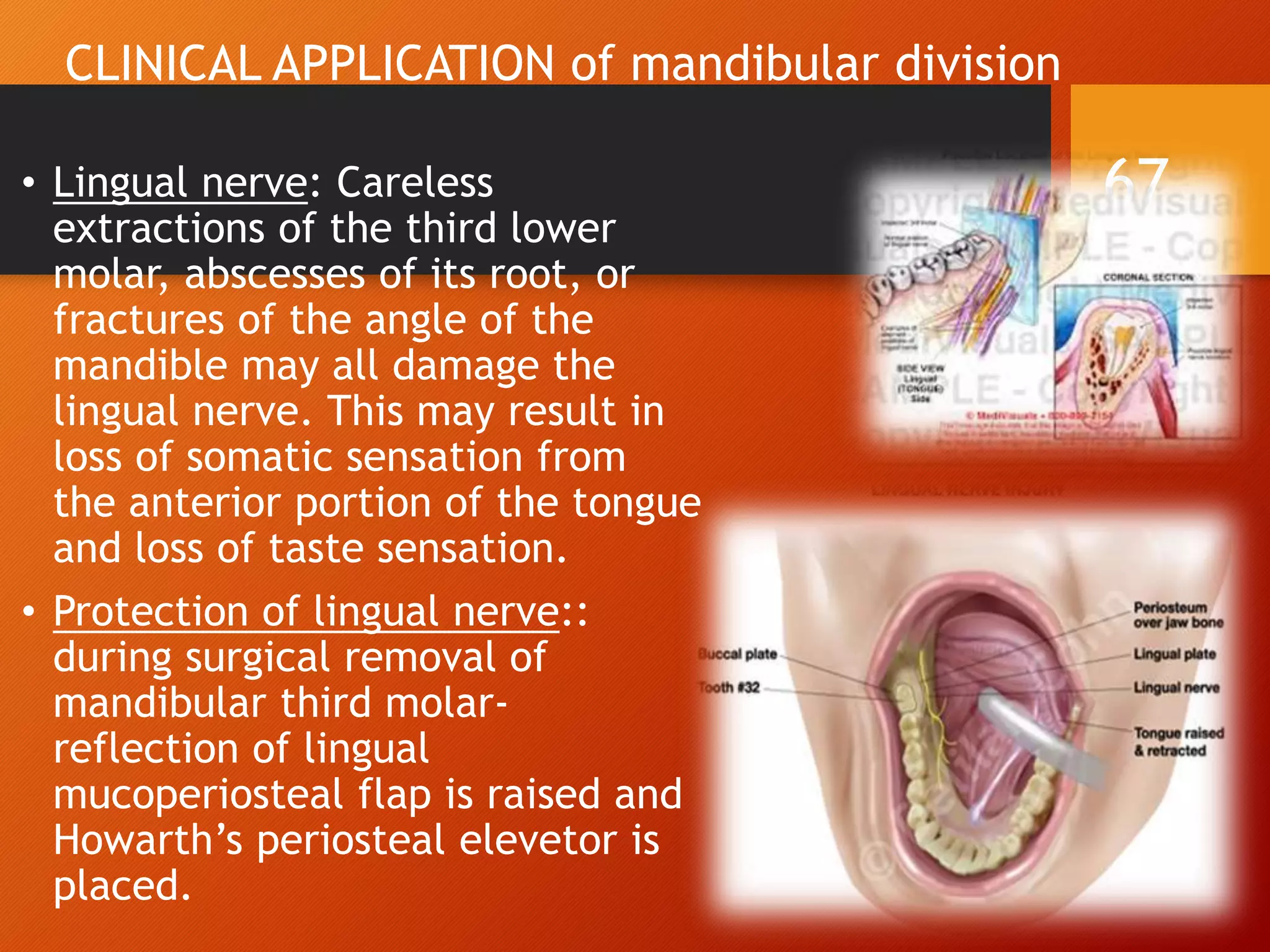
CLINICAL APPLICATION of mandibular division
• Lingual nerve: Careless
extractions of the third lower
molar, abscesses of its root, or
fractures of the angle of the
mandible may all damage the
lingual nerve. This may result in
loss of somatic sensation from
the anterior portion of the tongue
and loss of taste sensation.
• Protection of lingual nerve::
during surgical removal of
mandibular third molar-
reflection of lingual
mucoperiosteal flap is raised and
Howarth’s periosteal elevetor is
placed.
67
• Inferior alveolar nerve: Trauma to the
mandible may damage or tear the inferior
alveolar nerve in the mandibular canal leading
to sensory loss distal to the lesion.
68
• Mumps: Mumps is inflammation of the parotid gland
causing tension in the parotid capsule which is
innervated by the auriculotemporal nerve. It gives both
local tenderness and referred ear ache.
• Submandibular duct: The intimate relationship between the
submandibular duct and the lingual nerve is significant in duct infections
and surgery. If the lingual nerve were damaged during a submandibular
surgery, there would be sensory loss, both somatic and taste, in the
anterior portion of the tongue.
69
• Referred pain to the ear: Disease of the TMJ or
swelling of the parotid gland may cause ear ache
because of referred pain. Also, pain from the lower
teeth, oral cavity and tongue may be referred to the
ear.
• Superficial temporal artery biopsy: The
auriculotemporal nerve accompanies the superficial
temporal artery on the temple. In cases of temporal
arteritis, the nerve is anaesthetized so that the
overlying skin can be incised to obtain a biopsy of the
artery.
70
LESIONS ASSOCIATED WITH INTRACRANIAL PART OF
TRIGEMINAL
• Infections and neoplasia most commonly involve the
peripheral divisions of the trigeminal nerve rather than
the intracranial part.
• The Meckel’s cavity can be involved either by extrinsic
or intrinsic disease. Extrinsic lesions, usually bony
metastasis, chordoma, or chondrosarcoma, destroy
adjacent bone as they extend toward the Meckel’s
cavity. Intrinsic lesions simply expand the Meckel’s
cavity.
71
• Pituitary fossa and cavernous sinus lesions may extend
to the Meckel’s cavity or involve the cavernous portion
of the trigeminal nerve divisions as well.
• The trigeminal nerve has three sensory and one motor
nuclei. The sensory nuclei are the principal,
mesencephalic, and spinal sensory.
• The cervical extension of the spinal sensory nucleus
explains the relation of upper cervical disk herniation
and its association with trigeminal sensory neuropathy.
72
• Multiple sclerosis, glioma, and infarction are the most
common brainstem and upper cervical cord lesions
resulting in fifth cranial nerve symptom.
• Less common lesions include metastasis, cavernous
hemangiomas, hemorrhage, and arteriovenous
malformation.
• Rarely, rhombencephalitis may develop as a result of
retrograde extension of herpes simplex virus type 1
from the trigeminal ganglion into the brainstem.
73
THE AURICULOTEMPRAL NERVE
SYNDROME(FREY SYNDROME)
• Consists of flushing and sweating of the ipsilateral face
in the distribution of the auriculotemporal nerve upon
eating or tasting.
• It is occasionally seen following injury or infection of
the parotid gland area .
74
THE PARATRIGEMINAL SYNDROME
• It is also known as the Reader Syndrome and is a rare
disorder produced by tumors arising in the semilunar
ganglion.
• Characterised by trigeminal neuralgia at the onest
,followed by facial anesthesias on the affected side.
• The muscles of mastication are found weakened or
paralysed.
75
CONCLUSION
• In conclusion, a variety of conditions may involve the
different segments of the trigeminal nerve.
• Knowledge of its anatomic course and its application
allows an understanding of disorders involving the
brainstem, the nerve parts and adjacent skull base.
76
77

Trigeminal nerve - ROHIT N RATHOD

  • 2.
    • It isthe 5th cranial nerve • Largest cranial nerve • It is the main sensory nerve of the face and head • It was described by Fallopius & Meckle in 1748 4
  • 3.
    • As thisnerve has three identical peripheral branches so that called as trigeminal nerve • “Tri-Geminus” means thrice twinned • This term is coined by Winslow. 5
  • 4.
    Basic components • Thisthree roots are basically sensory by nature • Along with this sensory branch their is a motor root of this trigeminal nerve • It is mixed nerve. • Contains 170,000 sensory fibres 7,700 motor fibres • The 3 divisions have approx ophthalmic 26,000 maxillary 50,000 mandibular 78,000 7
  • 5.
    • 2 Roots: LargerSensory Root Smaller Motor Root 3 primary divisions: Ophthalmic ( V1) - sensory - innervates the upper portion of the face Maxillary (V2)- sensory – innervates the mid face region Mandibular (V3) -sensory+motor – innervates the lower facial region 8
  • 6.
    Nucleus of trigeminalnerve • Sensory nuclei • Motor nucleus 10
  • 7.
    Sensory nuclei • Mainsensory nuclei • Bulbospinal nuclei • Mesenchephalic nuclei 11
  • 8.
    Principle sensory nuclei •lies in pons lat to motor nucleus • relays discriminitive touch 12  continuous superiorly with main sensory nucleus and extends inferiorly through medulla oblongata and into upper part of spinal cord as far as second cervical segment.  where its continuous with sub.Gelatinosa.
  • 9.
    • PARS ORALIS •associated with the transmission of discriminative (fine) tactile sense from the orofacial region • PARS INTERPOLARIS • associated with the transmission of tactile sense, as well as dental pain • PARS CAUDALIS • associated with the transmission of nociception and thermal sensations from the head 13
  • 10.
    Mesencephalic nuclei • firstorder sensory nucleus . • cell body of pseudounipolar neurons • relay proprioception from muscles of mastication, facial muscles. • forms monosynaptic reflex arc . • situated in midbrain just lat to aqueduct 15
  • 11.
    Motor nucleus • Innervatesmuscles of mastication and tensor tympani and tensor palatini • Located in pons med. to princi sen. Nucleus 16
  • 12.
    ganglions • Semilunar ganglion •Cilliary ganglion • Sphenopalatine ganglion • Otic ganglion • Submaxillary ganglion 17
  • 13.
    Trigeminal ganglion • SEMILUNAROR GASSERIAN GANGLION. • Sensory ganglion corresponding to DRG of spinal nerves. • Cresentric in shape with convexity anterolat. • Contains cell bodies of pseudounipolar neurons. • LOCATION: lies in a bony fossa at apex of the petrous temporal bone on floor of middle cranial fossa , just lat to post. Part of lat wall of the cavernous sinus. 5 cm deep to the preauricular point 18
  • 14.
    • Give offminute branches - tentorium cerebelli and to dura mater in the middle cranial fossa. • From its convex border three large nerves arises Ophthalmic Maxillary Mandibular. • Ophthalmic and Maxillary - exclusively of sensory fibers. • Mandibular is joined outside the cranium by the motor root. 21
  • 15.
    Opthalmic branch • Smallestdiv. • Only sensory • Supplies : cornea,conjuctiva,upper lid,forehead,ant part of scalp,nose. • Course: emerges from trigeminal ganglion lat wall cavernous sinus 3 branches in ant part of cavernous sinus nasocilliary, frontal, lacrimal superior orbital fissure orbit 23
  • 16.
    LACRIMAL NERVE Smallest • Passesinto orbit through lat compartment of the sup orbital fissure outside the tendinous ring. • Receives communicating branch from trochlear nerve • Receives branch from zygomaticotemporal nerve • Passes along sup border of LR with lacrimal art • Sensory to lat conjunctiva,UL, lacrimal gland(parasym secretomotor). 24
  • 17.
    FRONTAL NERVE • Largest •Enters through lat part of sup orbital fissure outside tendinous ring • Passes forward between roof of orbit and LPS • Divides midway into SUPRATROCHLEAR NERVE SUPRAORBITAL NERVE 25
  • 18.
     SUPRATROCHLEAR N SUPRAORBITAL N • Smaller nerve • Medial • Receives commu branch from infratrochlear n • Curves around sup med margin of orbit • supplies: med conjunctiva and UL lower part of forehead • Lies betwn frontalis and corrugator supercilli 26 • Larger • Lies lateral • Passes through supraorbital notch • Lies beneath frontalis • Divides in med and lat branches. • Supplies: conjunctiva, scalp upto vertex, mucous membrane of frontal sinus
  • 19.
    NASOCILLIARY NERVE • Sensoryonly • Passes through med part of sup. Orbital fissure within the tendenious ring betwn the two div of occulomotor nerve. • Crosses from lat to med above Optic Nerve with ophthalmic art • Runs along med wall of orbit betwn SO and MR • Divides into terminal branches ANT ETHMOIDAL NERVE and INFRATROCHLEAR NERVE • 5 branches in orbit. 27
  • 20.
    1. Communicating branchto cilliary ganglion: passes along short cilliary nerves. carries symp fibres from IC plexus and sensory fibres from the eyeball. 2. LONG CILLIARY NERVES : 2 or 3. run along med side of the ON pierce sclera and supply cornea, iris, cilliary body. carry pain temp and touch. sympathetic motor supply to dilator pupillae. 3. POST ETHMOIDAL NERVE: passes thru post ethmoidal foramen to supply the ethmoid and sphenoid PNS. 28
  • 21.
    4. INFRATROCHLEAR NERVE: smallerterminal branch emerges below trochlea appears on face above med angle the eye. supplies: upper half of external nose skin of med most part of UL andLL medial conjunctiva lacrimal sac caruncle 29
  • 22.
    5. ANT ETHMOIDALNERVE: larger terminal branch course: ant ethmoidal foramen and canal into ant cranial fossa on sup surf of cribriform plate Through slit lat to crista galli into nasal cavity Med internal nasal branch lat internal nasal branch Supplies ant nasal septum supplies ant part lat nasal cavity emerges as external nasal nerve to skin of ala,vestibule,and tip of nose 30
  • 23.
    Maxillary division • Seconddivision of the trigeminal nerve. • Is a sensory nerve. • It begins - middle of semilunar ganglion as a flattened plexiform band, passing horizontally forward - leaves the skull , foramen rotundum. • Then crosses - pterygopalatine fossa - enters the orbit through the inferior orbital fissure - it traverses the infraorbital groove and canal in the floor of the orbit and appears on the face - infraorbital foramen 32
  • 24.
    33 In the craniumMiddle Meningeal Nerve In the Pterygopalatine fossa Zygomatic Sphenopalatine Posterior Superior Alveolar In the Infraorbital Canal Anterior Superior Alveolar Middle Superior Alveolar On the Face Inferior Palpebral External Nasal Superior Labial Branches of Maxillary Nerve
  • 25.
    From middle ofthe gasserion ganglion it travels anteriorly & downwards Branch Within cranium –Middle minengial nerve Run along with middle minengial artery, -- sensory innervation to dura matter. Exit cranium from foramen rotundum 34
  • 26.
    Within pterigopalatine fossa •Zygomatic nerve • Lies within inferior orbital fissure • Give two branches • Zygomaticotemporal • Supplies skin of temporal region after peircing temporal fascia 2 cm above zygoma • Gives communicating branch to lacrimal N suppling parasymp. Secretomotor fibres to lacrimal gland • Zygomaticofacial • Supply skin of face 35
  • 27.
    Pterygopalatine nerve • Twoshort nerve trunk • Unite with Pterygopalatine ganglion • Triangular or heart-shaped, of a reddish-gray color. • Situated just below the maxillary nerve as it crosses the fossa. • It receives a sensory, a motor, and a sympathetic root. • Redistribute in 4 branches • Orbital • Nasal/ nasopalatine • Palatine • Pharyngeal 36
  • 28.
    • Orbital • Periosteumof orbit • Post.ethmoid cells & sphenoid sinus • Secretory to lacrimal gland • Nasopalatine • Posterior superior lateral nasal branch • Carry sensation from mucous memb.of nasal septum & post.ethmoid cells • Medial/septal branch • Mucous membrane on vomer • Nasopalatine • Come out through incisal canal & supply premaxilla • Palatine • Greater/Anterior palatine • Emerge from greater palatine foramen • Carries secretory & sensory fibers to mucous of hard palate & palatal gingivae • Middle palatine • Emerge from small foramen of pyramidal part of palatine bone • Supply sensory & secretory fibers to soft palate • Posterior/ Lesser palatine • Emerge from lesser palatine foramen • Supply sensory and secretory fibers to tonsillar area • Pharyngeal • Sensory and secretory fibers to nasopharynx 37
  • 29.
    Post. Superior alveolarnv • 1st Trunk • External to bone • Buccal gingiva of maxillary molar • 2nd Trunk • Enters into maxilla • Sensory to maxillary sinus, maxillary molar (except mesio buccal root of 1st max.molar) 38
  • 30.
    In infra orbitalcanal 39MSA nerve ASA nerve 1st & 2nd PM region supplies antarior wall of Mesiobuccal root of 1st M maxillray sinus & supplies 1 to 3. PDL, buccal soft tissue, bone (in 30% cases, it is absent then Psa & Asa Provides its supplies).
  • 31.
    Terminal branches onface 40In the face (emerge through inferior orbital foramen) Inferior pulpaberal external nasal sup. Labial Skin of lower eyelid skin of lateral skin,mucous aspect of nose memb.,upper lip.
  • 32.
    Mandibular division 41  Largest Mixed  Motor root- from motor sensory root- gasserian ganglion nucleus in pons exit through foramen ovale in grt. Wing of shenoid from trunk in infratemporal fossa travels between lat. Pterygoid and otic ganglion laterally and tensor palatine medially anteriorly to med. Meningeal A. small ant. Division large post. division
  • 33.
    Branches • Trunk • Nervousspinosus • N. to med. Pterygoid • Ant. Division • Massetric N. • Deep temporal N. • N. to lat. Pterygoid • Buccal N. • Post. Division • Auriculo temporal • Inf. Alveolar • Lingual N. 42
  • 34.
    Branches from trunk •Nervous spinosus • Through foramen spinosus • Dura mid cranial fossa • Nerve to med. Pterygoid • Supplies medial pterygoid • Through otic ganglion without interruption to Tensor tympani Tensor palatini 43
  • 35.
    Branches from theanterior division • Nerve to lat pterygoid • Massetric nerve- lies sup to lat pterygoid,inf to temporalis tendon and ant to TMJ. supplies masseter and TMJ • Buccal nerve-is the only sensory branch of ant div. travels betwn 2 heads of lat pterygoid and emerges in cheek at ant border of masseter. Supplies skin and mm of cheek. • Deep temporal nerve -the 2 nerves ascend deep to lat pterygoid and supply temporalis. 44
  • 36.
    Branches from theposterior division 1.Auriculotemporal nerve- Arises from 2 roots which encircle the middle meningeal art The trunk passes post to lat pterygoid betwn neck of mandible and sphenomandibular lig sup to 1st part of maxillary art. Lies behind the TMJ close to the parotid Ascends behind sup temporal vessels and then in temporal region divides into superficial temporal branches. 45
  • 37.
    Branches of auriculotemporalnerve • auricular branches -supply tragus,upper part of aurical,roof of ext auditory meatus,anterosup part of tympanic memb • Superficial temporal branches- supply skin of temple • Articular branches-supply the TMJ. 46
  • 38.
    2. Inferior alveolarnerve: Is mixed nerve Passes between mandible and sphenomandibular lig inf to lat pterygoid, Enters mandible through mandibular foramen to run in a bony canal below the teeth Branches: to molars and premolars incisive nerve mental nerve mylohyoid nerve-mylohyoid and ant belly of diagastric communicating nerve to lingual nerve 47
  • 39.
    3.Lingual nerve: liesant to inf. alveolar n between lat pterygoid and tensor palatini receives chorda tympani (SVA) Emerges from inf border of lat pterygoid to lie betwn ramus and med pterygoid Between origins of sup constrictir and mylohyoid 1 cm below and behind 3rd molar in gingiva Rests on hypoglossus lat to the tongue where it is related to the submandibular ganglion Gives sensory supply to presulcal tongue ,floor of mouth, mandibular gums,and carries proprioception from tongue. 48
  • 40.
    Branches of lingualnerve and its communications: 1.Chorda tympani 2.Communications with submandibular ganglion 3.Hypoglossal nerve 49
  • 41.
    Ganglions in relationto mandibular nerve • Submandibular/ Submaxillary ganglion • Otic ganglion 50
  • 42.
    SUBMAXILLARY / SUBMANDIBULARGANGLION: • Small size & fusiform in shape. • Situated above the deep portion of the submaxillary / Submandibular gland. DISTRIBUTION: • Arise - from the lower part of the ganglion. • Supply - mucous membrane of the mouth and the duct of the submaxillary gland. 51
  • 43.
    OTIC GANGLION: • Small,oval shaped,reddish-gray color ganglion - situated immediately below the foramen ovale. • Lies - medial surface of the mandibular nerve. DISTRIBUTION: • A filament to the Tensor tympani. Tensor veli palatini. 52
  • 44.
  • 45.
  • 46.
    Technique of mandibular anaesthesia •Inferior alveolar nerve block • Lingual nerve block • Mental nerve block • PDL infiltration • Local infiltration (occasionally) 60
  • 47.
  • 48.
    CLINICAL APPLICATION OFTRIGEMINAL GANGLION • Shingles and varicella-zoster: The trigeminal ganglion, as any sensory ganglion, may be the site of infection by the herpes zoster virus causing shingles, a painful vesicular eruption in the sensory distribution of the nerve. • Trigeminal neuralgia (tic douloureux): This is severe pain in the distribution of the trigeminal nerve or one of its branches, the cause often being unknown. It may require partial destruction of the ganglion. 62
  • 49.
    CLINICAL APPLICATION ofopthalmic division • Ethmoid tumours Malignant tumours of the mucous lining of the ethmoid air cells may expand into the orbits, damaging branches of opthalmic nerve. This may lead to displacement of the orbital contents causing proptosis and squint, and sensory loss over the anterior nasal skin. • Nasal fractures Trauma to the nose may damage the nasociliary nerve. Sensory loss of the skin down to the tip of the nose may result. 63
  • 50.
    • Corneal reflex:When the cornea is touched, usually with a wisp of cotton, the subject blinks. This tests V and VII. The nerve impulses pass through cornea and then through nasociliary nerve to the brain. • Supraorbital injuries Trauma to the supraorbital margin may damage the supraorbital and supratrochlear nerves causing sensory loss in the scalp. 64
  • 51.
    CLINICAL APPLICATION ofmaxillary division • Infraorbital injuries (malar fractures): Trauma to infraorbital margin may cause sensory loss of infraorbital skin. • Maxillary antrum tumours: Malignant tumors of the mucous lining of the maxillary antrum may expand into the orbit, damaging branches of maxillary nerve, particularly the infraorbital. This may lead to anaesthesia over the facial skin. 65
  • 52.
    • Maxillary sinusinfections: Infections of the maxillary sinus may cause infraorbital pain or may cause referred pain to other structures supplied by maxillary nerve e.g. upper teeth. • Maxillary teeth abscesses: The roots of the maxillary teeth (especially the second molars) are intimately related to the maxillary sinus. Root abscesses are painful. 66
  • 53.
    CLINICAL APPLICATION ofmandibular division • Lingual nerve: Careless extractions of the third lower molar, abscesses of its root, or fractures of the angle of the mandible may all damage the lingual nerve. This may result in loss of somatic sensation from the anterior portion of the tongue and loss of taste sensation. • Protection of lingual nerve:: during surgical removal of mandibular third molar- reflection of lingual mucoperiosteal flap is raised and Howarth’s periosteal elevetor is placed. 67
  • 54.
    • Inferior alveolarnerve: Trauma to the mandible may damage or tear the inferior alveolar nerve in the mandibular canal leading to sensory loss distal to the lesion. 68
  • 55.
    • Mumps: Mumpsis inflammation of the parotid gland causing tension in the parotid capsule which is innervated by the auriculotemporal nerve. It gives both local tenderness and referred ear ache. • Submandibular duct: The intimate relationship between the submandibular duct and the lingual nerve is significant in duct infections and surgery. If the lingual nerve were damaged during a submandibular surgery, there would be sensory loss, both somatic and taste, in the anterior portion of the tongue. 69
  • 56.
    • Referred painto the ear: Disease of the TMJ or swelling of the parotid gland may cause ear ache because of referred pain. Also, pain from the lower teeth, oral cavity and tongue may be referred to the ear. • Superficial temporal artery biopsy: The auriculotemporal nerve accompanies the superficial temporal artery on the temple. In cases of temporal arteritis, the nerve is anaesthetized so that the overlying skin can be incised to obtain a biopsy of the artery. 70
  • 57.
    LESIONS ASSOCIATED WITHINTRACRANIAL PART OF TRIGEMINAL • Infections and neoplasia most commonly involve the peripheral divisions of the trigeminal nerve rather than the intracranial part. • The Meckel’s cavity can be involved either by extrinsic or intrinsic disease. Extrinsic lesions, usually bony metastasis, chordoma, or chondrosarcoma, destroy adjacent bone as they extend toward the Meckel’s cavity. Intrinsic lesions simply expand the Meckel’s cavity. 71
  • 58.
    • Pituitary fossaand cavernous sinus lesions may extend to the Meckel’s cavity or involve the cavernous portion of the trigeminal nerve divisions as well. • The trigeminal nerve has three sensory and one motor nuclei. The sensory nuclei are the principal, mesencephalic, and spinal sensory. • The cervical extension of the spinal sensory nucleus explains the relation of upper cervical disk herniation and its association with trigeminal sensory neuropathy. 72
  • 59.
    • Multiple sclerosis,glioma, and infarction are the most common brainstem and upper cervical cord lesions resulting in fifth cranial nerve symptom. • Less common lesions include metastasis, cavernous hemangiomas, hemorrhage, and arteriovenous malformation. • Rarely, rhombencephalitis may develop as a result of retrograde extension of herpes simplex virus type 1 from the trigeminal ganglion into the brainstem. 73
  • 60.
    THE AURICULOTEMPRAL NERVE SYNDROME(FREYSYNDROME) • Consists of flushing and sweating of the ipsilateral face in the distribution of the auriculotemporal nerve upon eating or tasting. • It is occasionally seen following injury or infection of the parotid gland area . 74
  • 61.
    THE PARATRIGEMINAL SYNDROME •It is also known as the Reader Syndrome and is a rare disorder produced by tumors arising in the semilunar ganglion. • Characterised by trigeminal neuralgia at the onest ,followed by facial anesthesias on the affected side. • The muscles of mastication are found weakened or paralysed. 75
  • 62.
    CONCLUSION • In conclusion,a variety of conditions may involve the different segments of the trigeminal nerve. • Knowledge of its anatomic course and its application allows an understanding of disorders involving the brainstem, the nerve parts and adjacent skull base. 76
  • 63.