

J.PRATHYUSHA G.TEJASRI
DEPARTMENT OF CIVIL ENGINEERING
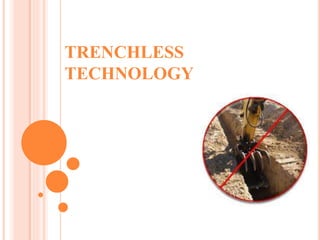
TRENCHLESS
TECHNOLOGY
INTRODUCTION
 Trenchless technology is basically making a tunnel
below the surface and installing service lines like water
or gas pipes, electric or telecommunication cables etc.
with out any disruption to the public.
 It also makes it possible to install the utilities under
rivers canals and other obstacles with no disruption of
flow and with minimum or no damage to the
environment.
NEED FOR TRENCH LESS TECHNOLOGY
 The disadvantages and difficulties encountered in
conventional trenching methods have resulted in
thinking of the need for trenchless technology.
 The advantages of the no-dig technology are also
responsible for the need of this technology to be adopted
in mainly urban areas
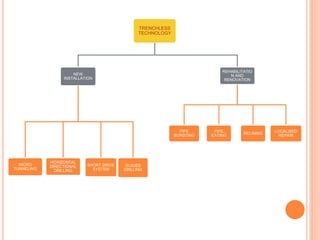
TRENCHLESS
TECHNOLOGY
NEW
INSTALLATION
MICRO
TUNNELING
HORIZONTAL
DIRECTIONAL
DRILLING
SHORT DRIVE
SYSTEM
GUIDED
DRILLING
REHABILITATIO
N AND
RENOVATION
PIPE
BURSTING
PIPE
EATING
RELINING
LOCALISED
REPAIR
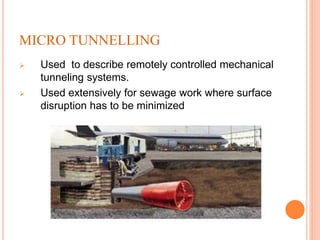
MICRO TUNNELLING
 Used to describe remotely controlled mechanical
tunneling systems.
 Used extensively for sewage work where surface
disruption has to be minimized
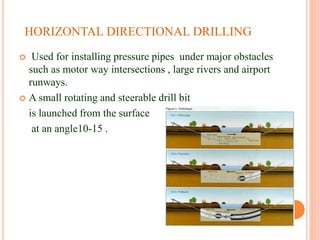
HORIZONTAL DIRECTIONAL DRILLING
 Used for installing pressure pipes under major obstacles
such as motor way intersections , large rivers and airport
runways.
 A small rotating and steerable drill bit
is launched from the surface
at an angle10-15 .
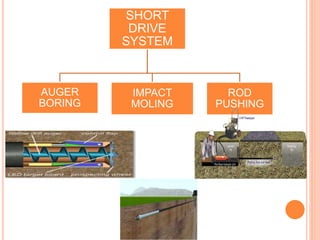
SHORT
DRIVE
SYSTEM
AUGER
BORING
IMPACT
MOLING
ROD
PUSHING
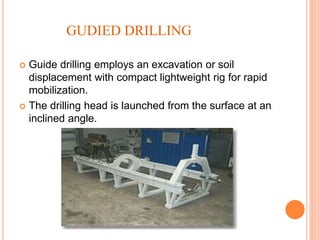
GUDIED DRILLING
 Guide drilling employs an excavation or soil
displacement with compact lightweight rig for rapid
mobilization.
 The drilling head is launched from the surface at an
inclined angle.
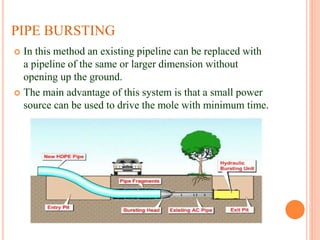
PIPE BURSTING
 In this method an existing pipeline can be replaced with
a pipeline of the same or larger dimension without
opening up the ground.
 The main advantage of this system is that a small power
source can be used to drive the mole with minimum time.
PIPE EATING
 Pipe eating is an online micro tunneled replacement
technique.
 The existing defective pipeline is crushed and removed
through the new pipeline.
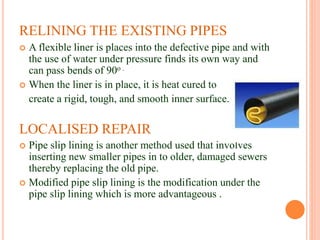
RELINING THE EXISTING PIPES
 A flexible liner is places into the defective pipe and with
the use of water under pressure finds its own way and
can pass bends of 90o .
 When the liner is in place, it is heat cured to
create a rigid, tough, and smooth inner surface.
LOCALISED REPAIR
 Pipe slip lining is another method used that involves
inserting new smaller pipes in to older, damaged sewers
thereby replacing the old pipe.
 Modified pipe slip lining is the modification under the
pipe slip lining which is more advantageous .
ADVANTAGES OF NO-DIG
TECHNOLOGY
 It reduces damages of valuable surface.
 It saves resources and it is accident free.
 It reduces the impact on the environment.
 It reduces the danger of improperly compacted
excavations.
 It saves underground space.
 For replacement, repair and rehabilitation of old water
and sewer lines in cities, it is very helpful to use trench
less technology without disturbing the normal life on the
surface.
CONCLUSION
 By adopting this technology we can successfully
implement pipes under the surface with out making any
disruptions to the environment and public.
This enables us to retain our available resources.
There by keeping the earth unexcavated
THANK YOU
QUERIES

Trenchless technology

  • 1.
  • 2.
  • 3.
    INTRODUCTION  Trenchless technologyis basically making a tunnel below the surface and installing service lines like water or gas pipes, electric or telecommunication cables etc. with out any disruption to the public.  It also makes it possible to install the utilities under rivers canals and other obstacles with no disruption of flow and with minimum or no damage to the environment.
  • 4.
    NEED FOR TRENCHLESS TECHNOLOGY  The disadvantages and difficulties encountered in conventional trenching methods have resulted in thinking of the need for trenchless technology.  The advantages of the no-dig technology are also responsible for the need of this technology to be adopted in mainly urban areas
  • 5.
  • 6.
    MICRO TUNNELLING  Usedto describe remotely controlled mechanical tunneling systems.  Used extensively for sewage work where surface disruption has to be minimized
  • 7.
    HORIZONTAL DIRECTIONAL DRILLING Used for installing pressure pipes under major obstacles such as motor way intersections , large rivers and airport runways.  A small rotating and steerable drill bit is launched from the surface at an angle10-15 .
  • 8.
  • 9.
    GUDIED DRILLING  Guidedrilling employs an excavation or soil displacement with compact lightweight rig for rapid mobilization.  The drilling head is launched from the surface at an inclined angle.
  • 10.
    PIPE BURSTING  Inthis method an existing pipeline can be replaced with a pipeline of the same or larger dimension without opening up the ground.  The main advantage of this system is that a small power source can be used to drive the mole with minimum time.
  • 11.
    PIPE EATING  Pipeeating is an online micro tunneled replacement technique.  The existing defective pipeline is crushed and removed through the new pipeline.
  • 12.
    RELINING THE EXISTINGPIPES  A flexible liner is places into the defective pipe and with the use of water under pressure finds its own way and can pass bends of 90o .  When the liner is in place, it is heat cured to create a rigid, tough, and smooth inner surface. LOCALISED REPAIR  Pipe slip lining is another method used that involves inserting new smaller pipes in to older, damaged sewers thereby replacing the old pipe.  Modified pipe slip lining is the modification under the pipe slip lining which is more advantageous .
  • 13.
    ADVANTAGES OF NO-DIG TECHNOLOGY It reduces damages of valuable surface.  It saves resources and it is accident free.  It reduces the impact on the environment.  It reduces the danger of improperly compacted excavations.  It saves underground space.  For replacement, repair and rehabilitation of old water and sewer lines in cities, it is very helpful to use trench less technology without disturbing the normal life on the surface.
  • 14.
    CONCLUSION  By adoptingthis technology we can successfully implement pipes under the surface with out making any disruptions to the environment and public. This enables us to retain our available resources. There by keeping the earth unexcavated
  • 15.
  • 16.