
How to get through an interview
for teaching post?
Presentation author:
Ms. G. Tejasri
Faculty of Engineering Sciences,
NIT AP – 534101.
Note
• This ppt is just an example and things may or
may not work as mentioned. This ppt is
intended only to give an idea on how to get
through the interview based on my personal
experience. Hope you will also get through it.
The start
• Be prepared for at least 2 subjects in your
stream.
• Try brushing up all important topics in those
subjects at least a week before.
• Prepare at least 2 topics from each subject in
detail for black board presentation (BBP).
• Try BBP at your home or in front of your friends
to know your limitations. ( It’s better to get
corrected by acquaintances rather than
interviewers).
How to prepare for a BBP?
• Generally, when you have a topic to explain,
think from students perspective.
• They usually have the following questions in
their minds: “how, when, where, what, who
and why”.
• So be ready to answer all of the above.
• In this ppt, I will show you how I have
prepared for a BBP and was successful in the
interview.
Choosing a topic
• I have chosen a very important topic called
“chlorination” from water treatment
processes chapter, Environmental Engineering.
(My domain is civil Engg.)
• Choose the topics and subjects which are
relevant to the year of the course you will be
teaching once you get the job.
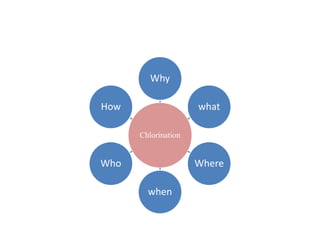
Chlorination
Why
what
Where
when
Who
How
What
• Addition of chlorine to water is called
“chlorination”.
• Chlorine is a green color gas and has
disinfecting quality. Because of its ideal and
unique nature, its accepted as “universal
disinfectant”
• Hence, chlorination is synonymously used for
“disinfection”
Questions expected
• You were talking about disinfection = chlorination.
• So they may ask, “what is the difference between
sterilization and disinfection?”
• Disinfection : killing of disease causing pathogens but
not all micro organisms. It’s a process of reduction of
no of contaminating organisms to a level that cannot
cause infection. Hence, some organisms and bacterial
spores may survive.
• Sterilization : killing of all the organisms. Generally, for
hospital usage and culture preparation where 100%
efficiency is required.
Who ?
• A C Houston from England in 1905 used
bleaching powder or chloride of lime for the
first time to disinfect water.
Questions expected
• Bleaching powder chemical formula : Ca(OCl)2
• Reactions of the same in the water.
• May be a break point chlorination graph will
also be a question to test your depth in
subject.
When?
• When water is tested and found to contain
fecal coli form.
• When Drinking water is derived from surface
sources like lake/ creek/ river.
Questions expected
• Source of fecal pollution?
• Polluted because of human feces.
• Coli form testing method may also be an
expected question.
How?
• Done in 3 different methods.
• Chlorine can be added in solid (eg: bleaching
powder contains 20 % - 30% Cl2 )/ liquid (eg:
sodium hypo chlorite i.e., NaClO contains 12 %
Cl2 ) / gaseous form (chlorine or chlorine
dioxide ClO2 gas contains 99.9 % Cl2)
• ClO2 has 100 to 200 times more oxidizing
power than Cl2
Questions expected
• Dosage recommended?
• 4 ppm as recommended by EPA.
• Free residual chlorine ?
• 0.2 ppm (desirable limit) and 1 ppm
(permissible limit).
Where?
• Water treatment for drinking purposes
especially and domestic purposes.
Questions expected
• Disadvantages of using chlorine in treatment
can be expected as its carcinogenic in nature.
• Prepare about pros and cons of the method.
Why?
• To kill pathogens that cause diseases to an
extent that their activity would not cause any
adverse effect on human / other higher forms
when consumed.
• Besides this, it also removes color, odor, taste,
Fe2+ and Mn2+
• Besides these, prepare about types like plain,
pot, pre, post chlorination etc.
• A question from WHO, IS: 10500-2012
standards an be expected.
• Don’t forget to prepare well and practice “tell
me about yourself” which will grab maximum
attention in the interview.
• Don’t stammer in between.
• Be confident and perform well.
• All the best!!
Thanks!!!

Interview hacks

  • 1.
    How to getthrough an interview for teaching post? Presentation author: Ms. G. Tejasri Faculty of Engineering Sciences, NIT AP – 534101.
  • 2.
    Note • This pptis just an example and things may or may not work as mentioned. This ppt is intended only to give an idea on how to get through the interview based on my personal experience. Hope you will also get through it.
  • 3.
    The start • Beprepared for at least 2 subjects in your stream. • Try brushing up all important topics in those subjects at least a week before. • Prepare at least 2 topics from each subject in detail for black board presentation (BBP). • Try BBP at your home or in front of your friends to know your limitations. ( It’s better to get corrected by acquaintances rather than interviewers).
  • 4.
    How to preparefor a BBP? • Generally, when you have a topic to explain, think from students perspective. • They usually have the following questions in their minds: “how, when, where, what, who and why”. • So be ready to answer all of the above. • In this ppt, I will show you how I have prepared for a BBP and was successful in the interview.
  • 5.
    Choosing a topic •I have chosen a very important topic called “chlorination” from water treatment processes chapter, Environmental Engineering. (My domain is civil Engg.) • Choose the topics and subjects which are relevant to the year of the course you will be teaching once you get the job.
  • 6.
  • 7.
    What • Addition ofchlorine to water is called “chlorination”. • Chlorine is a green color gas and has disinfecting quality. Because of its ideal and unique nature, its accepted as “universal disinfectant” • Hence, chlorination is synonymously used for “disinfection”
  • 8.
    Questions expected • Youwere talking about disinfection = chlorination. • So they may ask, “what is the difference between sterilization and disinfection?” • Disinfection : killing of disease causing pathogens but not all micro organisms. It’s a process of reduction of no of contaminating organisms to a level that cannot cause infection. Hence, some organisms and bacterial spores may survive. • Sterilization : killing of all the organisms. Generally, for hospital usage and culture preparation where 100% efficiency is required.
  • 9.
    Who ? • AC Houston from England in 1905 used bleaching powder or chloride of lime for the first time to disinfect water.
  • 10.
    Questions expected • Bleachingpowder chemical formula : Ca(OCl)2 • Reactions of the same in the water. • May be a break point chlorination graph will also be a question to test your depth in subject.
  • 11.
    When? • When wateris tested and found to contain fecal coli form. • When Drinking water is derived from surface sources like lake/ creek/ river.
  • 12.
    Questions expected • Sourceof fecal pollution? • Polluted because of human feces. • Coli form testing method may also be an expected question.
  • 13.
    How? • Done in3 different methods. • Chlorine can be added in solid (eg: bleaching powder contains 20 % - 30% Cl2 )/ liquid (eg: sodium hypo chlorite i.e., NaClO contains 12 % Cl2 ) / gaseous form (chlorine or chlorine dioxide ClO2 gas contains 99.9 % Cl2) • ClO2 has 100 to 200 times more oxidizing power than Cl2
  • 14.
    Questions expected • Dosagerecommended? • 4 ppm as recommended by EPA. • Free residual chlorine ? • 0.2 ppm (desirable limit) and 1 ppm (permissible limit).
  • 15.
    Where? • Water treatmentfor drinking purposes especially and domestic purposes.
  • 16.
    Questions expected • Disadvantagesof using chlorine in treatment can be expected as its carcinogenic in nature. • Prepare about pros and cons of the method.
  • 17.
    Why? • To killpathogens that cause diseases to an extent that their activity would not cause any adverse effect on human / other higher forms when consumed. • Besides this, it also removes color, odor, taste, Fe2+ and Mn2+
  • 18.
    • Besides these,prepare about types like plain, pot, pre, post chlorination etc. • A question from WHO, IS: 10500-2012 standards an be expected.
  • 19.
    • Don’t forgetto prepare well and practice “tell me about yourself” which will grab maximum attention in the interview. • Don’t stammer in between. • Be confident and perform well. • All the best!!
  • 20.