TRENCHLESS TECHNOLOGY
SUBMITTED TO, SUBMITTED BY,
PROF. ANUPAM MITTAL DINESH SHARMA
DEPT. OF CIVIL ENGINEERING ROLL NO. 31702114
CONTENTS
 Introduction
 Definition
 Purpose
 Methods of trenchless technology
 Effect of trenchless technology on surrounding soil
 Case Study
 Advantages
 Limitation
 Conclusion
 References
Introduction
 Digging of open trenches is a common practice for laying of almost
all underground utility services.
 Cities with growing population have road congestion, vehicular
traffic jams, increasing accidents, pollution problems, etc.
 If streets are excavated for laying pipes and cables the situation will
more difficult.
 If it happens in rainy season it involves dewatering.
 To overcome this problem Trenchless Technology is the best
solution.
Definition
 Trenchless technology can be defined as an innovative process of
installing utilities, rehabilitating and reconstructing the existing
underground utilities without digging the ground or minimum
digging.
 It also means no demolition of buildings, dislocation of traffic, or
disruption of existing sub surface cable or pipe network.
Purpose
 Gas pipeline
 Oil pipeline
 Water pipeline
 Sewer pipeline
 Electric power lines and cables
 Data communication cables
 Telecommunication cables
METHODS of
TRENCHLESS TECHNOLOGY
 Trenchless technology methods system have been categorized in to two groups
1) New installation
 Micro tunneling
 Horizontal directional drilling
 Guided drilling
2) Rehabilitation and Renovation
 Pipe bursting
 Slip lining
 Pipe eating
 Spray-On Lining
MICRO TUNNELING
 Micro tunneling is a method of installing new pipelines.
 Suitable for pipe dia. less than 1000mm and sewerage work where
surface disruption should be minimum.
Fig. showing Process of micro tunnelling
HORIZONTAL DIRECTIONAL
DRILLING
 Horizontal drilling systems are widely used for installing pipes under major
obstacles such a large rivers and airports runways.
 HDD proceeds in 3 stages
 Driving Pilot Hole
 Pre-reaming
 Pull Back
Fig. Showing components of HDD
Fig. Showing Process of Horizontal directional drilling
PIPE BURSTING
 It is a method of replacing burried pipelines such as sewer, water or
natural gas pipelines.
 An expending device called expander head is introduced into the
defective pipelines through a launching pit.
 As it travels through the pipelines towards the receiving pit, it breaks
the pipe into many small pieces, pushing the pieces into the
surrounding soil.
 New pipe is attached to the back of the expander head,replacing the
line immidiately.
Fig. Showing Pipe Bursting
SLIP LINING
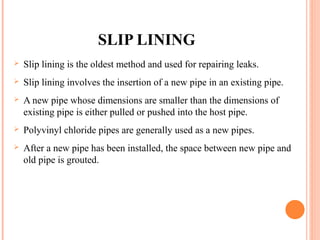
 Slip lining is the oldest method and used for repairing leaks.
 Slip lining involves the insertion of a new pipe in an existing pipe.
 A new pipe whose dimensions are smaller than the dimensions of
existing pipe is either pulled or pushed into the host pipe.
 Polyvinyl chloride pipes are generally used as a new pipes.
 After a new pipe has been installed, the space between new pipe and
old pipe is grouted.
INSERTION PIT RECEPTION PIT
Fig. Showing Slip lining
Effect of trenchless technology on
surrounding soil
 New Installation
 The primary subsurface risks associated with trenchless construction
are
 Heave
 Subsidence
 Frac-out
 Collision with underground obstacles.
 Trenchless rehabilitation methods are considered to have little to no
effect on the existing soil, with the exceptions of pipe bursting and
pipe splitting.
Case Study
 Location: Khan Market, New Delhi, OFC (Optical Fibre Cable)
 Project Name: Horizontal Directional Drilling.
 Client: Mahanagar Telephone Nigam Limited (MTNL)
 Requirements: Installation of 20cm diameter OFC to supply 4G line.
 Distance: 100m
 Crossing: Underneath the road and old Museum.
 Pit Size: Launch pit 4.5m x 1.5m
Constraints:
 Fully enclosed Garden at the centre of the museum with all plant and
equipment having to be transported through the public galleries to the
job site.
 Cable to be installed to connect the enclosed garden to a service area in
a basement 12m away.
 The cable route would be beneath the public gallery with installation
being completed during the museum’s opening hours.
 Space in the basement was extremely limited.
 The cable needed to be installed just 200mm below the buildings
foundations.
 Ground Conditions: Hard packed soil and gravel.
 Installation Time: 2 Days
 Trenchless Solution:
 To allow all equipment to be moved to the job site through the
museum by man power each 12m cable was divided into three 4m
long sections.
 Based on the calculated trajectory of the “blind shot” into the
basement portable runners were placed in the launch excavation.
 Initial set-up was very quick allowing two complete 4m sections of
cable to be installed by the end of the first day. Only 1 hour into the
second day.
 Welding of the final section of the first duct was complete and
breakthrough into the basement was observed by a very happy client.
 Soil removal was achieved by a combination of air pressure and
high pressure jetting to remove final residues.
ADVANTAGES OF TRENCHLESS
TECHNOLOGY
A. No Digging -
 The only digging involve for the access shaft located some 200M spacing.
 Even this shaft can be covered up with steel plates over which the traffic can
flow during busy day time. During lean time traffic period the shafts can be
open up & the work can carry out.
 Therefore the disturbance to traffic is minimum or negligible.
B. Trenching below the structure -
 It can be used to lay the services below the valuable property and existing
structure like building
C. Across the River or Lake -
 It is very use full for laying the service line of gas line below the river or lake.
D. Time required -
 Trenchless excavation is much faster than a conventional excavation
which may take extra time for shoring, strutting, dewatering,
backfilling etc. All of these can be avoided in Trenchless excavation.
 Trenchless technology required about 1 to 3 days where traditional
digging required about 1 to 4 weeks.
E. Site space requirement -
 At crossing trenchless technique requires 30 m2 to 80 m2 area
whereas traditional excavation requires @ 300 m2
Limitation
 If the underground strata consist of both soil and hard material like
rock or boulders different type of machine will be required which
may inconvenient and uneconomical.
 Ground obstacle like existing services, old pipe lines etc. May
create a problem
 Precise control of gradient and alignment are sometime difficult to
achieve.
 Equipment for trenchless technology are presently not manufactured
in India, additional time has to allowed while planning the work.
 The machine operator should have extensive experience in this work.
CONCLUSIONS
 Environmental friendly
 Reduce environment Construction hazards
 Reduce noise and air quality impacts
 Reduce traffic congestion
 Cost effective
 Trenchless technology is the new way forward
REFRENCES
 Sai kumar Daddala, Munasir Mohidin, “study of trenchless
technology” , INDSTT
 Su Trenchless Technology Selection Guidelines. (2010). New Delhi:
Indian Society For Trenchless Technology.
 Onkar K. Chothe,V.S. Kadam , “Comparative Study of traditional
method and innovative method for Trenchless Technology: A
Review” , International Research Journal of Engineering and
Technology (IRJET)
 www.istt.com
THANK YOU

Trenchless technology

  • 1.
    TRENCHLESS TECHNOLOGY SUBMITTED TO,SUBMITTED BY, PROF. ANUPAM MITTAL DINESH SHARMA DEPT. OF CIVIL ENGINEERING ROLL NO. 31702114
  • 2.
    CONTENTS  Introduction  Definition Purpose  Methods of trenchless technology  Effect of trenchless technology on surrounding soil  Case Study  Advantages  Limitation  Conclusion  References
  • 3.
    Introduction  Digging ofopen trenches is a common practice for laying of almost all underground utility services.  Cities with growing population have road congestion, vehicular traffic jams, increasing accidents, pollution problems, etc.  If streets are excavated for laying pipes and cables the situation will more difficult.  If it happens in rainy season it involves dewatering.  To overcome this problem Trenchless Technology is the best solution.
  • 4.
    Definition  Trenchless technologycan be defined as an innovative process of installing utilities, rehabilitating and reconstructing the existing underground utilities without digging the ground or minimum digging.  It also means no demolition of buildings, dislocation of traffic, or disruption of existing sub surface cable or pipe network.
  • 5.
    Purpose  Gas pipeline Oil pipeline  Water pipeline  Sewer pipeline  Electric power lines and cables  Data communication cables  Telecommunication cables
  • 6.
    METHODS of TRENCHLESS TECHNOLOGY Trenchless technology methods system have been categorized in to two groups 1) New installation  Micro tunneling  Horizontal directional drilling  Guided drilling 2) Rehabilitation and Renovation  Pipe bursting  Slip lining  Pipe eating  Spray-On Lining
  • 7.
    MICRO TUNNELING  Microtunneling is a method of installing new pipelines.  Suitable for pipe dia. less than 1000mm and sewerage work where surface disruption should be minimum. Fig. showing Process of micro tunnelling
  • 8.
    HORIZONTAL DIRECTIONAL DRILLING  Horizontaldrilling systems are widely used for installing pipes under major obstacles such a large rivers and airports runways.  HDD proceeds in 3 stages  Driving Pilot Hole  Pre-reaming  Pull Back
  • 9.
  • 10.
    Fig. Showing Processof Horizontal directional drilling
  • 11.
    PIPE BURSTING  Itis a method of replacing burried pipelines such as sewer, water or natural gas pipelines.  An expending device called expander head is introduced into the defective pipelines through a launching pit.  As it travels through the pipelines towards the receiving pit, it breaks the pipe into many small pieces, pushing the pieces into the surrounding soil.  New pipe is attached to the back of the expander head,replacing the line immidiately.
  • 12.
  • 13.
    SLIP LINING  Sliplining is the oldest method and used for repairing leaks.  Slip lining involves the insertion of a new pipe in an existing pipe.  A new pipe whose dimensions are smaller than the dimensions of existing pipe is either pulled or pushed into the host pipe.  Polyvinyl chloride pipes are generally used as a new pipes.  After a new pipe has been installed, the space between new pipe and old pipe is grouted.
  • 14.
    INSERTION PIT RECEPTIONPIT Fig. Showing Slip lining
  • 15.
    Effect of trenchlesstechnology on surrounding soil  New Installation  The primary subsurface risks associated with trenchless construction are  Heave  Subsidence  Frac-out  Collision with underground obstacles.  Trenchless rehabilitation methods are considered to have little to no effect on the existing soil, with the exceptions of pipe bursting and pipe splitting.
  • 16.
    Case Study  Location:Khan Market, New Delhi, OFC (Optical Fibre Cable)  Project Name: Horizontal Directional Drilling.  Client: Mahanagar Telephone Nigam Limited (MTNL)  Requirements: Installation of 20cm diameter OFC to supply 4G line.  Distance: 100m  Crossing: Underneath the road and old Museum.  Pit Size: Launch pit 4.5m x 1.5m
  • 17.
    Constraints:  Fully enclosedGarden at the centre of the museum with all plant and equipment having to be transported through the public galleries to the job site.  Cable to be installed to connect the enclosed garden to a service area in a basement 12m away.  The cable route would be beneath the public gallery with installation being completed during the museum’s opening hours.  Space in the basement was extremely limited.  The cable needed to be installed just 200mm below the buildings foundations.  Ground Conditions: Hard packed soil and gravel.  Installation Time: 2 Days
  • 18.
     Trenchless Solution: To allow all equipment to be moved to the job site through the museum by man power each 12m cable was divided into three 4m long sections.  Based on the calculated trajectory of the “blind shot” into the basement portable runners were placed in the launch excavation.  Initial set-up was very quick allowing two complete 4m sections of cable to be installed by the end of the first day. Only 1 hour into the second day.  Welding of the final section of the first duct was complete and breakthrough into the basement was observed by a very happy client.  Soil removal was achieved by a combination of air pressure and high pressure jetting to remove final residues.
  • 19.
    ADVANTAGES OF TRENCHLESS TECHNOLOGY A.No Digging -  The only digging involve for the access shaft located some 200M spacing.  Even this shaft can be covered up with steel plates over which the traffic can flow during busy day time. During lean time traffic period the shafts can be open up & the work can carry out.  Therefore the disturbance to traffic is minimum or negligible. B. Trenching below the structure -  It can be used to lay the services below the valuable property and existing structure like building C. Across the River or Lake -  It is very use full for laying the service line of gas line below the river or lake.
  • 20.
    D. Time required-  Trenchless excavation is much faster than a conventional excavation which may take extra time for shoring, strutting, dewatering, backfilling etc. All of these can be avoided in Trenchless excavation.  Trenchless technology required about 1 to 3 days where traditional digging required about 1 to 4 weeks. E. Site space requirement -  At crossing trenchless technique requires 30 m2 to 80 m2 area whereas traditional excavation requires @ 300 m2
  • 21.
    Limitation  If theunderground strata consist of both soil and hard material like rock or boulders different type of machine will be required which may inconvenient and uneconomical.  Ground obstacle like existing services, old pipe lines etc. May create a problem  Precise control of gradient and alignment are sometime difficult to achieve.  Equipment for trenchless technology are presently not manufactured in India, additional time has to allowed while planning the work.  The machine operator should have extensive experience in this work.
  • 22.
    CONCLUSIONS  Environmental friendly Reduce environment Construction hazards  Reduce noise and air quality impacts  Reduce traffic congestion  Cost effective  Trenchless technology is the new way forward
  • 23.
    REFRENCES  Sai kumarDaddala, Munasir Mohidin, “study of trenchless technology” , INDSTT  Su Trenchless Technology Selection Guidelines. (2010). New Delhi: Indian Society For Trenchless Technology.  Onkar K. Chothe,V.S. Kadam , “Comparative Study of traditional method and innovative method for Trenchless Technology: A Review” , International Research Journal of Engineering and Technology (IRJET)  www.istt.com
  • 24.

Editor's Notes

  • #4 <number>
  • #17 <number>