TRENCHLESS TECHNOLOGY
Prepared By:
PATEL HEMISHKUMAR ANILBHAI
ENROLLMENT NO: 130080714008
FIRST SEMESTER
BIRLA
VISHVAKARMA
MAHAVIDHYALAYA
GUJARAT
TECHNOLOGICAL
UNIVERSITY
M.E. [ CONSTRUCTION
ENGINEERING &
MANAGEMENT ]CONSTRUCTION TECHNIQUES
(711402)
Guide By:
PROF. JAYESHKUMAR R. PITRODA
ASSISTANT PROFESSOR & RESEARCH
SCHOLAR
CIVIL ENGINEERING DEPARTMENT
B.V.M ENGINEERING COLLEGE
CONTENTS
2
 Introduction
 History
 WHY Trenchless ?
 Trenchless methods
 New installation
 Rehabilitation and Renovation
 Techniques of Trenchless Technology
 Conclusion
 Reference
 Acknowledgement
Introduction
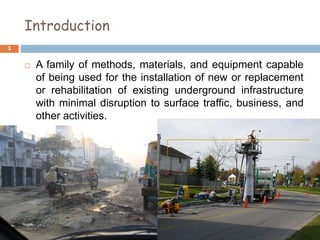
 A family of methods, materials, and equipment capable
of being used for the installation of new or replacement
or rehabilitation of existing underground infrastructure
with minimal disruption to surface traffic, business, and
other activities.
3
History
 Trenchless technology has been around for many decades
 Auger or Jack and Bore in use for 40-50 years
 Impact moles were populars for street crossings and to go
under rock gardens
 Horizontal Directional Drilling (HDD) started to gain
popularity in late 80`s
 Address at 1991 ‘ NO DIG’
4
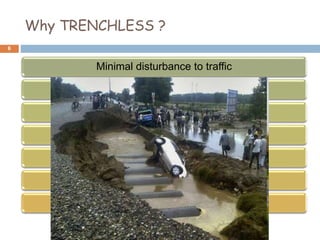
Why TRENCHLESS ?
5
Why TRENCHLESS ?
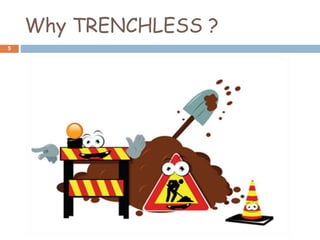
Minimal disturbance to traffic
Year around construction
Improved safety
Reduced landscape damage
Minimal disturbance to local business
Improved construction productivity
Can access otherwise inaccessible areas
6
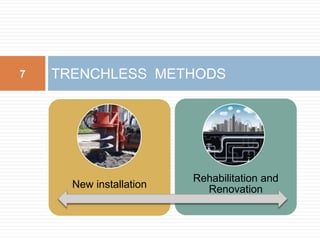
New installation
Rehabilitation and
Renovation
TRENCHLESS METHODS7
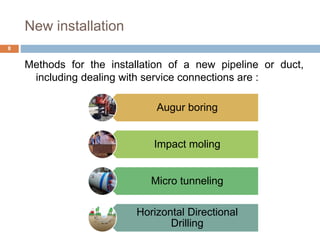
New installation
Methods for the installation of a new pipeline or duct,
including dealing with service connections are :
8
Augur boring
Impact moling
Micro tunneling
Horizontal Directional
Drilling
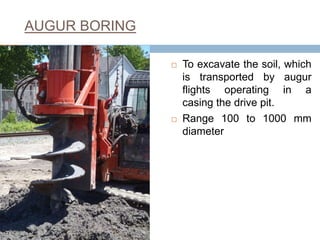
AUGUR BORING
 To excavate the soil, which
is transported by augur
flights operating in a
casing the drive pit.
 Range 100 to 1000 mm
diameter
9
IMPACT MOLING
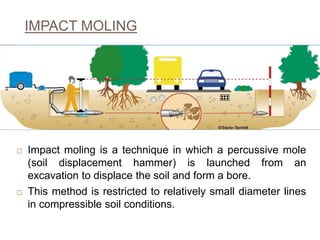
 Impact moling is a technique in which a percussive mole
(soil displacement hammer) is launched from an
excavation to displace the soil and form a bore.
 This method is restricted to relatively small diameter lines
in compressible soil conditions.
10
MICROTUNNELING
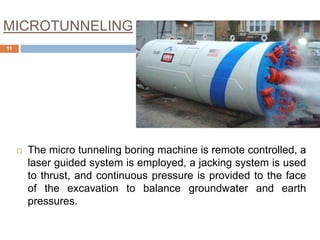
 The micro tunneling boring machine is remote controlled, a
laser guided system is employed, a jacking system is used
to thrust, and continuous pressure is provided to the face
of the excavation to balance groundwater and earth
pressures.
11
HORIZONTAL DIRECTIONAL
DRILLING (HDD)
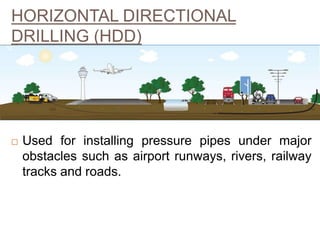
 Used for installing pressure pipes under major
obstacles such as airport runways, rivers, railway
tracks and roads.
12
Rehabilitation and Renovation
Methods including are:
i. Pipe bursting
ii. Pipe eating
iii. Relining the existing pipes
iv. Localized repair
13
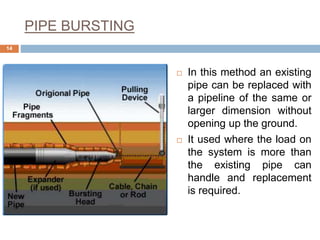
PIPE BURSTING
 In this method an existing
pipe can be replaced with
a pipeline of the same or
larger dimension without
opening up the ground.
 It used where the load on
the system is more than
the existing pipe can
handle and replacement
is required.
14
PIPE EATING
 Pipe eating is an online micro tunneled replacement
technique.
 The existing defective pipeline is crushed and removed
through the new pipeline
15
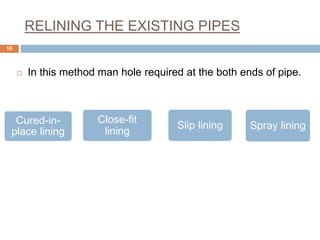
RELINING THE EXISTING PIPES
 In this method man hole required at the both ends of pipe.
16
Cured-in-
place lining
Spray liningSlip lining
Close-fit
lining
LOCALIZED REPAIR
i. Coatings
ii. Cement mortar
iii. Reinforced gunite
iv. Resin
v. Grout
17
Techniques of Trenchless Technology
i. Augur boring
ii. Moling
iii. Ramming
iv. Directional drilling
18
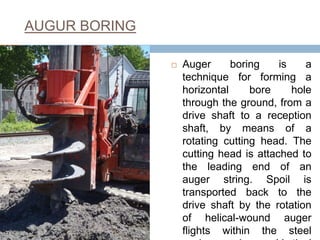
AUGUR BORING
 Auger boring is a
technique for forming a
horizontal bore hole
through the ground, from a
drive shaft to a reception
shaft, by means of a
rotating cutting head. The
cutting head is attached to
the leading end of an
auger string. Spoil is
transported back to the
drive shaft by the rotation
of helical-wound auger
flights within the steel
19
Advantages
A
U
G
U
R
B
O
R
I
N
G
 The major advantage is that the casing is
installed at the same time as the borehole
excavation takes place.
 This method can be used wide variety of soil
types.
20
Disadvantages
A
U
G
U
R
B
O
R
I
N
G
 This method requires different size cutting
heads and augur sizes or each casing diameter,
which increases the investment in equipment.
 The investment in bore, pit construction, and
the initial setup is also required.
 In case of soils containing large boulders, this
method cannot be used advantageously.
21
MOLING
 Instead pits are excavated at intervals for the mole to be
placed. The mole is then entered into the earth on the
horizontal face at the bottom of the pit. Destination pits of
similar proportions are also dug.
 The mole displaces the soil creating a bore for the new
services to then be pulled through.
22
Advantages
M
O
L
I
N
G
 It is a rapid, economic, and effective method of
installing small diameter lines.
 Any type of utility line can be installed using this
method.
 The stability of the soil around the borehole is
increased due to compaction.
 The investment in equipment is minimum.
23
Disadvantages
M
O
L
I
N
G
 Compaction method are limited in their length
by reliability because basic systems are
unintelligent, unguided tools that tend to bury
themselves, surface in the middle road or
damage exiting utility lines.
24
RAMMING
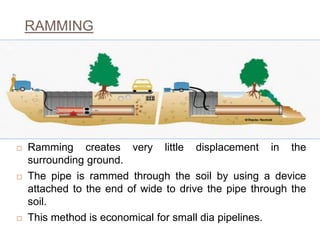
 Ramming creates very little displacement in the
surrounding ground.
 The pipe is rammed through the soil by using a device
attached to the end of wide to drive the pipe through the
soil.
 This method is economical for small dia pipelines.
25
DIRECTIONAL DRILLING (DD)
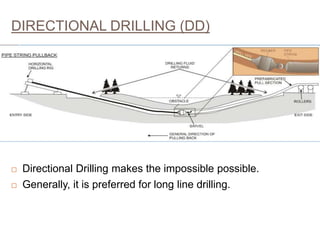
 Directional Drilling makes the impossible possible.
 Generally, it is preferred for long line drilling.
26
Advantages
D
D
 The major advantage is the speed of installation
combined with the minimum environmental and
social impact.
 Long and complicated crossings can be
accomplished with a great degree of accuracy.
 Sufficient depth can be accomplished to avoid
other utilities.
 Limitation of access and reception pits is
another advantage.
27
Disadvantages
D
D
 Special equipment and very high degree of
operation skill is required.
 As the cost of equipment and the operation are
high, bore length should be sufficient in order
for it to be economical.
 Mainly steel pipe is being installed by this
method.
28
CONCLUSION
 Cost effective
 Low labor requirements
 Little site restoration required
 Environmental friendly
 Reduce environment Construction hazards
 Reduce noise and air quality impacts
 Reduce traffic congestion
 Trenchless technology is the new way forward.
29
Reference
30
 www.groundforce.uk.com/Trenchless+Technology
 www.istt.com/guidelines/pipe-jacking-
microtunneling
 www.trenchlesssolutions.co.uk/services/impact-
moling
 www.molingsolutions.co.uk/
 www.tedberrycompany.com
 www.tritonpipelining.com
ACKNOWLEGEMENT
31
 DR. F. S. Umrigar, Principal, B.V.M. Engineering college,
Prof. J. J. Bhavsar, Associate Prof., PG co-ordinator, cvil
engineering department, B.V.M. Engineering college Vallabh
Vidhyanagar, Gujrat, India for their motivation and
infrastructural support to carry out the research work.
 Prof. Jayeshkumar R. Pitroda assitant prof. And research
scholar civil engineering department, B.V.M. Engineering
college Vallabh Vidhyanagar.
32
THANK

trenchless technology

  • 1.
    TRENCHLESS TECHNOLOGY Prepared By: PATELHEMISHKUMAR ANILBHAI ENROLLMENT NO: 130080714008 FIRST SEMESTER BIRLA VISHVAKARMA MAHAVIDHYALAYA GUJARAT TECHNOLOGICAL UNIVERSITY M.E. [ CONSTRUCTION ENGINEERING & MANAGEMENT ]CONSTRUCTION TECHNIQUES (711402) Guide By: PROF. JAYESHKUMAR R. PITRODA ASSISTANT PROFESSOR & RESEARCH SCHOLAR CIVIL ENGINEERING DEPARTMENT B.V.M ENGINEERING COLLEGE
  • 2.
    CONTENTS 2  Introduction  History WHY Trenchless ?  Trenchless methods  New installation  Rehabilitation and Renovation  Techniques of Trenchless Technology  Conclusion  Reference  Acknowledgement
  • 3.
    Introduction  A familyof methods, materials, and equipment capable of being used for the installation of new or replacement or rehabilitation of existing underground infrastructure with minimal disruption to surface traffic, business, and other activities. 3
  • 4.
    History  Trenchless technologyhas been around for many decades  Auger or Jack and Bore in use for 40-50 years  Impact moles were populars for street crossings and to go under rock gardens  Horizontal Directional Drilling (HDD) started to gain popularity in late 80`s  Address at 1991 ‘ NO DIG’ 4
  • 5.
  • 6.
    Why TRENCHLESS ? Minimaldisturbance to traffic Year around construction Improved safety Reduced landscape damage Minimal disturbance to local business Improved construction productivity Can access otherwise inaccessible areas 6
  • 7.
  • 8.
    New installation Methods forthe installation of a new pipeline or duct, including dealing with service connections are : 8 Augur boring Impact moling Micro tunneling Horizontal Directional Drilling
  • 9.
    AUGUR BORING  Toexcavate the soil, which is transported by augur flights operating in a casing the drive pit.  Range 100 to 1000 mm diameter 9
  • 10.
    IMPACT MOLING  Impactmoling is a technique in which a percussive mole (soil displacement hammer) is launched from an excavation to displace the soil and form a bore.  This method is restricted to relatively small diameter lines in compressible soil conditions. 10
  • 11.
    MICROTUNNELING  The microtunneling boring machine is remote controlled, a laser guided system is employed, a jacking system is used to thrust, and continuous pressure is provided to the face of the excavation to balance groundwater and earth pressures. 11
  • 12.
    HORIZONTAL DIRECTIONAL DRILLING (HDD) Used for installing pressure pipes under major obstacles such as airport runways, rivers, railway tracks and roads. 12
  • 13.
    Rehabilitation and Renovation Methodsincluding are: i. Pipe bursting ii. Pipe eating iii. Relining the existing pipes iv. Localized repair 13
  • 14.
    PIPE BURSTING  Inthis method an existing pipe can be replaced with a pipeline of the same or larger dimension without opening up the ground.  It used where the load on the system is more than the existing pipe can handle and replacement is required. 14
  • 15.
    PIPE EATING  Pipeeating is an online micro tunneled replacement technique.  The existing defective pipeline is crushed and removed through the new pipeline 15
  • 16.
    RELINING THE EXISTINGPIPES  In this method man hole required at the both ends of pipe. 16 Cured-in- place lining Spray liningSlip lining Close-fit lining
  • 17.
    LOCALIZED REPAIR i. Coatings ii.Cement mortar iii. Reinforced gunite iv. Resin v. Grout 17
  • 18.
    Techniques of TrenchlessTechnology i. Augur boring ii. Moling iii. Ramming iv. Directional drilling 18
  • 19.
    AUGUR BORING  Augerboring is a technique for forming a horizontal bore hole through the ground, from a drive shaft to a reception shaft, by means of a rotating cutting head. The cutting head is attached to the leading end of an auger string. Spoil is transported back to the drive shaft by the rotation of helical-wound auger flights within the steel 19
  • 20.
    Advantages A U G U R B O R I N G  The majoradvantage is that the casing is installed at the same time as the borehole excavation takes place.  This method can be used wide variety of soil types. 20
  • 21.
    Disadvantages A U G U R B O R I N G  This methodrequires different size cutting heads and augur sizes or each casing diameter, which increases the investment in equipment.  The investment in bore, pit construction, and the initial setup is also required.  In case of soils containing large boulders, this method cannot be used advantageously. 21
  • 22.
    MOLING  Instead pitsare excavated at intervals for the mole to be placed. The mole is then entered into the earth on the horizontal face at the bottom of the pit. Destination pits of similar proportions are also dug.  The mole displaces the soil creating a bore for the new services to then be pulled through. 22
  • 23.
    Advantages M O L I N G  It isa rapid, economic, and effective method of installing small diameter lines.  Any type of utility line can be installed using this method.  The stability of the soil around the borehole is increased due to compaction.  The investment in equipment is minimum. 23
  • 24.
    Disadvantages M O L I N G  Compaction methodare limited in their length by reliability because basic systems are unintelligent, unguided tools that tend to bury themselves, surface in the middle road or damage exiting utility lines. 24
  • 25.
    RAMMING  Ramming createsvery little displacement in the surrounding ground.  The pipe is rammed through the soil by using a device attached to the end of wide to drive the pipe through the soil.  This method is economical for small dia pipelines. 25
  • 26.
    DIRECTIONAL DRILLING (DD) Directional Drilling makes the impossible possible.  Generally, it is preferred for long line drilling. 26
  • 27.
    Advantages D D  The majoradvantage is the speed of installation combined with the minimum environmental and social impact.  Long and complicated crossings can be accomplished with a great degree of accuracy.  Sufficient depth can be accomplished to avoid other utilities.  Limitation of access and reception pits is another advantage. 27
  • 28.
    Disadvantages D D  Special equipmentand very high degree of operation skill is required.  As the cost of equipment and the operation are high, bore length should be sufficient in order for it to be economical.  Mainly steel pipe is being installed by this method. 28
  • 29.
    CONCLUSION  Cost effective Low labor requirements  Little site restoration required  Environmental friendly  Reduce environment Construction hazards  Reduce noise and air quality impacts  Reduce traffic congestion  Trenchless technology is the new way forward. 29
  • 30.
    Reference 30  www.groundforce.uk.com/Trenchless+Technology  www.istt.com/guidelines/pipe-jacking- microtunneling www.trenchlesssolutions.co.uk/services/impact- moling  www.molingsolutions.co.uk/  www.tedberrycompany.com  www.tritonpipelining.com
  • 31.
    ACKNOWLEGEMENT 31  DR. F.S. Umrigar, Principal, B.V.M. Engineering college, Prof. J. J. Bhavsar, Associate Prof., PG co-ordinator, cvil engineering department, B.V.M. Engineering college Vallabh Vidhyanagar, Gujrat, India for their motivation and infrastructural support to carry out the research work.  Prof. Jayeshkumar R. Pitroda assitant prof. And research scholar civil engineering department, B.V.M. Engineering college Vallabh Vidhyanagar.
  • 32.