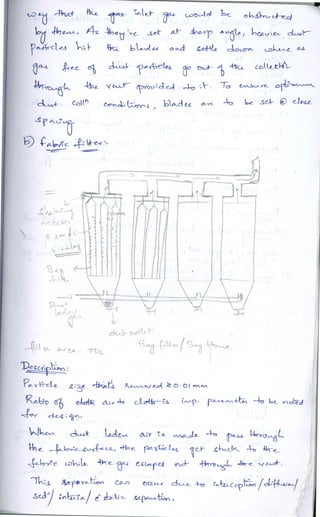
Gravity settling chamber:
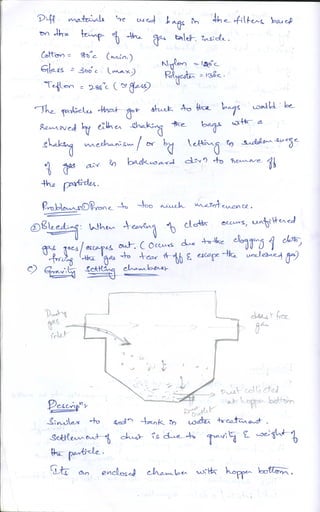
It’s similar to sedimentation tank in water treatment units. It does not use any external force to remove
the particles. Dust settles due to the weight of the particle and the gravity acting on it. It consists of an
enclosed chamber with hopper bottom. The dusty gas is made to enter through one end of the chamber
and the cleaned gas leaves the chamber from the opposite side. Settling of the particles and the
efficiency of the system depends on the velocity of the inlet gas. Less is the velocity, more is the
settlement, more is the efficiency, and more is the time required for settlement making the system
uneconomical. Hence, an optimum velocity of 0.3 mps is set for separating dust from the gas stream.
This system removes particles of size 40 mm.
Pros:
Low pressure loss.
Simple in design and maintenance.
Cons:
Low collection efficiency.
More space requirement.
Gravity settling chamber with trays:
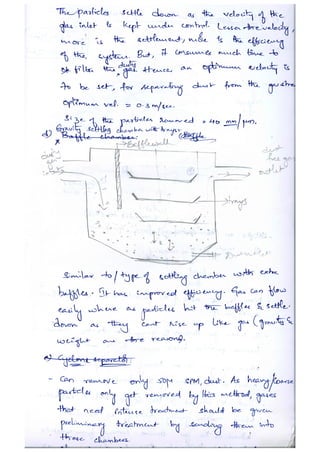
This is similar to that of Gravity settling chamber and is advancement over it. It has baffle wall at the
inlet and series of trays arranged one above to the inner side of the closed chamber. Baffle wall is
provided to change the direction of the stream and trays are provided so that the particles can settle
then and there even before reaching the hopper bottom. Because of providing the trays, smaller
particles which may escape out in their absence will also settle as they hit the trays. Hence, this system
has improved efficiency than gravity settling chambers. It can remove SPM and coarse dust particles
only. Hence, those gases which need intense treatment should be given a preliminary treatment using
these dust collectors.
Dust settles due to the weight of the particle and the gravity acting on it. It consists of an enclosed
chamber with hopper bottom. The dusty gas is made to enter through one end of the chamber and the
cleaned gas leaves the chamber from the opposite side. Settling of the particles and the efficiency of the
system depends on the velocity of the inlet gas. Less is the velocity, more is the settlement, more is the
efficiency, and more is the time required for settlement making the system uneconomical. Hence, an
optimum velocity of 0.3 mps is set for separating dust from the gas stream.
Pros:
Low pressure drop.
Simplicity of design and maintenance.
Cons:
Low collection efficiency.
More space requirement.
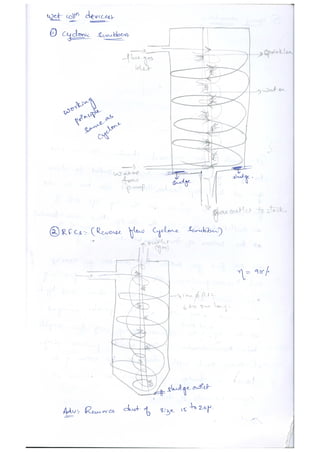
Cyclone separator/ centrifugal separator:
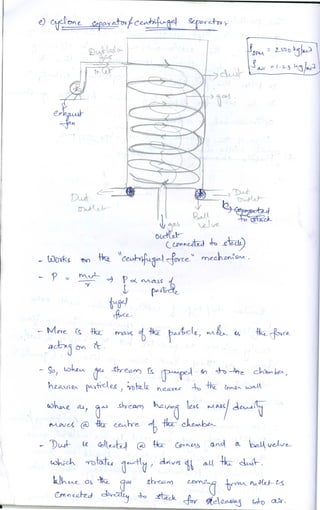
It consists of a long cylindrical steel chamber with an inlet at the top for dusty gas, an outlet for cleaned
gas at the bottom and two outlets connected with ball valves at both the sides of the bottom for
removing the collected dust.
It mainly works on the principle of centrifugal force which is directly proportional to the mass and
square of its velocity. More is the mass of the particle; more is the centrifugal force acting on it.
When dusty air is pumped into the chamber, due to more density (2500 kg/m3
) dust tends to rotate near
the walls of the chamber where as air (density = 1.23 kg/m3
) moves at the centre of the chamber. As the
dust hits the walls and falls down, it will be collected at the corners and driven off gently with the help
of ball valves. Whereas, the gas stream coming from outlet is directly connected to the stack for
releasing into the air.
Pros:
Simplicity of design and maintenance
Little floor space is required
Dry continuous disposal of collected dust
Low to moderate pressure drop
Temperature independent
Handles high dust loadings
Cons:
Much head room is required
Low collection efficiency of small particles
Sensitive to variable dust loadings and flow rates
Tends to clog up
Removal of gaseous pollutants:
Gaseous pollutants can be removed either by physical or chemical methods based on the physical and
chemical characteristics of the pollutants and by the economic and environmental considerations.
Gaseous industrial pollutants include acid gases (HCl2, H2, SO4, HBr, HCN, H2S, HF, etc), other inorganic
vapours (SOx, NOx, NH3, Cl2, etc) and organic vapours (formaldehyde, ethylene, benzene, etc).
Methods employed:
1. Absorption
2. Adsorption
3. Combustion/ Catalytic oxidation
4. Condensation
Absorption:
It’s the removal of one or more selected components from a mixture of gases by absorption into a
suitable liquid. The efficiency of the gas absorption depends upon the chemical reactivity of the
pollutant gas in the liquid phase. In the gas absorption techniques, gases are passed through scrubbers
or absorbers containing liquid absorbents that remove, treat or modify one or more of the offending
constituents in the gas stream.
It (literally means “taking in”, material that absorbs is called the solvent, gas being absorbed is called the
solute) is one of main mechanisms utilised within the industrial air pollution control industry to remove
gaseous pollutants. Operation - needs to be a sufficient contacting area between gas and solvent and
sufficient contact time.
It can be considered in two groups - those where process are solely physical and those where a chemical
reaction is occurring.
Physical: Two phases are brought into contact with each other - thus water in contact with air
evaporates until the air is saturated with water vapour and the air is absorbed by the water until it
becomes saturated with the individual gases. The degree of absorption is determined by its partial
pressure (dependant on its temp. and concentration. gas reaches equilibrium with a solvent without
changing its chemical properties (e.g. collection of gaseous HCl into water. HCl gas is very soluble in
water and readily absorbed. Within water, liquid HCl is formed
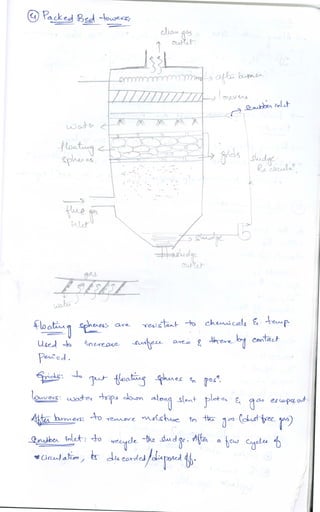
E.g. Wetted-wall columns/packed towers/spray towers
Chemical: The gas reacts chemically with a component of the liquid phase - in the cleaning of CO2 it
reacts directly with caustic soda or ethanolamine solution. The solute is chemically reacted with solvent
to form a new compound. Rate of absorption is directly related to the difference between the
concentration of the solute within the bulk gas and the concentration of the solvent will contain at
equilibrium. The chemical reactions used in absorption are relatively rapid when compared to time
required for mass transfer - usually assumed to be instantaneous.
Reactions are as follows:
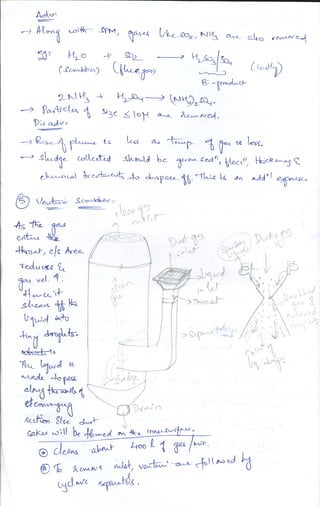
NH3 + H2SO4  (NH4)2SO4
SO2 + H2O  H2SO4 / H2SO3
Adsorption:
Like absorption is a mass transport operation, adsorption captures instead of chemically altering or
destroying the adsorbate. Often used where recovery of adsorbate is desired.
A porous solid will be brought into contact with either a liquid or gaseous fluid stream to selectively
remove unwanted contaminants by depositing them on the solid
It is a surface phenomenon in which, when 2 phases are brought together into contact with each other,
one phase or some constituent gets accumulated more at the interface than in bulk. It occurs on the
active site of the solid surface.
(Contaminant – adsorbate; collecting media – adsorbent)
The surface on which adsorption takes place is called adsorbent.
E.g.: Activated carbon, activated silica, activated alumina; molecular sieves are some of the adsorbents
The surface on to which the substance gets adsorbed is called adsorbate.
Adsorbent may capture the adsorbate by both physical and chemical means.
If the bonds formed between adsorbate - adsorbent is very weak, it’s called physisorption. It occurs due
to Vander walls forces and is reversible. Adsorbate molecules adhere to the adsorbent material (physical
bonding force) - condense on surface of adsorbent, releasing heat. If adsorbent is highly porous -
greater surface area.
If the bonds formed between adsorbate - adsorbent is very strong, it’s called chemisorption. It’s almost
irreversible. Usually occurs at elevated temperatures where there is adequate available energy to make
or break chemical bonds.
Air pollution notes
Air pollution notes
Air pollution notes
Air pollution notes
Air pollution notes
Air pollution notes
Air pollution notes
Air pollution notes
Air pollution notes
Air pollution notes
Air pollution notes
Air pollution notes

Air pollution notes

  • 1.
    Gravity settling chamber: It’ssimilar to sedimentation tank in water treatment units. It does not use any external force to remove the particles. Dust settles due to the weight of the particle and the gravity acting on it. It consists of an enclosed chamber with hopper bottom. The dusty gas is made to enter through one end of the chamber and the cleaned gas leaves the chamber from the opposite side. Settling of the particles and the efficiency of the system depends on the velocity of the inlet gas. Less is the velocity, more is the settlement, more is the efficiency, and more is the time required for settlement making the system uneconomical. Hence, an optimum velocity of 0.3 mps is set for separating dust from the gas stream. This system removes particles of size 40 mm. Pros: Low pressure loss. Simple in design and maintenance. Cons: Low collection efficiency. More space requirement. Gravity settling chamber with trays: This is similar to that of Gravity settling chamber and is advancement over it. It has baffle wall at the inlet and series of trays arranged one above to the inner side of the closed chamber. Baffle wall is provided to change the direction of the stream and trays are provided so that the particles can settle then and there even before reaching the hopper bottom. Because of providing the trays, smaller particles which may escape out in their absence will also settle as they hit the trays. Hence, this system has improved efficiency than gravity settling chambers. It can remove SPM and coarse dust particles only. Hence, those gases which need intense treatment should be given a preliminary treatment using these dust collectors. Dust settles due to the weight of the particle and the gravity acting on it. It consists of an enclosed chamber with hopper bottom. The dusty gas is made to enter through one end of the chamber and the cleaned gas leaves the chamber from the opposite side. Settling of the particles and the efficiency of the system depends on the velocity of the inlet gas. Less is the velocity, more is the settlement, more is the efficiency, and more is the time required for settlement making the system uneconomical. Hence, an optimum velocity of 0.3 mps is set for separating dust from the gas stream. Pros: Low pressure drop. Simplicity of design and maintenance. Cons: Low collection efficiency. More space requirement. Cyclone separator/ centrifugal separator:
  • 2.
    It consists ofa long cylindrical steel chamber with an inlet at the top for dusty gas, an outlet for cleaned gas at the bottom and two outlets connected with ball valves at both the sides of the bottom for removing the collected dust. It mainly works on the principle of centrifugal force which is directly proportional to the mass and square of its velocity. More is the mass of the particle; more is the centrifugal force acting on it. When dusty air is pumped into the chamber, due to more density (2500 kg/m3 ) dust tends to rotate near the walls of the chamber where as air (density = 1.23 kg/m3 ) moves at the centre of the chamber. As the dust hits the walls and falls down, it will be collected at the corners and driven off gently with the help of ball valves. Whereas, the gas stream coming from outlet is directly connected to the stack for releasing into the air. Pros: Simplicity of design and maintenance Little floor space is required Dry continuous disposal of collected dust Low to moderate pressure drop Temperature independent Handles high dust loadings Cons: Much head room is required Low collection efficiency of small particles Sensitive to variable dust loadings and flow rates Tends to clog up Removal of gaseous pollutants: Gaseous pollutants can be removed either by physical or chemical methods based on the physical and chemical characteristics of the pollutants and by the economic and environmental considerations. Gaseous industrial pollutants include acid gases (HCl2, H2, SO4, HBr, HCN, H2S, HF, etc), other inorganic vapours (SOx, NOx, NH3, Cl2, etc) and organic vapours (formaldehyde, ethylene, benzene, etc). Methods employed: 1. Absorption 2. Adsorption 3. Combustion/ Catalytic oxidation 4. Condensation Absorption: It’s the removal of one or more selected components from a mixture of gases by absorption into a suitable liquid. The efficiency of the gas absorption depends upon the chemical reactivity of the pollutant gas in the liquid phase. In the gas absorption techniques, gases are passed through scrubbers or absorbers containing liquid absorbents that remove, treat or modify one or more of the offending constituents in the gas stream.
  • 3.
    It (literally means“taking in”, material that absorbs is called the solvent, gas being absorbed is called the solute) is one of main mechanisms utilised within the industrial air pollution control industry to remove gaseous pollutants. Operation - needs to be a sufficient contacting area between gas and solvent and sufficient contact time. It can be considered in two groups - those where process are solely physical and those where a chemical reaction is occurring. Physical: Two phases are brought into contact with each other - thus water in contact with air evaporates until the air is saturated with water vapour and the air is absorbed by the water until it becomes saturated with the individual gases. The degree of absorption is determined by its partial pressure (dependant on its temp. and concentration. gas reaches equilibrium with a solvent without changing its chemical properties (e.g. collection of gaseous HCl into water. HCl gas is very soluble in water and readily absorbed. Within water, liquid HCl is formed E.g. Wetted-wall columns/packed towers/spray towers Chemical: The gas reacts chemically with a component of the liquid phase - in the cleaning of CO2 it reacts directly with caustic soda or ethanolamine solution. The solute is chemically reacted with solvent to form a new compound. Rate of absorption is directly related to the difference between the concentration of the solute within the bulk gas and the concentration of the solvent will contain at equilibrium. The chemical reactions used in absorption are relatively rapid when compared to time required for mass transfer - usually assumed to be instantaneous. Reactions are as follows: NH3 + H2SO4  (NH4)2SO4 SO2 + H2O  H2SO4 / H2SO3 Adsorption: Like absorption is a mass transport operation, adsorption captures instead of chemically altering or destroying the adsorbate. Often used where recovery of adsorbate is desired. A porous solid will be brought into contact with either a liquid or gaseous fluid stream to selectively remove unwanted contaminants by depositing them on the solid It is a surface phenomenon in which, when 2 phases are brought together into contact with each other, one phase or some constituent gets accumulated more at the interface than in bulk. It occurs on the active site of the solid surface. (Contaminant – adsorbate; collecting media – adsorbent) The surface on which adsorption takes place is called adsorbent. E.g.: Activated carbon, activated silica, activated alumina; molecular sieves are some of the adsorbents The surface on to which the substance gets adsorbed is called adsorbate. Adsorbent may capture the adsorbate by both physical and chemical means. If the bonds formed between adsorbate - adsorbent is very weak, it’s called physisorption. It occurs due to Vander walls forces and is reversible. Adsorbate molecules adhere to the adsorbent material (physical bonding force) - condense on surface of adsorbent, releasing heat. If adsorbent is highly porous - greater surface area. If the bonds formed between adsorbate - adsorbent is very strong, it’s called chemisorption. It’s almost irreversible. Usually occurs at elevated temperatures where there is adequate available energy to make or break chemical bonds.