Treasure Mountain
Research Retreat
http://digitallearningforallnow.com
http://www.slideshare.net/jpcostasr
http://www.newsela.com
http://www.rapgenius.com

Jonathan P. Costa, Sr.
The Mission
To prepare
EVERY student
for learning, life,
and work
in the 21st century.

© Corwin Press - 2011
Our world has changed…
1. It is flat.
2. It is digital.
3. It is constantly
evolving.
4. It is increasingly
unforgiving to those
who are unskilled.
http://digitallearningforallnow.com
© Corwin Press - 2011
Job one
is to
get to

1:1
© Corwin Press - 2011
Equity
Concerns
Until everyone can
have the same
thing, no one can
have anything.

Equitably deficient.
© Corwin Press - 2011
Equity
Equation
A device gap is
less
objectionable
than an
access gap.
© Corwin Press - 2011
Less &
More
Less
paper,
more
pixels.
Impact on
learning…
You must
(eventually)
get out of
the textbook
business.
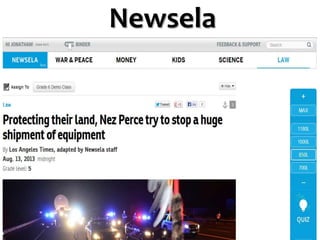
Newsela
Less &
More
Less single
source,
more
crowd
source.
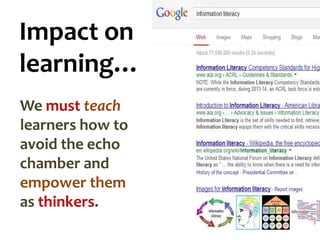
Impact on
learning…
We must teach
learners how to
avoid the echo
chamber and
empower them
as thinkers.
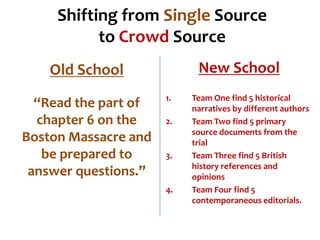
Shifting from Single Source
to Crowd Source
New School

Old School
“Read the part of
chapter 6 on the
Boston Massacre and
be prepared to
answer questions.”

1.
2.

3.

4.

Team One find 5 historical
narratives by different authors
Team Two find 5 primary
source documents from the
trial
Team Three find 5 British
history references and
opinions
Team Four find 5
contemporaneous editorials.
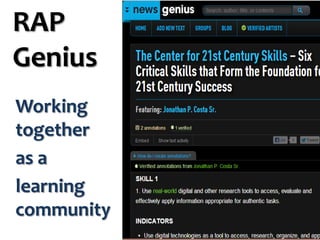
RAP
Genius
Working
together
as a
learning
community
Less &
More
Less
just in case,
more
just in time.
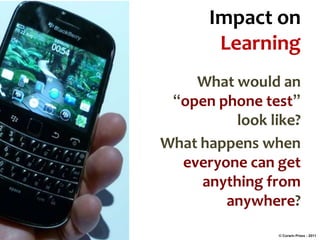
Impact on
Learning
What would an
“open phone test”
look like?
What happens when
everyone can get
anything from
anywhere?
© Corwin Press - 2011
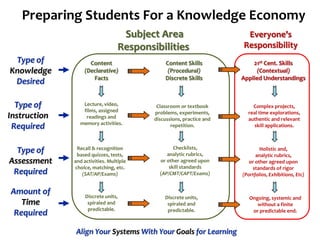
Preparing Students For a Knowledge Economy
Subject Area
Responsibilities
Type of
Knowledge
Desired
Type of
Instruction
Required

Content
(Declarative)
Facts

Lecture, video,
films, assigned
readings and
memory activities.

Type of
Assessment
Required

Recall & recognition
based quizzes, tests,
and activities. Multiple
choice, matching, etc.
(SAT/AP/Exams)

Amount of
Time
Required

Discrete units,
spiraled and
predictable.

Content Skills
(Procedural)
Discrete Skills

Classroom or textbook
problems, experiments,
discussions, practice and
repetition.

Checklists,
analytic rubrics,
or other agreed upon
skill standards
(AP/CMT/CAPT/Exams)

Discrete units,
spiraled and
predictable.

Align Your Systems With Your Goals for Learning

Everyone’s
Responsibility
21st Cent. Skills
(Contextual)
Applied Understandings

Complex projects,
real time explorations,
authentic and relevant
skill applications.

Holistic and,
analytic rubrics,
or other agreed upon
standards of rigor
(Portfolios, Exhibitions, Etc)

Ongoing, systemic and
without a finite
or predictable end.
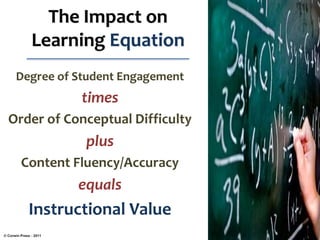
The Impact on
Learning Equation
Degree of Student Engagement

times
Order of Conceptual Difficulty

plus
Content Fluency/Accuracy

equals

Instructional Value
© Corwin Press - 2011
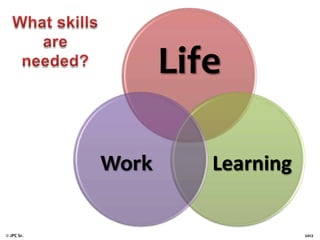
Life
Work

© JPC Sr.

Learning

2012
Student Skills

Questions, Objections, and Reflections

Professional Skills

Treasure Mountain Share

Editor's Notes

  • #3 This is the defining challenge of our times in public school.
  • #5 With that accomplished, all else is possible.Without it, your future is your print-based past.
  • #6 The only solution then is to wait – wait until that day when we can afford to buy every student the same device.Is it really more equitable to say that no one has access to technology until everyone can have the same thing?It’s not about the device, its about what we do with it.The only solution then is to wait – wait until that day when we can afford to buy every student the same device.Is it really more equitable to say that no one has access to technology until everyone can have the same thing?It’s not about the device, its about what we do with it.The only solution then is to wait – wait until that day when we can afford to buy every student the same device.Is it really more equitable to say that no one has access to technology until everyone can have the same thing?It’s not about the device, its about what we do with it.The only solution then is to wait – wait until that day when we can afford to buy every student the same device.Is it really more equitable to say that no one has access to technology until everyone can have the same thing?It’s not about the device, its about what we do with it.
  • #7 What is worse?