Fundamentalism, Legacy, Implosion,
    Explosion, Fact and Fiction:
     Perspectives on Learning
 Technologies for the South African
            landscape

       Duan van der Westhuizen
         University of Johannesburg
              12 September 2012
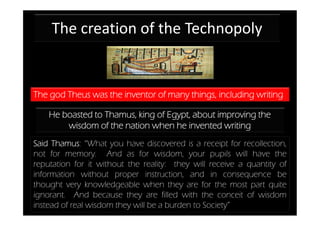
The creation of the Technopoly


The god Theus was the inventor of many things, including writing

    He boasted to Thamus, king of Egypt, about improving the
        wisdom of the nation when he invented writing
Said Thamus: “What you have discovered is a receipt for recollection,
not for memory. And as for wisdom, your pupils will have the
reputation for it without the reality: they will receive a quantity of
information without proper instruction, and in consequence be
thought very knowledgeable when they are for the most part quite
ignorant. And because they are filled with the conceit of wisdom
instead of real wisdom they will be a burden to Society”
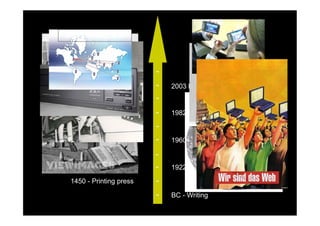
Web 3.0? Web 4.0?


 2004 - Web 2.0/FOSS

                         2003 Mobile learning
 1989 - The Internet

                         1982 - Computer Multimedia
 19xx VCR/ Laser
 Discs/Television
                         1960 - Teaching machines

 1930 - Radio
                         1922 - Film

 1450 - Printing press

                         BC - Writing
Education surrenders to the Technopoly
• 1975: Seymour Paper - Logo – Microworlds
• “Technology …. going to displace school and
  the way we understand school”
• 1985: Apple Classroom of tomorrow
• No empirical evidence > greater achievement
• Higher Education: Online education became
  “educationally seductive”
• Learning Management Systems 
• Digital Diploma Mills (Noble, 1998)
• Commodification of knowledge (Amory)
So much going on …


    Web
 Analytics 2.0
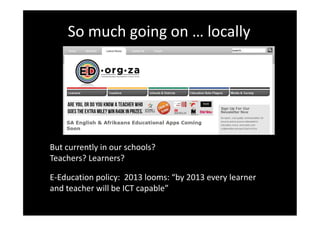
So much going on … locally


But currently in our schools?
Teachers? Learners?

E-Education policy: 2013 looms: “by 2013 every learner
and teacher will be ICT capable”
What’s else is hot?
•   MOOC (e.g. mobiMOOC)
•   Webinars
•   Tablets & mobile learning
•   The ‘flipped classroom’
•   Digital storytelling
•   Publishers and LMS vendors collaboration
•   Making e-Books
•   Cloud computing
•   Crowdsourcing
•   Badge-based learning
•   Megatrends: http://goo.gl/dqHaB
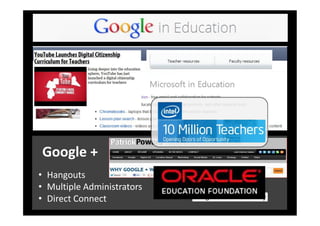
Google in Education


Google +
• Hangouts
• Multiple Administrators
• Direct Connect
Learning Technologies: Mashups
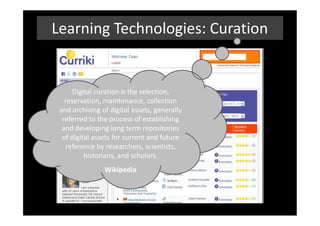
Learning Technologies: Curation


      Digital curation is the selection,
   reservation, maintenance, collection
 and archiving of digital assets, generally
  referred to the process of establishing
  and developing long term repositories
  of digital assets for current and future
    reference by researchers, scientists,
          historians, and scholars.
                Wikipedia
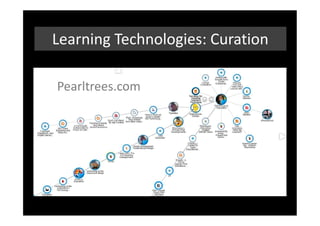
Learning Technologies: Curation

Pearltrees.com
The knowledge of the world in your
            pocket?
Learning Technologies: Resources
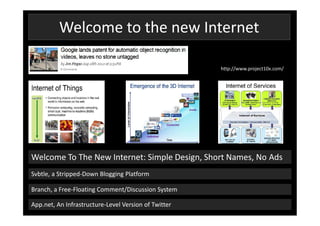
Welcome to the new Internet

                                                      http://www.project10x.com/


Welcome To The New Internet: Simple Design, Short Names, No Ads
Svbtle, a Stripped-Down Blogging Platform

Branch, a Free-Floating Comment/Discussion System

App.net, An Infrastructure-Level Version of Twitter
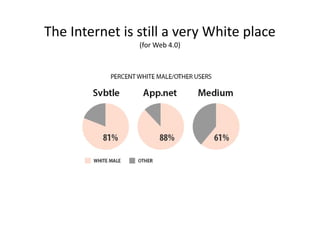
The Internet is still a very White place
                (for Web 4.0)
What does RESEARCH say?
The positive impact of ICT use in education has not been proven
In general, and despite thousands of impact studies, the impact
of ICT use on student achievement remains difficult to measure
and open to much reasonable debate.


“There is neither a strong and well-developed theoretical case
nor much empirical evidence supporting the expected benefits of
ICT …”

Contrasting evidence: BECTA (2002) and Machin et al(2006)
found positive effects, while Fuchs & Woessman (2004), Leuven
et al (2004) and others found no real positive effect
Lack of large-scale meta-analyses
• Most prior meta-analyses were conducted on
  Distance Education
• Kulik & Kulik pre-1980
• Most recently by US DoE: Evaluation of
  Evidence-Based Practices in Online Learning:
   A Meta-Analysis and Review of Online Learning Studies
• Project RED: THE TECHNOLOGY FACTOR
Insufficient local research
• Van der Westhuizen (2002), there is little research
  addressing and locating specifically local concerns
• Annotated Bibliography on e-Learning and Application of
  Educational Technology in African Countries, or in
  Contexts Relevant to Africa (Carnegie)
• Deficits in Academic Staff Capacity at African Universities
  (Partnership for Higher Education in Africa, 2010)
• Growth in student numbers not met by growth in staff
• Lack of female staff
• Low numbers of PhD and M students
• Staff qualifications
• SA: CHE Report on Higher Education Landscape
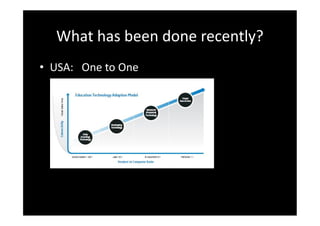
What has been done recently?
• USA: One to One
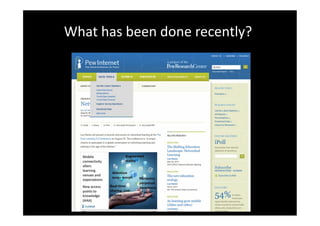
What has been done recently?
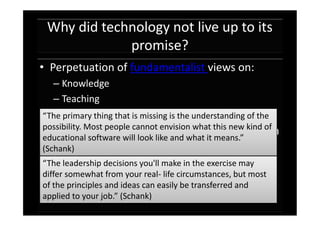
Why did technology not live up to its
              promise?
• Perpetuation of fundamentalist views on:
  – Knowledge
  – Teaching
“The Assessment that is missing is the understanding of the
  – primary thing
•possibility. Most people cannotlike and what it this new kind of
               learning look envision what put books on
   Most e-software willis an attempt to means.”
 educational
   a computer: duplication or virtualisation of
 (Schank)
   the classroom
 “The leadership decisions you'll make in the exercise may
•differ somewhat from your real- life circumstances, but most
   Lack of authenticity
 of the principles and ideas can easily be transferred and
   Lack of activity (learning by telling)
•applied to your job.” (Schank)
The Fundamentalist Teacher
• Is an experienced teacher
• Protects the status quo
• “It works, it always has worked (for me – look, I’m
  OK)”
• Student performance is a direct consequence of
  diligence
• Failure is the result of (laziness/ability)
• Absolves the fundamentalist from responsibility
• Inhibits reflection on teaching
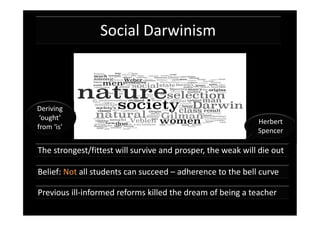
Social Darwinism


Deriving
 ‘ought’
                                                             Herbert
from ‘is’
                                                             Spencer

The strongest/fittest will survive and prosper, the weak will die out

Belief: Not all students can succeed – adherence to the bell curve

Previous ill-informed reforms killed the dream of being a teacher
The case for technology
“Technology is an essential component of human agency—culture
provides the ‘tool kit’ of technologies, techniques and procedures
with which different groups and communities learn about, respond
to, act on and manage their experience of the world” (Bruner, 1996)


“.. [it] is not likely that the current methods of teaching and learning
will suffice to prepare students for the lives that they will lead in the
twenty-first century.” (John Seely Brown, 2008)


     It is not really possible today to be relevant, nor
          effective if you teach without technology.
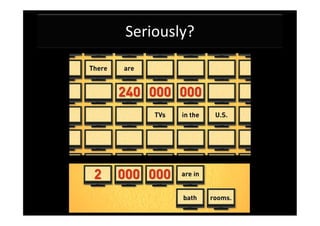
Seriously?
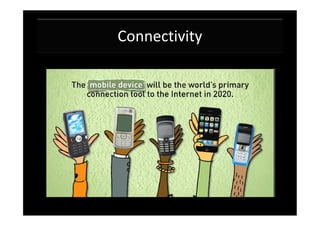
Connectivity
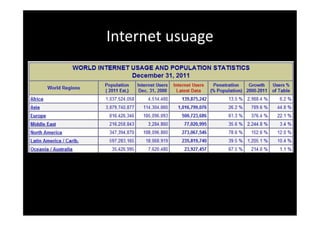
Internet usuage
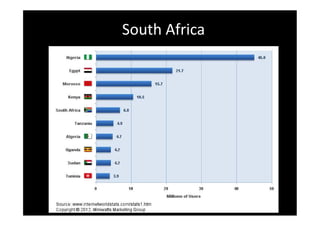
South Africa
Web 2.0 is also about
• Accepting that you are already digital
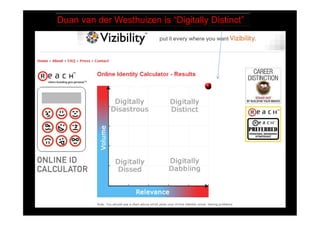
   –   Digital footprint (calculator @ www.emc.com)
   –   Spezify
   –   Mendeley
   –   Publish or Perish
   –   http://personas.media.mit.edu

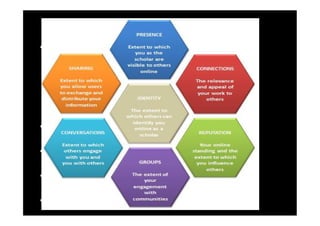
• Building blocks of a networked , digital scholar

• Creation, Curation, Collaboration, Communication

• Going “open”

• Teaching digitally (“techno expression”)
Duan van der Westhuizen is “Digitally Distinct”
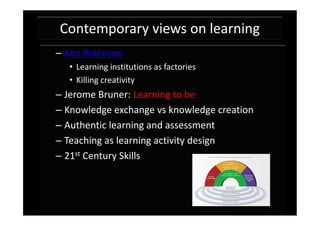
Contemporary views on learning
– Ken Robinson
  • Learning institutions as factories
  • Killing creativity
– Jerome Bruner: Learning to be
– Knowledge exchange vs knowledge creation
– Authentic learning and assessment
– Teaching as learning activity design
– 21st Century Skills
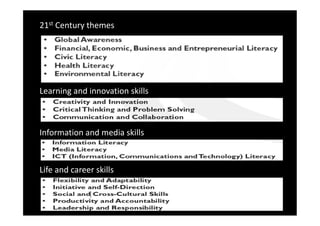
21st Century themes


Learning and innovation skills


Information and media skills


Life and career skills
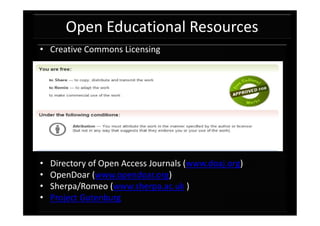
Open Educational Resources
• Creative Commons Licensing


•   Directory of Open Access Journals (www.doaj.org)
•   OpenDoar (www.opendoar.org)
•   Sherpa/Romeo (www.sherpa.ac.uk )
•   Project Gutenburg
Innovative spaces
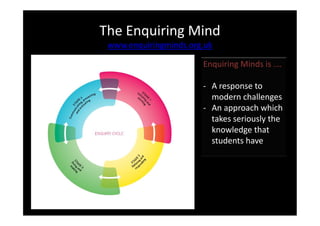
The Enquiring Mind
 www.enquiringminds.org.uk

                       Enquiring Minds is .…

                       - A response to
                         modern challenges
                       - An approach which
                         takes seriously the
                         knowledge that
                         students have
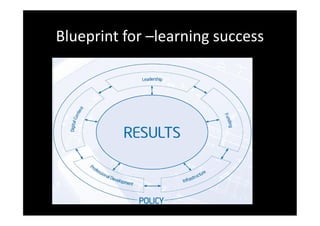
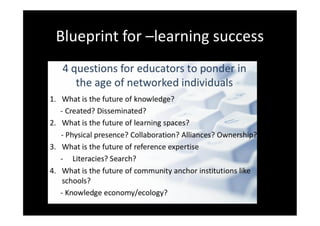
Blueprint for –learning success
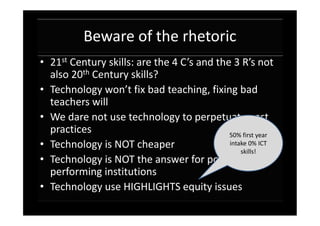
Beware of the rhetoric
• 21st Century skills: are the 4 C’s and the 3 R’s not
  also 20th Century skills?
• Technology won’t fix bad teaching, fixing bad
  teachers will
• We dare not use technology to perpetuate past
  practices                                 50% first year
• Technology is NOT cheaper                 intake 0% ICT
                                                skills!
• Technology is NOT the answer for poorly
  performing institutions
• Technology use HIGHLIGHTS equity issues
Sources
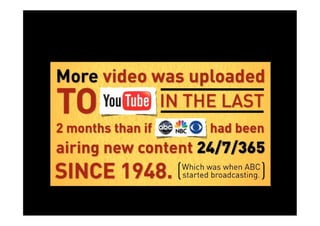
•   Did you know
•   http://www.internetworldstats.com/stats.htm
•   http://edutechdebate.org/ict-in-schools/there-are-no-technology-shortcuts-to-good-education
•   http://www.devaindustries.com/articles/ITProm.htm
•   http://www.learningtimes.com/what-we-do/badges/
•   http://chronicle.com/blogs/wiredcampus/
•   http://www.edutopia.org/core-concepts
•   http://www.socraticarts.com/docs/Educational_Technology_-_The_Promise_and_The_Myth.pdf
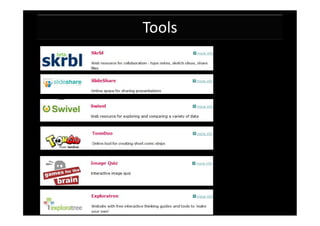
Tools

Learning technologies in South Africa

  • 1.
    Fundamentalism, Legacy, Implosion, Explosion, Fact and Fiction: Perspectives on Learning Technologies for the South African landscape Duan van der Westhuizen University of Johannesburg 12 September 2012
  • 2.
    The creation ofthe Technopoly The god Theus was the inventor of many things, including writing He boasted to Thamus, king of Egypt, about improving the wisdom of the nation when he invented writing Said Thamus: “What you have discovered is a receipt for recollection, not for memory. And as for wisdom, your pupils will have the reputation for it without the reality: they will receive a quantity of information without proper instruction, and in consequence be thought very knowledgeable when they are for the most part quite ignorant. And because they are filled with the conceit of wisdom instead of real wisdom they will be a burden to Society”
  • 3.
    Web 3.0? Web4.0? 2004 - Web 2.0/FOSS 2003 Mobile learning 1989 - The Internet 1982 - Computer Multimedia 19xx VCR/ Laser Discs/Television 1960 - Teaching machines 1930 - Radio 1922 - Film 1450 - Printing press BC - Writing
  • 4.
    Education surrenders tothe Technopoly • 1975: Seymour Paper - Logo – Microworlds • “Technology …. going to displace school and the way we understand school” • 1985: Apple Classroom of tomorrow • No empirical evidence > greater achievement • Higher Education: Online education became “educationally seductive” • Learning Management Systems  • Digital Diploma Mills (Noble, 1998) • Commodification of knowledge (Amory)
  • 5.
    So much goingon … Web Analytics 2.0
  • 6.
    So much goingon … locally But currently in our schools? Teachers? Learners? E-Education policy: 2013 looms: “by 2013 every learner and teacher will be ICT capable”
  • 7.
    What’s else ishot? • MOOC (e.g. mobiMOOC) • Webinars • Tablets & mobile learning • The ‘flipped classroom’ • Digital storytelling • Publishers and LMS vendors collaboration • Making e-Books • Cloud computing • Crowdsourcing • Badge-based learning • Megatrends: http://goo.gl/dqHaB
  • 8.
    Google in Education Google+ • Hangouts • Multiple Administrators • Direct Connect
  • 9.
  • 10.
    Learning Technologies: Curation Digital curation is the selection, reservation, maintenance, collection and archiving of digital assets, generally referred to the process of establishing and developing long term repositories of digital assets for current and future reference by researchers, scientists, historians, and scholars. Wikipedia
  • 11.
  • 12.
    The knowledge ofthe world in your pocket?
  • 13.
  • 14.
    Welcome to thenew Internet http://www.project10x.com/ Welcome To The New Internet: Simple Design, Short Names, No Ads Svbtle, a Stripped-Down Blogging Platform Branch, a Free-Floating Comment/Discussion System App.net, An Infrastructure-Level Version of Twitter
  • 15.
    The Internet isstill a very White place (for Web 4.0)
  • 16.
    What does RESEARCHsay? The positive impact of ICT use in education has not been proven In general, and despite thousands of impact studies, the impact of ICT use on student achievement remains difficult to measure and open to much reasonable debate. “There is neither a strong and well-developed theoretical case nor much empirical evidence supporting the expected benefits of ICT …” Contrasting evidence: BECTA (2002) and Machin et al(2006) found positive effects, while Fuchs & Woessman (2004), Leuven et al (2004) and others found no real positive effect
  • 17.
    Lack of large-scalemeta-analyses • Most prior meta-analyses were conducted on Distance Education • Kulik & Kulik pre-1980 • Most recently by US DoE: Evaluation of Evidence-Based Practices in Online Learning: A Meta-Analysis and Review of Online Learning Studies • Project RED: THE TECHNOLOGY FACTOR
  • 18.
    Insufficient local research •Van der Westhuizen (2002), there is little research addressing and locating specifically local concerns • Annotated Bibliography on e-Learning and Application of Educational Technology in African Countries, or in Contexts Relevant to Africa (Carnegie) • Deficits in Academic Staff Capacity at African Universities (Partnership for Higher Education in Africa, 2010) • Growth in student numbers not met by growth in staff • Lack of female staff • Low numbers of PhD and M students • Staff qualifications • SA: CHE Report on Higher Education Landscape
  • 19.
    What has beendone recently? • USA: One to One
  • 20.
    What has beendone recently?
  • 21.
    Why did technologynot live up to its promise? • Perpetuation of fundamentalist views on: – Knowledge – Teaching “The Assessment that is missing is the understanding of the – primary thing •possibility. Most people cannotlike and what it this new kind of learning look envision what put books on Most e-software willis an attempt to means.” educational a computer: duplication or virtualisation of (Schank) the classroom “The leadership decisions you'll make in the exercise may •differ somewhat from your real- life circumstances, but most Lack of authenticity of the principles and ideas can easily be transferred and Lack of activity (learning by telling) •applied to your job.” (Schank)
  • 22.
    The Fundamentalist Teacher •Is an experienced teacher • Protects the status quo • “It works, it always has worked (for me – look, I’m OK)” • Student performance is a direct consequence of diligence • Failure is the result of (laziness/ability) • Absolves the fundamentalist from responsibility • Inhibits reflection on teaching
  • 23.
    Social Darwinism Deriving ‘ought’ Herbert from ‘is’ Spencer The strongest/fittest will survive and prosper, the weak will die out Belief: Not all students can succeed – adherence to the bell curve Previous ill-informed reforms killed the dream of being a teacher
  • 24.
    The case fortechnology “Technology is an essential component of human agency—culture provides the ‘tool kit’ of technologies, techniques and procedures with which different groups and communities learn about, respond to, act on and manage their experience of the world” (Bruner, 1996) “.. [it] is not likely that the current methods of teaching and learning will suffice to prepare students for the lives that they will lead in the twenty-first century.” (John Seely Brown, 2008) It is not really possible today to be relevant, nor effective if you teach without technology.
  • 25.
  • 28.
  • 29.
  • 30.
  • 31.
    Web 2.0 isalso about • Accepting that you are already digital – Digital footprint (calculator @ www.emc.com) – Spezify – Mendeley – Publish or Perish – http://personas.media.mit.edu • Building blocks of a networked , digital scholar • Creation, Curation, Collaboration, Communication • Going “open” • Teaching digitally (“techno expression”)
  • 32.
    Duan van derWesthuizen is “Digitally Distinct”
  • 33.
    Contemporary views onlearning – Ken Robinson • Learning institutions as factories • Killing creativity – Jerome Bruner: Learning to be – Knowledge exchange vs knowledge creation – Authentic learning and assessment – Teaching as learning activity design – 21st Century Skills
  • 34.
    21st Century themes Learningand innovation skills Information and media skills Life and career skills
  • 35.
    Open Educational Resources •Creative Commons Licensing • Directory of Open Access Journals (www.doaj.org) • OpenDoar (www.opendoar.org) • Sherpa/Romeo (www.sherpa.ac.uk ) • Project Gutenburg
  • 36.
  • 38.
    The Enquiring Mind www.enquiringminds.org.uk Enquiring Minds is .… - A response to modern challenges - An approach which takes seriously the knowledge that students have
  • 39.
  • 40.
  • 41.
    Beware of therhetoric • 21st Century skills: are the 4 C’s and the 3 R’s not also 20th Century skills? • Technology won’t fix bad teaching, fixing bad teachers will • We dare not use technology to perpetuate past practices 50% first year • Technology is NOT cheaper intake 0% ICT skills! • Technology is NOT the answer for poorly performing institutions • Technology use HIGHLIGHTS equity issues
  • 42.
    Sources • Did you know • http://www.internetworldstats.com/stats.htm • http://edutechdebate.org/ict-in-schools/there-are-no-technology-shortcuts-to-good-education • http://www.devaindustries.com/articles/ITProm.htm • http://www.learningtimes.com/what-we-do/badges/ • http://chronicle.com/blogs/wiredcampus/ • http://www.edutopia.org/core-concepts • http://www.socraticarts.com/docs/Educational_Technology_-_The_Promise_and_The_Myth.pdf
  • 43.