Jonathan P. Costa, Sr.

Patrick Flynn

http://www.educationconnection.org
costa@educationconnection.org

http://www.revisionlearning.com
pflynn@revisionlearning.com

Digital Age Teacher Growth Systems
http://www.skills21.org
http://digitallearningforallnow.com
http://www.slideshare.net/jpcostasr
(Look for Collaborative Share and 21st Century ILS 120113 Domain 4 Sample)
The Mission
To prepare
EVERY learner
for life
and work
in the

21st century.
© Corwin Press - 2011
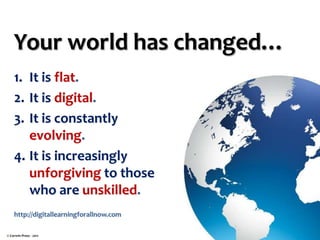
Your world has changed…
1. It is flat.
2. It is digital.
3. It is constantly
evolving.
4. It is increasingly
unforgiving to those
who are unskilled.
http://digitallearningforallnow.com
© Corwin Press - 2011
Purpose + Engagement = Learning

The Center for 21st Center Skills uses
rigorous, standards based blended
learning courses and virtual learning
tools in a 1:1 learning environment to
challenge and engage student learners
from grades 7-12.
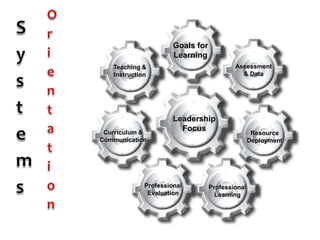
Goals for
Learning
Assessment
& Data

Teaching &
Instruction

Curriculum &
Communication

Leadership
Focus

Professional
Evaluation

Professional
Learning

Resource
Deployment
The Big Idea
Systems must align with
mission and goals.
By chance or plan, your
systems create the world
that they are designed (or
not) to support.
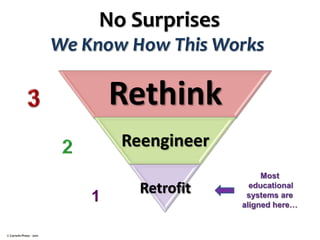
No Surprises
We Know How This Works

Rethink
Reengineer
1
© Corwin Press - 2011

Retrofit
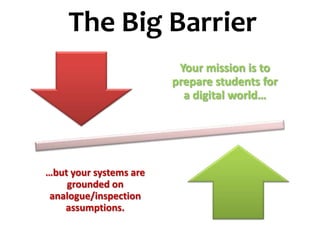
The Big Barrier
Your mission is to
prepare students for
a digital world…

…but your systems are
grounded on
analogue/inspection
assumptions.
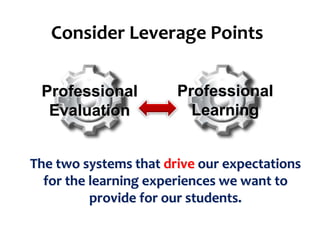
Consider Leverage Points
Professional
Evaluation

Professional
Learning

The two systems that drive our expectations
for the learning experiences we want to
provide for our students.
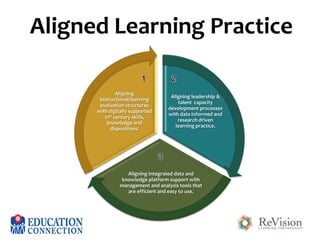
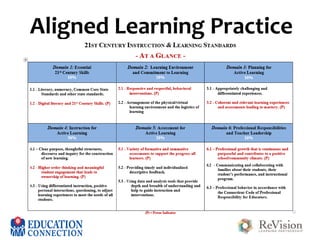
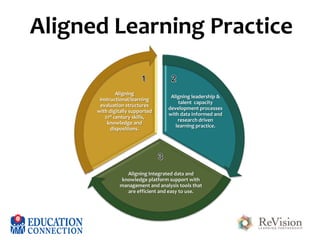
Aligned Learning Practice
Aligning
instructional/learning
evaluation structures
with digitally supported
21st century skills,
knowledge and
dispositions.

Aligning leadership &
talent capacity
development processes
with data informed and
research driven
learning practice.

Aligning Integrated data and
knowledge platform support with
management and analysis tools that
are efficient and easy to use.
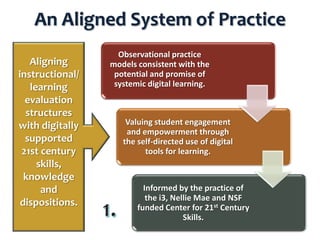
An Aligned System of Practice
Aligning
instructional/
learning
evaluation
structures
with digitally
supported
21st century
skills,
knowledge
and
dispositions.

Observational practice
models consistent with the
potential and promise of
systemic digital learning.

Valuing student engagement
and empowerment through
the self-directed use of digital
tools for learning.

Informed by the practice of
the i3, Nellie Mae and NSF
funded Center for 21st Century
Skills.
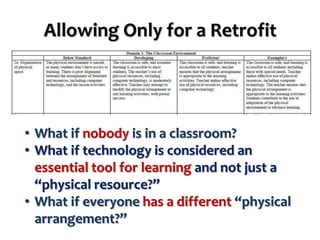
Allowing Only for a Retrofit

• What if nobody is in a classroom?
• What if technology is considered an
essential tool for learning and not just a
“physical resource?”
• What if everyone has a different “physical
arrangement?”
Aligned Learning Practice
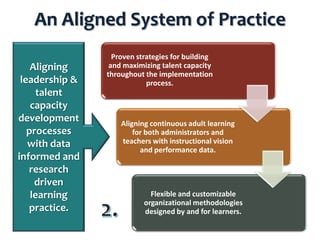
An Aligned System of Practice
Aligning
leadership &
talent
capacity
development
processes
with data
informed and
research
driven
learning
practice.

Proven strategies for building
and maximizing talent capacity
throughout the implementation
process.

Aligning continuous adult learning
for both administrators and
teachers with instructional vision
and performance data.

Flexible and customizable
organizational methodologies
designed by and for learners.
Aligned Learning Practice
Integrated Leadership Professional Learning Program
•
•
•
•

21st Century Rubric deconstruction
21st Century Rubric calibration and inter-rater agreement
Evaluator proficiency analysis
Effective classroom observation techniques and evidence collection
approaches
• Meaningful teacher and administrator feedback and support

On-Going Implementation Analysis
• Collegial Calibrations ™ for on-going calibration of evaluators
• Implementation reviews with District Leadership Team
• Personalized professional learning programming
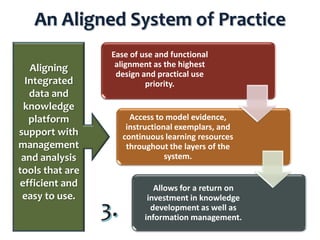
An Aligned System of Practice
Aligning
Integrated
data and
knowledge
platform
support with
management
and analysis
tools that are
efficient and
easy to use.

Ease of use and functional
alignment as the highest
design and practical use
priority.

Access to model evidence,
instructional exemplars, and
continuous learning resources
throughout the layers of the
system.

Allows for a return on
investment in knowledge
development as well as
information management.
Aligned Learning Practice
Educator Performance and Knowledge Management Learning Platform ™
Aligned Learning Practice
Aligning
instructional/learning
evaluation structures
with digitally supported
21st century skills,
knowledge and
dispositions.

Aligning leadership &
talent capacity
development processes
with data informed and
research driven
learning practice.

Aligning Integrated data and
knowledge platform support with
management and analysis tools that
are efficient and easy to use.
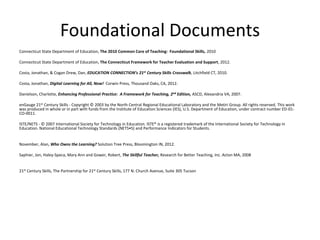
Foundational Documents
Connecticut State Department of Education, The 2010 Common Core of Teaching: Foundational Skills, 2010
Connecticut State Department of Education, The Connecticut Framework for Teacher Evaluation and Support, 2012.
Costa, Jonathan, & Cogan Drew, Dan, EDUCATION CONNECTION’s 21st Century Skills Crosswalk, Litchfield CT, 2010.
Costa, Jonathan, Digital Learning for All, Now! Corwin Press, Thousand Oaks, CA, 2012.
Danielson, Charlotte, Enhancing Professional Practice: A Framework for Teaching, 2nd Edition, ASCD, Alexandria VA, 2007.
enGauge 21st Century Skills - Copyright © 2003 by the North Central Regional Educational Laboratory and the Metiri Group. All rights reserved. This work
was produced in whole or in part with funds from the Institute of Education Sciences (IES), U.S. Department of Education, under contract number ED-01CO-0011.
ISTE/NETS - © 2007 International Society for Technology in Education. ISTE® is a registered trademark of the International Society for Technology in
Education. National Educational Technology Standards (NETS•S) and Performance Indicators for Students.

November, Alan, Who Owns the Learning? Solution Tree Press, Bloomington IN, 2012.
Saphier, Jon, Haley-Speca, Mary Ann and Gower, Robert, The Skillful Teacher, Research for Better Teaching, Inc. Acton MA, 2008

21st Century Skills, The Partnership for 21st Century Skills, 177 N. Church Avenue, Suite 305 Tucson
Foundational Documents
Bolton, R. (1979). People skills: How to assert yourself, listen to others, and resolve conflicts. New York, New York: Simon &Schuster, Inc.
Cialdini, R. (2007). Influence: The psychology of persuasion. New York: HarperCollins.
Downey, C. (2004). The Three-Minute Walkthrough: Changing school supervisory practice One teacher at a time. Thousand Oaks, CA: Corwin Press.
Fullan, Micheal (2007). The New Meaning of Educational Change, Fourth Edition, Teachers College Press, New York, NY
Fullan, Micheal (2007). The Six Secrets of Change: What the Best Leaders Do to Help Their Organizations Survive and Thrive, Jossey-Bass, San Francisco, CA
Garmston, R., and Dyer, J. (1999). The Art of Cognitive Coaching. Highlands Ranch, Colorado: Center for Cognitive Coaching.

Glickman, Carl (2008). Leadership for Learning: How to Help Teachers Succeed, ASCD, Alexandria,VA
Hanushek, E. A., Kain, J. F., O’Brien, D. M., & Rivkin, S. G. (2005). The market for teacher quality. (NBER Working Paper 11154). Cambridge, MA: National
Bureau of Economic Research.
Hattie, J. (2009), Visible Learning: A Synthesis of Over 800 Meta-Analyses Relating to Achievement. London & New York: Routledge, Taylor& Francis Group
Lipton, L., & Wellman, B. (2003) Mentoring Matters: A practical guide to learning-focused relationships. Sherman, CT: Mira Via.
McGuire, J.B. etal (2009). Transforming Your Organization: Global organization development white paper series. Center for Crerative Leadership.
http://www.ccl.org/leadership/pdf/solutions/TYO.pdf
Marzano, Robert (2005). School Leadership That Works: From Research to Results, ASCD, Alexandria,VA
Pink, Daniel (2011). Drive: The Surprising Truth About What Motivates Us, Penguin Books, New York, NY
Saphier, J. (1993). How to make Supervision and Evaluation Really Work: Supervision and evaluation in the context of strengthening school culture.
Carlisle, MA: Research for Better Teaching, Inc.
Sanders, W. L., & Rivers, J. C. (1996). Cumulative and residual effects of teachers on future students academic achievement. Knoxville, TN: University of
Tennessee Value-Added Research and Assessment Center.
Stone, D., Patton, B., & Heen, S. (2000). Difficult conversations. London: Penguin Books.
K. Walsh, If Wishes Were Horses: The Reality Behind Teacher Quality Ratings (Washington, DC: National Council on Teacher Quality, 2007)
Wheatley, Margeret (2009). Turning to One Another: Simple Conversations to Restore Hope to the Future, Berrett-Koehler Publishers, San Franscico, CA
costa@educationconnection.org

pflynn@revisionlearning.com

http://www.educationconnection.org
http://www.skills21.org
http://digitallearningforallnow.com

http://www.revisionlearning.com

http://www.slideshare.net/jpcostasr

If you go to Slideshare – look for:
AESA Share
21st Century ILS 120113 Domain 4 Sample

Collaborative Share

  • 1.
    Jonathan P. Costa,Sr. Patrick Flynn http://www.educationconnection.org costa@educationconnection.org http://www.revisionlearning.com pflynn@revisionlearning.com Digital Age Teacher Growth Systems http://www.skills21.org http://digitallearningforallnow.com http://www.slideshare.net/jpcostasr (Look for Collaborative Share and 21st Century ILS 120113 Domain 4 Sample)
  • 2.
    The Mission To prepare EVERYlearner for life and work in the 21st century. © Corwin Press - 2011
  • 3.
    Your world haschanged… 1. It is flat. 2. It is digital. 3. It is constantly evolving. 4. It is increasingly unforgiving to those who are unskilled. http://digitallearningforallnow.com © Corwin Press - 2011
  • 4.
    Purpose + Engagement= Learning The Center for 21st Center Skills uses rigorous, standards based blended learning courses and virtual learning tools in a 1:1 learning environment to challenge and engage student learners from grades 7-12.
  • 5.
    Goals for Learning Assessment & Data Teaching& Instruction Curriculum & Communication Leadership Focus Professional Evaluation Professional Learning Resource Deployment
  • 6.
    The Big Idea Systemsmust align with mission and goals. By chance or plan, your systems create the world that they are designed (or not) to support.
  • 7.
    No Surprises We KnowHow This Works Rethink Reengineer 1 © Corwin Press - 2011 Retrofit
  • 8.
    The Big Barrier Yourmission is to prepare students for a digital world… …but your systems are grounded on analogue/inspection assumptions.
  • 9.
    Consider Leverage Points Professional Evaluation Professional Learning Thetwo systems that drive our expectations for the learning experiences we want to provide for our students.
  • 10.
    Aligned Learning Practice Aligning instructional/learning evaluationstructures with digitally supported 21st century skills, knowledge and dispositions. Aligning leadership & talent capacity development processes with data informed and research driven learning practice. Aligning Integrated data and knowledge platform support with management and analysis tools that are efficient and easy to use.
  • 11.
    An Aligned Systemof Practice Aligning instructional/ learning evaluation structures with digitally supported 21st century skills, knowledge and dispositions. Observational practice models consistent with the potential and promise of systemic digital learning. Valuing student engagement and empowerment through the self-directed use of digital tools for learning. Informed by the practice of the i3, Nellie Mae and NSF funded Center for 21st Century Skills.
  • 12.
    Allowing Only fora Retrofit • What if nobody is in a classroom? • What if technology is considered an essential tool for learning and not just a “physical resource?” • What if everyone has a different “physical arrangement?”
  • 13.
  • 14.
    An Aligned Systemof Practice Aligning leadership & talent capacity development processes with data informed and research driven learning practice. Proven strategies for building and maximizing talent capacity throughout the implementation process. Aligning continuous adult learning for both administrators and teachers with instructional vision and performance data. Flexible and customizable organizational methodologies designed by and for learners.
  • 15.
    Aligned Learning Practice IntegratedLeadership Professional Learning Program • • • • 21st Century Rubric deconstruction 21st Century Rubric calibration and inter-rater agreement Evaluator proficiency analysis Effective classroom observation techniques and evidence collection approaches • Meaningful teacher and administrator feedback and support On-Going Implementation Analysis • Collegial Calibrations ™ for on-going calibration of evaluators • Implementation reviews with District Leadership Team • Personalized professional learning programming
  • 16.
    An Aligned Systemof Practice Aligning Integrated data and knowledge platform support with management and analysis tools that are efficient and easy to use. Ease of use and functional alignment as the highest design and practical use priority. Access to model evidence, instructional exemplars, and continuous learning resources throughout the layers of the system. Allows for a return on investment in knowledge development as well as information management.
  • 17.
    Aligned Learning Practice EducatorPerformance and Knowledge Management Learning Platform ™
  • 18.
    Aligned Learning Practice Aligning instructional/learning evaluationstructures with digitally supported 21st century skills, knowledge and dispositions. Aligning leadership & talent capacity development processes with data informed and research driven learning practice. Aligning Integrated data and knowledge platform support with management and analysis tools that are efficient and easy to use.
  • 19.
    Foundational Documents Connecticut StateDepartment of Education, The 2010 Common Core of Teaching: Foundational Skills, 2010 Connecticut State Department of Education, The Connecticut Framework for Teacher Evaluation and Support, 2012. Costa, Jonathan, & Cogan Drew, Dan, EDUCATION CONNECTION’s 21st Century Skills Crosswalk, Litchfield CT, 2010. Costa, Jonathan, Digital Learning for All, Now! Corwin Press, Thousand Oaks, CA, 2012. Danielson, Charlotte, Enhancing Professional Practice: A Framework for Teaching, 2nd Edition, ASCD, Alexandria VA, 2007. enGauge 21st Century Skills - Copyright © 2003 by the North Central Regional Educational Laboratory and the Metiri Group. All rights reserved. This work was produced in whole or in part with funds from the Institute of Education Sciences (IES), U.S. Department of Education, under contract number ED-01CO-0011. ISTE/NETS - © 2007 International Society for Technology in Education. ISTE® is a registered trademark of the International Society for Technology in Education. National Educational Technology Standards (NETS•S) and Performance Indicators for Students. November, Alan, Who Owns the Learning? Solution Tree Press, Bloomington IN, 2012. Saphier, Jon, Haley-Speca, Mary Ann and Gower, Robert, The Skillful Teacher, Research for Better Teaching, Inc. Acton MA, 2008 21st Century Skills, The Partnership for 21st Century Skills, 177 N. Church Avenue, Suite 305 Tucson
  • 20.
    Foundational Documents Bolton, R.(1979). People skills: How to assert yourself, listen to others, and resolve conflicts. New York, New York: Simon &Schuster, Inc. Cialdini, R. (2007). Influence: The psychology of persuasion. New York: HarperCollins. Downey, C. (2004). The Three-Minute Walkthrough: Changing school supervisory practice One teacher at a time. Thousand Oaks, CA: Corwin Press. Fullan, Micheal (2007). The New Meaning of Educational Change, Fourth Edition, Teachers College Press, New York, NY Fullan, Micheal (2007). The Six Secrets of Change: What the Best Leaders Do to Help Their Organizations Survive and Thrive, Jossey-Bass, San Francisco, CA Garmston, R., and Dyer, J. (1999). The Art of Cognitive Coaching. Highlands Ranch, Colorado: Center for Cognitive Coaching. Glickman, Carl (2008). Leadership for Learning: How to Help Teachers Succeed, ASCD, Alexandria,VA Hanushek, E. A., Kain, J. F., O’Brien, D. M., & Rivkin, S. G. (2005). The market for teacher quality. (NBER Working Paper 11154). Cambridge, MA: National Bureau of Economic Research. Hattie, J. (2009), Visible Learning: A Synthesis of Over 800 Meta-Analyses Relating to Achievement. London & New York: Routledge, Taylor& Francis Group Lipton, L., & Wellman, B. (2003) Mentoring Matters: A practical guide to learning-focused relationships. Sherman, CT: Mira Via. McGuire, J.B. etal (2009). Transforming Your Organization: Global organization development white paper series. Center for Crerative Leadership. http://www.ccl.org/leadership/pdf/solutions/TYO.pdf Marzano, Robert (2005). School Leadership That Works: From Research to Results, ASCD, Alexandria,VA Pink, Daniel (2011). Drive: The Surprising Truth About What Motivates Us, Penguin Books, New York, NY Saphier, J. (1993). How to make Supervision and Evaluation Really Work: Supervision and evaluation in the context of strengthening school culture. Carlisle, MA: Research for Better Teaching, Inc. Sanders, W. L., & Rivers, J. C. (1996). Cumulative and residual effects of teachers on future students academic achievement. Knoxville, TN: University of Tennessee Value-Added Research and Assessment Center. Stone, D., Patton, B., & Heen, S. (2000). Difficult conversations. London: Penguin Books. K. Walsh, If Wishes Were Horses: The Reality Behind Teacher Quality Ratings (Washington, DC: National Council on Teacher Quality, 2007) Wheatley, Margeret (2009). Turning to One Another: Simple Conversations to Restore Hope to the Future, Berrett-Koehler Publishers, San Franscico, CA
  • 21.

Editor's Notes

  • #3 This is the defining challenge of our times in public school.