Connecticut Core Standards 
The Good, the Bad, and the Ugly 
New Milford BOE 
December 3rd, 2014 
http://digitallearningforallnow.com 
http://www.slideshare.net/jpcostasr 
costa@educationconnection.org 
Jonathan P. Costa
Mission 
To prepare 
EVERY student 
for learning, life, 
and work 
in the 21st century.
Our world has changed… 
1. It is digital, flat, open 
and pluralistic. 
2. It is unpredictable and 
volatile. 
3. It is increasingly 
unforgiving to those 
who are unskilled.
3 Domains 
of Education 
Goals 
Mission 
Leadership 
Focus 
Practices Measures 
Common 
Core?
The Evolution of Educational Standards and Testing 
Areas of Before 1986 NCLB 2001 PA12-116 2012 
Focus 
Learning Goals 
Assessment Protocols 
Accountability 
Teacher Prep 
Curriculum 
Testing Tools 
Student Abilities 
Instructional Focus 
Inputs/Outputs 
Universal Access 
Locally Determined 
Rank and Sort 
No News is Good News 
Get A Degree 
Table of Contents 
Pencil & Paper 
Grouped & Labeled 
Teacher Dependent 
Ready for K - 59.9 to Leave 
Universal Proficiency 
State by State 
Tests for ALL 
Label Failing Schools 
Certifications & BEST 
State Standards & 
Frameworks 
Pencil & Paper With 
Performance Tasks 
Integrated (N=40) 
Standards Aligned 
Need for Pre-School 
Skill Demonstrations 
Universal Measures 
46 State Consortia 
(Math, LA, Science) 
Smarter Balance 
(IPI) for All 
Ranking Every District, School 
and Teacher 
Certifications, TEAM, 
and SEED 
Multi-State 
Unified Standards 
Digital With 
Performance Tasks 
Integrated & Scrutinized 
(N=20) 
Common Core Aligned 
And Digitally Supported 
Pre-K and Full-K Standards 
Demonstrations & Tests
The Irony of it All 
Close reading to determine 
fact is a CCSS foundational 
skill…from the tone of the 
debate over this last year, I 
think we could all use a 
little more of it. 
Jonathan P. Costa
These Standards Are Lowering the Bar 
Point: Not rigorous, not 
benchmarked, somehow 
actually less difficult than 
your current state 
standards. 
Counter Point : Read the 
standards. 
• 91% ELA Aligned 
• 83% Math Aligned
Which of These Skills Would 
You Want Your Child to NOT HAVE? 
• Read closely to determine what the text says explicitly and to make logical inferences from it; 
cite specific textual evidence when writing or speaking to support conclusions drawn from the 
text. 
• Determine central ideas or themes of a text and analyze their development; summarize the key 
supporting details and ideas. 
• Delineate and evaluate the argument and specific claims in a text, including the validity of the 
reasoning as well as the relevance and sufficiency of the evidence. 
• Produce clear and coherent writing in which the development, organization, and style are 
appropriate to task, purpose, and audience. 
• Gather relevant information from multiple print and digital sources, assess the credibility and 
accuracy of each source, and integrate the information while avoiding plagiarism. 
• Make sense of problems and persevere in solving them. 
• Construct viable arguments and critique the reasoning of others. 
• Use appropriate tools strategically and attend to precision.
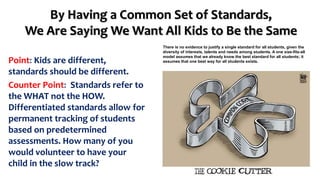
By Having a Common Set of Standards, 
We Are Saying We Want All Kids to Be the Same 
Point: Kids are different, 
standards should be different. 
Counter Point: Standards refer to 
the WHAT not the HOW. 
Differentiated standards allow for 
permanent tracking of students 
based on predetermined 
assessments. How many of you 
would volunteer to have your 
child in the slow track? 
There is no evidence to justify a single standard for all students, given the 
diversity of interests, talents and needs among students. A one size-fits-all 
model assumes that we already know the best standard for all students; it 
assumes that one best way for all students exists.
No Teachers Were Involved in 
Writing the Standards 
• Point: The standards were created by 
non-educators who don’t understand 
children. 
• Counter Point: The Common Core 
drafting process relied on teachers and 
standards experts from across the 
country. Connecticut teachers were 
involved, as was our CSDE, as well as 
extended periods for public comment. 
No different from any other standards 
drafting process for the last 30 years.
Big Brother, Big Government Takeover 
Point: By having common standards, we are 
endorsing Obama’s collectivist & socialist 
future and allowing a federal intrusion into 
local public education. 
Counter Point: The largest federal intrusion in 
history came under freedom loving President 
George W. Bush (NCLB) and passed the 2001 
Congress on a combined vote of 475-53. As 
for getting more money if you adopt them – 
yes – the same as every other federal education 
program - ever.
Common Curriculum Resources for Free 
Race to the Top: While Connecticut did 
not win one, we benefit from the 
states that did. All curriculum 
resources as a result of these 
grants, must be made 
available to the public 
at no expense.
This Is About Money, Not Education 
Point: Pearson and other 
contractors/publishers are 
getting rich and are pushing 
these tests and materials just 
to make money. 
Counter Point: Apparently 
pre-Common Core educational 
vendors were all non-profit 
organizations selling materials 
for the good of all mankind.
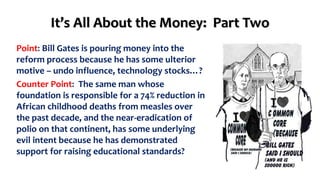
It’s All About the Money: Part Two 
Point: Bill Gates is pouring money into the 
reform process because he has some ulterior 
motive – undo influence, technology stocks…? 
Counter Point: The same man whose 
foundation is responsible for a 74% reduction in 
African childhood deaths from measles over 
the past decade, and the near-eradication of 
polio on that continent, has some underlying 
evil intent because he has demonstrated 
support for raising educational standards?
Big Brother Data Mining 
The Charge: Vendors or the 
government are going to use the 
data they have on your children to 
gain some leverage and control your 
future. 
Counter Point: In the modern era, 
schools have always collected this 
data (address, phone, wealth, health, 
performance) and there are laws 
that govern who has it and what it 
can be used for.
Tests, Tests, and More Tests 
Point: Testing is out of control. We 
are dramatically increasing the 
amount of time we spend testing our 
children and it plays too large a role 
in determining our children’s future. 
Counter Point: The actual amount of 
time tested – when compared to 
CMT/CAPT is less – although – if a 
student wants more time to finish 
any portion of the test, they can have 
it (formally, just the purview of 
special education IEPs).
Perfect, no - but it is a better test. 
The assessment 
consortia has published 
the criteria that they 
will use to score open 
ended items.
Student’s Under Stress 
Point: All of this testing and 
accountability talk puts too much stress 
on our children. 
The Counter: We own this one. The 
higher the stakes, the more corrupt the 
system will become and the more stress 
will be communicated through the adults 
in the system to the children in the 
system. This is not about the test – its 
about what we do with the results of the 
test.
Improvements? 
There is always room… 
• Fewer, high leverage skills 
should be focus. 
• Seamless integration of digital 
learning – not just testing. 
• Less reliance on text for 
comprehension/communication. 
• Communicate with parents about 
implementation strategies. 
• Other?

Connecticut Core 2014

  • 1.
    Connecticut Core Standards The Good, the Bad, and the Ugly New Milford BOE December 3rd, 2014 http://digitallearningforallnow.com http://www.slideshare.net/jpcostasr costa@educationconnection.org Jonathan P. Costa
  • 2.
    Mission To prepare EVERY student for learning, life, and work in the 21st century.
  • 3.
    Our world haschanged… 1. It is digital, flat, open and pluralistic. 2. It is unpredictable and volatile. 3. It is increasingly unforgiving to those who are unskilled.
  • 4.
    3 Domains ofEducation Goals Mission Leadership Focus Practices Measures Common Core?
  • 5.
    The Evolution ofEducational Standards and Testing Areas of Before 1986 NCLB 2001 PA12-116 2012 Focus Learning Goals Assessment Protocols Accountability Teacher Prep Curriculum Testing Tools Student Abilities Instructional Focus Inputs/Outputs Universal Access Locally Determined Rank and Sort No News is Good News Get A Degree Table of Contents Pencil & Paper Grouped & Labeled Teacher Dependent Ready for K - 59.9 to Leave Universal Proficiency State by State Tests for ALL Label Failing Schools Certifications & BEST State Standards & Frameworks Pencil & Paper With Performance Tasks Integrated (N=40) Standards Aligned Need for Pre-School Skill Demonstrations Universal Measures 46 State Consortia (Math, LA, Science) Smarter Balance (IPI) for All Ranking Every District, School and Teacher Certifications, TEAM, and SEED Multi-State Unified Standards Digital With Performance Tasks Integrated & Scrutinized (N=20) Common Core Aligned And Digitally Supported Pre-K and Full-K Standards Demonstrations & Tests
  • 6.
    The Irony ofit All Close reading to determine fact is a CCSS foundational skill…from the tone of the debate over this last year, I think we could all use a little more of it. Jonathan P. Costa
  • 7.
    These Standards AreLowering the Bar Point: Not rigorous, not benchmarked, somehow actually less difficult than your current state standards. Counter Point : Read the standards. • 91% ELA Aligned • 83% Math Aligned
  • 8.
    Which of TheseSkills Would You Want Your Child to NOT HAVE? • Read closely to determine what the text says explicitly and to make logical inferences from it; cite specific textual evidence when writing or speaking to support conclusions drawn from the text. • Determine central ideas or themes of a text and analyze their development; summarize the key supporting details and ideas. • Delineate and evaluate the argument and specific claims in a text, including the validity of the reasoning as well as the relevance and sufficiency of the evidence. • Produce clear and coherent writing in which the development, organization, and style are appropriate to task, purpose, and audience. • Gather relevant information from multiple print and digital sources, assess the credibility and accuracy of each source, and integrate the information while avoiding plagiarism. • Make sense of problems and persevere in solving them. • Construct viable arguments and critique the reasoning of others. • Use appropriate tools strategically and attend to precision.
  • 9.
    By Having aCommon Set of Standards, We Are Saying We Want All Kids to Be the Same Point: Kids are different, standards should be different. Counter Point: Standards refer to the WHAT not the HOW. Differentiated standards allow for permanent tracking of students based on predetermined assessments. How many of you would volunteer to have your child in the slow track? There is no evidence to justify a single standard for all students, given the diversity of interests, talents and needs among students. A one size-fits-all model assumes that we already know the best standard for all students; it assumes that one best way for all students exists.
  • 10.
    No Teachers WereInvolved in Writing the Standards • Point: The standards were created by non-educators who don’t understand children. • Counter Point: The Common Core drafting process relied on teachers and standards experts from across the country. Connecticut teachers were involved, as was our CSDE, as well as extended periods for public comment. No different from any other standards drafting process for the last 30 years.
  • 11.
    Big Brother, BigGovernment Takeover Point: By having common standards, we are endorsing Obama’s collectivist & socialist future and allowing a federal intrusion into local public education. Counter Point: The largest federal intrusion in history came under freedom loving President George W. Bush (NCLB) and passed the 2001 Congress on a combined vote of 475-53. As for getting more money if you adopt them – yes – the same as every other federal education program - ever.
  • 12.
    Common Curriculum Resourcesfor Free Race to the Top: While Connecticut did not win one, we benefit from the states that did. All curriculum resources as a result of these grants, must be made available to the public at no expense.
  • 13.
    This Is AboutMoney, Not Education Point: Pearson and other contractors/publishers are getting rich and are pushing these tests and materials just to make money. Counter Point: Apparently pre-Common Core educational vendors were all non-profit organizations selling materials for the good of all mankind.
  • 14.
    It’s All Aboutthe Money: Part Two Point: Bill Gates is pouring money into the reform process because he has some ulterior motive – undo influence, technology stocks…? Counter Point: The same man whose foundation is responsible for a 74% reduction in African childhood deaths from measles over the past decade, and the near-eradication of polio on that continent, has some underlying evil intent because he has demonstrated support for raising educational standards?
  • 15.
    Big Brother DataMining The Charge: Vendors or the government are going to use the data they have on your children to gain some leverage and control your future. Counter Point: In the modern era, schools have always collected this data (address, phone, wealth, health, performance) and there are laws that govern who has it and what it can be used for.
  • 16.
    Tests, Tests, andMore Tests Point: Testing is out of control. We are dramatically increasing the amount of time we spend testing our children and it plays too large a role in determining our children’s future. Counter Point: The actual amount of time tested – when compared to CMT/CAPT is less – although – if a student wants more time to finish any portion of the test, they can have it (formally, just the purview of special education IEPs).
  • 17.
    Perfect, no -but it is a better test. The assessment consortia has published the criteria that they will use to score open ended items.
  • 18.
    Student’s Under Stress Point: All of this testing and accountability talk puts too much stress on our children. The Counter: We own this one. The higher the stakes, the more corrupt the system will become and the more stress will be communicated through the adults in the system to the children in the system. This is not about the test – its about what we do with the results of the test.
  • 19.
    Improvements? There isalways room… • Fewer, high leverage skills should be focus. • Seamless integration of digital learning – not just testing. • Less reliance on text for comprehension/communication. • Communicate with parents about implementation strategies. • Other?

Editor's Notes

  • #3 This is the defining challenge of our times in public school.