TRAUMATIZED
ANTERIOR TEETH
Dr. Khin Swe Aye
BDS., DipDSc., MDSc., Dr Dental Science,
FICCDE
Dept. of Conservative Dentistry, UDMY
 Loss of a child’s anterior teeth especially
permanent dentition, cause greater
psychological impact on parents and on child
 CausesCauses
 Simple accidents minor falls, accidents
during sports or childish pranks
 ResultResult
 Facial appearance is altered
(attractive → unattractive
target for teasing and even ridicule by other
children)
 Dentist’s DutyDentist’s Duty
 To preserve the vitality of injured teeth
 To restore them skillfully to their orginal
apperance, without producing additional
trauma or endangering integrity of the teeth

TimeTime
 Important consideration in treatment of TATTAT
 Every effort should be made immediatelyimmediately
and should be given preference and
emergency treatment
Therefore
•further irritation to the pulp could be
prevented,
• avulsed tooth could be replanted with
higher percentage of success,
• more favorable result could be
anticipated
Prevalence of Injuries to Anterior Teeth
TeethTeeth – Maxillary central incisors (most
frequently involved)
SexSex – Boys > Girls (2 : 1)
AgeAge - between 9–10 yrs
HistoryHistory
 When the accident occur?
 How the accident occur?
 Where of the accident occur?
 Whether treatment of any kind taken or not?
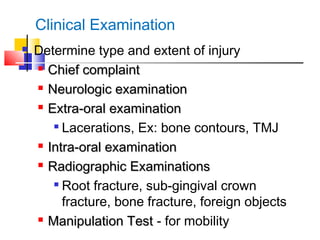
Clinical Examination
 Determine type and extent of injury

Chief complaintChief complaint

Neurologic examinationNeurologic examination

Extra-oral examinationExtra-oral examination

Lacerations, Ex: bone contours, TMJ

Intra-oral examinationIntra-oral examination

Radiographic ExaminationsRadiographic Examinations

Root fracture, sub-gingival crown
fracture, bone fracture, foreign objects

Manipulation TestManipulation Test - for mobility

Vitality TestVitality Test – should be recorded, to
compare with vital tests at recall lists

Heat Test, Cold Test, EPT
PrognosisPrognosis - on histologic condition of pulp

PercussionPercussion

To check injury to periodontal membrane
and other supporting structure
SummarySummary - The examination of traumatic
injuries must be thorough and meticulously
recorded
Classification of Traumatic Injuries of
Permanent Teeth
 Class 0Class 0 → Enamel Crack
 Class 1Class 1 → Enamel Fracture
 Class 2Class 2 → Enamel –Dentin #
without pulp exposure
 Class 3Class 3 → Enamel –Dentin #
with pulp exposure
 Class 4Class 4 → E,D,C # without Pulp
exposure
 Class 5Class 5 → E,D,C # with Pulp exposure
 Class 6Class 6 → Root fracture
 Class 7Class 7 → Concussion
 Class 8Class 8 → Luxation (loosening)
 Class 9Class 9 → Lateral Displacement
 Class 10Class 10 → Intrusion
 Class 11Class 11 → Extrusion
 Class 12Class 12 → Avulsion
( WHO CLASSIFICATION )( WHO CLASSIFICATION )
Anatomy
Classification (WHO)
Enamel infraction Enamel fracture Crown fracture without
pulp involvement
Classification (WHO)
Crown fracture with
pulp involvement
Crown-root fracture Root fracture
Classification (WHO)
Concussion Subluxation Extrusive luxation
Classification (WHO)
Lateral luxation Intrusive luxation Avulsion
Classification (WHO)
 Traumatic injuries are classified into
various fracture and luxation types, but
combination injuries often occur
 For the sake of clarity, however, each
type of injury will be described
individually
Enamel infraction and fractureEnamel infraction and fracture
Infraction
An incomplete fracture of the enamel
without an enamel defect (crack)
Enamel fracture
A small chip of enamel only
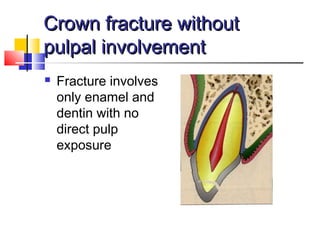
Crown fracture withoutCrown fracture without
pulpal involvementpulpal involvement
 Fracture involves
only enamel and
dentin with no
direct pulp
exposure
Crown fracture withCrown fracture with
pulpal involvementpulpal involvement
 Fracture involves
enamel, dentin,
and direct
exposure of the
pulp
Crown-root fractureCrown-root fracture
 This fracture
involves enamel,
dentin, and
cementum, and
may or may not
involve pulp
exposure
Root fractureRoot fracture
This fracture involves
dentin, cementum
and pulp
(Note: Root fracture
and luxation injury
may occur
simultaneously)
ConcussionConcussion
 This is minor injury
of the periodontium
with no
displacement of
the tooth nor
mobility
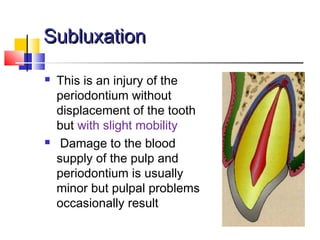
SubluxationSubluxation
 This is an injury of the
periodontium without
displacement of the tooth
but with slight mobility
 Damage to the blood
supply of the pulp and
periodontium is usually
minor but pulpal problems
occasionally result
Extrusive luxationExtrusive luxation
 This injury is
displacement of
the tooth in an
extrusive direction
involving the
periodontal support
and the pulpal
blood supply
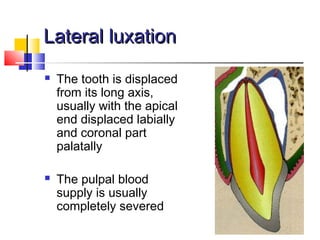
Lateral luxationLateral luxation
 The tooth is displaced
from its long axis,
usually with the apical
end displaced labially
and coronal part
palatally
 The pulpal blood
supply is usually
completely severed
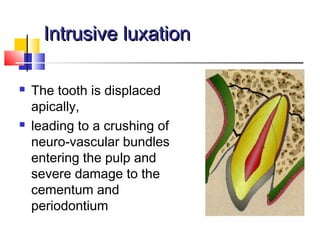
Intrusive luxationIntrusive luxation
 The tooth is displaced
apically,
 leading to a crushing of
neuro-vascular bundles
entering the pulp and
severe damage to the
cementum and
periodontium
AvulsionAvulsion
 The tooth is
completely displaced
from the alveolus with
total disruption of the
pulpal blood supply
Examination and Diagnosis
 Patient history
 Clinical examination
 Radiographic examination
 Other factors
Patient history
 When, Where, How it happens?
 Any fragment or avulsed tooth brought
to the dental office?
 Milk is a good storage medium for
avulsed tooth
Clinical examination
 Intraoral examination includes;
 Inspection – laceration, bleeding
 Palpation – mobility
 Percussion - pain
 Thermal test
 Electric pulp test
 Dental record – missing, displacement,
discoloration,
Radiographic examination
 Detect and confirm the fractures – crown,
root, alveolus, avulsion, displacement etc.,
 Good quality radiograph is essential
 Identify the stages of root development
Other factors
 For avulsed tooth, determine the length of
time that the tooth has been out of the
mouth, and storage medium
Example Cases – Case 1
 A 14-year-
old boy fell
and hit his
teeth #21 &
22. Slight
bleeding
and mobility
was
observed.
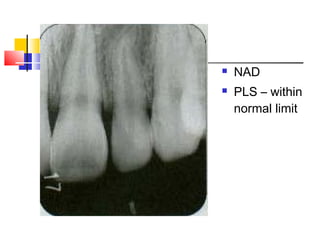
 NAD
 PLS – within
normal limit
 One month
later,
discoloration
is noted.
 The
diagnosis is
subluxation
resulting in
disruption
of the blood
supply to
the pulp.
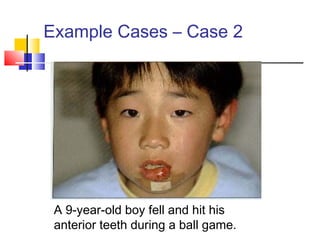
Example Cases – Case 2
A 9-year-old boy fell and hit his
anterior teeth during a ball game.
Note the contusion of the lower lip and crown fracture of tooth
#21. Because the fracture fragments are still attached, there is
possibility of crown-root fracture.
The fracture line reaches subgingivally on the
palatal aspect.
The fracture line extends below he crestal bone
margin. The diagnosis is crown-root fracture.
Example Cases – Case 3
 A 38-year-old
man hit his
lower face
with a tool
while
gardening
 Palpation of
the lips
indicates
embedded
foreign body
in the upper
lip.
 Tooth
fragment
in the
upper lip
Example Cases – Case 4
 18-year-old
woman with
enamel fracture
at #11 due to
automobile
accident. Two
months later,
discoloration
was observed.
 PLS - widening
The canal was filled with CaOH.
5 months later, root fracture was observed
Example Cases – Case 4
 A 32-year-
old woman
with a
severe
facial injury
in a
automobile
accident.
Extrusive luxation of #12, fracture of alveolar
bone, avulsion of teeth #11 and #22, and
intrusive luxation of #21
Crown FractureCrown Fracture
 Crown fracture may
involve enamel only,
enamel and dentin, or
enamel, dentin and pulp
 Any type of crown fracture
may also be combined with
a luxation injury
Types of Crown Fracture
Enamel fracture Uncomplicated crown fracture
involving enamel and dentin
Types of Crown Fracture
Complicated crown
fracture, involving
enamel, dentin, and
exposing the pulp.
Crown fracture combined
with luxation
Treatment of Enamel FractureTreatment of Enamel Fracture
Preoperativ view – chipping of enamel edge
Treatment of Enamel FractureTreatment of Enamel Fracture
After selective grinding
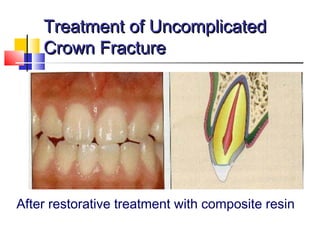
Treatment of UncomplicatedTreatment of Uncomplicated
Crown FractureCrown Fracture
Preoperative view –
No tooth fragment available
Treatment of UncomplicatedTreatment of Uncomplicated
Crown FractureCrown Fracture
After restorative treatment with composite resin
Treatment of UncomplicatedTreatment of Uncomplicated
Crown FractureCrown Fracture
Preoperative view -
Tooth fragment has been saved.
Treatment of UncomplicatedTreatment of Uncomplicated
Crown FractureCrown Fracture
After reattachment of the fragment
Treatment of Complicated CrownTreatment of Complicated Crown
Fracture with minimal pulpFracture with minimal pulp
exposureexposure
Preoperative view –
The tooth fragment has been saved.
Treatment of Complicated CrownTreatment of Complicated Crown
Fracture with minimal pulp exposureFracture with minimal pulp exposure
After pulp capping and reattachment
Treatment of Complicated CrownTreatment of Complicated Crown
Fracture with considerable pulpFracture with considerable pulp
exposureexposure
Preoperative view – The tooth fragment
available
Treatment of Complicated CrownTreatment of Complicated Crown
Fracture with considerable pulpFracture with considerable pulp
exposureexposure
Note: The root is incompletely formed
Treatment of Complicated CrownTreatment of Complicated Crown
Fracture with considerable pulpFracture with considerable pulp
exposureexposure
After partial pulpotomy and reattachment of
the tooth fragment.
Treatment of Complicated CrownTreatment of Complicated Crown
Fracture with considerable pulpFracture with considerable pulp
exposureexposure
Root formation is almost complete after 1
year and 4 months.
Treatment of Crown FractureTreatment of Crown Fracture
combined with luxation injurycombined with luxation injury
Preoperative view – Tooth fragments available
Treatment of crown fractureTreatment of crown fracture
combined with luxation injurycombined with luxation injury
Preoperative view
Treatment of Crown FractureTreatment of Crown Fracture
combined with luxation injurycombined with luxation injury
After restorative treatment. After 3 months, tooth
#21 was suspected for pulp necrosis
Treatment of crown fractureTreatment of crown fracture
combined with luxation injurycombined with luxation injury
Apexification using calcium hydroxide. 9 months
later the RCT is completed
Treatment of Crown Fracture withTreatment of Crown Fracture with
large pulp exposurelarge pulp exposure
Preoperative view – Tooth fragments
available
Treatment of Crown Fracture withTreatment of Crown Fracture with
large pulp exposularge pulp exposure
LA & rubber damExaminatio
n
Exam. Tooth
fragment
Treatment of Crown Fracture withTreatment of Crown Fracture with
large pulp exposurelarge pulp exposure
Fit the
tooth
fragment
Partial
pulpotomy
After rinsing
and
hemostasis
Treatment of Crown Fracture withTreatment of Crown Fracture with
large pulp exposurelarge pulp exposure
After placement
of pulp dressing
& composite
resin
Removal of pulp tissue from
the tooth fragment
Treatment of Crown Fracture withTreatment of Crown Fracture with
large pulp exposurelarge pulp exposure
Beveling of
the tooth
fragment
Beveling of
the original
tooth
Beveling of the
proximal
surface
Treatment of Crown Fracture withTreatment of Crown Fracture with
large pulp exposurelarge pulp exposure
Try-in of
tooth
fragment
Fitting of
Tofflemire
retainer and
matrix
Acid-etching
and bonding
Treatment of Crown Fracture withTreatment of Crown Fracture with
large pulp exposurelarge pulp exposure
Acid-etching, bonding,
and composite
placement
Fitting the fragment,
tightening the matrix,
remove the excess and
light curing
Treatment of Crown Fracture withTreatment of Crown Fracture with
large pulp exposurelarge pulp exposure
After removal of the matrix
band
Finishing and
shaping with a
finishing bur
Treatment of Crown Fracture withTreatment of Crown Fracture with
large pulp exposurelarge pulp exposure
Finishing and polishing with a white silicone point
Treatment of Crown Fracture withTreatment of Crown Fracture with
large pulp exposurelarge pulp exposure
Post-operative view
Pulp Capping and PulpPulp Capping and Pulp
HealingHealing
The mechanism of
dentin bridge formation
1. Immediate after vitalImmediate after vital
pulp treatmentpulp treatment
A necrotic layer is
observed below the
calcium hydroxide. The
inflammatory tissue
response is observed
under the necrotic layer
2. After 1 to 2 weeksAfter 1 to 2 weeks
A layer with a deposit of
calcium carbonate
granules is noticed
Beneath that layer,
osteo-odontoblasts
derived from pulp cells
emerge
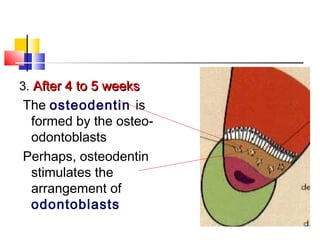
3. After 4 to 5 weeksAfter 4 to 5 weeks
The osteodentin is
formed by the osteo-
odontoblasts
Perhaps, osteodentin
stimulates the
arrangement of
odontoblasts
3. A few months after
The dentin bridge is
formed
It is composed of two
layers of hard tissue,
osteodentin and
dentin with dentinal
tubules
ApexogenesisApexogenesis
If the pulpotomy is performed successfully in a
tooth with incompletely formed root, normal
narrowing of the pulp cavity and normal
development of the root will occur
CROWN-ROOT
FRACTURE
a and b.
Uncomplicate
d crown-root
fracture
c. Complicated
crown-root
fracture
Treatment of uncomplicated
crown-root fracture
Preoperative view. Uncomplicated crown-
root fracture in an 8-year-old boy
Treatment of uncomplicated
crown-root fracture
The fit of tooth
fragment is
checked
The pulp
horn is
capped
The tooth fragment is
reattached using acid
etching, bonding, and
composite resin
Treatment of uncomplicated
crown-root fracture
After polishing of
the tooth
5 years 3 months after the
treatment
Treatment of complicated
crown-root fracture
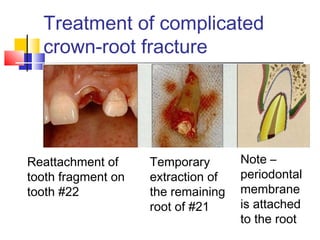
16-year-old boy with crown-root fracture on
tooth #21 and on #22
Treatment of complicated
crown-root fracture
Reattachment of
tooth fragment on
tooth #22
Temporary
extraction of
the remaining
root of #21
Note –
periodontal
membrane
is attached
to the root
Treatment of complicated
crown-root fracture
The root is rotated 180 degrees and
replanted into the alveolus with about 4 mm
extrusion. Stabilize with suture
Treatment of complicated
crown-root fracture
Blood clot
Secondary
reattachment zone
(1 to 8 weeks)
Primary reattachment
zone (2 to 7 days)
Treatment of complicated
crown-root fracture
The healing process:
Primary reattachment -
2-7 days: Reattachment between the
periodontal membrane on the root and
the gingival connective tissue
Treatment of complicated
crown-root fracture
Secondary Reattachment –
0-1 week. Blood clot occupy the space
between the root and alveolar cavity.
1-2 weeks. Blood clot is replaced by bony
granulation tissues.
4-8 weeks. Bony granulation tissue is
replaced by bone.
Treatment of complicated
crown-root fracture
Surgical
dressing is
placed
Sutures and
surgical dressing
are removed after
5 days
Follow-up
radiograph, 1
month
postoperative
Treatment of complicated
crown-root fracture
Composite
core built-up
All ceramic
restoration
Follow-up
radiograph –
2 years
postoperative
Treatment of complicated
crown-root fracture
Re-
establishing
biologic width
Biologic width
Prosthesis
margin
Treatment of complicated
crown-root fracture
1 mm, connective
tissue attachment
1 mm epithelial
attachment
1 mm gingival sulcus
>1 mm prosthesis
margin
Treatment of complicated
crown-root fracture
 For biologic width, there should be 3 mm of
tooth structure coronal to the bony margin
 However, it is often wise to add another 1
mm of tooth structure because the margin
of the prosthesis should be placed on
sound tooth structure near the gingival
margin
Orthodontic Extrusion
Re-establishing Biologic width:
 Orthodontic Extrusion
 Surgical extrusion
 Apically positioned flap with osseous
surgery
Orthodontic Extrusion
A case of crown-root fracture, tooth #21,
which has undergone endodontic treatment
Orthodontic Extrusion
Removal of
the tooth
fragment
Appliance for
orthodontic
extrusion using
an elastic band
Resin shell for
esthetic
purpose during
the treatment
Orthodontic Extrusion
After extrusion. The
gingiva has moved
coronally causing
esthetic problem
After
extrusion
Apically positioned
flap
Orthodontic Extrusion
2 weeks after
periodontal surgery
A provisional
restoration should be
placed before the final
prosthesis is made
1 year and 6 months after
the initial examination
Traumatized Teeth

Traumatized Teeth

  • 1.
    TRAUMATIZED ANTERIOR TEETH Dr. KhinSwe Aye BDS., DipDSc., MDSc., Dr Dental Science, FICCDE Dept. of Conservative Dentistry, UDMY
  • 2.
     Loss ofa child’s anterior teeth especially permanent dentition, cause greater psychological impact on parents and on child  CausesCauses  Simple accidents minor falls, accidents during sports or childish pranks
  • 3.
     ResultResult  Facialappearance is altered (attractive → unattractive target for teasing and even ridicule by other children)  Dentist’s DutyDentist’s Duty  To preserve the vitality of injured teeth  To restore them skillfully to their orginal apperance, without producing additional trauma or endangering integrity of the teeth
  • 4.
     TimeTime  Important considerationin treatment of TATTAT  Every effort should be made immediatelyimmediately and should be given preference and emergency treatment
  • 5.
    Therefore •further irritation tothe pulp could be prevented, • avulsed tooth could be replanted with higher percentage of success, • more favorable result could be anticipated
  • 6.
    Prevalence of Injuriesto Anterior Teeth TeethTeeth – Maxillary central incisors (most frequently involved) SexSex – Boys > Girls (2 : 1) AgeAge - between 9–10 yrs HistoryHistory  When the accident occur?  How the accident occur?  Where of the accident occur?  Whether treatment of any kind taken or not?
  • 7.
    Clinical Examination  Determinetype and extent of injury  Chief complaintChief complaint  Neurologic examinationNeurologic examination  Extra-oral examinationExtra-oral examination  Lacerations, Ex: bone contours, TMJ  Intra-oral examinationIntra-oral examination  Radiographic ExaminationsRadiographic Examinations  Root fracture, sub-gingival crown fracture, bone fracture, foreign objects  Manipulation TestManipulation Test - for mobility
  • 8.
     Vitality TestVitality Test– should be recorded, to compare with vital tests at recall lists  Heat Test, Cold Test, EPT PrognosisPrognosis - on histologic condition of pulp  PercussionPercussion  To check injury to periodontal membrane and other supporting structure SummarySummary - The examination of traumatic injuries must be thorough and meticulously recorded
  • 9.
    Classification of TraumaticInjuries of Permanent Teeth  Class 0Class 0 → Enamel Crack  Class 1Class 1 → Enamel Fracture  Class 2Class 2 → Enamel –Dentin # without pulp exposure  Class 3Class 3 → Enamel –Dentin # with pulp exposure  Class 4Class 4 → E,D,C # without Pulp exposure  Class 5Class 5 → E,D,C # with Pulp exposure
  • 10.
     Class 6Class6 → Root fracture  Class 7Class 7 → Concussion  Class 8Class 8 → Luxation (loosening)  Class 9Class 9 → Lateral Displacement  Class 10Class 10 → Intrusion  Class 11Class 11 → Extrusion  Class 12Class 12 → Avulsion ( WHO CLASSIFICATION )( WHO CLASSIFICATION )
  • 11.
  • 12.
    Classification (WHO) Enamel infractionEnamel fracture Crown fracture without pulp involvement
  • 13.
    Classification (WHO) Crown fracturewith pulp involvement Crown-root fracture Root fracture
  • 14.
  • 15.
    Classification (WHO) Lateral luxationIntrusive luxation Avulsion
  • 16.
    Classification (WHO)  Traumaticinjuries are classified into various fracture and luxation types, but combination injuries often occur  For the sake of clarity, however, each type of injury will be described individually
  • 17.
    Enamel infraction andfractureEnamel infraction and fracture Infraction An incomplete fracture of the enamel without an enamel defect (crack) Enamel fracture A small chip of enamel only
  • 18.
    Crown fracture withoutCrownfracture without pulpal involvementpulpal involvement  Fracture involves only enamel and dentin with no direct pulp exposure
  • 19.
    Crown fracture withCrownfracture with pulpal involvementpulpal involvement  Fracture involves enamel, dentin, and direct exposure of the pulp
  • 20.
    Crown-root fractureCrown-root fracture This fracture involves enamel, dentin, and cementum, and may or may not involve pulp exposure
  • 21.
    Root fractureRoot fracture Thisfracture involves dentin, cementum and pulp (Note: Root fracture and luxation injury may occur simultaneously)
  • 22.
    ConcussionConcussion  This isminor injury of the periodontium with no displacement of the tooth nor mobility
  • 23.
    SubluxationSubluxation  This isan injury of the periodontium without displacement of the tooth but with slight mobility  Damage to the blood supply of the pulp and periodontium is usually minor but pulpal problems occasionally result
  • 24.
    Extrusive luxationExtrusive luxation This injury is displacement of the tooth in an extrusive direction involving the periodontal support and the pulpal blood supply
  • 25.
    Lateral luxationLateral luxation The tooth is displaced from its long axis, usually with the apical end displaced labially and coronal part palatally  The pulpal blood supply is usually completely severed
  • 26.
    Intrusive luxationIntrusive luxation The tooth is displaced apically,  leading to a crushing of neuro-vascular bundles entering the pulp and severe damage to the cementum and periodontium
  • 27.
    AvulsionAvulsion  The toothis completely displaced from the alveolus with total disruption of the pulpal blood supply
  • 28.
    Examination and Diagnosis Patient history  Clinical examination  Radiographic examination  Other factors
  • 29.
    Patient history  When,Where, How it happens?  Any fragment or avulsed tooth brought to the dental office?  Milk is a good storage medium for avulsed tooth
  • 30.
    Clinical examination  Intraoralexamination includes;  Inspection – laceration, bleeding  Palpation – mobility  Percussion - pain  Thermal test  Electric pulp test  Dental record – missing, displacement, discoloration,
  • 31.
    Radiographic examination  Detectand confirm the fractures – crown, root, alveolus, avulsion, displacement etc.,  Good quality radiograph is essential  Identify the stages of root development
  • 32.
    Other factors  Foravulsed tooth, determine the length of time that the tooth has been out of the mouth, and storage medium
  • 33.
    Example Cases –Case 1  A 14-year- old boy fell and hit his teeth #21 & 22. Slight bleeding and mobility was observed.
  • 34.
     NAD  PLS– within normal limit
  • 35.
  • 36.
     The diagnosis is subluxation resultingin disruption of the blood supply to the pulp.
  • 37.
    Example Cases –Case 2 A 9-year-old boy fell and hit his anterior teeth during a ball game.
  • 38.
    Note the contusionof the lower lip and crown fracture of tooth #21. Because the fracture fragments are still attached, there is possibility of crown-root fracture.
  • 39.
    The fracture linereaches subgingivally on the palatal aspect.
  • 40.
    The fracture lineextends below he crestal bone margin. The diagnosis is crown-root fracture.
  • 41.
    Example Cases –Case 3  A 38-year-old man hit his lower face with a tool while gardening
  • 43.
     Palpation of thelips indicates embedded foreign body in the upper lip.
  • 44.
  • 45.
    Example Cases –Case 4  18-year-old woman with enamel fracture at #11 due to automobile accident. Two months later, discoloration was observed.
  • 46.
     PLS -widening
  • 47.
    The canal wasfilled with CaOH. 5 months later, root fracture was observed
  • 48.
    Example Cases –Case 4  A 32-year- old woman with a severe facial injury in a automobile accident.
  • 49.
    Extrusive luxation of#12, fracture of alveolar bone, avulsion of teeth #11 and #22, and intrusive luxation of #21
  • 50.
    Crown FractureCrown Fracture Crown fracture may involve enamel only, enamel and dentin, or enamel, dentin and pulp  Any type of crown fracture may also be combined with a luxation injury
  • 51.
    Types of CrownFracture Enamel fracture Uncomplicated crown fracture involving enamel and dentin
  • 52.
    Types of CrownFracture Complicated crown fracture, involving enamel, dentin, and exposing the pulp. Crown fracture combined with luxation
  • 53.
    Treatment of EnamelFractureTreatment of Enamel Fracture Preoperativ view – chipping of enamel edge
  • 54.
    Treatment of EnamelFractureTreatment of Enamel Fracture After selective grinding
  • 55.
    Treatment of UncomplicatedTreatmentof Uncomplicated Crown FractureCrown Fracture Preoperative view – No tooth fragment available
  • 56.
    Treatment of UncomplicatedTreatmentof Uncomplicated Crown FractureCrown Fracture After restorative treatment with composite resin
  • 57.
    Treatment of UncomplicatedTreatmentof Uncomplicated Crown FractureCrown Fracture Preoperative view - Tooth fragment has been saved.
  • 58.
    Treatment of UncomplicatedTreatmentof Uncomplicated Crown FractureCrown Fracture After reattachment of the fragment
  • 59.
    Treatment of ComplicatedCrownTreatment of Complicated Crown Fracture with minimal pulpFracture with minimal pulp exposureexposure Preoperative view – The tooth fragment has been saved.
  • 60.
    Treatment of ComplicatedCrownTreatment of Complicated Crown Fracture with minimal pulp exposureFracture with minimal pulp exposure After pulp capping and reattachment
  • 61.
    Treatment of ComplicatedCrownTreatment of Complicated Crown Fracture with considerable pulpFracture with considerable pulp exposureexposure Preoperative view – The tooth fragment available
  • 62.
    Treatment of ComplicatedCrownTreatment of Complicated Crown Fracture with considerable pulpFracture with considerable pulp exposureexposure Note: The root is incompletely formed
  • 63.
    Treatment of ComplicatedCrownTreatment of Complicated Crown Fracture with considerable pulpFracture with considerable pulp exposureexposure After partial pulpotomy and reattachment of the tooth fragment.
  • 64.
    Treatment of ComplicatedCrownTreatment of Complicated Crown Fracture with considerable pulpFracture with considerable pulp exposureexposure Root formation is almost complete after 1 year and 4 months.
  • 65.
    Treatment of CrownFractureTreatment of Crown Fracture combined with luxation injurycombined with luxation injury Preoperative view – Tooth fragments available
  • 66.
    Treatment of crownfractureTreatment of crown fracture combined with luxation injurycombined with luxation injury Preoperative view
  • 67.
    Treatment of CrownFractureTreatment of Crown Fracture combined with luxation injurycombined with luxation injury After restorative treatment. After 3 months, tooth #21 was suspected for pulp necrosis
  • 68.
    Treatment of crownfractureTreatment of crown fracture combined with luxation injurycombined with luxation injury Apexification using calcium hydroxide. 9 months later the RCT is completed
  • 69.
    Treatment of CrownFracture withTreatment of Crown Fracture with large pulp exposurelarge pulp exposure Preoperative view – Tooth fragments available
  • 70.
    Treatment of CrownFracture withTreatment of Crown Fracture with large pulp exposularge pulp exposure LA & rubber damExaminatio n Exam. Tooth fragment
  • 71.
    Treatment of CrownFracture withTreatment of Crown Fracture with large pulp exposurelarge pulp exposure Fit the tooth fragment Partial pulpotomy After rinsing and hemostasis
  • 72.
    Treatment of CrownFracture withTreatment of Crown Fracture with large pulp exposurelarge pulp exposure After placement of pulp dressing & composite resin Removal of pulp tissue from the tooth fragment
  • 73.
    Treatment of CrownFracture withTreatment of Crown Fracture with large pulp exposurelarge pulp exposure Beveling of the tooth fragment Beveling of the original tooth Beveling of the proximal surface
  • 74.
    Treatment of CrownFracture withTreatment of Crown Fracture with large pulp exposurelarge pulp exposure Try-in of tooth fragment Fitting of Tofflemire retainer and matrix Acid-etching and bonding
  • 75.
    Treatment of CrownFracture withTreatment of Crown Fracture with large pulp exposurelarge pulp exposure Acid-etching, bonding, and composite placement Fitting the fragment, tightening the matrix, remove the excess and light curing
  • 76.
    Treatment of CrownFracture withTreatment of Crown Fracture with large pulp exposurelarge pulp exposure After removal of the matrix band Finishing and shaping with a finishing bur
  • 77.
    Treatment of CrownFracture withTreatment of Crown Fracture with large pulp exposurelarge pulp exposure Finishing and polishing with a white silicone point
  • 78.
    Treatment of CrownFracture withTreatment of Crown Fracture with large pulp exposurelarge pulp exposure Post-operative view
  • 79.
    Pulp Capping andPulpPulp Capping and Pulp HealingHealing
  • 80.
    The mechanism of dentinbridge formation 1. Immediate after vitalImmediate after vital pulp treatmentpulp treatment A necrotic layer is observed below the calcium hydroxide. The inflammatory tissue response is observed under the necrotic layer
  • 81.
    2. After 1to 2 weeksAfter 1 to 2 weeks A layer with a deposit of calcium carbonate granules is noticed Beneath that layer, osteo-odontoblasts derived from pulp cells emerge
  • 82.
    3. After 4to 5 weeksAfter 4 to 5 weeks The osteodentin is formed by the osteo- odontoblasts Perhaps, osteodentin stimulates the arrangement of odontoblasts
  • 83.
    3. A fewmonths after The dentin bridge is formed It is composed of two layers of hard tissue, osteodentin and dentin with dentinal tubules
  • 84.
    ApexogenesisApexogenesis If the pulpotomyis performed successfully in a tooth with incompletely formed root, normal narrowing of the pulp cavity and normal development of the root will occur
  • 85.
    CROWN-ROOT FRACTURE a and b. Uncomplicate dcrown-root fracture c. Complicated crown-root fracture
  • 86.
    Treatment of uncomplicated crown-rootfracture Preoperative view. Uncomplicated crown- root fracture in an 8-year-old boy
  • 87.
    Treatment of uncomplicated crown-rootfracture The fit of tooth fragment is checked The pulp horn is capped The tooth fragment is reattached using acid etching, bonding, and composite resin
  • 88.
    Treatment of uncomplicated crown-rootfracture After polishing of the tooth 5 years 3 months after the treatment
  • 89.
    Treatment of complicated crown-rootfracture 16-year-old boy with crown-root fracture on tooth #21 and on #22
  • 90.
    Treatment of complicated crown-rootfracture Reattachment of tooth fragment on tooth #22 Temporary extraction of the remaining root of #21 Note – periodontal membrane is attached to the root
  • 91.
    Treatment of complicated crown-rootfracture The root is rotated 180 degrees and replanted into the alveolus with about 4 mm extrusion. Stabilize with suture
  • 92.
    Treatment of complicated crown-rootfracture Blood clot Secondary reattachment zone (1 to 8 weeks) Primary reattachment zone (2 to 7 days)
  • 93.
    Treatment of complicated crown-rootfracture The healing process: Primary reattachment - 2-7 days: Reattachment between the periodontal membrane on the root and the gingival connective tissue
  • 94.
    Treatment of complicated crown-rootfracture Secondary Reattachment – 0-1 week. Blood clot occupy the space between the root and alveolar cavity. 1-2 weeks. Blood clot is replaced by bony granulation tissues. 4-8 weeks. Bony granulation tissue is replaced by bone.
  • 95.
    Treatment of complicated crown-rootfracture Surgical dressing is placed Sutures and surgical dressing are removed after 5 days Follow-up radiograph, 1 month postoperative
  • 96.
    Treatment of complicated crown-rootfracture Composite core built-up All ceramic restoration Follow-up radiograph – 2 years postoperative
  • 97.
    Treatment of complicated crown-rootfracture Re- establishing biologic width Biologic width Prosthesis margin
  • 98.
    Treatment of complicated crown-rootfracture 1 mm, connective tissue attachment 1 mm epithelial attachment 1 mm gingival sulcus >1 mm prosthesis margin
  • 99.
    Treatment of complicated crown-rootfracture  For biologic width, there should be 3 mm of tooth structure coronal to the bony margin  However, it is often wise to add another 1 mm of tooth structure because the margin of the prosthesis should be placed on sound tooth structure near the gingival margin
  • 100.
    Orthodontic Extrusion Re-establishing Biologicwidth:  Orthodontic Extrusion  Surgical extrusion  Apically positioned flap with osseous surgery
  • 101.
    Orthodontic Extrusion A caseof crown-root fracture, tooth #21, which has undergone endodontic treatment
  • 102.
    Orthodontic Extrusion Removal of thetooth fragment Appliance for orthodontic extrusion using an elastic band Resin shell for esthetic purpose during the treatment
  • 103.
    Orthodontic Extrusion After extrusion.The gingiva has moved coronally causing esthetic problem After extrusion Apically positioned flap
  • 104.
    Orthodontic Extrusion 2 weeksafter periodontal surgery A provisional restoration should be placed before the final prosthesis is made 1 year and 6 months after the initial examination