

© Ramaiah University of Applied Sciences
1
Faculty of Dental Sciences
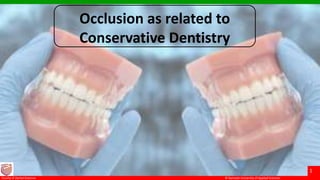
Occlusion as related to
Conservative Dentistry
© Ramaiah University of Applied Sciences
2
Faculty of Dental Sciences
Contents
• Introduction
• Terminologies
• General description
– Tooth alignment and dental arches
– Anterior-posterior inter arch relationship
– Inter arch tooth relationship
– Posterior cusp characteristics
– Supporting and non supporting cusp
• Types and directions of mandibular movements
• Mechanism of mandibular motion
• Tooth contacts during mandibular movements
• Role of contact, contours and marginal ridges
•Signs of instability of occlusion
•Response to high restoration
•Requirements for equilibrium of the masticatory
system
•Requirements for occlusal stability
• Occlusal interferences
•Occlusal equilibration
•Occlusal considerations for restorative treatment
•Stamp Technique
•Conclusion
•References
© Ramaiah University of Applied Sciences
3
Faculty of Dental Sciences
Occlusion – “Closing”
Introduction
In dentistry, occlusion - “The Contact of the opposing dental arches when they are in contacts
(static) and during various jaw movements (dynamic occlusion)”- Sturdevant’s, 7th edition
Carlsson et al, concluded that “in final analysis, optimal function & the absence of disease is
the principal characteristic of a good occlusion”- Sturdevant’s, 7th edition
© Ramaiah University of Applied Sciences
4
Faculty of Dental Sciences
Significance of occlusion in conservative dentistry
A dental restoration after being placed in a tooth, becomes one
of the essential components of stomato-gnathic system
They can initiate/ predispose into myriad of pathologic processes
© Ramaiah University of Applied Sciences
5
Faculty of Dental Sciences
Terminologies
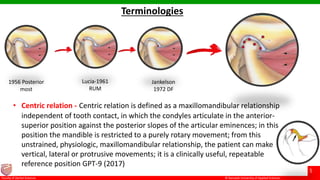
• Centric relation - Centric relation is defined as a maxillomandibular relationship
independent of tooth contact, in which the condyles articulate in the anterior-
superior position against the posterior slopes of the articular eminences; in this
position the mandible is restricted to a purely rotary movement; from this
unstrained, physiologic, maxillomandibular relationship, the patient can make
vertical, lateral or protrusive movements; it is a clinically useful, repeatable
reference position GPT-9 (2017)
Jankelson
1972 DF
1956 Posterior
most
Lucia-1961
RUM
© Ramaiah University of Applied Sciences
6
Faculty of Dental Sciences
• Centric Occlusion: The occlusion of opposing teeth when the mandible is in centric
relation. This may or may not coincide with the maximal intercuspal position
• Maximal Intercuspal Position: The complete intercuspation of the opposing teeth
independent of condylar position, sometimes referred to as the best fit of teeth
regardless of the condylar position- called also maximal intercuspation
• Balanced Occlusion: Simultaneous bilateral contacting of maxillary and mandibular
teeth in anterior and posterior occlusal areas in centric and eccentric positions
© Ramaiah University of Applied Sciences
7
Faculty of Dental Sciences
General description:
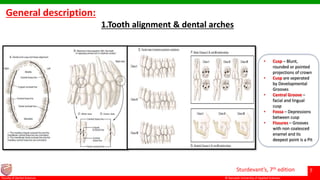
1.Tooth alignment & dental arches
Sturdevant’s, 7th edition
• Cusp – Blunt,
rounded or pointed
projections of crown
• Cusp are seperated
by Developmental
Grooves
• Central Groove –
facial and lingual
cusp
• Fossa – Depressions
between cusp
• Fissures – Grooves
with non coalesced
enamel and its
deepest point is a Pit
© Ramaiah University of Applied Sciences
8
Faculty of Dental Sciences
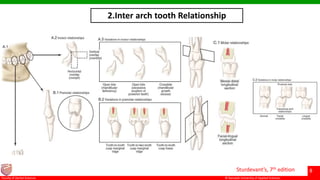
2.Inter arch tooth Relationship
Sturdevant’s, 7th edition
© Ramaiah University of Applied Sciences
9
Faculty of Dental Sciences
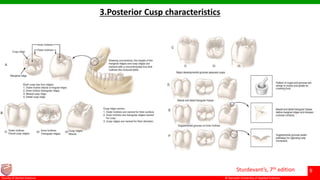
3.Posterior Cusp characteristics
Sturdevant’s, 7th edition
© Ramaiah University of Applied Sciences
10
Faculty of Dental Sciences
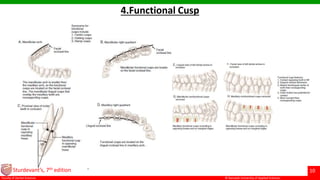
4.Functional Cusp
Sturdevant’s, 7th edition
© Ramaiah University of Applied Sciences
11
Faculty of Dental Sciences
5.Non-functional Cusp
Sturdevant’s, 7th edition
© Ramaiah University of Applied Sciences
12
Faculty of Dental Sciences
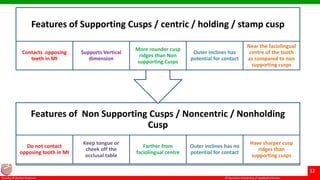
Features of Non Supporting Cusps / Noncentric / Nonholding
Cusp
Do not contact
opposing tooth in MI
Keep tongue or
cheek off the
occlusal table
Farther from
faciolingual centre
Outer inclines has no
potential for contact
Have sharper cusp
ridges than
supporting cusps
Features of Supporting Cusps / centric / holding / stamp cusp
Contacts opposing
teeth in MI
Supports Vertical
dimension
More rounder cusp
ridges than Non
supporting Cusps
Outer Inclines has
potential for contact
Near the faciolingual
centre of the tooth
as compared to non
supporting cusps
© Ramaiah University of Applied Sciences
13
Faculty of Dental Sciences
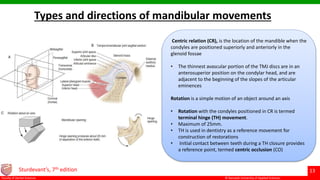
Types and directions of mandibular movements
Sturdevant’s, 7th edition
Centric relation (CR), is the location of the mandible when the
condyles are positioned superiorly and anteriorly in the
glenoid fossae
• The thinnest avascular portion of the TMJ discs are in an
anterosuperior position on the condylar head, and are
adjacent to the beginning of the slopes of the articular
eminences
Rotation is a simple motion of an object around an axis
• Rotation with the condyles positioned in CR is termed
terminal hinge (TH) movement.
• Maximum of 25mm.
• TH is used in dentistry as a reference movement for
construction of restorations
• Initial contact between teeth during a TH closure provides
a reference point, termed centric occlusion (CO)
© Ramaiah University of Applied Sciences
14
Faculty of Dental Sciences
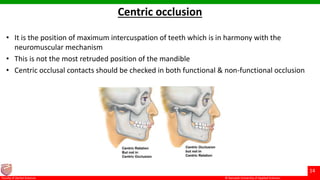
Centric occlusion
• It is the position of maximum intercuspation of teeth which is in harmony with the
neuromuscular mechanism
• This is not the most retruded position of the mandible
• Centric occlusal contacts should be checked in both functional & non-functional occlusion
© Ramaiah University of Applied Sciences
15
Faculty of Dental Sciences
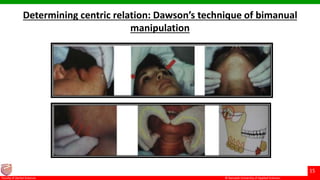
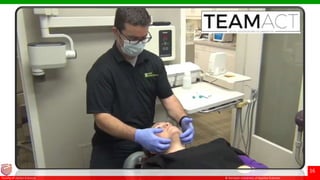
Determining centric relation: Dawson’s technique of bimanual
manipulation
© Ramaiah University of Applied Sciences
16
Faculty of Dental Sciences
© Ramaiah University of Applied Sciences
17
Faculty of Dental Sciences
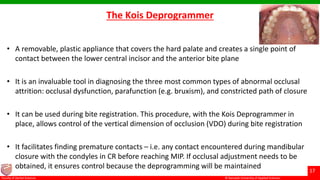
The Kois Deprogrammer
• A removable, plastic appliance that covers the hard palate and creates a single point of
contact between the lower central incisor and the anterior bite plane
• It is an invaluable tool in diagnosing the three most common types of abnormal occlusal
attrition: occlusal dysfunction, parafunction (e.g. bruxism), and constricted path of closure
• It can be used during bite registration. This procedure, with the Kois Deprogrammer in
place, allows control of the vertical dimension of occlusion (VDO) during bite registration
• It facilitates finding premature contacts – i.e. any contact encountered during mandibular
closure with the condyles in CR before reaching MIP. If occlusal adjustment needs to be
obtained, it ensures control because the deprogramming will be maintained
© Ramaiah University of Applied Sciences
18
Faculty of Dental Sciences
Recording centric relation criteria for accuracy in making an
interocclusal bite record
The bite record must not cause any movement of teeth or displacement of soft tissue
It must be possible to verify the accuracy of the interocclusal record in the mouth & on
the casts
The bite record must fit the casts as accurately as it fits the mouth
The bite record must not distort during storage or transportation to the laboratory
© Ramaiah University of Applied Sciences
19
Faculty of Dental Sciences
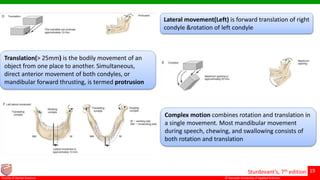
Lateral movement(Left) is forward translation of right
condyle &rotation of left condyle
Translation(> 25mm) is the bodily movement of an
object from one place to another. Simultaneous,
direct anterior movement of both condyles, or
mandibular forward thrusting, is termed protrusion
Complex motion combines rotation and translation in
a single movement. Most mandibular movement
during speech, chewing, and swallowing consists of
both rotation and translation
Sturdevant’s, 7th edition
© Ramaiah University of Applied Sciences
20
Faculty of Dental Sciences
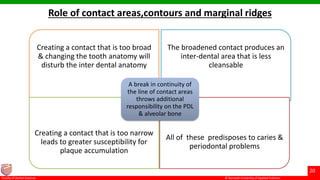
Role of contact areas,contours and marginal ridges
Creating a contact that is too broad
& changing the tooth anatomy will
disturb the inter dental anatomy
The broadened contact produces an
inter-dental area that is less
cleansable
Creating a contact that is too narrow
leads to greater susceptibility for
plaque accumulation
All of these predisposes to caries &
periodontal problems
A break in continuity of
the line of contact areas
throws additional
responsibility on the PDL
& alveolar bone
© Ramaiah University of Applied Sciences
21
Faculty of Dental Sciences
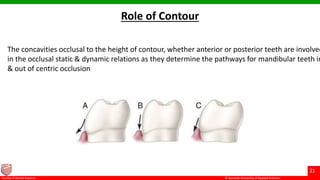
Role of Contour
The concavities occlusal to the height of contour, whether anterior or posterior teeth are involved
in the occlusal static & dynamic relations as they determine the pathways for mandibular teeth in
& out of centric occlusion
© Ramaiah University of Applied Sciences
22
Faculty of Dental Sciences
Role of marginal ridges
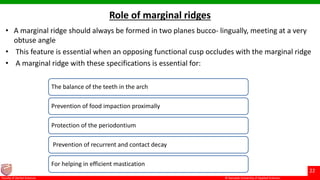
• A marginal ridge should always be formed in two planes bucco- lingually, meeting at a very
obtuse angle
• This feature is essential when an opposing functional cusp occludes with the marginal ridge
• A marginal ridge with these specifications is essential for:
The balance of the teeth in the arch
Prevention of food impaction proximally
Protection of the periodontium
Prevention of recurrent and contact decay
For helping in efficient mastication
© Ramaiah University of Applied Sciences
23
Faculty of Dental Sciences
Requirements for Occlusal Stability
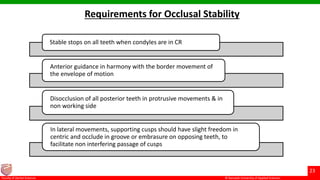
Stable stops on all teeth when condyles are in CR
Anterior guidance in harmony with the border movement of
the envelope of motion
Disocclusion of all posterior teeth in protrusive movements & in
non working side
In lateral movements, supporting cusps should have slight freedom in
centric and occlude in groove or embrasure on opposing teeth, to
facilitate non interfering passage of cusps
© Ramaiah University of Applied Sciences
24
Faculty of Dental Sciences
Symptoms/Response to High Restoration
• Tooth ache
• Tooth tender on biting
• Tooth wear
• Spastic masticatory muscles
• Muscle tension headache
• Condyle/ disk displacement
• Degenerative arthritic changes in TMJ
© Ramaiah University of Applied Sciences
25
Faculty of Dental Sciences
Occlusal Interferences
• When the teeth are not in harmony with the joints & the mandibular movements,
interference is said to exist
• Interferences are undesirable occlusal contacts that may produce mandibular deviation
during closure to maximum intercuspation or may hinder smooth passage to and from
the intercuspal position
© Ramaiah University of Applied Sciences
26
Faculty of Dental Sciences
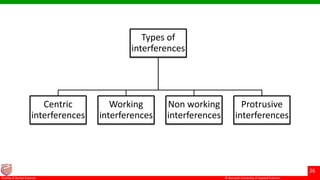
Types of
interferences
Centric
interferences
Working
interferences
Non working
interferences
Protrusive
interferences
© Ramaiah University of Applied Sciences
27
Faculty of Dental Sciences
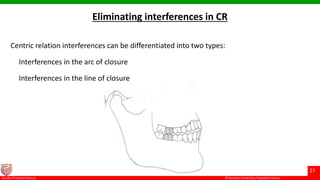
Eliminating interferences in CR
Centric relation interferences can be differentiated into two types:
Interferences in the arc of closure
Interferences in the line of closure
© Ramaiah University of Applied Sciences
28
Faculty of Dental Sciences
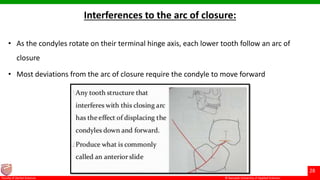
Interferences to the arc of closure:
• As the condyles rotate on their terminal hinge axis, each lower tooth follow an arc of
closure
• Most deviations from the arc of closure require the condyle to move forward
© Ramaiah University of Applied Sciences
29
Faculty of Dental Sciences
Interferences to the arc of closure:
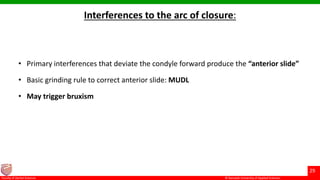
• Primary interferences that deviate the condyle forward produce the “anterior slide”
• Basic grinding rule to correct anterior slide: MUDL
• May trigger bruxism
© Ramaiah University of Applied Sciences
30
Faculty of Dental Sciences
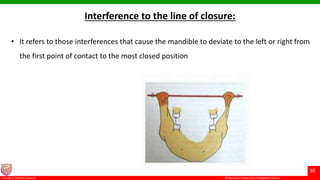
Interference to the line of closure:
• It refers to those interferences that cause the mandible to deviate to the left or right from
the first point of contact to the most closed position
© Ramaiah University of Applied Sciences
31
Faculty of Dental Sciences
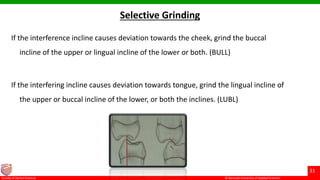
If the interference incline causes deviation towards the cheek, grind the buccal
incline of the upper or lingual incline of the lower or both. (BULL)
If the interfering incline causes deviation towards tongue, grind the lingual incline of
the upper or buccal incline of the lower, or both the inclines. (LUBL)
Selective Grinding
© Ramaiah University of Applied Sciences
32
Faculty of Dental Sciences
Why to adjust interferences in CR first??
By adjusting the centric
interferences first, you
have the option of
improving cusp-tip
position
Occlusal grinding is more
evenly distributed to both
arches
Eccentric interferences
can be eliminated with
speed and simplicity
© Ramaiah University of Applied Sciences
33
Faculty of Dental Sciences
Lateral excursion interferences:
• When lateral excursions are being equilibrated, the mandible must be guided with
firm upward pressure
• Guiding the mandible with firm pressure during excursions will routinely pick up
posterior interferences that are missed with unguided movements
© Ramaiah University of Applied Sciences
34
Faculty of Dental Sciences
Protrusive
interferences:
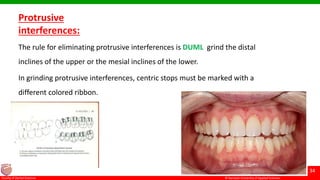
The rule for eliminating protrusive interferences is DUML grind the distal
inclines of the upper or the mesial inclines of the lower.
In grinding protrusive interferences, centric stops must be marked with a
different colored ribbon.
© Ramaiah University of Applied Sciences
35
Faculty of Dental Sciences
Occlusal Equilibration
The modification of the occlusal form of the teeth with the intent of equalizing occlusal
stress, producing simultaneous occlusal contacts or harmonizing cuspal relations.
GPT 8
© Ramaiah University of Applied Sciences
36
Faculty of Dental Sciences
Equilibration Procedures:
Divided into 4 parts:
1. Reduction of all contacting tooth interferences in centric relation
2. Selective reduction of tooth interferences with lateral excursions
3. Elimination of all posterior tooth structure that interferes with protrusive excursions
4. Harmonization of the anterior guidance
© Ramaiah University of Applied Sciences
37
Faculty of Dental Sciences
Verification of Completion
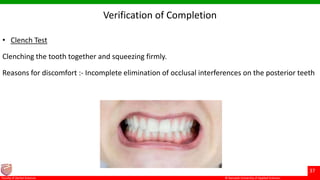
• Clench Test
Clenching the tooth together and squeezing firmly.
Reasons for discomfort :- Incomplete elimination of occlusal interferences on the posterior teeth
© Ramaiah University of Applied Sciences
38
Faculty of Dental Sciences
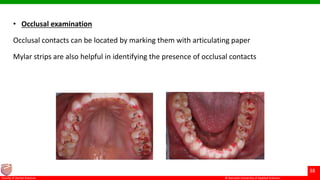
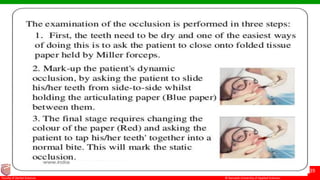
• Occlusal examination
Occlusal contacts can be located by marking them with articulating paper
Mylar strips are also helpful in identifying the presence of occlusal contacts
© Ramaiah University of Applied Sciences
39
Faculty of Dental Sciences
© Ramaiah University of Applied Sciences
40
Faculty of Dental Sciences
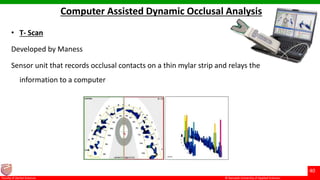
Computer Assisted Dynamic Occlusal Analysis
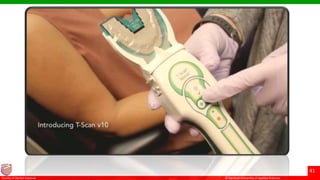
• T- Scan
Developed by Maness
Sensor unit that records occlusal contacts on a thin mylar strip and relays the
information to a computer
© Ramaiah University of Applied Sciences
41
Faculty of Dental Sciences
© Ramaiah University of Applied Sciences
42
Faculty of Dental Sciences
Treatment planning- Confirmative Approach
• Before initiating treatment the clinician must decide whether to provide restorations
within the existing occlusal scheme or to change it
• Confirmative approach is defined as the provision of restorations in harmony with the
existing jaw relationships
• It is the principle of providing a new restoration that does not alter the patients occlusion
• Majority of restorations follow this principle
S J Davies et al, Occlusion: Good occlusal practice in simple restorative dentistry. British Dental Journal (2001) 191, 365-3810
© Ramaiah University of Applied Sciences
43
Faculty of Dental Sciences
Technique
– The sequence followed is The ‘EDEC’ Principle
E= Examine and record the pre-existing occlusion
D= Design the restoration
E= Execute the restoration
C= Check the occlusion
The EDEC Principle is useful in relation to :
- Direct Restorations
- Indirect Restorations
S J Davies et al, Occlusion: Good occlusal practice in simple restorative dentistry. British Dental Journal (2001) 191, 365-381
© Ramaiah University of Applied Sciences
44
Faculty of Dental Sciences
The EDEC Principle for Direct & Indirect Restorations
1. Examine :
– Examine static and dynamic occlusion
– Mark them preoperatively
– Malpositioned opposing supporting cusps, ridges or fossae may be recountoured in order to achieve
optimal occlusal contacts
– Plunger cusps and over erupted teeth are to be reduced
– In anterior restorations, the scheme of incisal guidance must be examined properly
– Assessment of periodontal condition must be made
© Ramaiah University of Applied Sciences
45
Faculty of Dental Sciences
2. Design :
– Visualize the design of cavity
– Existing occlusal marks will either be preserved by being avoided in the preparation, or they will be
involved in the design, but never end preparation margins at these points.
3. Execution :
– Controlled interproximal cutting and care in restoring axial tooth contour to avoid overcontouring is
essential
– Carving of restoration must be harmonious to occlusion and should not produce premature contacts
4. Check :
– Check the occlusion by either reversing the color of paper or foils used pre-operatively and using the
preoperative marks as a refrence
© Ramaiah University of Applied Sciences
46
Faculty of Dental Sciences
Occlusal Considerations For Restorative Treatment
• Restorations are influenced by the need to withstand forceful contact with the opposing
teeth
• The restorations should provide contacts on smoothly concave fossae such that the
masticatory forces are directed parallel to the long axis of the tooth
• Occlusal features should be compatible with the patients existing occlusion, especially in
cases of bruxism
• Both in anterior and posterior teeth
© Ramaiah University of Applied Sciences
47
Faculty of Dental Sciences
• When restoring Mandibular 1st molar following precautions are to be taken :
 Provide adequate stops on mandibular 2nd molar to prevent distal migration
 The disto-lingual cusp of max 1st molar should contact the mesial marginal ridge of mand 2nd
molar
 The cusp tip should not occlude with the embrasure area of mand 1st and 2nd molar – food
impaction and distal movement
© Ramaiah University of Applied Sciences
48
Faculty of Dental Sciences
OCCLUSAL ADJUSTMENTS
Directly Inserted Restorative Materials:
• Eg : Amalgam, Composite
• Should be carved to contact, contour & correct margins
• Check with marking ribbon for deflections in maximum intercuspation, protrusive
and lateral excursions
• Proceed with occlusal adjustments
© Ramaiah University of Applied Sciences
49
Faculty of Dental Sciences
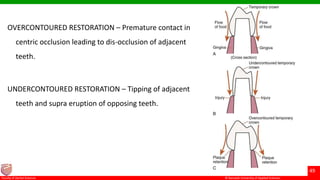
OVERCONTOURED RESTORATION – Premature contact in
centric occlusion leading to dis-occlusion of adjacent
teeth.
UNDERCONTOURED RESTORATION – Tipping of adjacent
teeth and supra eruption of opposing teeth.
© Ramaiah University of Applied Sciences
50
Faculty of Dental Sciences
CAST RESTORATIONS:
• Occlusal equilibration prior to preparation
• After Fabrication, occlusal adjustments similar to directly inserted restorative materials.
COMPLEX RESTORATIONS:
• Pre operative study models
• Recording centric relation
• Facebow transfer
• Use of semi or fully adjustable articulators
• Boyarsky et al – occlusal refinement of mounted casts before crown fabrication decreases
clinical time
© Ramaiah University of Applied Sciences
51
Faculty of Dental Sciences
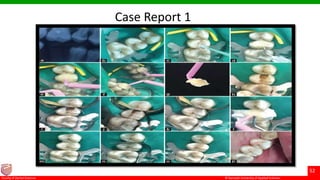
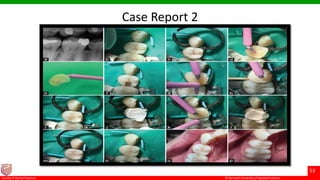
Stamp Technique (MOOS technique by Maroun-Motawie et al)
• A new method for placing large composite restorations with accurate occlusal topography
• It consists of fabricating an occlusal matrix to impress the occlusal anatomy of posterior
teeth before cavity preparation takes place
• This matrix is then pressed against the final composite increment before curing takes place
• It is suitable in cases where the caries is evident during the clinical examination or routine
radiographic examination of teeth with intact marginal ridges and idea
• It is recommended to clean the occlusal surfaces with manual or ultrasonic devices prior to
the placement of the stamp material in order to eliminate interference and to obtain an
exact copy (Chiodera et al., 2016)
© Ramaiah University of Applied Sciences
52
Faculty of Dental Sciences
Case Report 1
© Ramaiah University of Applied Sciences
53
Faculty of Dental Sciences
Case Report 2
© Ramaiah University of Applied Sciences
54
Faculty of Dental Sciences
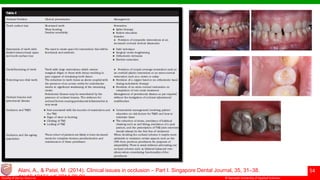
Alani, A., & Patel, M. (2014). Clinical issues in occlusion – Part I. Singapore Dental Journal, 35, 31–38.
doi:10.1016/j.sdj.2014.09.00
© Ramaiah University of Applied Sciences
55
Faculty of Dental Sciences
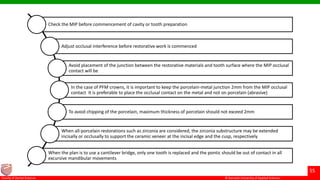
Check the MIP before commencement of cavity or tooth preparation
Adjust occlusal interference before restorative work is commenced
Avoid placement of the junction between the restorative materials and tooth surface where the MIP occlusal
contact will be
In the case of PFM crowns, it is important to keep the porcelain-metal junction 2mm from the MIP occlusal
contact It is preferable to place the occlusal contact on the metal and not on porcelain (abrasive)
To avoid chipping of the porcelain, maximum thickness of porcelain should not exceed 2mm
When all-porcelain restorations such as zirconia are considered, the zirconia substructure may be extended
incisally or occlusally to support the ceramic veneer at the incisal edge and the cusp, respectively
When the plan is to use a cantilever bridge, only one tooth is replaced and the pontic should be out of contact in all
excursive mandibular movements
© Ramaiah University of Applied Sciences
56
Faculty of Dental Sciences
Conclusion
• Occlusion is fundamental to the practice of dentistry in providing a biologically
functional restoration and for comprehensive patient care
• A dental restoration after being placed in the tooth becomes one of the essential
components of the stomatognathic system. Hence, any restoration (from
intracoronal direct restoration to complex crown and bridge work) must be planned
to conform to the existing occlusal pattern and not to disturb it
© Ramaiah University of Applied Sciences
57
Faculty of Dental Sciences
References
• Sturdevant’s Art & Science of Operative Dentistry – 7th Ed – Roberson, Heymann & Swift
• Operative Dentistry- Modern theory and practice – 1st Ed – Marzouk
• Principles and Practice of operative dentistry – 3rd Ed – Charbeneau
• Functional Occlusion – From TMJ to smile Design – Peter. E. Dawson
• Wheeler’s Dental anatomy, Physiology & Occlusion- 8th Ed- Ash and Nelson
• S J Davies et al, Occlusion: Good occlusal practice in simple restorative dentistry. British Dental Journal (2001)
191, 365-381
• CASE REPORT:Year : 2016 | Volume : 19 | Issue : 5 | Page : 490-493,The stamp technique for direct Class II
composite restorations: A case series,Saaid et al
• Glossary of Prosthodontic Terms 5 and 8
© Ramaiah University of Applied Sciences
58
Faculty of Dental Sciences

Occlusion in restorative dentistry

  • 1.
    © Ramaiah Universityof Applied Sciences 1 Faculty of Dental Sciences Occlusion as related to Conservative Dentistry
  • 2.
    © Ramaiah Universityof Applied Sciences 2 Faculty of Dental Sciences Contents • Introduction • Terminologies • General description – Tooth alignment and dental arches – Anterior-posterior inter arch relationship – Inter arch tooth relationship – Posterior cusp characteristics – Supporting and non supporting cusp • Types and directions of mandibular movements • Mechanism of mandibular motion • Tooth contacts during mandibular movements • Role of contact, contours and marginal ridges •Signs of instability of occlusion •Response to high restoration •Requirements for equilibrium of the masticatory system •Requirements for occlusal stability • Occlusal interferences •Occlusal equilibration •Occlusal considerations for restorative treatment •Stamp Technique •Conclusion •References
  • 3.
    © Ramaiah Universityof Applied Sciences 3 Faculty of Dental Sciences Occlusion – “Closing” Introduction In dentistry, occlusion - “The Contact of the opposing dental arches when they are in contacts (static) and during various jaw movements (dynamic occlusion)”- Sturdevant’s, 7th edition Carlsson et al, concluded that “in final analysis, optimal function & the absence of disease is the principal characteristic of a good occlusion”- Sturdevant’s, 7th edition
  • 4.
    © Ramaiah Universityof Applied Sciences 4 Faculty of Dental Sciences Significance of occlusion in conservative dentistry A dental restoration after being placed in a tooth, becomes one of the essential components of stomato-gnathic system They can initiate/ predispose into myriad of pathologic processes
  • 5.
    © Ramaiah Universityof Applied Sciences 5 Faculty of Dental Sciences Terminologies • Centric relation - Centric relation is defined as a maxillomandibular relationship independent of tooth contact, in which the condyles articulate in the anterior- superior position against the posterior slopes of the articular eminences; in this position the mandible is restricted to a purely rotary movement; from this unstrained, physiologic, maxillomandibular relationship, the patient can make vertical, lateral or protrusive movements; it is a clinically useful, repeatable reference position GPT-9 (2017) Jankelson 1972 DF 1956 Posterior most Lucia-1961 RUM
  • 6.
    © Ramaiah Universityof Applied Sciences 6 Faculty of Dental Sciences • Centric Occlusion: The occlusion of opposing teeth when the mandible is in centric relation. This may or may not coincide with the maximal intercuspal position • Maximal Intercuspal Position: The complete intercuspation of the opposing teeth independent of condylar position, sometimes referred to as the best fit of teeth regardless of the condylar position- called also maximal intercuspation • Balanced Occlusion: Simultaneous bilateral contacting of maxillary and mandibular teeth in anterior and posterior occlusal areas in centric and eccentric positions
  • 7.
    © Ramaiah Universityof Applied Sciences 7 Faculty of Dental Sciences General description: 1.Tooth alignment & dental arches Sturdevant’s, 7th edition • Cusp – Blunt, rounded or pointed projections of crown • Cusp are seperated by Developmental Grooves • Central Groove – facial and lingual cusp • Fossa – Depressions between cusp • Fissures – Grooves with non coalesced enamel and its deepest point is a Pit
  • 8.
    © Ramaiah Universityof Applied Sciences 8 Faculty of Dental Sciences 2.Inter arch tooth Relationship Sturdevant’s, 7th edition
  • 9.
    © Ramaiah Universityof Applied Sciences 9 Faculty of Dental Sciences 3.Posterior Cusp characteristics Sturdevant’s, 7th edition
  • 10.
    © Ramaiah Universityof Applied Sciences 10 Faculty of Dental Sciences 4.Functional Cusp Sturdevant’s, 7th edition
  • 11.
    © Ramaiah Universityof Applied Sciences 11 Faculty of Dental Sciences 5.Non-functional Cusp Sturdevant’s, 7th edition
  • 12.
    © Ramaiah Universityof Applied Sciences 12 Faculty of Dental Sciences Features of Non Supporting Cusps / Noncentric / Nonholding Cusp Do not contact opposing tooth in MI Keep tongue or cheek off the occlusal table Farther from faciolingual centre Outer inclines has no potential for contact Have sharper cusp ridges than supporting cusps Features of Supporting Cusps / centric / holding / stamp cusp Contacts opposing teeth in MI Supports Vertical dimension More rounder cusp ridges than Non supporting Cusps Outer Inclines has potential for contact Near the faciolingual centre of the tooth as compared to non supporting cusps
  • 13.
    © Ramaiah Universityof Applied Sciences 13 Faculty of Dental Sciences Types and directions of mandibular movements Sturdevant’s, 7th edition Centric relation (CR), is the location of the mandible when the condyles are positioned superiorly and anteriorly in the glenoid fossae • The thinnest avascular portion of the TMJ discs are in an anterosuperior position on the condylar head, and are adjacent to the beginning of the slopes of the articular eminences Rotation is a simple motion of an object around an axis • Rotation with the condyles positioned in CR is termed terminal hinge (TH) movement. • Maximum of 25mm. • TH is used in dentistry as a reference movement for construction of restorations • Initial contact between teeth during a TH closure provides a reference point, termed centric occlusion (CO)
  • 14.
    © Ramaiah Universityof Applied Sciences 14 Faculty of Dental Sciences Centric occlusion • It is the position of maximum intercuspation of teeth which is in harmony with the neuromuscular mechanism • This is not the most retruded position of the mandible • Centric occlusal contacts should be checked in both functional & non-functional occlusion
  • 15.
    © Ramaiah Universityof Applied Sciences 15 Faculty of Dental Sciences Determining centric relation: Dawson’s technique of bimanual manipulation
  • 16.
    © Ramaiah Universityof Applied Sciences 16 Faculty of Dental Sciences
  • 17.
    © Ramaiah Universityof Applied Sciences 17 Faculty of Dental Sciences The Kois Deprogrammer • A removable, plastic appliance that covers the hard palate and creates a single point of contact between the lower central incisor and the anterior bite plane • It is an invaluable tool in diagnosing the three most common types of abnormal occlusal attrition: occlusal dysfunction, parafunction (e.g. bruxism), and constricted path of closure • It can be used during bite registration. This procedure, with the Kois Deprogrammer in place, allows control of the vertical dimension of occlusion (VDO) during bite registration • It facilitates finding premature contacts – i.e. any contact encountered during mandibular closure with the condyles in CR before reaching MIP. If occlusal adjustment needs to be obtained, it ensures control because the deprogramming will be maintained
  • 18.
    © Ramaiah Universityof Applied Sciences 18 Faculty of Dental Sciences Recording centric relation criteria for accuracy in making an interocclusal bite record The bite record must not cause any movement of teeth or displacement of soft tissue It must be possible to verify the accuracy of the interocclusal record in the mouth & on the casts The bite record must fit the casts as accurately as it fits the mouth The bite record must not distort during storage or transportation to the laboratory
  • 19.
    © Ramaiah Universityof Applied Sciences 19 Faculty of Dental Sciences Lateral movement(Left) is forward translation of right condyle &rotation of left condyle Translation(> 25mm) is the bodily movement of an object from one place to another. Simultaneous, direct anterior movement of both condyles, or mandibular forward thrusting, is termed protrusion Complex motion combines rotation and translation in a single movement. Most mandibular movement during speech, chewing, and swallowing consists of both rotation and translation Sturdevant’s, 7th edition
  • 20.
    © Ramaiah Universityof Applied Sciences 20 Faculty of Dental Sciences Role of contact areas,contours and marginal ridges Creating a contact that is too broad & changing the tooth anatomy will disturb the inter dental anatomy The broadened contact produces an inter-dental area that is less cleansable Creating a contact that is too narrow leads to greater susceptibility for plaque accumulation All of these predisposes to caries & periodontal problems A break in continuity of the line of contact areas throws additional responsibility on the PDL & alveolar bone
  • 21.
    © Ramaiah Universityof Applied Sciences 21 Faculty of Dental Sciences Role of Contour The concavities occlusal to the height of contour, whether anterior or posterior teeth are involved in the occlusal static & dynamic relations as they determine the pathways for mandibular teeth in & out of centric occlusion
  • 22.
    © Ramaiah Universityof Applied Sciences 22 Faculty of Dental Sciences Role of marginal ridges • A marginal ridge should always be formed in two planes bucco- lingually, meeting at a very obtuse angle • This feature is essential when an opposing functional cusp occludes with the marginal ridge • A marginal ridge with these specifications is essential for: The balance of the teeth in the arch Prevention of food impaction proximally Protection of the periodontium Prevention of recurrent and contact decay For helping in efficient mastication
  • 23.
    © Ramaiah Universityof Applied Sciences 23 Faculty of Dental Sciences Requirements for Occlusal Stability Stable stops on all teeth when condyles are in CR Anterior guidance in harmony with the border movement of the envelope of motion Disocclusion of all posterior teeth in protrusive movements & in non working side In lateral movements, supporting cusps should have slight freedom in centric and occlude in groove or embrasure on opposing teeth, to facilitate non interfering passage of cusps
  • 24.
    © Ramaiah Universityof Applied Sciences 24 Faculty of Dental Sciences Symptoms/Response to High Restoration • Tooth ache • Tooth tender on biting • Tooth wear • Spastic masticatory muscles • Muscle tension headache • Condyle/ disk displacement • Degenerative arthritic changes in TMJ
  • 25.
    © Ramaiah Universityof Applied Sciences 25 Faculty of Dental Sciences Occlusal Interferences • When the teeth are not in harmony with the joints & the mandibular movements, interference is said to exist • Interferences are undesirable occlusal contacts that may produce mandibular deviation during closure to maximum intercuspation or may hinder smooth passage to and from the intercuspal position
  • 26.
    © Ramaiah Universityof Applied Sciences 26 Faculty of Dental Sciences Types of interferences Centric interferences Working interferences Non working interferences Protrusive interferences
  • 27.
    © Ramaiah Universityof Applied Sciences 27 Faculty of Dental Sciences Eliminating interferences in CR Centric relation interferences can be differentiated into two types: Interferences in the arc of closure Interferences in the line of closure
  • 28.
    © Ramaiah Universityof Applied Sciences 28 Faculty of Dental Sciences Interferences to the arc of closure: • As the condyles rotate on their terminal hinge axis, each lower tooth follow an arc of closure • Most deviations from the arc of closure require the condyle to move forward
  • 29.
    © Ramaiah Universityof Applied Sciences 29 Faculty of Dental Sciences Interferences to the arc of closure: • Primary interferences that deviate the condyle forward produce the “anterior slide” • Basic grinding rule to correct anterior slide: MUDL • May trigger bruxism
  • 30.
    © Ramaiah Universityof Applied Sciences 30 Faculty of Dental Sciences Interference to the line of closure: • It refers to those interferences that cause the mandible to deviate to the left or right from the first point of contact to the most closed position
  • 31.
    © Ramaiah Universityof Applied Sciences 31 Faculty of Dental Sciences If the interference incline causes deviation towards the cheek, grind the buccal incline of the upper or lingual incline of the lower or both. (BULL) If the interfering incline causes deviation towards tongue, grind the lingual incline of the upper or buccal incline of the lower, or both the inclines. (LUBL) Selective Grinding
  • 32.
    © Ramaiah Universityof Applied Sciences 32 Faculty of Dental Sciences Why to adjust interferences in CR first?? By adjusting the centric interferences first, you have the option of improving cusp-tip position Occlusal grinding is more evenly distributed to both arches Eccentric interferences can be eliminated with speed and simplicity
  • 33.
    © Ramaiah Universityof Applied Sciences 33 Faculty of Dental Sciences Lateral excursion interferences: • When lateral excursions are being equilibrated, the mandible must be guided with firm upward pressure • Guiding the mandible with firm pressure during excursions will routinely pick up posterior interferences that are missed with unguided movements
  • 34.
    © Ramaiah Universityof Applied Sciences 34 Faculty of Dental Sciences Protrusive interferences: The rule for eliminating protrusive interferences is DUML grind the distal inclines of the upper or the mesial inclines of the lower. In grinding protrusive interferences, centric stops must be marked with a different colored ribbon.
  • 35.
    © Ramaiah Universityof Applied Sciences 35 Faculty of Dental Sciences Occlusal Equilibration The modification of the occlusal form of the teeth with the intent of equalizing occlusal stress, producing simultaneous occlusal contacts or harmonizing cuspal relations. GPT 8
  • 36.
    © Ramaiah Universityof Applied Sciences 36 Faculty of Dental Sciences Equilibration Procedures: Divided into 4 parts: 1. Reduction of all contacting tooth interferences in centric relation 2. Selective reduction of tooth interferences with lateral excursions 3. Elimination of all posterior tooth structure that interferes with protrusive excursions 4. Harmonization of the anterior guidance
  • 37.
    © Ramaiah Universityof Applied Sciences 37 Faculty of Dental Sciences Verification of Completion • Clench Test Clenching the tooth together and squeezing firmly. Reasons for discomfort :- Incomplete elimination of occlusal interferences on the posterior teeth
  • 38.
    © Ramaiah Universityof Applied Sciences 38 Faculty of Dental Sciences • Occlusal examination Occlusal contacts can be located by marking them with articulating paper Mylar strips are also helpful in identifying the presence of occlusal contacts
  • 39.
    © Ramaiah Universityof Applied Sciences 39 Faculty of Dental Sciences
  • 40.
    © Ramaiah Universityof Applied Sciences 40 Faculty of Dental Sciences Computer Assisted Dynamic Occlusal Analysis • T- Scan Developed by Maness Sensor unit that records occlusal contacts on a thin mylar strip and relays the information to a computer
  • 41.
    © Ramaiah Universityof Applied Sciences 41 Faculty of Dental Sciences
  • 42.
    © Ramaiah Universityof Applied Sciences 42 Faculty of Dental Sciences Treatment planning- Confirmative Approach • Before initiating treatment the clinician must decide whether to provide restorations within the existing occlusal scheme or to change it • Confirmative approach is defined as the provision of restorations in harmony with the existing jaw relationships • It is the principle of providing a new restoration that does not alter the patients occlusion • Majority of restorations follow this principle S J Davies et al, Occlusion: Good occlusal practice in simple restorative dentistry. British Dental Journal (2001) 191, 365-3810
  • 43.
    © Ramaiah Universityof Applied Sciences 43 Faculty of Dental Sciences Technique – The sequence followed is The ‘EDEC’ Principle E= Examine and record the pre-existing occlusion D= Design the restoration E= Execute the restoration C= Check the occlusion The EDEC Principle is useful in relation to : - Direct Restorations - Indirect Restorations S J Davies et al, Occlusion: Good occlusal practice in simple restorative dentistry. British Dental Journal (2001) 191, 365-381
  • 44.
    © Ramaiah Universityof Applied Sciences 44 Faculty of Dental Sciences The EDEC Principle for Direct & Indirect Restorations 1. Examine : – Examine static and dynamic occlusion – Mark them preoperatively – Malpositioned opposing supporting cusps, ridges or fossae may be recountoured in order to achieve optimal occlusal contacts – Plunger cusps and over erupted teeth are to be reduced – In anterior restorations, the scheme of incisal guidance must be examined properly – Assessment of periodontal condition must be made
  • 45.
    © Ramaiah Universityof Applied Sciences 45 Faculty of Dental Sciences 2. Design : – Visualize the design of cavity – Existing occlusal marks will either be preserved by being avoided in the preparation, or they will be involved in the design, but never end preparation margins at these points. 3. Execution : – Controlled interproximal cutting and care in restoring axial tooth contour to avoid overcontouring is essential – Carving of restoration must be harmonious to occlusion and should not produce premature contacts 4. Check : – Check the occlusion by either reversing the color of paper or foils used pre-operatively and using the preoperative marks as a refrence
  • 46.
    © Ramaiah Universityof Applied Sciences 46 Faculty of Dental Sciences Occlusal Considerations For Restorative Treatment • Restorations are influenced by the need to withstand forceful contact with the opposing teeth • The restorations should provide contacts on smoothly concave fossae such that the masticatory forces are directed parallel to the long axis of the tooth • Occlusal features should be compatible with the patients existing occlusion, especially in cases of bruxism • Both in anterior and posterior teeth
  • 47.
    © Ramaiah Universityof Applied Sciences 47 Faculty of Dental Sciences • When restoring Mandibular 1st molar following precautions are to be taken :  Provide adequate stops on mandibular 2nd molar to prevent distal migration  The disto-lingual cusp of max 1st molar should contact the mesial marginal ridge of mand 2nd molar  The cusp tip should not occlude with the embrasure area of mand 1st and 2nd molar – food impaction and distal movement
  • 48.
    © Ramaiah Universityof Applied Sciences 48 Faculty of Dental Sciences OCCLUSAL ADJUSTMENTS Directly Inserted Restorative Materials: • Eg : Amalgam, Composite • Should be carved to contact, contour & correct margins • Check with marking ribbon for deflections in maximum intercuspation, protrusive and lateral excursions • Proceed with occlusal adjustments
  • 49.
    © Ramaiah Universityof Applied Sciences 49 Faculty of Dental Sciences OVERCONTOURED RESTORATION – Premature contact in centric occlusion leading to dis-occlusion of adjacent teeth. UNDERCONTOURED RESTORATION – Tipping of adjacent teeth and supra eruption of opposing teeth.
  • 50.
    © Ramaiah Universityof Applied Sciences 50 Faculty of Dental Sciences CAST RESTORATIONS: • Occlusal equilibration prior to preparation • After Fabrication, occlusal adjustments similar to directly inserted restorative materials. COMPLEX RESTORATIONS: • Pre operative study models • Recording centric relation • Facebow transfer • Use of semi or fully adjustable articulators • Boyarsky et al – occlusal refinement of mounted casts before crown fabrication decreases clinical time
  • 51.
    © Ramaiah Universityof Applied Sciences 51 Faculty of Dental Sciences Stamp Technique (MOOS technique by Maroun-Motawie et al) • A new method for placing large composite restorations with accurate occlusal topography • It consists of fabricating an occlusal matrix to impress the occlusal anatomy of posterior teeth before cavity preparation takes place • This matrix is then pressed against the final composite increment before curing takes place • It is suitable in cases where the caries is evident during the clinical examination or routine radiographic examination of teeth with intact marginal ridges and idea • It is recommended to clean the occlusal surfaces with manual or ultrasonic devices prior to the placement of the stamp material in order to eliminate interference and to obtain an exact copy (Chiodera et al., 2016)
  • 52.
    © Ramaiah Universityof Applied Sciences 52 Faculty of Dental Sciences Case Report 1
  • 53.
    © Ramaiah Universityof Applied Sciences 53 Faculty of Dental Sciences Case Report 2
  • 54.
    © Ramaiah Universityof Applied Sciences 54 Faculty of Dental Sciences Alani, A., & Patel, M. (2014). Clinical issues in occlusion – Part I. Singapore Dental Journal, 35, 31–38. doi:10.1016/j.sdj.2014.09.00
  • 55.
    © Ramaiah Universityof Applied Sciences 55 Faculty of Dental Sciences Check the MIP before commencement of cavity or tooth preparation Adjust occlusal interference before restorative work is commenced Avoid placement of the junction between the restorative materials and tooth surface where the MIP occlusal contact will be In the case of PFM crowns, it is important to keep the porcelain-metal junction 2mm from the MIP occlusal contact It is preferable to place the occlusal contact on the metal and not on porcelain (abrasive) To avoid chipping of the porcelain, maximum thickness of porcelain should not exceed 2mm When all-porcelain restorations such as zirconia are considered, the zirconia substructure may be extended incisally or occlusally to support the ceramic veneer at the incisal edge and the cusp, respectively When the plan is to use a cantilever bridge, only one tooth is replaced and the pontic should be out of contact in all excursive mandibular movements
  • 56.
    © Ramaiah Universityof Applied Sciences 56 Faculty of Dental Sciences Conclusion • Occlusion is fundamental to the practice of dentistry in providing a biologically functional restoration and for comprehensive patient care • A dental restoration after being placed in the tooth becomes one of the essential components of the stomatognathic system. Hence, any restoration (from intracoronal direct restoration to complex crown and bridge work) must be planned to conform to the existing occlusal pattern and not to disturb it
  • 57.
    © Ramaiah Universityof Applied Sciences 57 Faculty of Dental Sciences References • Sturdevant’s Art & Science of Operative Dentistry – 7th Ed – Roberson, Heymann & Swift • Operative Dentistry- Modern theory and practice – 1st Ed – Marzouk • Principles and Practice of operative dentistry – 3rd Ed – Charbeneau • Functional Occlusion – From TMJ to smile Design – Peter. E. Dawson • Wheeler’s Dental anatomy, Physiology & Occlusion- 8th Ed- Ash and Nelson • S J Davies et al, Occlusion: Good occlusal practice in simple restorative dentistry. British Dental Journal (2001) 191, 365-381 • CASE REPORT:Year : 2016 | Volume : 19 | Issue : 5 | Page : 490-493,The stamp technique for direct Class II composite restorations: A case series,Saaid et al • Glossary of Prosthodontic Terms 5 and 8
  • 58.
    © Ramaiah Universityof Applied Sciences 58 Faculty of Dental Sciences