Introduction
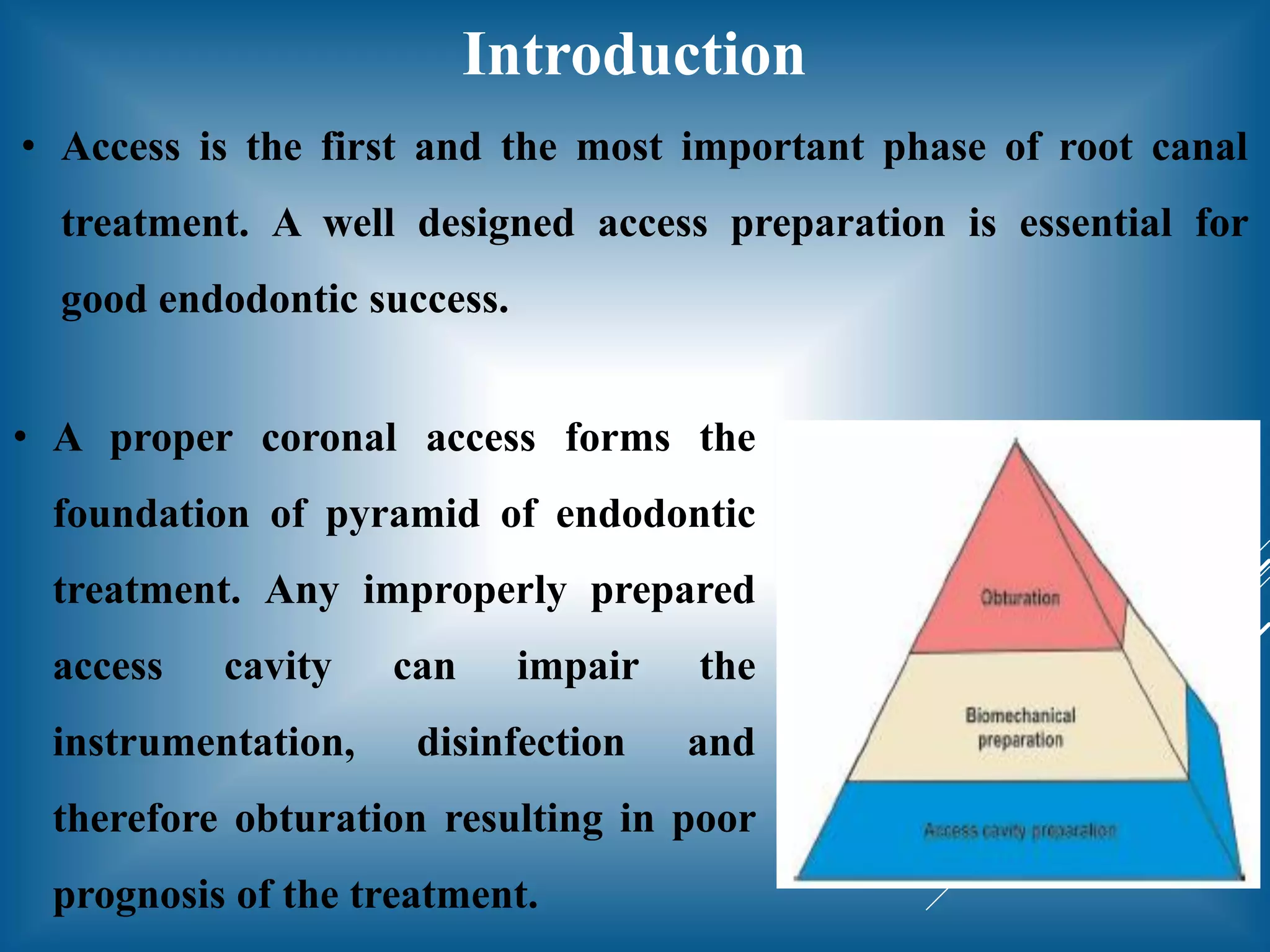
• Access is the first and the most important phase of root canal
treatment. A well designed access preparation is essential for
good endodontic success.
• A proper coronal access forms the
foundation of pyramid of endodontic
treatment. Any improperly prepared
access cavity can impair the
instrumentation, disinfection and
therefore obturation resulting in poor
prognosis of the treatment.
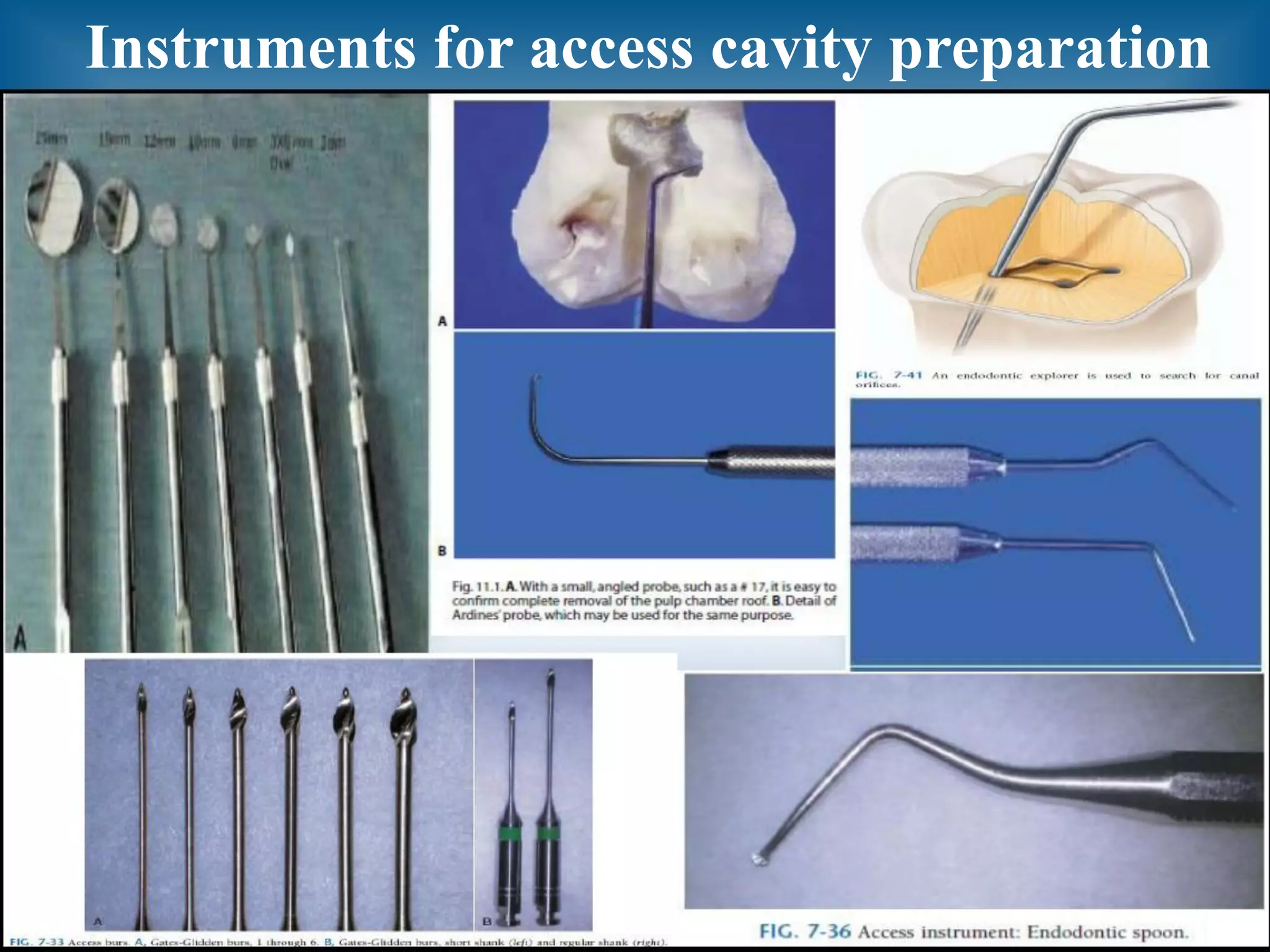
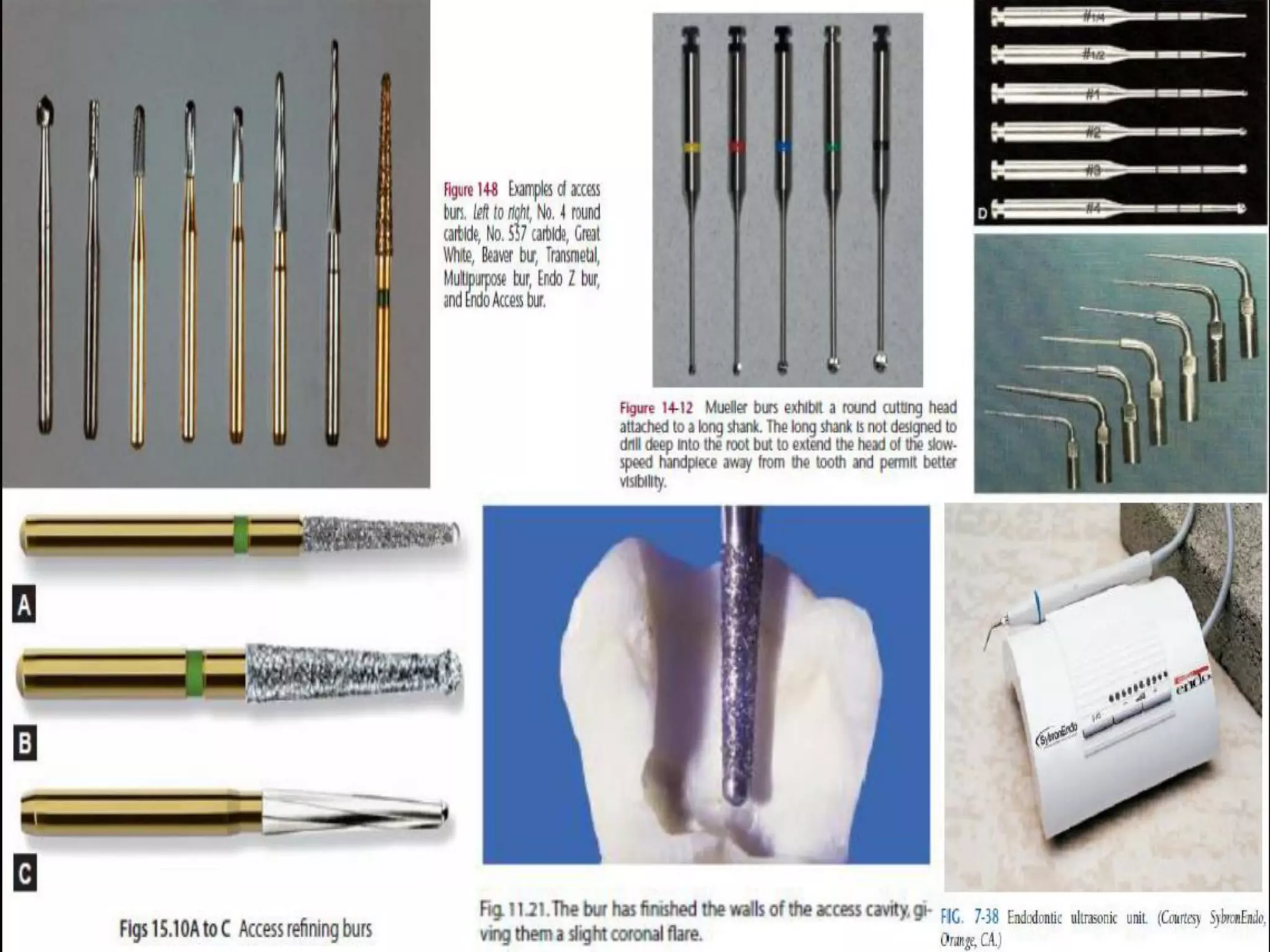
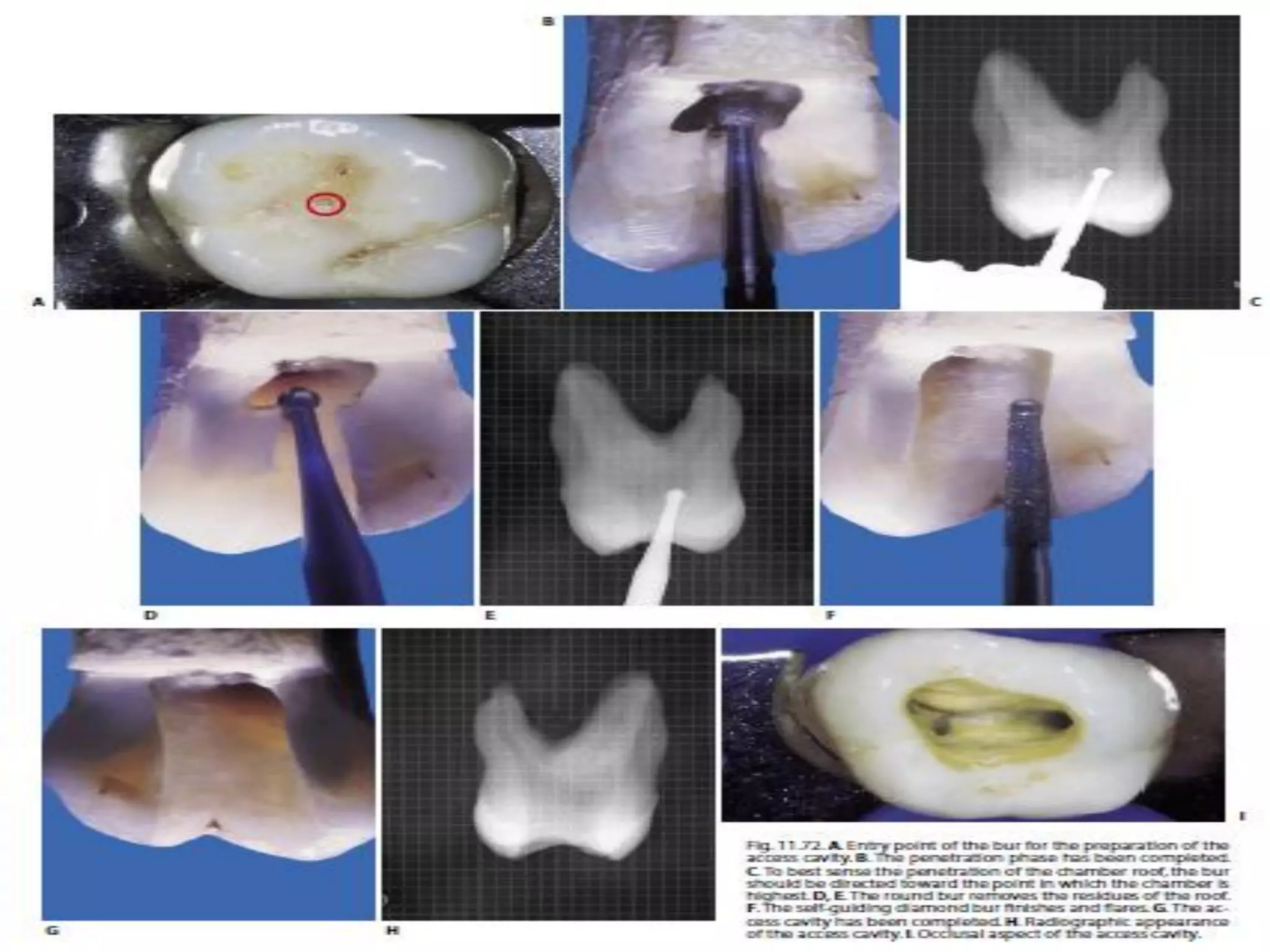
Instruments for access cavity preparation
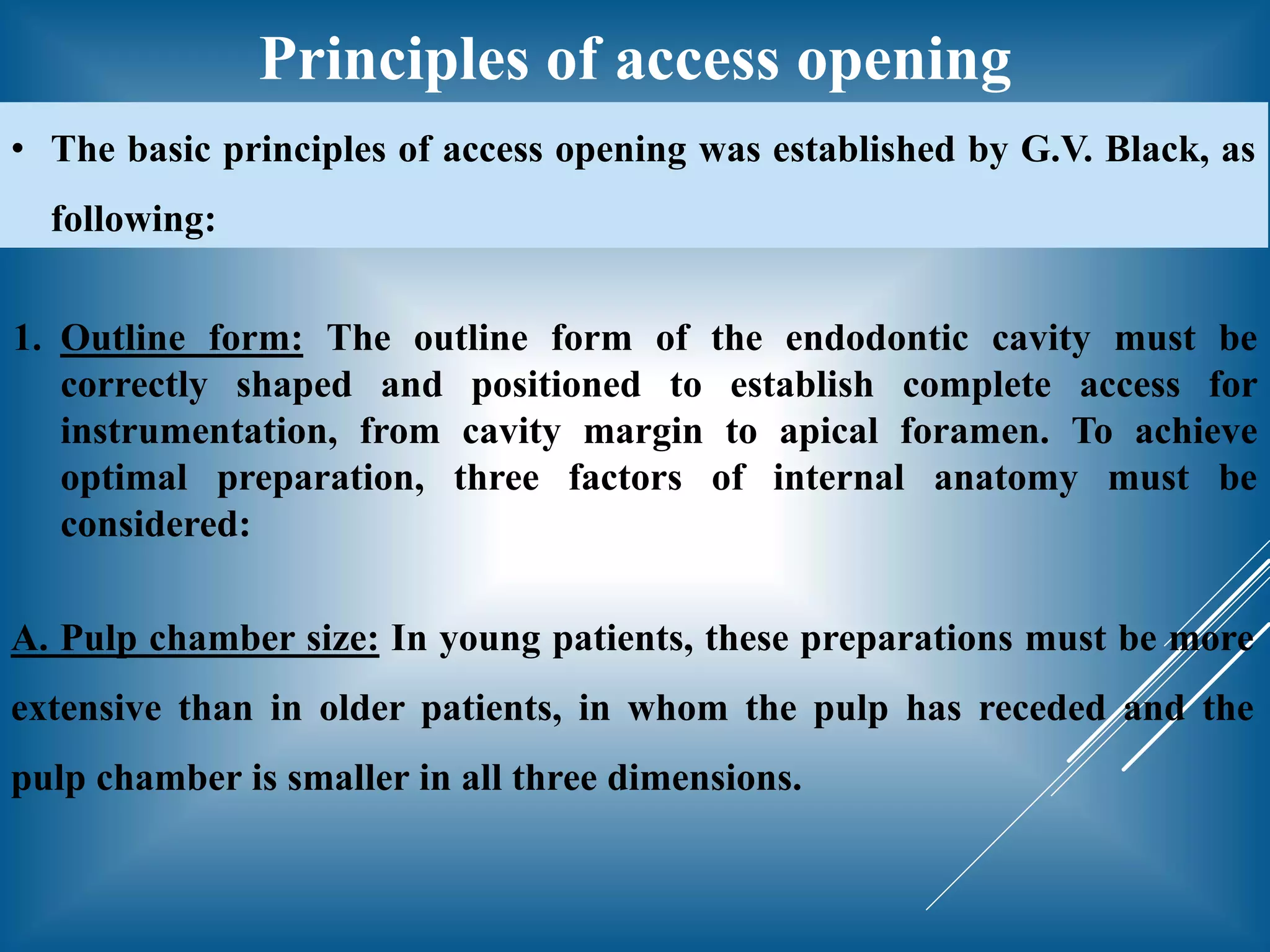
• The basic principles of access opening was established by G.V. Black, as
following:
1. Outline form: The outline form of the endodontic cavity must be
correctly shaped and positioned to establish complete access for
instrumentation, from cavity margin to apical foramen. To achieve
optimal preparation, three factors of internal anatomy must be
considered:
Principles of access opening
A. Pulp chamber size: In young patients, these preparations must be more
extensive than in older patients, in whom the pulp has receded and the
pulp chamber is smaller in all three dimensions.
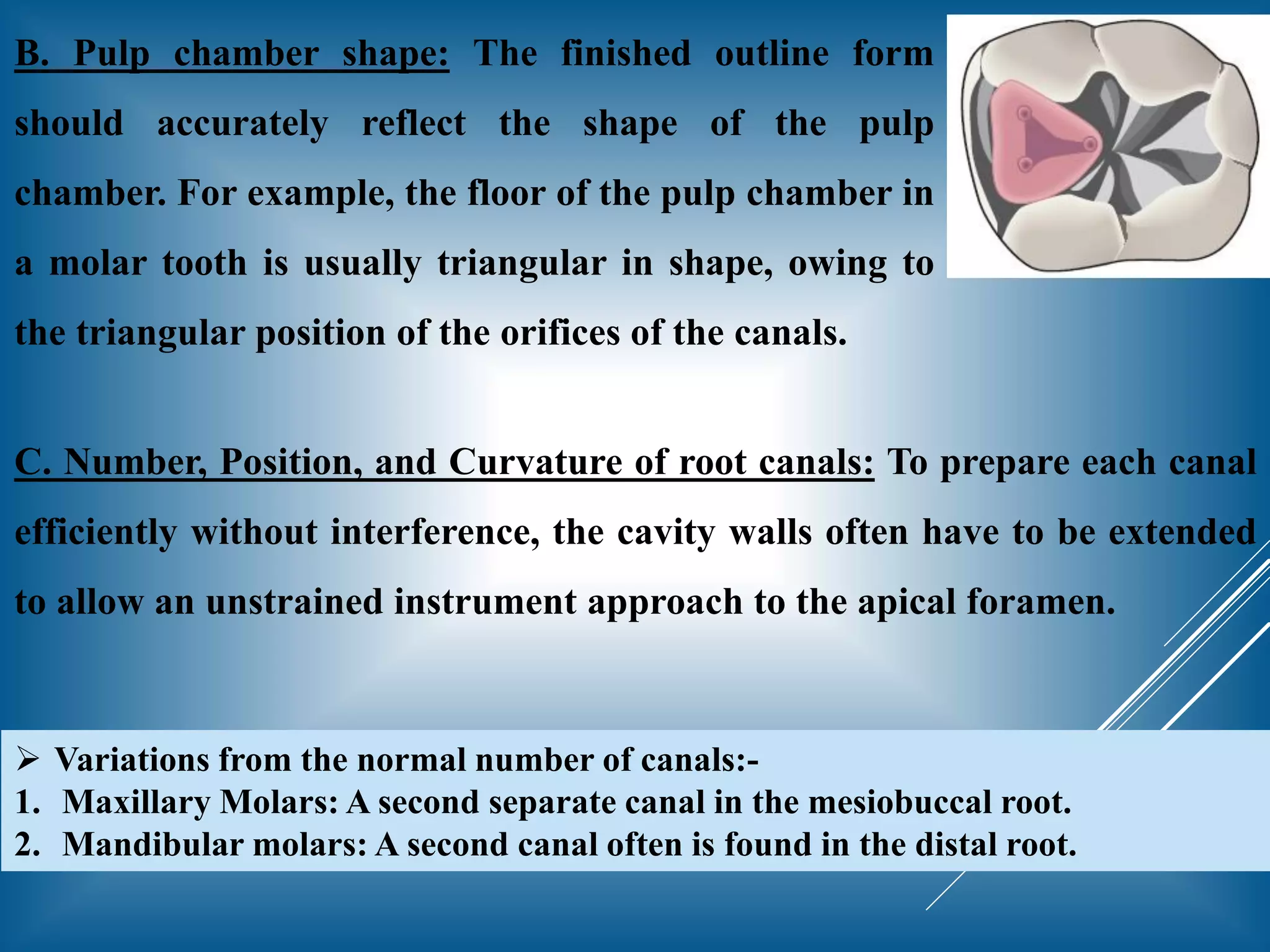
B. Pulp chamber shape: The finished outline form
should accurately reflect the shape of the pulp
chamber. For example, the floor of the pulp chamber in
a molar tooth is usually triangular in shape, owing to
the triangular position of the orifices of the canals.
C. Number, Position, and Curvature of root canals: To prepare each canal
efficiently without interference, the cavity walls often have to be extended
to allow an unstrained instrument approach to the apical foramen.
 Variations from the normal number of canals:-
1. Maxillary Molars: A second separate canal in the mesiobuccal root.
2. Mandibular molars: A second canal often is found in the distal root.
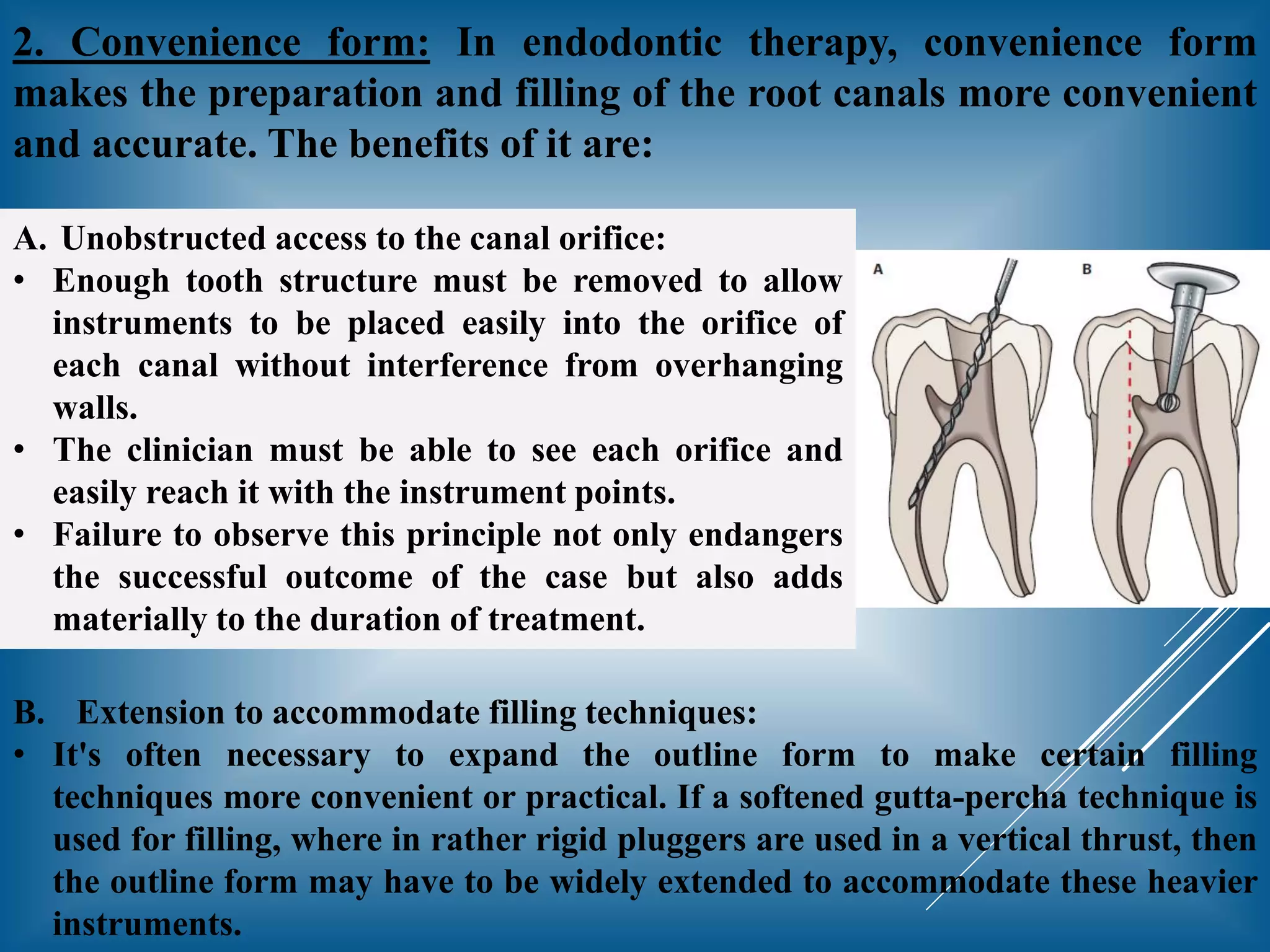
2. Convenience form: In endodontic therapy, convenience form
makes the preparation and filling of the root canals more convenient
and accurate. The benefits of it are:
A. Unobstructed access to the canal orifice:
• Enough tooth structure must be removed to allow
instruments to be placed easily into the orifice of
each canal without interference from overhanging
walls.
• The clinician must be able to see each orifice and
easily reach it with the instrument points.
• Failure to observe this principle not only endangers
the successful outcome of the case but also adds
materially to the duration of treatment.
B. Extension to accommodate filling techniques:
• It's often necessary to expand the outline form to make certain filling
techniques more convenient or practical. If a softened gutta-percha technique is
used for filling, where in rather rigid pluggers are used in a vertical thrust, then
the outline form may have to be widely extended to accommodate these heavier
instruments.
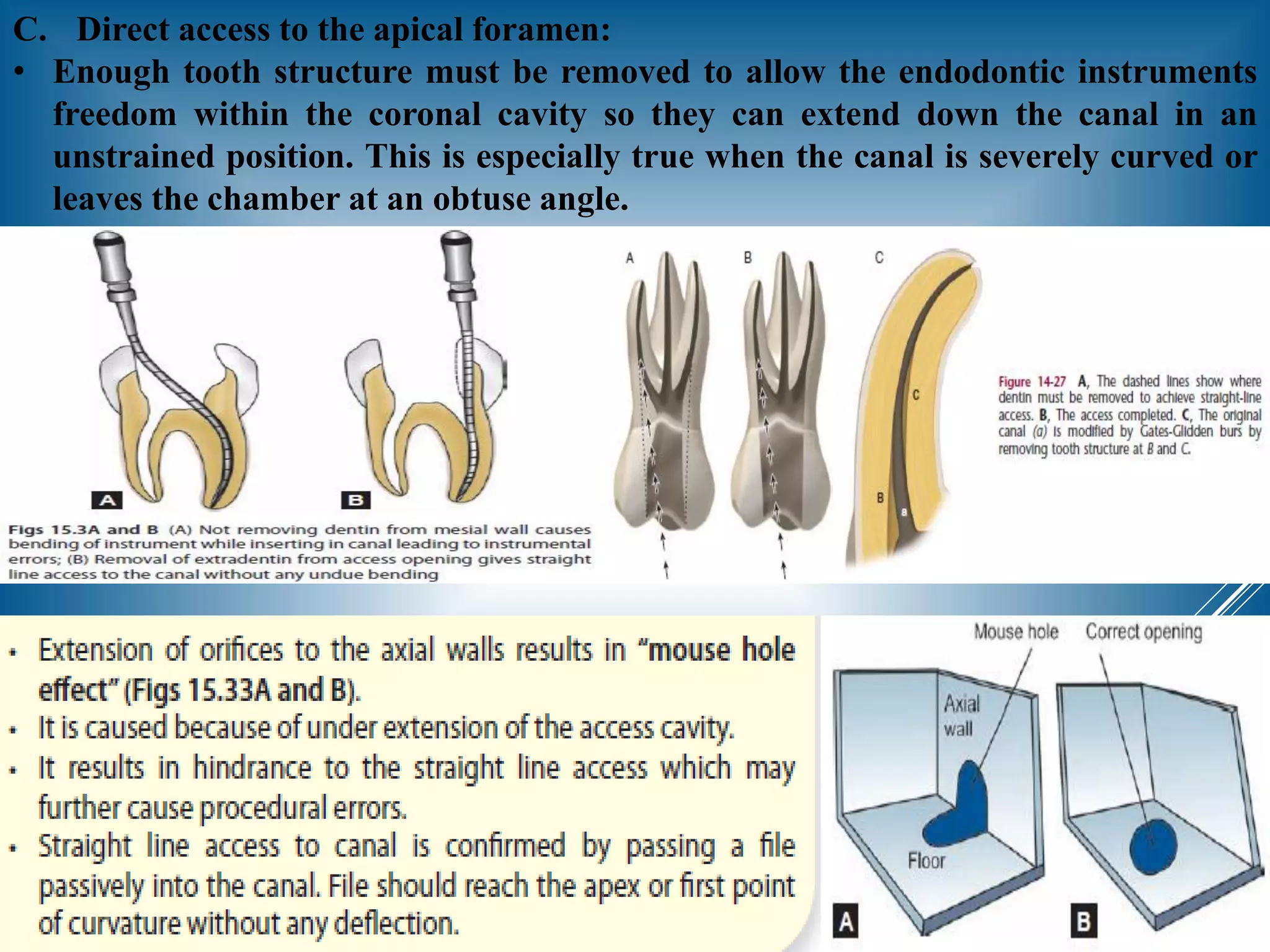
C. Direct access to the apical foramen:
• Enough tooth structure must be removed to allow the endodontic instruments
freedom within the coronal cavity so they can extend down the canal in an
unstrained position. This is especially true when the canal is severely curved or
leaves the chamber at an obtuse angle.
4. Debridement of the cavity:
• All of the caries, debris, and necrotic material must be removed from the
chamber before the radicular preparation is begun. If the calcified or
metallic debris is left in the chamber and carried into the canal, it may act
as an obstruction during canal enlargement.
• Soft debris carried from the chamber might increase the bacterial
population in the canal. Coronal debris may also stain the crown,
particularly in anterior teeth.
• Round burs are most helpful in cavity debridement. The long-blade
endodontic spoon excavator is ideal for debris removal. Irrigation with
sodium hypochlorite is also an excellent measure for cleaning the chamber
and canals of persistent debris.
3. Removal of the remaining carious dentin and defective restorations: The
advantages of its removal are:
A. To eliminate mechanically as many bacteria as possible from the interior
of the tooth.
B. To eliminate the discolored tooth structure, that may ultimately lead to
staining of the crown.
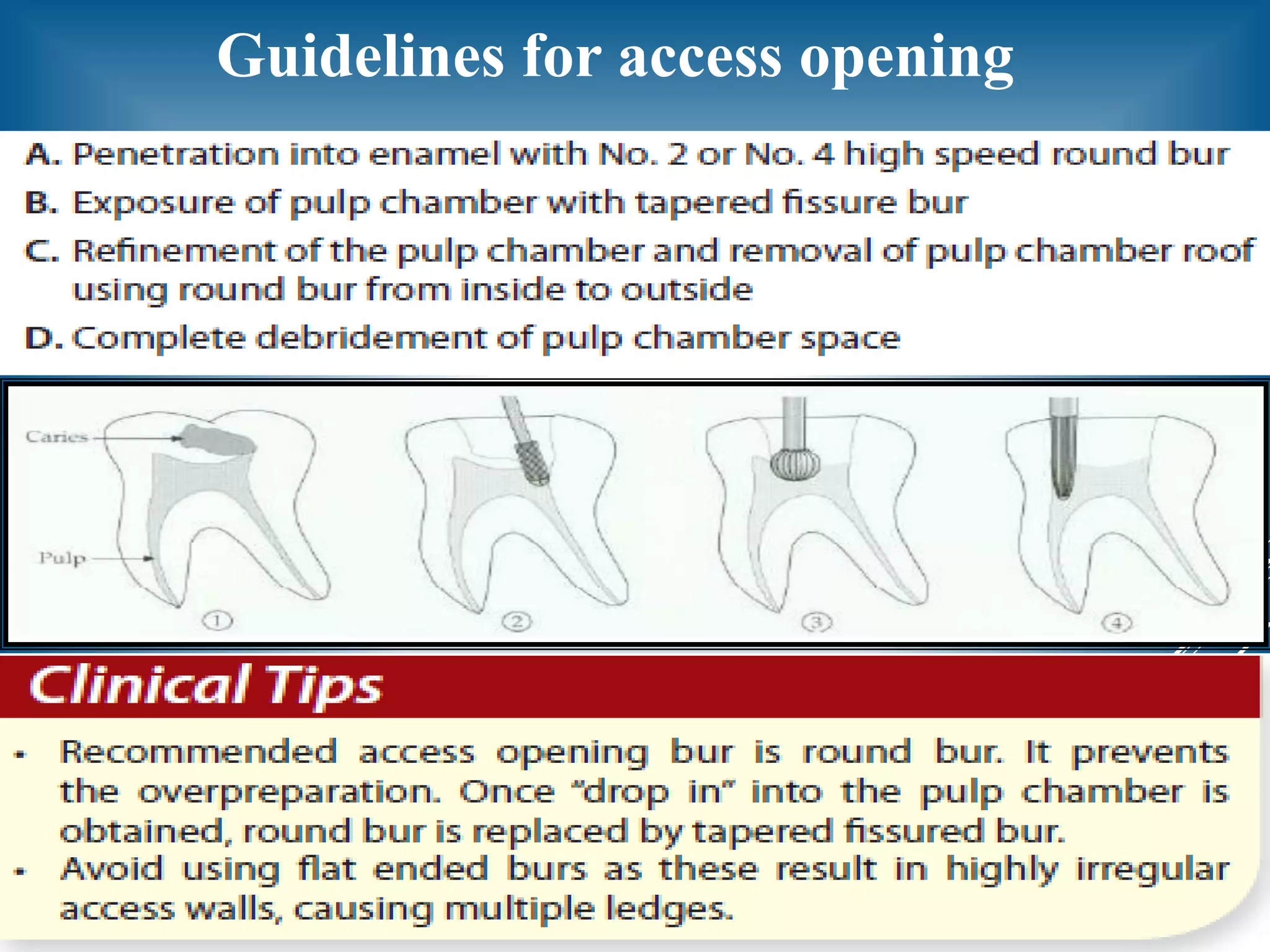
Guidelines for access opening
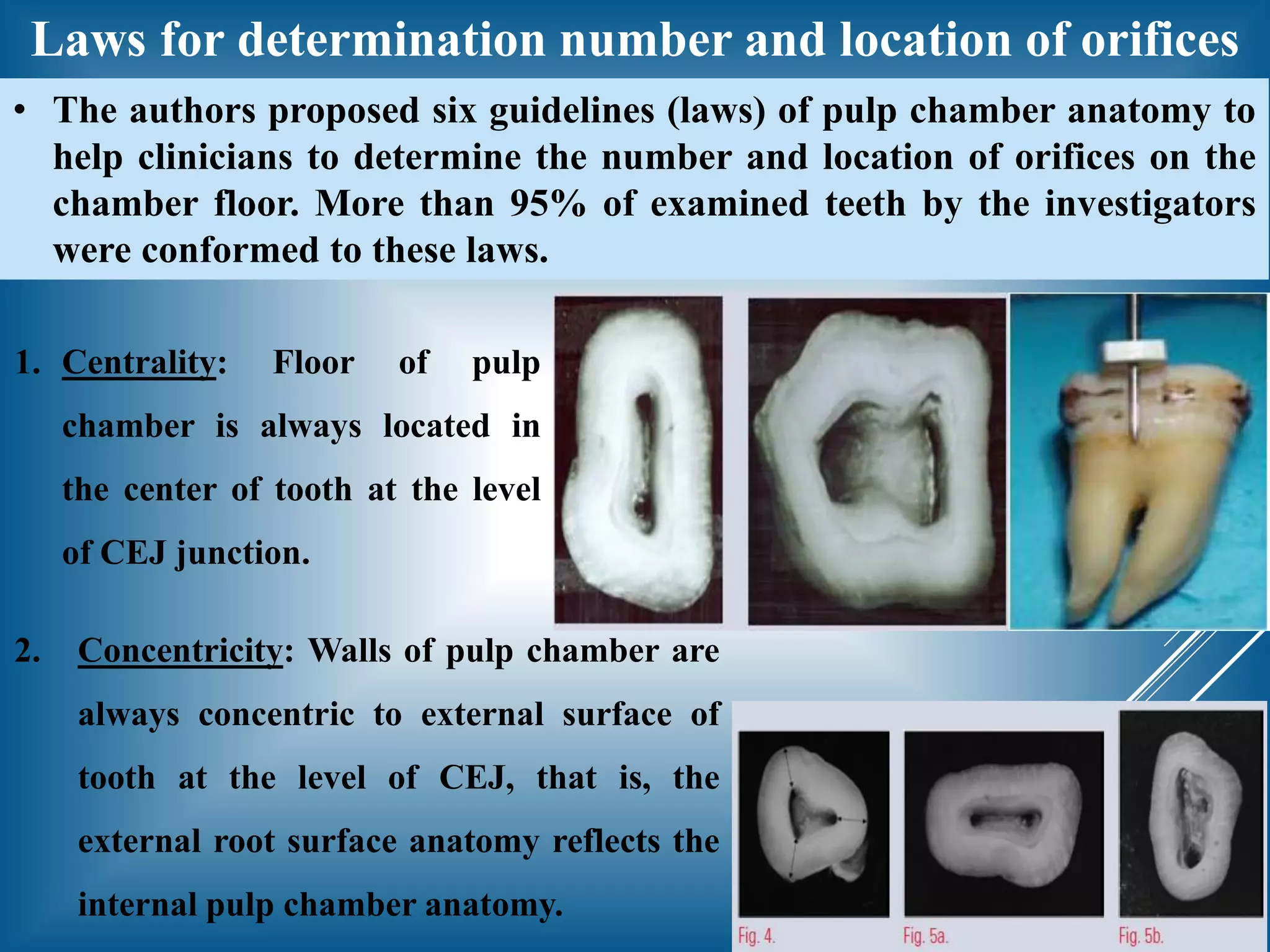
Laws for determination number and location of orifices
1. Centrality: Floor of pulp
chamber is always located in
the center of tooth at the level
of CEJ junction.
2. Concentricity: Walls of pulp chamber are
always concentric to external surface of
tooth at the level of CEJ, that is, the
external root surface anatomy reflects the
internal pulp chamber anatomy.
• The authors proposed six guidelines (laws) of pulp chamber anatomy to
help clinicians to determine the number and location of orifices on the
chamber floor. More than 95% of examined teeth by the investigators
were conformed to these laws.
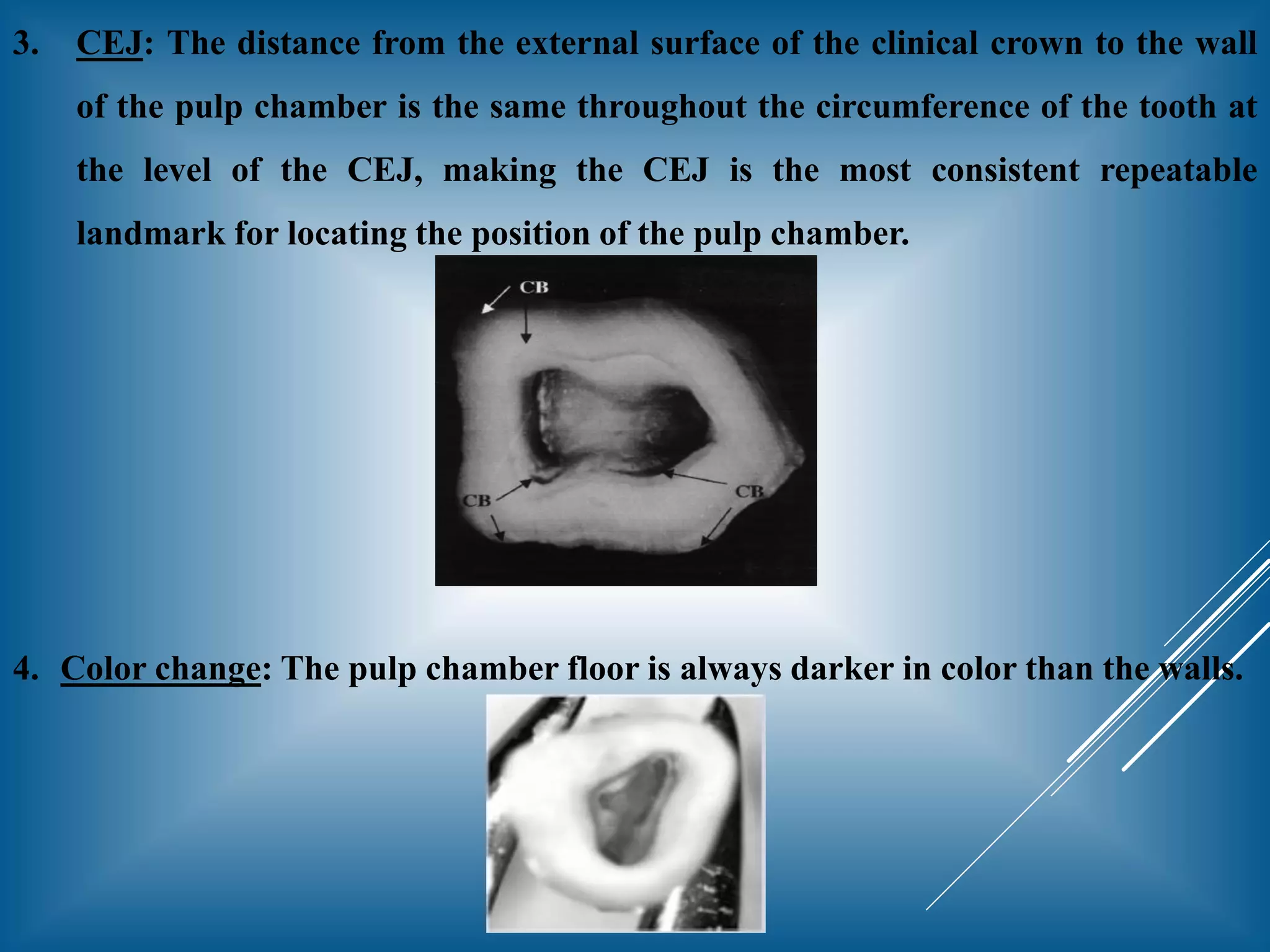
3. CEJ: The distance from the external surface of the clinical crown to the wall
of the pulp chamber is the same throughout the circumference of the tooth at
the level of the CEJ, making the CEJ is the most consistent repeatable
landmark for locating the position of the pulp chamber.
4. Color change: The pulp chamber floor is always darker in color than the walls.
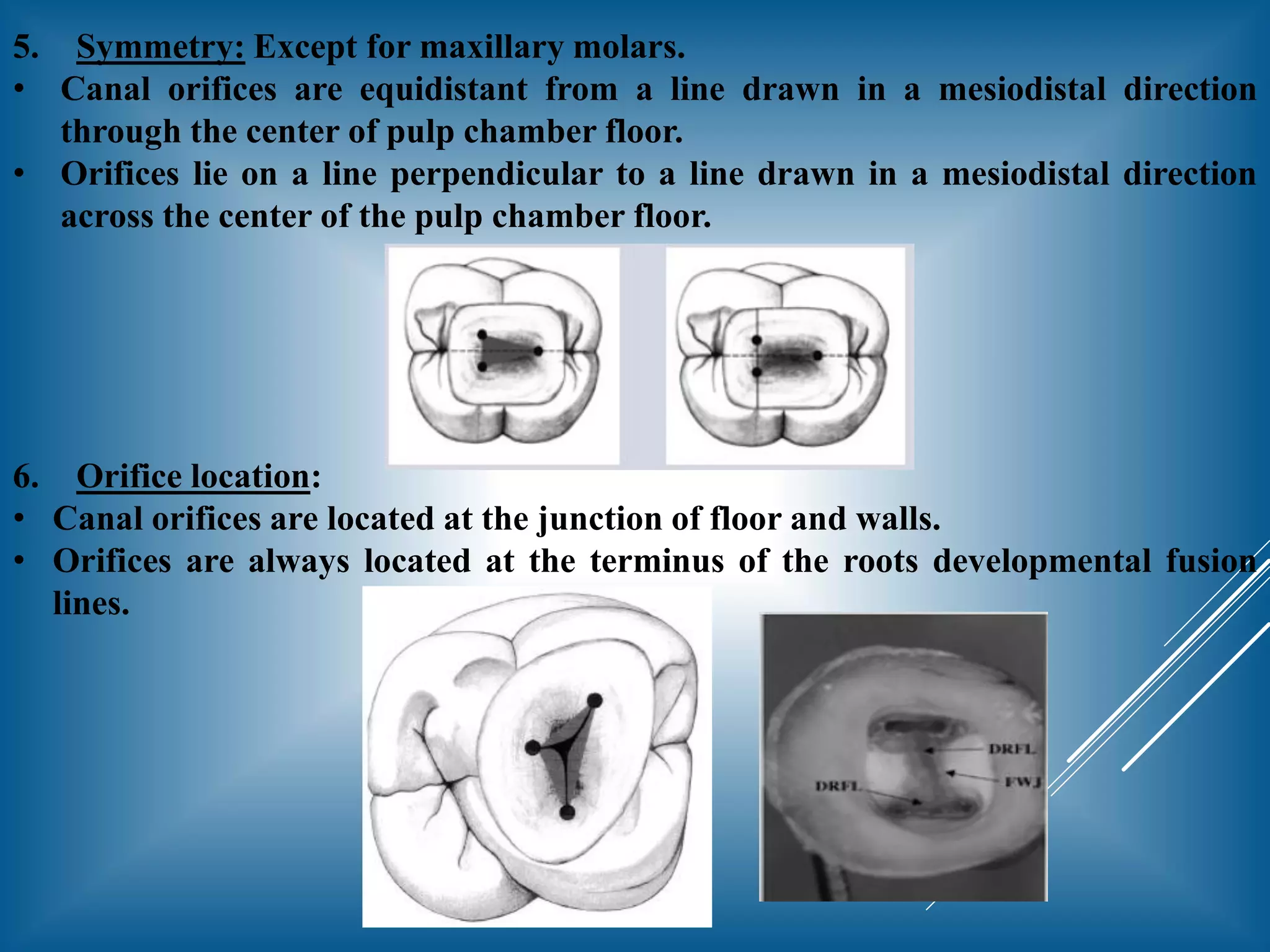
5. Symmetry: Except for maxillary molars.
• Canal orifices are equidistant from a line drawn in a mesiodistal direction
through the center of pulp chamber floor.
• Orifices lie on a line perpendicular to a line drawn in a mesiodistal direction
across the center of the pulp chamber floor.
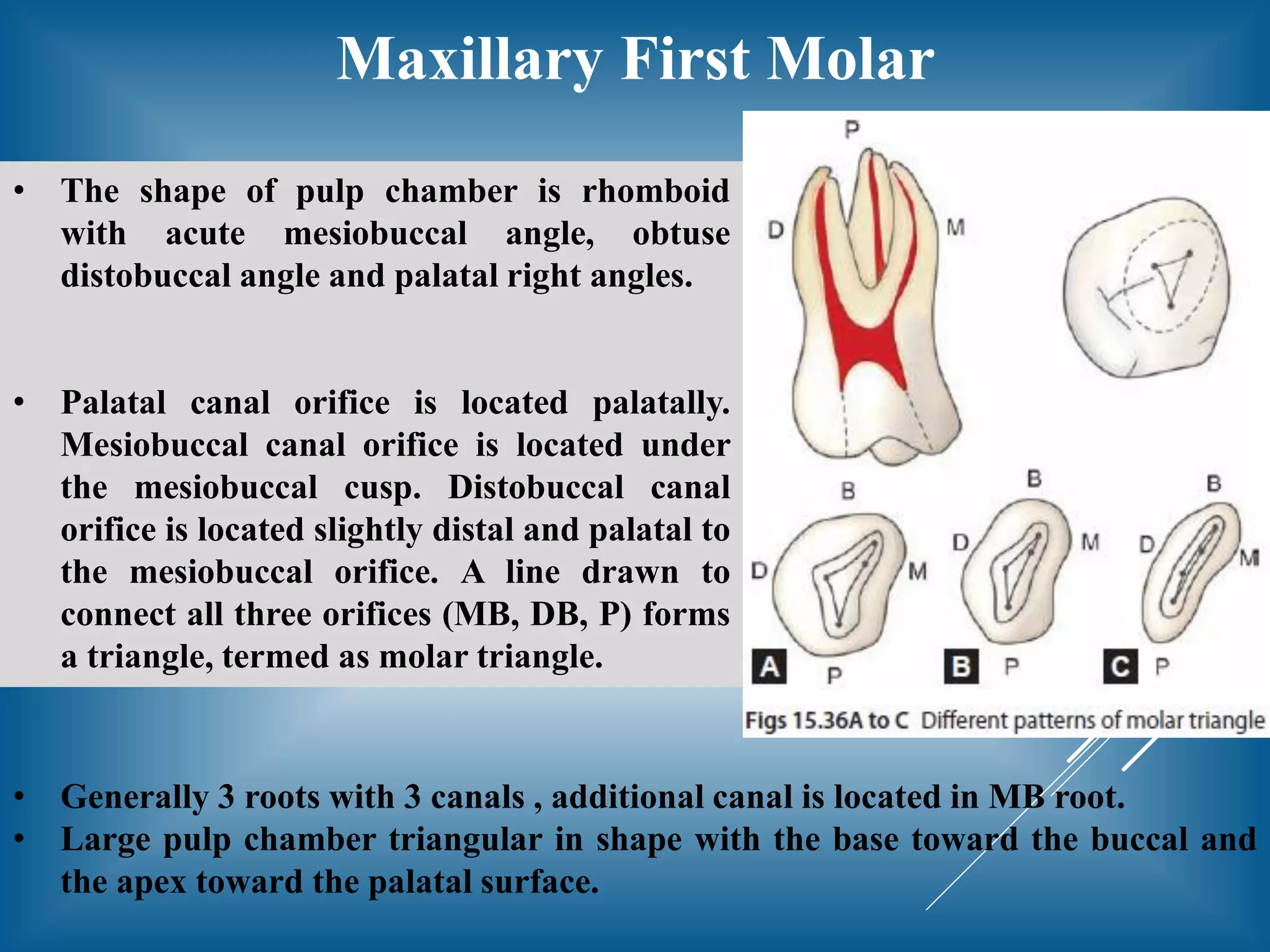
6. Orifice location:
• Canal orifices are located at the junction of floor and walls.
• Orifices are always located at the terminus of the roots developmental fusion
lines.
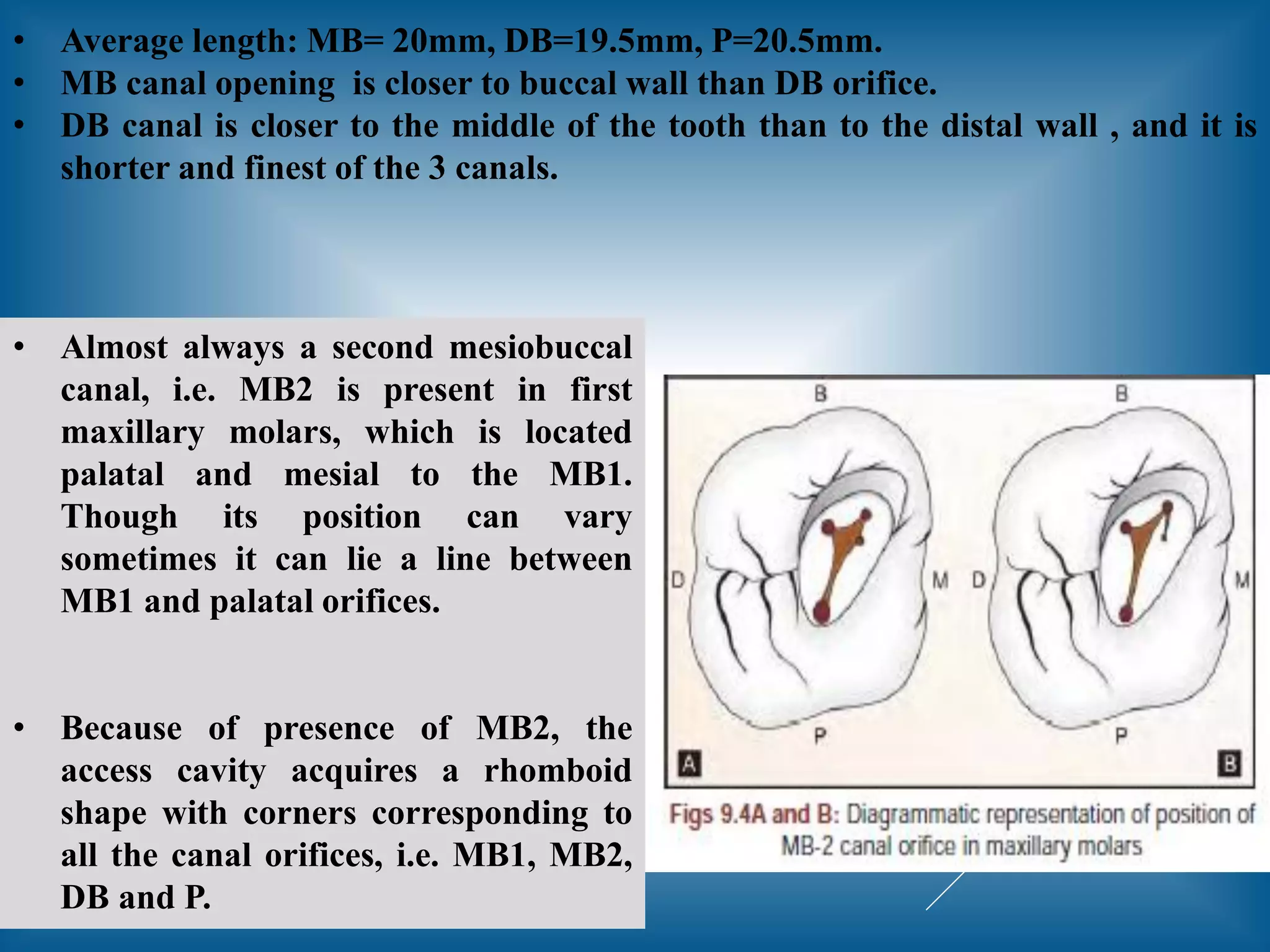
Maxillary First Molar
• The shape of pulp chamber is rhomboid
with acute mesiobuccal angle, obtuse
distobuccal angle and palatal right angles.
• Palatal canal orifice is located palatally.
Mesiobuccal canal orifice is located under
the mesiobuccal cusp. Distobuccal canal
orifice is located slightly distal and palatal to
the mesiobuccal orifice. A line drawn to
connect all three orifices (MB, DB, P) forms
a triangle, termed as molar triangle.
• Generally 3 roots with 3 canals , additional canal is located in MB root.
• Large pulp chamber triangular in shape with the base toward the buccal and
the apex toward the palatal surface.
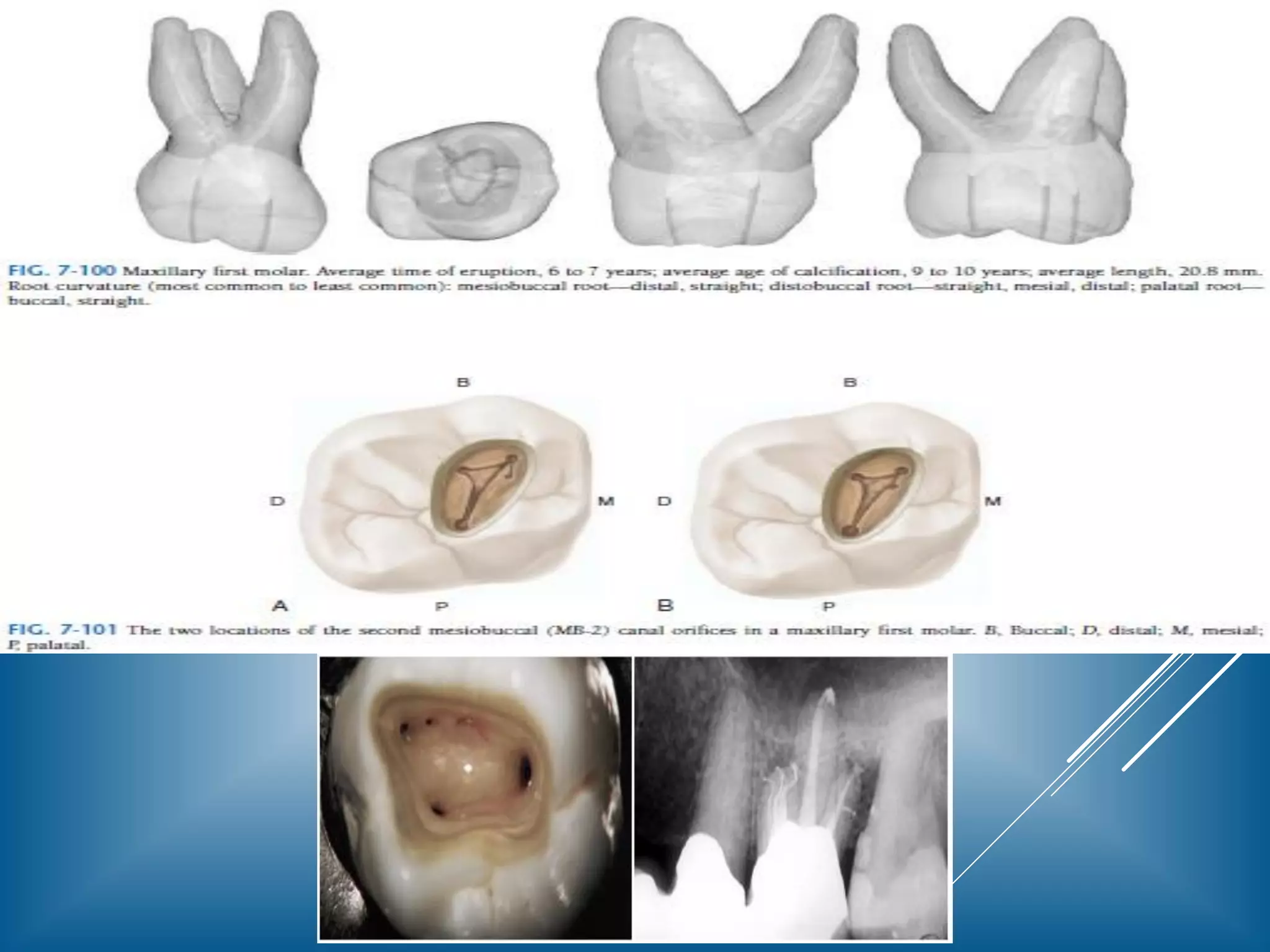
• Almost always a second mesiobuccal
canal, i.e. MB2 is present in first
maxillary molars, which is located
palatal and mesial to the MB1.
Though its position can vary
sometimes it can lie a line between
MB1 and palatal orifices.
• Because of presence of MB2, the
access cavity acquires a rhomboid
shape with corners corresponding to
all the canal orifices, i.e. MB1, MB2,
DB and P.
• Average length: MB= 20mm, DB=19.5mm, P=20.5mm.
• MB canal opening is closer to buccal wall than DB orifice.
• DB canal is closer to the middle of the tooth than to the distal wall , and it is
shorter and finest of the 3 canals.
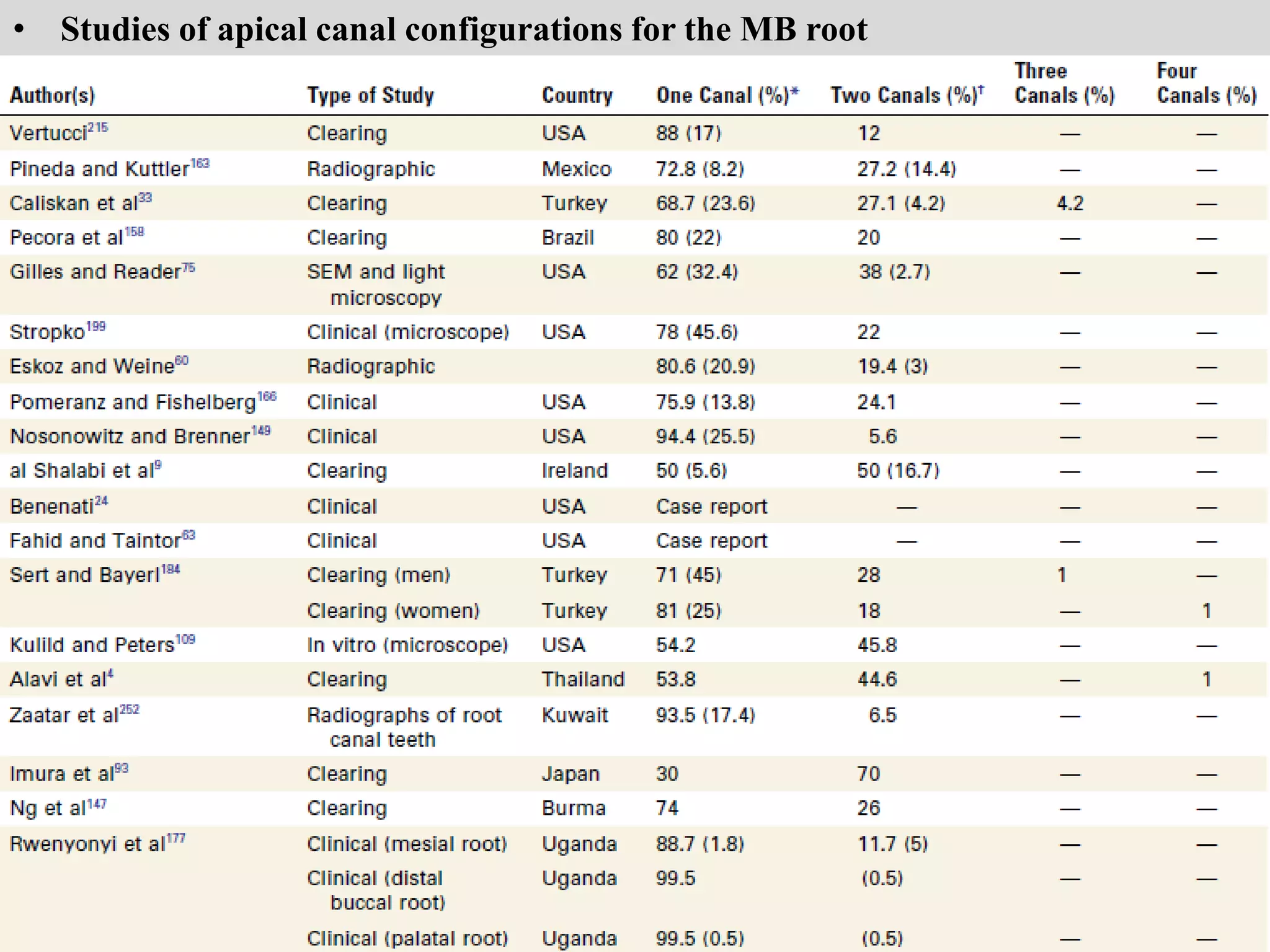
• Studies of apical canal configurations for the MB root
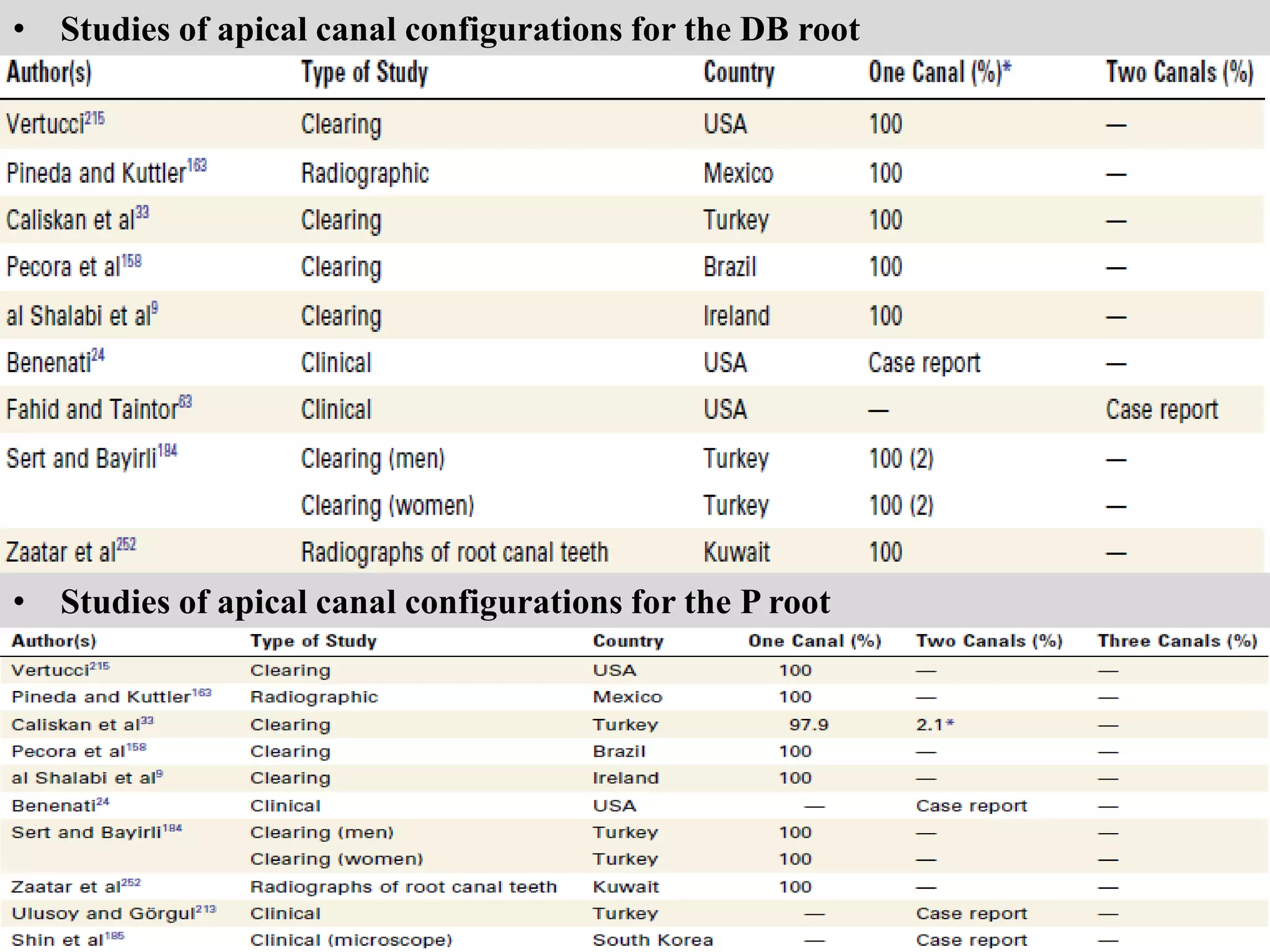
• Studies of apical canal configurations for the DB root
• Studies of apical canal configurations for the P root
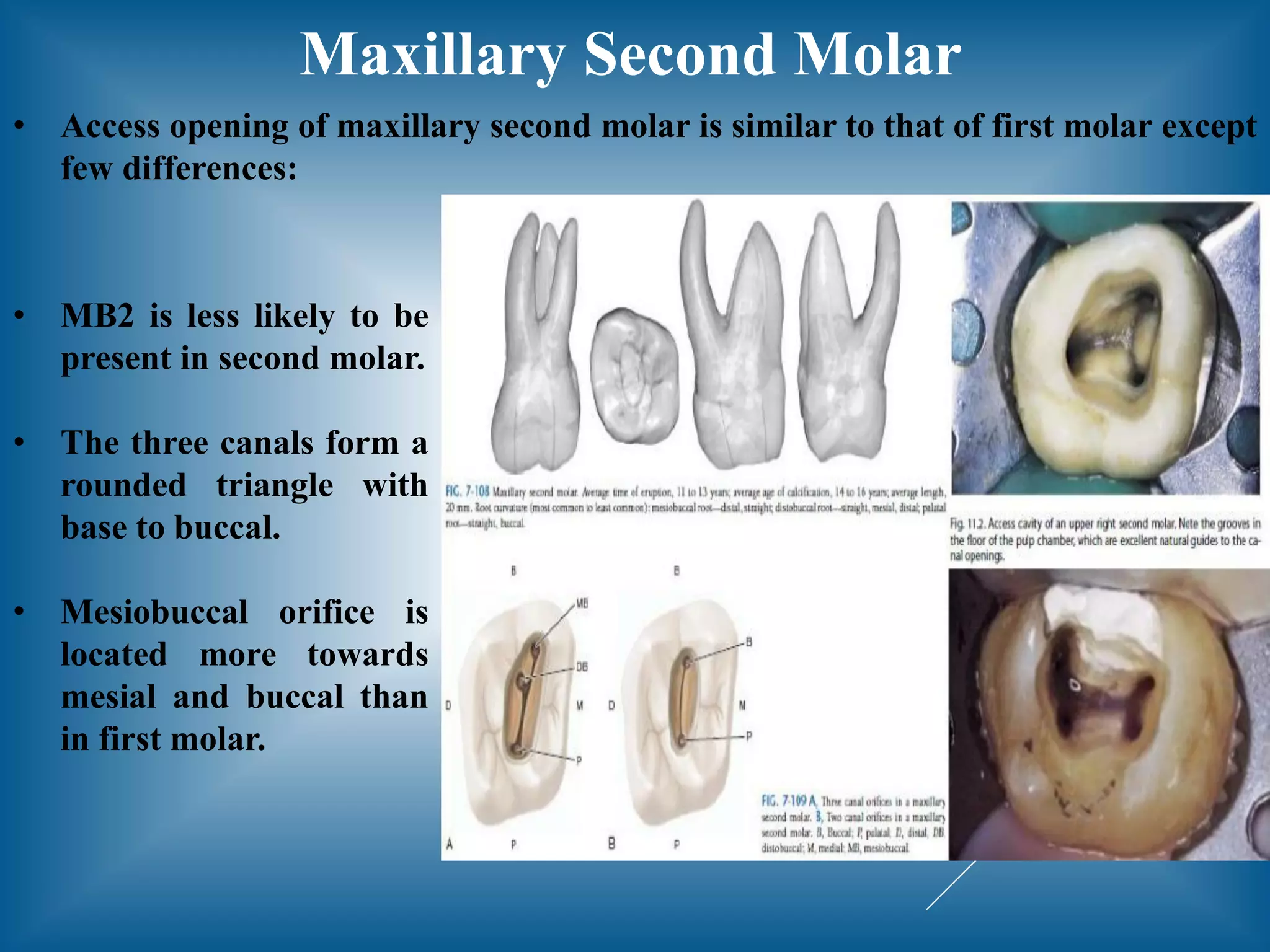
Maxillary Second Molar
• MB2 is less likely to be
present in second molar.
• The three canals form a
rounded triangle with
base to buccal.
• Mesiobuccal orifice is
located more towards
mesial and buccal than
in first molar.
• Access opening of maxillary second molar is similar to that of first molar except
few differences:
• Studies of apical canal configurations for the MB root
• Studies of apical canal configurations for the DB root
• Studies of apical canal configurations for the P root
• Mesiobuccal orifice is under the mesiobuccal cusp. Mesiolingual orifice is
located in a depression formed by mesial and the lingual walls. The distal
orifice is oval in shape with largest diameter buccolingually, located distal to
the buccal groove. Orifices of all the canals are usually located in the mesial
two-thirds of the crown.
• Distal root has also shown to have more than one orifice, i.e. distobuccal,
distolingual and middle distal. These orifices are usually joined by the
developmental grooves.
• The shape of access cavity is usually trapezoidal or rhomboid.
• Average length: 21 mm.
• Triangular outline form reflect the anatomy of pulp chamber with the base
toward the mesial and the apex toward the distal wall.
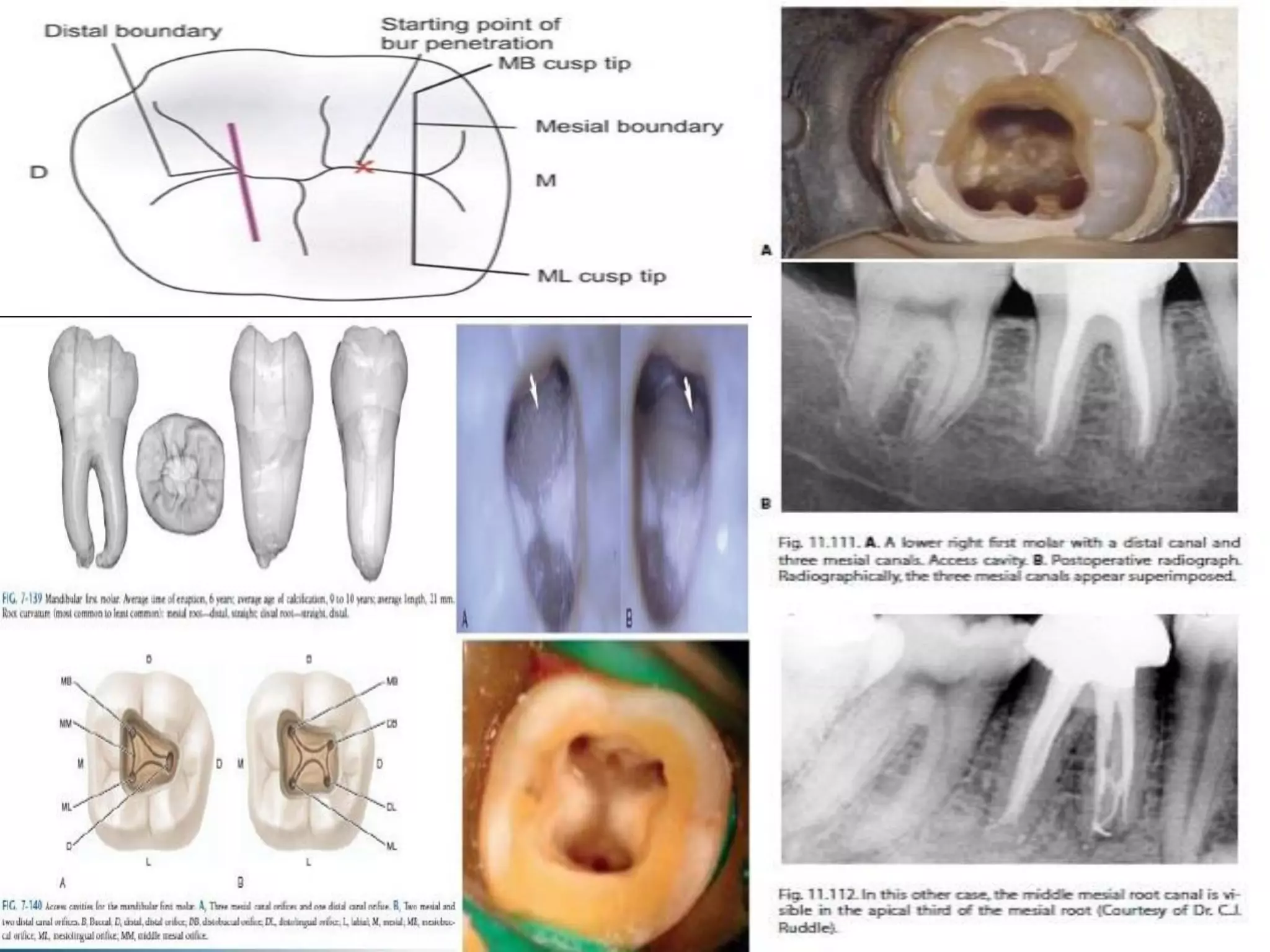
Mandibular First Molar
• Studies of apical canal configurations for the M root
• Studies of apical canal configurations for the D root
• Access opening of mandibular second molar is similar to that of first
molar except few differences:
 Pulp chamber is smaller in size.
 One, two or more canals may be present.
 Mesiobuccal and mesiolingual canal orifices are usually located
closer together.
 When three canals are present, shape of access cavity is almost
similar to mandibular first molar, but it is more triangular and less
of rhomboid shape.
 When two canal orifices are present, access cavity is rectangular,
wide mesiodistally and narrow buccolingually.
Mandibular Second Molar
• Average length= 20mm.
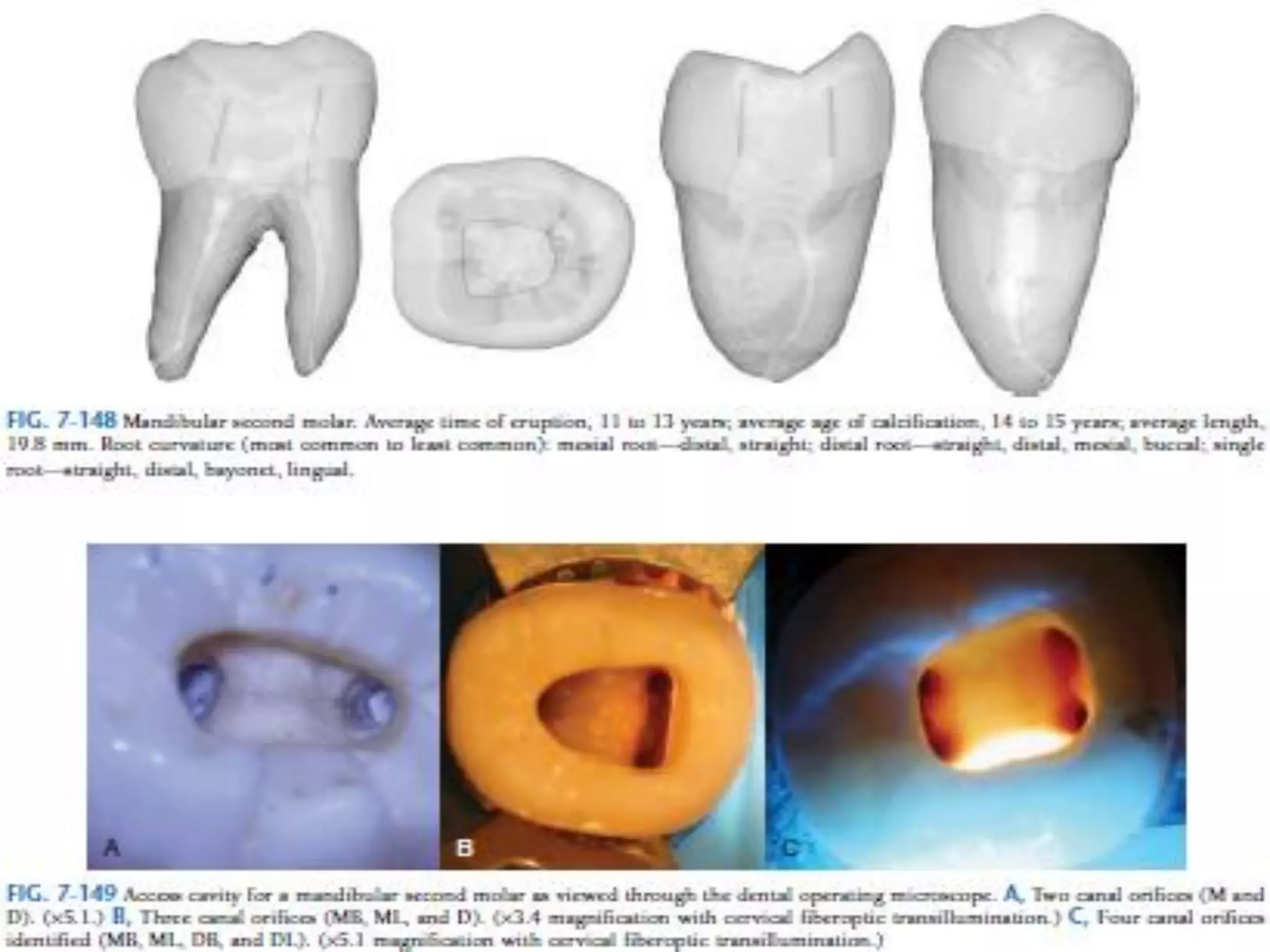
• Mesial root have 2 canals, while distal root have one canal.
• Studies of apical canal configurations of mandibular second molar
• Mandibular molars usually have two roots. However, occasionally three
roots are present with two or three canals in the mesial and one, two, or
three canals in the distal root.
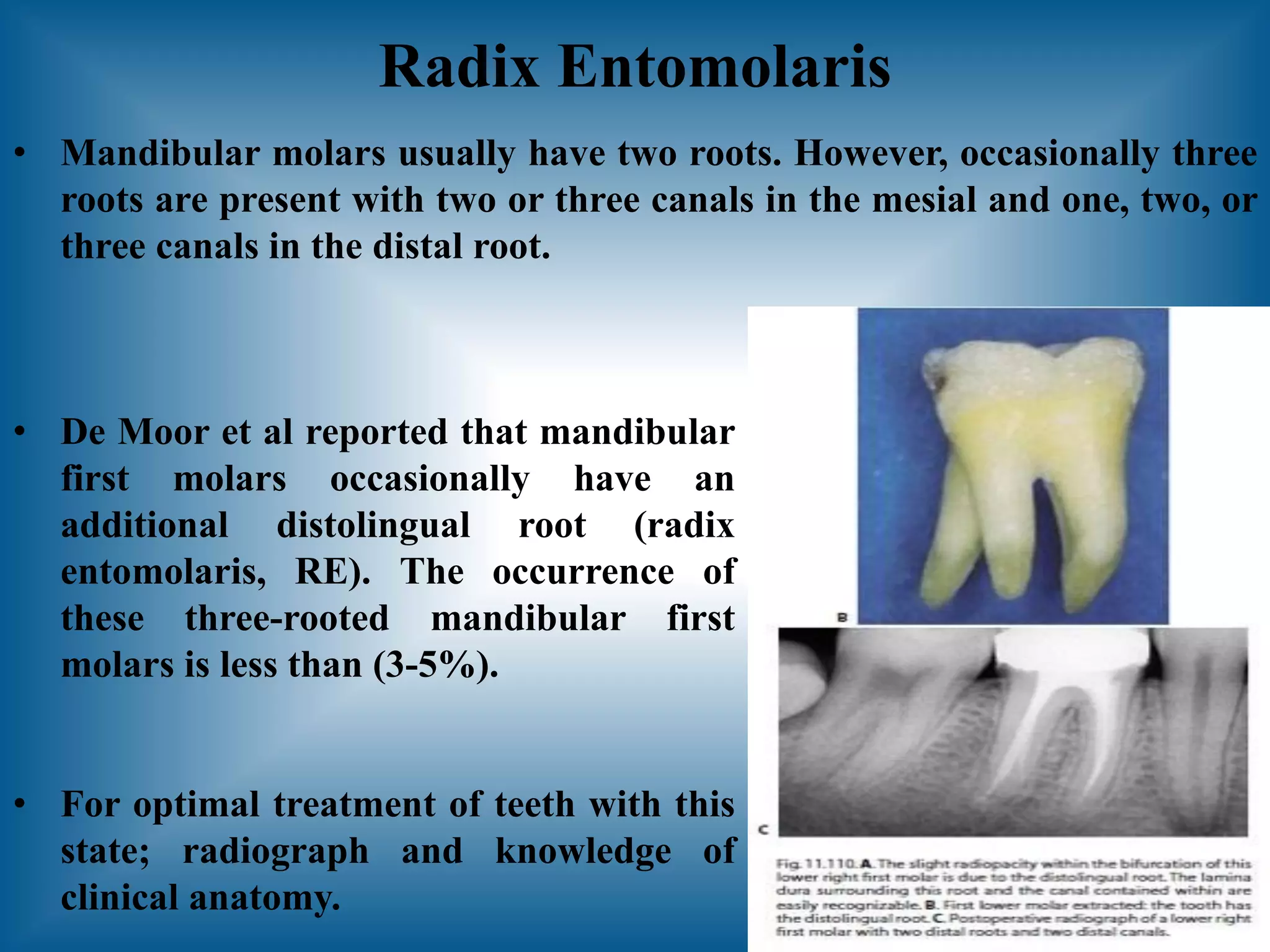
Radix Entomolaris
• De Moor et al reported that mandibular
first molars occasionally have an
additional distolingual root (radix
entomolaris, RE). The occurrence of
these three-rooted mandibular first
molars is less than (3-5%).
• For optimal treatment of teeth with this
state; radiograph and knowledge of
clinical anatomy.
C-shaped Canals
• The main cause for C-shaped roots and canals is the failure of Hertwig’s
epithelial root sheath to fuse on either the buccal or lingual root surface.
• The most C-shaped canals occur in the mandibular second molar, they
have also been reported in the mandibular first molar, the maxillary
first and second molars and the mandibular first premolar.
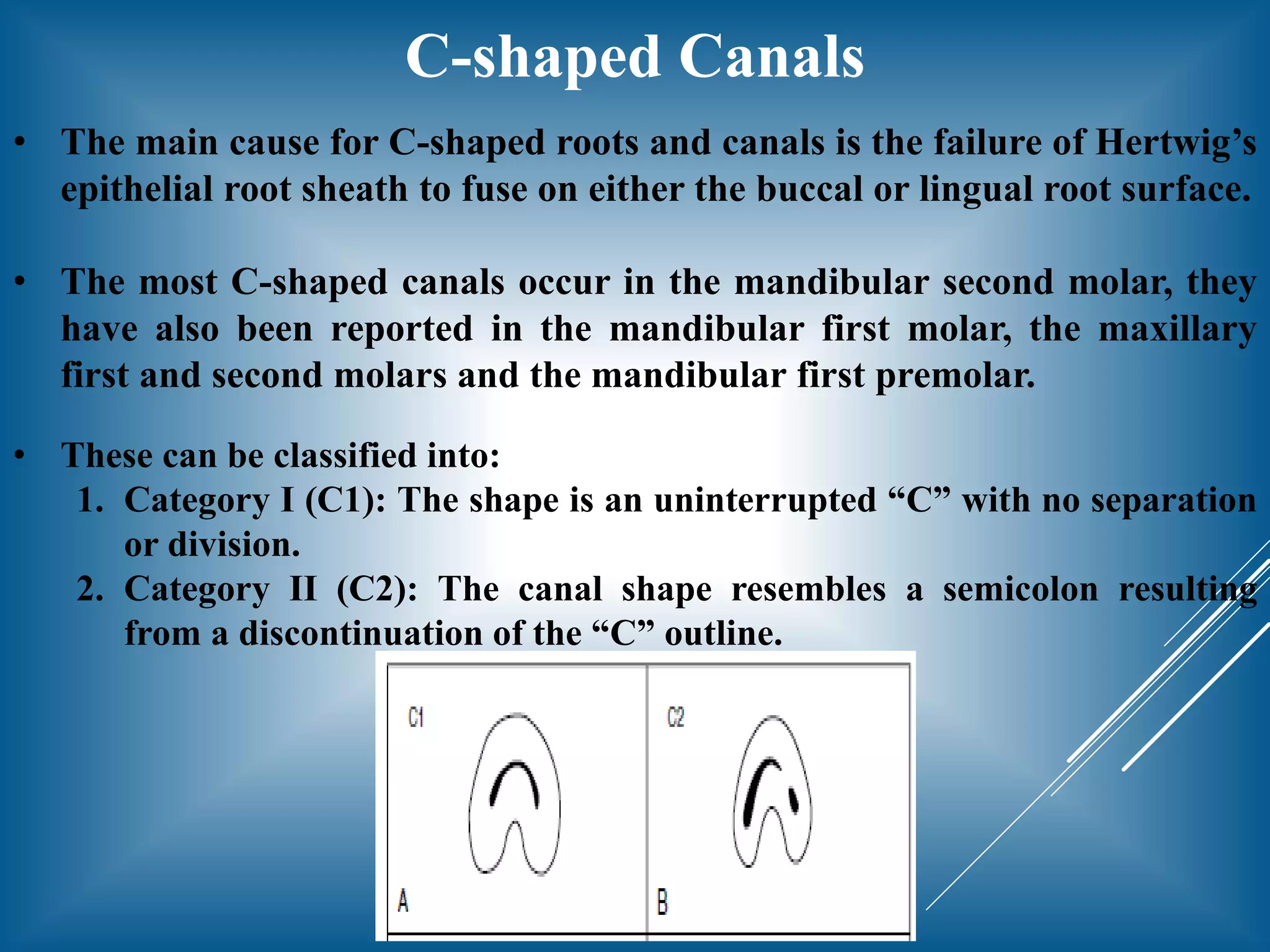
• These can be classified into:
1. Category I (C1): The shape is an uninterrupted “C” with no separation
or division.
2. Category II (C2): The canal shape resembles a semicolon resulting
from a discontinuation of the “C” outline.
• Extirpation of pulp may be difficult leading to more bleeding which can
be mistaken for perforation. Removal of pulp tissue at coronal isthmus
is difficult. To overcome these difficulties, the dental operating
microscope, sonic and ultrasonic instrumentation and thermoplastic
obturation techniques should be used.
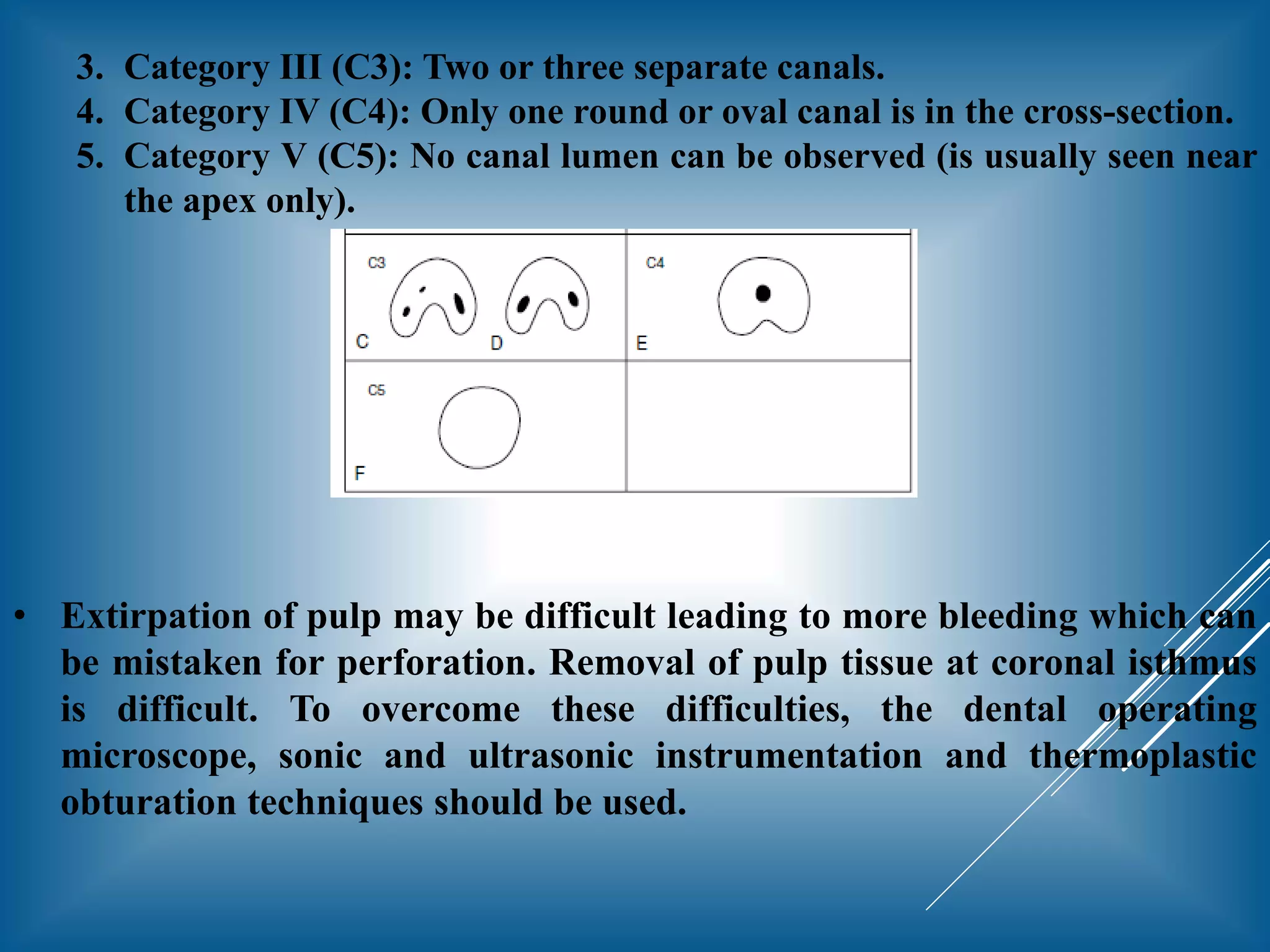
3. Category III (C3): Two or three separate canals.
4. Category IV (C4): Only one round or oval canal is in the cross-section.
5. Category V (C5): No canal lumen can be observed (is usually seen near
the apex only).
Extensive restorations
• If possible, complete removal of extensive restoration allows the most
favorable access to the root canals.
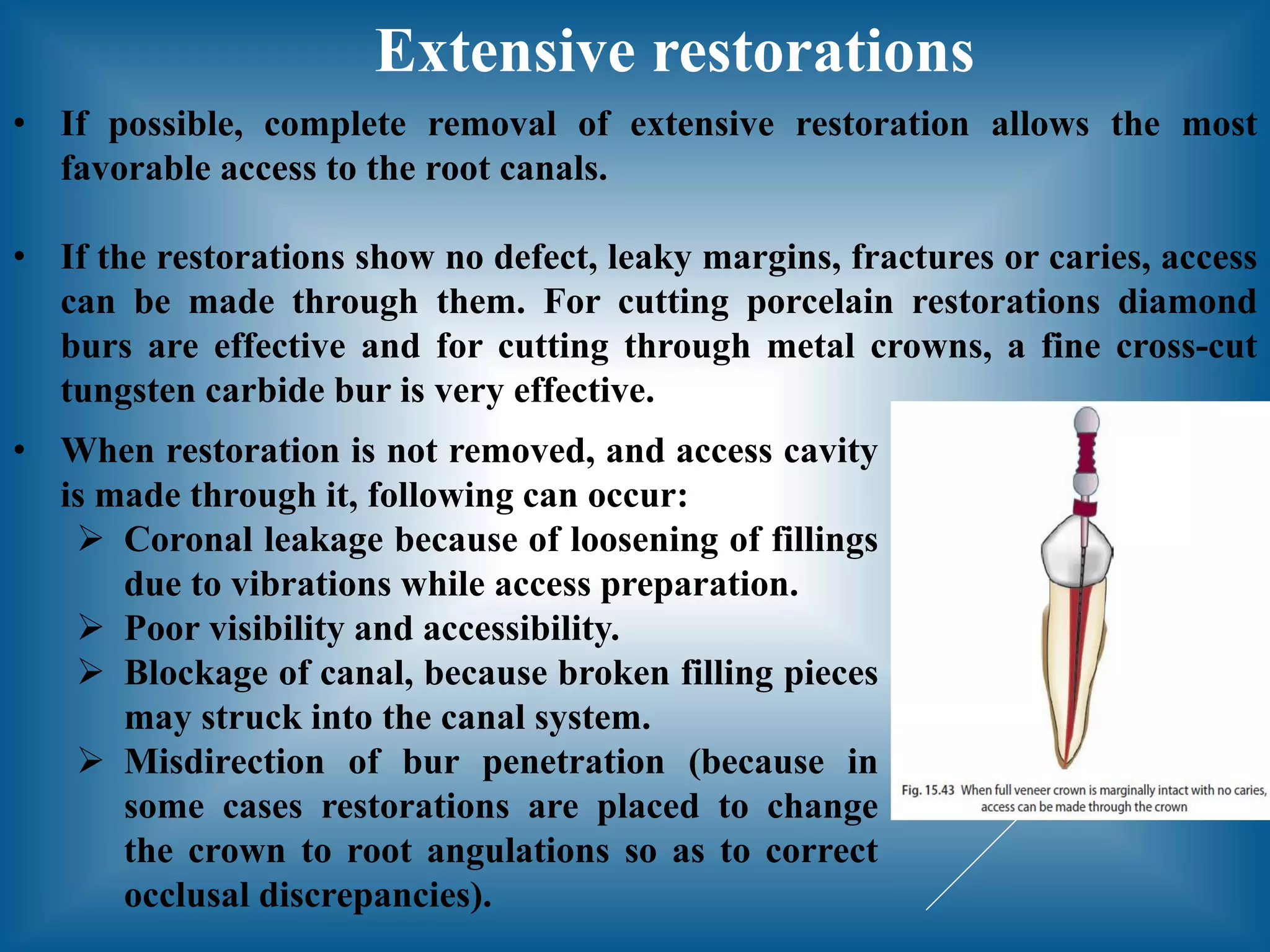
• If the restorations show no defect, leaky margins, fractures or caries, access
can be made through them. For cutting porcelain restorations diamond
burs are effective and for cutting through metal crowns, a fine cross-cut
tungsten carbide bur is very effective.
• When restoration is not removed, and access cavity
is made through it, following can occur:
 Coronal leakage because of loosening of fillings
due to vibrations while access preparation.
 Poor visibility and accessibility.
 Blockage of canal, because broken filling pieces
may struck into the canal system.
 Misdirection of bur penetration (because in
some cases restorations are placed to change
the crown to root angulations so as to correct
occlusal discrepancies).
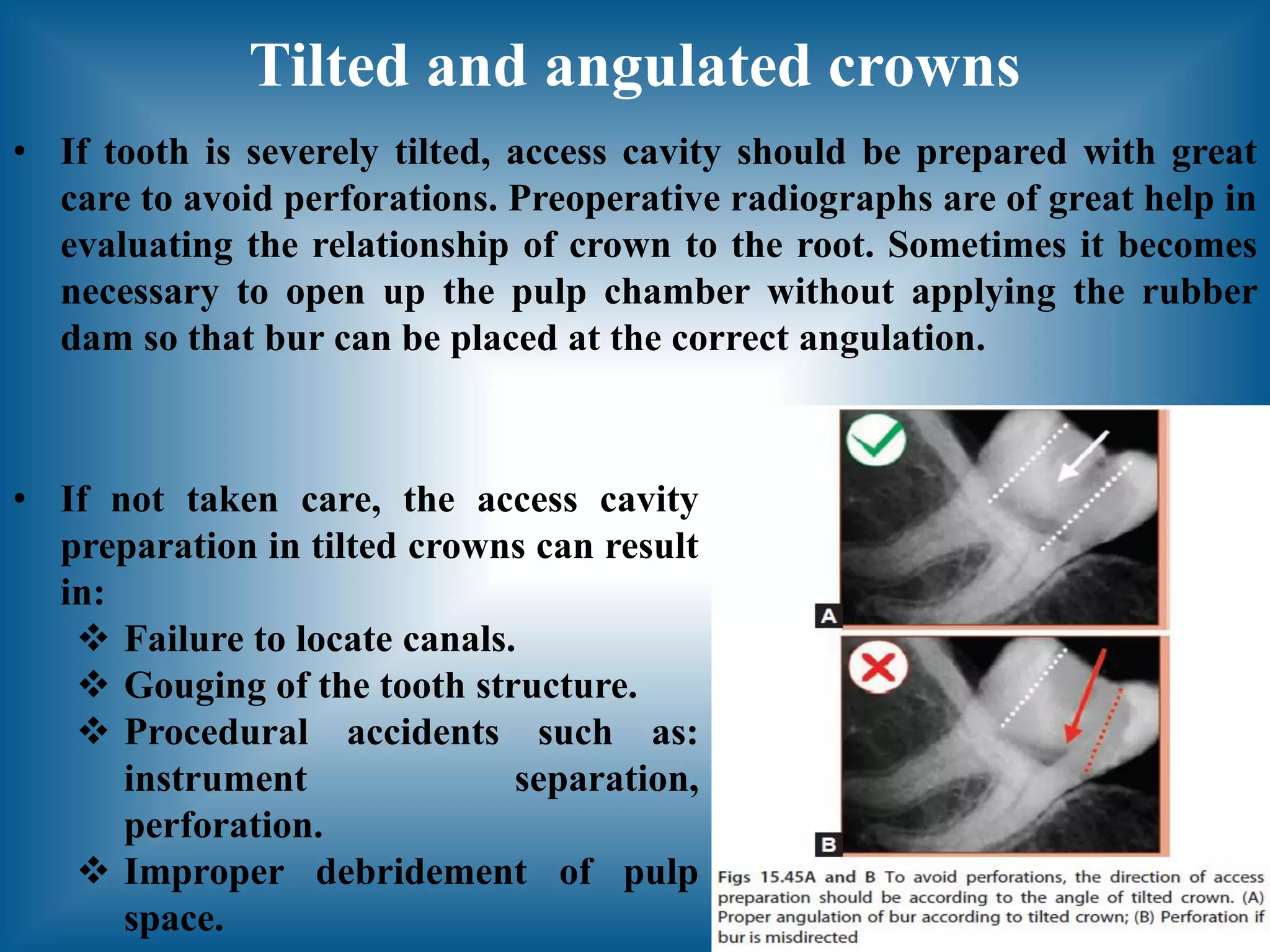
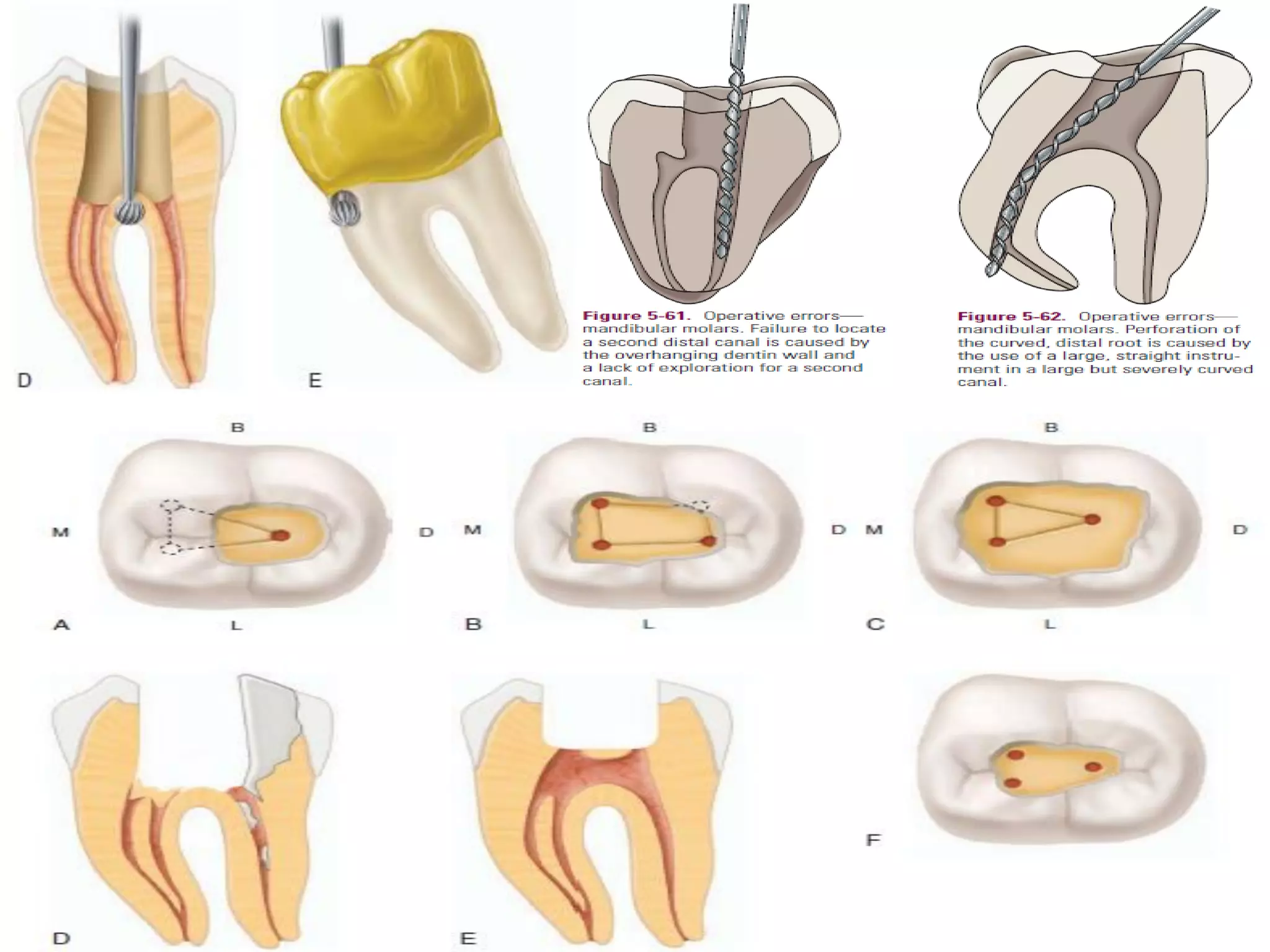
• If tooth is severely tilted, access cavity should be prepared with great
care to avoid perforations. Preoperative radiographs are of great help in
evaluating the relationship of crown to the root. Sometimes it becomes
necessary to open up the pulp chamber without applying the rubber
dam so that bur can be placed at the correct angulation.
Tilted and angulated crowns
• If not taken care, the access cavity
preparation in tilted crowns can result
in:
 Failure to locate canals.
 Gouging of the tooth structure.
 Procedural accidents such as:
instrument separation,
perforation.
 Improper debridement of pulp
space.
• Calcifications in the pulp space are of common occurrence. Pulp space
can be partially or completely obliterated by the pulp stones. Teeth with
calcifications result in difficulty in locating and further treatment of the
calcified canals.
• Special tips for ultrasonic handpieces are best suited for treating such
cases. They allow the precised removal of dentin from the pulp floor
while locating calcified canals. But magnification and illumination are
the main requirements before negotiating a calcified canal.

Calcified canals
• If special tips are not available then a
pointed ultrasonic scaler tip can be used for
removal of calcifications from the pulp
space. One should avoid over cutting of the
dentin in order to locate the canals, this will
further result in loss of landmarks and the
tooth weakening.
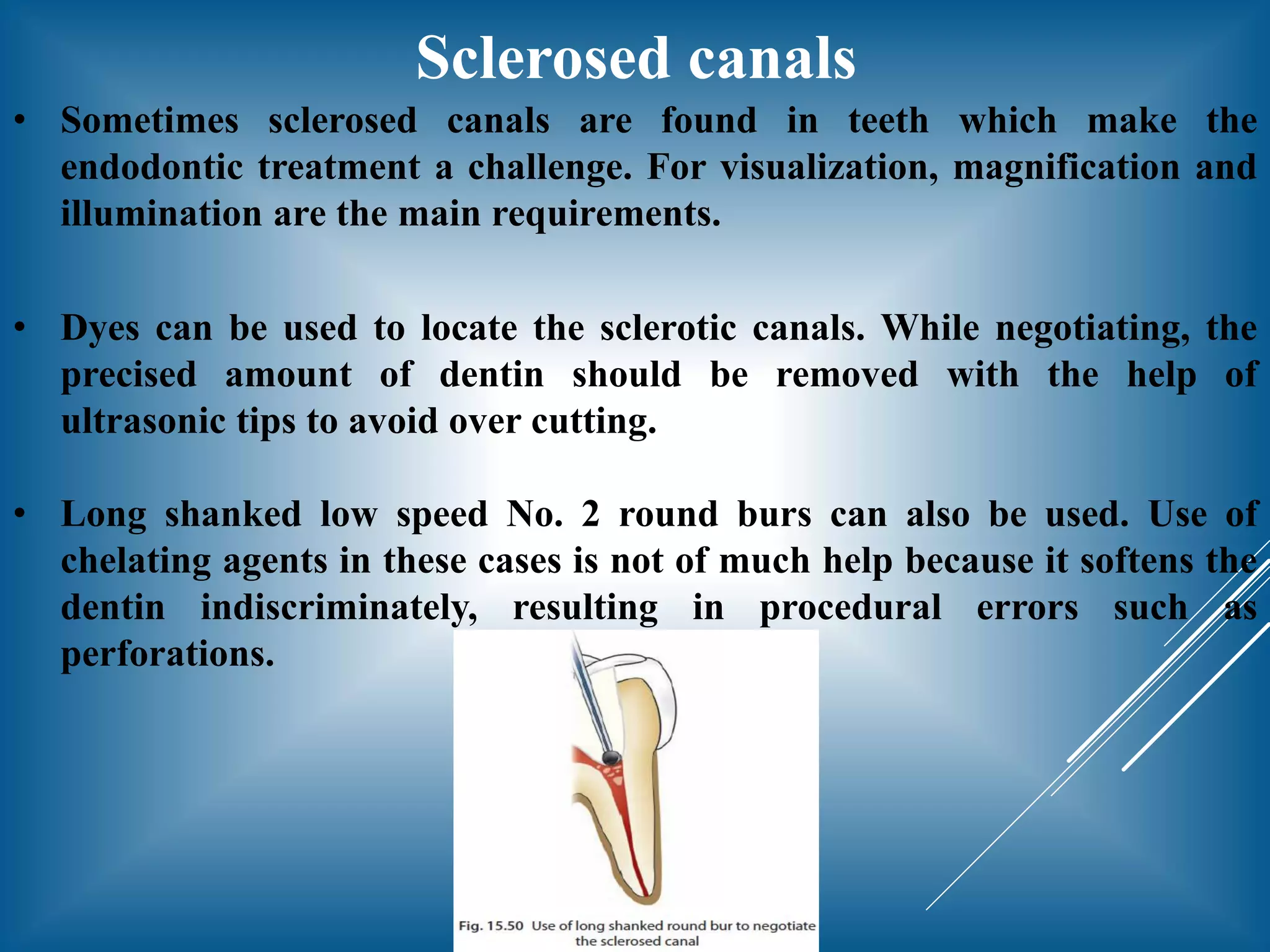
• Sometimes sclerosed canals are found in teeth which make the
endodontic treatment a challenge. For visualization, magnification and
illumination are the main requirements.
Sclerosed canals
• Dyes can be used to locate the sclerotic canals. While negotiating, the
precised amount of dentin should be removed with the help of
ultrasonic tips to avoid over cutting.
• Long shanked low speed No. 2 round burs can also be used. Use of
chelating agents in these cases is not of much help because it softens the
dentin indiscriminately, resulting in procedural errors such as
perforations.
Teeth with no or minimal crown
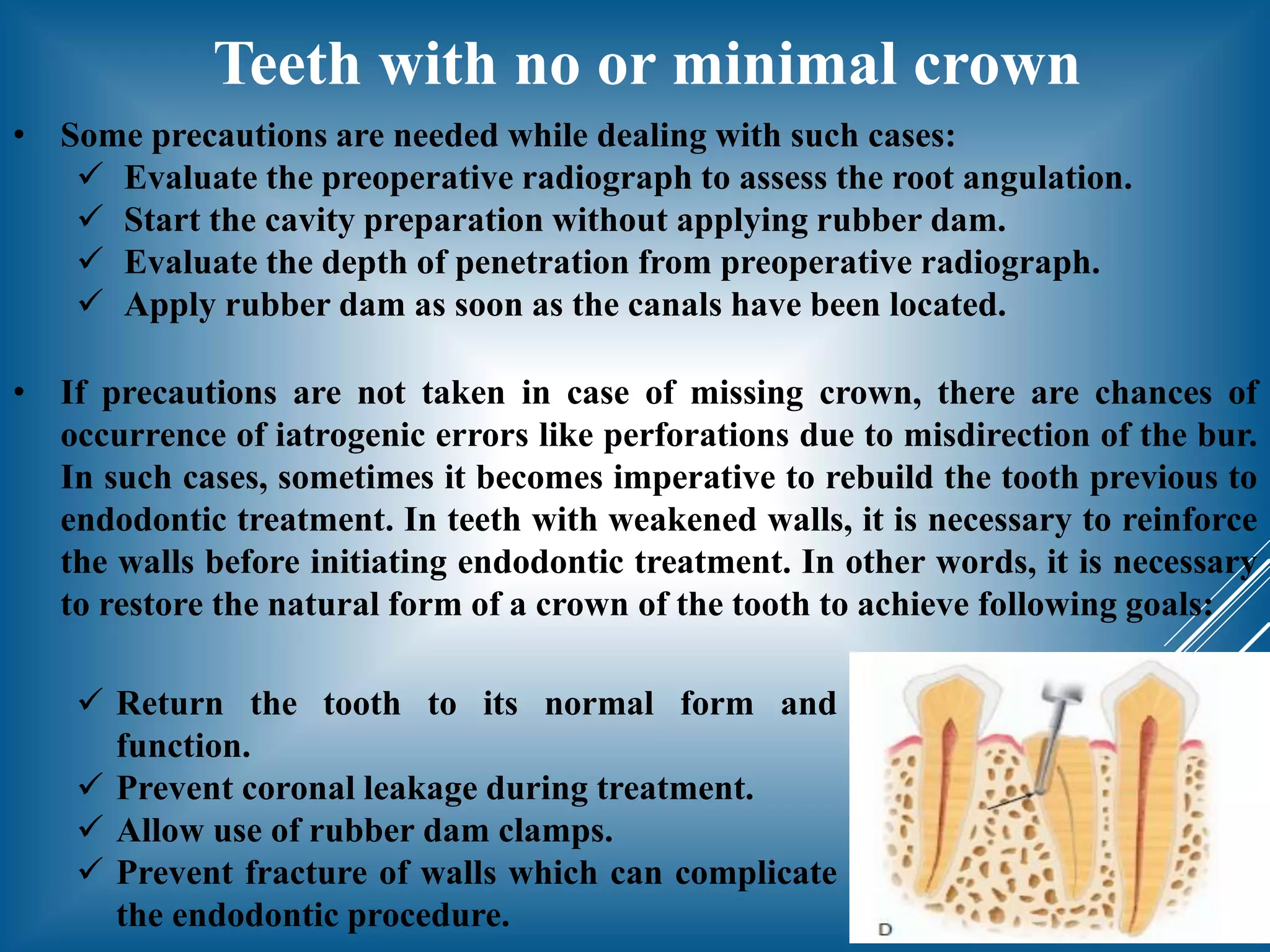
• Some precautions are needed while dealing with such cases:
 Evaluate the preoperative radiograph to assess the root angulation.
 Start the cavity preparation without applying rubber dam.
 Evaluate the depth of penetration from preoperative radiograph.
 Apply rubber dam as soon as the canals have been located.
• If precautions are not taken in case of missing crown, there are chances of
occurrence of iatrogenic errors like perforations due to misdirection of the bur.
In such cases, sometimes it becomes imperative to rebuild the tooth previous to
endodontic treatment. In teeth with weakened walls, it is necessary to reinforce
the walls before initiating endodontic treatment. In other words, it is necessary
to restore the natural form of a crown of the tooth to achieve following goals:
 Return the tooth to its normal form and
function.
 Prevent coronal leakage during treatment.
 Allow use of rubber dam clamps.
 Prevent fracture of walls which can complicate
the endodontic procedure.
 Advanced endodontics 1st ed. 2009.
 Endodontics (Principles & Practice) Torabinejad 4th ed. 2009.
 Endodontics- Castellucci 12th ed. 2009.
 Endodontics- Ingle 6th ed. 2008.
 Pathways of the pulp 10th ed. 2011.
 PDQ endodontics 1st ed. 2009.
 Textbook of endodontics- Nisha Garg 3rd ed. 2014.
References
Access opening of molar teeth

Access opening of molar teeth

  • 2.
    Introduction • Access isthe first and the most important phase of root canal treatment. A well designed access preparation is essential for good endodontic success. • A proper coronal access forms the foundation of pyramid of endodontic treatment. Any improperly prepared access cavity can impair the instrumentation, disinfection and therefore obturation resulting in poor prognosis of the treatment.
  • 4.
    Instruments for accesscavity preparation
  • 6.
    • The basicprinciples of access opening was established by G.V. Black, as following: 1. Outline form: The outline form of the endodontic cavity must be correctly shaped and positioned to establish complete access for instrumentation, from cavity margin to apical foramen. To achieve optimal preparation, three factors of internal anatomy must be considered: Principles of access opening A. Pulp chamber size: In young patients, these preparations must be more extensive than in older patients, in whom the pulp has receded and the pulp chamber is smaller in all three dimensions.
  • 7.
    B. Pulp chambershape: The finished outline form should accurately reflect the shape of the pulp chamber. For example, the floor of the pulp chamber in a molar tooth is usually triangular in shape, owing to the triangular position of the orifices of the canals. C. Number, Position, and Curvature of root canals: To prepare each canal efficiently without interference, the cavity walls often have to be extended to allow an unstrained instrument approach to the apical foramen.  Variations from the normal number of canals:- 1. Maxillary Molars: A second separate canal in the mesiobuccal root. 2. Mandibular molars: A second canal often is found in the distal root.
  • 8.
    2. Convenience form:In endodontic therapy, convenience form makes the preparation and filling of the root canals more convenient and accurate. The benefits of it are: A. Unobstructed access to the canal orifice: • Enough tooth structure must be removed to allow instruments to be placed easily into the orifice of each canal without interference from overhanging walls. • The clinician must be able to see each orifice and easily reach it with the instrument points. • Failure to observe this principle not only endangers the successful outcome of the case but also adds materially to the duration of treatment. B. Extension to accommodate filling techniques: • It's often necessary to expand the outline form to make certain filling techniques more convenient or practical. If a softened gutta-percha technique is used for filling, where in rather rigid pluggers are used in a vertical thrust, then the outline form may have to be widely extended to accommodate these heavier instruments.
  • 9.
    C. Direct accessto the apical foramen: • Enough tooth structure must be removed to allow the endodontic instruments freedom within the coronal cavity so they can extend down the canal in an unstrained position. This is especially true when the canal is severely curved or leaves the chamber at an obtuse angle.
  • 10.
    4. Debridement ofthe cavity: • All of the caries, debris, and necrotic material must be removed from the chamber before the radicular preparation is begun. If the calcified or metallic debris is left in the chamber and carried into the canal, it may act as an obstruction during canal enlargement. • Soft debris carried from the chamber might increase the bacterial population in the canal. Coronal debris may also stain the crown, particularly in anterior teeth. • Round burs are most helpful in cavity debridement. The long-blade endodontic spoon excavator is ideal for debris removal. Irrigation with sodium hypochlorite is also an excellent measure for cleaning the chamber and canals of persistent debris. 3. Removal of the remaining carious dentin and defective restorations: The advantages of its removal are: A. To eliminate mechanically as many bacteria as possible from the interior of the tooth. B. To eliminate the discolored tooth structure, that may ultimately lead to staining of the crown.
  • 11.
  • 12.
    Laws for determinationnumber and location of orifices 1. Centrality: Floor of pulp chamber is always located in the center of tooth at the level of CEJ junction. 2. Concentricity: Walls of pulp chamber are always concentric to external surface of tooth at the level of CEJ, that is, the external root surface anatomy reflects the internal pulp chamber anatomy. • The authors proposed six guidelines (laws) of pulp chamber anatomy to help clinicians to determine the number and location of orifices on the chamber floor. More than 95% of examined teeth by the investigators were conformed to these laws.
  • 13.
    3. CEJ: Thedistance from the external surface of the clinical crown to the wall of the pulp chamber is the same throughout the circumference of the tooth at the level of the CEJ, making the CEJ is the most consistent repeatable landmark for locating the position of the pulp chamber. 4. Color change: The pulp chamber floor is always darker in color than the walls.
  • 14.
    5. Symmetry: Exceptfor maxillary molars. • Canal orifices are equidistant from a line drawn in a mesiodistal direction through the center of pulp chamber floor. • Orifices lie on a line perpendicular to a line drawn in a mesiodistal direction across the center of the pulp chamber floor. 6. Orifice location: • Canal orifices are located at the junction of floor and walls. • Orifices are always located at the terminus of the roots developmental fusion lines.
  • 17.
    Maxillary First Molar •The shape of pulp chamber is rhomboid with acute mesiobuccal angle, obtuse distobuccal angle and palatal right angles. • Palatal canal orifice is located palatally. Mesiobuccal canal orifice is located under the mesiobuccal cusp. Distobuccal canal orifice is located slightly distal and palatal to the mesiobuccal orifice. A line drawn to connect all three orifices (MB, DB, P) forms a triangle, termed as molar triangle. • Generally 3 roots with 3 canals , additional canal is located in MB root. • Large pulp chamber triangular in shape with the base toward the buccal and the apex toward the palatal surface.
  • 18.
    • Almost alwaysa second mesiobuccal canal, i.e. MB2 is present in first maxillary molars, which is located palatal and mesial to the MB1. Though its position can vary sometimes it can lie a line between MB1 and palatal orifices. • Because of presence of MB2, the access cavity acquires a rhomboid shape with corners corresponding to all the canal orifices, i.e. MB1, MB2, DB and P. • Average length: MB= 20mm, DB=19.5mm, P=20.5mm. • MB canal opening is closer to buccal wall than DB orifice. • DB canal is closer to the middle of the tooth than to the distal wall , and it is shorter and finest of the 3 canals.
  • 21.
    • Studies ofapical canal configurations for the MB root
  • 22.
    • Studies ofapical canal configurations for the DB root
  • 23.
    • Studies ofapical canal configurations for the P root
  • 24.
    Maxillary Second Molar •MB2 is less likely to be present in second molar. • The three canals form a rounded triangle with base to buccal. • Mesiobuccal orifice is located more towards mesial and buccal than in first molar. • Access opening of maxillary second molar is similar to that of first molar except few differences:
  • 25.
    • Studies ofapical canal configurations for the MB root
  • 26.
    • Studies ofapical canal configurations for the DB root • Studies of apical canal configurations for the P root
  • 30.
    • Mesiobuccal orificeis under the mesiobuccal cusp. Mesiolingual orifice is located in a depression formed by mesial and the lingual walls. The distal orifice is oval in shape with largest diameter buccolingually, located distal to the buccal groove. Orifices of all the canals are usually located in the mesial two-thirds of the crown. • Distal root has also shown to have more than one orifice, i.e. distobuccal, distolingual and middle distal. These orifices are usually joined by the developmental grooves. • The shape of access cavity is usually trapezoidal or rhomboid. • Average length: 21 mm. • Triangular outline form reflect the anatomy of pulp chamber with the base toward the mesial and the apex toward the distal wall. Mandibular First Molar
  • 32.
    • Studies ofapical canal configurations for the M root
  • 33.
    • Studies ofapical canal configurations for the D root
  • 34.
    • Access openingof mandibular second molar is similar to that of first molar except few differences:  Pulp chamber is smaller in size.  One, two or more canals may be present.  Mesiobuccal and mesiolingual canal orifices are usually located closer together.  When three canals are present, shape of access cavity is almost similar to mandibular first molar, but it is more triangular and less of rhomboid shape.  When two canal orifices are present, access cavity is rectangular, wide mesiodistally and narrow buccolingually. Mandibular Second Molar • Average length= 20mm. • Mesial root have 2 canals, while distal root have one canal.
  • 36.
    • Studies ofapical canal configurations of mandibular second molar
  • 40.
    • Mandibular molarsusually have two roots. However, occasionally three roots are present with two or three canals in the mesial and one, two, or three canals in the distal root. Radix Entomolaris • De Moor et al reported that mandibular first molars occasionally have an additional distolingual root (radix entomolaris, RE). The occurrence of these three-rooted mandibular first molars is less than (3-5%). • For optimal treatment of teeth with this state; radiograph and knowledge of clinical anatomy.
  • 41.
    C-shaped Canals • Themain cause for C-shaped roots and canals is the failure of Hertwig’s epithelial root sheath to fuse on either the buccal or lingual root surface. • The most C-shaped canals occur in the mandibular second molar, they have also been reported in the mandibular first molar, the maxillary first and second molars and the mandibular first premolar. • These can be classified into: 1. Category I (C1): The shape is an uninterrupted “C” with no separation or division. 2. Category II (C2): The canal shape resembles a semicolon resulting from a discontinuation of the “C” outline.
  • 42.
    • Extirpation ofpulp may be difficult leading to more bleeding which can be mistaken for perforation. Removal of pulp tissue at coronal isthmus is difficult. To overcome these difficulties, the dental operating microscope, sonic and ultrasonic instrumentation and thermoplastic obturation techniques should be used. 3. Category III (C3): Two or three separate canals. 4. Category IV (C4): Only one round or oval canal is in the cross-section. 5. Category V (C5): No canal lumen can be observed (is usually seen near the apex only).
  • 44.
    Extensive restorations • Ifpossible, complete removal of extensive restoration allows the most favorable access to the root canals. • If the restorations show no defect, leaky margins, fractures or caries, access can be made through them. For cutting porcelain restorations diamond burs are effective and for cutting through metal crowns, a fine cross-cut tungsten carbide bur is very effective. • When restoration is not removed, and access cavity is made through it, following can occur:  Coronal leakage because of loosening of fillings due to vibrations while access preparation.  Poor visibility and accessibility.  Blockage of canal, because broken filling pieces may struck into the canal system.  Misdirection of bur penetration (because in some cases restorations are placed to change the crown to root angulations so as to correct occlusal discrepancies).
  • 45.
    • If toothis severely tilted, access cavity should be prepared with great care to avoid perforations. Preoperative radiographs are of great help in evaluating the relationship of crown to the root. Sometimes it becomes necessary to open up the pulp chamber without applying the rubber dam so that bur can be placed at the correct angulation. Tilted and angulated crowns • If not taken care, the access cavity preparation in tilted crowns can result in:  Failure to locate canals.  Gouging of the tooth structure.  Procedural accidents such as: instrument separation, perforation.  Improper debridement of pulp space.
  • 46.
    • Calcifications inthe pulp space are of common occurrence. Pulp space can be partially or completely obliterated by the pulp stones. Teeth with calcifications result in difficulty in locating and further treatment of the calcified canals. • Special tips for ultrasonic handpieces are best suited for treating such cases. They allow the precised removal of dentin from the pulp floor while locating calcified canals. But magnification and illumination are the main requirements before negotiating a calcified canal. Calcified canals • If special tips are not available then a pointed ultrasonic scaler tip can be used for removal of calcifications from the pulp space. One should avoid over cutting of the dentin in order to locate the canals, this will further result in loss of landmarks and the tooth weakening.
  • 47.
    • Sometimes sclerosedcanals are found in teeth which make the endodontic treatment a challenge. For visualization, magnification and illumination are the main requirements. Sclerosed canals • Dyes can be used to locate the sclerotic canals. While negotiating, the precised amount of dentin should be removed with the help of ultrasonic tips to avoid over cutting. • Long shanked low speed No. 2 round burs can also be used. Use of chelating agents in these cases is not of much help because it softens the dentin indiscriminately, resulting in procedural errors such as perforations.
  • 48.
    Teeth with noor minimal crown • Some precautions are needed while dealing with such cases:  Evaluate the preoperative radiograph to assess the root angulation.  Start the cavity preparation without applying rubber dam.  Evaluate the depth of penetration from preoperative radiograph.  Apply rubber dam as soon as the canals have been located. • If precautions are not taken in case of missing crown, there are chances of occurrence of iatrogenic errors like perforations due to misdirection of the bur. In such cases, sometimes it becomes imperative to rebuild the tooth previous to endodontic treatment. In teeth with weakened walls, it is necessary to reinforce the walls before initiating endodontic treatment. In other words, it is necessary to restore the natural form of a crown of the tooth to achieve following goals:  Return the tooth to its normal form and function.  Prevent coronal leakage during treatment.  Allow use of rubber dam clamps.  Prevent fracture of walls which can complicate the endodontic procedure.
  • 49.
     Advanced endodontics1st ed. 2009.  Endodontics (Principles & Practice) Torabinejad 4th ed. 2009.  Endodontics- Castellucci 12th ed. 2009.  Endodontics- Ingle 6th ed. 2008.  Pathways of the pulp 10th ed. 2011.  PDQ endodontics 1st ed. 2009.  Textbook of endodontics- Nisha Garg 3rd ed. 2014. References