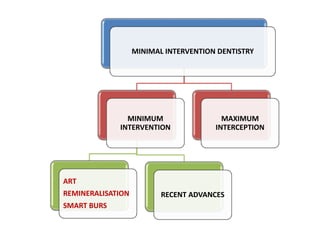
MINIMAL INTERVENTION DENTISTRY
MINIMUM
INTERVENTION
ART
REMINERALISATION
SMART BURS
RECENT ADVANCES
MAXIMUM
INTERCEPTION
CONTENTS
Introduction
ART
Remineralization
Remineralizing agent
Fluoride
Newer enamel remineralizing systems
Dispensing method
Smart bur
Introduction
Minimal Intervention Dentistry describes
contemporary ultraconservative operative
management of cavitated lesions requiring surgical
intervention.
It does not mean unduly early operative intervention of
incipient lesions, which in most cases is unnecessary as
more effective and appropriate non-invasive preventive
approaches exist.
ATRAUMATIC RESTORATIVE TECHNIQUE(ART)
ART is an innovative, largely painfree,
minimal intervention approach for
treating caries teeth, particularly in
countries where highly trained
dental personnel and the electricity
needed for clinical equipment are
not readily available or affordable
The Atraumatic restorative
treatment is a procedure based on
removing carious tooth tissues using
hand instruments alone and
restoring the cavity with an adhesive
restorative material.
Developed in Tanzania in the mid-
1980s.ART is launched by the World
Health Organization on 7th April,
1994 (world health day).
Principles of ART
Removing carious tooth tissues using hand
instruments only
Restoring the cavity with a restorative material that
sticks to the tooth.
Use of GIC in ART
Properties such as fluoride release, chemical bonding to the tooth
structure, biocompatibility and applicability in clinical situations, make
them the most appropriate materials for the ART approach.
Data suggest excellent results at a 1-year evaluation of ART restorations,
where a survival rate of 93% was found for one-surface fillings.
Evaluation after 2 and 3 years have been shown success rates of 89% and
85%.
Med Principles Pract 2002;11(suppl 1):44–47
According to a study
comparing the
antibacterial activity
of four glass
ionomer cements
used in ART
Fuji IX demonstrate
the greatest inhibitory
activity for
Streptococcus mutans
while Ketac Molar and
Fuji IX are statistically
effective against
Streptococcus sobrinus
and Lactobacillus
acidophilus.
Ketac molar also has greatest
inhibiting halo against
Actinomyces viscosus
• High strength conventional
GIC Fuji IX and Ketac Molar
present high P/L ratios that
improve their mechanical
properties for restorations in
posterior teeth making these
materials specially marked
for ART
J Mater Sci: Mater Med (2007) 18:1859–
1862
It was demonstrated that experimental GICs
containing CHX are effective in inhibiting bacteria
associated with caries, and incorporation of 1% CHX
diacetate is optimal to give appropriate physical and
bonding properties.
RMGI exhibit better clinical performance than GIC in
ART, except for marginal discoloration. RMGI can be
an alternative material to the GIC.
Med Princ Pract 2005;14:277–280
Dental Materials (2006) 22, 647–652
Composites
The effective bonding of
resin to enamel is a key
factor in the selection of
this material in MID
In mechanical sense, the
heavily filled resin-based
composites with smaller
filler particles can
compete more or less
with dental amalgam.
Greatest features are their
aesthetics and presumed
ease of application.
10
Main limitations
are Micro-leakage, polymerization
shrinkage and strength
• Although no ‘magic bullet’ to solve all
problems related to dental caries ART is a
combined preventive and curative oral
care procedure which must be
administered along with health promoting
messages about a prudent diet , good oral
hygiene, use of fluoride toothpaste and
sealant application.
REMINERALIZATION
Remineralization is defined as the process whereby calcium and phosphate
ions are supplied from a source external to the tooth to promote ion
deposition into crystal voids in demineralized enamel to produce net mineral
gain
Remineralization of dental lesions requires the presence of partially
demineralized crystals that can grow to their original size when they are
exposed to fluid that is supersaturated with respect to hydroxyapatite
minerals.
• Cochrane NJ, CaiF, Huq NL, Burrow MF, Reynolds EC. New approach to enhance
remineralization of tooth enamel. J Dent Res 2010;89:1187-97.]
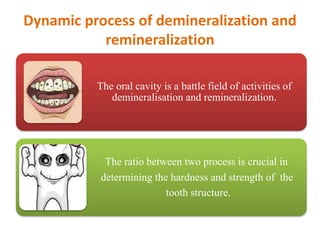
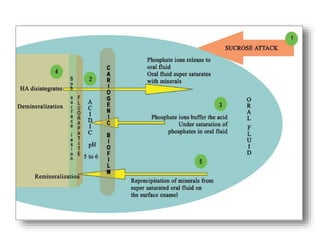
Dynamic process of demineralization and
remineralization
The oral cavity is a battle field of activities of
demineralisation and remineralization.
The ratio between two process is crucial in
determining the hardness and strength of the
tooth structure.
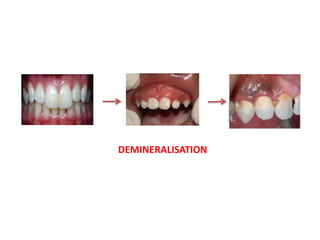
DEMINERALISATION
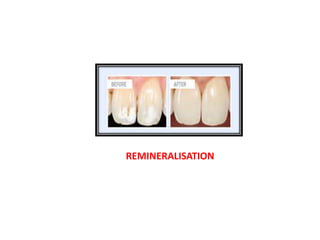
REMINERALISATION
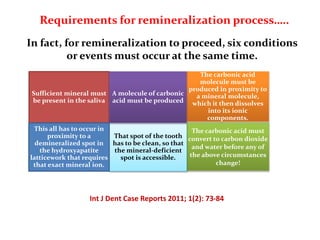
Requirements for remineralization process…..
In fact, for remineralization to proceed, six conditions
or events must occur at the same time.
Sufficient mineral must
be present in the saliva
The carbonic acid
molecule must be
produced in proximity to
a mineral molecule,
which it then dissolves
into its ionic
components.
The carbonic acid must
convert to carbon dioxide
and water before any of
the above circumstances
change!
That spot of the tooth
has to be clean, so that
the mineral-deficient
spot is accessible.
A molecule of carbonic
acid must be produced
This all has to occur in
proximity to a
demineralized spot in
the hydroxyapatite
latticework that requires
that exact mineral ion.
Int J Dent Case Reports 2011; 1(2): 73-84
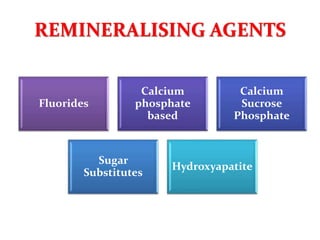
REMINERALISING AGENTS
Fluorides
Calcium
phosphate
based
Calcium
Sucrose
Phosphate
Sugar
Substitutes
Hydroxyapatite
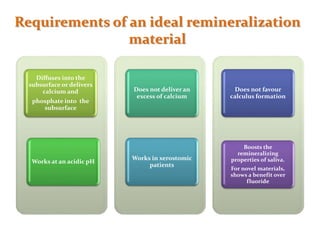
Requirements of an ideal remineralization
material
Diffuses into the
subsurface or delivers
calcium and
phosphate into the
subsurface
Works at an acidic pH
Does not deliver an
excess of calcium
Works in xerostomic
patients
Does not favour
calculus formation
Boosts the
remineralizing
properties of saliva.
For novel materials,
shows a benefit over
fluoride
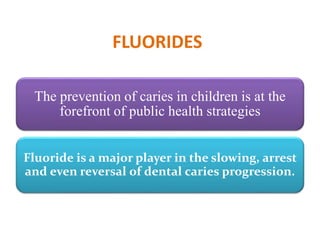
FLUORIDES
The prevention of caries in children is at the
forefront of public health strategies
Fluoride is a major player in the slowing, arrest
and even reversal of dental caries progression.
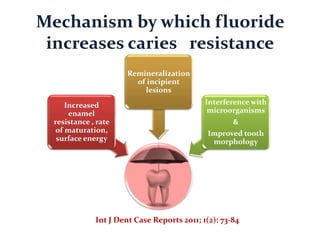
Mechanism by which fluoride
increases caries resistance
Increased
enamel
resistance , rate
of maturation,
surface energy
Remineralization
of incipient
lesions
Interference with
microorganisms
&
Improved tooth
morphology
Int J Dent Case Reports 2011; 1(2): 73-84
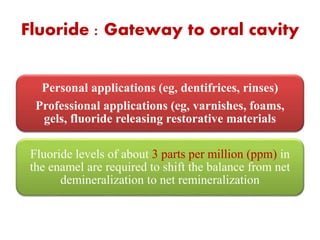
Fluoride : Gateway to oral cavity
Personal applications (eg, dentifrices, rinses)
Professional applications (eg, varnishes, foams,
gels, fluoride releasing restorative materials
Fluoride levels of about 3 parts per million (ppm) in
the enamel are required to shift the balance from net
demineralization to net remineralization
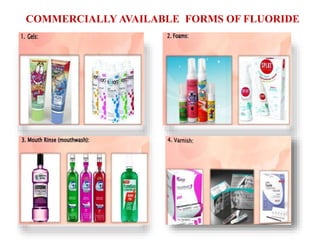
COMMERCIALLY AVAILABLE FORMS OF FLUORIDE
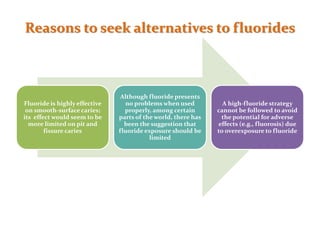
Reasons to seek alternatives to fluorides
Fluoride is highly effective
on smooth-surface caries;
its effect would seem to be
more limited on pit and
fissure caries
Although fluoride presents
no problems when used
properly, among certain
parts of the world, there has
been the suggestion that
fluoride exposure should be
limited
A high-fluoride strategy
cannot be followed to avoid
the potential for adverse
effects (e.g., fluorosis) due
to overexposure to fluoride
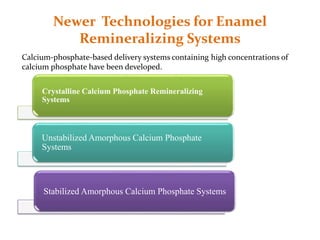
Newer Technologies for Enamel
Remineralizing Systems
Crystalline Calcium Phosphate Remineralizing
Systems
Unstabilized Amorphous Calcium Phosphate
Systems
Stabilized Amorphous Calcium Phosphate Systems
Calcium-phosphate-based delivery systems containing high concentrations of
calcium phosphate have been developed.
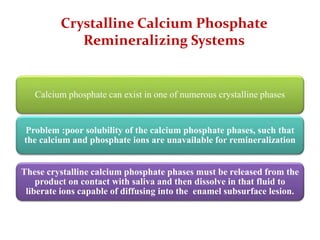
Crystalline Calcium Phosphate
Remineralizing Systems
Calcium phosphate can exist in one of numerous crystalline phases
Problem :poor solubility of the calcium phosphate phases, such that
the calcium and phosphate ions are unavailable for remineralization
These crystalline calcium phosphate phases must be released from the
product on contact with saliva and then dissolve in that fluid to
liberate ions capable of diffusing into the enamel subsurface lesion.
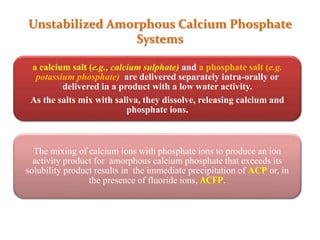
Unstabilized Amorphous Calcium Phosphate
Systems
a calcium salt (e.g., calcium sulphate) and a phosphate salt (e.g.
potassium phosphate) are delivered separately intra-orally or
delivered in a product with a low water activity.
As the salts mix with saliva, they dissolve, releasing calcium and
phosphate ions.
The mixing of calcium ions with phosphate ions to produce an ion
activity product for amorphous calcium phosphate that exceeds its
solubility product results in the immediate precipitation of ACP or, in
the presence of fluoride ions, ACFP.
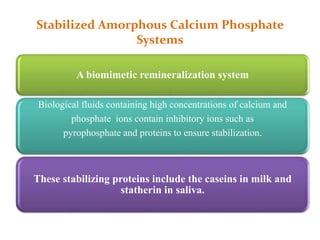
Stabilized Amorphous Calcium Phosphate
Systems
A biomimetic remineralization system
Biological fluids containing high concentrations of calcium and
phosphate ions contain inhibitory ions such as
pyrophosphate and proteins to ensure stabilization.
These stabilizing proteins include the caseins in milk and
statherin in saliva.
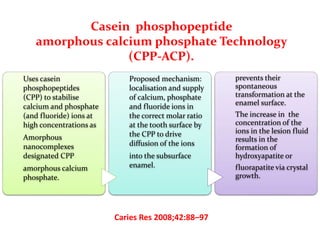
Casein phosphopeptide
amorphous calcium phosphate Technology
(CPP-ACP).
Uses casein
phosphopeptides
(CPP) to stabilise
calcium and phosphate
(and fluoride) ions at
high concentrations as
Amorphous
nanocomplexes
designated CPP
amorphous calcium
phosphate.
Proposed mechanism:
localisation and supply
of calcium, phosphate
and fluoride ions in
the correct molar ratio
at the tooth surface by
the CPP to drive
diffusion of the ions
into the subsurface
enamel.
prevents their
spontaneous
transformation at the
enamel surface.
The increase in the
concentration of the
ions in the lesion fluid
results in the
formation of
hydroxyapatite or
fluorapatite via crystal
growth.
Caries Res 2008;42:88–97
30
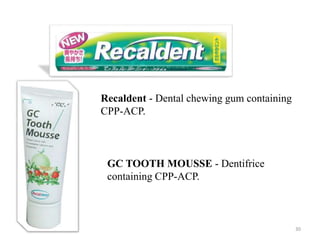
Recaldent - Dental chewing gum containing
CPP-ACP.
GC TOOTH MOUSSE - Dentifrice
containing CPP-ACP.
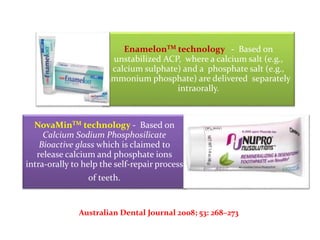
EnamelonTM technology - Based on
unstabilized ACP, where a calcium salt (e.g.,
calcium sulphate) and a phosphate salt (e.g.,
ammonium phosphate) are delivered separately
intraorally.
NovaMinTM technology - Based on
Calcium Sodium Phosphosilicate
Bioactive glass which is claimed to
release calcium and phosphate ions
intra-orally to help the self-repair process
of teeth.
Australian Dental Journal 2008; 53: 268–273
Clinpro Tooth CrèmeTM
commercially available
organically modified
tricalcium phosphate which
can coexist
with fluoride in aqueous
environment
During brushing,
this toothpaste contacts saliva
and thereby calcium,
phosphate and fluoride ions
become readily available to
tooth thus preventing
demineralization
International Journal of Pharm. Tech Research. 6(2), Apr-Jun 2014,487-493. ]
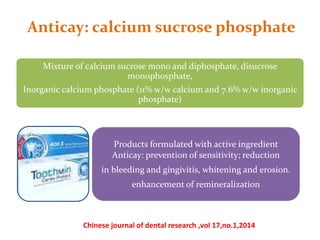
Anticay: calcium sucrose phosphate
Mixture of calcium sucrose mono and diphosphate, disucrose
monophosphate,
Inorganic calcium phosphate (11% w/w calcium and 7.6% w/w inorganic
phosphate)
Products formulated with active ingredient
Anticay: prevention of sensitivity; reduction
in bleeding and gingivitis, whitening and erosion.
enhancement of remineralization
Chinese journal of dental research ,vol 17,no.1,2014
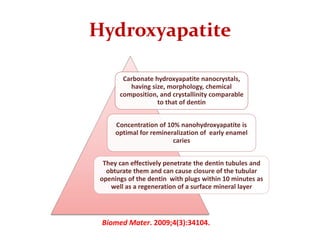
Hydroxyapatite
Carbonate hydroxyapatite nanocrystals,
having size, morphology, chemical
composition, and crystallinity comparable
to that of dentin
Concentration of 10% nanohydroxyapatite is
optimal for remineralization of early enamel
caries
They can effectively penetrate the dentin tubules and
obturate them and can cause closure of the tubular
openings of the dentin with plugs within 10 minutes as
well as a regeneration of a surface mineral layer
Biomed Mater. 2009;4(3):34104.
Dispensing methods
Commonly used vehicles are dentifrices, pit-
and-fissure sealants, chewing gums, rinses and
restorative materials
Dentifrices
One of the most
practical methods
for delivering
remineralizing
agents.
Burwell and Muscle
found that CPP-
ACP provided
sustained condition
for
remineralization
when used in a
dentifrice
J Contemp Dent Pract. 2007;8(7):1-10.]
Dentrifices
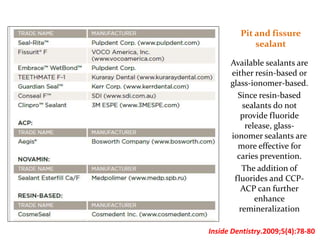
Pit and fissure
sealant
Available sealants are
either resin-based or
glass-ionomer-based.
Since resin-based
sealants do not
provide fluoride
release, glass-
ionomer sealants are
more effective for
caries prevention.
The addition of
fluorides and CCP-
ACP can further
enhance
remineralization
Inside Dentistry.2009;5(4):78-80
Pastes Rinses
and Dental
Floss
 .
Pastes used for
remineralization contain
calcium- and phosphate
realeasing components (eg,
CCP-ACP) with or without
fluoride.
Commercial pastes
containing CPP are
designed for professional
application as well as
professionally supervised
home application.
They can be applied via
prophy cup, custom tray,
toothbrush,
or fingertip.
J Dent Hyg. 2008;82(2):19].
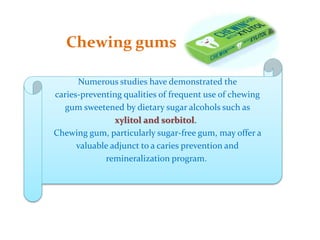
Chewing gums
Numerous studies have demonstrated the
caries-preventing qualities of frequent use of chewing
gum sweetened by dietary sugar alcohols such as
xylitol and sorbitol.
Chewing gum, particularly sugar-free gum, may offer a
valuable adjunct to a caries prevention and
remineralization program.
Chewing gums
In a trial, Manton et al showed that a sugar-free gum containing xylitol produces
superior remineralization.
[Int J Paediatr Dent. 2008;18(4):284-290.]
Sorbitol is another sugar substitute that is used as an artificial sweetener.
Isomalt is a noncariogenic sweetener that is widely used as a sugar
substitute. Adding isomalt to a demineralizing solution has shown to
significantly reduce tooth mineral loss.
[Clin Oral Investig. 2008;12(2):173-177.]
Restorative materials
Glass Ionomers
Compomers
Giomers
Glass ionomers
Glass ionomer cement is a water based material that
hardens following an acid base reaction between basic
fluoroaluminosilicate glass and an aqueous solution of
polyacids.
Salivary fluoride concentration is found to remain elevated for up
to 1 year after placement of GIC restorations (0.3 ppm after
placement and 0.04 ppm 1 year later)
Certain studies reported a “burst” of fluoride release, with
high early release for 1 to 2 days, followed by a rapid decline
The fluoride release must be maintained to about 2 to 3
Îźg/mL/day for effective remineralization, and this can be
achieved by fluoride recharge
Am J. Dent, 13,2000, 201-204
Compomers
Compomers
contain polyacid-
modified
monomers with
fluoride-releasing
silicate glasses and
are formulated
without water.
Used for
restorations in low
stress-bearing areas
and
for patients at
medium risk of
developing caries,
or when using
the sandwich
technique
Release fluoride by
a mechanism
similar to that of
glass and hybrid
ionomers but the
amount of fluoride
release and
its duration are less
than those of glass
and hybrid
ionomers.
J Can Dent Assoc. 1999;65(9):500-504.
Giomers
Anhydrous resin-based restoratives that utilizes prereacted glass
ionomer technology (PRG).Incorporate fillers that are produced
from the complete or partial reaction of ion-leachable glasses with
polyalkenoic acid
E.g. Beautifil (Shofu); Reactmer paste (Shofu).
• J Am Dent Assoc. 2007;138(5):621-627.
While giomer released fluoride, it did not have an initial “burst”
type of release like glass ionomers. Their long term release of
fluoride is lower than that of the other materials.
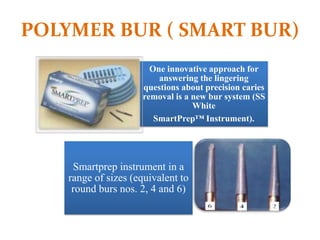
POLYMER BUR ( SMART BUR)
One innovative approach for
answering the lingering
questions about precision caries
removal is a new bur system (SS
White
SmartPrep™ Instrument).
Smartprep instrument in a
range of sizes (equivalent to
round burs nos. 2, 4 and 6)
The Smartprep Instrument is used in a slow speed
handpiece (500-800 rpm) to complete caries
removal.
Are single-patient-use rotary instruments.
Carious tissue is removed with circular movements
starting from the center to the periphery
DISADVANTAGES of POLYMER BUR or SMART BUR
Polymer bur left large amount of decayed tissue unexcavated
(underprepation)
Technique sensitive (the Smart Prep can be readily defeated by the
dumb operator).
The burs disintegrate when they touch enamel or even sound dentin
Potentially expensive.
With the progress in understanding
the caries process, the MI Concept
has evolved as a proposal for
dentistry in the 21st century.
.

Remineralization

  • 1.
  • 2.
  • 3.
    Introduction Minimal Intervention Dentistrydescribes contemporary ultraconservative operative management of cavitated lesions requiring surgical intervention. It does not mean unduly early operative intervention of incipient lesions, which in most cases is unnecessary as more effective and appropriate non-invasive preventive approaches exist.
  • 4.
    ATRAUMATIC RESTORATIVE TECHNIQUE(ART) ARTis an innovative, largely painfree, minimal intervention approach for treating caries teeth, particularly in countries where highly trained dental personnel and the electricity needed for clinical equipment are not readily available or affordable The Atraumatic restorative treatment is a procedure based on removing carious tooth tissues using hand instruments alone and restoring the cavity with an adhesive restorative material. Developed in Tanzania in the mid- 1980s.ART is launched by the World Health Organization on 7th April, 1994 (world health day).
  • 5.
    Principles of ART Removingcarious tooth tissues using hand instruments only Restoring the cavity with a restorative material that sticks to the tooth.
  • 6.
    Use of GICin ART Properties such as fluoride release, chemical bonding to the tooth structure, biocompatibility and applicability in clinical situations, make them the most appropriate materials for the ART approach. Data suggest excellent results at a 1-year evaluation of ART restorations, where a survival rate of 93% was found for one-surface fillings. Evaluation after 2 and 3 years have been shown success rates of 89% and 85%. Med Principles Pract 2002;11(suppl 1):44–47
  • 7.
    According to astudy comparing the antibacterial activity of four glass ionomer cements used in ART Fuji IX demonstrate the greatest inhibitory activity for Streptococcus mutans while Ketac Molar and Fuji IX are statistically effective against Streptococcus sobrinus and Lactobacillus acidophilus. Ketac molar also has greatest inhibiting halo against Actinomyces viscosus • High strength conventional GIC Fuji IX and Ketac Molar present high P/L ratios that improve their mechanical properties for restorations in posterior teeth making these materials specially marked for ART J Mater Sci: Mater Med (2007) 18:1859– 1862
  • 8.
    It was demonstratedthat experimental GICs containing CHX are effective in inhibiting bacteria associated with caries, and incorporation of 1% CHX diacetate is optimal to give appropriate physical and bonding properties. RMGI exhibit better clinical performance than GIC in ART, except for marginal discoloration. RMGI can be an alternative material to the GIC. Med Princ Pract 2005;14:277–280 Dental Materials (2006) 22, 647–652
  • 9.
    Composites The effective bondingof resin to enamel is a key factor in the selection of this material in MID In mechanical sense, the heavily filled resin-based composites with smaller filler particles can compete more or less with dental amalgam. Greatest features are their aesthetics and presumed ease of application.
  • 10.
    10 Main limitations are Micro-leakage,polymerization shrinkage and strength
  • 11.
    • Although no‘magic bullet’ to solve all problems related to dental caries ART is a combined preventive and curative oral care procedure which must be administered along with health promoting messages about a prudent diet , good oral hygiene, use of fluoride toothpaste and sealant application.
  • 12.
    REMINERALIZATION Remineralization is definedas the process whereby calcium and phosphate ions are supplied from a source external to the tooth to promote ion deposition into crystal voids in demineralized enamel to produce net mineral gain Remineralization of dental lesions requires the presence of partially demineralized crystals that can grow to their original size when they are exposed to fluid that is supersaturated with respect to hydroxyapatite minerals. • Cochrane NJ, CaiF, Huq NL, Burrow MF, Reynolds EC. New approach to enhance remineralization of tooth enamel. J Dent Res 2010;89:1187-97.]
  • 13.
    Dynamic process ofdemineralization and remineralization The oral cavity is a battle field of activities of demineralisation and remineralization. The ratio between two process is crucial in determining the hardness and strength of the tooth structure.
  • 15.
  • 16.
  • 17.
    Requirements for remineralizationprocess….. In fact, for remineralization to proceed, six conditions or events must occur at the same time. Sufficient mineral must be present in the saliva The carbonic acid molecule must be produced in proximity to a mineral molecule, which it then dissolves into its ionic components. The carbonic acid must convert to carbon dioxide and water before any of the above circumstances change! That spot of the tooth has to be clean, so that the mineral-deficient spot is accessible. A molecule of carbonic acid must be produced This all has to occur in proximity to a demineralized spot in the hydroxyapatite latticework that requires that exact mineral ion. Int J Dent Case Reports 2011; 1(2): 73-84
  • 18.
  • 19.
    Requirements of anideal remineralization material Diffuses into the subsurface or delivers calcium and phosphate into the subsurface Works at an acidic pH Does not deliver an excess of calcium Works in xerostomic patients Does not favour calculus formation Boosts the remineralizing properties of saliva. For novel materials, shows a benefit over fluoride
  • 20.
    FLUORIDES The prevention ofcaries in children is at the forefront of public health strategies Fluoride is a major player in the slowing, arrest and even reversal of dental caries progression.
  • 21.
    Mechanism by whichfluoride increases caries resistance Increased enamel resistance , rate of maturation, surface energy Remineralization of incipient lesions Interference with microorganisms & Improved tooth morphology Int J Dent Case Reports 2011; 1(2): 73-84
  • 22.
    Fluoride : Gatewayto oral cavity Personal applications (eg, dentifrices, rinses) Professional applications (eg, varnishes, foams, gels, fluoride releasing restorative materials Fluoride levels of about 3 parts per million (ppm) in the enamel are required to shift the balance from net demineralization to net remineralization
  • 23.
  • 24.
    Reasons to seekalternatives to fluorides Fluoride is highly effective on smooth-surface caries; its effect would seem to be more limited on pit and fissure caries Although fluoride presents no problems when used properly, among certain parts of the world, there has been the suggestion that fluoride exposure should be limited A high-fluoride strategy cannot be followed to avoid the potential for adverse effects (e.g., fluorosis) due to overexposure to fluoride
  • 25.
    Newer Technologies forEnamel Remineralizing Systems Crystalline Calcium Phosphate Remineralizing Systems Unstabilized Amorphous Calcium Phosphate Systems Stabilized Amorphous Calcium Phosphate Systems Calcium-phosphate-based delivery systems containing high concentrations of calcium phosphate have been developed.
  • 26.
    Crystalline Calcium Phosphate RemineralizingSystems Calcium phosphate can exist in one of numerous crystalline phases Problem :poor solubility of the calcium phosphate phases, such that the calcium and phosphate ions are unavailable for remineralization These crystalline calcium phosphate phases must be released from the product on contact with saliva and then dissolve in that fluid to liberate ions capable of diffusing into the enamel subsurface lesion.
  • 27.
    Unstabilized Amorphous CalciumPhosphate Systems a calcium salt (e.g., calcium sulphate) and a phosphate salt (e.g. potassium phosphate) are delivered separately intra-orally or delivered in a product with a low water activity. As the salts mix with saliva, they dissolve, releasing calcium and phosphate ions. The mixing of calcium ions with phosphate ions to produce an ion activity product for amorphous calcium phosphate that exceeds its solubility product results in the immediate precipitation of ACP or, in the presence of fluoride ions, ACFP.
  • 28.
    Stabilized Amorphous CalciumPhosphate Systems A biomimetic remineralization system Biological fluids containing high concentrations of calcium and phosphate ions contain inhibitory ions such as pyrophosphate and proteins to ensure stabilization. These stabilizing proteins include the caseins in milk and statherin in saliva.
  • 29.
    Casein phosphopeptide amorphous calciumphosphate Technology (CPP-ACP). Uses casein phosphopeptides (CPP) to stabilise calcium and phosphate (and fluoride) ions at high concentrations as Amorphous nanocomplexes designated CPP amorphous calcium phosphate. Proposed mechanism: localisation and supply of calcium, phosphate and fluoride ions in the correct molar ratio at the tooth surface by the CPP to drive diffusion of the ions into the subsurface enamel. prevents their spontaneous transformation at the enamel surface. The increase in the concentration of the ions in the lesion fluid results in the formation of hydroxyapatite or fluorapatite via crystal growth. Caries Res 2008;42:88–97
  • 30.
    30 Recaldent - Dentalchewing gum containing CPP-ACP. GC TOOTH MOUSSE - Dentifrice containing CPP-ACP.
  • 31.
    EnamelonTM technology -Based on unstabilized ACP, where a calcium salt (e.g., calcium sulphate) and a phosphate salt (e.g., ammonium phosphate) are delivered separately intraorally. NovaMinTM technology - Based on Calcium Sodium Phosphosilicate Bioactive glass which is claimed to release calcium and phosphate ions intra-orally to help the self-repair process of teeth. Australian Dental Journal 2008; 53: 268–273
  • 32.
    Clinpro Tooth CrèmeTM commerciallyavailable organically modified tricalcium phosphate which can coexist with fluoride in aqueous environment During brushing, this toothpaste contacts saliva and thereby calcium, phosphate and fluoride ions become readily available to tooth thus preventing demineralization International Journal of Pharm. Tech Research. 6(2), Apr-Jun 2014,487-493. ]
  • 33.
    Anticay: calcium sucrosephosphate Mixture of calcium sucrose mono and diphosphate, disucrose monophosphate, Inorganic calcium phosphate (11% w/w calcium and 7.6% w/w inorganic phosphate) Products formulated with active ingredient Anticay: prevention of sensitivity; reduction in bleeding and gingivitis, whitening and erosion. enhancement of remineralization Chinese journal of dental research ,vol 17,no.1,2014
  • 34.
    Hydroxyapatite Carbonate hydroxyapatite nanocrystals, havingsize, morphology, chemical composition, and crystallinity comparable to that of dentin Concentration of 10% nanohydroxyapatite is optimal for remineralization of early enamel caries They can effectively penetrate the dentin tubules and obturate them and can cause closure of the tubular openings of the dentin with plugs within 10 minutes as well as a regeneration of a surface mineral layer Biomed Mater. 2009;4(3):34104.
  • 35.
    Dispensing methods Commonly usedvehicles are dentifrices, pit- and-fissure sealants, chewing gums, rinses and restorative materials
  • 36.
    Dentifrices One of themost practical methods for delivering remineralizing agents. Burwell and Muscle found that CPP- ACP provided sustained condition for remineralization when used in a dentifrice J Contemp Dent Pract. 2007;8(7):1-10.] Dentrifices
  • 37.
    Pit and fissure sealant Availablesealants are either resin-based or glass-ionomer-based. Since resin-based sealants do not provide fluoride release, glass- ionomer sealants are more effective for caries prevention. The addition of fluorides and CCP- ACP can further enhance remineralization Inside Dentistry.2009;5(4):78-80
  • 38.
    Pastes Rinses and Dental Floss . Pastes used for remineralization contain calcium- and phosphate realeasing components (eg, CCP-ACP) with or without fluoride. Commercial pastes containing CPP are designed for professional application as well as professionally supervised home application. They can be applied via prophy cup, custom tray, toothbrush, or fingertip. J Dent Hyg. 2008;82(2):19].
  • 39.
    Chewing gums Numerous studieshave demonstrated the caries-preventing qualities of frequent use of chewing gum sweetened by dietary sugar alcohols such as xylitol and sorbitol. Chewing gum, particularly sugar-free gum, may offer a valuable adjunct to a caries prevention and remineralization program. Chewing gums
  • 40.
    In a trial,Manton et al showed that a sugar-free gum containing xylitol produces superior remineralization. [Int J Paediatr Dent. 2008;18(4):284-290.] Sorbitol is another sugar substitute that is used as an artificial sweetener. Isomalt is a noncariogenic sweetener that is widely used as a sugar substitute. Adding isomalt to a demineralizing solution has shown to significantly reduce tooth mineral loss. [Clin Oral Investig. 2008;12(2):173-177.]
  • 41.
  • 42.
    Glass ionomers Glass ionomercement is a water based material that hardens following an acid base reaction between basic fluoroaluminosilicate glass and an aqueous solution of polyacids. Salivary fluoride concentration is found to remain elevated for up to 1 year after placement of GIC restorations (0.3 ppm after placement and 0.04 ppm 1 year later)
  • 43.
    Certain studies reporteda “burst” of fluoride release, with high early release for 1 to 2 days, followed by a rapid decline The fluoride release must be maintained to about 2 to 3 μg/mL/day for effective remineralization, and this can be achieved by fluoride recharge Am J. Dent, 13,2000, 201-204
  • 44.
    Compomers Compomers contain polyacid- modified monomers with fluoride-releasing silicateglasses and are formulated without water. Used for restorations in low stress-bearing areas and for patients at medium risk of developing caries, or when using the sandwich technique Release fluoride by a mechanism similar to that of glass and hybrid ionomers but the amount of fluoride release and its duration are less than those of glass and hybrid ionomers. J Can Dent Assoc. 1999;65(9):500-504.
  • 45.
    Giomers Anhydrous resin-based restorativesthat utilizes prereacted glass ionomer technology (PRG).Incorporate fillers that are produced from the complete or partial reaction of ion-leachable glasses with polyalkenoic acid E.g. Beautifil (Shofu); Reactmer paste (Shofu). • J Am Dent Assoc. 2007;138(5):621-627. While giomer released fluoride, it did not have an initial “burst” type of release like glass ionomers. Their long term release of fluoride is lower than that of the other materials.
  • 46.
    POLYMER BUR (SMART BUR) One innovative approach for answering the lingering questions about precision caries removal is a new bur system (SS White SmartPrep™ Instrument). Smartprep instrument in a range of sizes (equivalent to round burs nos. 2, 4 and 6)
  • 47.
    The Smartprep Instrumentis used in a slow speed handpiece (500-800 rpm) to complete caries removal. Are single-patient-use rotary instruments. Carious tissue is removed with circular movements starting from the center to the periphery
  • 48.
    DISADVANTAGES of POLYMERBUR or SMART BUR Polymer bur left large amount of decayed tissue unexcavated (underprepation) Technique sensitive (the Smart Prep can be readily defeated by the dumb operator). The burs disintegrate when they touch enamel or even sound dentin Potentially expensive.
  • 49.
    With the progressin understanding the caries process, the MI Concept has evolved as a proposal for dentistry in the 21st century. .