Posterior CrossbitePosterior Crossbite
Dr.Hla Hla Yee
Posterior CrossbitePosterior Crossbite
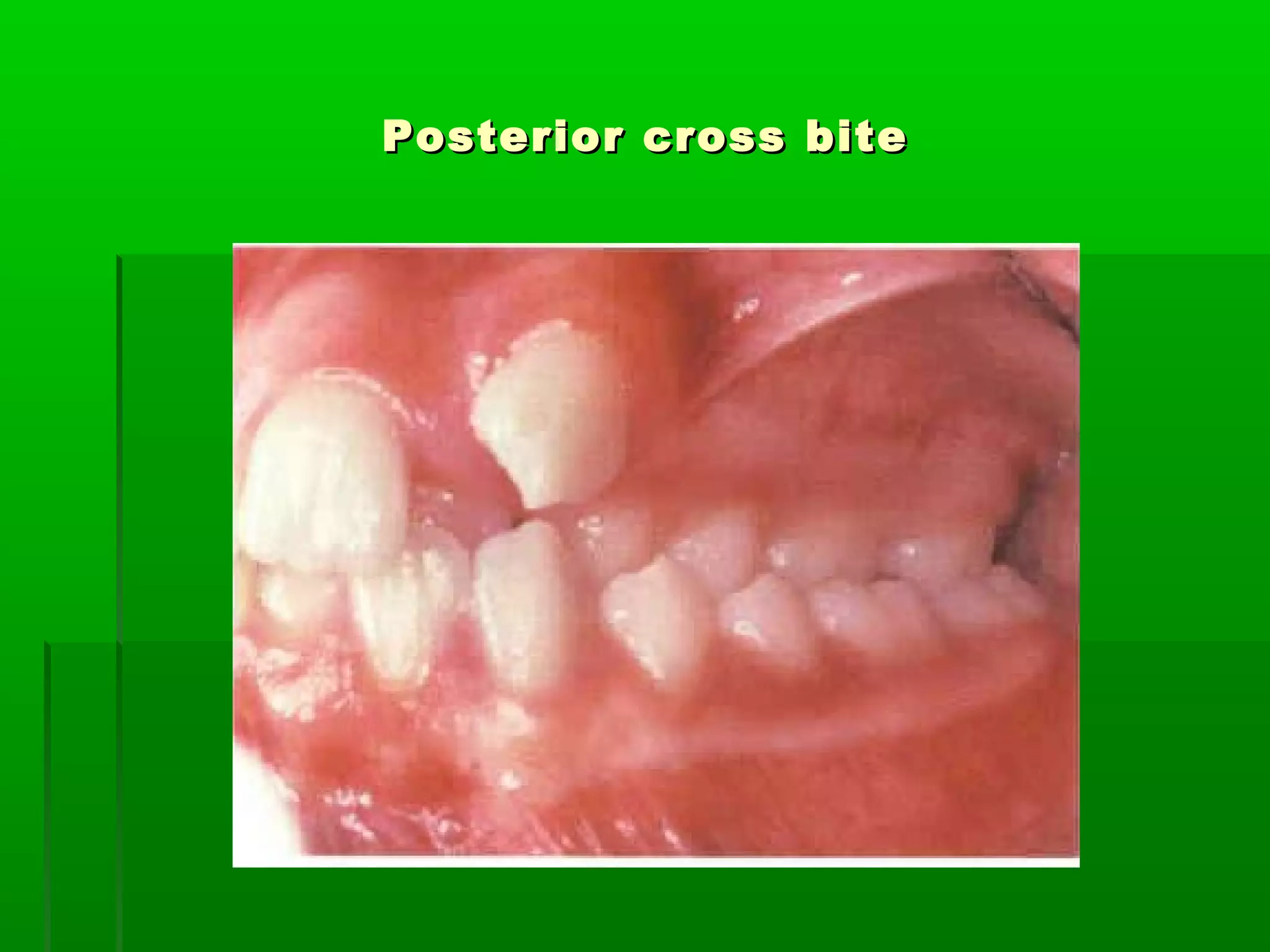
 Posterior crossbite reflects deviationsPosterior crossbite reflects deviations
from ideal occlusion in the transversefrom ideal occlusion in the transverse
plane of space.plane of space.
Posterior cross bitePosterior cross bite
CausesCauses
( I ) Skeletal crossbite( I ) Skeletal crossbite
 Narrow maxilla but occasionally from anNarrow maxilla but occasionally from an
excessively wide mandibleexcessively wide mandible
 Hemimandibular hypertrophyHemimandibular hypertrophy
 Surgical treated cleft lip and palate.Surgical treated cleft lip and palate.
Hemimandibular hypertrophyHemimandibular hypertrophy
- Excessive growth of the mandible
on the right side.
- The dental occlusion shows an open
bite on the affected right side ,
reflecting the vertical component of
the excessive growth.
( II ) Dental crossbite( II ) Dental crossbite
 Premolar or molar erupted palatally orPremolar or molar erupted palatally or
buccallybuccally
 due to crowdingdue to crowding
 or early loss of deciduous second molar.or early loss of deciduous second molar.
( III ) Functional crossbite( III ) Functional crossbite
 mandible displaced laterally due to occlusalmandible displaced laterally due to occlusal
interference (premature contact )interference (premature contact )
 ( IV ) Habit( IV ) Habit
 eg. Thumb sucking habiteg. Thumb sucking habit
Types of posteriorTypes of posterior
crossbitecrossbite
 ( 1 ) Unilateral posterior crossbite( 1 ) Unilateral posterior crossbite
 unilateral crossbite in centric relation and maximumunilateral crossbite in centric relation and maximum
intercuspation without a mandibular shift.intercuspation without a mandibular shift.
 Caused by narrow maxillary arch combined with aCaused by narrow maxillary arch combined with a
functional shift.functional shift.
- On close examination usually is found as result from- On close examination usually is found as result from
bilateral constriction of maxillary arch and a shift of thebilateral constriction of maxillary arch and a shift of the
mandible to one side on closuremandible to one side on closure
 single tooth cross bitesingle tooth cross bite
 ( 2 ) Bilateral posterior crossbite( 2 ) Bilateral posterior crossbite
 more severe maxillary constriction maymore severe maxillary constriction may
result in a bilateral crossbite withoutresult in a bilateral crossbite without
mandibular shift.mandibular shift.
Bilateral posterior cross biteBilateral posterior cross bite
Differential diagnosis
- Differentiate skeletal from non skeletal.
Dental cross bite
Skeletal cross bite
- a patient with adequate palatal width
(i.e., distance AB approximately
equals distance CD),
- inadequate palatal width (i.e.,
distance CD is considerably larger
than distance AB).
TreatmentTreatment
 For skeletal posterior crossbite(Narrow Maxillary Arch)For skeletal posterior crossbite(Narrow Maxillary Arch)
 It is necessary to place force directly across the suture.It is necessary to place force directly across the suture.
 Transverse maxillary expansion ( by opening the midpalatalTransverse maxillary expansion ( by opening the midpalatal
suture )suture )
But heavy force and rapid expansion are not indicated inBut heavy force and rapid expansion are not indicated in
younger children ( Primary dentition and early mixed dentiton )younger children ( Primary dentition and early mixed dentiton )
There is significant risk of distortion of the nose.There is significant risk of distortion of the nose.
 Before age of 15 years – nearly 100% successBefore age of 15 years – nearly 100% success
Expansion on a skull , showing how the palateExpansion on a skull , showing how the palate
opens as if on a hinge at the base of the nose.opens as if on a hinge at the base of the nose.
Types of expansion applianceTypes of expansion appliance
 ( 1 ) removable appliance incorporate( 1 ) removable appliance incorporate
screw or wire springscrew or wire spring
 ( 2 ) Fixed appliance( 2 ) Fixed appliance
 bonded or banded screw appliancebonded or banded screw appliance
 ( 3 ) Adjustable Lingual arch such as( 3 ) Adjustable Lingual arch such as
 W – archW – arch
 Quadhelix applianceQuadhelix appliance
 ( 4 ) Myofunctional appliance( 4 ) Myofunctional appliance
 Buccal shieldsBuccal shields
To expand arch
with middle screw
Fixed appliance with screw F.A with screw incorporated
posterior bite plane
W - arch
For bimaxillary expansion
Activated by opening the
apices of the W ( opened 3 to
4 mm wider than the passive
width )
Intraoral appliance adjustment
is possible but may lead to
unexpected changes.
For this reason removal and
recementation are
recommended at each active
W - arch
Quadhelix appliance
To correct bilateral
maxillary constriction
Frankel - III
Buccal shields
 For rapid palatal expansionFor rapid palatal expansion, 0.5 mm or more per day, 0.5 mm or more per day
( Two turns daily )( Two turns daily )
- Produce 10-20 pounds of pressureProduce 10-20 pounds of pressure
- After expansion requires 3 months for retentionAfter expansion requires 3 months for retention
 For semirapid expansion,For semirapid expansion,0.250.25 mm per daymm per day
- (One turn daily)(One turn daily)
 For slow expansionFor slow expansion ,1mm per week expansion,1mm per week expansion
-- (One quarter turn twice a week)(One quarter turn twice a week)
 -- Produce 2 pounds of pressureProduce 2 pounds of pressure
Activation of screw applianceActivation of screw appliance
Rapid Palatal ExpansionRapid Palatal Expansion
 The expansion is carried out in approximately 2 weeksThe expansion is carried out in approximately 2 weeks
but the screw should be stabilized and the appliancesbut the screw should be stabilized and the appliances
maintained in place for 3-4 months of retension.maintained in place for 3-4 months of retension.
 Relapse can be expected because of the elasticity ofRelapse can be expected because of the elasticity of
the palatal soft tissue.the palatal soft tissue.
 Therefore it is wise to overcorrect the crossbite initially.Therefore it is wise to overcorrect the crossbite initially.
 For additional retention period, the fixed appliance canFor additional retention period, the fixed appliance can
be removed but a removable retainer that covers thebe removed but a removable retainer that covers the
palate and often need as further insurance againstpalate and often need as further insurance against
early relapse.early relapse.
Slow Palatal ExpansionSlow Palatal Expansion
 approximately 2approximately 211/2/2 months are needed to obtainmonths are needed to obtain
the expansion and the appliance can bethe expansion and the appliance can be
removed in another 2 months.removed in another 2 months.
 After 10 – 12 weeks approximately the sameAfter 10 – 12 weeks approximately the same
roughly equal amounts of skeletal & dentalroughly equal amounts of skeletal & dental
expansion are present that were seen as theexpansion are present that were seen as the
same time with rapid expansion.same time with rapid expansion.
Unilateral cross-bite left side with anUnilateral cross-bite left side with an
associated displacement of theassociated displacement of the
mandible to the leftmandible to the left
Corrected cross-bite by
screw appliance (note
correction of centre line )
( 2 ) Unilateral crossbite correction( 2 ) Unilateral crossbite correction
 ( a )for unilateral crossbite( a )for unilateral crossbite
 due to unilateral crossbite in centric relation anddue to unilateral crossbite in centric relation and
maximum intercuspation without a mandibular shift.maximum intercuspation without a mandibular shift.
 by usingby using
 unequal “ w “ arch or quad-helix.unequal “ w “ arch or quad-helix.
 cross-elastic to maxillary teeth and thecross-elastic to maxillary teeth and the
mandibular lingual arch uses to stabilize themandibular lingual arch uses to stabilize the
lower arch.lower arch.
 removable appliance that has been sectionedremovable appliance that has been sectioned
asymmetrically.asymmetrically.
removable applianceremovable appliance
that has been sectionedthat has been sectioned
asymmetrically.asymmetrically.
True unilateral maxillary posterior constriction.
A - Initial contact B – Full occlusion (no shift)
This problem is best treated with unilateral posterior expansion.
Unequal W arch appliance
To correct a true unilateral maxillary
constriction.
The appliances are constructed more
teeth in the anchorage unit than in the
unit where teeth are expected to move
But some bilateral expansion must be
expected
( b ) For dental crossbite( b ) For dental crossbite
 are treated by moving the teeth withare treated by moving the teeth with
lighter forces.lighter forces.
 Single tooth crossbite or true unilateral asymmetries ofSingle tooth crossbite or true unilateral asymmetries of
the dental arch are usually best corrected bythe dental arch are usually best corrected by cross-cross-
elastic.elastic.
( Elastic from the lingual of one arch to the buccal of( Elastic from the lingual of one arch to the buccal of
the other )the other )
OrOr
 Removable applianceRemovable appliance incorporate screw or wire springincorporate screw or wire spring
 T springT spring
 to move a molar, or premolar or canines buccallyto move a molar, or premolar or canines buccally
 Flap springFlap spring
 to move mandibular premolar or molar bucallyto move mandibular premolar or molar bucally
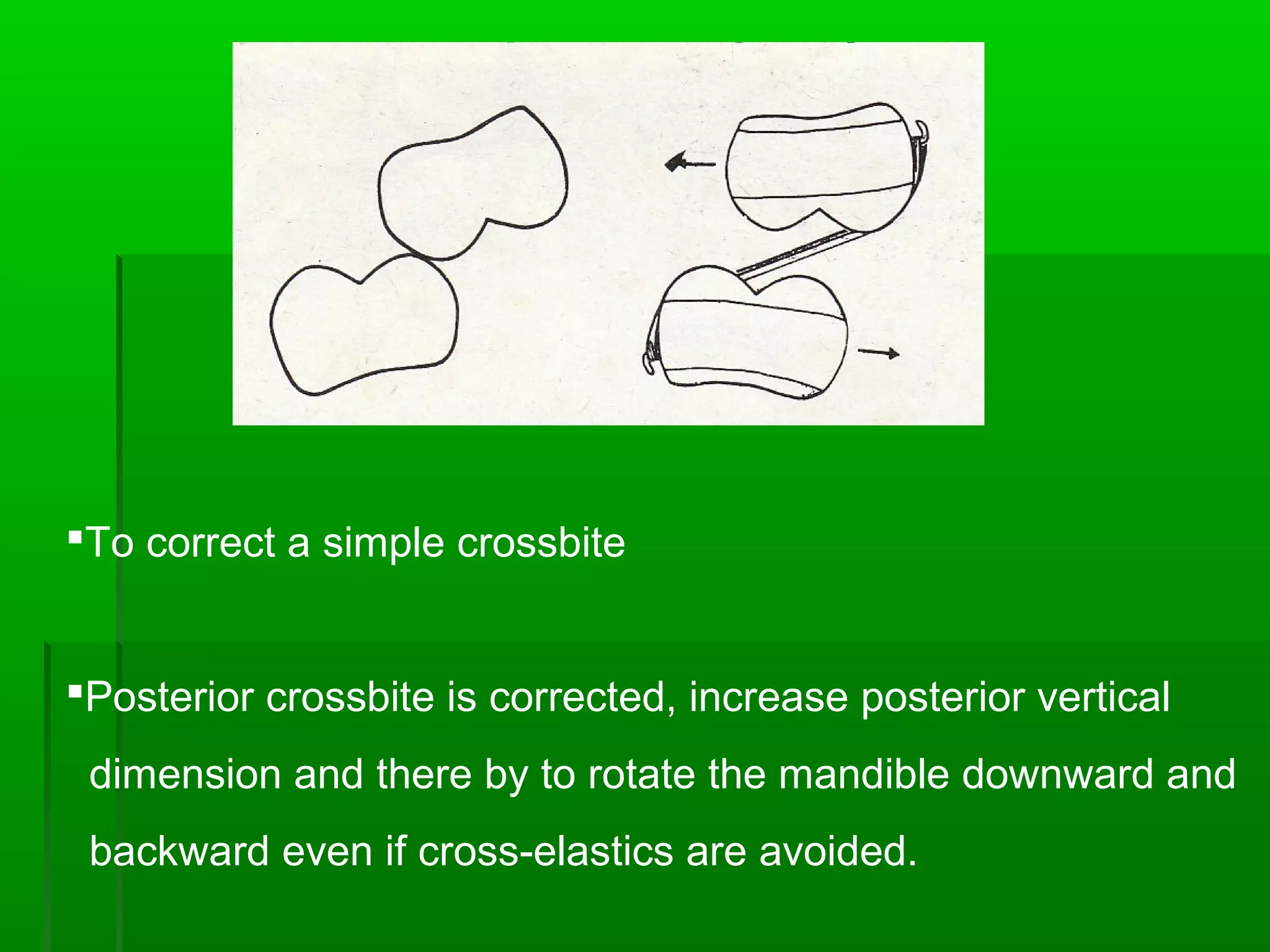
To correct a simple crossbite
Posterior crossbite is corrected, increase posterior vertical
dimension and there by to rotate the mandible downward and
backward even if cross-elastics are avoided.
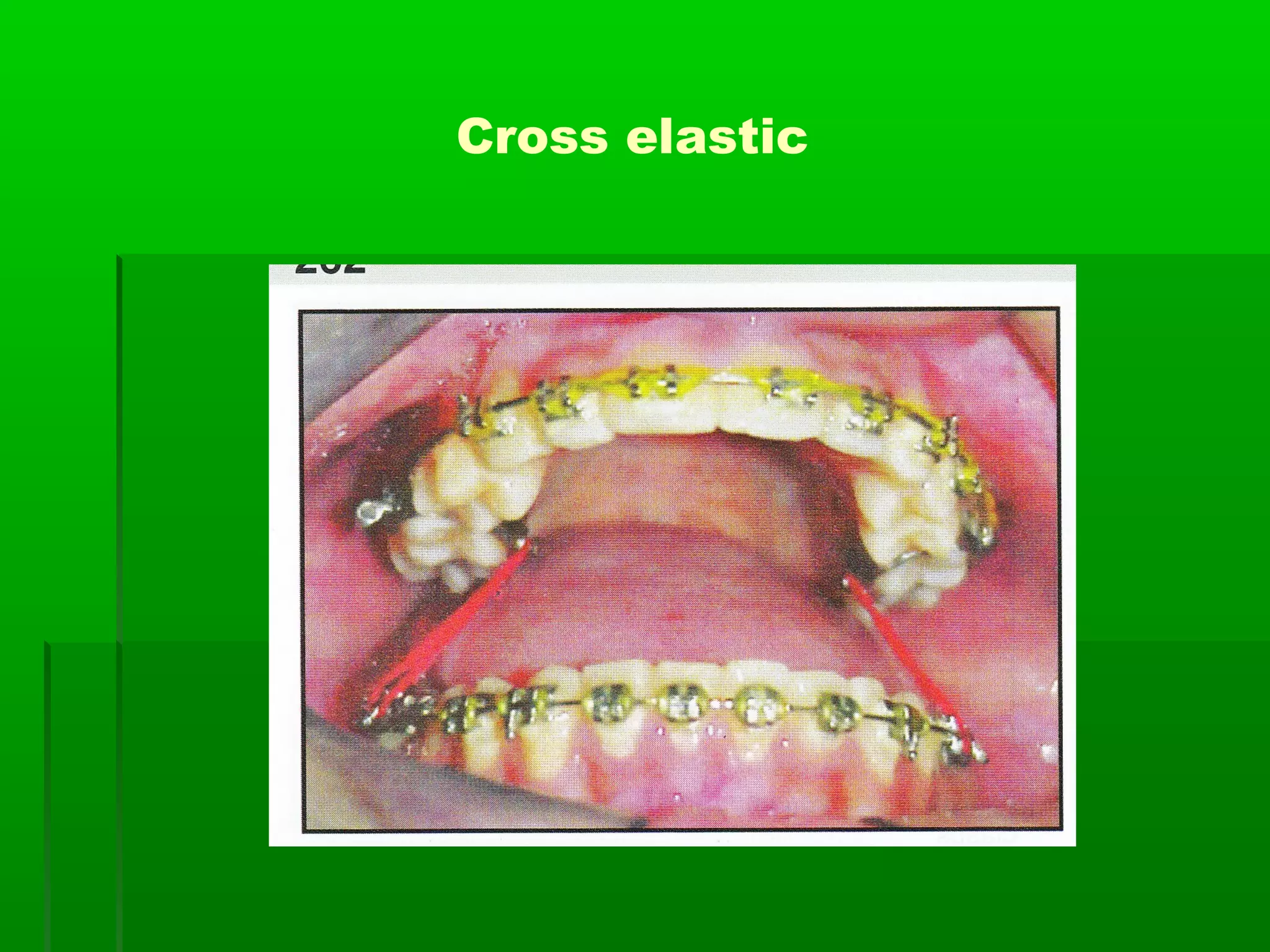
Cross elastic
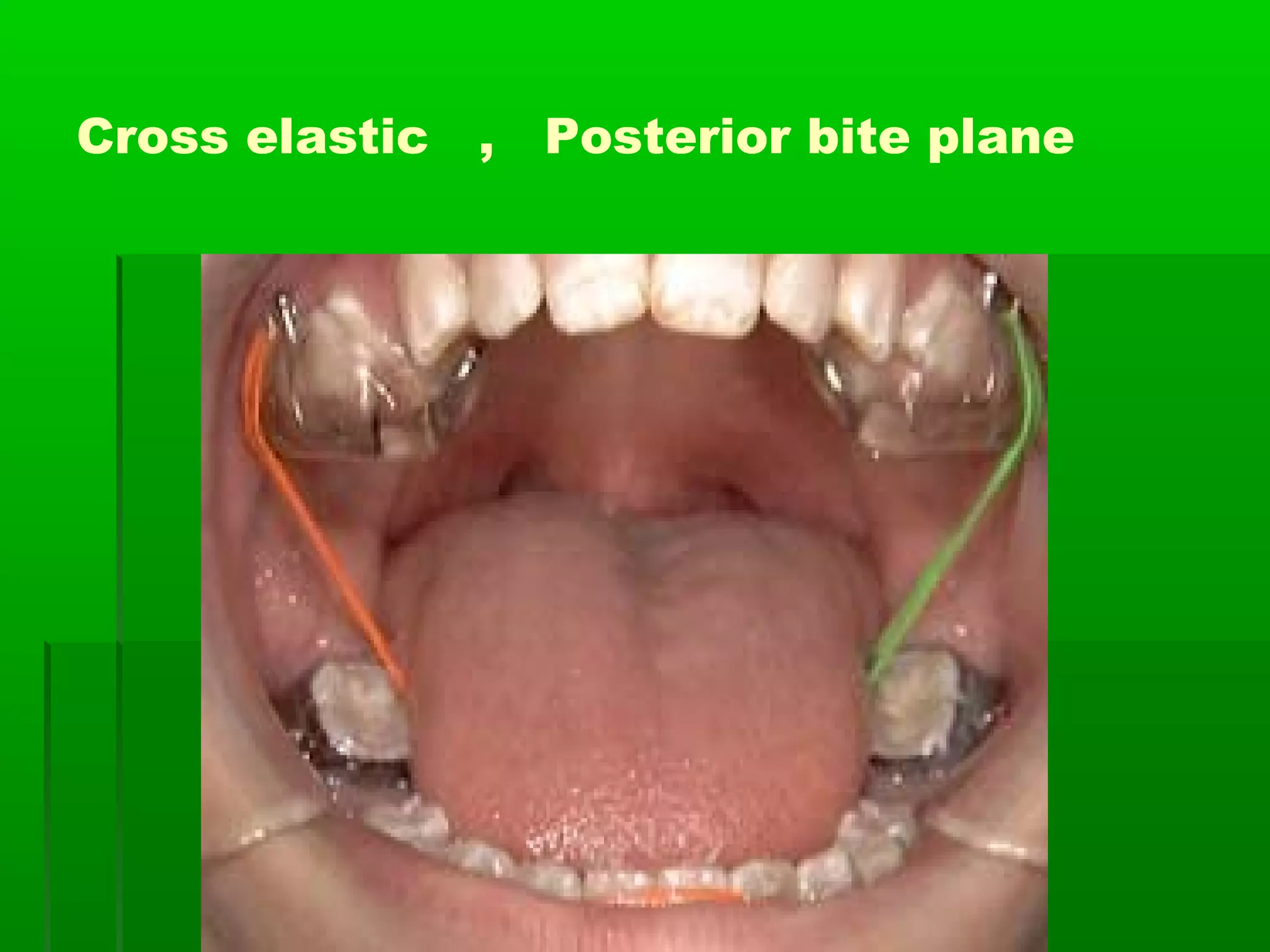
Cross elastic , Posterior bite plane
A, the permanenmt axillary left first molar displaced lingually and
the permanent mandibular left first molar displaced facially,
which resulted in a posterior crossbite between these teeth.
B , A short and relatively heavy cross-elastic is placed between the
buttons welded on the bands.
The elastic can be challenging for some children to place , but
should be worn full-time and changed frequently.
 To move a molar buccally
 ( also effective on premolars and
canines )
T – spring
Flap spring
To move mandibular premolar or
molar buccally
Removable plates and lingual arches produce slow expansion
Coffin Spring
( 3 ) For functional crossbite( 3 ) For functional crossbite
 Crossbite caused by a mandibular shift shouldCrossbite caused by a mandibular shift should
be treated as soon as that are discovered.be treated as soon as that are discovered.
 Equilibration to eliminate mandibular shiftEquilibration to eliminate mandibular shift
 Expansion of a constricted archExpansion of a constricted arch
 Repositioning of individual teeth to deal withRepositioning of individual teeth to deal with
intra arch asymmetriesintra arch asymmetries
( 4 ) For Habit( 4 ) For Habit
 Habit treatmentHabit treatment
 Treat the conditionTreat the condition
 Correcting posterior crossbites in the mixed dentition in
creases arch circumference and provides more room f or
the permanent teeth .
 On the average, a 1 mm increase in the inter-premolar
width increases arch perimeter values by 0. 7 mm.
 Total relapse into crossbite is unlikely in the absence of
a skeletal problem, and mixed dentition expansion
reduces the incidence of posterior crossbite in the
permanent dentition , so early correction also simplifies
future diagnosis and treatment by eliminating at least that
problem from the list .

Posterior Crossbite

  • 1.
  • 2.
    Posterior CrossbitePosterior Crossbite Posterior crossbite reflects deviationsPosterior crossbite reflects deviations from ideal occlusion in the transversefrom ideal occlusion in the transverse plane of space.plane of space.
  • 3.
  • 4.
  • 5.
    CausesCauses ( I )Skeletal crossbite( I ) Skeletal crossbite  Narrow maxilla but occasionally from anNarrow maxilla but occasionally from an excessively wide mandibleexcessively wide mandible  Hemimandibular hypertrophyHemimandibular hypertrophy  Surgical treated cleft lip and palate.Surgical treated cleft lip and palate.
  • 6.
    Hemimandibular hypertrophyHemimandibular hypertrophy -Excessive growth of the mandible on the right side. - The dental occlusion shows an open bite on the affected right side , reflecting the vertical component of the excessive growth.
  • 7.
    ( II )Dental crossbite( II ) Dental crossbite  Premolar or molar erupted palatally orPremolar or molar erupted palatally or buccallybuccally  due to crowdingdue to crowding  or early loss of deciduous second molar.or early loss of deciduous second molar.
  • 8.
    ( III )Functional crossbite( III ) Functional crossbite  mandible displaced laterally due to occlusalmandible displaced laterally due to occlusal interference (premature contact )interference (premature contact )
  • 9.
     ( IV) Habit( IV ) Habit  eg. Thumb sucking habiteg. Thumb sucking habit
  • 10.
    Types of posteriorTypesof posterior crossbitecrossbite  ( 1 ) Unilateral posterior crossbite( 1 ) Unilateral posterior crossbite  unilateral crossbite in centric relation and maximumunilateral crossbite in centric relation and maximum intercuspation without a mandibular shift.intercuspation without a mandibular shift.  Caused by narrow maxillary arch combined with aCaused by narrow maxillary arch combined with a functional shift.functional shift. - On close examination usually is found as result from- On close examination usually is found as result from bilateral constriction of maxillary arch and a shift of thebilateral constriction of maxillary arch and a shift of the mandible to one side on closuremandible to one side on closure  single tooth cross bitesingle tooth cross bite
  • 12.
     ( 2) Bilateral posterior crossbite( 2 ) Bilateral posterior crossbite  more severe maxillary constriction maymore severe maxillary constriction may result in a bilateral crossbite withoutresult in a bilateral crossbite without mandibular shift.mandibular shift.
  • 13.
    Bilateral posterior crossbiteBilateral posterior cross bite
  • 14.
    Differential diagnosis - Differentiateskeletal from non skeletal.
  • 15.
    Dental cross bite Skeletalcross bite - a patient with adequate palatal width (i.e., distance AB approximately equals distance CD), - inadequate palatal width (i.e., distance CD is considerably larger than distance AB).
  • 16.
    TreatmentTreatment  For skeletalposterior crossbite(Narrow Maxillary Arch)For skeletal posterior crossbite(Narrow Maxillary Arch)  It is necessary to place force directly across the suture.It is necessary to place force directly across the suture.  Transverse maxillary expansion ( by opening the midpalatalTransverse maxillary expansion ( by opening the midpalatal suture )suture ) But heavy force and rapid expansion are not indicated inBut heavy force and rapid expansion are not indicated in younger children ( Primary dentition and early mixed dentiton )younger children ( Primary dentition and early mixed dentiton ) There is significant risk of distortion of the nose.There is significant risk of distortion of the nose.  Before age of 15 years – nearly 100% successBefore age of 15 years – nearly 100% success
  • 17.
    Expansion on askull , showing how the palateExpansion on a skull , showing how the palate opens as if on a hinge at the base of the nose.opens as if on a hinge at the base of the nose.
  • 18.
    Types of expansionapplianceTypes of expansion appliance  ( 1 ) removable appliance incorporate( 1 ) removable appliance incorporate screw or wire springscrew or wire spring  ( 2 ) Fixed appliance( 2 ) Fixed appliance  bonded or banded screw appliancebonded or banded screw appliance  ( 3 ) Adjustable Lingual arch such as( 3 ) Adjustable Lingual arch such as  W – archW – arch  Quadhelix applianceQuadhelix appliance  ( 4 ) Myofunctional appliance( 4 ) Myofunctional appliance  Buccal shieldsBuccal shields
  • 19.
  • 20.
    Fixed appliance withscrew F.A with screw incorporated posterior bite plane
  • 22.
  • 23.
    For bimaxillary expansion Activatedby opening the apices of the W ( opened 3 to 4 mm wider than the passive width ) Intraoral appliance adjustment is possible but may lead to unexpected changes. For this reason removal and recementation are recommended at each active W - arch
  • 24.
    Quadhelix appliance To correctbilateral maxillary constriction
  • 27.
  • 28.
     For rapidpalatal expansionFor rapid palatal expansion, 0.5 mm or more per day, 0.5 mm or more per day ( Two turns daily )( Two turns daily ) - Produce 10-20 pounds of pressureProduce 10-20 pounds of pressure - After expansion requires 3 months for retentionAfter expansion requires 3 months for retention  For semirapid expansion,For semirapid expansion,0.250.25 mm per daymm per day - (One turn daily)(One turn daily)  For slow expansionFor slow expansion ,1mm per week expansion,1mm per week expansion -- (One quarter turn twice a week)(One quarter turn twice a week)  -- Produce 2 pounds of pressureProduce 2 pounds of pressure Activation of screw applianceActivation of screw appliance
  • 29.
    Rapid Palatal ExpansionRapidPalatal Expansion  The expansion is carried out in approximately 2 weeksThe expansion is carried out in approximately 2 weeks but the screw should be stabilized and the appliancesbut the screw should be stabilized and the appliances maintained in place for 3-4 months of retension.maintained in place for 3-4 months of retension.  Relapse can be expected because of the elasticity ofRelapse can be expected because of the elasticity of the palatal soft tissue.the palatal soft tissue.  Therefore it is wise to overcorrect the crossbite initially.Therefore it is wise to overcorrect the crossbite initially.  For additional retention period, the fixed appliance canFor additional retention period, the fixed appliance can be removed but a removable retainer that covers thebe removed but a removable retainer that covers the palate and often need as further insurance againstpalate and often need as further insurance against early relapse.early relapse.
  • 32.
    Slow Palatal ExpansionSlowPalatal Expansion  approximately 2approximately 211/2/2 months are needed to obtainmonths are needed to obtain the expansion and the appliance can bethe expansion and the appliance can be removed in another 2 months.removed in another 2 months.  After 10 – 12 weeks approximately the sameAfter 10 – 12 weeks approximately the same roughly equal amounts of skeletal & dentalroughly equal amounts of skeletal & dental expansion are present that were seen as theexpansion are present that were seen as the same time with rapid expansion.same time with rapid expansion.
  • 33.
    Unilateral cross-bite leftside with anUnilateral cross-bite left side with an associated displacement of theassociated displacement of the mandible to the leftmandible to the left Corrected cross-bite by screw appliance (note correction of centre line )
  • 34.
    ( 2 )Unilateral crossbite correction( 2 ) Unilateral crossbite correction  ( a )for unilateral crossbite( a )for unilateral crossbite  due to unilateral crossbite in centric relation anddue to unilateral crossbite in centric relation and maximum intercuspation without a mandibular shift.maximum intercuspation without a mandibular shift.  by usingby using  unequal “ w “ arch or quad-helix.unequal “ w “ arch or quad-helix.  cross-elastic to maxillary teeth and thecross-elastic to maxillary teeth and the mandibular lingual arch uses to stabilize themandibular lingual arch uses to stabilize the lower arch.lower arch.  removable appliance that has been sectionedremovable appliance that has been sectioned asymmetrically.asymmetrically.
  • 35.
    removable applianceremovable appliance thathas been sectionedthat has been sectioned asymmetrically.asymmetrically.
  • 36.
    True unilateral maxillaryposterior constriction. A - Initial contact B – Full occlusion (no shift) This problem is best treated with unilateral posterior expansion. Unequal W arch appliance To correct a true unilateral maxillary constriction. The appliances are constructed more teeth in the anchorage unit than in the unit where teeth are expected to move But some bilateral expansion must be expected
  • 37.
    ( b )For dental crossbite( b ) For dental crossbite  are treated by moving the teeth withare treated by moving the teeth with lighter forces.lighter forces.
  • 38.
     Single toothcrossbite or true unilateral asymmetries ofSingle tooth crossbite or true unilateral asymmetries of the dental arch are usually best corrected bythe dental arch are usually best corrected by cross-cross- elastic.elastic. ( Elastic from the lingual of one arch to the buccal of( Elastic from the lingual of one arch to the buccal of the other )the other ) OrOr  Removable applianceRemovable appliance incorporate screw or wire springincorporate screw or wire spring  T springT spring  to move a molar, or premolar or canines buccallyto move a molar, or premolar or canines buccally  Flap springFlap spring  to move mandibular premolar or molar bucallyto move mandibular premolar or molar bucally
  • 39.
    To correct asimple crossbite Posterior crossbite is corrected, increase posterior vertical dimension and there by to rotate the mandible downward and backward even if cross-elastics are avoided.
  • 40.
  • 41.
    Cross elastic ,Posterior bite plane
  • 42.
    A, the permanenmtaxillary left first molar displaced lingually and the permanent mandibular left first molar displaced facially, which resulted in a posterior crossbite between these teeth. B , A short and relatively heavy cross-elastic is placed between the buttons welded on the bands. The elastic can be challenging for some children to place , but should be worn full-time and changed frequently.
  • 43.
     To movea molar buccally  ( also effective on premolars and canines ) T – spring
  • 44.
    Flap spring To movemandibular premolar or molar buccally
  • 45.
    Removable plates andlingual arches produce slow expansion Coffin Spring
  • 46.
    ( 3 )For functional crossbite( 3 ) For functional crossbite  Crossbite caused by a mandibular shift shouldCrossbite caused by a mandibular shift should be treated as soon as that are discovered.be treated as soon as that are discovered.  Equilibration to eliminate mandibular shiftEquilibration to eliminate mandibular shift  Expansion of a constricted archExpansion of a constricted arch  Repositioning of individual teeth to deal withRepositioning of individual teeth to deal with intra arch asymmetriesintra arch asymmetries
  • 47.
    ( 4 )For Habit( 4 ) For Habit  Habit treatmentHabit treatment  Treat the conditionTreat the condition
  • 48.
     Correcting posteriorcrossbites in the mixed dentition in creases arch circumference and provides more room f or the permanent teeth .  On the average, a 1 mm increase in the inter-premolar width increases arch perimeter values by 0. 7 mm.  Total relapse into crossbite is unlikely in the absence of a skeletal problem, and mixed dentition expansion reduces the incidence of posterior crossbite in the permanent dentition , so early correction also simplifies future diagnosis and treatment by eliminating at least that problem from the list .