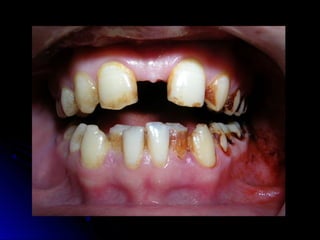
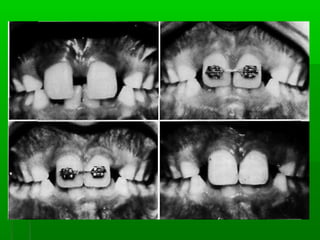

Maxillary Median DiastemaMaxillary Median Diastema
 Presence of space in between the twoPresence of space in between the two
maxillary incisors.maxillary incisors.
Dr.Hla Hla Yee
Midline diastemaMidline diastema
 Any spacing or gaps existing in the midlineAny spacing or gaps existing in the midline
of the dental arch.of the dental arch.
 EtilogyEtilogy
Deciduous dentition ( Physiological diastema )Deciduous dentition ( Physiological diastema )
Ugly duckling stage before the eruptionUgly duckling stage before the eruption
of the permanent caninesof the permanent canines
Abnormal frenal attachments ( High attachment ofAbnormal frenal attachments ( High attachment of
the maxillary labial frenum )the maxillary labial frenum )
Microdontia ( Peg-shaped lateral incisors )Microdontia ( Peg-shaped lateral incisors )
Presence of a mesiodensPresence of a mesiodens
 Etiology Cont’dEtiology Cont’d
Congenitally missing teethCongenitally missing teeth
Trauma leading to tooth loss in the incisor region.Trauma leading to tooth loss in the incisor region.
Extraction of teeth in large archExtraction of teeth in large arch
Abnormal pressure habitsAbnormal pressure habits
-tongue thrust, mouth breathing, digit sucking,-tongue thrust, mouth breathing, digit sucking,
etc.etc.
HereditaryHereditary
 Etiology Cont’dEtiology Cont’d
Racial predispositionRacial predisposition
 eg.Negroidseg.Negroids
Imperfect fusion at midline of premaxillaImperfect fusion at midline of premaxilla
DiagnosisDiagnosis
 Measure the teeth and compare theirMeasure the teeth and compare their
sizes with the averagesizes with the average
 Blenching TestBlenching Test
lift the upper lip and while it is displaced, looklift the upper lip and while it is displaced, look
for blanching of the soft tissue lingual to andfor blanching of the soft tissue lingual to and
between the central incisors.between the central incisors.
The presence of blenching points to aThe presence of blenching points to a
malposed labial frenum.malposed labial frenum.
 Radiographic examinationRadiographic examination
to check the no. of teethto check the no. of teeth
to detect the intrabony lesionto detect the intrabony lesion
to assess the frenum attachmentto assess the frenum attachment
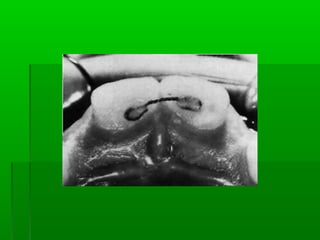
radiographically, there is a V shaped notch in theradiographically, there is a V shaped notch in the
interdental bone between 1 1 indicating theinterdental bone between 1 1 indicating the
attachment of frenum.attachment of frenum.
Major indicationsMajor indications
for correction of midline diastemafor correction of midline diastema
in the mixed dentition arein the mixed dentition are
 unaesthetic complaintunaesthetic complaint
 positioning of the central incisors thatpositioning of the central incisors that
inhibits eruption of the lateral incisors orinhibits eruption of the lateral incisors or
caninescanines
 TreatmentTreatment
 Before maxillary canine eruptedBefore maxillary canine erupted
If diastema 2mm or lessIf diastema 2mm or less
No treatment (close spontaneously )No treatment (close spontaneously )
A small but unaesthetic diastema ( 2mm orA small but unaesthetic diastema ( 2mm or
less ) can be closed by tipping the centalless ) can be closed by tipping the cental
incisors together.incisors together.
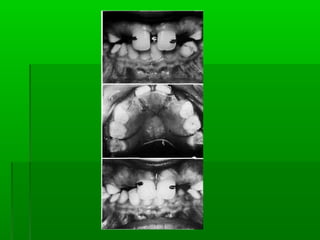
 If diastema > 2mm can be reduced byIf diastema > 2mm can be reduced by
tipping the central incisors together withtipping the central incisors together with
RA.( 0r ) Fixed appliance.RA.( 0r ) Fixed appliance.
 Bodily movement by FA.Bodily movement by FA.
 After maxillary canine eruptedAfter maxillary canine erupted
orthodontic close will requireorthodontic close will require
prolonged retention to prevent relapseprolonged retention to prevent relapse
Types of applianceTypes of appliance
 Removable appliance ( Hawley'sRemovable appliance ( Hawley's
appliance)appliance)
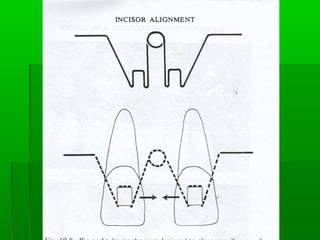
Incorporating two finger springs distal to theIncorporating two finger springs distal to the
central incisorscentral incisors
Labial bowLabial bow
Adam's clasp or “ C “ claspAdam's clasp or “ C “ clasp
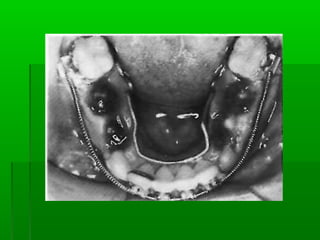
 Fixed orthodontic applianceFixed orthodontic appliance
 Initial alignment of the incisors with a flexible wire isInitial alignment of the incisors with a flexible wire is
required.required.
 Then a stiffer arch wire can be employed as the teethThen a stiffer arch wire can be employed as the teeth
slide together.slide together.
 The force to move the incisors together can beThe force to move the incisors together can be
provided by an elsastomeric chain tying these teethprovided by an elsastomeric chain tying these teeth
together or by a coil spring compressed over the archtogether or by a coil spring compressed over the arch
wire between the first molar and lateral incisors.wire between the first molar and lateral incisors.
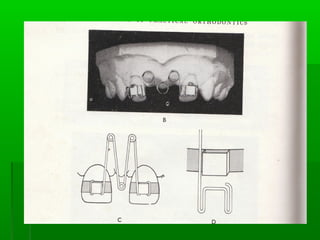
Appliance cont’dAppliance cont’d
 ““ M “ spring A simple appliance with fixedM “ spring A simple appliance with fixed
attachments on the labial or palatalattachments on the labial or palatal
surfaces of the central with a “ M “ or “ W “surfaces of the central with a “ M “ or “ W “
shaped springs can easily close midlineshaped springs can easily close midline
diastema.diastema.
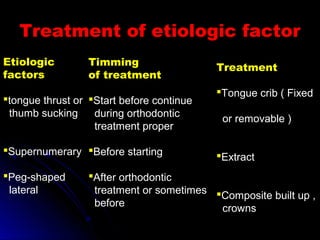
Treatment of etiologic factorTreatment of etiologic factor
Etiologic
factors
tongue thrust or
thumb sucking
Supernumerary
Peg-shaped
lateral
Timming
of treatment
Start before continue
during orthodontic
treatment proper
Before starting
After orthodontic
treatment or sometimes
before
Treatment
Tongue crib ( Fixed
or removable )
Extract
Composite built up ,
crowns
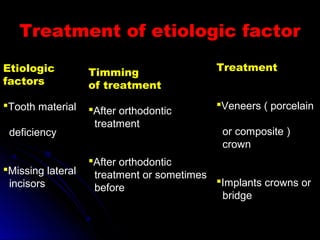
Treatment of etiologic factorTreatment of etiologic factor
Etiologic
factors
Tooth material
deficiency
Missing lateral
incisors
Timming
of treatment
After orthodontic
treatment
After orthodontic
treatment or sometimes
before
Treatment
Veneers ( porcelain
or composite )
crown
Implants crowns or
bridge
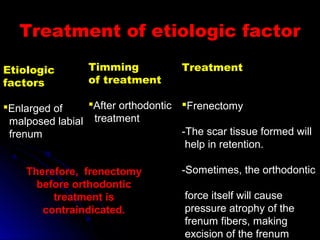
Treatment of etiologic factorTreatment of etiologic factor
Etiologic
factors
Enlarged of
malposed labial
frenum
Timming
of treatment
After orthodontic
treatment
Treatment
Frenectomy
-The scar tissue formed will
help in retention.
-Sometimes, the orthodontic
force itself will cause
pressure atrophy of the
frenum fibers, making
excision of the frenum
Therefore, frenectomy
before orthodontic
treatment is
contraindicated.
Generalized SpacingGeneralized Spacing
Causes and treatmentCauses and treatment
 (1)Small teeth in normal arches ( or )(1)Small teeth in normal arches ( or )
normal sized teeth in large arches.normal sized teeth in large arches.
 TreatmentTreatment
Due to small teethDue to small teeth
Jacket crown ( or ) Porcelain crownJacket crown ( or ) Porcelain crown
Build up with acid etch composite ( or )Build up with acid etch composite ( or )
Consolidation of the arch and the placement ofConsolidation of the arch and the placement of
bridgesbridges
Due to normal sized teeth and large archesDue to normal sized teeth and large arches
Try and talk patient into accepting their deastemaTry and talk patient into accepting their deastema
 (2)Large tongue ( Macroglossia )(2)Large tongue ( Macroglossia )
Diagnosis is made by careful examination ofDiagnosis is made by careful examination of
the tongue. The lateral edges of the tonguethe tongue. The lateral edges of the tongue
( when it is too large for the alveolar arch )( when it is too large for the alveolar arch )
usually display scalloping where the tongueusually display scalloping where the tongue
rests against the lingual surfaces of therests against the lingual surfaces of the
mandibular teeth.mandibular teeth.
 TreatmentTreatment
Is contraindicated unless gross malocclusionIs contraindicated unless gross malocclusion
is present, in which case wedge of tissue isis present, in which case wedge of tissue is
excised from the tongue.excised from the tongue.
 (3)Tongue thrusting habit.(3)Tongue thrusting habit.
 (4)Abnormal tongue posture(4)Abnormal tongue posture
May also cause generalized spacing.May also cause generalized spacing.
The prognosis is dependent on the reason forThe prognosis is dependent on the reason for
the atypical postural position.the atypical postural position.
Endogenous protracted postures are mostEndogenous protracted postures are most
intractable, while those associated withintractable, while those associated with
nasorespiratory dysfunction ( eg. Mouthnasorespiratory dysfunction ( eg. Mouth
breathing ) often are correctable when normalbreathing ) often are correctable when normal
respiratory function returns.respiratory function returns.
Maxillary median diastema

Maxillary median diastema

  • 1.
    Maxillary Median DiastemaMaxillaryMedian Diastema  Presence of space in between the twoPresence of space in between the two maxillary incisors.maxillary incisors. Dr.Hla Hla Yee
  • 3.
    Midline diastemaMidline diastema Any spacing or gaps existing in the midlineAny spacing or gaps existing in the midline of the dental arch.of the dental arch.
  • 4.
     EtilogyEtilogy Deciduous dentition( Physiological diastema )Deciduous dentition ( Physiological diastema ) Ugly duckling stage before the eruptionUgly duckling stage before the eruption of the permanent caninesof the permanent canines Abnormal frenal attachments ( High attachment ofAbnormal frenal attachments ( High attachment of the maxillary labial frenum )the maxillary labial frenum ) Microdontia ( Peg-shaped lateral incisors )Microdontia ( Peg-shaped lateral incisors ) Presence of a mesiodensPresence of a mesiodens
  • 5.
     Etiology Cont’dEtiologyCont’d Congenitally missing teethCongenitally missing teeth Trauma leading to tooth loss in the incisor region.Trauma leading to tooth loss in the incisor region. Extraction of teeth in large archExtraction of teeth in large arch Abnormal pressure habitsAbnormal pressure habits -tongue thrust, mouth breathing, digit sucking,-tongue thrust, mouth breathing, digit sucking, etc.etc. HereditaryHereditary
  • 6.
     Etiology Cont’dEtiologyCont’d Racial predispositionRacial predisposition  eg.Negroidseg.Negroids Imperfect fusion at midline of premaxillaImperfect fusion at midline of premaxilla
  • 7.
    DiagnosisDiagnosis  Measure theteeth and compare theirMeasure the teeth and compare their sizes with the averagesizes with the average  Blenching TestBlenching Test lift the upper lip and while it is displaced, looklift the upper lip and while it is displaced, look for blanching of the soft tissue lingual to andfor blanching of the soft tissue lingual to and between the central incisors.between the central incisors. The presence of blenching points to aThe presence of blenching points to a malposed labial frenum.malposed labial frenum.
  • 8.
     Radiographic examinationRadiographicexamination to check the no. of teethto check the no. of teeth to detect the intrabony lesionto detect the intrabony lesion to assess the frenum attachmentto assess the frenum attachment radiographically, there is a V shaped notch in theradiographically, there is a V shaped notch in the interdental bone between 1 1 indicating theinterdental bone between 1 1 indicating the attachment of frenum.attachment of frenum.
  • 9.
    Major indicationsMajor indications forcorrection of midline diastemafor correction of midline diastema in the mixed dentition arein the mixed dentition are  unaesthetic complaintunaesthetic complaint  positioning of the central incisors thatpositioning of the central incisors that inhibits eruption of the lateral incisors orinhibits eruption of the lateral incisors or caninescanines
  • 10.
     TreatmentTreatment  Beforemaxillary canine eruptedBefore maxillary canine erupted If diastema 2mm or lessIf diastema 2mm or less No treatment (close spontaneously )No treatment (close spontaneously ) A small but unaesthetic diastema ( 2mm orA small but unaesthetic diastema ( 2mm or less ) can be closed by tipping the centalless ) can be closed by tipping the cental incisors together.incisors together.
  • 11.
     If diastema> 2mm can be reduced byIf diastema > 2mm can be reduced by tipping the central incisors together withtipping the central incisors together with RA.( 0r ) Fixed appliance.RA.( 0r ) Fixed appliance.  Bodily movement by FA.Bodily movement by FA.
  • 14.
     After maxillarycanine eruptedAfter maxillary canine erupted orthodontic close will requireorthodontic close will require prolonged retention to prevent relapseprolonged retention to prevent relapse
  • 16.
    Types of applianceTypesof appliance  Removable appliance ( Hawley'sRemovable appliance ( Hawley's appliance)appliance) Incorporating two finger springs distal to theIncorporating two finger springs distal to the central incisorscentral incisors Labial bowLabial bow Adam's clasp or “ C “ claspAdam's clasp or “ C “ clasp
  • 17.
     Fixed orthodonticapplianceFixed orthodontic appliance  Initial alignment of the incisors with a flexible wire isInitial alignment of the incisors with a flexible wire is required.required.  Then a stiffer arch wire can be employed as the teethThen a stiffer arch wire can be employed as the teeth slide together.slide together.  The force to move the incisors together can beThe force to move the incisors together can be provided by an elsastomeric chain tying these teethprovided by an elsastomeric chain tying these teeth together or by a coil spring compressed over the archtogether or by a coil spring compressed over the arch wire between the first molar and lateral incisors.wire between the first molar and lateral incisors.
  • 19.
    Appliance cont’dAppliance cont’d ““ M “ spring A simple appliance with fixedM “ spring A simple appliance with fixed attachments on the labial or palatalattachments on the labial or palatal surfaces of the central with a “ M “ or “ W “surfaces of the central with a “ M “ or “ W “ shaped springs can easily close midlineshaped springs can easily close midline diastema.diastema.
  • 22.
    Treatment of etiologicfactorTreatment of etiologic factor Etiologic factors tongue thrust or thumb sucking Supernumerary Peg-shaped lateral Timming of treatment Start before continue during orthodontic treatment proper Before starting After orthodontic treatment or sometimes before Treatment Tongue crib ( Fixed or removable ) Extract Composite built up , crowns
  • 23.
    Treatment of etiologicfactorTreatment of etiologic factor Etiologic factors Tooth material deficiency Missing lateral incisors Timming of treatment After orthodontic treatment After orthodontic treatment or sometimes before Treatment Veneers ( porcelain or composite ) crown Implants crowns or bridge
  • 24.
    Treatment of etiologicfactorTreatment of etiologic factor Etiologic factors Enlarged of malposed labial frenum Timming of treatment After orthodontic treatment Treatment Frenectomy -The scar tissue formed will help in retention. -Sometimes, the orthodontic force itself will cause pressure atrophy of the frenum fibers, making excision of the frenum Therefore, frenectomy before orthodontic treatment is contraindicated.
  • 25.
  • 26.
    Causes and treatmentCausesand treatment  (1)Small teeth in normal arches ( or )(1)Small teeth in normal arches ( or ) normal sized teeth in large arches.normal sized teeth in large arches.  TreatmentTreatment Due to small teethDue to small teeth Jacket crown ( or ) Porcelain crownJacket crown ( or ) Porcelain crown Build up with acid etch composite ( or )Build up with acid etch composite ( or ) Consolidation of the arch and the placement ofConsolidation of the arch and the placement of bridgesbridges Due to normal sized teeth and large archesDue to normal sized teeth and large arches Try and talk patient into accepting their deastemaTry and talk patient into accepting their deastema
  • 27.
     (2)Large tongue( Macroglossia )(2)Large tongue ( Macroglossia ) Diagnosis is made by careful examination ofDiagnosis is made by careful examination of the tongue. The lateral edges of the tonguethe tongue. The lateral edges of the tongue ( when it is too large for the alveolar arch )( when it is too large for the alveolar arch ) usually display scalloping where the tongueusually display scalloping where the tongue rests against the lingual surfaces of therests against the lingual surfaces of the mandibular teeth.mandibular teeth.  TreatmentTreatment Is contraindicated unless gross malocclusionIs contraindicated unless gross malocclusion is present, in which case wedge of tissue isis present, in which case wedge of tissue is excised from the tongue.excised from the tongue.
  • 28.
     (3)Tongue thrustinghabit.(3)Tongue thrusting habit.  (4)Abnormal tongue posture(4)Abnormal tongue posture May also cause generalized spacing.May also cause generalized spacing. The prognosis is dependent on the reason forThe prognosis is dependent on the reason for the atypical postural position.the atypical postural position. Endogenous protracted postures are mostEndogenous protracted postures are most intractable, while those associated withintractable, while those associated with nasorespiratory dysfunction ( eg. Mouthnasorespiratory dysfunction ( eg. Mouth breathing ) often are correctable when normalbreathing ) often are correctable when normal respiratory function returns.respiratory function returns.