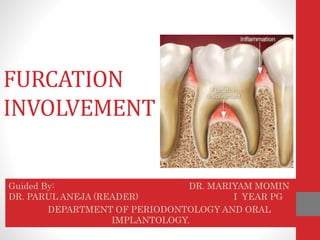
FURCATION
INVOLVEMENT
Guided By: DR. MARIYAM MOMIN
DR. PARUL ANEJA (READER) I YEAR PG
DEPARTMENT OF PERIODONTOLOGY AND ORAL
IMPLANTOLOGY.
CONTENTS
• Introduction
• Definitions
• Terminologies
• Classifications
• Etiology
• Clinical features
• Radiographic features
• Examination
• Diagnosis
• Prognosis
• Management
• References
INTRODUCTION
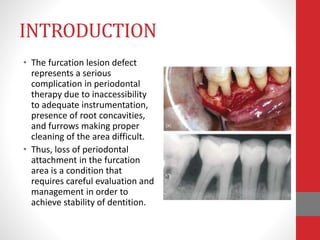
• The furcation lesion defect
represents a serious
complication in periodontal
therapy due to inaccessibility
to adequate instrumentation,
presence of root concavities,
and furrows making proper
cleaning of the area difficult.
• Thus, loss of periodontal
attachment in the furcation
area is a condition that
requires careful evaluation and
management in order to
achieve stability of dentition.
DEFINITIONS
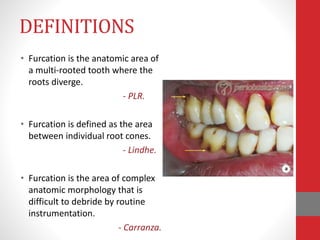
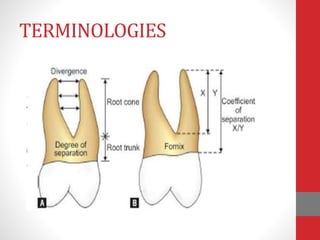
• Furcation is the anatomic area of
a multi-rooted tooth where the
roots diverge.
- PLR.
• Furcation is defined as the area
between individual root cones.
- Lindhe.
• Furcation is the area of complex
anatomic morphology that is
difficult to debride by routine
instrumentation.
- Carranza.
TERMINOLOGIES
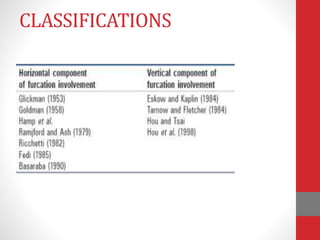
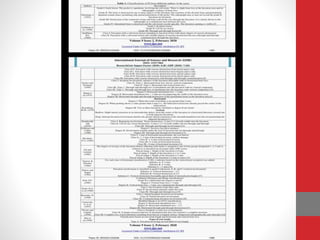
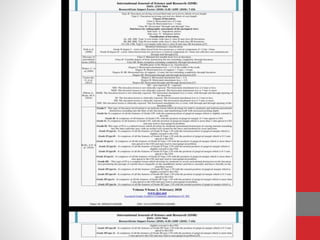
CLASSIFICATIONS
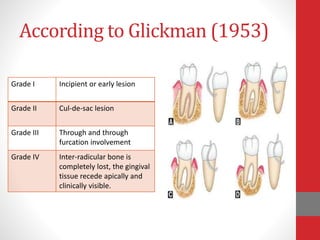
According to Glickman (1953)
Grade I Incipient or early lesion
Grade II Cul-de-sac lesion
Grade III Through and through
furcation involvement
Grade IV Inter-radicular bone is
completely lost, the gingival
tissue recede apically and
clinically visible.
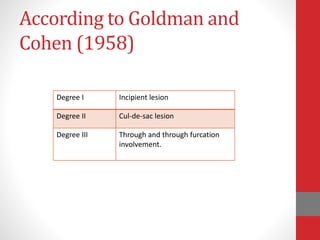
According to Goldman and
Cohen (1958)
Degree I Incipient lesion
Degree II Cul-de-sac lesion
Degree III Through and through furcation
involvement.
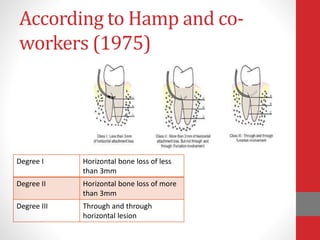
According to Hamp and co-
workers (1975)
Degree I Horizontal bone loss of less
than 3mm
Degree II Horizontal bone loss of more
than 3mm
Degree III Through and through
horizontal lesion
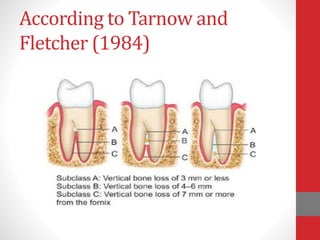
According to Tarnow and
Fletcher (1984)
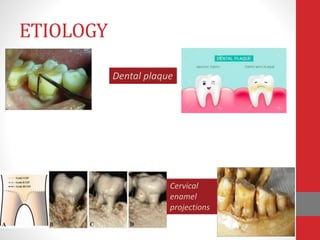
ETIOLOGY
Dental plaque
Cervical
enamel
projections
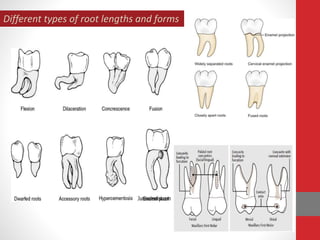
Different types of root lengths and forms
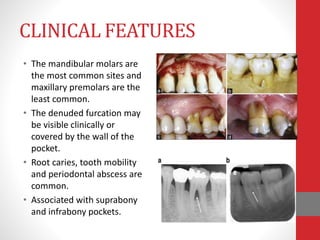
CLINICAL FEATURES
• The mandibular molars are
the most common sites and
maxillary premolars are the
least common.
• The denuded furcation may
be visible clinically or
covered by the wall of the
pocket.
• Root caries, tooth mobility
and periodontal abscess are
common.
• Associated with suprabony
and infrabony pockets.
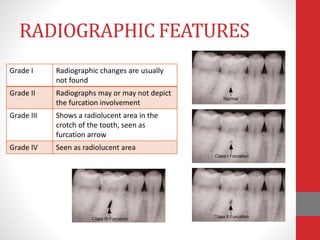
RADIOGRAPHIC FEATURES
Grade I Radiographic changes are usually
not found
Grade II Radiographs may or may not depict
the furcation involvement
Grade III Shows a radiolucent area in the
crotch of the tooth, seen as
furcation arrow
Grade IV Seen as radiolucent area
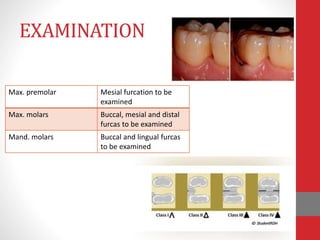
EXAMINATION
Max. premolar Mesial furcation to be
examined
Max. molars Buccal, mesial and distal
furcas to be examined
Mand. molars Buccal and lingual furcas
to be examined
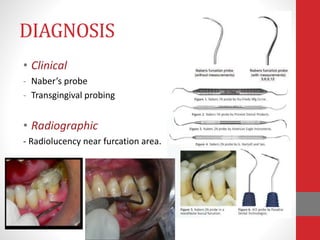
DIAGNOSIS
• Clinical
- Naber’s probe
- Transgingival probing
• Radiographic
- Radiolucency near furcation area.
PROGNOSIS
Furcation Prognosis
Grade I Good
Grade II Good-fair (initial furca)
Grade III Fair-poor
Grade IV Poor
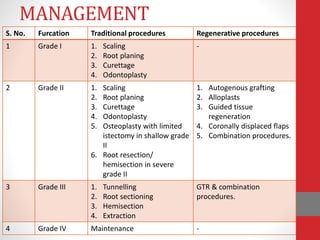
MANAGEMENT
S. No. Furcation Traditional procedures Regenerative procedures
1 Grade I 1. Scaling
2. Root planing
3. Curettage
4. Odontoplasty
-
2 Grade II 1. Scaling
2. Root planing
3. Curettage
4. Odontoplasty
5. Osteoplasty with limited
istectomy in shallow grade
II
6. Root resection/
hemisection in severe
grade II
1. Autogenous grafting
2. Alloplasts
3. Guided tissue
regeneration
4. Coronally displaced flaps
5. Combination procedures.
3 Grade III 1. Tunnelling
2. Root sectioning
3. Hemisection
4. Extraction
GTR & combination
procedures.
4 Grade IV Maintenance -
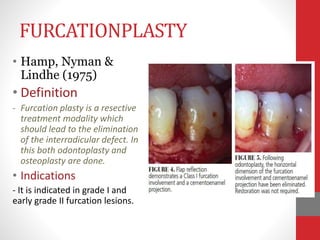
FURCATIONPLASTY
• Hamp, Nyman &
Lindhe (1975)
• Definition
- Furcation plasty is a resective
treatment modality which
should lead to the elimination
of the interradicular defect. In
this both odontoplasty and
osteoplasty are done.
• Indications
- It is indicated in grade I and
early grade II furcation lesions.
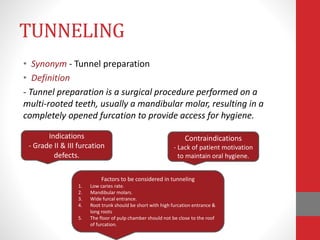
TUNNELING
• Synonym - Tunnel preparation
• Definition
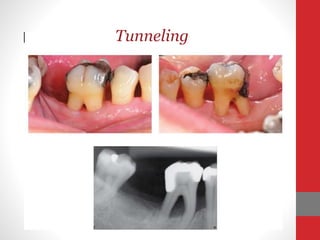
- Tunnel preparation is a surgical procedure performed on a
multi-rooted teeth, usually a mandibular molar, resulting in a
completely opened furcation to provide access for hygiene.
Indications
- Grade II & III furcation
defects.
Contraindications
- Lack of patient motivation
to maintain oral hygiene.
Factors to be considered in tunneling
1. Low caries rate.
2. Mandibular molars.
3. Wide furcal entrance.
4. Root trunk should be short with high furcation entrance &
long roots
5. The floor of pulp chamber should not be close to the roof
of furcation.
Tunneling
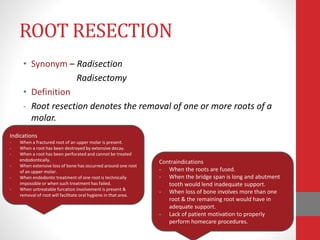
ROOT RESECTION
• Synonym – Radisection
Radisectomy
• Definition
- Root resection denotes the removal of one or more roots of a
molar.
Indications
- When a fractured root of an upper molar is present.
- When a root has been destroyed by extensive decay.
- When a root has been perforated and cannot be treated
endodontically.
- When extensive loss of bone has occurred around one root
of an upper molar.
- When endodontic treatment of one root is technically
impossible or when such treatment has failed.
- When untreatable furcation involvement is present &
removal of root will facilitate oral hygiene in that area.
Contraindications
- When the roots are fused.
- When the bridge span is long and abutment
tooth would lend inadequate support.
- When loss of bone involves more than one
root & the remaining root would have in
adequate support.
- Lack of patient motivation to properly
perform homecare procedures.
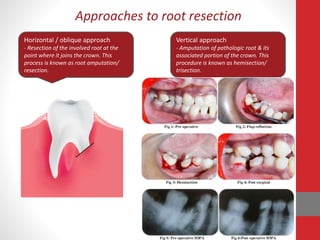
Horizontal / oblique approach
- Resection of the involved root at the
point where it joins the crown. This
process is known as root amputation/
resection.
Vertical approach
- Amputation of pathologic root & its
associated portion of the crown. This
procedure is known as hemisection/
trisection.
Approaches to root resection
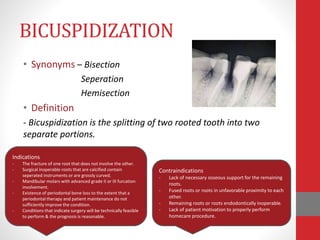
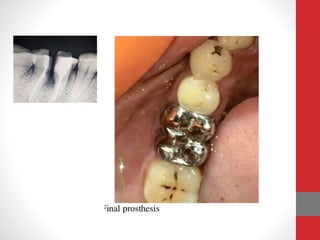
BICUSPIDIZATION
• Synonyms – Bisection
Seperation
Hemisection
• Definition
- Bicuspidization is the splitting of two rooted tooth into two
separate portions.
Indications
- The fracture of one root that does not involve the other.
- Surgical inoperable roots that are calcified contain
seperated instruments or are grossly curved.
- Mandibular molars with advanced grade II or III furcation
involvement.
- Existence of periodontal bone loss to the extent that a
periodontal therapy and patient maintenance do not
sufficiently improve the condition.
- Conditions that indicate surgery will be technically feasible
to perform & the prognosis is reasonable.
Contraindications
- Lack of necessary osseous support for the remaining
roots.
- Fused roots or roots in unfavorable proximity to each
other.
- Remaining roots or roots endodontically inoperable.
- Lack of patient motivation to properly perform
homecare procedure.
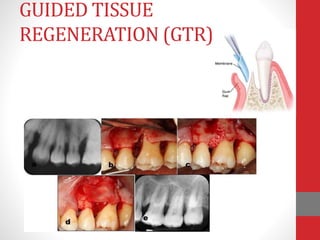
GUIDED TISSUE
REGENERATION (GTR)
References
• Newman & Carranza’s Clinical Periodontology-(13th edition)
• Textbook of Periodontics – (Shalu Bathla 2nd edition)
• Essentials of Periodontology – (Sahitya Reddy S)
Furcation involvement

Furcation involvement

  • 1.
    FURCATION INVOLVEMENT Guided By: DR.MARIYAM MOMIN DR. PARUL ANEJA (READER) I YEAR PG DEPARTMENT OF PERIODONTOLOGY AND ORAL IMPLANTOLOGY.
  • 2.
    CONTENTS • Introduction • Definitions •Terminologies • Classifications • Etiology • Clinical features • Radiographic features • Examination • Diagnosis • Prognosis • Management • References
  • 3.
    INTRODUCTION • The furcationlesion defect represents a serious complication in periodontal therapy due to inaccessibility to adequate instrumentation, presence of root concavities, and furrows making proper cleaning of the area difficult. • Thus, loss of periodontal attachment in the furcation area is a condition that requires careful evaluation and management in order to achieve stability of dentition.
  • 4.
    DEFINITIONS • Furcation isthe anatomic area of a multi-rooted tooth where the roots diverge. - PLR. • Furcation is defined as the area between individual root cones. - Lindhe. • Furcation is the area of complex anatomic morphology that is difficult to debride by routine instrumentation. - Carranza.
  • 5.
  • 6.
  • 9.
    According to Glickman(1953) Grade I Incipient or early lesion Grade II Cul-de-sac lesion Grade III Through and through furcation involvement Grade IV Inter-radicular bone is completely lost, the gingival tissue recede apically and clinically visible.
  • 10.
    According to Goldmanand Cohen (1958) Degree I Incipient lesion Degree II Cul-de-sac lesion Degree III Through and through furcation involvement.
  • 11.
    According to Hampand co- workers (1975) Degree I Horizontal bone loss of less than 3mm Degree II Horizontal bone loss of more than 3mm Degree III Through and through horizontal lesion
  • 12.
    According to Tarnowand Fletcher (1984)
  • 13.
  • 14.
    Different types ofroot lengths and forms
  • 15.
    CLINICAL FEATURES • Themandibular molars are the most common sites and maxillary premolars are the least common. • The denuded furcation may be visible clinically or covered by the wall of the pocket. • Root caries, tooth mobility and periodontal abscess are common. • Associated with suprabony and infrabony pockets.
  • 16.
    RADIOGRAPHIC FEATURES Grade IRadiographic changes are usually not found Grade II Radiographs may or may not depict the furcation involvement Grade III Shows a radiolucent area in the crotch of the tooth, seen as furcation arrow Grade IV Seen as radiolucent area
  • 17.
    EXAMINATION Max. premolar Mesialfurcation to be examined Max. molars Buccal, mesial and distal furcas to be examined Mand. molars Buccal and lingual furcas to be examined
  • 18.
    DIAGNOSIS • Clinical - Naber’sprobe - Transgingival probing • Radiographic - Radiolucency near furcation area.
  • 19.
    PROGNOSIS Furcation Prognosis Grade IGood Grade II Good-fair (initial furca) Grade III Fair-poor Grade IV Poor
  • 20.
    MANAGEMENT S. No. FurcationTraditional procedures Regenerative procedures 1 Grade I 1. Scaling 2. Root planing 3. Curettage 4. Odontoplasty - 2 Grade II 1. Scaling 2. Root planing 3. Curettage 4. Odontoplasty 5. Osteoplasty with limited istectomy in shallow grade II 6. Root resection/ hemisection in severe grade II 1. Autogenous grafting 2. Alloplasts 3. Guided tissue regeneration 4. Coronally displaced flaps 5. Combination procedures. 3 Grade III 1. Tunnelling 2. Root sectioning 3. Hemisection 4. Extraction GTR & combination procedures. 4 Grade IV Maintenance -
  • 21.
    FURCATIONPLASTY • Hamp, Nyman& Lindhe (1975) • Definition - Furcation plasty is a resective treatment modality which should lead to the elimination of the interradicular defect. In this both odontoplasty and osteoplasty are done. • Indications - It is indicated in grade I and early grade II furcation lesions.
  • 22.
    TUNNELING • Synonym -Tunnel preparation • Definition - Tunnel preparation is a surgical procedure performed on a multi-rooted teeth, usually a mandibular molar, resulting in a completely opened furcation to provide access for hygiene. Indications - Grade II & III furcation defects. Contraindications - Lack of patient motivation to maintain oral hygiene. Factors to be considered in tunneling 1. Low caries rate. 2. Mandibular molars. 3. Wide furcal entrance. 4. Root trunk should be short with high furcation entrance & long roots 5. The floor of pulp chamber should not be close to the roof of furcation.
  • 23.
  • 24.
    ROOT RESECTION • Synonym– Radisection Radisectomy • Definition - Root resection denotes the removal of one or more roots of a molar. Indications - When a fractured root of an upper molar is present. - When a root has been destroyed by extensive decay. - When a root has been perforated and cannot be treated endodontically. - When extensive loss of bone has occurred around one root of an upper molar. - When endodontic treatment of one root is technically impossible or when such treatment has failed. - When untreatable furcation involvement is present & removal of root will facilitate oral hygiene in that area. Contraindications - When the roots are fused. - When the bridge span is long and abutment tooth would lend inadequate support. - When loss of bone involves more than one root & the remaining root would have in adequate support. - Lack of patient motivation to properly perform homecare procedures.

  • 25.
    Horizontal / obliqueapproach - Resection of the involved root at the point where it joins the crown. This process is known as root amputation/ resection. Vertical approach - Amputation of pathologic root & its associated portion of the crown. This procedure is known as hemisection/ trisection. Approaches to root resection
  • 26.
    BICUSPIDIZATION • Synonyms –Bisection Seperation Hemisection • Definition - Bicuspidization is the splitting of two rooted tooth into two separate portions. Indications - The fracture of one root that does not involve the other. - Surgical inoperable roots that are calcified contain seperated instruments or are grossly curved. - Mandibular molars with advanced grade II or III furcation involvement. - Existence of periodontal bone loss to the extent that a periodontal therapy and patient maintenance do not sufficiently improve the condition. - Conditions that indicate surgery will be technically feasible to perform & the prognosis is reasonable. Contraindications - Lack of necessary osseous support for the remaining roots. - Fused roots or roots in unfavorable proximity to each other. - Remaining roots or roots endodontically inoperable. - Lack of patient motivation to properly perform homecare procedure.
  • 28.
  • 29.
    References • Newman &Carranza’s Clinical Periodontology-(13th edition) • Textbook of Periodontics – (Shalu Bathla 2nd edition) • Essentials of Periodontology – (Sahitya Reddy S)