Internal Guidance Submitted By:
ASHISH BIRDARPATIL ABDULAZIZ
(13QH1A0101)
HOLY MARY INSTITUTE OF TECHNOLOGY & SCIENCE
DEPARTMENT OF CIVIL ENGINEERING
A
Technical Seminar
Report
On
ADVANCED ROAD TRANSPORTATRION SYSTEM
CONTENTS
ADVANCED ROAD TRANSPORTATION
SYSTEM AND PLANNING
• Advanced Road Transportation System
and its planning is a preparation planning
to move/transfer human, animal or other
item to some place to another place.
• This planning will related to the
operation of the highway system,
geometry, and operation of traffic
facilities .
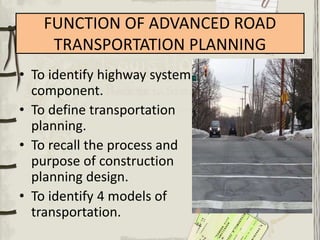
FUNCTION OF ADVANCED ROAD
TRANSPORTATION PLANNING
• To identify highway system
component.
• To define transportation
planning.
• To recall the process and
purpose of construction
planning design.
• To identify 4 models of
transportation.
IMPORTANT OF TRANSPORTATION
SYSTEMATIC PLANNING
• Efficiency – to achieve efficient management and
better management of existing resources
 Effective use of transportation system
 Uses of technology
 Land use and resource controlling
• Quality
To reduce a negative impact to the traffic that
produce a pollution
• Equity
to meet travel demand and response for all
communities
TRAVEL DEMAND MODEL IN
ADVANCED ROAD TRANSPORTATION
• This process is important to be in advanced road
transportation of systematic planning for:
provide new transportation system
improve the existing system
build highways, transit systems and other
• to determine the number of trips that will use the
existing transportation system. trips taken in the
form of vehicle / non-transport
and private vehicles and public transport
TRANSPORTATION STUDIES IN
PLANNING PROCESS FOR ADVANCED
ROAD PLAN
• Origin and Destination study (O-D)
• Traffic Volume Studies
• Spot speed studies
• Travel time and delay studies
• Parking studies
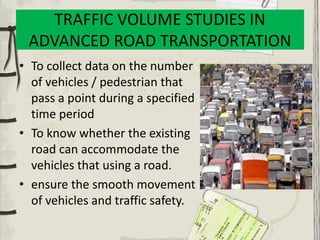
TRAFFIC VOLUME STUDIES IN
ADVANCED ROAD TRANSPORTATION
• To collect data on the number
of vehicles / pedestrian that
pass a point during a specified
time period
• To know whether the existing
road can accommodate the
vehicles that using a road.
• ensure the smooth movement
of vehicles and traffic safety.
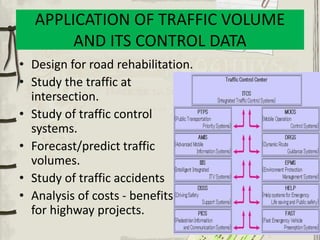
APPLICATION OF TRAFFIC VOLUME
AND ITS CONTROL DATA
• Design for road rehabilitation.
• Study the traffic at
intersection.
• Study of traffic control
systems.
• Forecast/predict traffic
volumes.
• Study of traffic accidents
• Analysis of costs - benefits
for highway projects.
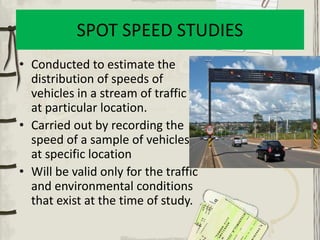
SPOT SPEED STUDIES
• Conducted to estimate the
distribution of speeds of
vehicles in a stream of traffic
at particular location.
• Carried out by recording the
speed of a sample of vehicles
at specific location
• Will be valid only for the traffic
and environmental conditions
that exist at the time of study.
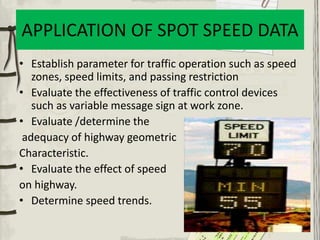
APPLICATION OF SPOT SPEED DATA
• Establish parameter for traffic operation such as speed
zones, speed limits, and passing restriction
• Evaluate the effectiveness of traffic control devices
such as variable message sign at work zone.
• Evaluate /determine the
adequacy of highway geometric
Characteristic.
• Evaluate the effect of speed
on highway.
• Determine speed trends.
TRAVEL TIME AND DELAY STUDIES
• A travel time study determines
the amount of time required
to travel from one point to
another on a given route.
• Information may also collected
on the location, duration, and
causes of delays.
• data also aid the traffic
engineer in identifying
problems at the location.
APPLICATION OF TIME & DELAY DATA
• Determine the efficiency of a route with respect
to its ability to carry traffic
• Identification of locations with relatively high
delay and the causes for those delay.
• Determine the traffic times on specific link for use
in trip assignment models
• Performance of economic studied in the
evaluation of traffic operation alternative that
reduce travel time.
• To evaluate the change in efficiency and level of
service with time.
PARKING STUDIES
• The need of parking spaces is usually very
great in the areas where land uses including
business, residential and commercial activities
• Providing adequate parking space to meet the
demand for parking in central parking district
may affect the level of service.
APPLICATION OF PARKING DATA
• To get the valid information (before and latest)
• To know whether it is adequate parking or not
• To provide information needed to enable the
implementation of payment by the parties
involved.
General policy of Advanced Road
transportation System
• social aspects
improve the social aspects as can be done safely and
comfortably
• economic aspects
with the existence variety of travel pattern, activities
such as employment, population and household
income will be increase.
• physical aspects
create an efficient transportation system because there
are various modes of transportation introduced
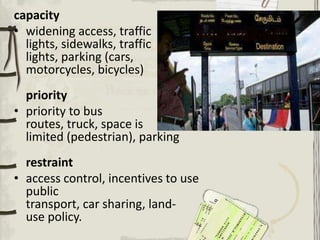
capacity
• widening access, traffic
lights, sidewalks, traffic
lights, parking (cars,
motorcycles, bicycles)
priority
• priority to bus
routes, truck, space is
limited (pedestrian), parking
restraint
• access control, incentives to use
public
transport, car sharing, land-
use policy.
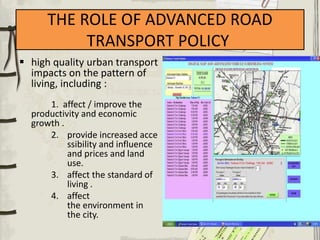
THE ROLE OF ADVANCED ROAD
TRANSPORT POLICY
 high quality urban transport
impacts on the pattern of
living, including :
1. affect / improve the
productivity and economic
growth .
2. provide increased acce
ssibility and influence
and prices and land
use.
3. affect the standard of
living .
4. affect
the environment in
the city.
CONCLUSION
 The rapidly increasing vehicle population in
India, spurred by the population boom and
economic upturn lays a critical burden on
traffic management in the metropolitan cities
and towns of the country.
 While India has already made a foray into
intelligent transport systems in organizing
traffic, more extensive and urgent integration
of advanced technology and concepts into
mainstream traffic management is imperative.
REFERENCES
 www.google.com
 www.wikipedia.com
 www.itsroads.in
 www.usroadplan.org
 European Commission, Directorate-General “Information Society”,
Directorate C “Miniaturisation, Embedded Systems and Societal
Applications”,
 Transport and the Environment, "Towards Cooperative Systems for
Advanced Road Transport", Transport Clustering Meeting, 8 Nov.
2004.
• Network Analysis of Inka Roads, Administrative Centers, and Storage
Facilities" (Volume 48 ed.). Duke University Press. p. 659.
• Fellman, Bruce (2002). "Rediscovering Mach Picchu". Yale Alumni
Magazine.
Advance road transportation system ppt

Advance road transportation system ppt

  • 1.
    Internal Guidance SubmittedBy: ASHISH BIRDARPATIL ABDULAZIZ (13QH1A0101) HOLY MARY INSTITUTE OF TECHNOLOGY & SCIENCE DEPARTMENT OF CIVIL ENGINEERING A Technical Seminar Report On ADVANCED ROAD TRANSPORTATRION SYSTEM
  • 2.
  • 3.
    ADVANCED ROAD TRANSPORTATION SYSTEMAND PLANNING • Advanced Road Transportation System and its planning is a preparation planning to move/transfer human, animal or other item to some place to another place. • This planning will related to the operation of the highway system, geometry, and operation of traffic facilities .
  • 4.
    FUNCTION OF ADVANCEDROAD TRANSPORTATION PLANNING • To identify highway system component. • To define transportation planning. • To recall the process and purpose of construction planning design. • To identify 4 models of transportation.
  • 5.
    IMPORTANT OF TRANSPORTATION SYSTEMATICPLANNING • Efficiency – to achieve efficient management and better management of existing resources  Effective use of transportation system  Uses of technology  Land use and resource controlling • Quality To reduce a negative impact to the traffic that produce a pollution • Equity to meet travel demand and response for all communities
  • 6.
    TRAVEL DEMAND MODELIN ADVANCED ROAD TRANSPORTATION • This process is important to be in advanced road transportation of systematic planning for: provide new transportation system improve the existing system build highways, transit systems and other • to determine the number of trips that will use the existing transportation system. trips taken in the form of vehicle / non-transport and private vehicles and public transport
  • 7.
    TRANSPORTATION STUDIES IN PLANNINGPROCESS FOR ADVANCED ROAD PLAN • Origin and Destination study (O-D) • Traffic Volume Studies • Spot speed studies • Travel time and delay studies • Parking studies
  • 8.
    TRAFFIC VOLUME STUDIESIN ADVANCED ROAD TRANSPORTATION • To collect data on the number of vehicles / pedestrian that pass a point during a specified time period • To know whether the existing road can accommodate the vehicles that using a road. • ensure the smooth movement of vehicles and traffic safety.
  • 9.
    APPLICATION OF TRAFFICVOLUME AND ITS CONTROL DATA • Design for road rehabilitation. • Study the traffic at intersection. • Study of traffic control systems. • Forecast/predict traffic volumes. • Study of traffic accidents • Analysis of costs - benefits for highway projects.
  • 10.
    SPOT SPEED STUDIES •Conducted to estimate the distribution of speeds of vehicles in a stream of traffic at particular location. • Carried out by recording the speed of a sample of vehicles at specific location • Will be valid only for the traffic and environmental conditions that exist at the time of study.
  • 11.
    APPLICATION OF SPOTSPEED DATA • Establish parameter for traffic operation such as speed zones, speed limits, and passing restriction • Evaluate the effectiveness of traffic control devices such as variable message sign at work zone. • Evaluate /determine the adequacy of highway geometric Characteristic. • Evaluate the effect of speed on highway. • Determine speed trends.
  • 12.
    TRAVEL TIME ANDDELAY STUDIES • A travel time study determines the amount of time required to travel from one point to another on a given route. • Information may also collected on the location, duration, and causes of delays. • data also aid the traffic engineer in identifying problems at the location.
  • 13.
    APPLICATION OF TIME& DELAY DATA • Determine the efficiency of a route with respect to its ability to carry traffic • Identification of locations with relatively high delay and the causes for those delay. • Determine the traffic times on specific link for use in trip assignment models • Performance of economic studied in the evaluation of traffic operation alternative that reduce travel time. • To evaluate the change in efficiency and level of service with time.
  • 14.
    PARKING STUDIES • Theneed of parking spaces is usually very great in the areas where land uses including business, residential and commercial activities • Providing adequate parking space to meet the demand for parking in central parking district may affect the level of service.
  • 15.
    APPLICATION OF PARKINGDATA • To get the valid information (before and latest) • To know whether it is adequate parking or not • To provide information needed to enable the implementation of payment by the parties involved.
  • 16.
    General policy ofAdvanced Road transportation System • social aspects improve the social aspects as can be done safely and comfortably • economic aspects with the existence variety of travel pattern, activities such as employment, population and household income will be increase. • physical aspects create an efficient transportation system because there are various modes of transportation introduced
  • 17.
    capacity • widening access,traffic lights, sidewalks, traffic lights, parking (cars, motorcycles, bicycles) priority • priority to bus routes, truck, space is limited (pedestrian), parking restraint • access control, incentives to use public transport, car sharing, land- use policy.
  • 18.
    THE ROLE OFADVANCED ROAD TRANSPORT POLICY  high quality urban transport impacts on the pattern of living, including : 1. affect / improve the productivity and economic growth . 2. provide increased acce ssibility and influence and prices and land use. 3. affect the standard of living . 4. affect the environment in the city.
  • 19.
    CONCLUSION  The rapidlyincreasing vehicle population in India, spurred by the population boom and economic upturn lays a critical burden on traffic management in the metropolitan cities and towns of the country.  While India has already made a foray into intelligent transport systems in organizing traffic, more extensive and urgent integration of advanced technology and concepts into mainstream traffic management is imperative.
  • 20.
    REFERENCES  www.google.com  www.wikipedia.com www.itsroads.in  www.usroadplan.org  European Commission, Directorate-General “Information Society”, Directorate C “Miniaturisation, Embedded Systems and Societal Applications”,  Transport and the Environment, "Towards Cooperative Systems for Advanced Road Transport", Transport Clustering Meeting, 8 Nov. 2004. • Network Analysis of Inka Roads, Administrative Centers, and Storage Facilities" (Volume 48 ed.). Duke University Press. p. 659. • Fellman, Bruce (2002). "Rediscovering Mach Picchu". Yale Alumni Magazine.

Editor's Notes