1
A Case Study Of Traffic Flow Pattern Study On Weekends (Dandiya Bazar Crossing
Road, Vadodara)
• Parmar Dipak 2102105502
• Solanki Jignesh 2102105504
• Prajapati Mahesh 2102105505
• Gohil Vashant 2102105509
Guided by :Proff. Chirag R Sindhav
Prepared by :- Enrollment no :-
Civil Engg. Dept. KSDS
2
INTRODUCTION
Comparatively urbanization is moderate in India. The urban population
has grown from ten percent in 1901 to twenty eight percent in 2001.
 The skewed distribution of the urban population amongst a few cities is a
matter of concern to the planners and administrators of urban
infrastructure. Nearly seventy percent of the urban population is located
in Class-I cities (population of one hundred thousand and more).
Further 38 percent of the total urban population is located in
metropolitan cities (population of one million and more) numbering about
thirty-five.
3
INTRODUCTION
• This heavy concentration of population in a few centers has resulted in the
expansion of cities in density as well as area. With the increase in population
and economic activities the travel demand has increased many folds.
• The inadequate public transport and the easy availability of financing
facilities for private vehicles have resulted in increased vehicle ownership
levels and their usage
• Further, the changes in urban form and structure in terms of lad use, density
of population and concentration of activities have changed the travel
pattern. In other words the traffic problems are increasing in the cities in
general and the situation is becoming complex especially in core areas of the
city
4
Abstract :
The revolution in the automobile industry and liberalised
economy has led to tremendous increase in the vehicle
ownership levels. This has resulted in changing traffic
characteristics on road network.
In this project an attempt has been made to analyse the
changing traffic composition trends, speed characteristics
and travel patterns by taking few case studies.
5
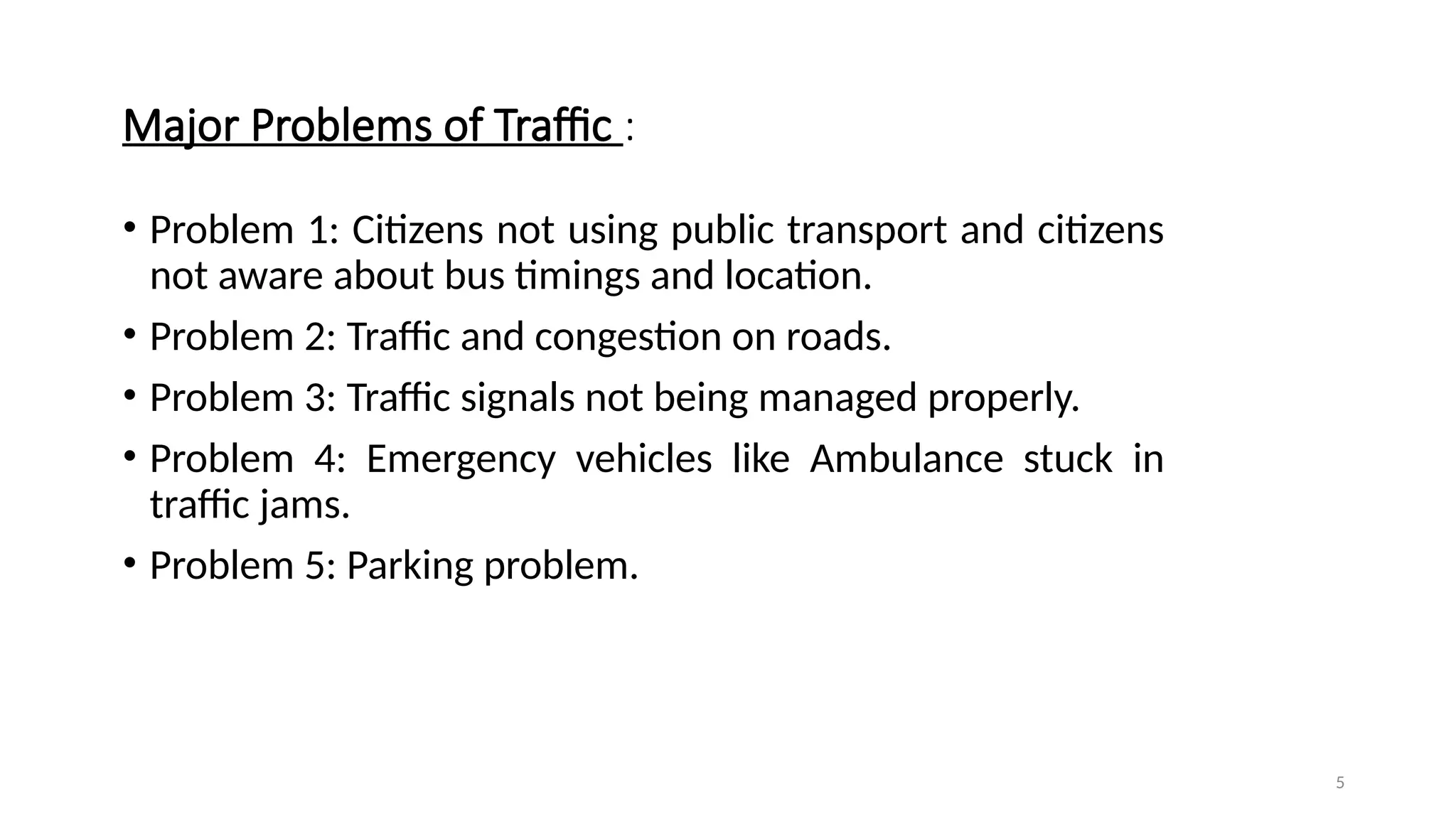
Major Problems of Traffic :
• Problem 1: Citizens not using public transport and citizens
not aware about bus timings and location.
• Problem 2: Traffic and congestion on roads.
• Problem 3: Traffic signals not being managed properly.
• Problem 4: Emergency vehicles like Ambulance stuck in
traffic jams.
• Problem 5: Parking problem.
6
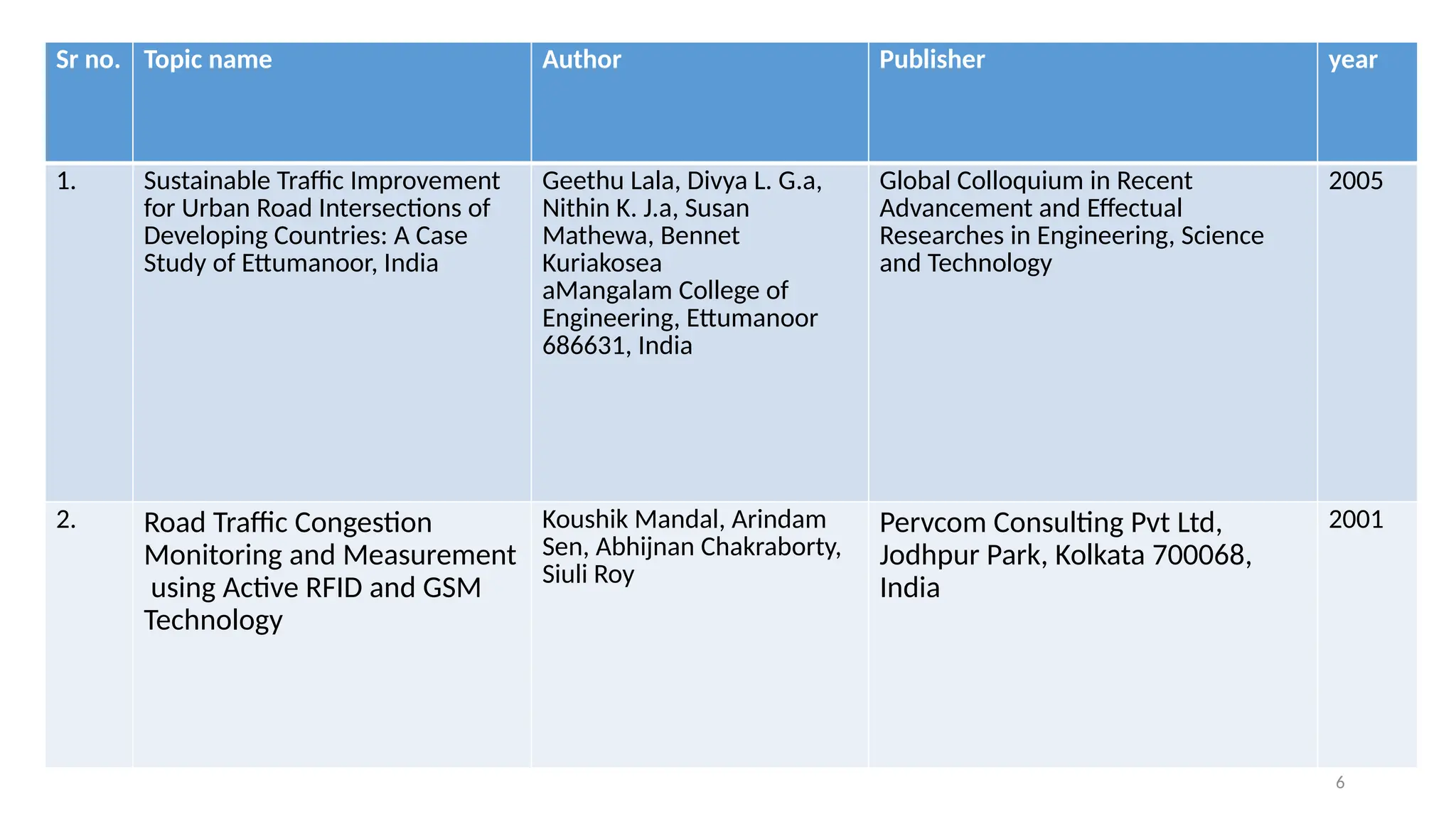
Sr no. Topic name Author Publisher year
1. Sustainable Traffic Improvement
for Urban Road Intersections of
Developing Countries: A Case
Study of Ettumanoor, India
Geethu Lala, Divya L. G.a,
Nithin K. J.a, Susan
Mathewa, Bennet
Kuriakosea
aMangalam College of
Engineering, Ettumanoor
686631, India
Global Colloquium in Recent
Advancement and Effectual
Researches in Engineering, Science
and Technology
2005
2. Road Traffic Congestion
Monitoring and Measurement
using Active RFID and GSM
Technology
Koushik Mandal, Arindam
Sen, Abhijnan Chakraborty,
Siuli Roy
Pervcom Consulting Pvt Ltd,
Jodhpur Park, Kolkata 700068,
India
2001
7
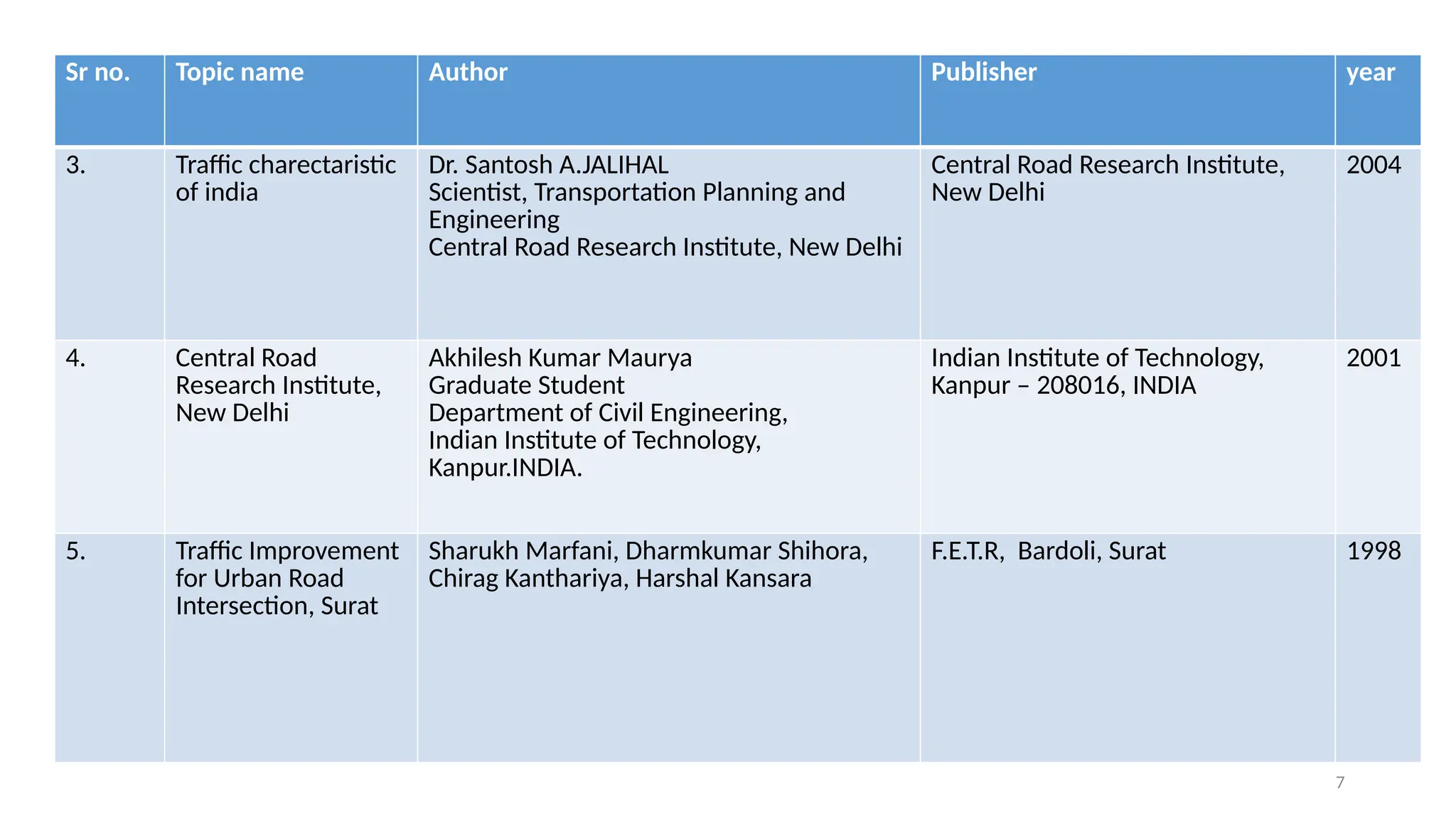
Sr no. Topic name Author Publisher year
3. Traffic charectaristic
of india
Dr. Santosh A.JALIHAL
Scientist, Transportation Planning and
Engineering
Central Road Research Institute, New Delhi
Central Road Research Institute,
New Delhi
2004
4. Central Road
Research Institute,
New Delhi
Akhilesh Kumar Maurya
Graduate Student
Department of Civil Engineering,
Indian Institute of Technology,
Kanpur.INDIA.
Indian Institute of Technology,
Kanpur – 208016, INDIA
2001
5. Traffic Improvement
for Urban Road
Intersection, Surat
Sharukh Marfani, Dharmkumar Shihora,
Chirag Kanthariya, Harshal Kansara
F.E.T.R, Bardoli, Surat 1998
8
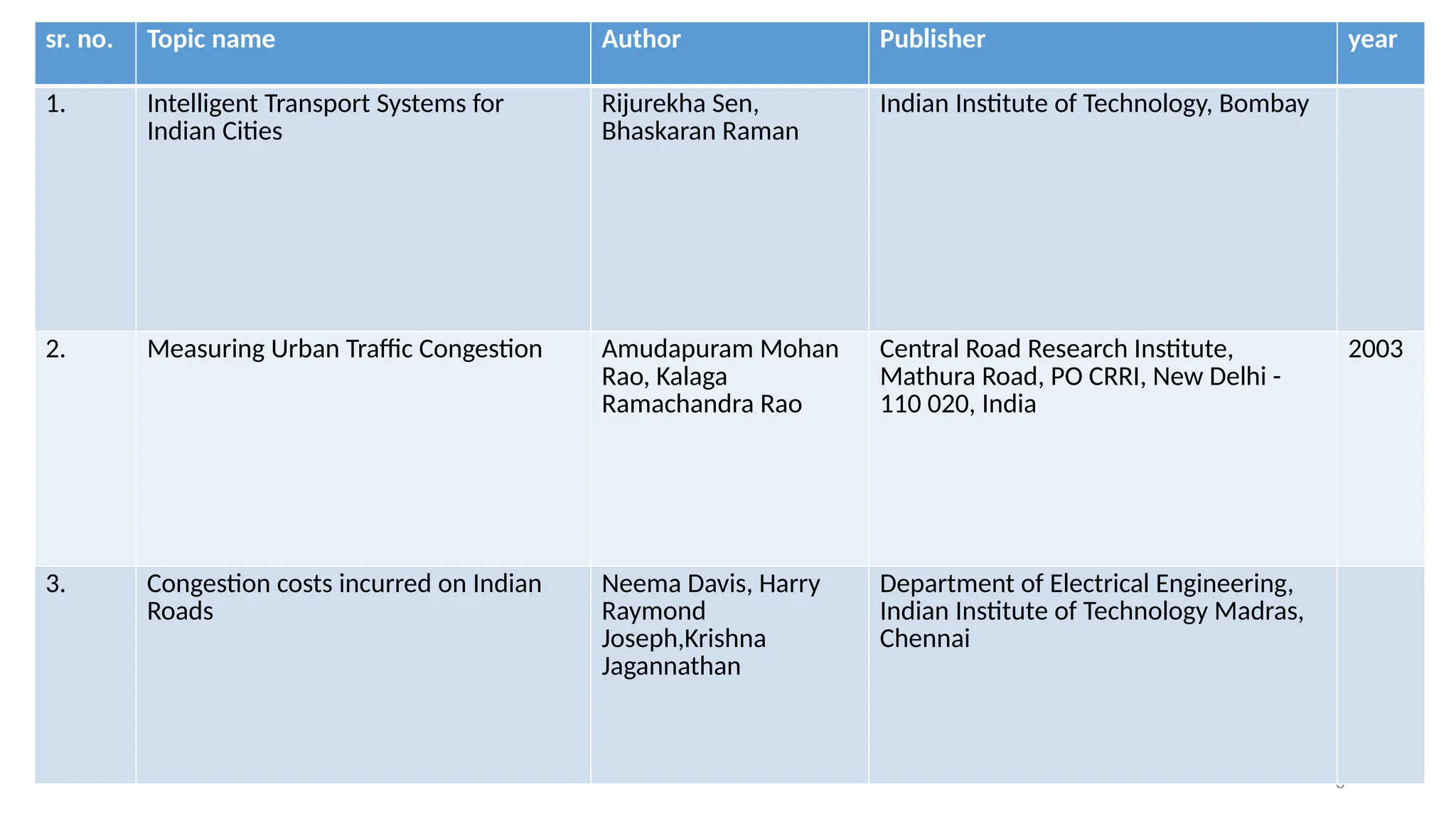
sr. no. Topic name Author Publisher year
1. Intelligent Transport Systems for
Indian Cities
Rijurekha Sen,
Bhaskaran Raman
Indian Institute of Technology, Bombay
2. Measuring Urban Traffic Congestion Amudapuram Mohan
Rao, Kalaga
Ramachandra Rao
Central Road Research Institute,
Mathura Road, PO CRRI, New Delhi -
110 020, India
2003
3. Congestion costs incurred on Indian
Roads
Neema Davis, Harry
Raymond
Joseph,Krishna
Jagannathan
Department of Electrical Engineering,
Indian Institute of Technology Madras,
Chennai
9
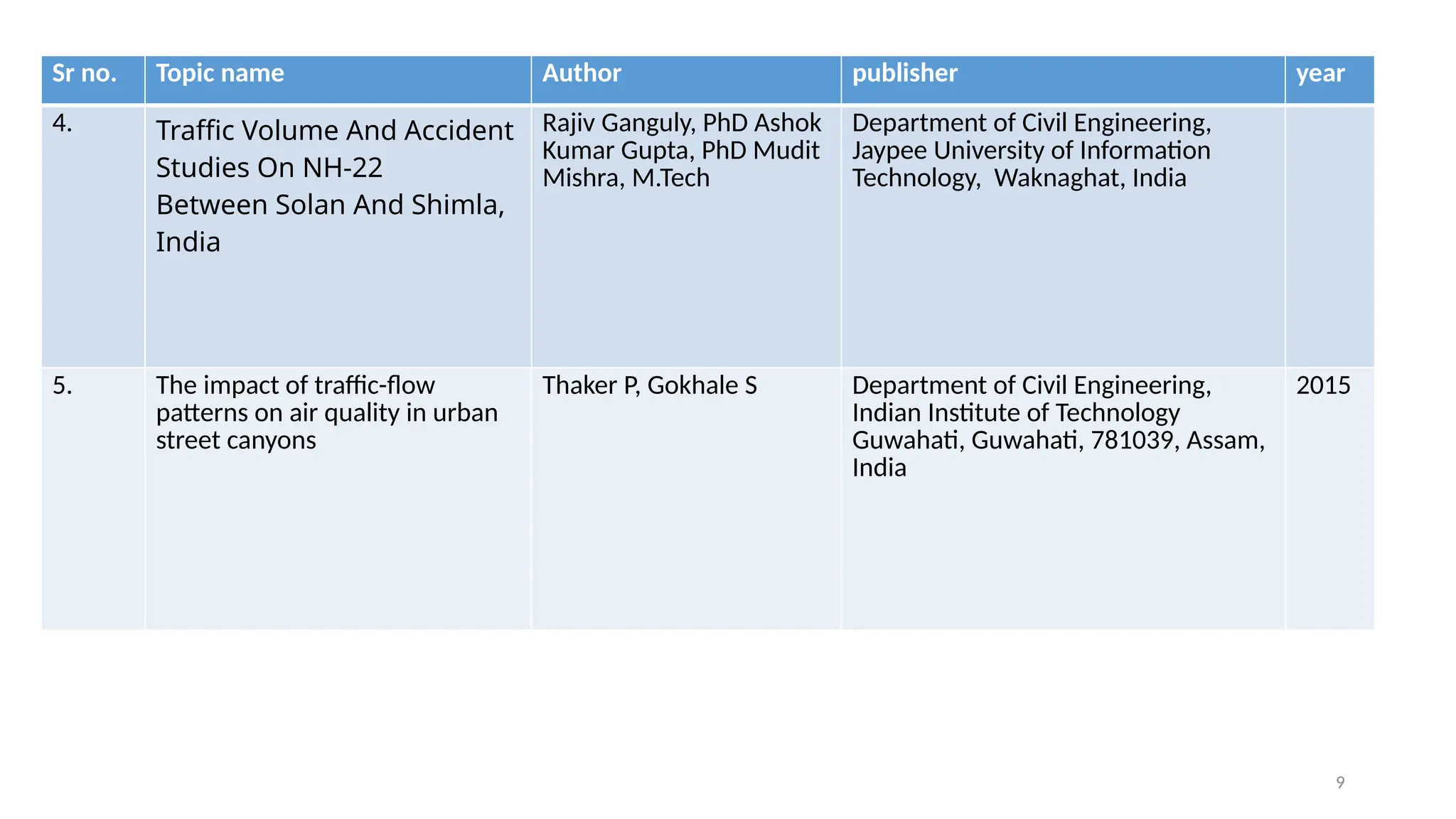
Sr no. Topic name Author publisher year
4. Traffic Volume And Accident
Studies On NH-22
Between Solan And Shimla,
India
Rajiv Ganguly, PhD Ashok
Kumar Gupta, PhD Mudit
Mishra, M.Tech
Department of Civil Engineering,
Jaypee University of Information
Technology, Waknaghat, India
5. The impact of traffic-flow
patterns on air quality in urban
street canyons
Thaker P, Gokhale S Department of Civil Engineering,
Indian Institute of Technology
Guwahati, Guwahati, 781039, Assam,
India
2015
10
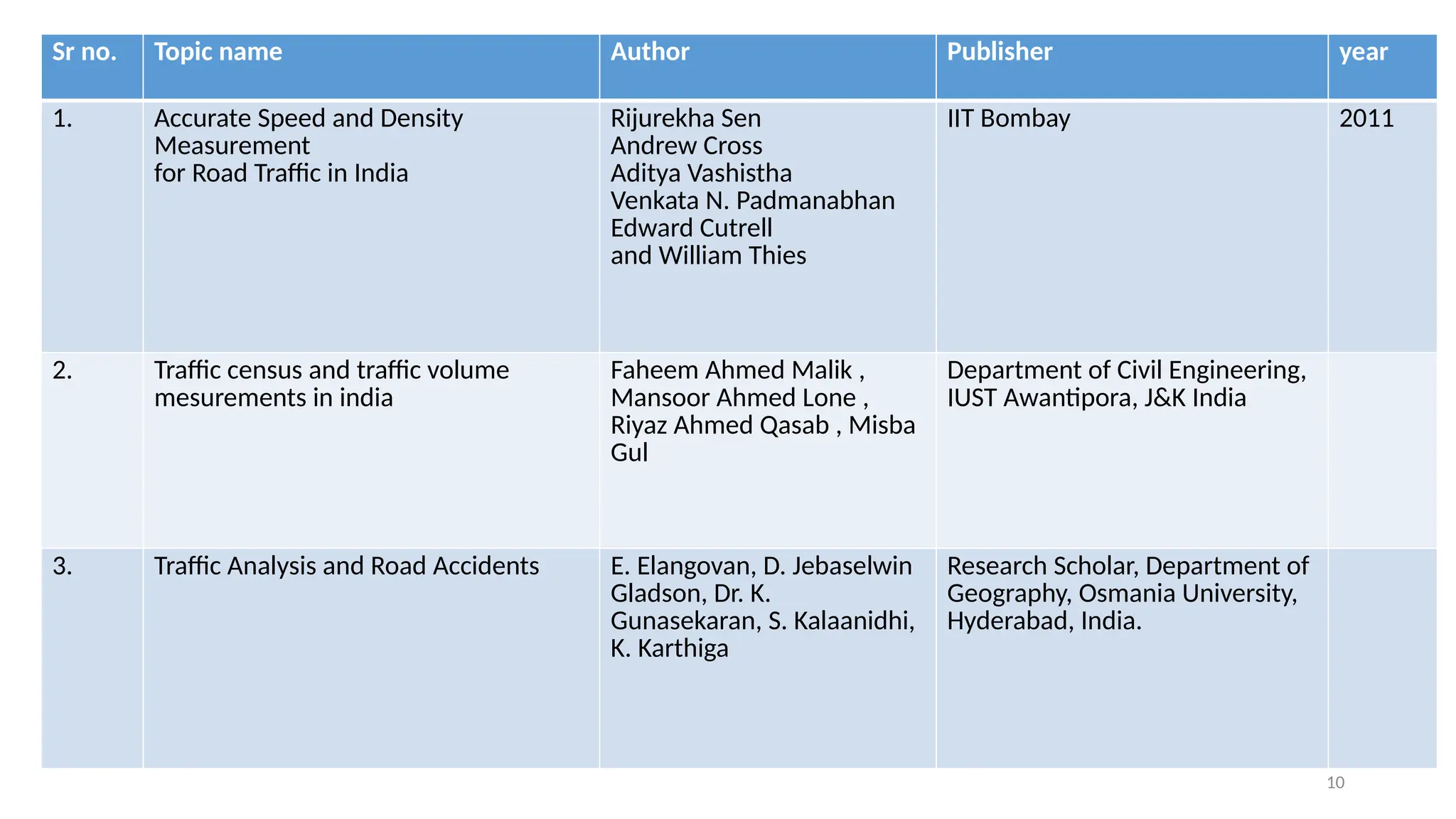
Sr no. Topic name Author Publisher year
1. Accurate Speed and Density
Measurement
for Road Traffic in India
Rijurekha Sen
Andrew Cross
Aditya Vashistha
Venkata N. Padmanabhan
Edward Cutrell
and William Thies
IIT Bombay 2011
2. Traffic census and traffic volume
mesurements in india
Faheem Ahmed Malik ,
Mansoor Ahmed Lone ,
Riyaz Ahmed Qasab , Misba
Gul
Department of Civil Engineering,
IUST Awantipora, J&K India
3. Traffic Analysis and Road Accidents E. Elangovan, D. Jebaselwin
Gladson, Dr. K.
Gunasekaran, S. Kalaanidhi,
K. Karthiga
Research Scholar, Department of
Geography, Osmania University,
Hyderabad, India.
11
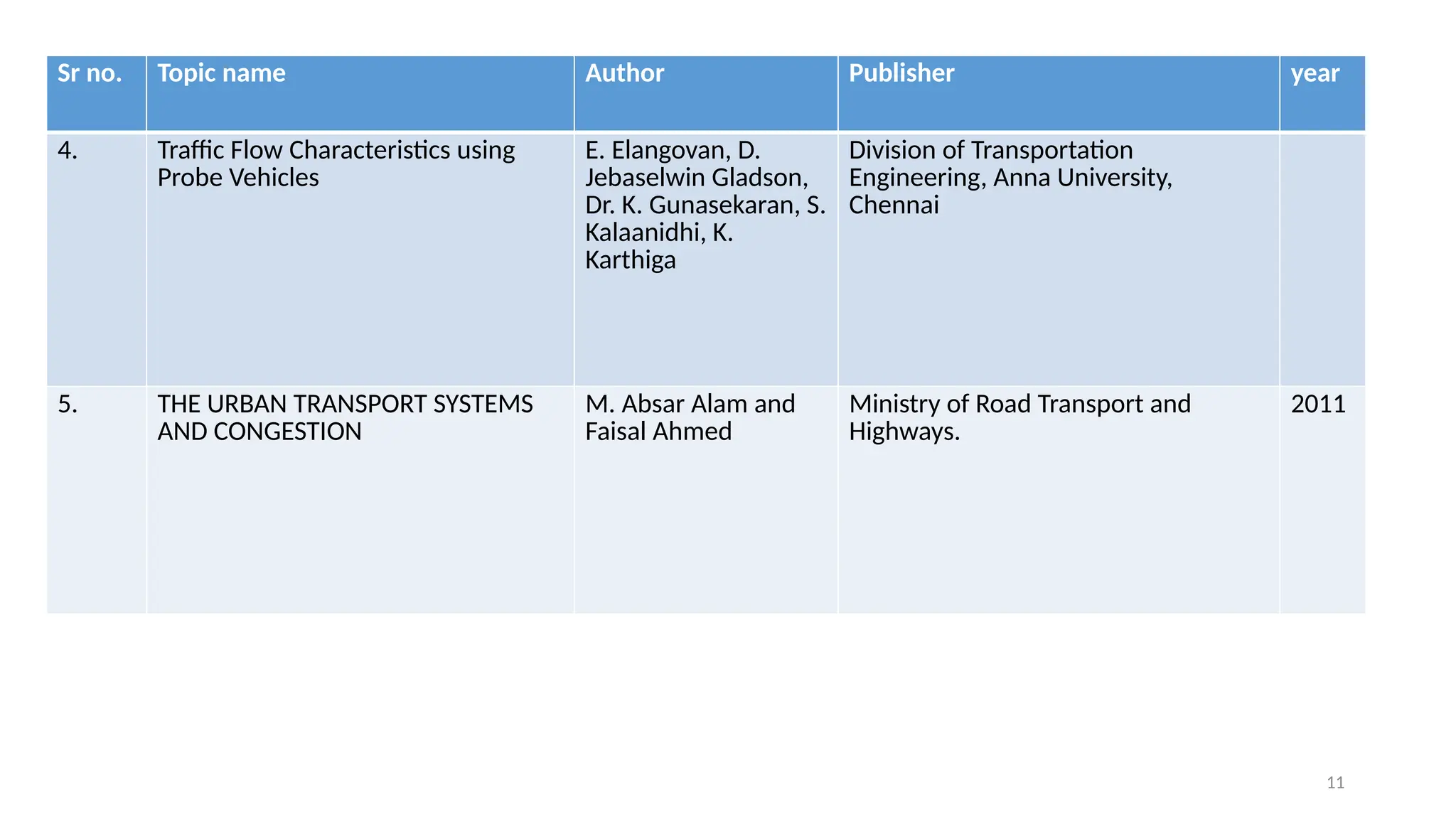
Sr no. Topic name Author Publisher year
4. Traffic Flow Characteristics using
Probe Vehicles
E. Elangovan, D.
Jebaselwin Gladson,
Dr. K. Gunasekaran, S.
Kalaanidhi, K.
Karthiga
Division of Transportation
Engineering, Anna University,
Chennai
5. THE URBAN TRANSPORT SYSTEMS
AND CONGESTION
M. Absar Alam and
Faisal Ahmed
Ministry of Road Transport and
Highways.
2011
12
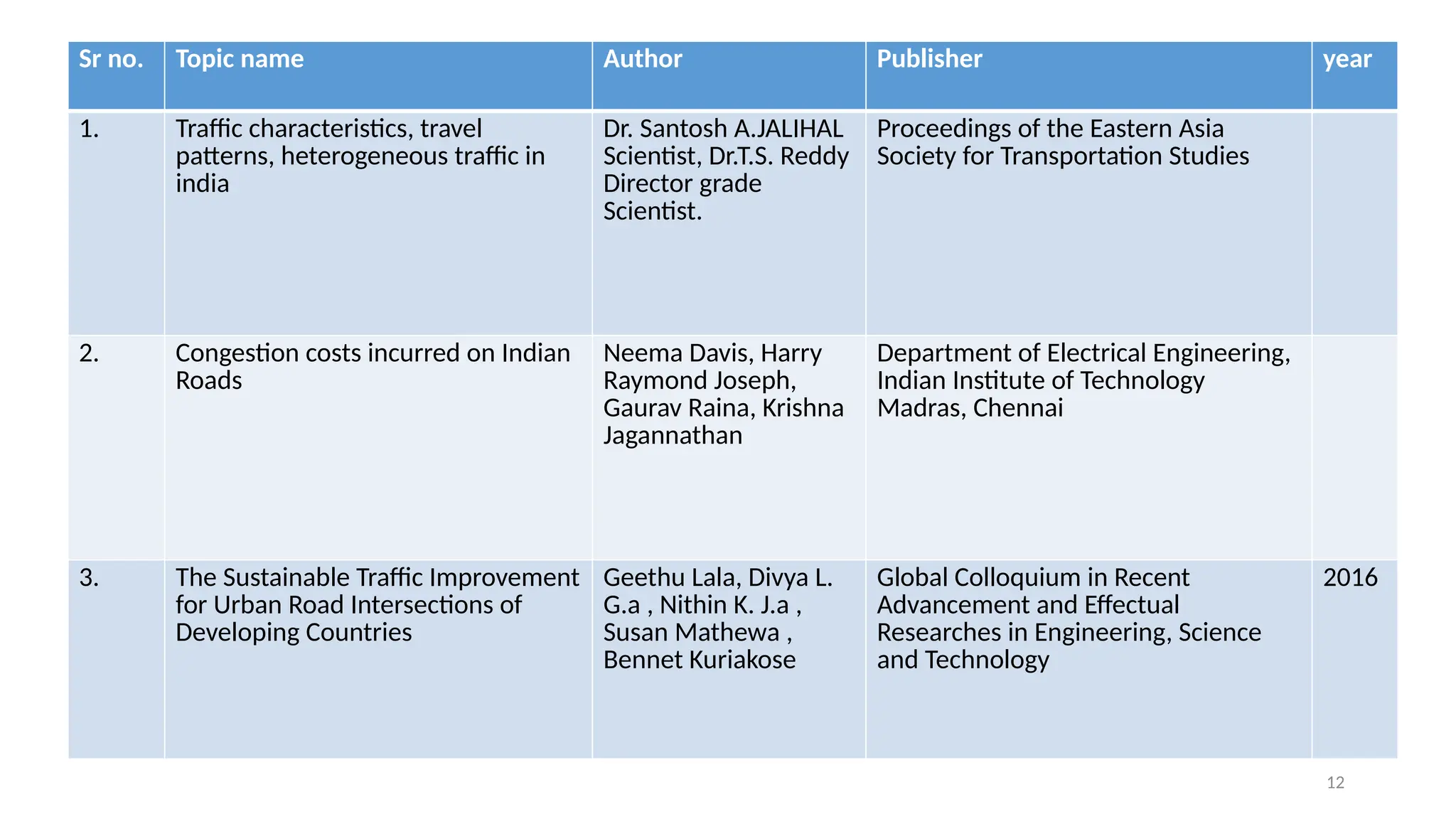
Sr no. Topic name Author Publisher year
1. Traffic characteristics, travel
patterns, heterogeneous traffic in
india
Dr. Santosh A.JALIHAL
Scientist, Dr.T.S. Reddy
Director grade
Scientist.
Proceedings of the Eastern Asia
Society for Transportation Studies
2. Congestion costs incurred on Indian
Roads
Neema Davis, Harry
Raymond Joseph,
Gaurav Raina, Krishna
Jagannathan
Department of Electrical Engineering,
Indian Institute of Technology
Madras, Chennai
3. The Sustainable Traffic Improvement
for Urban Road Intersections of
Developing Countries
Geethu Lala, Divya L.
G.a , Nithin K. J.a ,
Susan Mathewa ,
Bennet Kuriakose
Global Colloquium in Recent
Advancement and Effectual
Researches in Engineering, Science
and Technology
2016
13
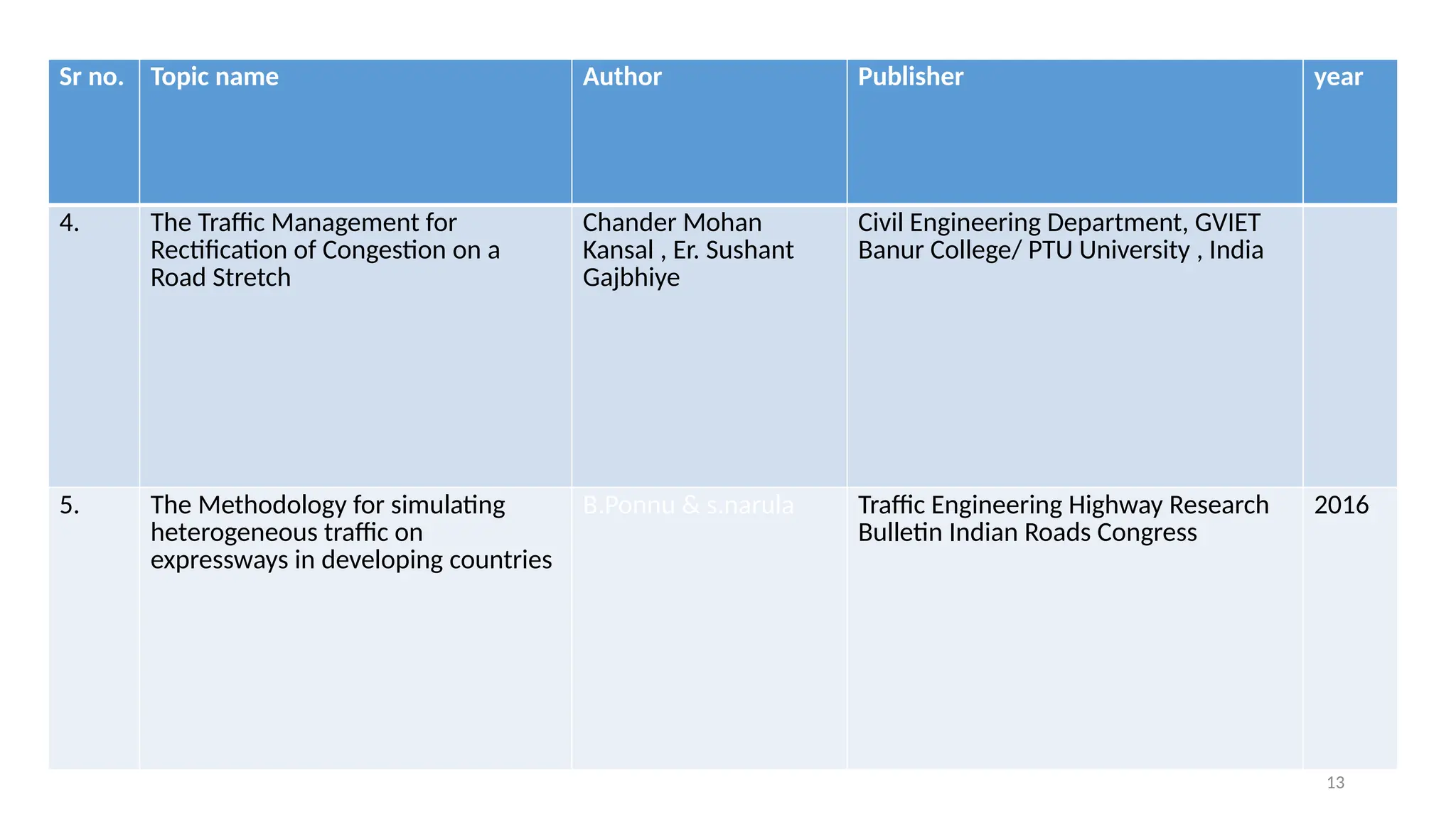
Sr no. Topic name Author Publisher year
4. The Traffic Management for
Rectification of Congestion on a
Road Stretch
Chander Mohan
Kansal , Er. Sushant
Gajbhiye
Civil Engineering Department, GVIET
Banur College/ PTU University , India
5. The Methodology for simulating
heterogeneous traffic on
expressways in developing countries
B.Ponnu & s.narula Traffic Engineering Highway Research
Bulletin Indian Roads Congress
2016
14
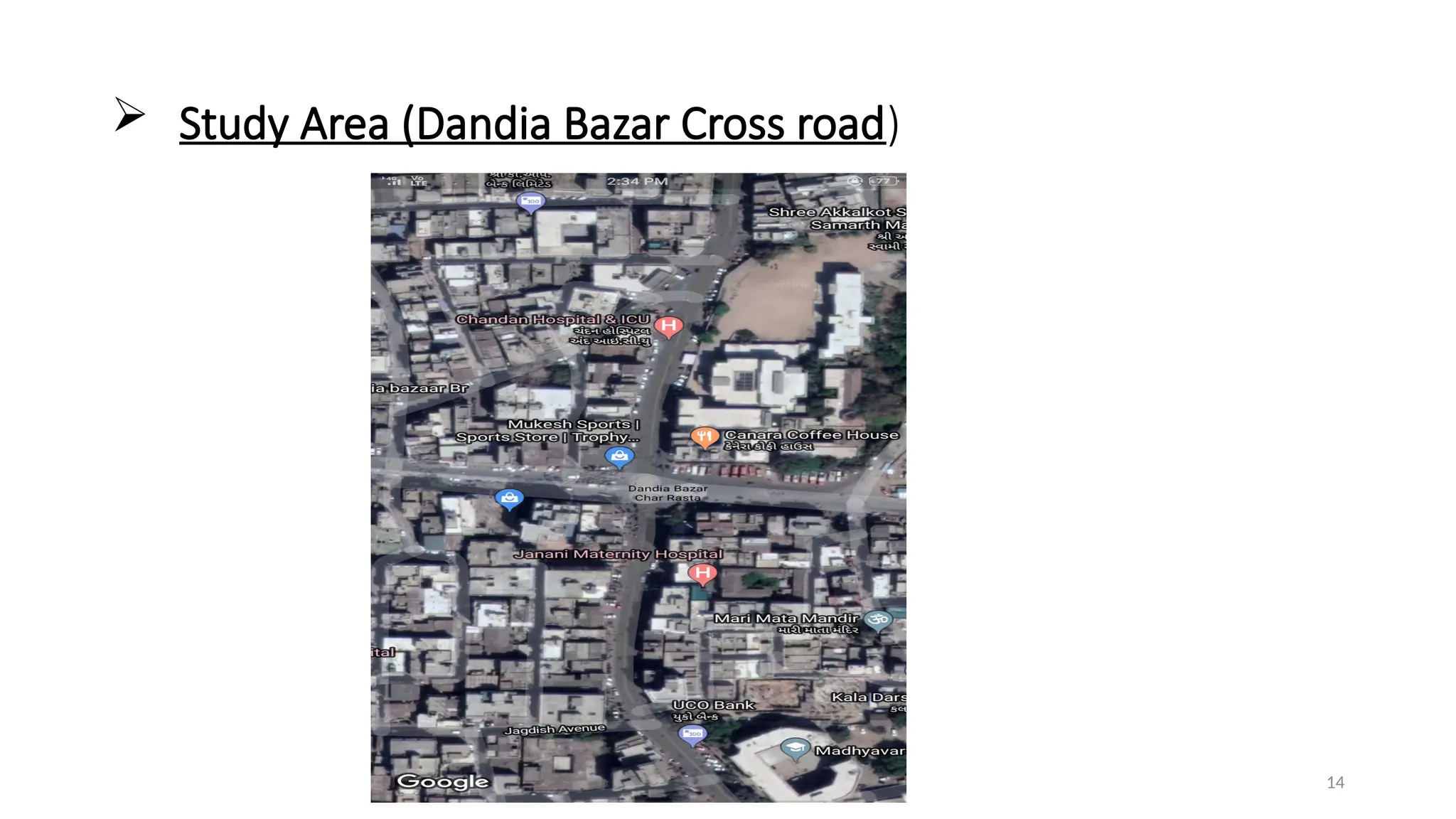
 Study Area (Dandia Bazar Cross road)
15
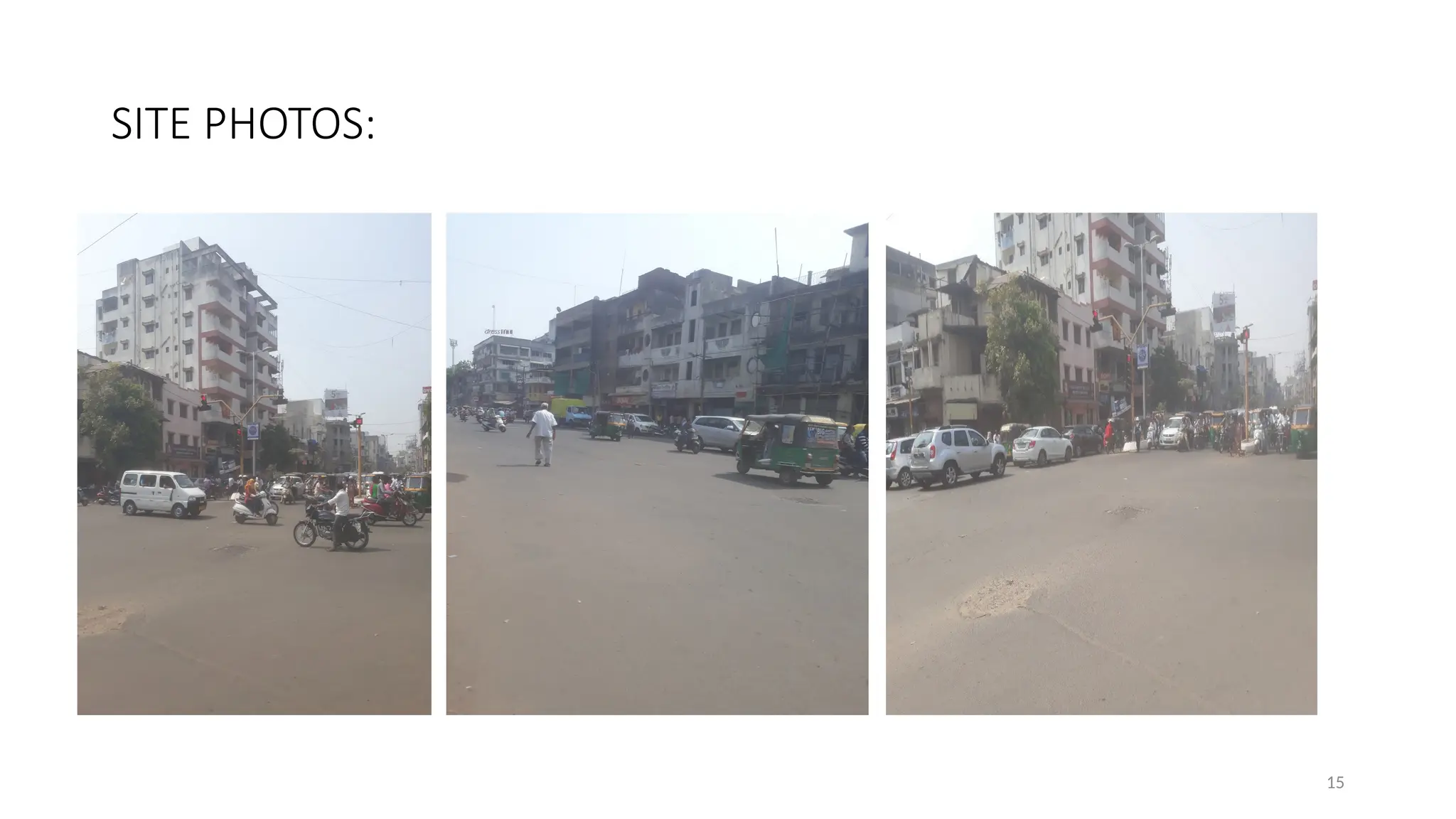
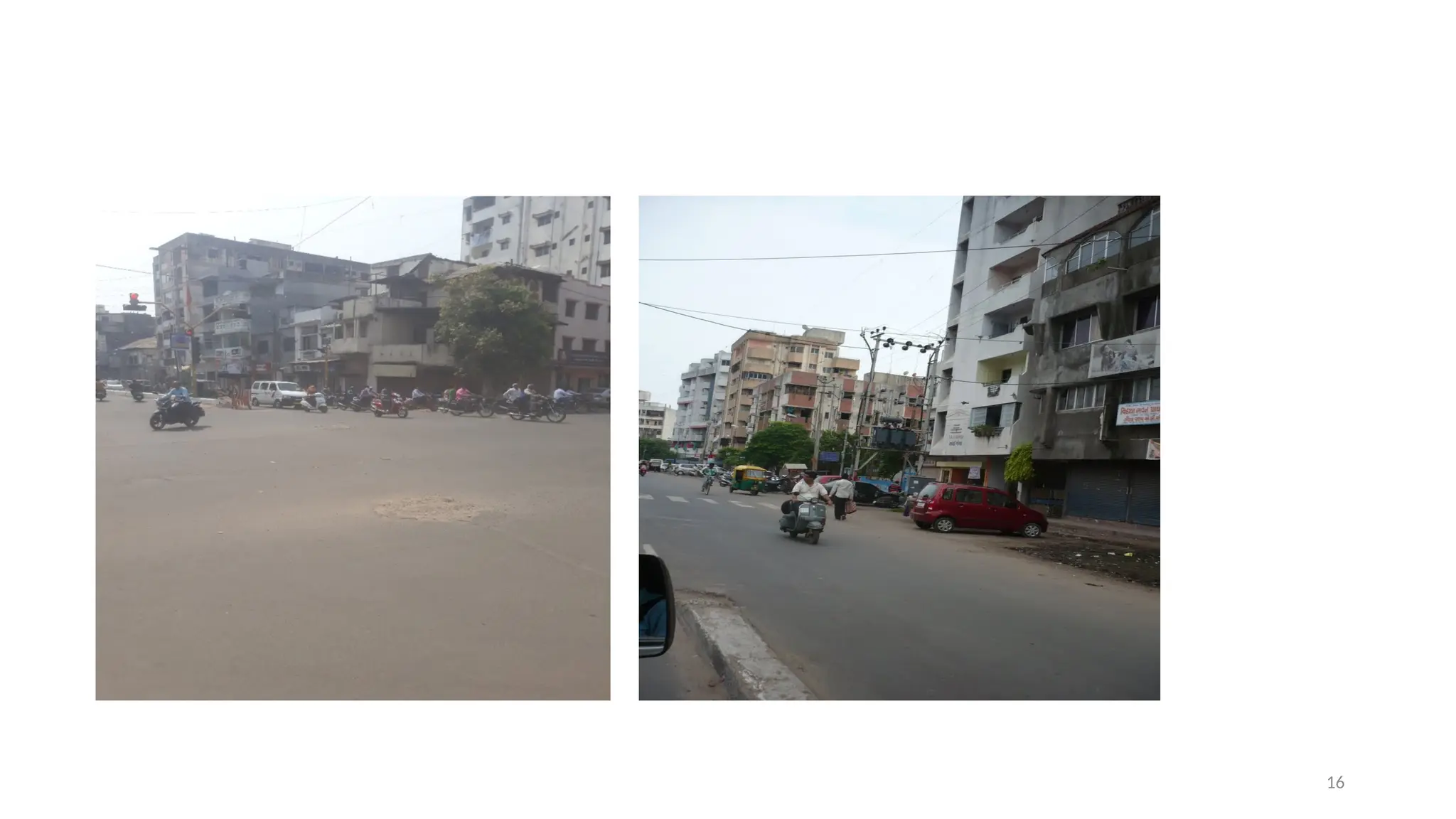
SITE PHOTOS:
16
17
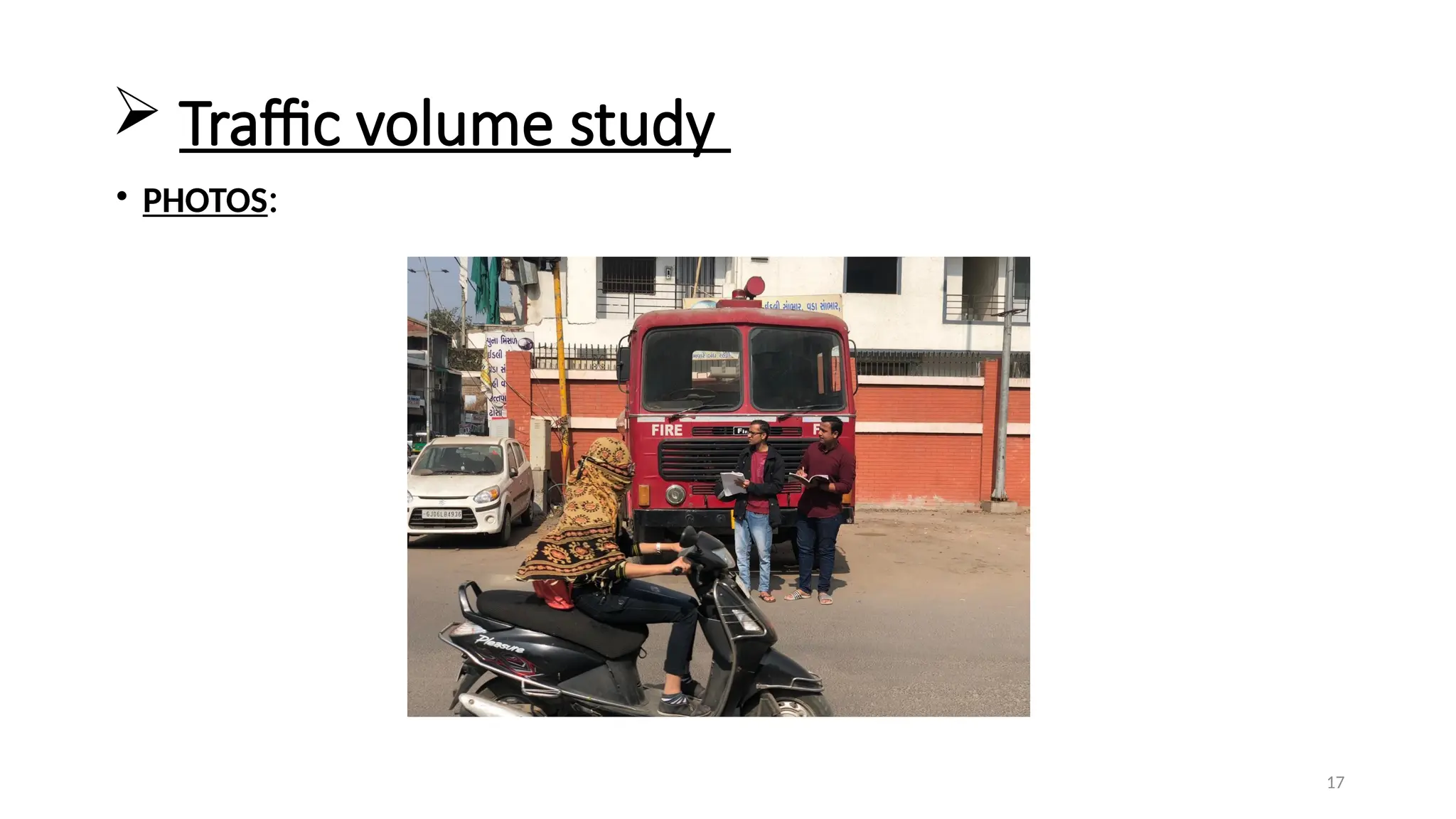
 Traffic volume study
• PHOTOS:
18
METHODOLOGY
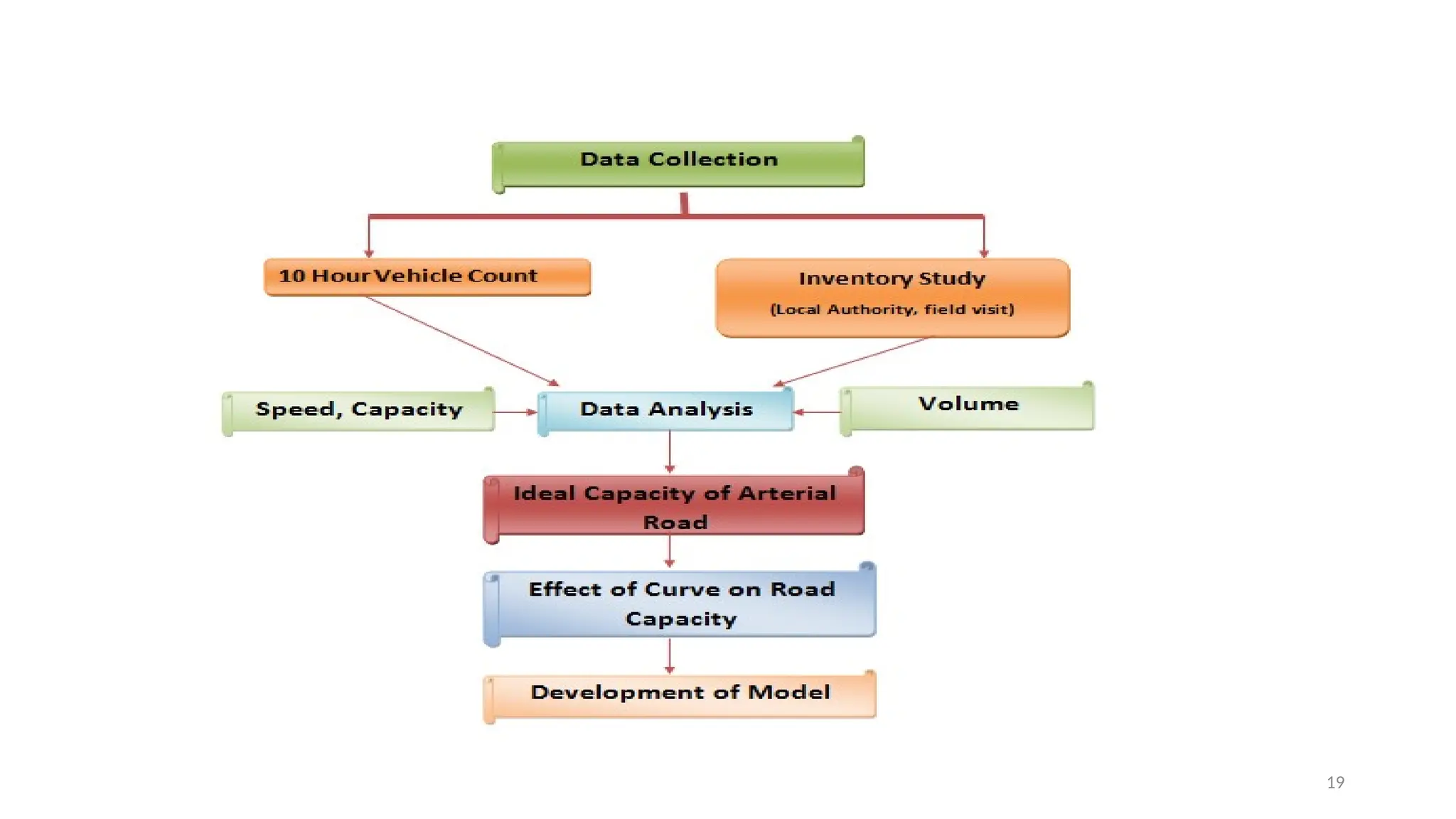
• Properly check out methodology for the study is essential to complete
task according to objectives of the thesis in fig. below shows various
stages of the methodology adopted for the present study.
• The methodology adopted in the present study is illustrated step by
step below.
• The first step is the identification of the problem followed by definition of the
problem. The problem of traffic characterization and flow behaviour for urban
road is identified and defined considering two arterial and sub arterial roads
midblock sections
• Collect data for speed and volume by using of 12 hours vehicles count on
morning and evening and Inventory study
19
20
 Procedure of data collection
Area where the traffic volume data collected : Dadiya
bazar crossing
Time duration : 8:00 AM TO 8:00 PM
(There are 15 minute interval in every hour)
21
Data was collected in 2 wheeler, 3 wheeler, 4 wheeler,
bus/truck, and L.C.V categories individually
After that PCU is calculated at every 1 hour.
22
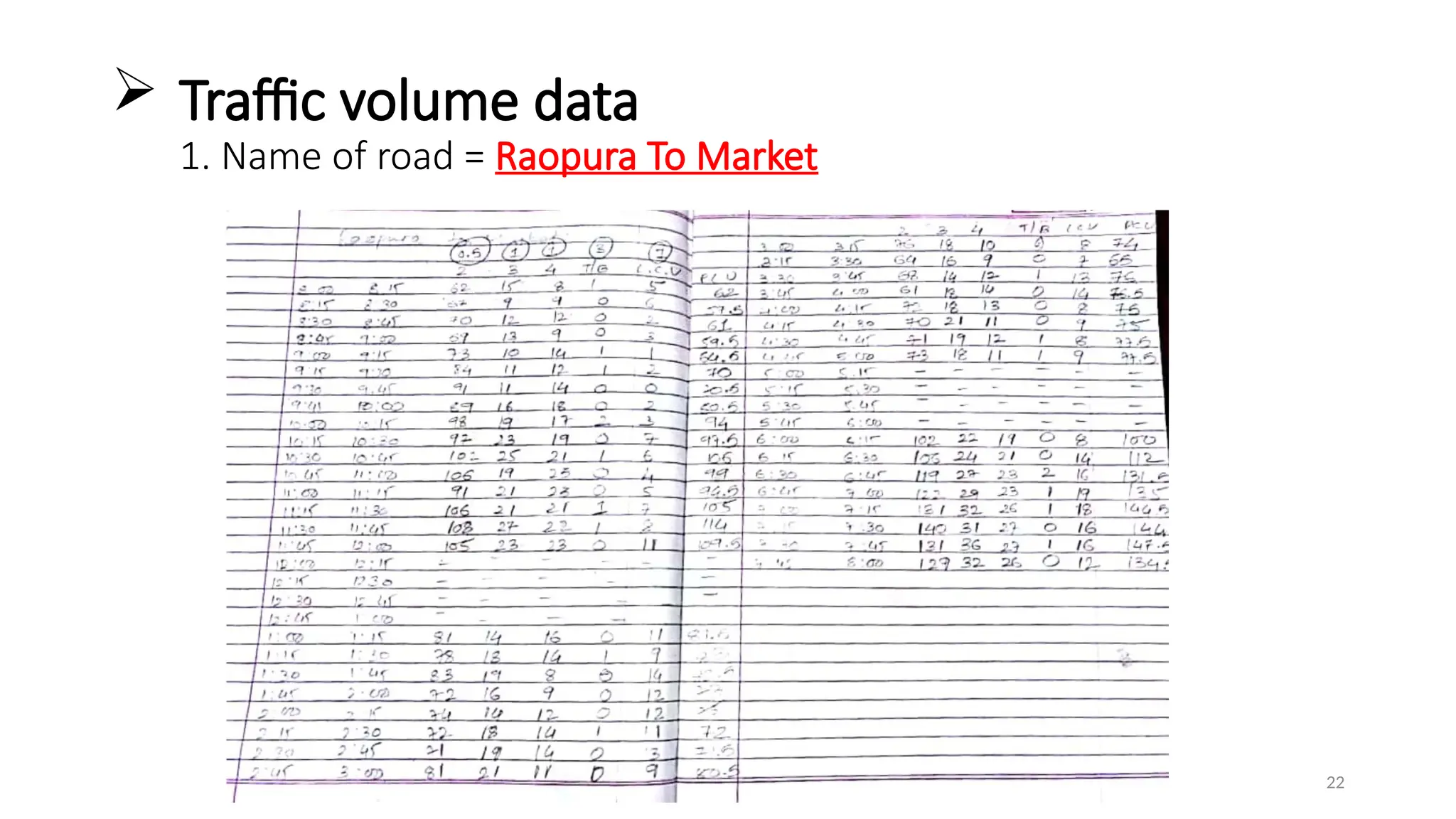
 Traffic volume data
1. Name of road = Raopura To Market
23
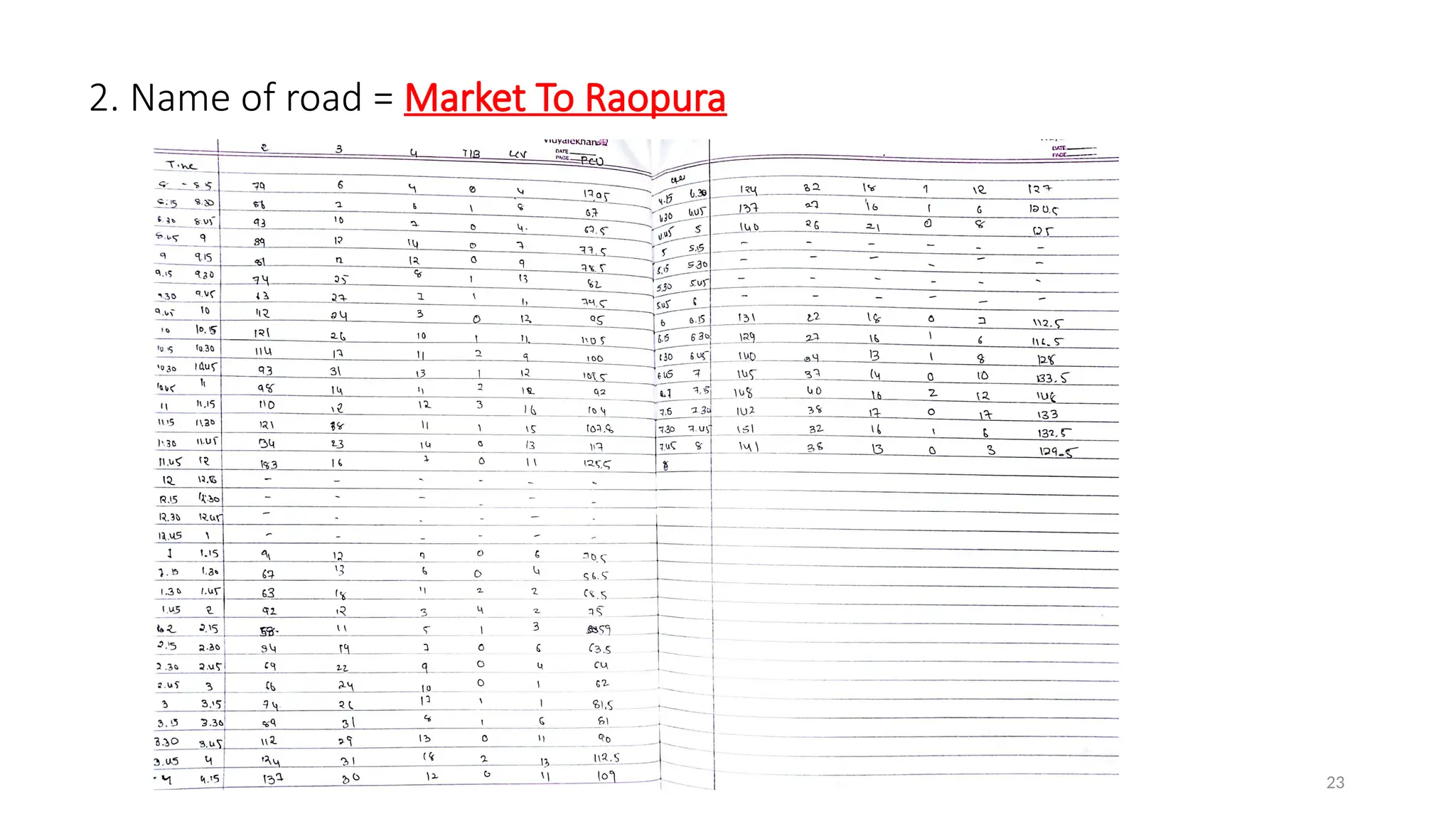
2. Name of road = Market To Raopura
24
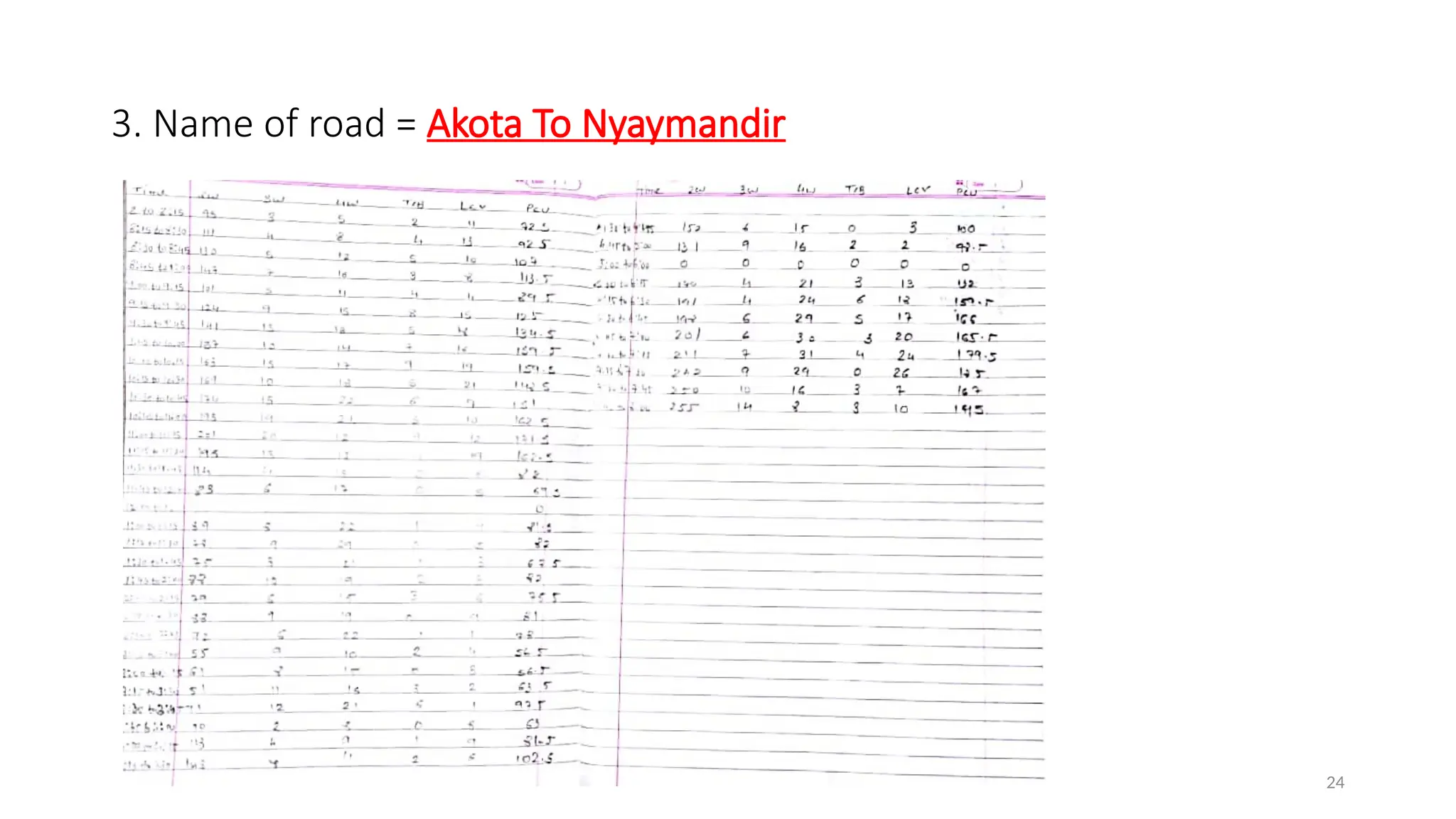
3. Name of road = Akota To Nyaymandir
25
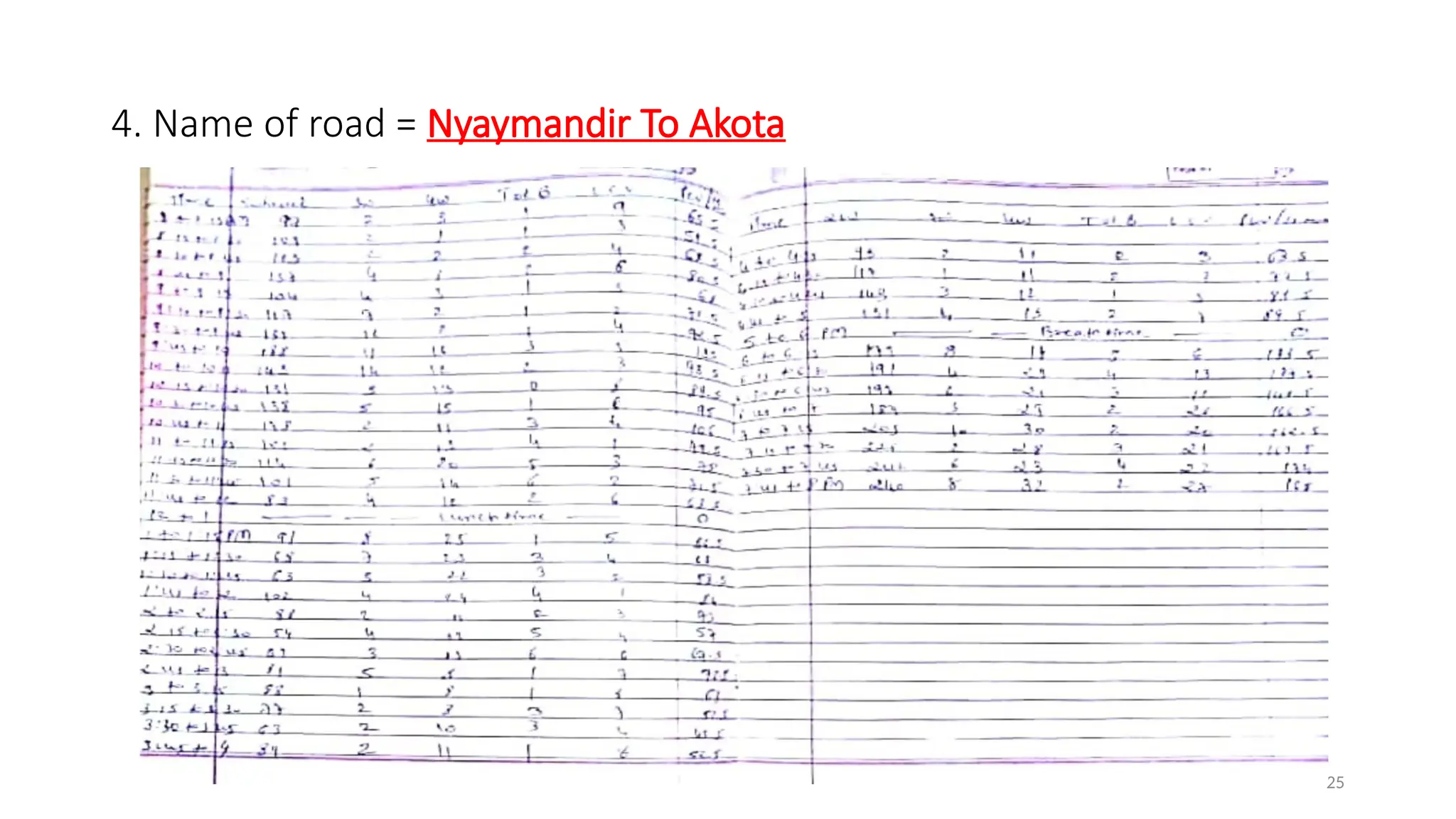
4. Name of road = Nyaymandir To Akota
26
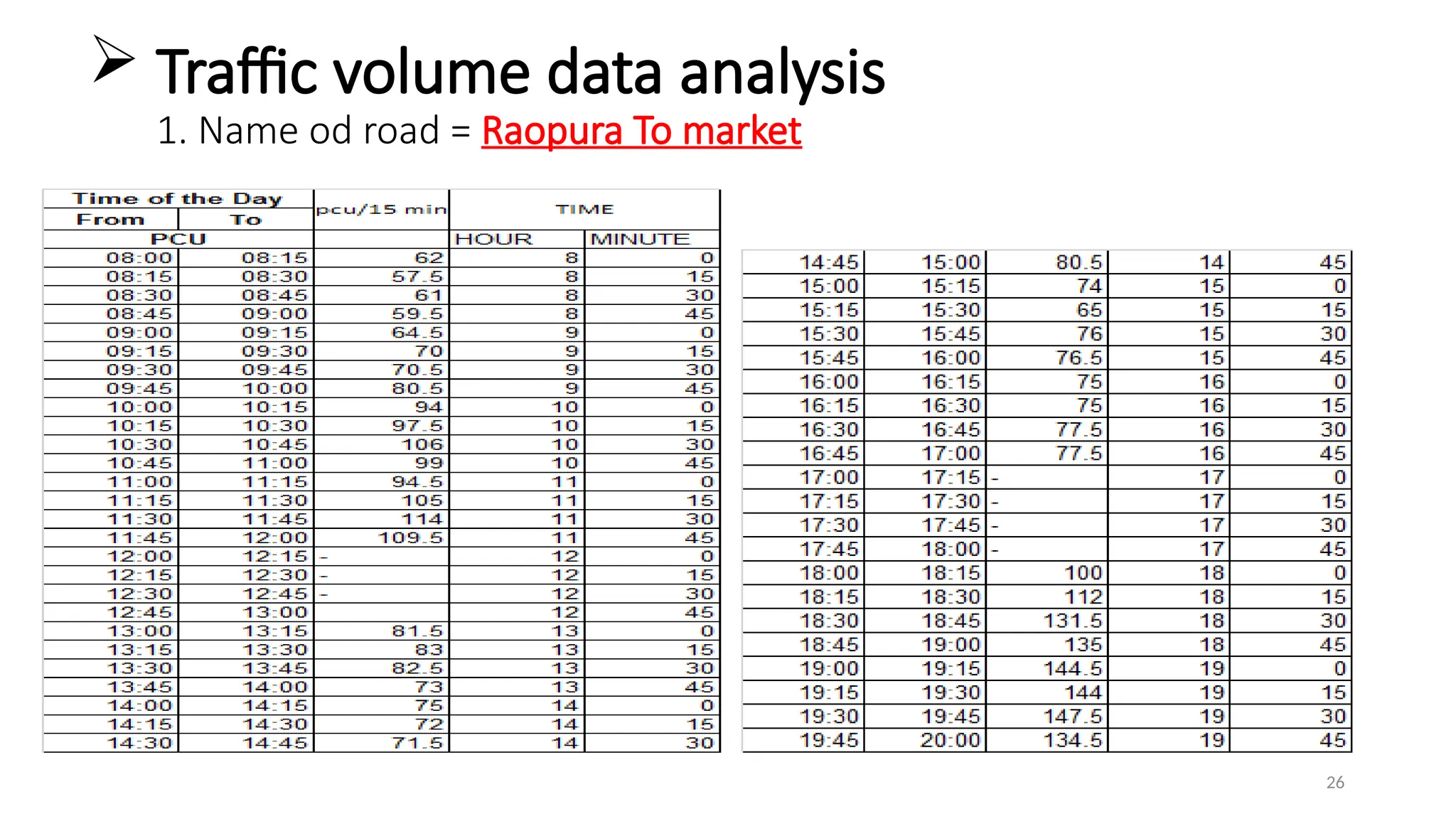
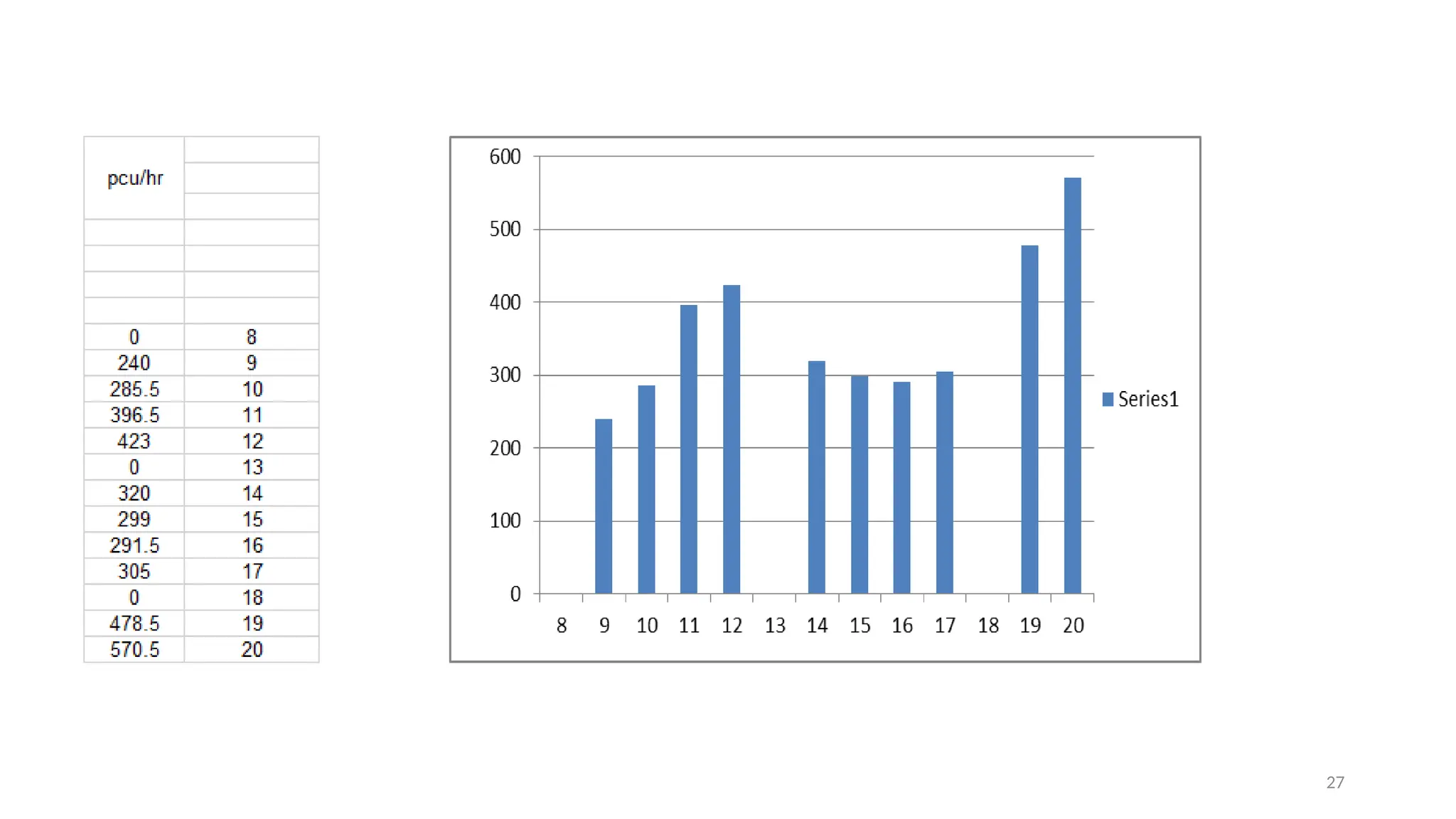
 Traffic volume data analysis
1. Name od road = Raopura To market
27
28
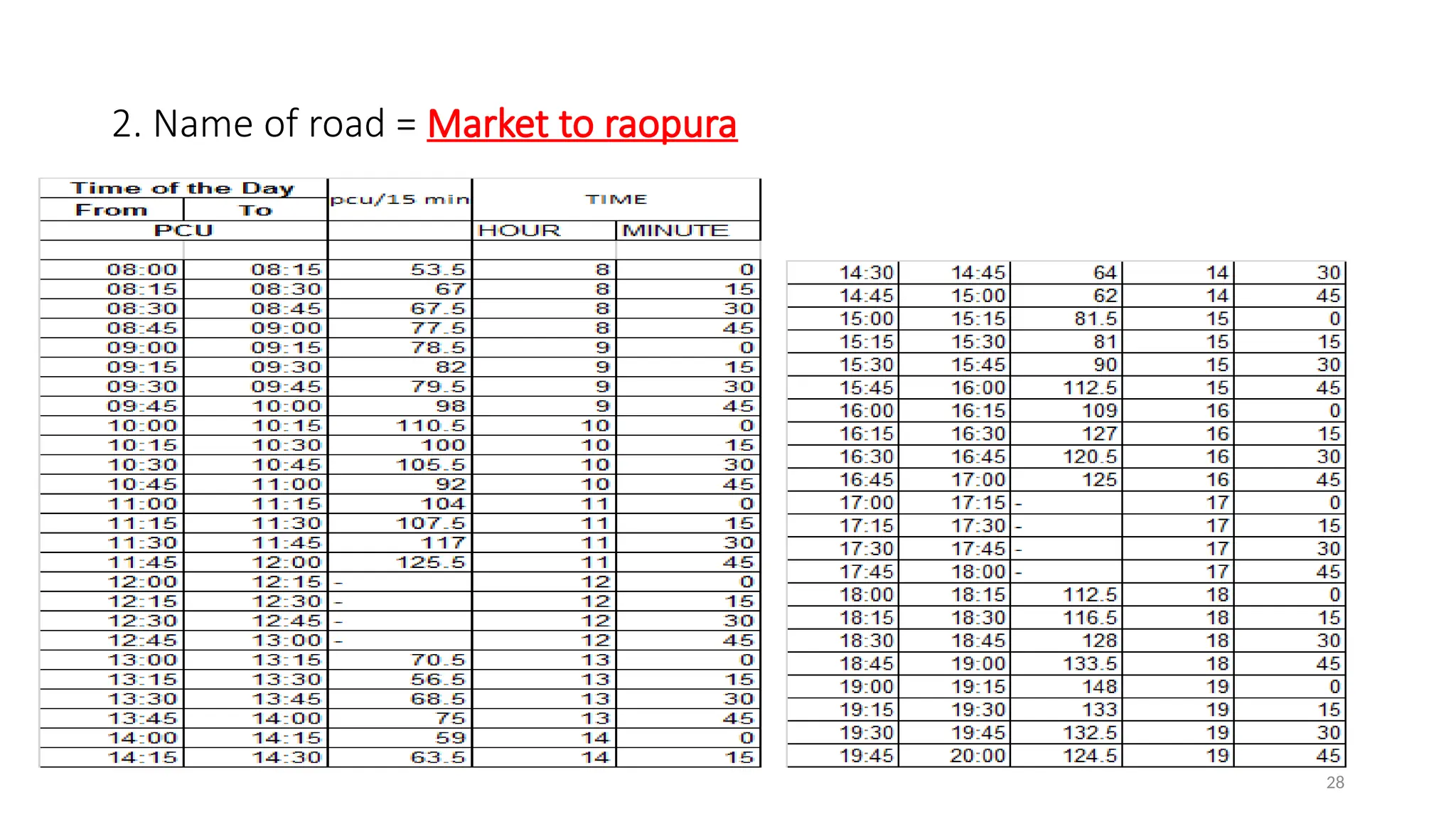
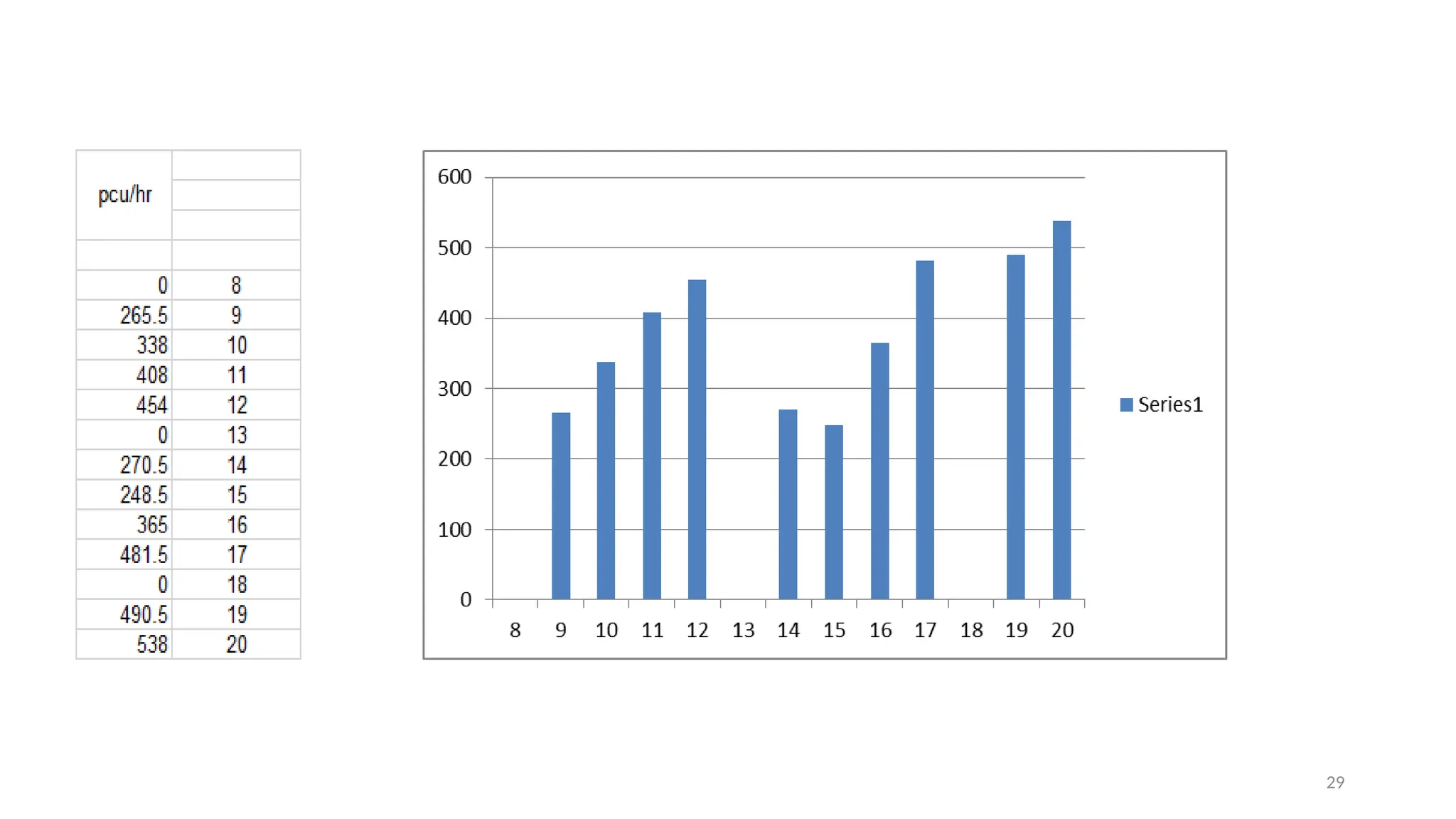
2. Name of road = Market to raopura
29
30
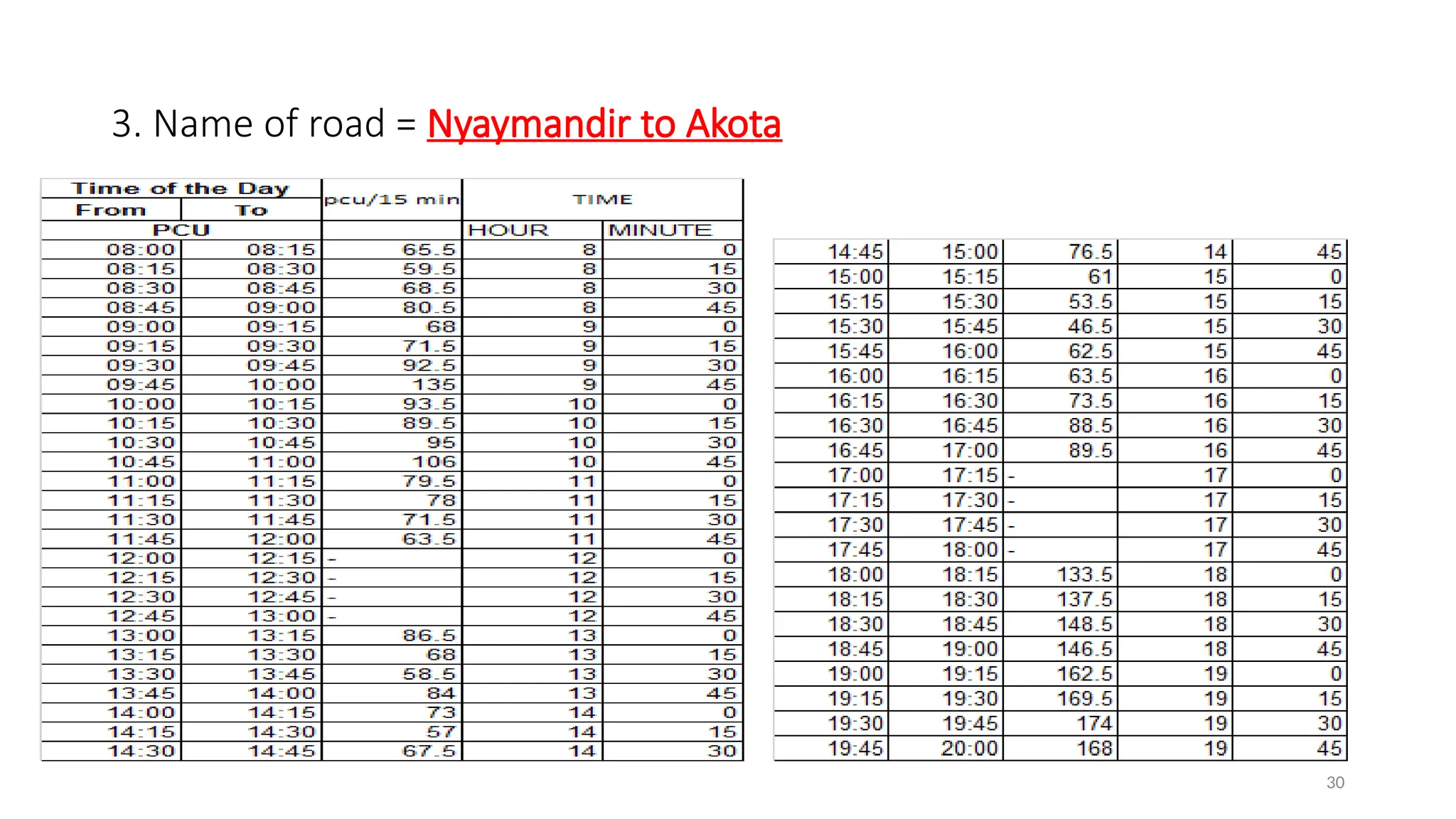
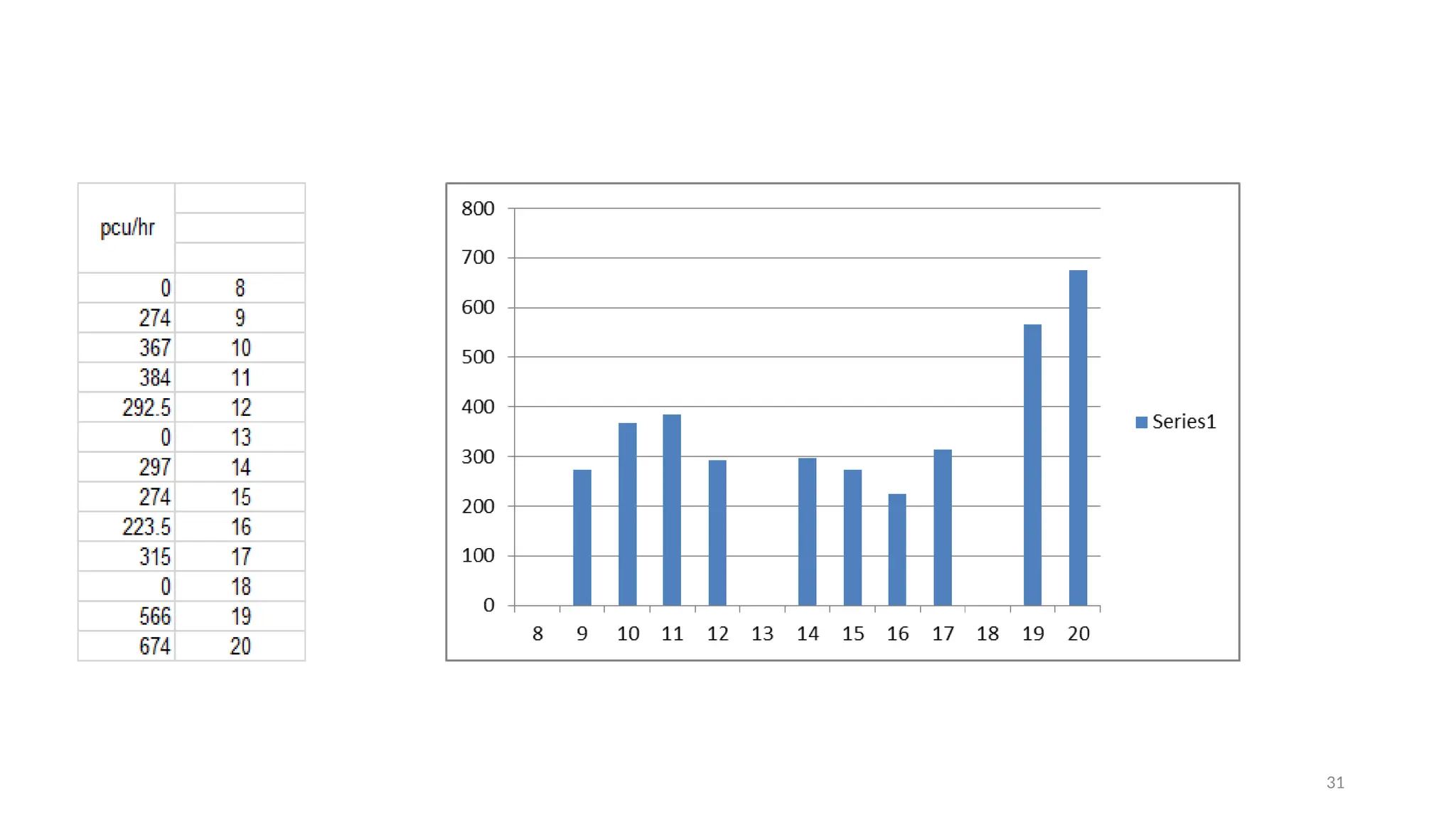
3. Name of road = Nyaymandir to Akota
31
32
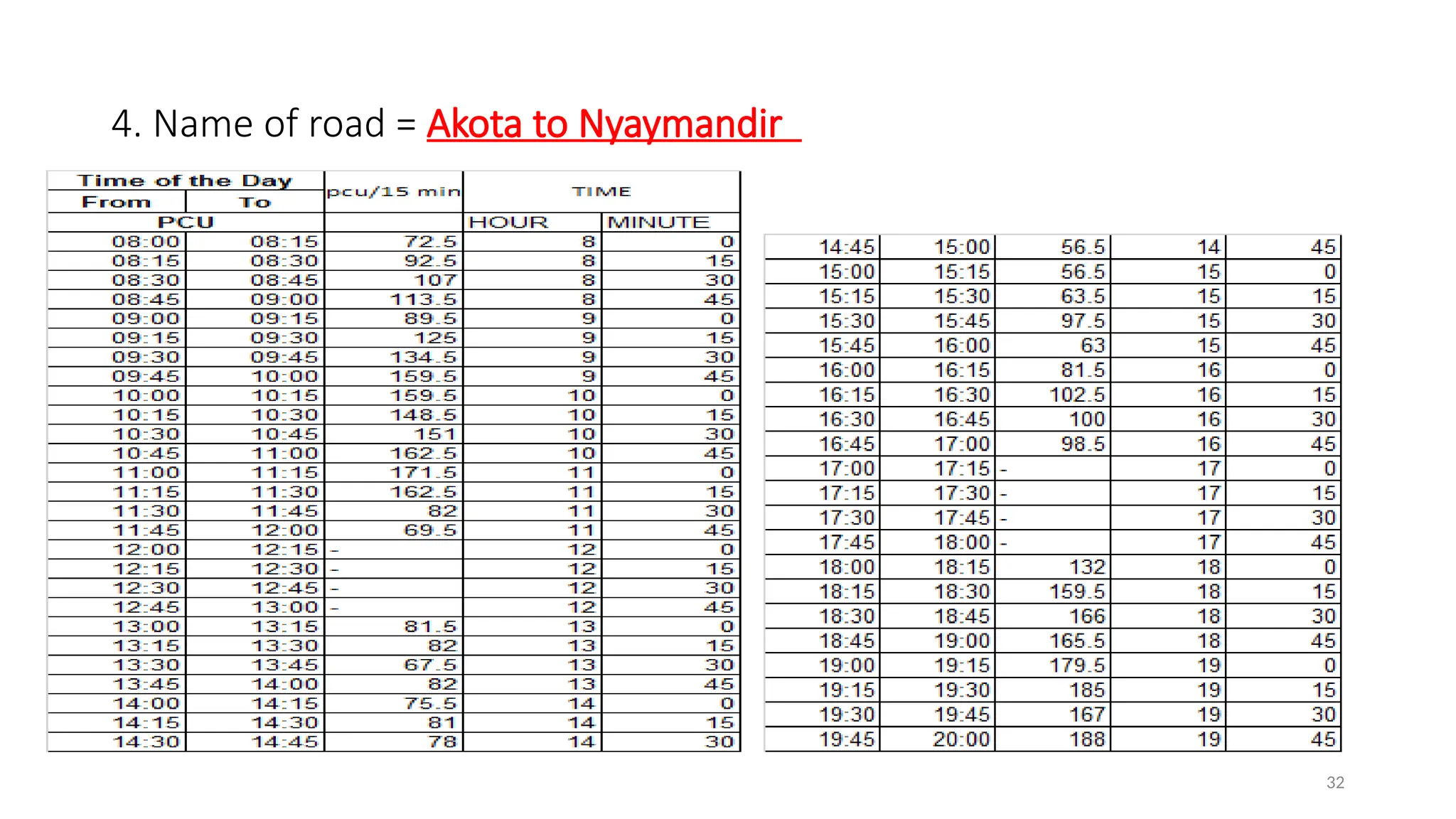
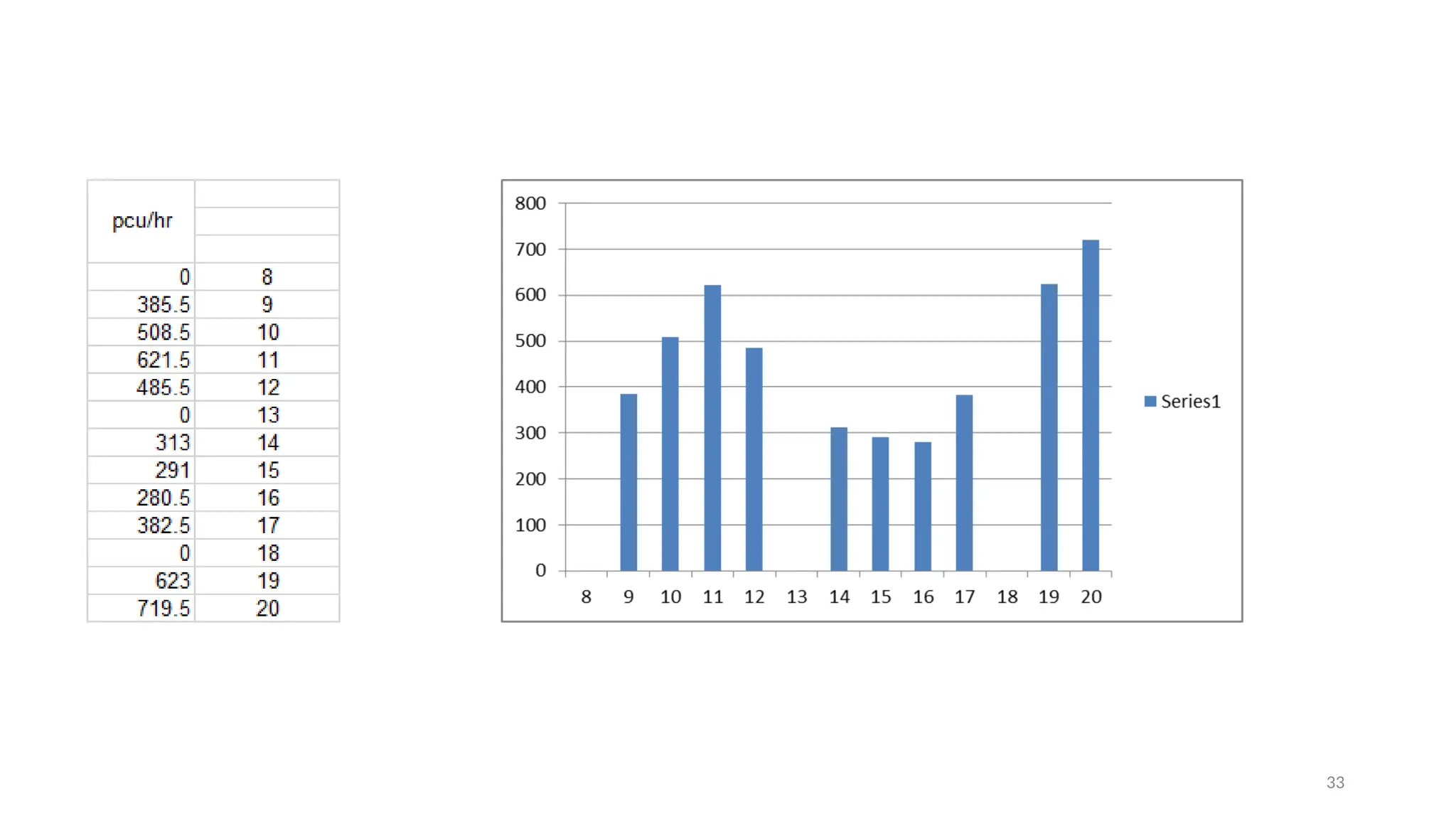
4. Name of road = Akota to Nyaymandir
33
34
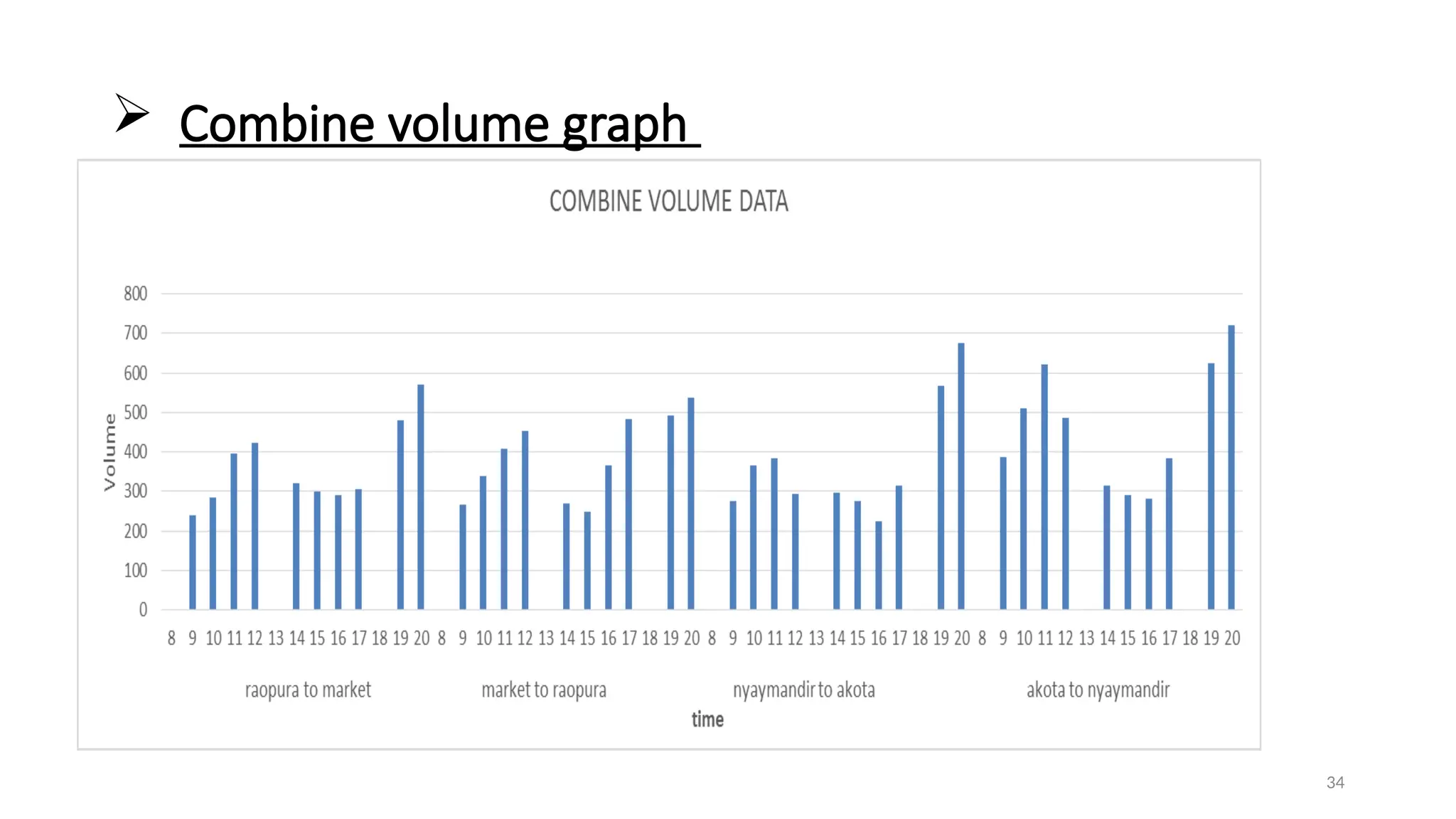
 Combine volume graph
35
 REFERENCES
• 1. B. R. Marwah, Bhuvanesh Singh, “Level of Service Classification for
Urban Heterogeneous Traffic a Case Study of Kanapur Metropolis”.
• 2. C. Jotin Khisty, B. Kent Lall, “Transportation Engineering”,Third
Edition Prentice Hall of India Private Limited New Delhi 2008.
• 3. Dr. Satish Chandra, “Capacity Estimation Procedure for Two Lane
Roads Under Mixed Traffic Condition”, Paper no 498.
• 4. Dr. V. Thamizh Arasan, G. Dhivya, “Measuring Heterogeneous
Traffic Flow Density”, World Academy of Science, Engineering and
Technology 22, 2008.
36
THANK YOU

DCV SEM 5 PROJECT PPT FORMAT........pptx

  • 1.
    1 A Case StudyOf Traffic Flow Pattern Study On Weekends (Dandiya Bazar Crossing Road, Vadodara) • Parmar Dipak 2102105502 • Solanki Jignesh 2102105504 • Prajapati Mahesh 2102105505 • Gohil Vashant 2102105509 Guided by :Proff. Chirag R Sindhav Prepared by :- Enrollment no :- Civil Engg. Dept. KSDS
  • 2.
    2 INTRODUCTION Comparatively urbanization ismoderate in India. The urban population has grown from ten percent in 1901 to twenty eight percent in 2001.  The skewed distribution of the urban population amongst a few cities is a matter of concern to the planners and administrators of urban infrastructure. Nearly seventy percent of the urban population is located in Class-I cities (population of one hundred thousand and more). Further 38 percent of the total urban population is located in metropolitan cities (population of one million and more) numbering about thirty-five.
  • 3.
    3 INTRODUCTION • This heavyconcentration of population in a few centers has resulted in the expansion of cities in density as well as area. With the increase in population and economic activities the travel demand has increased many folds. • The inadequate public transport and the easy availability of financing facilities for private vehicles have resulted in increased vehicle ownership levels and their usage • Further, the changes in urban form and structure in terms of lad use, density of population and concentration of activities have changed the travel pattern. In other words the traffic problems are increasing in the cities in general and the situation is becoming complex especially in core areas of the city
  • 4.
    4 Abstract : The revolutionin the automobile industry and liberalised economy has led to tremendous increase in the vehicle ownership levels. This has resulted in changing traffic characteristics on road network. In this project an attempt has been made to analyse the changing traffic composition trends, speed characteristics and travel patterns by taking few case studies.
  • 5.
    5 Major Problems ofTraffic : • Problem 1: Citizens not using public transport and citizens not aware about bus timings and location. • Problem 2: Traffic and congestion on roads. • Problem 3: Traffic signals not being managed properly. • Problem 4: Emergency vehicles like Ambulance stuck in traffic jams. • Problem 5: Parking problem.
  • 6.
    6 Sr no. Topicname Author Publisher year 1. Sustainable Traffic Improvement for Urban Road Intersections of Developing Countries: A Case Study of Ettumanoor, India Geethu Lala, Divya L. G.a, Nithin K. J.a, Susan Mathewa, Bennet Kuriakosea aMangalam College of Engineering, Ettumanoor 686631, India Global Colloquium in Recent Advancement and Effectual Researches in Engineering, Science and Technology 2005 2. Road Traffic Congestion Monitoring and Measurement using Active RFID and GSM Technology Koushik Mandal, Arindam Sen, Abhijnan Chakraborty, Siuli Roy Pervcom Consulting Pvt Ltd, Jodhpur Park, Kolkata 700068, India 2001
  • 7.
    7 Sr no. Topicname Author Publisher year 3. Traffic charectaristic of india Dr. Santosh A.JALIHAL Scientist, Transportation Planning and Engineering Central Road Research Institute, New Delhi Central Road Research Institute, New Delhi 2004 4. Central Road Research Institute, New Delhi Akhilesh Kumar Maurya Graduate Student Department of Civil Engineering, Indian Institute of Technology, Kanpur.INDIA. Indian Institute of Technology, Kanpur – 208016, INDIA 2001 5. Traffic Improvement for Urban Road Intersection, Surat Sharukh Marfani, Dharmkumar Shihora, Chirag Kanthariya, Harshal Kansara F.E.T.R, Bardoli, Surat 1998
  • 8.
    8 sr. no. Topicname Author Publisher year 1. Intelligent Transport Systems for Indian Cities Rijurekha Sen, Bhaskaran Raman Indian Institute of Technology, Bombay 2. Measuring Urban Traffic Congestion Amudapuram Mohan Rao, Kalaga Ramachandra Rao Central Road Research Institute, Mathura Road, PO CRRI, New Delhi - 110 020, India 2003 3. Congestion costs incurred on Indian Roads Neema Davis, Harry Raymond Joseph,Krishna Jagannathan Department of Electrical Engineering, Indian Institute of Technology Madras, Chennai
  • 9.
    9 Sr no. Topicname Author publisher year 4. Traffic Volume And Accident Studies On NH-22 Between Solan And Shimla, India Rajiv Ganguly, PhD Ashok Kumar Gupta, PhD Mudit Mishra, M.Tech Department of Civil Engineering, Jaypee University of Information Technology, Waknaghat, India 5. The impact of traffic-flow patterns on air quality in urban street canyons Thaker P, Gokhale S Department of Civil Engineering, Indian Institute of Technology Guwahati, Guwahati, 781039, Assam, India 2015
  • 10.
    10 Sr no. Topicname Author Publisher year 1. Accurate Speed and Density Measurement for Road Traffic in India Rijurekha Sen Andrew Cross Aditya Vashistha Venkata N. Padmanabhan Edward Cutrell and William Thies IIT Bombay 2011 2. Traffic census and traffic volume mesurements in india Faheem Ahmed Malik , Mansoor Ahmed Lone , Riyaz Ahmed Qasab , Misba Gul Department of Civil Engineering, IUST Awantipora, J&K India 3. Traffic Analysis and Road Accidents E. Elangovan, D. Jebaselwin Gladson, Dr. K. Gunasekaran, S. Kalaanidhi, K. Karthiga Research Scholar, Department of Geography, Osmania University, Hyderabad, India.
  • 11.
    11 Sr no. Topicname Author Publisher year 4. Traffic Flow Characteristics using Probe Vehicles E. Elangovan, D. Jebaselwin Gladson, Dr. K. Gunasekaran, S. Kalaanidhi, K. Karthiga Division of Transportation Engineering, Anna University, Chennai 5. THE URBAN TRANSPORT SYSTEMS AND CONGESTION M. Absar Alam and Faisal Ahmed Ministry of Road Transport and Highways. 2011
  • 12.
    12 Sr no. Topicname Author Publisher year 1. Traffic characteristics, travel patterns, heterogeneous traffic in india Dr. Santosh A.JALIHAL Scientist, Dr.T.S. Reddy Director grade Scientist. Proceedings of the Eastern Asia Society for Transportation Studies 2. Congestion costs incurred on Indian Roads Neema Davis, Harry Raymond Joseph, Gaurav Raina, Krishna Jagannathan Department of Electrical Engineering, Indian Institute of Technology Madras, Chennai 3. The Sustainable Traffic Improvement for Urban Road Intersections of Developing Countries Geethu Lala, Divya L. G.a , Nithin K. J.a , Susan Mathewa , Bennet Kuriakose Global Colloquium in Recent Advancement and Effectual Researches in Engineering, Science and Technology 2016
  • 13.
    13 Sr no. Topicname Author Publisher year 4. The Traffic Management for Rectification of Congestion on a Road Stretch Chander Mohan Kansal , Er. Sushant Gajbhiye Civil Engineering Department, GVIET Banur College/ PTU University , India 5. The Methodology for simulating heterogeneous traffic on expressways in developing countries B.Ponnu & s.narula Traffic Engineering Highway Research Bulletin Indian Roads Congress 2016
  • 14.
    14  Study Area(Dandia Bazar Cross road)
  • 15.
  • 16.
  • 17.
    17  Traffic volumestudy • PHOTOS:
  • 18.
    18 METHODOLOGY • Properly checkout methodology for the study is essential to complete task according to objectives of the thesis in fig. below shows various stages of the methodology adopted for the present study. • The methodology adopted in the present study is illustrated step by step below. • The first step is the identification of the problem followed by definition of the problem. The problem of traffic characterization and flow behaviour for urban road is identified and defined considering two arterial and sub arterial roads midblock sections • Collect data for speed and volume by using of 12 hours vehicles count on morning and evening and Inventory study
  • 19.
  • 20.
    20  Procedure ofdata collection Area where the traffic volume data collected : Dadiya bazar crossing Time duration : 8:00 AM TO 8:00 PM (There are 15 minute interval in every hour)
  • 21.
    21 Data was collectedin 2 wheeler, 3 wheeler, 4 wheeler, bus/truck, and L.C.V categories individually After that PCU is calculated at every 1 hour.
  • 22.
    22  Traffic volumedata 1. Name of road = Raopura To Market
  • 23.
    23 2. Name ofroad = Market To Raopura
  • 24.
    24 3. Name ofroad = Akota To Nyaymandir
  • 25.
    25 4. Name ofroad = Nyaymandir To Akota
  • 26.
    26  Traffic volumedata analysis 1. Name od road = Raopura To market
  • 27.
  • 28.
    28 2. Name ofroad = Market to raopura
  • 29.
  • 30.
    30 3. Name ofroad = Nyaymandir to Akota
  • 31.
  • 32.
    32 4. Name ofroad = Akota to Nyaymandir
  • 33.
  • 34.
  • 35.
    35  REFERENCES • 1.B. R. Marwah, Bhuvanesh Singh, “Level of Service Classification for Urban Heterogeneous Traffic a Case Study of Kanapur Metropolis”. • 2. C. Jotin Khisty, B. Kent Lall, “Transportation Engineering”,Third Edition Prentice Hall of India Private Limited New Delhi 2008. • 3. Dr. Satish Chandra, “Capacity Estimation Procedure for Two Lane Roads Under Mixed Traffic Condition”, Paper no 498. • 4. Dr. V. Thamizh Arasan, G. Dhivya, “Measuring Heterogeneous Traffic Flow Density”, World Academy of Science, Engineering and Technology 22, 2008.
  • 36.