TRANSPIRATION
EXPERIMENT
Y E A R 8 – B O D Y S Y S T E M S A N D S U P P O RT
AIM & HYPOTHESIS
• Aim: To observe the
transpiration pathway in a
celery plant.
• Hypothesis:
You need to make your own
hypothesis. This should
include where you think the
water will enter the celery,
what path will it take and
where it will exit the plant.
EQUIPMENT
Part 1:
• Celery
• Beaker
• Food colouring (not
green)
• Water
• Knife/Scissors (teacher
use only)

Part 2:
• Scalpel
• Glass slide
• Cover slip
• Microscope
• Drop of water
RISK ASSESSMENT
List at least 3 of the risks involved in conducting this
experiment, consider the equipment that we will be using and
your personal safety at all times.
Risk

Injury

Prevention
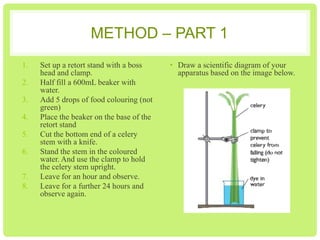
METHOD – PART 1
1.

2.
3.
4.

5.
6.
7.
8.

Set up a retort stand with a boss
head and clamp.
Half fill a 600mL beaker with
water.
Add 5 drops of food colouring (not
green)
Place the beaker on the base of the
retort stand
Cut the bottom end of a celery
stem with a knife.
Stand the stem in the coloured
water. And use the clamp to hold
the celery stem upright.
Leave for an hour and observe.
Leave for a further 24 hours and
observe again.

• Draw a scientific diagram of your
apparatus based on the image below.
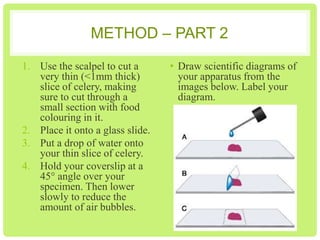
METHOD – PART 2
1. Use the scalpel to cut a
very thin (<1mm thick)
slice of celery, making
sure to cut through a
small section with food
colouring in it.
2. Place it onto a glass slide.
3. Put a drop of water onto
your thin slice of celery.
4. Hold your coverslip at a
45° angle over your
specimen. Then lower
slowly to reduce the
amount of air bubbles.
RESULTS
Part 1
• Draw a picture of what your celery looked like after you
passed the food dye through the plant.
• Explain what you saw
Part 2
• Draw a picture of what you could see in the field of view of
your microscope.
• Explain what you saw.
DISCUSSION
1. Why would you not use green food dye in this experiment?
2. Why do you think you held the cover slip at a 45° angle over
your specimen?
3. List any improvements you could have made to this
experiment and describe how it would have improved the
validity, accuracy or reliability?
CONCLUSION
Write in your Google doc:
• Where the water will
entered the celery,
• What path it took and
• Where it exited the plant.
Add the next sentence to
your conclusion, using the
appropriate word:
• This supports/rejects your
hypothesis.

Transpiration experiment

  • 1.
    TRANSPIRATION EXPERIMENT Y E AR 8 – B O D Y S Y S T E M S A N D S U P P O RT
  • 2.
    AIM & HYPOTHESIS •Aim: To observe the transpiration pathway in a celery plant. • Hypothesis: You need to make your own hypothesis. This should include where you think the water will enter the celery, what path will it take and where it will exit the plant.
  • 3.
    EQUIPMENT Part 1: • Celery •Beaker • Food colouring (not green) • Water • Knife/Scissors (teacher use only) Part 2: • Scalpel • Glass slide • Cover slip • Microscope • Drop of water
  • 4.
    RISK ASSESSMENT List atleast 3 of the risks involved in conducting this experiment, consider the equipment that we will be using and your personal safety at all times. Risk Injury Prevention
  • 5.
    METHOD – PART1 1. 2. 3. 4. 5. 6. 7. 8. Set up a retort stand with a boss head and clamp. Half fill a 600mL beaker with water. Add 5 drops of food colouring (not green) Place the beaker on the base of the retort stand Cut the bottom end of a celery stem with a knife. Stand the stem in the coloured water. And use the clamp to hold the celery stem upright. Leave for an hour and observe. Leave for a further 24 hours and observe again. • Draw a scientific diagram of your apparatus based on the image below.
  • 6.
    METHOD – PART2 1. Use the scalpel to cut a very thin (<1mm thick) slice of celery, making sure to cut through a small section with food colouring in it. 2. Place it onto a glass slide. 3. Put a drop of water onto your thin slice of celery. 4. Hold your coverslip at a 45° angle over your specimen. Then lower slowly to reduce the amount of air bubbles.
  • 7.
    RESULTS Part 1 • Drawa picture of what your celery looked like after you passed the food dye through the plant. • Explain what you saw Part 2 • Draw a picture of what you could see in the field of view of your microscope. • Explain what you saw.
  • 8.
    DISCUSSION 1. Why wouldyou not use green food dye in this experiment? 2. Why do you think you held the cover slip at a 45° angle over your specimen? 3. List any improvements you could have made to this experiment and describe how it would have improved the validity, accuracy or reliability?
  • 9.
    CONCLUSION Write in yourGoogle doc: • Where the water will entered the celery, • What path it took and • Where it exited the plant. Add the next sentence to your conclusion, using the appropriate word: • This supports/rejects your hypothesis.