Starting in the Name of Allah,
The Most Beneficent, The Most Merciful
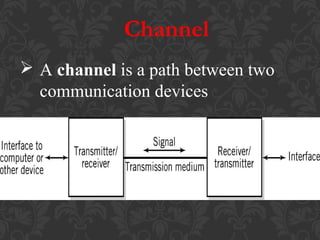
Channel
 A channel is a path between two
communication devices
Characteristics
 Signaling transmission method
 Medium used
 Bandwidth: amount of data transmitted
in a fixed amount of time
 Direction(s) in which signal can flow
 Noise, attenuation, and distortion
characteristics
Signaling transmission method
Analog: continuous varying waveforms
to carry data
Digital:
a.Two different values of electrical
voltage or current
b.On/off light source
c.Frequently preferred because less
susceptible to noise and interference
Directions
 Point to point channels
a. Simplex: channel passes data in one
direction only
b. Half-duplex: transmits data one direction
at a time (walkie-talkie)
c. Full-duplex: transmits data in both
directions simultaneously (telephone)
Channel Organization
 Multipoint: broadcasts messages to all
connected receivers larger number of recievers
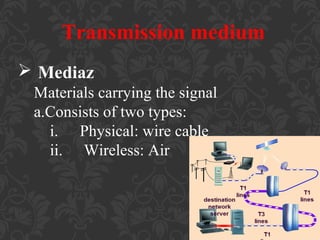
Transmission medium
 Mediaz
Materials carrying the signal
a.Consists of two types:
i. Physical: wire cable
ii. Wireless: Air
Physical Transmission Media
 Twisted-pair cable
 Coaxial cable

 Fiber-optics
Twisted-pair cable
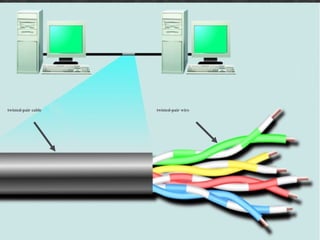
 Cabling is a type of wiring in which two
conductors of a single circuit are twisted
together for the purposes of canceling out
electromagnetic interference (EMI) from
external sources
Twisted-pair cable
c
twisted-pair cable

twisted-pair wire
Coaxial cable
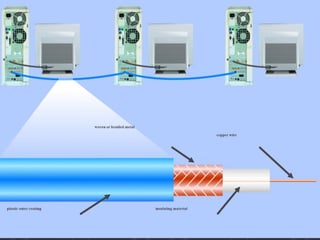
 A type of cable that has an inner
conductor surrounded by a tubular
insulating layer, surrounded by a tubular
conducting shield. Many coaxial cables
also have an insulating outer sheath or
jacket.
Fiber-optics
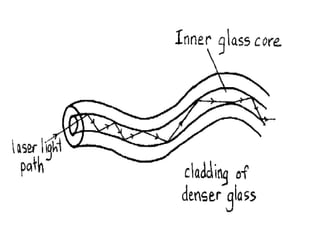
 Its a flexible, transparent fiber made of
high quality glass (silica) or plastic,
slightly thicker than a human hair. It can
function as a waveguide, or “light
pipe”, to transmit light between the two
ends of the fiber
Fiber-optics
Fiber-optics
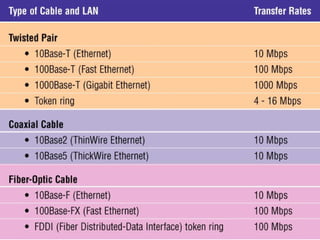
 Optical fibers are widely used in fiberoptic communications, which permits
transmission over longer distances and at
higher bandwidths (data rates) than other
forms of communication. Fibers are used
instead of metalwires because signals
travel along them with less loss and are
also
immune
to electromagnetic
interference.
Fiber-optics
Wireless Transmission Media


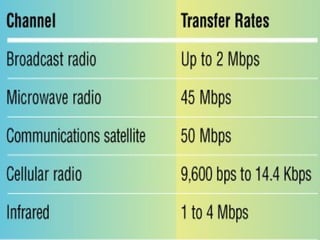
Broadcast Radio
a. Distribute signals through the
air over long distance
b. Uses an antenna
c. Typically for stationary
locations
d. Can be short range
Wireless Transmission Media
 Cellular Radio
a. A form of broadcast radio
used for mobile
communication
b. High frequency radio waves to
transmit voice or data
Wireless Transmission Media
 Microwaves

a. Radio waves providing high
speed transmission
b. They are point-to-point (can’t be
obstructed)
c. Used for satellite communication
Wireless Transmission Media
 Infrared (IR)

a. Wireless transmission media that
sends signals using infrared lightwaves
Wireless Transmission Media
 Infrared (IR)

a. Wireless transmission media that
sends signals using infrared lightwaves
Communication channels.ppt

Communication channels.ppt

  • 2.
    Starting in theName of Allah, The Most Beneficent, The Most Merciful
  • 3.
    Channel  A channelis a path between two communication devices
  • 4.
    Characteristics  Signaling transmissionmethod  Medium used  Bandwidth: amount of data transmitted in a fixed amount of time  Direction(s) in which signal can flow  Noise, attenuation, and distortion characteristics
  • 5.
    Signaling transmission method Analog:continuous varying waveforms to carry data Digital: a.Two different values of electrical voltage or current b.On/off light source c.Frequently preferred because less susceptible to noise and interference
  • 6.
    Directions  Point topoint channels a. Simplex: channel passes data in one direction only b. Half-duplex: transmits data one direction at a time (walkie-talkie) c. Full-duplex: transmits data in both directions simultaneously (telephone)
  • 7.
    Channel Organization  Multipoint:broadcasts messages to all connected receivers larger number of recievers
  • 8.
    Transmission medium  Mediaz Materialscarrying the signal a.Consists of two types: i. Physical: wire cable ii. Wireless: Air
  • 9.
    Physical Transmission Media Twisted-pair cable  Coaxial cable  Fiber-optics
  • 10.
    Twisted-pair cable  Cablingis a type of wiring in which two conductors of a single circuit are twisted together for the purposes of canceling out electromagnetic interference (EMI) from external sources
  • 11.
  • 12.
    Coaxial cable  Atype of cable that has an inner conductor surrounded by a tubular insulating layer, surrounded by a tubular conducting shield. Many coaxial cables also have an insulating outer sheath or jacket.
  • 14.
    Fiber-optics  Its aflexible, transparent fiber made of high quality glass (silica) or plastic, slightly thicker than a human hair. It can function as a waveguide, or “light pipe”, to transmit light between the two ends of the fiber
  • 15.
  • 16.
    Fiber-optics  Optical fibersare widely used in fiberoptic communications, which permits transmission over longer distances and at higher bandwidths (data rates) than other forms of communication. Fibers are used instead of metalwires because signals travel along them with less loss and are also immune to electromagnetic interference.
  • 17.
  • 18.
    Wireless Transmission Media  BroadcastRadio a. Distribute signals through the air over long distance b. Uses an antenna c. Typically for stationary locations d. Can be short range
  • 19.
    Wireless Transmission Media Cellular Radio a. A form of broadcast radio used for mobile communication b. High frequency radio waves to transmit voice or data
  • 20.
    Wireless Transmission Media Microwaves a. Radio waves providing high speed transmission b. They are point-to-point (can’t be obstructed) c. Used for satellite communication
  • 21.
    Wireless Transmission Media Infrared (IR) a. Wireless transmission media that sends signals using infrared lightwaves
  • 22.
    Wireless Transmission Media Infrared (IR) a. Wireless transmission media that sends signals using infrared lightwaves