Data transmission rates depend on three main factors: available bandwidth, the signal used, and noise levels. Bandwidth refers to the range of frequencies a channel can pass and is measured in Hertz, while transmission rate is measured in bits per second. Digital data uses discrete states represented by bits, while analog data is continuous. Common digital transmission systems include telephone lines, Ethernet, cable modems, DSL, wireless networks, and optical fiber, with rates ranging from kilobits per second to several gigabits per second. Analog transmission faithfully reproduces all signal details but quality degrades with each repeater, while digital only needs to reproduce discrete levels.
Data transmission
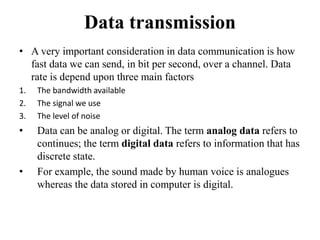
• Avery important consideration in data communication is how
fast data we can send, in bit per second, over a channel. Data
rate is depend upon three main factors
1. The bandwidth available
2. The signal we use
3. The level of noise
• Data can be analog or digital. The term analog data refers to
continues; the term digital data refers to information that has
discrete state.
• For example, the sound made by human voice is analogues
whereas the data stored in computer is digital.
3.
Digital transmission
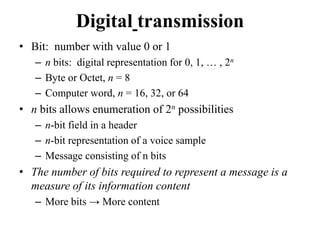
• Bit:number with value 0 or 1
– n bits: digital representation for 0, 1, … , 2n
– Byte or Octet, n = 8
– Computer word, n = 16, 32, or 64
• n bits allows enumeration of 2n possibilities
– n-bit field in a header
– n-bit representation of a voice sample
– Message consisting of n bits
• The number of bits required to represent a message is a
measure of its information content
– More bits → More content
4.
Bit Rates ofDigital Transmission
Systems
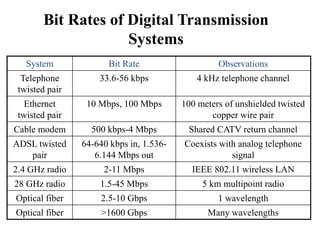
System Bit Rate Observations
Telephone
twisted pair
33.6-56 kbps 4 kHz telephone channel
Ethernet
twisted pair
10 Mbps, 100 Mbps 100 meters of unshielded twisted
copper wire pair
Cable modem 500 kbps-4 Mbps Shared CATV return channel
ADSL twisted
pair
64-640 kbps in, 1.536-
6.144 Mbps out
Coexists with analog telephone
signal
2.4 GHz radio 2-11 Mbps IEEE 802.11 wireless LAN
28 GHz radio 1.5-45 Mbps 5 km multipoint radio
Optical fiber 2.5-10 Gbps 1 wavelength
Optical fiber >1600 Gbps Many wavelengths
5.
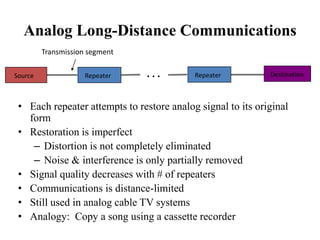
Analog Long-Distance Communications
•Each repeater attempts to restore analog signal to its original
form
• Restoration is imperfect
– Distortion is not completely eliminated
– Noise & interference is only partially removed
• Signal quality decreases with # of repeaters
• Communications is distance-limited
• Still used in analog cable TV systems
• Analogy: Copy a song using a cassette recorder
Source DestinationRepeater
Transmission segment
Repeater. . .
6.
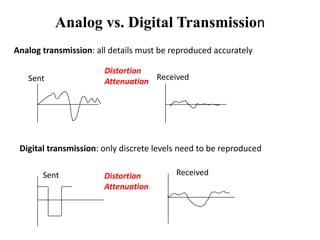
Analog vs. DigitalTransmission
Analog transmission: all details must be reproduced accurately
Sent
Sent
Received
Received
Distortion
Attenuation
Digital transmission: only discrete levels need to be reproduced
Distortion
Attenuation
7.
Bandwidth
• One characteristicsthat measures network
performance is Bandwidth. However this term can
be used in two different context bandwidth in hertz
and in bits per second.
• Bandwidth in hertz
• Bandwidth in bits per second
8.
• Bandwidth inhertz is the range of frequencies contained in a
composite signal or the range of frequencies a channel can
pass. For example, we can say the bandwidth of a subscriber
telephone line is 4khz.
• Bandwidth in bits per second
the term bandwidth can also refer to the number of bits per
second that a channel, a link or even a network can transmit.
For example, one can say the bandwidth of fast internet
network (or the link in this network) is a maximum of 100
Mbps. This means that this network can send 100 Mbps.