By
ABHIJIT
AMIT
DAMAN
HIMANSHU
PARMEET
 On any network, the various entities must

communicate through some form of media.
 Just as humans can communicate through telephone

wires or sound waves in the air, computers can
communicate through cables, light, and radio waves.
• Transmission media enables computers to send and

receive messages but do not guarantee that the
messages will be understood.

2
 Communication is possible only if information is

encoded in a signal, and the signal is carried on a
transmission ,the characteristics of the signal and of
the medium both determine the quality of the
communication medium.
 There are two main groups of transmission media,

namely the guided medium and the unguided
medium (wireless medium).

3
 For the guided medium, there is a physical path (such

as a cable) for electromagnetic wave propagation.

 For the unguided medium, however, the

electromagnetic wave is transmitted through air,
water, or vacuum.

4
CHARACTERISTICS
 A good transmission medium should provide

communication with good quality at long distance.
 For voice communication, quality of communication is
determined by the voice quality.
 For data communication, however, the quality of
communication is mainly determined by the effective
data rate of communication.

5


Communication bandwidth of the medium

 Interference
 The transmission impairments
6
 The bandwidth of a medium determines the

signal frequencies that can be carried in the
medium.
 A wide bandwidth, or broadband, usually

allows communication at a higher data rate.

7
 Attenuation
 Distortion during signal propagation
 Noises.

8
9
Transmission
Media
Guided
Media

Twisted
Pair
Cable

Coaxial
Cable

Unguided
Media

FiberOptic
Cable

Radio

Microwave

Satellite

10
Guided media includes everything that
‘guides’ the transmission. That usually
takes the form of some sort of a wire.
Usually copper, but can also be optical
fibre.

11
• A transmission medium consisting of pairs
of twisted copper wires.
• We can transmit 1 Mbps over short distances
(less than 100m).
• They are mainly used to transmit analog
signals, but they can be used for digital
signals.
12
The twisted pair cable can be broadly categorized

into the following two types
• Shielded Twisted Pair (STP) Cable
the pair is wrapped with metallic foil or braid to

insulate the pair from electromagnetic interference
• Unshielded Twisted Pair (UTP) Cable
each wire is insulated with plastic wrap, but the pair is
encased in an outer covering
13
STP (shielded twisted pair)

UTP (unshielded twisted pair)

14
• In its simplest form, coaxial consists of a
core made of solid copper surrounded by
insulation, a braided metal shielding, and
an outer cover.

• A transmission medium consisting of
thickly insulated copper wire, which can
transmit a large volume of data than twisted
wire.
15
16
• Optical fiber consists of a glass core,
surrounded by a glass cladding with
slightly lower refractive index.
• In most networks fiber-optic cable is
used as the high-speed backbone, and
twisted wire and coaxial cable are used to
connect the backbone to individual
devices.
17
18
Unguided media is still ‘media’ (stuff that
signal travels though). The trick is that the
media is usually not directional, like air,
space, etc. Because the effect is usually
much wider than with guided media, there
have been a lot of regulation, licensing,
and standardization of transmissions via
unguided media.
19
• Wireless transmission that sends signals
through air or space without any physical
wire.
• Common uses of wireless data
transmission include pagers, cellular
telephones, microwave transmissions,
communication satellites, mobile data
networks, personal digital assistants,
television remote controls.

20
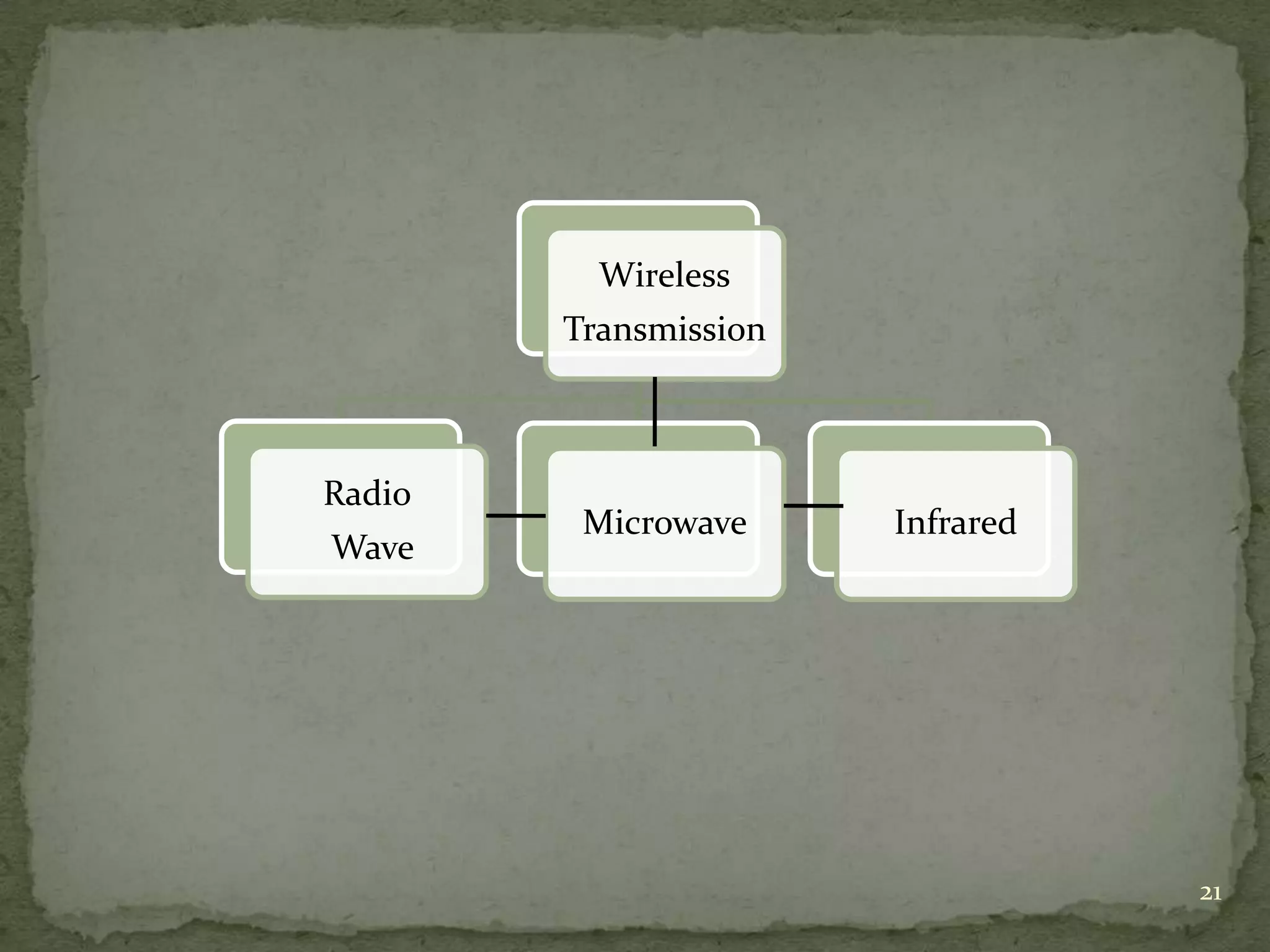
Wireless
Transmission

Radio
Wave

Microwave

Infrared

21
Radio waves are used for multicast
communications, such as radio and television, and
paging systems. They can penetrate through walls.
Highly regulated. Use Omni directional antennas

Omni directional antenna
22
Microwaves are used for unicast communication
such as cellular telephones, satellite networks,
and wireless LANs.
Higher frequency ranges cannot penetrate walls.
Use directional antennas - point to point line of sight
communications

Infrared signals can be used for shortrange communication in a closed area using
line-of-sight propagation.

23
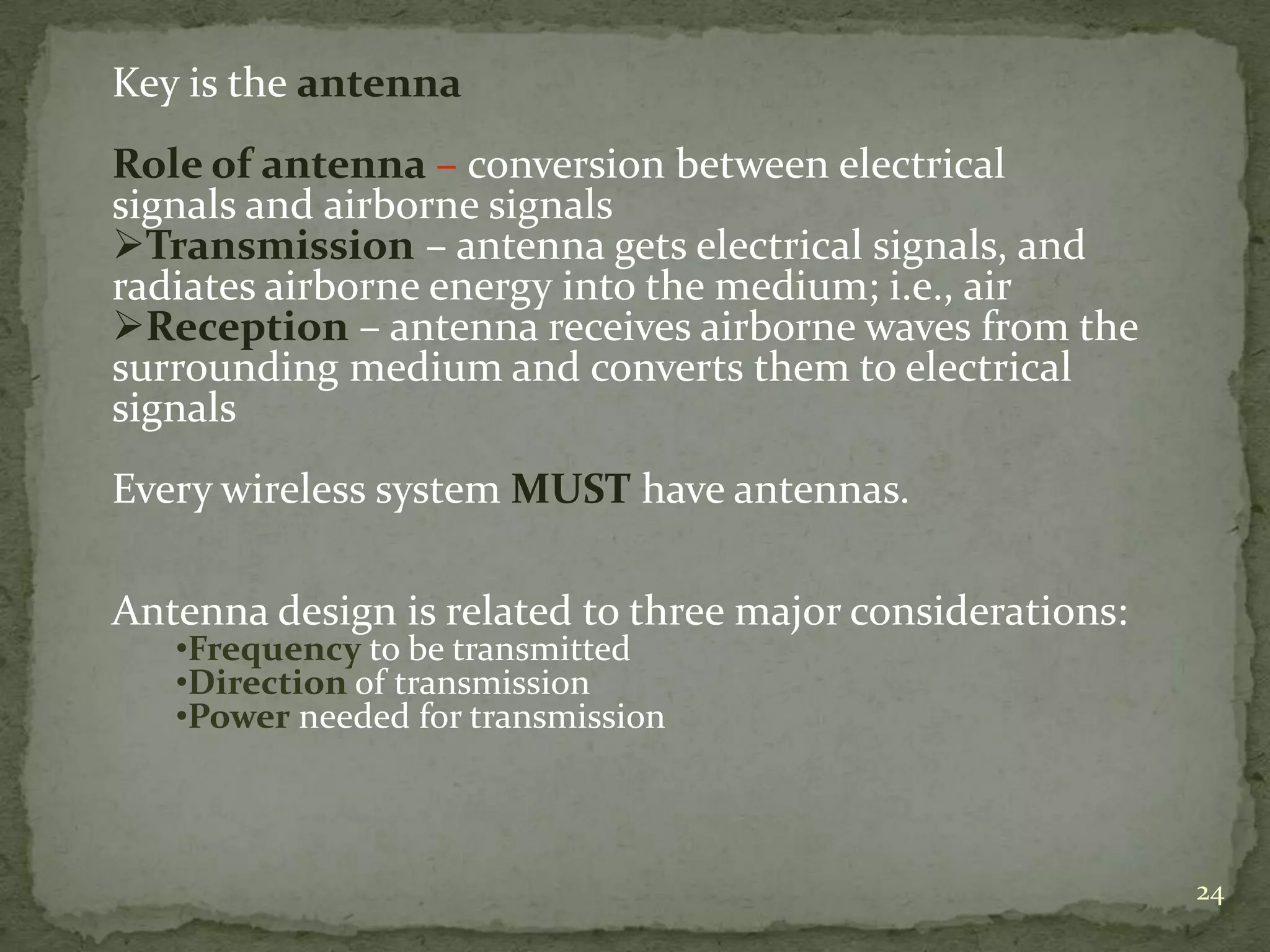
Key is the antenna
Role of antenna – conversion between electrical
signals and airborne signals
Transmission – antenna gets electrical signals, and
radiates airborne energy into the medium; i.e., air
Reception – antenna receives airborne waves from the
surrounding medium and converts them to electrical
signals

Every wireless system MUST have antennas.
Antenna design is related to three major considerations:
•Frequency to be transmitted
•Direction of transmission
•Power needed for transmission

24
 It is inexpensive and already is in use.
 Twisted wires are slow, high-speed transmission causes

interference (crosstalk).
 Limiting factors: skin effect & radiation effect.

26
 It is often used in place of twisted wire for important

links in a network because it is a faster.
 More interference-free transmission medium (speed:
200 megabits per second).
 Coaxial cable is thick, is hard to wire in many
buildings. It does not support analog conversations.

27
 Optical fibers are faster, lighter, and suitable for

transferring large amount of data.
 Fiber-optic cable is more difficult to work with, more

expensive.
 Its difficult to install them.

28
• Optical fiber cable differs from both these transmission

media in that it carries the transmitted information in
the form of a fluctuating beam of light in a glass fiber.
• Light transmission has much wider bandwidth, thus

enabling the transmission rate of hundreds of
megabits per second.

29
• Optical transmission is immune to

electromagnetic interference and crosstalk.
While others are immune to interference.

• Optical fibers have less loss of signal

strength than copper, after every 30 miles we
need to use a repeater, whereas in copper, we
should insert repeaters at an interval of 2.8
miles .

• Optical fiber is more secure, no easy tapping

on the cable, like in copper.

• But optical fibers are more expensive than

other two cables.

30
Bandwidth: The difference between
the lowest and highest frequency signals
that can be transmitted across a
transmission line or communication system.

Interference: The distortion on the
signal in transmission due to unwanted
signals from outside sources.
31
Transmission Impairments:
Attenuation, distortion, or noises that will
degrade the signal quality during
transmission.

Attenuation: The loss of a signal’s
energy when the signal is transmitted
across a medium.

Signal Distortion: Any change in a
signal during signal transmission.
32
Noises: Random signals that can be
picked up during signal transmission and
result in degradation or distortion of
data.

Trunk Circuits: The
communication circuits between two
switching offices.

33
 In summary, transmission media are essential for

communication systems. Signals that carry
information can be transmitted on a transmission
medium for communication purposes. The
transmission characteristics of the medium in use
are important because they directly affect the
communication quality. Since different types of
transmission media have different transmission
characteristics and costs, they are used in different
(and the most suited) applications.

34
35

The transmission media

  • 1.
  • 2.
     On anynetwork, the various entities must communicate through some form of media.  Just as humans can communicate through telephone wires or sound waves in the air, computers can communicate through cables, light, and radio waves. • Transmission media enables computers to send and receive messages but do not guarantee that the messages will be understood. 2
  • 3.
     Communication ispossible only if information is encoded in a signal, and the signal is carried on a transmission ,the characteristics of the signal and of the medium both determine the quality of the communication medium.  There are two main groups of transmission media, namely the guided medium and the unguided medium (wireless medium). 3
  • 4.
     For theguided medium, there is a physical path (such as a cable) for electromagnetic wave propagation.  For the unguided medium, however, the electromagnetic wave is transmitted through air, water, or vacuum. 4
  • 5.
    CHARACTERISTICS  A goodtransmission medium should provide communication with good quality at long distance.  For voice communication, quality of communication is determined by the voice quality.  For data communication, however, the quality of communication is mainly determined by the effective data rate of communication. 5
  • 6.
     Communication bandwidth ofthe medium  Interference  The transmission impairments 6
  • 7.
     The bandwidthof a medium determines the signal frequencies that can be carried in the medium.  A wide bandwidth, or broadband, usually allows communication at a higher data rate. 7
  • 8.
     Attenuation  Distortionduring signal propagation  Noises. 8
  • 9.
  • 10.
  • 11.
    Guided media includeseverything that ‘guides’ the transmission. That usually takes the form of some sort of a wire. Usually copper, but can also be optical fibre. 11
  • 12.
    • A transmissionmedium consisting of pairs of twisted copper wires. • We can transmit 1 Mbps over short distances (less than 100m). • They are mainly used to transmit analog signals, but they can be used for digital signals. 12
  • 13.
    The twisted paircable can be broadly categorized into the following two types • Shielded Twisted Pair (STP) Cable the pair is wrapped with metallic foil or braid to insulate the pair from electromagnetic interference • Unshielded Twisted Pair (UTP) Cable each wire is insulated with plastic wrap, but the pair is encased in an outer covering 13
  • 14.
    STP (shielded twistedpair) UTP (unshielded twisted pair) 14
  • 15.
    • In itssimplest form, coaxial consists of a core made of solid copper surrounded by insulation, a braided metal shielding, and an outer cover. • A transmission medium consisting of thickly insulated copper wire, which can transmit a large volume of data than twisted wire. 15
  • 16.
  • 17.
    • Optical fiberconsists of a glass core, surrounded by a glass cladding with slightly lower refractive index. • In most networks fiber-optic cable is used as the high-speed backbone, and twisted wire and coaxial cable are used to connect the backbone to individual devices. 17
  • 18.
  • 19.
    Unguided media isstill ‘media’ (stuff that signal travels though). The trick is that the media is usually not directional, like air, space, etc. Because the effect is usually much wider than with guided media, there have been a lot of regulation, licensing, and standardization of transmissions via unguided media. 19
  • 20.
    • Wireless transmissionthat sends signals through air or space without any physical wire. • Common uses of wireless data transmission include pagers, cellular telephones, microwave transmissions, communication satellites, mobile data networks, personal digital assistants, television remote controls. 20
  • 21.
  • 22.
    Radio waves areused for multicast communications, such as radio and television, and paging systems. They can penetrate through walls. Highly regulated. Use Omni directional antennas Omni directional antenna 22
  • 23.
    Microwaves are usedfor unicast communication such as cellular telephones, satellite networks, and wireless LANs. Higher frequency ranges cannot penetrate walls. Use directional antennas - point to point line of sight communications Infrared signals can be used for shortrange communication in a closed area using line-of-sight propagation. 23
  • 24.
    Key is theantenna Role of antenna – conversion between electrical signals and airborne signals Transmission – antenna gets electrical signals, and radiates airborne energy into the medium; i.e., air Reception – antenna receives airborne waves from the surrounding medium and converts them to electrical signals Every wireless system MUST have antennas. Antenna design is related to three major considerations: •Frequency to be transmitted •Direction of transmission •Power needed for transmission 24
  • 26.
     It isinexpensive and already is in use.  Twisted wires are slow, high-speed transmission causes interference (crosstalk).  Limiting factors: skin effect & radiation effect. 26
  • 27.
     It isoften used in place of twisted wire for important links in a network because it is a faster.  More interference-free transmission medium (speed: 200 megabits per second).  Coaxial cable is thick, is hard to wire in many buildings. It does not support analog conversations. 27
  • 28.
     Optical fibersare faster, lighter, and suitable for transferring large amount of data.  Fiber-optic cable is more difficult to work with, more expensive.  Its difficult to install them. 28
  • 29.
    • Optical fibercable differs from both these transmission media in that it carries the transmitted information in the form of a fluctuating beam of light in a glass fiber. • Light transmission has much wider bandwidth, thus enabling the transmission rate of hundreds of megabits per second. 29
  • 30.
    • Optical transmissionis immune to electromagnetic interference and crosstalk. While others are immune to interference. • Optical fibers have less loss of signal strength than copper, after every 30 miles we need to use a repeater, whereas in copper, we should insert repeaters at an interval of 2.8 miles . • Optical fiber is more secure, no easy tapping on the cable, like in copper. • But optical fibers are more expensive than other two cables. 30
  • 31.
    Bandwidth: The differencebetween the lowest and highest frequency signals that can be transmitted across a transmission line or communication system. Interference: The distortion on the signal in transmission due to unwanted signals from outside sources. 31
  • 32.
    Transmission Impairments: Attenuation, distortion,or noises that will degrade the signal quality during transmission. Attenuation: The loss of a signal’s energy when the signal is transmitted across a medium. Signal Distortion: Any change in a signal during signal transmission. 32
  • 33.
    Noises: Random signalsthat can be picked up during signal transmission and result in degradation or distortion of data. Trunk Circuits: The communication circuits between two switching offices. 33
  • 34.
     In summary,transmission media are essential for communication systems. Signals that carry information can be transmitted on a transmission medium for communication purposes. The transmission characteristics of the medium in use are important because they directly affect the communication quality. Since different types of transmission media have different transmission characteristics and costs, they are used in different (and the most suited) applications. 34
  • 35.