1. Introduction
2. Guided Media
I. Twisted Pair Cable
II. Co-axial Cable
III. Optical Fiber Cable
3. Unguided Media
I. Radio Waves
II. Micro Waves
III. Infrared Waves
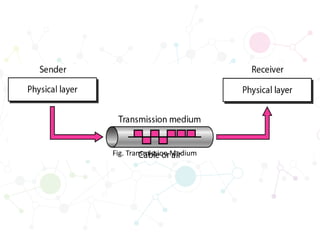
• In data communication terminology, a transmission
medium is a physical path between the transmitter and
the receiver i.e. it is the channel through which data is
sent from one place to another.
• Transmission medium is the means through which we
send our data from one place to another.
• The first layer (physical layer) of Communication
Networks OSI Seven layer model is dedicated to the
transmission media, we will study the OSI Model later.
Fig. Transmission Medium
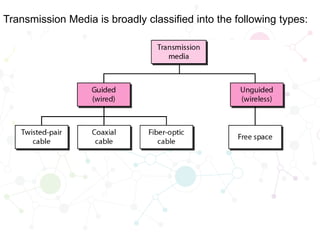
Transmission Media is broadly classified into the following types:
• Guided media, which are those that provide a conduit
from one device to another, include twisted-pair cable,
coaxial cable, and fiber-optic cable.
• Signals being transmitted are directed and confined in
a narrow pathway by using physical links
• Features:
 High Speed
 Secure
 Used for comparatively shorter distances
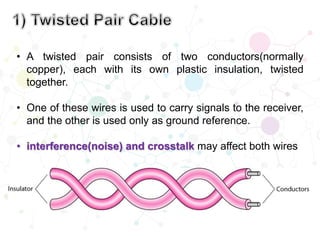
• A twisted pair consists of two conductors(normally
copper), each with its own plastic insulation, twisted
together.
• One of these wires is used to carry signals to the receiver,
and the other is used only as ground reference.
• interference(noise) and crosstalk may affect both wires
It is lightweight, cheap, can be installed easily, and they
support many different types of network. Some important
points :
• Its frequency range is 0 to 3.5 kHz.
• Typical attenuation is 0.2 dB/Km @ 1kHz.
• Typical delay is 50 µs/km.
• Repeater spacing is 2km.
Twisted Pair is of two types:
I. Unshielded Twisted Pair (UTP)
II. Shielded Twisted Pair (STP)
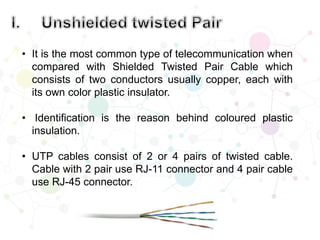
• It is the most common type of telecommunication when
compared with Shielded Twisted Pair Cable which
consists of two conductors usually copper, each with
its own color plastic insulator.
• Identification is the reason behind coloured plastic
insulation.
• UTP cables consist of 2 or 4 pairs of twisted cable.
Cable with 2 pair use RJ-11 connector and 4 pair cable
use RJ-45 connector.
Advantages
• Installation is easy
• Flexible
• Cheap
• It has high speed capacity
• 100 meter limit
• Higher grades of UTP are used in LAN technologies like
Ethernet.
Disadvantages
• Bandwidth is low when compared with Coaxial Cable
• Provides less protection from interference
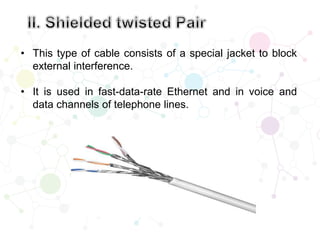
• This type of cable consists of a special jacket to block
external interference.
• It is used in fast-data-rate Ethernet and in voice and
data channels of telephone lines.
Advantages
• Easy to install
• Performance is adequate
• Can be used for Analog or Digital transmission
• Increases the signaling rate
• Higher capacity than unshielded twisted pair
• Eliminates crosstalk
Disadvantages
• Difficult to manufacture
• Heavy
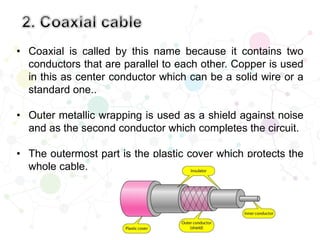
• Coaxial is called by this name because it contains two
conductors that are parallel to each other. Copper is used
in this as center conductor which can be a solid wire or a
standard one..
• Outer metallic wrapping is used as a shield against noise
and as the second conductor which completes the circuit.
• The outermost part is the plastic cover which protects the
whole cable.
Here the most common coaxial standards.
• 50-Ohm RG-7 or RG-11 : used with thick Ethernet.
• 50-Ohm RG-58 : used with thin Ethernet
• 75-Ohm RG-59 : used with cable television
• 93-Ohm RG-62 : used with ARCNET.
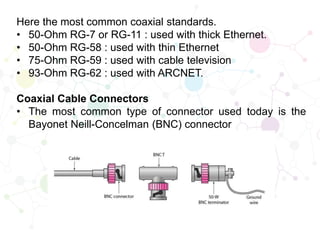
Coaxial Cable Connectors
• The most common type of connector used today is the
Bayonet Neill-Concelman (BNC) connector
There are two types of Coaxial cables:
1. BaseBand
• This is a 50 ohm (Ω) coaxial cable which is used for digital
transmission. It is mostly used for LAN's.
• Baseband transmits a single signal at a time with very high
speed.
• The major drawback is that it needs amplification after
every 1000 feet.
2. BroadBand
• This uses analog transmission on standard cable television
cabling.
• It transmits several simultaneous signal using different
frequencies.
• It covers large area when compared with Baseband Coaxial
Cable.
Advantages of Coaxial Cable
• Bandwidth is high
• Transmits digital signals at a very high rate of 10Mbps.
• Much higher noise immunity.
• The can span to longer distance at higher speeds as
they have better shielding when compared to twisted
pair cable
Disadvantages of Coaxial Cable
• Single cable failure can fail the entire network.
• Difficult to install and expensive when compared with
twisted pair.
• If the shield is imperfect, it can lead to grounded loop.
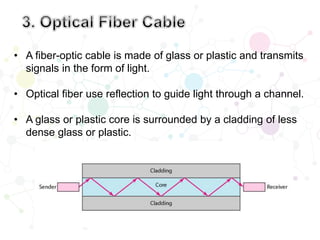
• A fiber-optic cable is made of glass or plastic and transmits
signals in the form of light.
• Optical fiber use reflection to guide light through a channel.
• A glass or plastic core is surrounded by a cladding of less
dense glass or plastic.
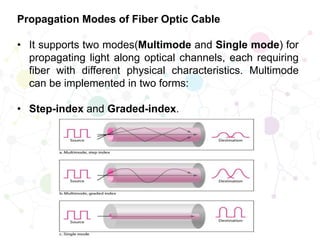
Propagation Modes of Fiber Optic Cable
• It supports two modes(Multimode and Single mode) for
propagating light along optical channels, each requiring
fiber with different physical characteristics. Multimode
can be implemented in two forms:
• Step-index and Graded-index.
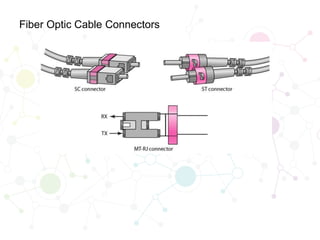
Fiber Optic Cable Connectors
Advantages :
• Higher bandwidth
• Less signal attenuation
• Immunity to electromagnetic interference
• Resistance to corrosive materials
• Light weight
• Greater immunity to tapping
Disadvantages :
• Installation and maintenance
• Unidirectional light propagation
• High Cost
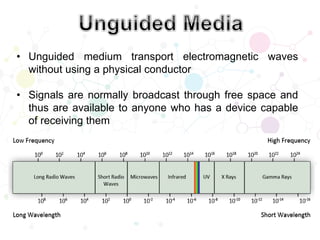
• Unguided medium transport electromagnetic waves
without using a physical conductor
• Signals are normally broadcast through free space and
thus are available to anyone who has a device capable
of receiving them
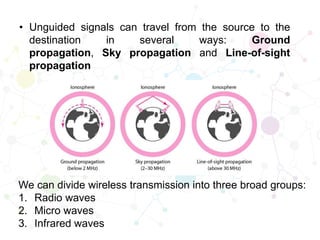
• Unguided signals can travel from the source to the
destination in several ways: Ground
propagation, Sky propagation and Line-of-sight
propagation
We can divide wireless transmission into three broad groups:
1. Radio waves
2. Micro waves
3. Infrared waves
• Electromagnetic waves ranging in frequencies between
3 KHz and 1 GHz are normally called radio waves.
• Radio waves are omnidirectional
• When an antenna transmits radio waves, they are
propagated in all directions. This means that the
sending and receiving antennas do not have to be
aligned.
• Radio waves can penetrate walls.
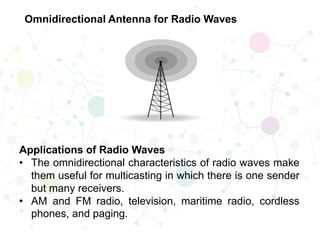
Omnidirectional Antenna for Radio Waves
Applications of Radio Waves
• The omnidirectional characteristics of radio waves make
them useful for multicasting in which there is one sender
but many receivers.
• AM and FM radio, television, maritime radio, cordless
phones, and paging.
• Electromagnetic waves having frequencies between 1
and 300 GHz are called micro waves.
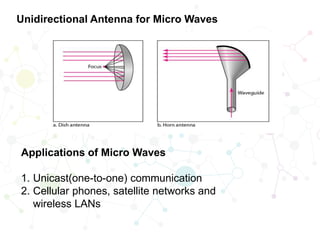
• Micro waves are unidirectional.
• The sending and receiving antennas need to be aligned
The following describes some characteristics of microwaves
propagation:
1. Microwave propagation is line-of-sight.
2. Cannot penetrate walls.
3. The microwave band is relatively wide, almost 299 GHz.
Therefore, wider sub-bands can be assigned and a high
date rate is possible.
Unidirectional Antenna for Micro Waves
Applications of Micro Waves
1. Unicast(one-to-one) communication
2. Cellular phones, satellite networks and
wireless LANs
• Infrared waves, with frequencies from 300 GHz to 400
THz, can be used for short-range communication
• Infrared waves, having high frequencies, cannot penetrate
walls
• short-range communication
Applications of Infrared Waves
• The Infrared Data Association(IrDA) has established standards
for using these signals for communication between devices
such as keyboards, mouse, PCs and printers.
• infrared remote control
Media

Media

  • 2.
    1. Introduction 2. GuidedMedia I. Twisted Pair Cable II. Co-axial Cable III. Optical Fiber Cable 3. Unguided Media I. Radio Waves II. Micro Waves III. Infrared Waves
  • 3.
    • In datacommunication terminology, a transmission medium is a physical path between the transmitter and the receiver i.e. it is the channel through which data is sent from one place to another. • Transmission medium is the means through which we send our data from one place to another. • The first layer (physical layer) of Communication Networks OSI Seven layer model is dedicated to the transmission media, we will study the OSI Model later.
  • 4.
  • 5.
    Transmission Media isbroadly classified into the following types:
  • 6.
    • Guided media,which are those that provide a conduit from one device to another, include twisted-pair cable, coaxial cable, and fiber-optic cable. • Signals being transmitted are directed and confined in a narrow pathway by using physical links • Features:  High Speed  Secure  Used for comparatively shorter distances
  • 7.
    • A twistedpair consists of two conductors(normally copper), each with its own plastic insulation, twisted together. • One of these wires is used to carry signals to the receiver, and the other is used only as ground reference. • interference(noise) and crosstalk may affect both wires
  • 8.
    It is lightweight,cheap, can be installed easily, and they support many different types of network. Some important points : • Its frequency range is 0 to 3.5 kHz. • Typical attenuation is 0.2 dB/Km @ 1kHz. • Typical delay is 50 µs/km. • Repeater spacing is 2km. Twisted Pair is of two types: I. Unshielded Twisted Pair (UTP) II. Shielded Twisted Pair (STP)
  • 9.
    • It isthe most common type of telecommunication when compared with Shielded Twisted Pair Cable which consists of two conductors usually copper, each with its own color plastic insulator. • Identification is the reason behind coloured plastic insulation. • UTP cables consist of 2 or 4 pairs of twisted cable. Cable with 2 pair use RJ-11 connector and 4 pair cable use RJ-45 connector.
  • 10.
    Advantages • Installation iseasy • Flexible • Cheap • It has high speed capacity • 100 meter limit • Higher grades of UTP are used in LAN technologies like Ethernet. Disadvantages • Bandwidth is low when compared with Coaxial Cable • Provides less protection from interference
  • 11.
    • This typeof cable consists of a special jacket to block external interference. • It is used in fast-data-rate Ethernet and in voice and data channels of telephone lines.
  • 12.
    Advantages • Easy toinstall • Performance is adequate • Can be used for Analog or Digital transmission • Increases the signaling rate • Higher capacity than unshielded twisted pair • Eliminates crosstalk Disadvantages • Difficult to manufacture • Heavy
  • 13.
    • Coaxial iscalled by this name because it contains two conductors that are parallel to each other. Copper is used in this as center conductor which can be a solid wire or a standard one.. • Outer metallic wrapping is used as a shield against noise and as the second conductor which completes the circuit. • The outermost part is the plastic cover which protects the whole cable.
  • 14.
    Here the mostcommon coaxial standards. • 50-Ohm RG-7 or RG-11 : used with thick Ethernet. • 50-Ohm RG-58 : used with thin Ethernet • 75-Ohm RG-59 : used with cable television • 93-Ohm RG-62 : used with ARCNET. Coaxial Cable Connectors • The most common type of connector used today is the Bayonet Neill-Concelman (BNC) connector
  • 15.
    There are twotypes of Coaxial cables: 1. BaseBand • This is a 50 ohm (Ω) coaxial cable which is used for digital transmission. It is mostly used for LAN's. • Baseband transmits a single signal at a time with very high speed. • The major drawback is that it needs amplification after every 1000 feet. 2. BroadBand • This uses analog transmission on standard cable television cabling. • It transmits several simultaneous signal using different frequencies. • It covers large area when compared with Baseband Coaxial Cable.
  • 16.
    Advantages of CoaxialCable • Bandwidth is high • Transmits digital signals at a very high rate of 10Mbps. • Much higher noise immunity. • The can span to longer distance at higher speeds as they have better shielding when compared to twisted pair cable Disadvantages of Coaxial Cable • Single cable failure can fail the entire network. • Difficult to install and expensive when compared with twisted pair. • If the shield is imperfect, it can lead to grounded loop.
  • 17.
    • A fiber-opticcable is made of glass or plastic and transmits signals in the form of light. • Optical fiber use reflection to guide light through a channel. • A glass or plastic core is surrounded by a cladding of less dense glass or plastic.
  • 18.
    Propagation Modes ofFiber Optic Cable • It supports two modes(Multimode and Single mode) for propagating light along optical channels, each requiring fiber with different physical characteristics. Multimode can be implemented in two forms: • Step-index and Graded-index.
  • 19.
  • 20.
    Advantages : • Higherbandwidth • Less signal attenuation • Immunity to electromagnetic interference • Resistance to corrosive materials • Light weight • Greater immunity to tapping Disadvantages : • Installation and maintenance • Unidirectional light propagation • High Cost
  • 21.
    • Unguided mediumtransport electromagnetic waves without using a physical conductor • Signals are normally broadcast through free space and thus are available to anyone who has a device capable of receiving them
  • 22.
    • Unguided signalscan travel from the source to the destination in several ways: Ground propagation, Sky propagation and Line-of-sight propagation We can divide wireless transmission into three broad groups: 1. Radio waves 2. Micro waves 3. Infrared waves
  • 23.
    • Electromagnetic wavesranging in frequencies between 3 KHz and 1 GHz are normally called radio waves. • Radio waves are omnidirectional • When an antenna transmits radio waves, they are propagated in all directions. This means that the sending and receiving antennas do not have to be aligned. • Radio waves can penetrate walls.
  • 24.
    Omnidirectional Antenna forRadio Waves Applications of Radio Waves • The omnidirectional characteristics of radio waves make them useful for multicasting in which there is one sender but many receivers. • AM and FM radio, television, maritime radio, cordless phones, and paging.
  • 25.
    • Electromagnetic waveshaving frequencies between 1 and 300 GHz are called micro waves. • Micro waves are unidirectional. • The sending and receiving antennas need to be aligned The following describes some characteristics of microwaves propagation: 1. Microwave propagation is line-of-sight. 2. Cannot penetrate walls. 3. The microwave band is relatively wide, almost 299 GHz. Therefore, wider sub-bands can be assigned and a high date rate is possible.
  • 26.
    Unidirectional Antenna forMicro Waves Applications of Micro Waves 1. Unicast(one-to-one) communication 2. Cellular phones, satellite networks and wireless LANs
  • 27.
    • Infrared waves,with frequencies from 300 GHz to 400 THz, can be used for short-range communication • Infrared waves, having high frequencies, cannot penetrate walls • short-range communication Applications of Infrared Waves • The Infrared Data Association(IrDA) has established standards for using these signals for communication between devices such as keyboards, mouse, PCs and printers. • infrared remote control