Telecommunication andTelecommunication and
NetworksNetworks
Telecommunications and Networks,
describes basic concepts and
components of networks used for data
communications.
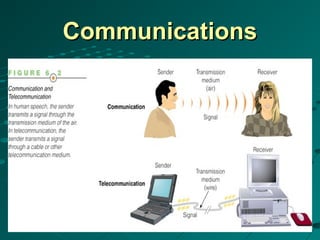
Communications is defined as the
transmission of a signal over a medium
from a sender to a receiver.
CommunicationsCommunications
Communication FlowCommunication Flow
Synchronous communicationSynchronous communication
Asynchronous communicationAsynchronous communication
Synchronous CommunicationSynchronous Communication
In synchronous communication, the
receiver gets the message immediately.
Telephone conversations are examples of
synchronous communication
Asynchronous CommunicationAsynchronous Communication
asynchronous communication, the
receiver gets the message at a late time
– possibly even days after the message is
sent.
Sending a letter is an example of
asynchronous communication, as is e-
mail.
TelecommunicationsTelecommunications
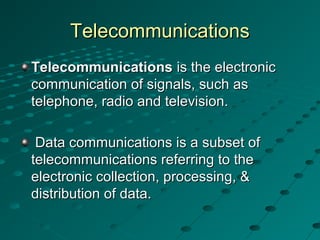
TelecommunicationsTelecommunications is the electronicis the electronic
communication of signals, such ascommunication of signals, such as
telephone, radio and television.telephone, radio and television.
Data communications is a subset ofData communications is a subset of
telecommunications referring to thetelecommunications referring to the
electronic collection, processing, &electronic collection, processing, &
distribution of data.distribution of data.
Telecommunications MediaTelecommunications Media
BandwidthBandwidth

The range of frequencies that an electronicThe range of frequencies that an electronic
signal occupies on a given transmissionsignal occupies on a given transmission
medium.medium.
BroadbandBroadband

Telecommunications in which a wide band ofTelecommunications in which a wide band of
frequencies is available to transmitfrequencies is available to transmit
information, allowing more information to beinformation, allowing more information to be
transmitted in a given amount of time.transmitted in a given amount of time.
Data Transmission SpeedsData Transmission Speeds
Measured in bits per second (bps)Measured in bits per second (bps)
Kilobits per second (kbps)Kilobits per second (kbps)
Megabits per second (Mbps)Megabits per second (Mbps)
Gigabits per second (Gbps)Gigabits per second (Gbps)
Data communications is characterized byData communications is characterized by
the speed at which the data is sent,the speed at which the data is sent,
measured in bits per second. The mostmeasured in bits per second. The most
common data transmission speeds rangecommon data transmission speeds range
from thousands to millions of bits perfrom thousands to millions of bits per
second, or kilobits to megabits persecond, or kilobits to megabits per
second. Some networks can supportsecond. Some networks can support
transmission of billions of bits, or gigabits,transmission of billions of bits, or gigabits,
per second.per second.
Computer NetworksComputer Networks
Telecommunications mediaTelecommunications media
Telecommunications devicesTelecommunications devices
SoftwareSoftware
Hardware devicesHardware devices
Types of MediaTypes of Media
Twisted-PairTwisted-Pair
Coaxial CableCoaxial Cable
Fiber-Optic CableFiber-Optic Cable
Microwave TransmissionMicrowave Transmission
The first 3 types of media – twisted pair,The first 3 types of media – twisted pair,
coaxial cable, and fiber optic cable – arecoaxial cable, and fiber optic cable – are
usually referred to asusually referred to as guided or conductedguided or conducted
media.media. That is, a signal is conducted overThat is, a signal is conducted over
a physical medium.a physical medium.
Microwave and other forms of wirelessMicrowave and other forms of wireless
transmission are called broadcast media.transmission are called broadcast media.
Twisted-Pair Wire CableTwisted-Pair Wire Cable
consisted of pairs of twisted copper wireconsisted of pairs of twisted copper wire
used for both analogue and digital transmissionused for both analogue and digital transmission
low in costlow in cost
low in transmission speedlow in transmission speed
Twisted pair cabling is made of pairs of copper wires twisted
together. Twisted pair is used for the phone connection to
your house. In networking it is common to see cable
consisting of 4 pairs of wires. Each pair is twisted together
to reduce electrical interference between neighboring
pairs, or crosstalk. The more twists there are per foot, the
less interference there will be. Twisted pair is classified by
the number of twists per foot. Data grade cable has more
twists per foot than does voice grade cable.
Shielded twisted pair cabling includes additional shielding
against external electro-magnetic interference. Unshielded
twisted pair, although it doesn’t have the extra shielding, is
used more often because of its lower costs and greater
practicality.
Coaxial CableCoaxial Cable
A thick insulated copper wireA thick insulated copper wire
Can transmit large volumes of data quicklyCan transmit large volumes of data quickly
Faster and more interference free mediumFaster and more interference free medium
Speed up to 200MB per secondSpeed up to 200MB per second
Cannot support analogue phoneCannot support analogue phone
conversationsconversations
Like twisted pair, coaxial cable, or “co-ax”, is also
made from copper. However, because of extra
shielding and insulation, coax has less interference,
and therefore a higher capacity, or bandwidth,
than does twisted pair. Data can be sent over coax
at about 500 Mbps, whereas data transmission
speeds over twisted pair for long distances are
typically well below that, although in a local area
network fast speeds can be attained using twisted
pair.
A type of coaxial cable is used for cable TV to your
home. Cable modems can be used for Internet
access several hundreds as times as fast as a
modem and dial-up phone line.
Fiber Optic CableFiber Optic Cable
Fiber optic cableFiber optic cable
Consists of strands of clear glass fiberConsists of strands of clear glass fiber
Has the thickness of a human hairHas the thickness of a human hair
Data are transformed into pulses of lightData are transformed into pulses of light
Rate 500kb – several trillion bit per secondRate 500kb – several trillion bit per second
Fiber optic cableFiber optic cable
Faster lighter and more durable than wireFaster lighter and more durable than wire
mediamedia
Suitable to transfer large volumes of dataSuitable to transfer large volumes of data
More expensiveMore expensive
Fiber optic cableFiber optic cable
Difficult to work withDifficult to work with
Harder to installHarder to install
Used for backbone cablingUsed for backbone cabling

that handle the major trafficthat handle the major traffic
a primary patha primary path
No delays and no degradation in qualityNo delays and no degradation in quality
Unlike twisted pair and coax, fiber optic cable is
made of thin filaments of glass or plastic, not of
copper wire. Whereas a data signal travels over
twisted pair or cable as electricity, signals are
transmitted as light pulses over fiber. Lasers or
LCDs produce the light. A thin coating, called
cladding, prevents the light from leaving the strand.
Also unlike copper media, fiber is not vulnerable to
electro-magnetic interference.
Fiber has a much higher bandwidth than does
copper media – that is, it can carry more data faster.
Fiber can have a capacity of billions of bits per
second. Fiber is also the most secure medium
around today. The biggest drawback of fiber is that
labor costs to install and repair fiber are very high.
MicrowaveMicrowave
TransmissionTransmission
MicrowaveMicrowave
High frequency radio signals areHigh frequency radio signals are
transmitted trough the atmosphere fromtransmitted trough the atmosphere from
one terrestrial transmission station toone terrestrial transmission station to
anotheranother
A high volumeA high volume
long distancelong distance
point – to – point transmission methodpoint – to – point transmission method
The expense of physical media can be great.
Whereas broadcast media, such as microwave,
don’t require the purchase of physical media, the
hardware required is more expensive. Microwave
is a high frequency radio signal.
In terrestrial microwave, a signal travels directly
between microwave transmission towers. This
requires an unobstructed straight path between
towers. Also, due to the curvature of the earth,
towers must be spaced about 30 miles apart.
Satellite TransmissionSatellite Transmission
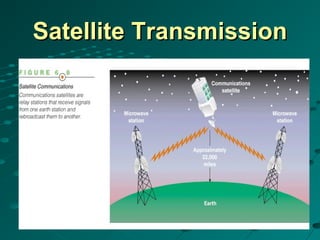
Satellite transmission involves sending a signal
from a microwave tower to the satellite, which is
basically a microwave station, then back to another
microwave tower.
Although this eliminates the need for a line-of-
sight between towers, the delays to upload and
download the signal often make satellite
transmission impractical for sending signals short
distance.
Wireless transmissionWireless transmission
Sends signals through air or spaceSends signals through air or space
Technologies includeTechnologies include

microwave transmissionmicrowave transmission

communication satellitescommunication satellites

pagerspagers

cellular phonescellular phones

smart phonessmart phones

PDAsPDAs
Infrared TransmissionInfrared Transmission
Line of sightLine of sight
Short distancesShort distances
Infrared transmission can be used to send
data short distances, for example, from a
handheld computer to a desktop or a
printer. Infrared transmission can also be
used to connect peripherals, such as a
mouse, to a computer.
Telecommunications DevicesTelecommunications Devices
Telecommunications devices areTelecommunications devices are
hardware that make an electronichardware that make an electronic
transmission occur or make it moretransmission occur or make it more
efficient.efficient.
Modems, multiplexers, and front-endModems, multiplexers, and front-end
processors are examples ofprocessors are examples of
telecommunications devices.telecommunications devices.
ModemsModems
Analog signals: continuousAnalog signals: continuous
Digital signals: discreteDigital signals: discrete
Modulation: translating digital data toModulation: translating digital data to
analoganalog
Demodulation: translating analog data toDemodulation: translating analog data to
digitaldigital
Modems modulate & demodulate dataModems modulate & demodulate data
Often, data is sent over the regularOften, data is sent over the regular
telephone network, which transmits analogtelephone network, which transmits analog
signals.signals.
An analog signal is a continuous signal;An analog signal is a continuous signal;
the transmission line varies smoothlythe transmission line varies smoothly
among an infinite number of states.among an infinite number of states.
Analog waves can carry a continuousAnalog waves can carry a continuous
range of datarange of data
computers produce digital signals. Digitalcomputers produce digital signals. Digital
signals send discrete pulses andsignals send discrete pulses and
represent a limited number of states.represent a limited number of states.
In the case of a computer, two states areIn the case of a computer, two states are
represented.represented.
In order to send a digital signal over anIn order to send a digital signal over an
analog line, the signal must first beanalog line, the signal must first be
modulated, or changed to a form that canmodulated, or changed to a form that can
be carried over an analog line. When thebe carried over an analog line. When the
signal is received, it must be demodulatedsignal is received, it must be demodulated
so the computer can understand it.so the computer can understand it.
This is what a modem does.This is what a modem does.
MultiplexersMultiplexers
MultiplexersMultiplexers are devices that combineare devices that combine
signals from several computers to allowsignals from several computers to allow
them to be sent over a single transmissionthem to be sent over a single transmission
line.line.
Networks & DistributedNetworks & Distributed
ProcessingProcessing
Telecommunications networks areTelecommunications networks are
becoming increasingly important sincebecoming increasingly important since
they allow work to be done wherever andthey allow work to be done wherever and
whenever it is most advantageous. Data,whenever it is most advantageous. Data,
software, hardware, and other resourcessoftware, hardware, and other resources
are becoming ubiquitous – that is, easilyare becoming ubiquitous – that is, easily
accessible by anyone, anytime, any place.accessible by anyone, anytime, any place.
Basic Processing StrategiesBasic Processing Strategies
Centralized processingCentralized processing
Decentralized processingDecentralized processing
Distributed processingDistributed processing
There are 3 basic processing strategies whenThere are 3 basic processing strategies when
more than 2 computer systems are used.more than 2 computer systems are used.
In centralized processingIn centralized processing, all processing is, all processing is
done at one location. This is the easiestdone at one location. This is the easiest
strategy for the IS department to control and isstrategy for the IS department to control and is
appropriate when an enterprise needs a highappropriate when an enterprise needs a high
level of security.level of security.
In decentralized computingIn decentralized computing, different locations, different locations
have their own processing devices. Devices athave their own processing devices. Devices at
different locations aren’t connected together.different locations aren’t connected together.
This strategy works well when there areThis strategy works well when there are
independent operating units and no dataindependent operating units and no data
interchange between units.interchange between units.
In distributed processingIn distributed processing, computers at, computers at
different locations are connected by adifferent locations are connected by a
communications network. Data and processingcommunications network. Data and processing
are located where it is most efficient andare located where it is most efficient and
effective. For example, data and programs usedeffective. For example, data and programs used
most by the Miami office would be located inmost by the Miami office would be located in
Miami, and those used most by the Boston officeMiami, and those used most by the Boston office
would be in Boston. Users at both locationswould be in Boston. Users at both locations
could access data and programs at the othercould access data and programs at the other
site when needed.site when needed.
Network Concepts &Network Concepts &
ConsiderationsConsiderations
Network topologyNetwork topology
Network typesNetwork types

Local Area NetworksLocal Area Networks

Wide Area NetworksWide Area Networks

International networksInternational networks

Home & small business networksHome & small business networks
Network TopologyNetwork Topology
Network topology describes how aNetwork topology describes how a
network is logically organized – that is,network is logically organized – that is,
how the data flows in the network.how the data flows in the network.
Depending on the distance betweenDepending on the distance between
nodes and the services provided,nodes and the services provided,
networks may be classified as local areanetworks may be classified as local area
networks or wide area networks.networks or wide area networks.
Network TopologiesNetwork Topologies
BusBus
A bus network contains devices connectedA bus network contains devices connected
directly in a straight line. Each device candirectly in a straight line. Each device can
communicate directly with every othercommunicate directly with every other
device one the network.device one the network.
RingRing
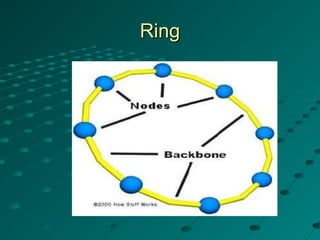
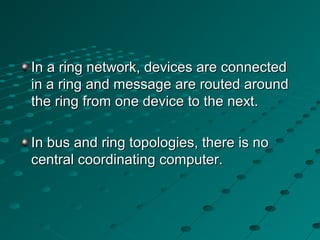
In a ring network, devices are connectedIn a ring network, devices are connected
in a ring and message are routed aroundin a ring and message are routed around
the ring from one device to the next.the ring from one device to the next.
In bus and ring topologies, there is noIn bus and ring topologies, there is no
central coordinating computer.central coordinating computer.
StarStar
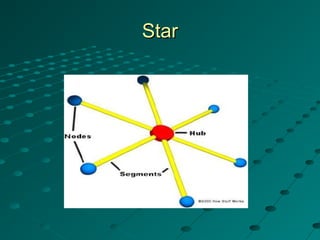
A star network has a central, coordinatingA star network has a central, coordinating
device; each computer on the network isdevice; each computer on the network is
directly attached only to the central device.directly attached only to the central device.
The central device is the vulnerability ofThe central device is the vulnerability of
the network – it can become a bottleneckthe network – it can become a bottleneck
under heavy traffic and the whole networkunder heavy traffic and the whole network
fails if it fails.fails if it fails.
Network TypesNetwork Types
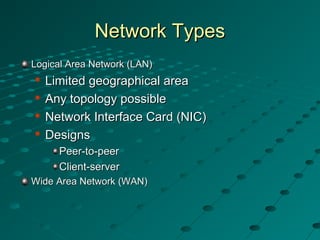
Logical Area Network (LAN)Logical Area Network (LAN)

Limited geographical areaLimited geographical area

Any topology possibleAny topology possible

Network Interface Card (NIC)Network Interface Card (NIC)

DesignsDesigns
Peer-to-peerPeer-to-peer
Client-serverClient-server
Wide Area Network (WAN)Wide Area Network (WAN)
LANLAN
Local Area Networks connect processingLocal Area Networks connect processing
devices within a limited geographic areadevices within a limited geographic area
and do not usually use common carrierand do not usually use common carrier
facilities.facilities.
Devices are attached to the media usingDevices are attached to the media using
network interface cards, also callednetwork interface cards, also called
network adaptersnetwork adapters..
WANWAN
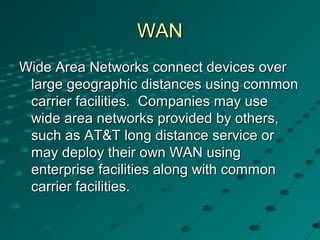
Wide Area Networks connect devices overWide Area Networks connect devices over
large geographic distances using commonlarge geographic distances using common
carrier facilities. Companies may usecarrier facilities. Companies may use
wide area networks provided by others,wide area networks provided by others,
such as AT&T long distance service orsuch as AT&T long distance service or
may deploy their own WAN usingmay deploy their own WAN using
enterprise facilities along with commonenterprise facilities along with common
carrier facilities.carrier facilities.

Telecommunication and networks

  • 1.
  • 2.
    Telecommunications and Networks, describesbasic concepts and components of networks used for data communications. Communications is defined as the transmission of a signal over a medium from a sender to a receiver.
  • 3.
  • 4.
    Communication FlowCommunication Flow SynchronouscommunicationSynchronous communication Asynchronous communicationAsynchronous communication
  • 5.
    Synchronous CommunicationSynchronous Communication Insynchronous communication, the receiver gets the message immediately. Telephone conversations are examples of synchronous communication
  • 6.
    Asynchronous CommunicationAsynchronous Communication asynchronouscommunication, the receiver gets the message at a late time – possibly even days after the message is sent. Sending a letter is an example of asynchronous communication, as is e- mail.
  • 7.
  • 8.
    TelecommunicationsTelecommunications TelecommunicationsTelecommunications is theelectronicis the electronic communication of signals, such ascommunication of signals, such as telephone, radio and television.telephone, radio and television. Data communications is a subset ofData communications is a subset of telecommunications referring to thetelecommunications referring to the electronic collection, processing, &electronic collection, processing, & distribution of data.distribution of data.
  • 9.
    Telecommunications MediaTelecommunications Media BandwidthBandwidth  Therange of frequencies that an electronicThe range of frequencies that an electronic signal occupies on a given transmissionsignal occupies on a given transmission medium.medium. BroadbandBroadband  Telecommunications in which a wide band ofTelecommunications in which a wide band of frequencies is available to transmitfrequencies is available to transmit information, allowing more information to beinformation, allowing more information to be transmitted in a given amount of time.transmitted in a given amount of time.
  • 10.
    Data Transmission SpeedsDataTransmission Speeds Measured in bits per second (bps)Measured in bits per second (bps) Kilobits per second (kbps)Kilobits per second (kbps) Megabits per second (Mbps)Megabits per second (Mbps) Gigabits per second (Gbps)Gigabits per second (Gbps)
  • 11.
    Data communications ischaracterized byData communications is characterized by the speed at which the data is sent,the speed at which the data is sent, measured in bits per second. The mostmeasured in bits per second. The most common data transmission speeds rangecommon data transmission speeds range from thousands to millions of bits perfrom thousands to millions of bits per second, or kilobits to megabits persecond, or kilobits to megabits per second. Some networks can supportsecond. Some networks can support transmission of billions of bits, or gigabits,transmission of billions of bits, or gigabits, per second.per second.
  • 12.
    Computer NetworksComputer Networks TelecommunicationsmediaTelecommunications media Telecommunications devicesTelecommunications devices SoftwareSoftware Hardware devicesHardware devices
  • 13.
    Types of MediaTypesof Media Twisted-PairTwisted-Pair Coaxial CableCoaxial Cable Fiber-Optic CableFiber-Optic Cable Microwave TransmissionMicrowave Transmission
  • 14.
    The first 3types of media – twisted pair,The first 3 types of media – twisted pair, coaxial cable, and fiber optic cable – arecoaxial cable, and fiber optic cable – are usually referred to asusually referred to as guided or conductedguided or conducted media.media. That is, a signal is conducted overThat is, a signal is conducted over a physical medium.a physical medium. Microwave and other forms of wirelessMicrowave and other forms of wireless transmission are called broadcast media.transmission are called broadcast media.
  • 15.
  • 16.
    Twisted-Pair Wire CableTwisted-PairWire Cable consisted of pairs of twisted copper wireconsisted of pairs of twisted copper wire used for both analogue and digital transmissionused for both analogue and digital transmission low in costlow in cost low in transmission speedlow in transmission speed
  • 17.
    Twisted pair cablingis made of pairs of copper wires twisted together. Twisted pair is used for the phone connection to your house. In networking it is common to see cable consisting of 4 pairs of wires. Each pair is twisted together to reduce electrical interference between neighboring pairs, or crosstalk. The more twists there are per foot, the less interference there will be. Twisted pair is classified by the number of twists per foot. Data grade cable has more twists per foot than does voice grade cable. Shielded twisted pair cabling includes additional shielding against external electro-magnetic interference. Unshielded twisted pair, although it doesn’t have the extra shielding, is used more often because of its lower costs and greater practicality.
  • 18.
  • 19.
    Coaxial CableCoaxial Cable Athick insulated copper wireA thick insulated copper wire Can transmit large volumes of data quicklyCan transmit large volumes of data quickly Faster and more interference free mediumFaster and more interference free medium Speed up to 200MB per secondSpeed up to 200MB per second Cannot support analogue phoneCannot support analogue phone conversationsconversations
  • 20.
    Like twisted pair,coaxial cable, or “co-ax”, is also made from copper. However, because of extra shielding and insulation, coax has less interference, and therefore a higher capacity, or bandwidth, than does twisted pair. Data can be sent over coax at about 500 Mbps, whereas data transmission speeds over twisted pair for long distances are typically well below that, although in a local area network fast speeds can be attained using twisted pair.
  • 21.
    A type ofcoaxial cable is used for cable TV to your home. Cable modems can be used for Internet access several hundreds as times as fast as a modem and dial-up phone line.
  • 22.
  • 23.
    Fiber optic cableFiberoptic cable Consists of strands of clear glass fiberConsists of strands of clear glass fiber Has the thickness of a human hairHas the thickness of a human hair Data are transformed into pulses of lightData are transformed into pulses of light Rate 500kb – several trillion bit per secondRate 500kb – several trillion bit per second
  • 24.
    Fiber optic cableFiberoptic cable Faster lighter and more durable than wireFaster lighter and more durable than wire mediamedia Suitable to transfer large volumes of dataSuitable to transfer large volumes of data More expensiveMore expensive
  • 25.
    Fiber optic cableFiberoptic cable Difficult to work withDifficult to work with Harder to installHarder to install Used for backbone cablingUsed for backbone cabling  that handle the major trafficthat handle the major traffic a primary patha primary path No delays and no degradation in qualityNo delays and no degradation in quality
  • 26.
    Unlike twisted pairand coax, fiber optic cable is made of thin filaments of glass or plastic, not of copper wire. Whereas a data signal travels over twisted pair or cable as electricity, signals are transmitted as light pulses over fiber. Lasers or LCDs produce the light. A thin coating, called cladding, prevents the light from leaving the strand. Also unlike copper media, fiber is not vulnerable to electro-magnetic interference.
  • 27.
    Fiber has amuch higher bandwidth than does copper media – that is, it can carry more data faster. Fiber can have a capacity of billions of bits per second. Fiber is also the most secure medium around today. The biggest drawback of fiber is that labor costs to install and repair fiber are very high.
  • 28.
  • 29.
    MicrowaveMicrowave High frequency radiosignals areHigh frequency radio signals are transmitted trough the atmosphere fromtransmitted trough the atmosphere from one terrestrial transmission station toone terrestrial transmission station to anotheranother A high volumeA high volume long distancelong distance point – to – point transmission methodpoint – to – point transmission method
  • 30.
    The expense ofphysical media can be great. Whereas broadcast media, such as microwave, don’t require the purchase of physical media, the hardware required is more expensive. Microwave is a high frequency radio signal. In terrestrial microwave, a signal travels directly between microwave transmission towers. This requires an unobstructed straight path between towers. Also, due to the curvature of the earth, towers must be spaced about 30 miles apart.
  • 31.
  • 32.
    Satellite transmission involvessending a signal from a microwave tower to the satellite, which is basically a microwave station, then back to another microwave tower. Although this eliminates the need for a line-of- sight between towers, the delays to upload and download the signal often make satellite transmission impractical for sending signals short distance.
  • 33.
    Wireless transmissionWireless transmission Sendssignals through air or spaceSends signals through air or space Technologies includeTechnologies include  microwave transmissionmicrowave transmission  communication satellitescommunication satellites  pagerspagers  cellular phonescellular phones  smart phonessmart phones  PDAsPDAs
  • 34.
    Infrared TransmissionInfrared Transmission Lineof sightLine of sight Short distancesShort distances Infrared transmission can be used to send data short distances, for example, from a handheld computer to a desktop or a printer. Infrared transmission can also be used to connect peripherals, such as a mouse, to a computer.
  • 35.
    Telecommunications DevicesTelecommunications Devices Telecommunicationsdevices areTelecommunications devices are hardware that make an electronichardware that make an electronic transmission occur or make it moretransmission occur or make it more efficient.efficient. Modems, multiplexers, and front-endModems, multiplexers, and front-end processors are examples ofprocessors are examples of telecommunications devices.telecommunications devices.
  • 36.
    ModemsModems Analog signals: continuousAnalogsignals: continuous Digital signals: discreteDigital signals: discrete Modulation: translating digital data toModulation: translating digital data to analoganalog Demodulation: translating analog data toDemodulation: translating analog data to digitaldigital Modems modulate & demodulate dataModems modulate & demodulate data
  • 37.
    Often, data issent over the regularOften, data is sent over the regular telephone network, which transmits analogtelephone network, which transmits analog signals.signals. An analog signal is a continuous signal;An analog signal is a continuous signal; the transmission line varies smoothlythe transmission line varies smoothly among an infinite number of states.among an infinite number of states. Analog waves can carry a continuousAnalog waves can carry a continuous range of datarange of data
  • 38.
    computers produce digitalsignals. Digitalcomputers produce digital signals. Digital signals send discrete pulses andsignals send discrete pulses and represent a limited number of states.represent a limited number of states. In the case of a computer, two states areIn the case of a computer, two states are represented.represented.
  • 39.
    In order tosend a digital signal over anIn order to send a digital signal over an analog line, the signal must first beanalog line, the signal must first be modulated, or changed to a form that canmodulated, or changed to a form that can be carried over an analog line. When thebe carried over an analog line. When the signal is received, it must be demodulatedsignal is received, it must be demodulated so the computer can understand it.so the computer can understand it. This is what a modem does.This is what a modem does.
  • 41.
  • 42.
    MultiplexersMultiplexers are devicesthat combineare devices that combine signals from several computers to allowsignals from several computers to allow them to be sent over a single transmissionthem to be sent over a single transmission line.line.
  • 43.
    Networks & DistributedNetworks& Distributed ProcessingProcessing Telecommunications networks areTelecommunications networks are becoming increasingly important sincebecoming increasingly important since they allow work to be done wherever andthey allow work to be done wherever and whenever it is most advantageous. Data,whenever it is most advantageous. Data, software, hardware, and other resourcessoftware, hardware, and other resources are becoming ubiquitous – that is, easilyare becoming ubiquitous – that is, easily accessible by anyone, anytime, any place.accessible by anyone, anytime, any place.
  • 44.
    Basic Processing StrategiesBasicProcessing Strategies Centralized processingCentralized processing Decentralized processingDecentralized processing Distributed processingDistributed processing
  • 45.
    There are 3basic processing strategies whenThere are 3 basic processing strategies when more than 2 computer systems are used.more than 2 computer systems are used. In centralized processingIn centralized processing, all processing is, all processing is done at one location. This is the easiestdone at one location. This is the easiest strategy for the IS department to control and isstrategy for the IS department to control and is appropriate when an enterprise needs a highappropriate when an enterprise needs a high level of security.level of security.
  • 46.
    In decentralized computingIndecentralized computing, different locations, different locations have their own processing devices. Devices athave their own processing devices. Devices at different locations aren’t connected together.different locations aren’t connected together. This strategy works well when there areThis strategy works well when there are independent operating units and no dataindependent operating units and no data interchange between units.interchange between units.
  • 47.
    In distributed processingIndistributed processing, computers at, computers at different locations are connected by adifferent locations are connected by a communications network. Data and processingcommunications network. Data and processing are located where it is most efficient andare located where it is most efficient and effective. For example, data and programs usedeffective. For example, data and programs used most by the Miami office would be located inmost by the Miami office would be located in Miami, and those used most by the Boston officeMiami, and those used most by the Boston office would be in Boston. Users at both locationswould be in Boston. Users at both locations could access data and programs at the othercould access data and programs at the other site when needed.site when needed.
  • 48.
    Network Concepts &NetworkConcepts & ConsiderationsConsiderations Network topologyNetwork topology Network typesNetwork types  Local Area NetworksLocal Area Networks  Wide Area NetworksWide Area Networks  International networksInternational networks  Home & small business networksHome & small business networks
  • 49.
    Network TopologyNetwork Topology Networktopology describes how aNetwork topology describes how a network is logically organized – that is,network is logically organized – that is, how the data flows in the network.how the data flows in the network. Depending on the distance betweenDepending on the distance between nodes and the services provided,nodes and the services provided, networks may be classified as local areanetworks may be classified as local area networks or wide area networks.networks or wide area networks.
  • 50.
  • 51.
    A bus networkcontains devices connectedA bus network contains devices connected directly in a straight line. Each device candirectly in a straight line. Each device can communicate directly with every othercommunicate directly with every other device one the network.device one the network.
  • 52.
  • 53.
    In a ringnetwork, devices are connectedIn a ring network, devices are connected in a ring and message are routed aroundin a ring and message are routed around the ring from one device to the next.the ring from one device to the next. In bus and ring topologies, there is noIn bus and ring topologies, there is no central coordinating computer.central coordinating computer.
  • 54.
  • 55.
    A star networkhas a central, coordinatingA star network has a central, coordinating device; each computer on the network isdevice; each computer on the network is directly attached only to the central device.directly attached only to the central device. The central device is the vulnerability ofThe central device is the vulnerability of the network – it can become a bottleneckthe network – it can become a bottleneck under heavy traffic and the whole networkunder heavy traffic and the whole network fails if it fails.fails if it fails.
  • 56.
    Network TypesNetwork Types LogicalArea Network (LAN)Logical Area Network (LAN)  Limited geographical areaLimited geographical area  Any topology possibleAny topology possible  Network Interface Card (NIC)Network Interface Card (NIC)  DesignsDesigns Peer-to-peerPeer-to-peer Client-serverClient-server Wide Area Network (WAN)Wide Area Network (WAN)
  • 57.
    LANLAN Local Area Networksconnect processingLocal Area Networks connect processing devices within a limited geographic areadevices within a limited geographic area and do not usually use common carrierand do not usually use common carrier facilities.facilities. Devices are attached to the media usingDevices are attached to the media using network interface cards, also callednetwork interface cards, also called network adaptersnetwork adapters..
  • 58.
    WANWAN Wide Area Networksconnect devices overWide Area Networks connect devices over large geographic distances using commonlarge geographic distances using common carrier facilities. Companies may usecarrier facilities. Companies may use wide area networks provided by others,wide area networks provided by others, such as AT&T long distance service orsuch as AT&T long distance service or may deploy their own WAN usingmay deploy their own WAN using enterprise facilities along with commonenterprise facilities along with common carrier facilities.carrier facilities.