Disclaimer: This presentation is prepared by trainees of
baabtra as a part of mentoring program. This is not official
document of baabtra –Mentoring Partner
Baabtra-Mentoring Partner is the mentoring division of baabte System Technologies Pvt .
Ltd
TRANSLATORS AND
INTERPRETER
ARJUN S R
Arjun.sr007@gmail.com
www.facebook.com/arjuna
ryavartham
twitter.com/arjun.sr007
Arjun.sr007
9745649882
INTRODUCTION
Any program that is not written in machine language
has to be translated in machine language before it is
executed by the computer. The means used for translation
are themselves computer programs. There are three types of
translator programs i.e. Assembler, Compilers and
Interpreters.
ASSEMBLER:
Assembler is a computer program which is used to translate program
written in Assembly Language in to machine language. The translated
program is called as object program. Assembler checks each instruction
for its correctness and generates diagnostic messages, if there are
mistakes in the program.
• Translate mnemonic operation codes to their machine language
equivalents. Assigning machine addresses to symbolic labels.
• Assembler directives (or pseudo-instructions) provide instructions to the
assembler itself. They are not translated into machine instructions
Eg: START,END
• The output of the assembler program is called the object code or object
program.
• The object code is usually a machine code, also called a machine language,
which can be understood directly by a specific type of CPU (central
processing unit), such as x86 (i.e., Intel-compatible) or PowerPC. However,
• some compilers are designed to convert source code into
an assembly language or some other another programming
language. An assembly language is a human-readable notation for
the machine language that a specific type of CPU uses.
• An object code file can contain not only the object code, but also
relocation information that the linker uses to assemble multiple
object files to form an executable program. It can also contain other
information, such as program symbols (names of variables and
functions) and debugging (i.e., removing errors) information
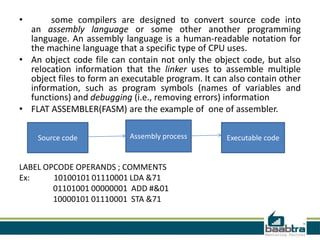
• FLAT ASSEMBLER(FASM) are the example of one of assembler.
LABEL OPCODE OPERANDS ; COMMENTS
Ex: 10100101 01110001 LDA &71
01101001 00000001 ADD #&01
10000101 01110001 STA &71
Source code Assembly process Executable code
COMPILER
A compiler is a program that translates a program written in
HLL to executable machine language. The process of
transferring HLL source program in to object code is a lengthy
and complex process as compared to assembling. Compliers
have diagnostic capabilities and prompt the programmer with
appropriate error message while compiling a HLL program.
The corrections are to be incorporated in the program,
whenever needed, and the program has to be recompiled. The
process is repeated until the program is mistake free and
translated to an object code.
JOB OF COMPILER
1.To translate HLL source program to machine codes.
2. To trace variables in the program
3. To include linkage for subroutines.
4. To allocate memory for storage of program and variables.
5. To generate error messages, if there are errors in then program.
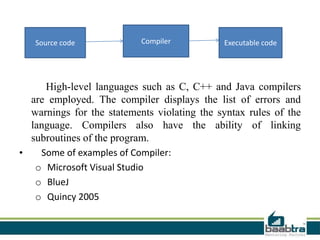
High-level languages such as C, C++ and Java compilers
are employed. The compiler displays the list of errors and
warnings for the statements violating the syntax rules of the
language. Compilers also have the ability of linking
subroutines of the program.
• Some of examples of Compiler:
o Microsoft Visual Studio
o BlueJ
o Quincy 2005
Source code Compiler Executable code
INTERPRETER
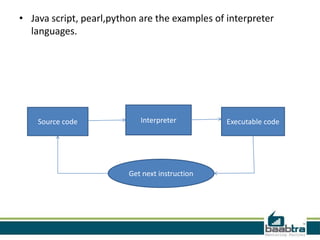
The basic purpose of interpreter is same as that of complier.
In compiler, the program is translated completely and directly
executable version is generated. Whereas interpreter translates
each instruction, executes it and then the next instruction is
translated and this goes on until end of the program. In this
case, object code is not stored and reused. Every time the
program is executed, the interpreter translates each instruction
freshly
• Java script, pearl,python are the examples of interpreter
languages.
Source code Interpreter Executable code
Get next instruction
ADVANTAGE:
1. Good at locating errors in programs
2. Debugging is easier since the interpreter stops when it encounters an error.
3. If an error is deducted there is no need to retranslate the whole program
DISADVANTAGE:
1. Rather slow
2. No object code is produced, so a translation has to be done every time the
program is running.
3. For the program to run, the Interpreter must be present
this presentation helped you, please visit our
page facebook.com/baabtra and like it.
Thanks in advance.
www.baabtra.com | www.massbaab.com |www.baabte.com
Translators(Compiler, Assembler) and interpreter

Translators(Compiler, Assembler) and interpreter

  • 2.
    Disclaimer: This presentationis prepared by trainees of baabtra as a part of mentoring program. This is not official document of baabtra –Mentoring Partner Baabtra-Mentoring Partner is the mentoring division of baabte System Technologies Pvt . Ltd
  • 3.
    TRANSLATORS AND INTERPRETER ARJUN SR Arjun.sr007@gmail.com www.facebook.com/arjuna ryavartham twitter.com/arjun.sr007 Arjun.sr007 9745649882
  • 4.
    INTRODUCTION Any program thatis not written in machine language has to be translated in machine language before it is executed by the computer. The means used for translation are themselves computer programs. There are three types of translator programs i.e. Assembler, Compilers and Interpreters.
  • 5.
    ASSEMBLER: Assembler is acomputer program which is used to translate program written in Assembly Language in to machine language. The translated program is called as object program. Assembler checks each instruction for its correctness and generates diagnostic messages, if there are mistakes in the program. • Translate mnemonic operation codes to their machine language equivalents. Assigning machine addresses to symbolic labels. • Assembler directives (or pseudo-instructions) provide instructions to the assembler itself. They are not translated into machine instructions Eg: START,END • The output of the assembler program is called the object code or object program. • The object code is usually a machine code, also called a machine language, which can be understood directly by a specific type of CPU (central processing unit), such as x86 (i.e., Intel-compatible) or PowerPC. However,
  • 6.
    • some compilersare designed to convert source code into an assembly language or some other another programming language. An assembly language is a human-readable notation for the machine language that a specific type of CPU uses. • An object code file can contain not only the object code, but also relocation information that the linker uses to assemble multiple object files to form an executable program. It can also contain other information, such as program symbols (names of variables and functions) and debugging (i.e., removing errors) information • FLAT ASSEMBLER(FASM) are the example of one of assembler. LABEL OPCODE OPERANDS ; COMMENTS Ex: 10100101 01110001 LDA &71 01101001 00000001 ADD #&01 10000101 01110001 STA &71 Source code Assembly process Executable code
  • 7.
    COMPILER A compiler isa program that translates a program written in HLL to executable machine language. The process of transferring HLL source program in to object code is a lengthy and complex process as compared to assembling. Compliers have diagnostic capabilities and prompt the programmer with appropriate error message while compiling a HLL program. The corrections are to be incorporated in the program, whenever needed, and the program has to be recompiled. The process is repeated until the program is mistake free and translated to an object code.
  • 8.
    JOB OF COMPILER 1.Totranslate HLL source program to machine codes. 2. To trace variables in the program 3. To include linkage for subroutines. 4. To allocate memory for storage of program and variables. 5. To generate error messages, if there are errors in then program.
  • 9.
    High-level languages suchas C, C++ and Java compilers are employed. The compiler displays the list of errors and warnings for the statements violating the syntax rules of the language. Compilers also have the ability of linking subroutines of the program. • Some of examples of Compiler: o Microsoft Visual Studio o BlueJ o Quincy 2005 Source code Compiler Executable code
  • 10.
    INTERPRETER The basic purposeof interpreter is same as that of complier. In compiler, the program is translated completely and directly executable version is generated. Whereas interpreter translates each instruction, executes it and then the next instruction is translated and this goes on until end of the program. In this case, object code is not stored and reused. Every time the program is executed, the interpreter translates each instruction freshly
  • 11.
    • Java script,pearl,python are the examples of interpreter languages. Source code Interpreter Executable code Get next instruction
  • 12.
    ADVANTAGE: 1. Good atlocating errors in programs 2. Debugging is easier since the interpreter stops when it encounters an error. 3. If an error is deducted there is no need to retranslate the whole program DISADVANTAGE: 1. Rather slow 2. No object code is produced, so a translation has to be done every time the program is running. 3. For the program to run, the Interpreter must be present
  • 13.
    this presentation helpedyou, please visit our page facebook.com/baabtra and like it. Thanks in advance. www.baabtra.com | www.massbaab.com |www.baabte.com