CS40106 Compiler Design Compiler Design 40106
Prerequisites:  Automata Theory: DFAs, NFAs, Regular Expressions Textbook: Alfred V. Aho, Ravi Sethi, and Jeffrey D. Ullman, “ Compilers: Principles, Techniques, and Tools ” Addison-Wesley, 1986. K. Cooper, L. Torczon, ‘Engineering a Compiler’, Morgan Kaufmann, 1 st  Edition, 2003 Compiler Design 40106
Course Outline Introduction to Compiling Lexical Analysis Syntax Analysis Context Free Grammars Top-Down Parsing, LL Parsing Bottom-Up Parsing, LR Parsing Syntax-Directed Translation Attribute Definitions Evaluation of Attribute Definitions Semantic Analysis, Type Checking Run-Time Organization Intermediate Code Generation Code Optimization Compiler Design 40106
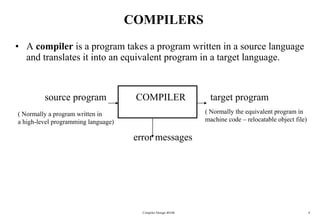
COMPILERS A  compiler  is a program takes a program written in a source language and translates it into an equivalent program in a target language. source program  COMPILER  target program error messages Compiler Design 40106 ( Normally a program written in  a high-level programming language) ( Normally the equivalent program in machine code – relocatable object file)
Other Applications In addition to the development of a compiler, the techniques used in compiler design can be applicable to many problems in computer science. Techniques used in a lexical analyzer can be used in text editors, information retrieval system, and pattern recognition programs. Techniques used in a parser can be used in a query processing system such as SQL. A symbolic equation solver which takes an equation as input. That program should parse the given input equation. Most of the techniques used in compiler design  can be used in Natural Language Processing (NLP) systems. Compiler Design 40106
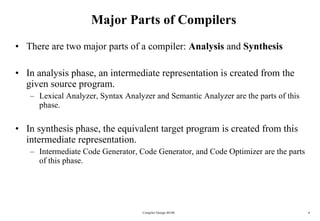
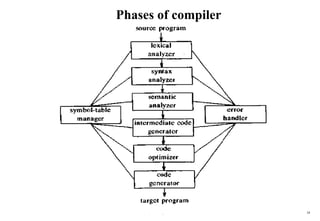
Major Parts of Compilers There are two major parts of a compiler:  Analysis  and  Synthesis In analysis phase, an intermediate representation is created from the given source program.  Lexical Analyzer, Syntax Analyzer and Semantic Analyzer are the parts of this phase. In synthesis phase, the equivalent target program is created from this intermediate representation.  Intermediate Code Generator, Code Generator, and Code Optimizer are the parts of this phase. Compiler Design 40106
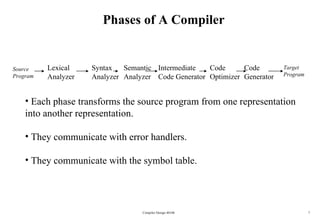
Phases of A Compiler Compiler Design 40106 Lexical  Analyzer Semantic  Analyzer Syntax  Analyzer Intermediate Code Generator Code  Optimizer Code Generator Target Program Source Program Each phase transforms the source program from one representation  into another representation. They communicate with error handlers. They communicate with the symbol table.
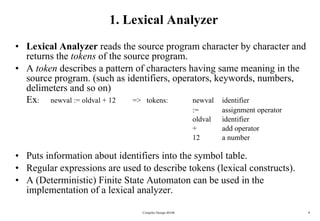
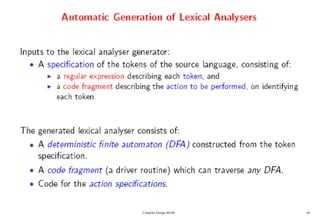
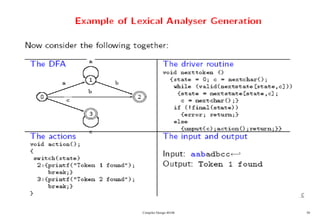
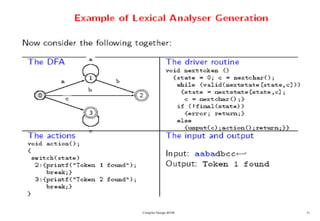
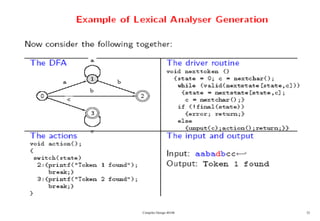
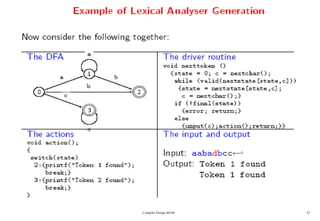
1. Lexical Analyzer Lexical Analyzer  reads the source program character by character and returns the  tokens  of the source program. A  token  describes a pattern of characters having same meaning in the source program. (such as identifiers, operators, keywords, numbers, delimeters and so on) Ex :  newval := oldval + 12  =>  tokens:  newval  identifier :=  assignment operator oldval identifier + add operator 12 a number Puts information about identifiers into the symbol table. Regular expressions are used to describe tokens (lexical constructs). A (Deterministic) Finite State Automaton can be used in the implementation of a lexical analyzer. Compiler Design 40106
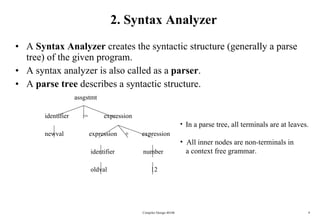
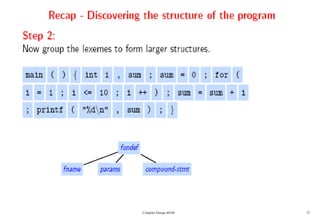
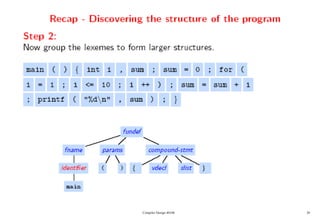
2. Syntax Analyzer A  Syntax Analyzer  creates the syntactic structure (generally a parse tree) of the given program. A syntax analyzer is also called as a  parser . A  parse tree  describes a syntactic structure. assgstmt identifier   :=  expression newval   expression  +  expression   identifier    number   oldval  12 Compiler Design 40106 In a parse tree, all terminals are at leaves. All inner nodes are non-terminals in  a context free grammar.
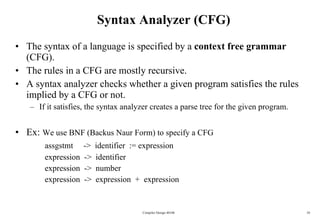
Syntax Analyzer (CFG) The syntax of a language is specified by a  context free grammar  (CFG). The rules in a CFG are mostly recursive. A syntax analyzer checks whether a given program satisfies the rules implied by a CFG or not. If it satisfies, the syntax analyzer creates a parse tree for the given program. Ex:  We use BNF (Backus Naur Form) to specify a CFG assgstmt  ->  identifier  := expression expression  ->  identifier expression  ->  number expression  ->  expression  +  expression Compiler Design 40106
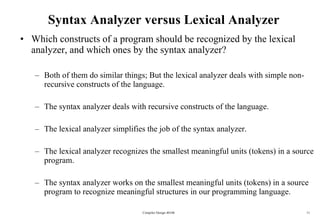
Syntax Analyzer versus Lexical Analyzer Which constructs of a program should be recognized by the lexical analyzer, and which ones by the syntax analyzer? Both of them do similar things; But the lexical analyzer deals with simple non-recursive constructs of the language. The syntax analyzer deals with recursive constructs of the language. The lexical analyzer simplifies the job of the syntax analyzer. The lexical analyzer recognizes the smallest meaningful units (tokens) in a source program. The syntax analyzer works on the smallest meaningful units (tokens) in a source program to recognize meaningful structures in our programming language. Compiler Design 40106
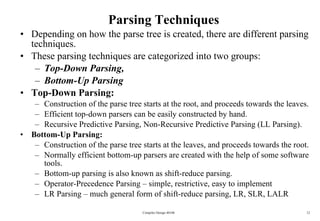
Parsing Techniques Depending on how the parse tree is created, there are different parsing techniques. These parsing techniques are categorized into two groups:  Top-Down Parsing,  Bottom-Up Parsing Top-Down Parsing: Construction of the parse tree starts at the root, and proceeds towards the leaves. Efficient top-down parsers can be easily constructed by hand. Recursive Predictive Parsing, Non-Recursive Predictive Parsing (LL Parsing). Bottom-Up Parsing: Construction of the parse tree starts at the leaves, and proceeds towards the root. Normally efficient bottom-up parsers are created with the help of some software tools. Bottom-up parsing is also known as shift-reduce parsing. Operator-Precedence Parsing – simple, restrictive, easy to implement  LR Parsing – much general form of shift-reduce parsing, LR, SLR, LALR Compiler Design 40106
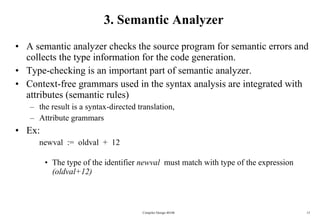
3. Semantic Analyzer A semantic analyzer checks the source program for semantic errors and collects the type information for the code generation. Type-checking is an important part of semantic analyzer. Context-free grammars used in the syntax analysis are integrated with attributes (semantic rules)  the result is a syntax-directed translation,  Attribute grammars Ex: newval  :=  oldval  +  12 The type of the identifier  newval   must match with type of the expression  (oldval+12) Compiler Design 40106
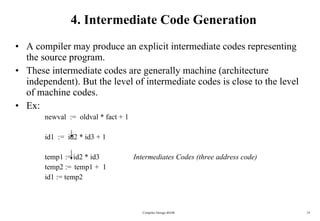
4. Intermediate Code Generation A compiler may produce an explicit intermediate codes representing  the source program. These intermediate codes are generally machine (architecture independent). But the level of intermediate codes is close to the level  of machine codes. Ex: newval  :=  oldval * fact + 1 id1  :=  id2 * id3 + 1 temp1 := id2 * id3 Intermediates Codes (three address code) temp2 :=  temp1 +  1 id1 := temp2 Compiler Design 40106
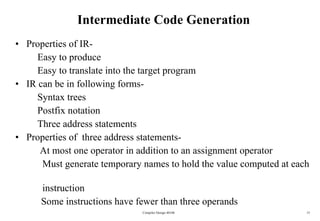
Intermediate Code Generation Properties of IR-  Easy to produce Easy to translate into the target program IR can be in following forms- Syntax trees Postfix notation Three address statements Properties of  three address statements- At most one operator in addition to an assignment operator Must generate temporary names to hold the value computed at each  instruction   Some instructions have fewer than three operands Compiler Design 40106
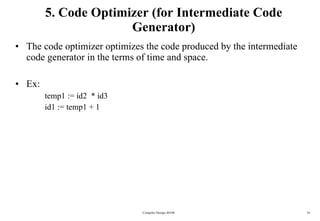
5. Code Optimizer (for Intermediate Code Generator) The code optimizer optimizes the code produced by the intermediate code generator in the terms of time and space. Ex: temp1 := id2  * id3 id1 := temp1 + 1 Compiler Design 40106
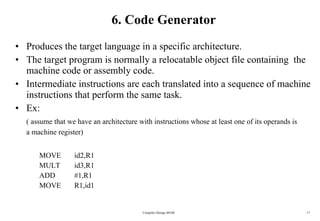
6. Code Generator Produces the target language in a specific architecture. The target program is normally a relocatable object file containing  the machine code or assembly code. Intermediate instructions are each translated into a sequence of machine instructions that perform the same task. Ex:  ( assume that we have an architecture with instructions whose at least one of its operands is a machine register) MOVE id2,R1 MULT id3,R1 ADD #1,R1 MOVE R1,id1 Compiler Design 40106
Phases of compiler Compiler Design 40106
Compiler Design 40106
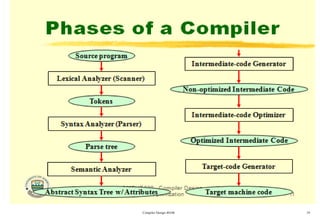
The Structure of a Compiler  (8) Scanner  [Lexical Analyzer] Parser  [Syntax Analyzer] Semantic Process  [Semantic analyzer] Code Generator [Intermediate Code Generator] Code Optimizer Parse tree Abstract Syntax Tree w/ Attributes Non-optimized Intermediate Code Optimized Intermediate Code Code Genrator Target machine code Compiler Design 40106 Tokens
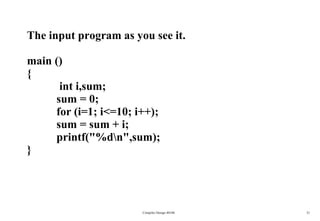
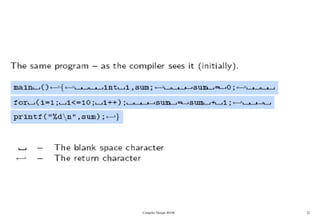
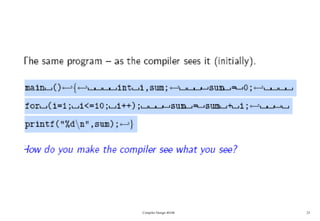
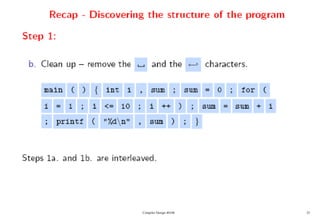
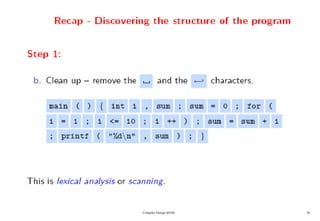
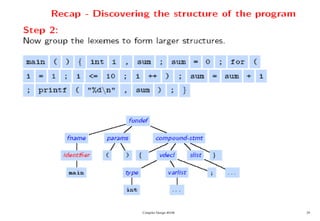
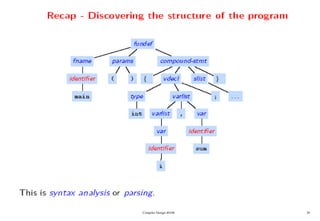
The input program as you see it. main () {    int i,sum;   sum = 0;   for (i=1; i<=10; i++);   sum = sum + i;   printf(&quot;%d\n&quot;,sum); }   Compiler Design 40106
Compiler Design 40106
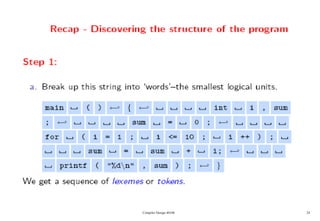
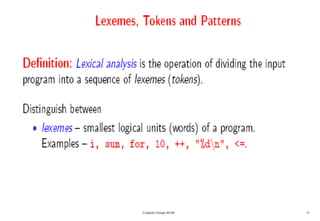
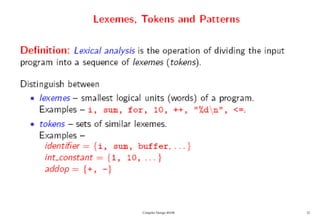
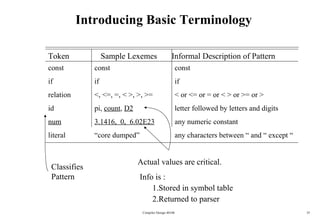
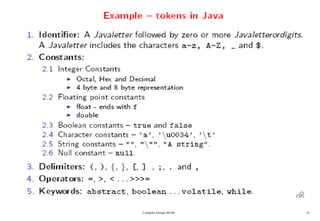
Introducing Basic Terminology What are Major Terms for Lexical Analysis? TOKEN A classification for a common set of strings Examples Include <Identifier>, <number>, etc. PATTERN The rules which characterize the set of strings for a token Recall File and OS Wildcards ([A-Z]*.*) LEXEME Actual sequence of characters that matches pattern and is classified by a token Identifiers: x, count, name, etc…  Compiler Design 40106
Introducing Basic Terminology Compiler Design 40106 Token Sample Lexemes Informal Description of Pattern const if relation id num literal const if <, <=, =, < >, >, >= pi,  count ,  D2 3.1416,  0,  6.02E23 “ core dumped” const if < or <= or = or < > or >= or > letter followed by letters and digits any numeric constant any characters between “ and “ except “ Classifies Pattern Actual values are critical.  Info is : 1.Stored in symbol table 2.Returned to parser
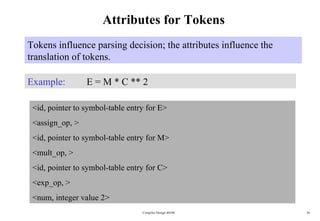
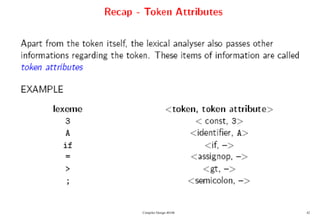
Attributes for Tokens Tokens influence parsing decision; the attributes influence the translation of tokens. Example: E = M * C ** 2 <id, pointer to symbol-table entry for E> <assign_op, > <id, pointer to symbol-table entry for M> <mult_op, > <id, pointer to symbol-table entry for C> <exp_op, > <num, integer value 2> Compiler Design 40106
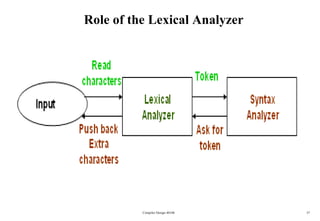
Role of the Lexical Analyzer Compiler Design 40106
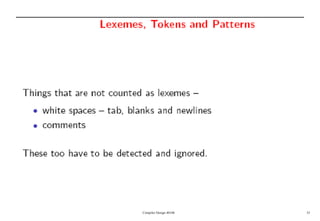
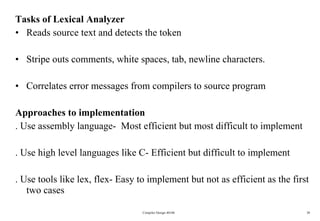
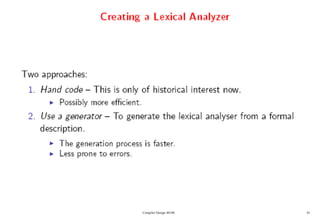
Tasks of Lexical Analyzer Reads source text and detects the token Stripe outs comments, white spaces, tab, newline characters. Correlates error messages from compilers to source program Approaches to implementation  . Use assembly language-  Most efficient but most difficult to implement  . Use high level languages like C- Efficient but difficult to implement . Use tools like lex, flex- Easy to implement but not as efficient as the first two cases  Compiler Design 40106
Compiler Design 40106
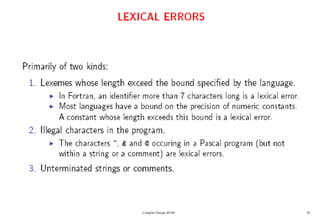
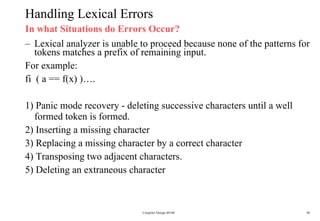
Handling Lexical Errors In what Situations do Errors Occur? Lexical analyzer is unable to proceed because none of the patterns for  tokens matches a prefix of remaining input. For example:  fi  ( a == f(x) )…. 1) Panic mode recovery - deleting successive characters until a well  formed token is formed. 2) Inserting a missing character 3) Replacing a missing character by a correct character 4) Transposing two adjacent characters. 5) Deleting an extraneous character Compiler Design 40106
Compiler Design 40106
 
Compiler Design 40106

Lexical analyzer

  • 1.
    CS40106 Compiler DesignCompiler Design 40106
  • 2.
    Prerequisites: AutomataTheory: DFAs, NFAs, Regular Expressions Textbook: Alfred V. Aho, Ravi Sethi, and Jeffrey D. Ullman, “ Compilers: Principles, Techniques, and Tools ” Addison-Wesley, 1986. K. Cooper, L. Torczon, ‘Engineering a Compiler’, Morgan Kaufmann, 1 st Edition, 2003 Compiler Design 40106
  • 3.
    Course Outline Introductionto Compiling Lexical Analysis Syntax Analysis Context Free Grammars Top-Down Parsing, LL Parsing Bottom-Up Parsing, LR Parsing Syntax-Directed Translation Attribute Definitions Evaluation of Attribute Definitions Semantic Analysis, Type Checking Run-Time Organization Intermediate Code Generation Code Optimization Compiler Design 40106
  • 4.
    COMPILERS A compiler is a program takes a program written in a source language and translates it into an equivalent program in a target language. source program COMPILER target program error messages Compiler Design 40106 ( Normally a program written in a high-level programming language) ( Normally the equivalent program in machine code – relocatable object file)
  • 5.
    Other Applications Inaddition to the development of a compiler, the techniques used in compiler design can be applicable to many problems in computer science. Techniques used in a lexical analyzer can be used in text editors, information retrieval system, and pattern recognition programs. Techniques used in a parser can be used in a query processing system such as SQL. A symbolic equation solver which takes an equation as input. That program should parse the given input equation. Most of the techniques used in compiler design can be used in Natural Language Processing (NLP) systems. Compiler Design 40106
  • 6.
    Major Parts ofCompilers There are two major parts of a compiler: Analysis and Synthesis In analysis phase, an intermediate representation is created from the given source program. Lexical Analyzer, Syntax Analyzer and Semantic Analyzer are the parts of this phase. In synthesis phase, the equivalent target program is created from this intermediate representation. Intermediate Code Generator, Code Generator, and Code Optimizer are the parts of this phase. Compiler Design 40106
  • 7.
    Phases of ACompiler Compiler Design 40106 Lexical Analyzer Semantic Analyzer Syntax Analyzer Intermediate Code Generator Code Optimizer Code Generator Target Program Source Program Each phase transforms the source program from one representation into another representation. They communicate with error handlers. They communicate with the symbol table.
  • 8.
    1. Lexical AnalyzerLexical Analyzer reads the source program character by character and returns the tokens of the source program. A token describes a pattern of characters having same meaning in the source program. (such as identifiers, operators, keywords, numbers, delimeters and so on) Ex : newval := oldval + 12 => tokens: newval identifier := assignment operator oldval identifier + add operator 12 a number Puts information about identifiers into the symbol table. Regular expressions are used to describe tokens (lexical constructs). A (Deterministic) Finite State Automaton can be used in the implementation of a lexical analyzer. Compiler Design 40106
  • 9.
    2. Syntax AnalyzerA Syntax Analyzer creates the syntactic structure (generally a parse tree) of the given program. A syntax analyzer is also called as a parser . A parse tree describes a syntactic structure. assgstmt identifier := expression newval expression + expression identifier number oldval 12 Compiler Design 40106 In a parse tree, all terminals are at leaves. All inner nodes are non-terminals in a context free grammar.
  • 10.
    Syntax Analyzer (CFG)The syntax of a language is specified by a context free grammar (CFG). The rules in a CFG are mostly recursive. A syntax analyzer checks whether a given program satisfies the rules implied by a CFG or not. If it satisfies, the syntax analyzer creates a parse tree for the given program. Ex: We use BNF (Backus Naur Form) to specify a CFG assgstmt -> identifier := expression expression -> identifier expression -> number expression -> expression + expression Compiler Design 40106
  • 11.
    Syntax Analyzer versusLexical Analyzer Which constructs of a program should be recognized by the lexical analyzer, and which ones by the syntax analyzer? Both of them do similar things; But the lexical analyzer deals with simple non-recursive constructs of the language. The syntax analyzer deals with recursive constructs of the language. The lexical analyzer simplifies the job of the syntax analyzer. The lexical analyzer recognizes the smallest meaningful units (tokens) in a source program. The syntax analyzer works on the smallest meaningful units (tokens) in a source program to recognize meaningful structures in our programming language. Compiler Design 40106
  • 12.
    Parsing Techniques Dependingon how the parse tree is created, there are different parsing techniques. These parsing techniques are categorized into two groups: Top-Down Parsing, Bottom-Up Parsing Top-Down Parsing: Construction of the parse tree starts at the root, and proceeds towards the leaves. Efficient top-down parsers can be easily constructed by hand. Recursive Predictive Parsing, Non-Recursive Predictive Parsing (LL Parsing). Bottom-Up Parsing: Construction of the parse tree starts at the leaves, and proceeds towards the root. Normally efficient bottom-up parsers are created with the help of some software tools. Bottom-up parsing is also known as shift-reduce parsing. Operator-Precedence Parsing – simple, restrictive, easy to implement LR Parsing – much general form of shift-reduce parsing, LR, SLR, LALR Compiler Design 40106
  • 13.
    3. Semantic AnalyzerA semantic analyzer checks the source program for semantic errors and collects the type information for the code generation. Type-checking is an important part of semantic analyzer. Context-free grammars used in the syntax analysis are integrated with attributes (semantic rules) the result is a syntax-directed translation, Attribute grammars Ex: newval := oldval + 12 The type of the identifier newval must match with type of the expression (oldval+12) Compiler Design 40106
  • 14.
    4. Intermediate CodeGeneration A compiler may produce an explicit intermediate codes representing the source program. These intermediate codes are generally machine (architecture independent). But the level of intermediate codes is close to the level of machine codes. Ex: newval := oldval * fact + 1 id1 := id2 * id3 + 1 temp1 := id2 * id3 Intermediates Codes (three address code) temp2 := temp1 + 1 id1 := temp2 Compiler Design 40106
  • 15.
    Intermediate Code GenerationProperties of IR- Easy to produce Easy to translate into the target program IR can be in following forms- Syntax trees Postfix notation Three address statements Properties of three address statements- At most one operator in addition to an assignment operator Must generate temporary names to hold the value computed at each instruction Some instructions have fewer than three operands Compiler Design 40106
  • 16.
    5. Code Optimizer(for Intermediate Code Generator) The code optimizer optimizes the code produced by the intermediate code generator in the terms of time and space. Ex: temp1 := id2 * id3 id1 := temp1 + 1 Compiler Design 40106
  • 17.
    6. Code GeneratorProduces the target language in a specific architecture. The target program is normally a relocatable object file containing the machine code or assembly code. Intermediate instructions are each translated into a sequence of machine instructions that perform the same task. Ex: ( assume that we have an architecture with instructions whose at least one of its operands is a machine register) MOVE id2,R1 MULT id3,R1 ADD #1,R1 MOVE R1,id1 Compiler Design 40106
  • 18.
    Phases of compilerCompiler Design 40106
  • 19.
  • 20.
    The Structure ofa Compiler (8) Scanner [Lexical Analyzer] Parser [Syntax Analyzer] Semantic Process [Semantic analyzer] Code Generator [Intermediate Code Generator] Code Optimizer Parse tree Abstract Syntax Tree w/ Attributes Non-optimized Intermediate Code Optimized Intermediate Code Code Genrator Target machine code Compiler Design 40106 Tokens
  • 21.
    The input programas you see it. main () { int i,sum; sum = 0; for (i=1; i<=10; i++); sum = sum + i; printf(&quot;%d\n&quot;,sum); } Compiler Design 40106
  • 22.
  • 23.
  • 24.
  • 25.
  • 26.
  • 27.
  • 28.
  • 29.
  • 30.
  • 31.
  • 32.
  • 33.
  • 34.
    Introducing Basic TerminologyWhat are Major Terms for Lexical Analysis? TOKEN A classification for a common set of strings Examples Include <Identifier>, <number>, etc. PATTERN The rules which characterize the set of strings for a token Recall File and OS Wildcards ([A-Z]*.*) LEXEME Actual sequence of characters that matches pattern and is classified by a token Identifiers: x, count, name, etc… Compiler Design 40106
  • 35.
    Introducing Basic TerminologyCompiler Design 40106 Token Sample Lexemes Informal Description of Pattern const if relation id num literal const if <, <=, =, < >, >, >= pi, count , D2 3.1416, 0, 6.02E23 “ core dumped” const if < or <= or = or < > or >= or > letter followed by letters and digits any numeric constant any characters between “ and “ except “ Classifies Pattern Actual values are critical. Info is : 1.Stored in symbol table 2.Returned to parser
  • 36.
    Attributes for TokensTokens influence parsing decision; the attributes influence the translation of tokens. Example: E = M * C ** 2 <id, pointer to symbol-table entry for E> <assign_op, > <id, pointer to symbol-table entry for M> <mult_op, > <id, pointer to symbol-table entry for C> <exp_op, > <num, integer value 2> Compiler Design 40106
  • 37.
    Role of theLexical Analyzer Compiler Design 40106
  • 38.
    Tasks of LexicalAnalyzer Reads source text and detects the token Stripe outs comments, white spaces, tab, newline characters. Correlates error messages from compilers to source program Approaches to implementation . Use assembly language- Most efficient but most difficult to implement . Use high level languages like C- Efficient but difficult to implement . Use tools like lex, flex- Easy to implement but not as efficient as the first two cases Compiler Design 40106
  • 39.
  • 40.
    Handling Lexical ErrorsIn what Situations do Errors Occur? Lexical analyzer is unable to proceed because none of the patterns for tokens matches a prefix of remaining input. For example: fi ( a == f(x) )…. 1) Panic mode recovery - deleting successive characters until a well formed token is formed. 2) Inserting a missing character 3) Replacing a missing character by a correct character 4) Transposing two adjacent characters. 5) Deleting an extraneous character Compiler Design 40106
  • 41.
  • 42.
  • 43.
  • 44.
  • 45.
  • 46.
  • 47.
  • 48.
  • 49.
  • 50.
  • 51.
  • 52.
  • 53.
  • 54.
  • 55.
  • 56.
  • 57.
  • 58.
  • 59.
  • 60.
  • 61.
  • 62.
  • 63.
  • 64.
  • 65.
  • 66.
  • 67.
  • 68.
  • 69.
  • 70.
  • 71.
  • 72.
  • 73.
  • 74.
  • 75.
  • 76.
  • 77.
  • 78.
  • 79.

Editor's Notes

  • #2 lec00-outline August 9, 2011