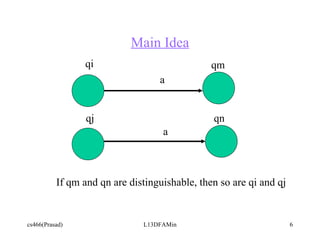
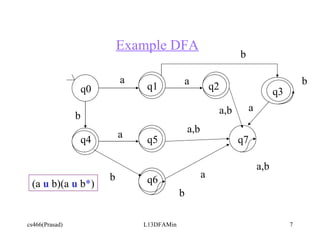
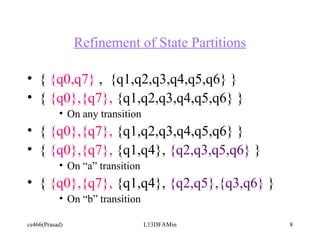
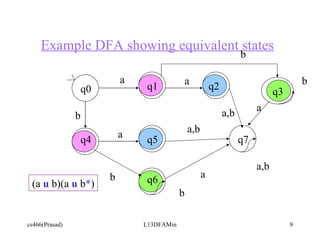
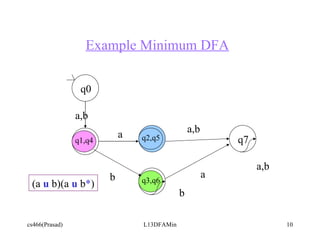
The document discusses determining equivalent states in a deterministic finite automaton (DFA) and using them to minimize the DFA. It provides an example of a DFA over the alphabet {a,b} recognizing strings with an even number of a's. The states {[Ea,Eb], [Ea,Ob]} and {[Oa,Eb], [Oa,Ob]} in this DFA are equivalent and can be collapsed into single states, creating a smaller minimal DFA with equivalent state partitions. The example DFA is then refined step-by-step to show the equivalent state partitions.

![Strings over { a,b } with even number of a ’s * Ea Oa Eb Ob Ob Eb b b b b a a a a [Oa,Ob] [Ea,Eb] [Ea,Ob] [Oa,Eb]](https://image.slidesharecdn.com/1269764/85/DFA-Minimization-2-320.jpg)
![Strings over { a,b } with even number of a ’s * Ea Oa a a [Ea] [Oa] b b](https://image.slidesharecdn.com/1269764/85/DFA-Minimization-3-320.jpg)
![Observation The states among the state sets {[Ea,Eb], [Ea,Ob]} and {[Oa,Eb], [Oa,Ob]} differ on aspect immaterial for the problem at hand. Why not collapse these state sets into one state each, to get a smaller DFA?](https://image.slidesharecdn.com/1269764/85/DFA-Minimization-4-320.jpg)