COMPUTER PROGRAMMING
Imtiaz Ali
INTRODUCTION TO COMPUTER PROGRAMMING
1) Introduction to Computer Programming.
2) Computer, Hierarchy of Computer, Compiler.
3) Interpreter, High level language, Features of C language.
• Program
• Software
• Compiler
• Interpreter
• Modular programming/Structured Programming
• Non structured programming
• Need of Programming language
• Difference between structured and object oriented
programming
• Advantages of object oriented programming
Computer
• In basic term, a computer is an
electronic device that processes data,
converting it into information that is
useful to people.
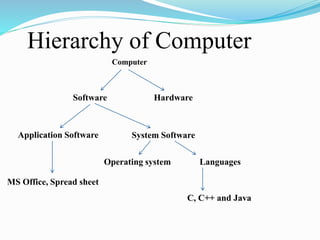
Hierarchy of Computer
Computer
HardwareSoftware
Application Software System Software
MS Office, Spread sheet
Operating system Languages
C, C++ and Java
Program
It is the set of instructions to be
given to computer for processing
and desired results.
Software
Set of program(s).
Compiler
A compiler is a special program that
processes statements written in a
particular programming language and
turns them into machine language or
"code" that a computer's processor uses.
Interpreter
An interpreter translates high-level
instructions into an intermediate form,
which it then executes.
Computer language processor that
translates a program line-by-line
(statement-by-statement) and carries out
the specified actions.
High level language
• A programming language such as C, FORTRAN, or
Pascal that enables a programmer to write programs
that are more or less independent of a particular type
of computer.
• Such languages are considered high-level because
they are closer to human languages and further from
machine languages.
Features of C language
Why Learn C
• Compact, fast and powerful.
• “Mid-level” language.
• Standard for program development(Wide Acceptance).
• It is everywhere (Portable).
• Supports modular programming style.
• Useful for all applications.
• C is native language of Unix.
• Easy to interface with System devices/assemble routines.
• C is terse.

COMPUTER PROGRAMMING

  • 1.
  • 2.
    INTRODUCTION TO COMPUTERPROGRAMMING 1) Introduction to Computer Programming. 2) Computer, Hierarchy of Computer, Compiler. 3) Interpreter, High level language, Features of C language.
  • 3.
    • Program • Software •Compiler • Interpreter • Modular programming/Structured Programming • Non structured programming • Need of Programming language • Difference between structured and object oriented programming • Advantages of object oriented programming
  • 4.
    Computer • In basicterm, a computer is an electronic device that processes data, converting it into information that is useful to people.
  • 5.
    Hierarchy of Computer Computer HardwareSoftware ApplicationSoftware System Software MS Office, Spread sheet Operating system Languages C, C++ and Java
  • 6.
    Program It is theset of instructions to be given to computer for processing and desired results.
  • 7.
  • 8.
    Compiler A compiler isa special program that processes statements written in a particular programming language and turns them into machine language or "code" that a computer's processor uses.
  • 9.
    Interpreter An interpreter translateshigh-level instructions into an intermediate form, which it then executes. Computer language processor that translates a program line-by-line (statement-by-statement) and carries out the specified actions.
  • 10.
    High level language •A programming language such as C, FORTRAN, or Pascal that enables a programmer to write programs that are more or less independent of a particular type of computer. • Such languages are considered high-level because they are closer to human languages and further from machine languages.
  • 11.
    Features of Clanguage Why Learn C • Compact, fast and powerful. • “Mid-level” language. • Standard for program development(Wide Acceptance). • It is everywhere (Portable). • Supports modular programming style. • Useful for all applications. • C is native language of Unix. • Easy to interface with System devices/assemble routines. • C is terse.