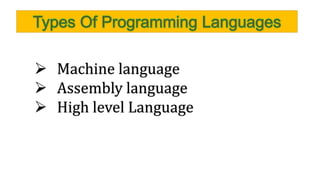
 Machine language
 Assembly language
 High level Language
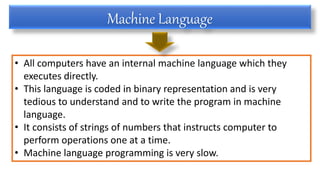
Machine Language
• All computers have an internal machine language which they
executes directly.
• This language is coded in binary representation and is very
tedious to understand and to write the program in machine
language.
• It consists of strings of numbers that instructs computer to
perform operations one at a time.
• Machine language programming is very slow.
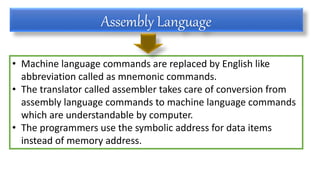
Assembly Language
• Machine language commands are replaced by English like
abbreviation called as mnemonic commands.
• The translator called assembler takes care of conversion from
assembly language commands to machine language commands
which are understandable by computer.
• The programmers use the symbolic address for data items
instead of memory address.
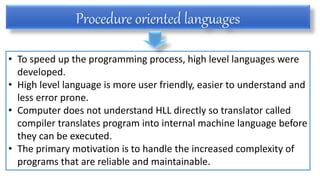
Procedure oriented languages
• To speed up the programming process, high level languages were
developed.
• High level language is more user friendly, easier to understand and
less error prone.
• Computer does not understand HLL directly so translator called
compiler translates program into internal machine language before
they can be executed.
• The primary motivation is to handle the increased complexity of
programs that are reliable and maintainable.
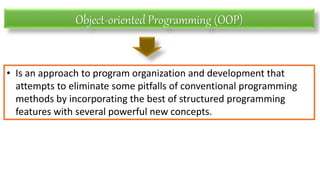
Object-oriented Programming (OOP)
• Is an approach to program organization and development that
attempts to eliminate some pitfalls of conventional programming
methods by incorporating the best of structured programming
features with several powerful new concepts.
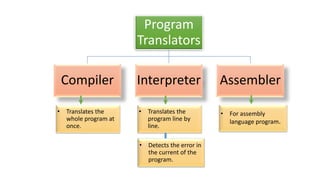
Program
Translators
Compiler Interpreter Assembler
• Translates the
whole program at
once.
• For assembly
language program.
• Detects the error in
the current of the
program.
• Translates the
program line by
line.
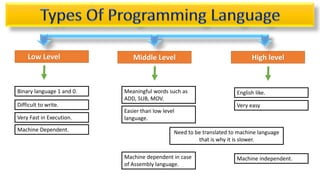
Low Level
Binary language 1 and 0.
Difficult to write.
Middle Level
Meaningful words such as
ADD, SUB, MOV.
Easier than low level
language.
High level
English like.
Very easy
Very Fast in Execution.
Machine Dependent. Need to be translated to machine language
that is why it is slower.
Machine dependent in case
of Assembly language.
Machine independent.

Types of Programming Languages

  • 2.
     Machine language Assembly language  High level Language
  • 3.
    Machine Language • Allcomputers have an internal machine language which they executes directly. • This language is coded in binary representation and is very tedious to understand and to write the program in machine language. • It consists of strings of numbers that instructs computer to perform operations one at a time. • Machine language programming is very slow.
  • 4.
    Assembly Language • Machinelanguage commands are replaced by English like abbreviation called as mnemonic commands. • The translator called assembler takes care of conversion from assembly language commands to machine language commands which are understandable by computer. • The programmers use the symbolic address for data items instead of memory address.
  • 5.
    Procedure oriented languages •To speed up the programming process, high level languages were developed. • High level language is more user friendly, easier to understand and less error prone. • Computer does not understand HLL directly so translator called compiler translates program into internal machine language before they can be executed. • The primary motivation is to handle the increased complexity of programs that are reliable and maintainable.
  • 6.
    Object-oriented Programming (OOP) •Is an approach to program organization and development that attempts to eliminate some pitfalls of conventional programming methods by incorporating the best of structured programming features with several powerful new concepts.
  • 7.
    Program Translators Compiler Interpreter Assembler •Translates the whole program at once. • For assembly language program. • Detects the error in the current of the program. • Translates the program line by line.
  • 8.
    Low Level Binary language1 and 0. Difficult to write. Middle Level Meaningful words such as ADD, SUB, MOV. Easier than low level language. High level English like. Very easy Very Fast in Execution. Machine Dependent. Need to be translated to machine language that is why it is slower. Machine dependent in case of Assembly language. Machine independent.