Introduction to Compiler
1
Compiler
โ€ข Programming languages are notations for describing computations to people
and to machines. The world as we know it depends on programming
languages, because all the software running on all the computers was
written in some programming language. But, before a program can be run, it
first must be translated into a form in which it can be executed by a
computer. The software systems that do this translation are called compilers.
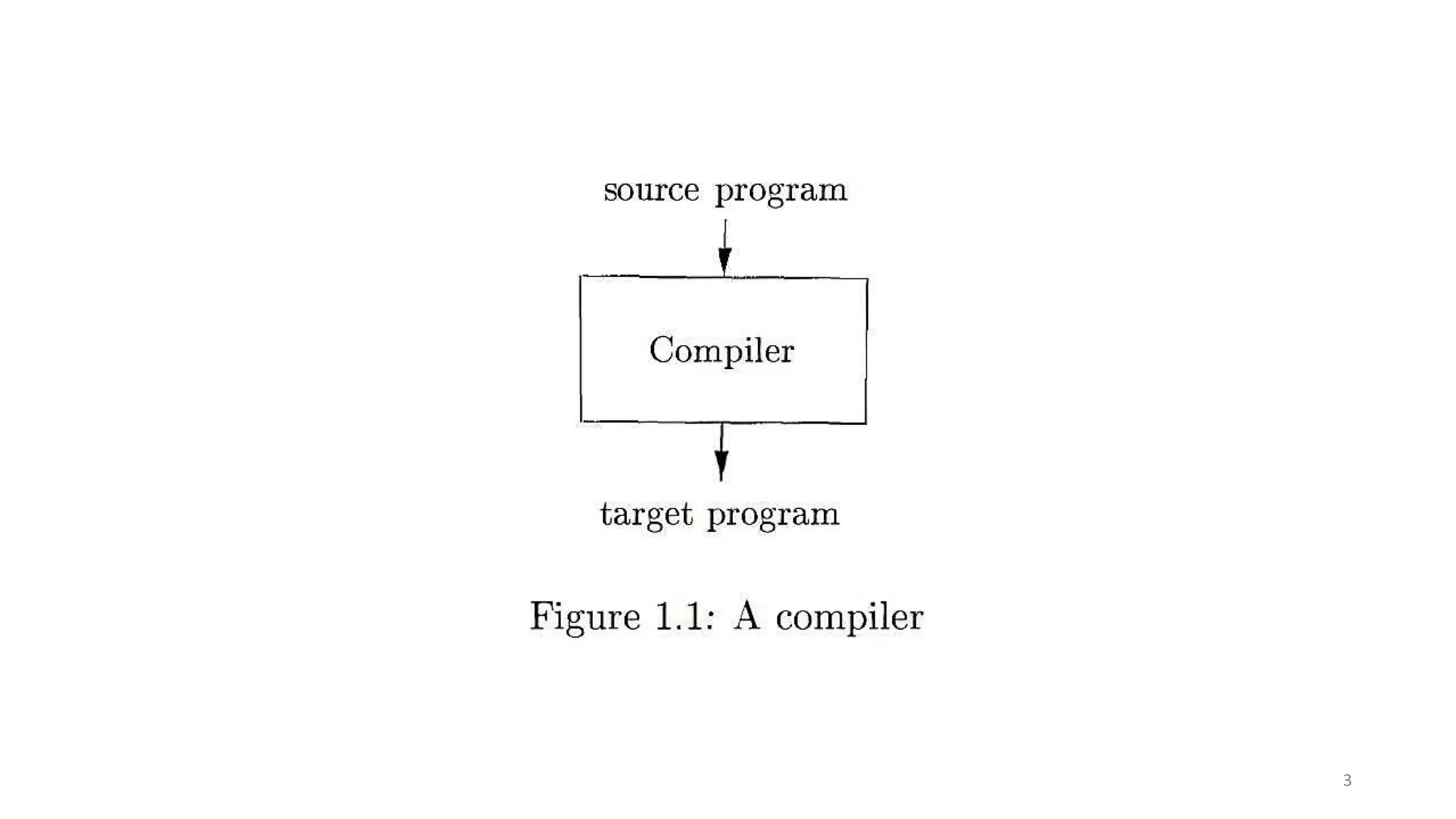
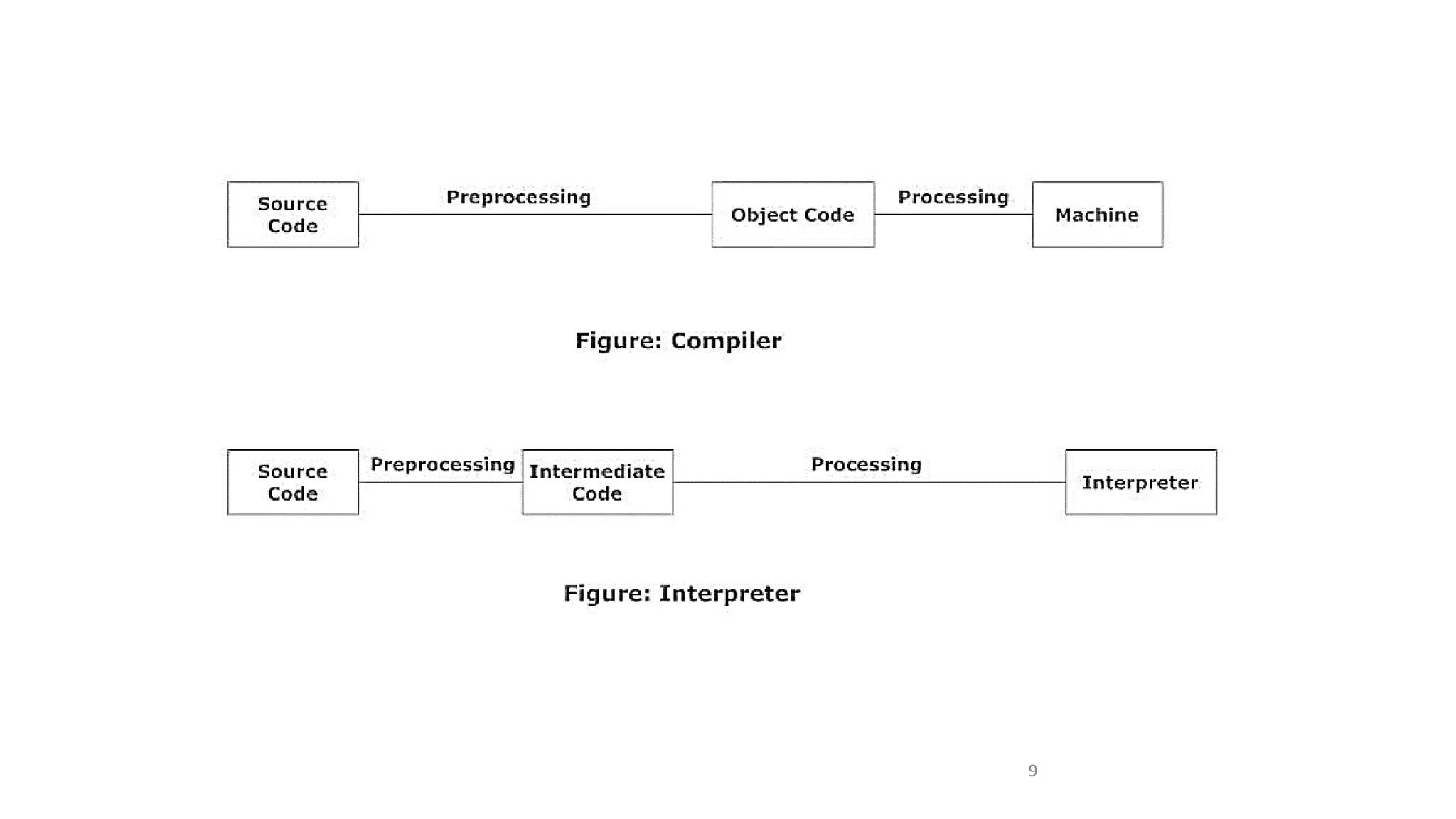
โ€ข A compiler is a program that can read a program in one language - the
source language - and translate it into an equivalent program in another
language - the target language; An important role of the compiler is to
report any errors in the source program that it detects during the
translation process.
2
3
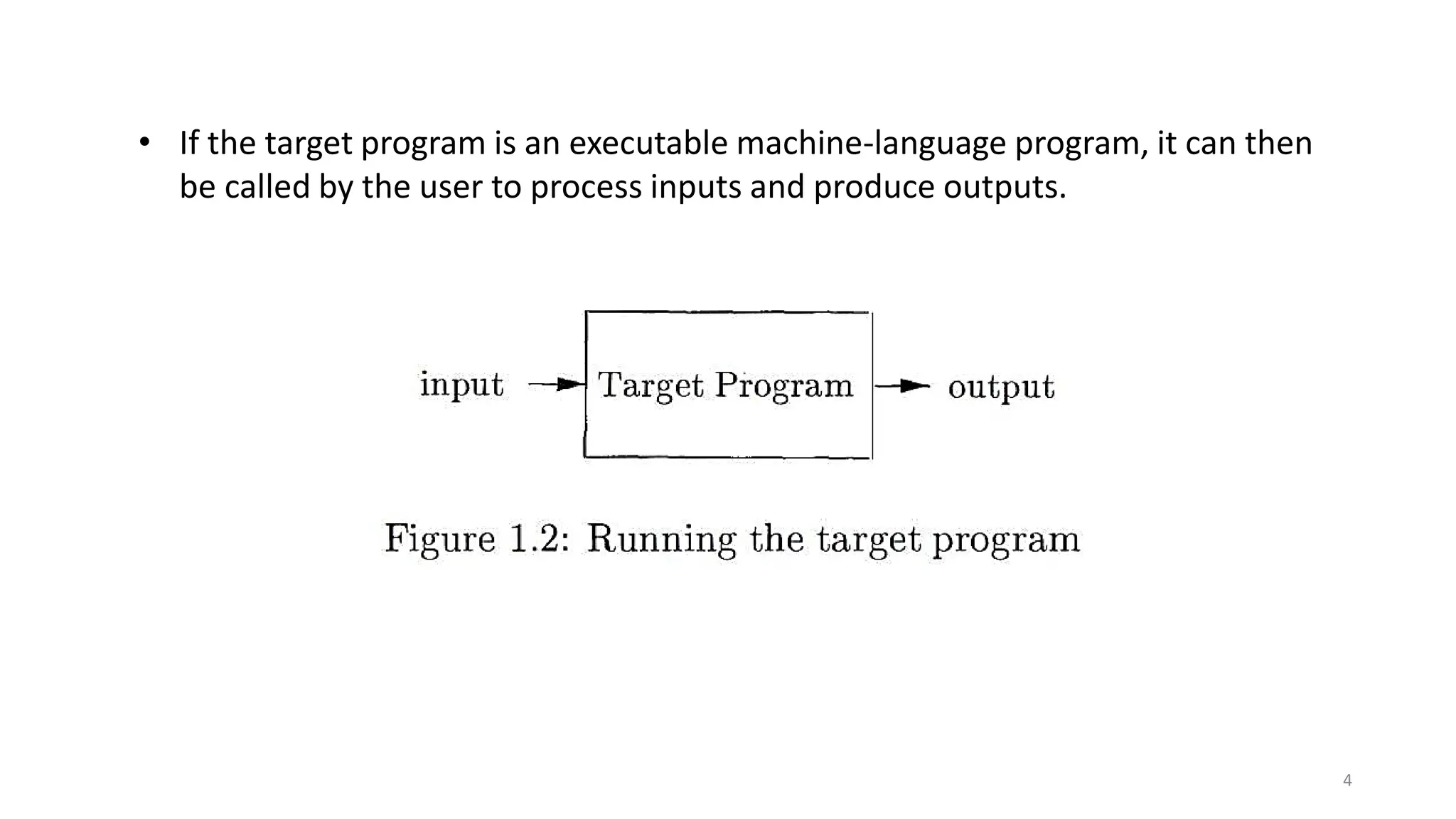
โ€ข If the target program is an executable machine-language program, it can then
be called by the user to process inputs and produce outputs.
4
Interpreter
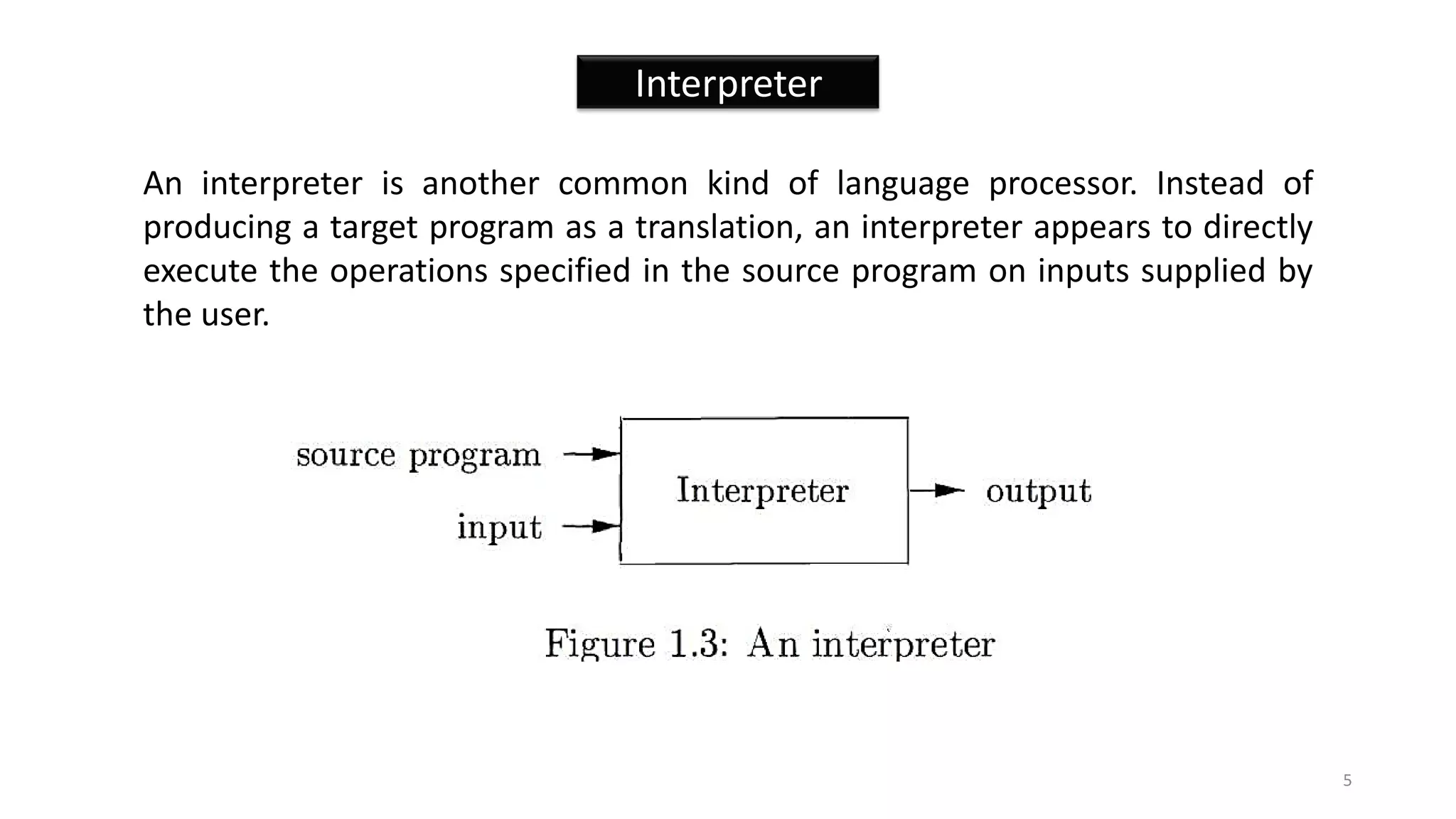
An interpreter is another common kind of language processor. Instead of
producing a target program as a translation, an interpreter appears to directly
execute the operations specified in the source program on inputs supplied by
the user.
5
โ€ข The machine-language target program produced by a compiler is usually much
faster than an interpreter at mapping inputs to outputs . An interpreter, however,
can usually give better error diagnostics than a compiler, because it executes
the source program statement by statement.
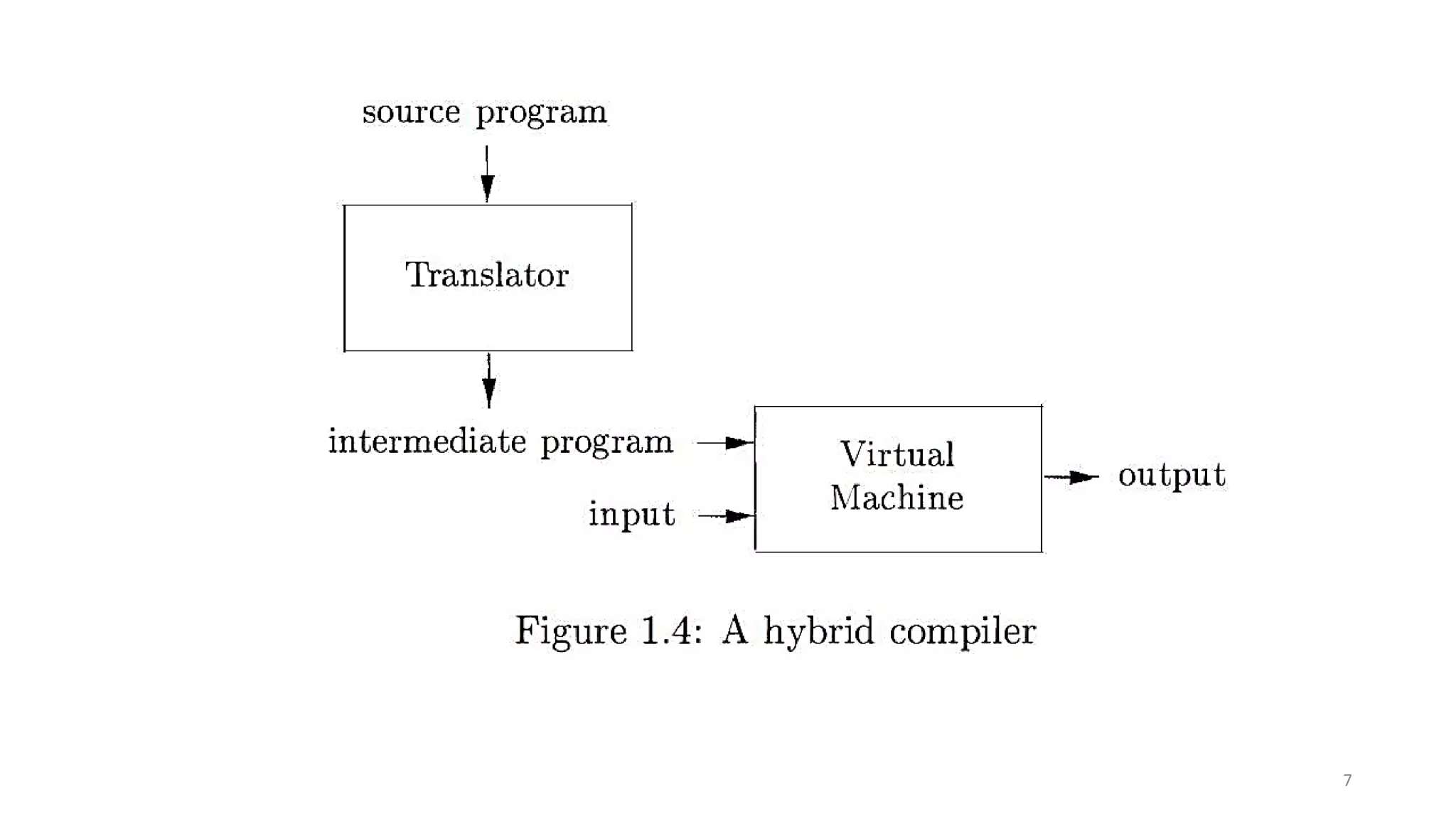
โ€ข Java language processors combine compilation and interpretation, as shown in
Fig. 1.4. A Java source program may first be compiled into an intermediate form
called bytecodes. The bytecodes are then interpreted by a virtual machine. A
benefit of this arrangement is that bytecodes compiled on one machine can be
interpreted on another machine , perhaps across a network.
6
7
Compiler & Interpreter
8
9
Interpreter Compiler
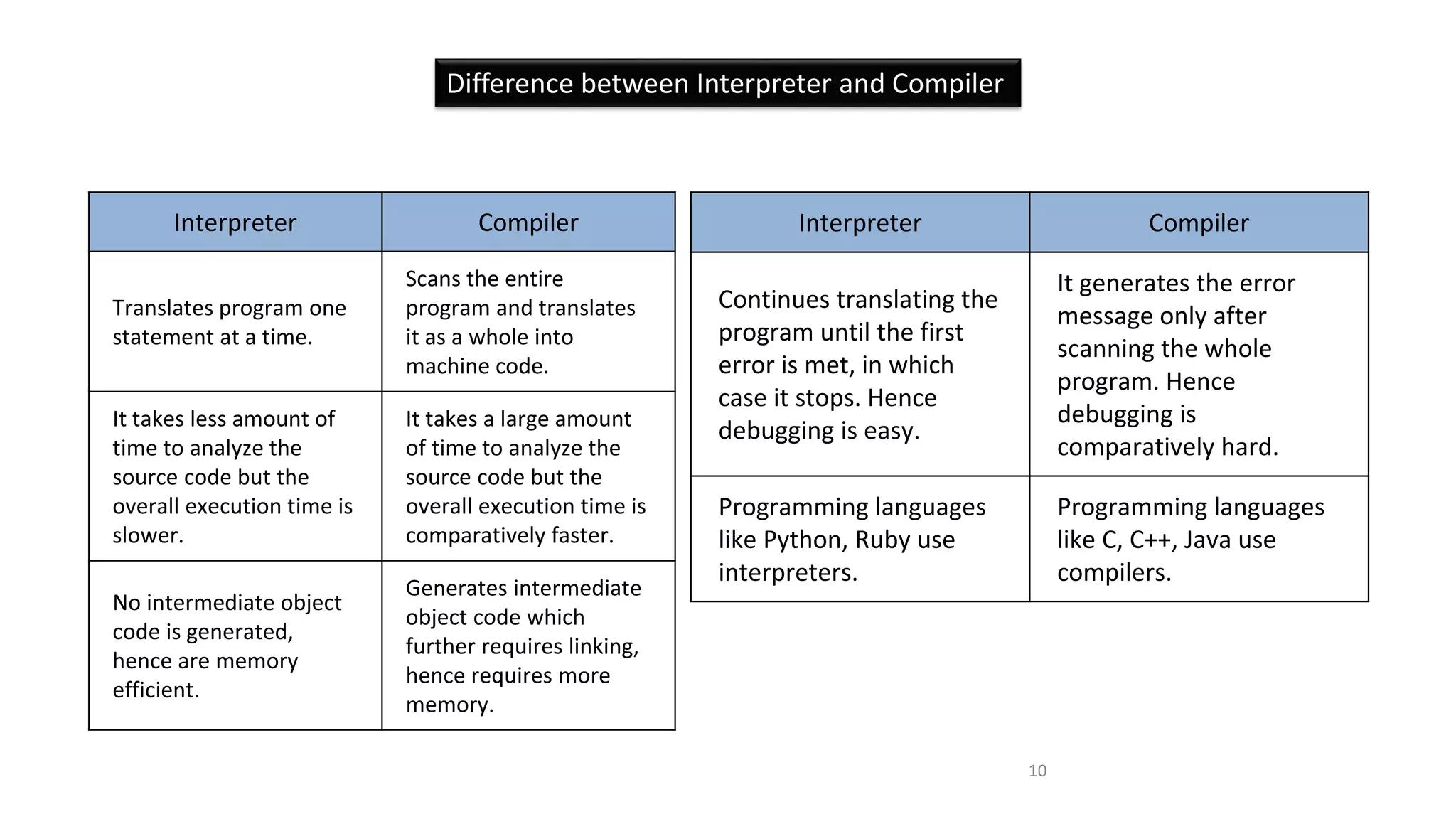
Translates program one
statement at a time.
Scans the entire
program and translates
it as a whole into
machine code.
It takes less amount of
time to analyze the
source code but the
overall execution time is
slower.
It takes a large amount
of time to analyze the
source code but the
overall execution time is
comparatively faster.
No intermediate object
code is generated,
hence are memory
efficient.
Generates intermediate
object code which
further requires linking,
hence requires more
memory.
Interpreter Compiler
Continues translating the
program until the first
error is met, in which
case it stops. Hence
debugging is easy.
It generates the error
message only after
scanning the whole
program. Hence
debugging is
comparatively hard.
Programming languages
like Python, Ruby use
interpreters.
Programming languages
like C, C++, Java use
compilers.
Difference between Interpreter and Compiler
10
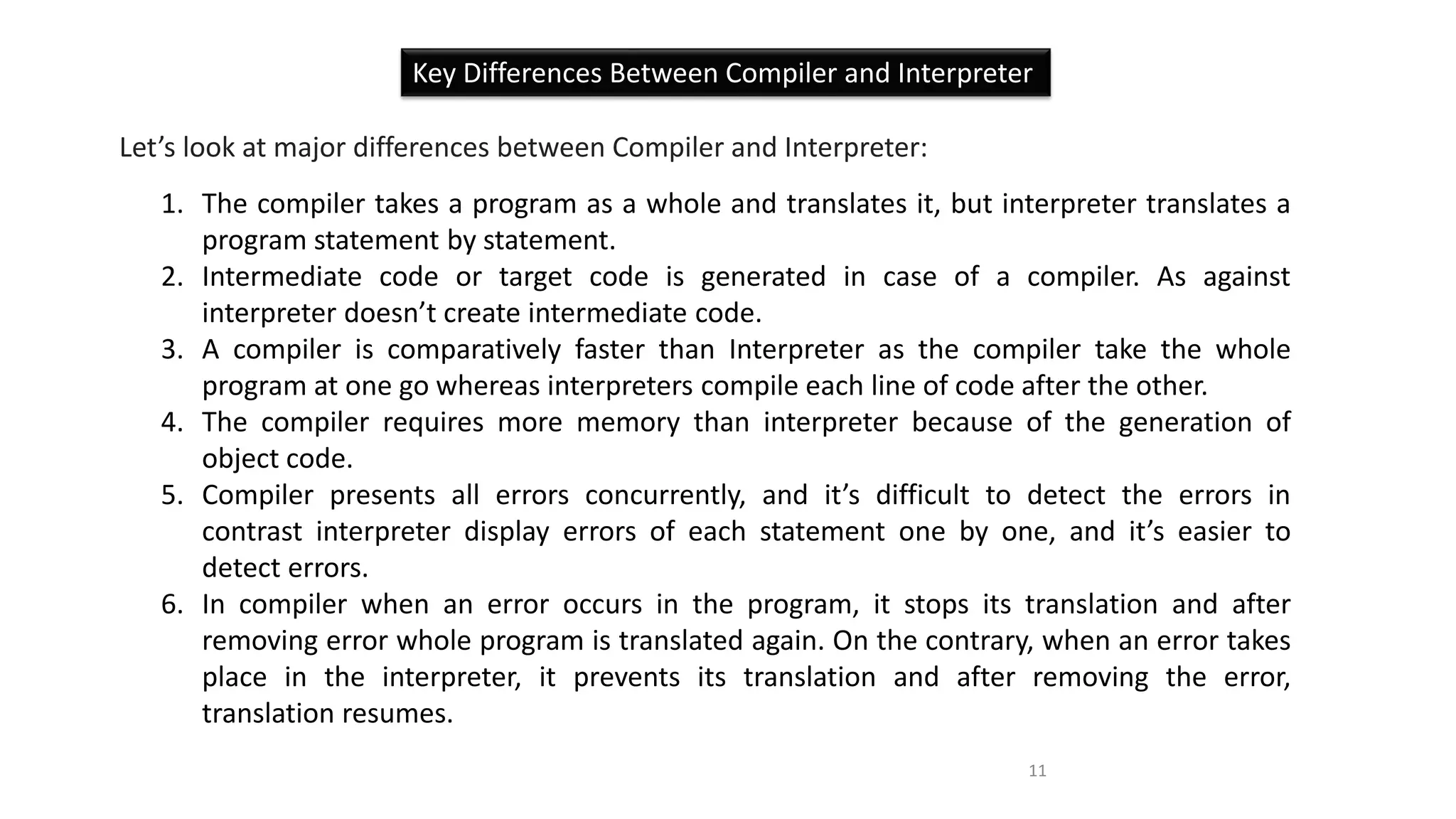
Key Differences Between Compiler and Interpreter
Letโ€™s look at major differences between Compiler and Interpreter:
1. The compiler takes a program as a whole and translates it, but interpreter translates a
program statement by statement.
2. Intermediate code or target code is generated in case of a compiler. As against
interpreter doesnโ€™t create intermediate code.
3. A compiler is comparatively faster than Interpreter as the compiler take the whole
program at one go whereas interpreters compile each line of code after the other.
4. The compiler requires more memory than interpreter because of the generation of
object code.
5. Compiler presents all errors concurrently, and itโ€™s difficult to detect the errors in
contrast interpreter display errors of each statement one by one, and itโ€™s easier to
detect errors.
6. In compiler when an error occurs in the program, it stops its translation and after
removing error whole program is translated again. On the contrary, when an error takes
place in the interpreter, it prevents its translation and after removing the error,
translation resumes.
11
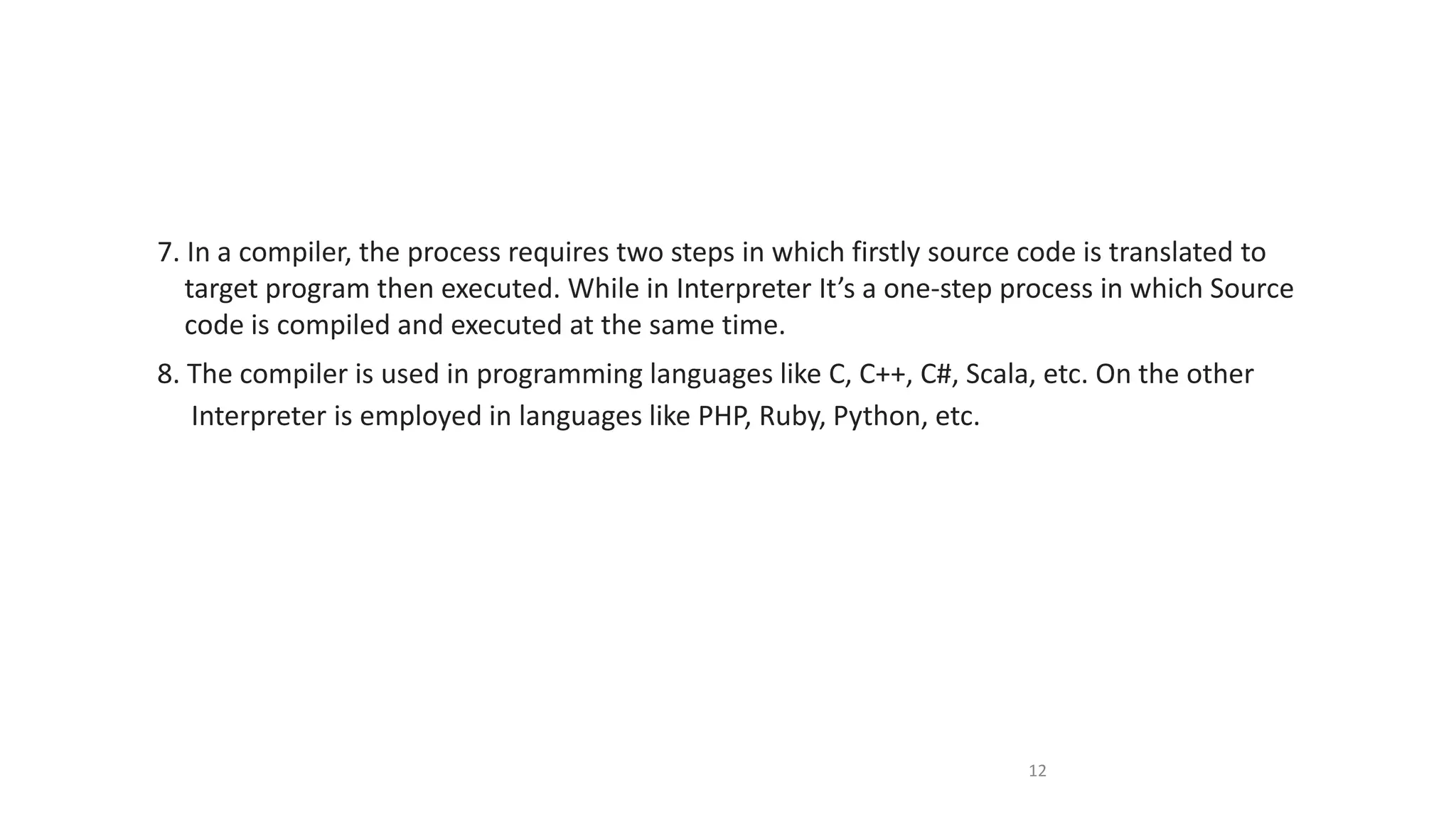
7. In a compiler, the process requires two steps in which firstly source code is translated to
target program then executed. While in Interpreter Itโ€™s a one-step process in which Source
code is compiled and executed at the same time.
8. The compiler is used in programming languages like C, C++, C#, Scala, etc. On the other
Interpreter is employed in languages like PHP, Ruby, Python, etc.
12
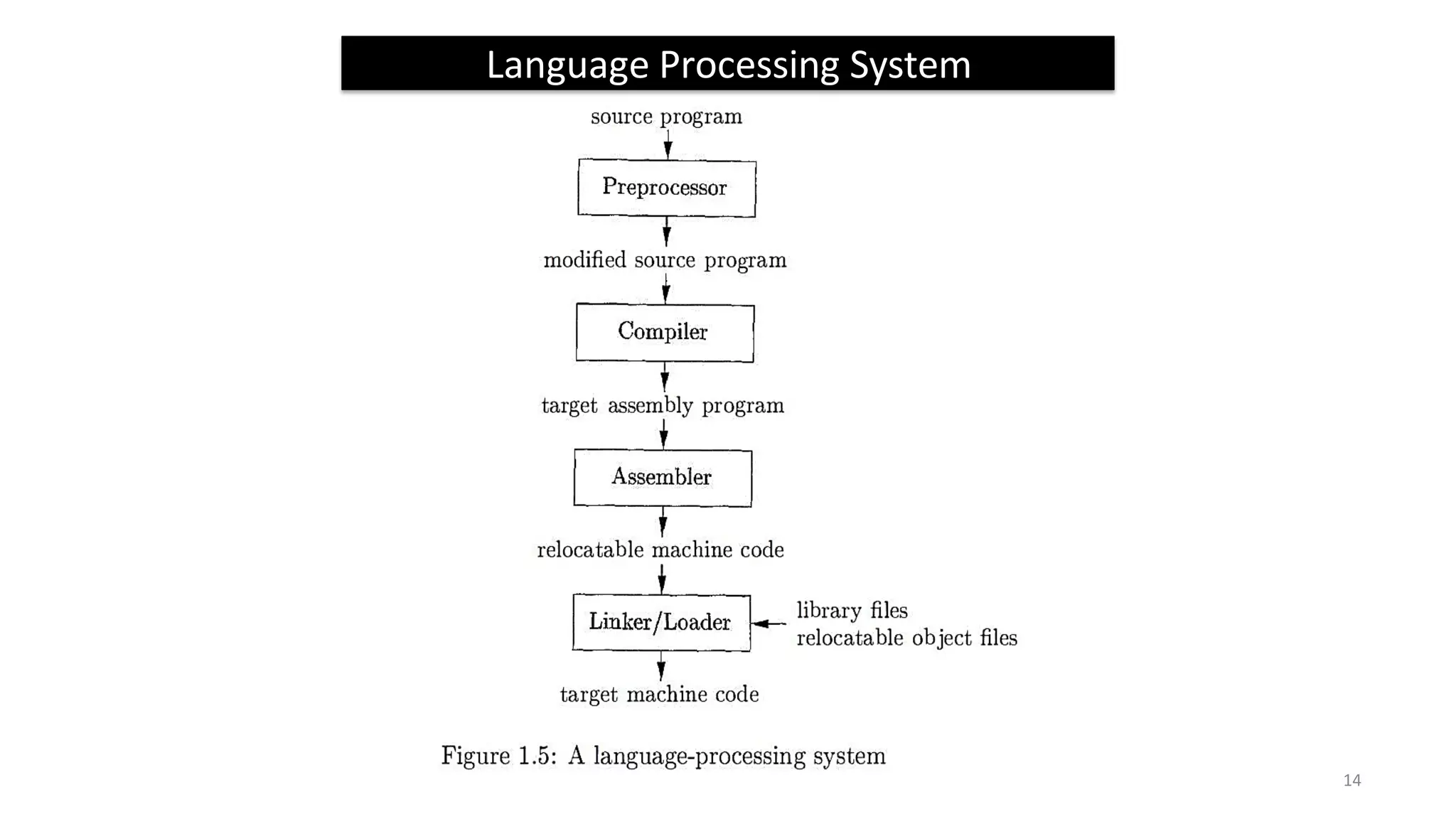
We know a computer is a logical assembly of Software and Hardware. The
hardware knows a language, that is hard for us to understand, consequently we
tend to write programs in high-level language, that is much less complicated for us
to comprehend and maintain in thoughts. Now these programs go through a series
of transformation so that they can readily be used in machines. This is where
language procedure systems come handy.
13
Language Processing System
14
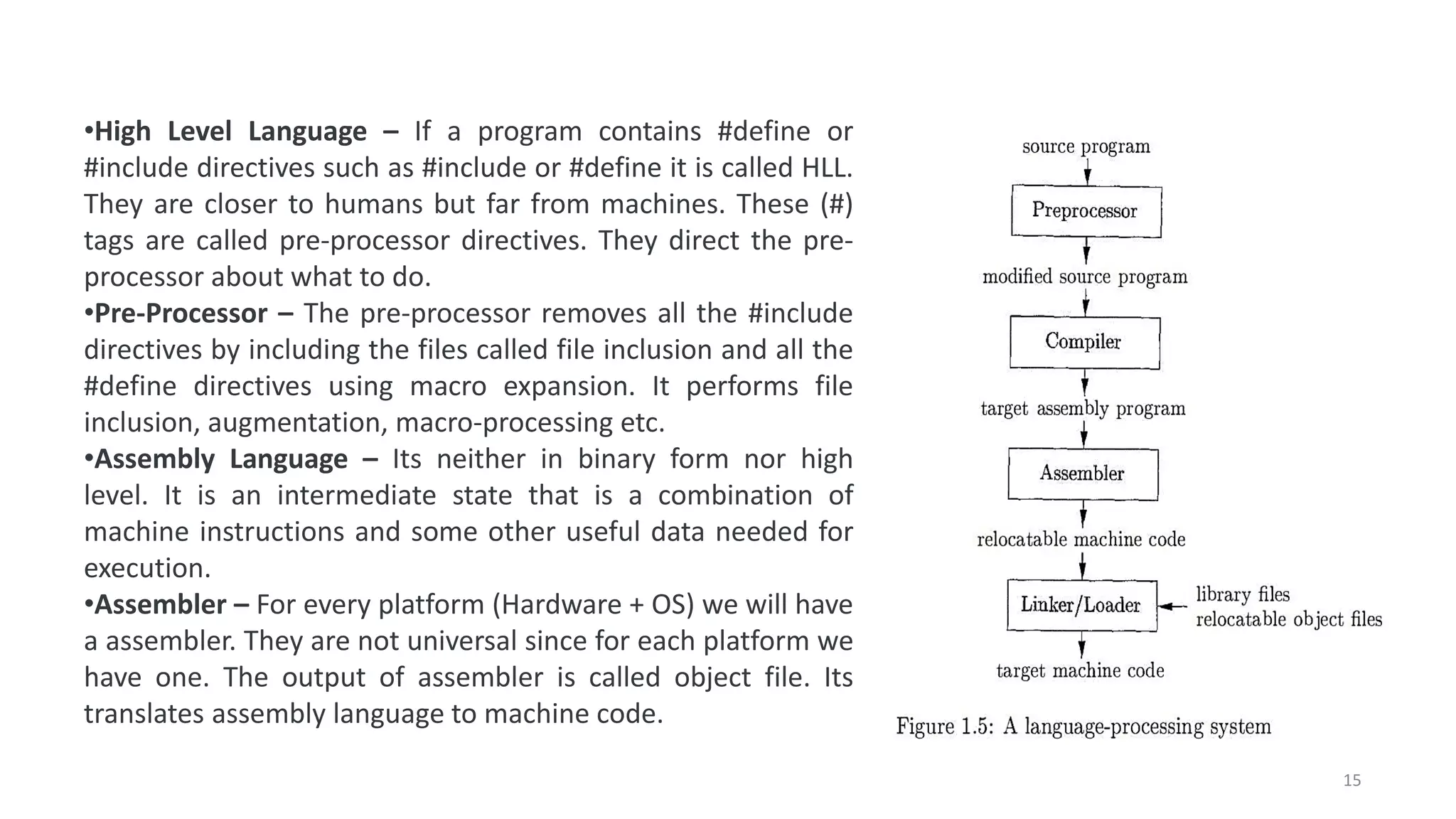
โ€ขHigh Level Language โ€“ If a program contains #define or
#include directives such as #include or #define it is called HLL.
They are closer to humans but far from machines. These (#)
tags are called pre-processor directives. They direct the pre-
processor about what to do.
โ€ขPre-Processor โ€“ The pre-processor removes all the #include
directives by including the files called file inclusion and all the
#define directives using macro expansion. It performs file
inclusion, augmentation, macro-processing etc.
โ€ขAssembly Language โ€“ Its neither in binary form nor high
level. It is an intermediate state that is a combination of
machine instructions and some other useful data needed for
execution.
โ€ขAssembler โ€“ For every platform (Hardware + OS) we will have
a assembler. They are not universal since for each platform we
have one. The output of assembler is called object file. Its
translates assembly language to machine code.
15
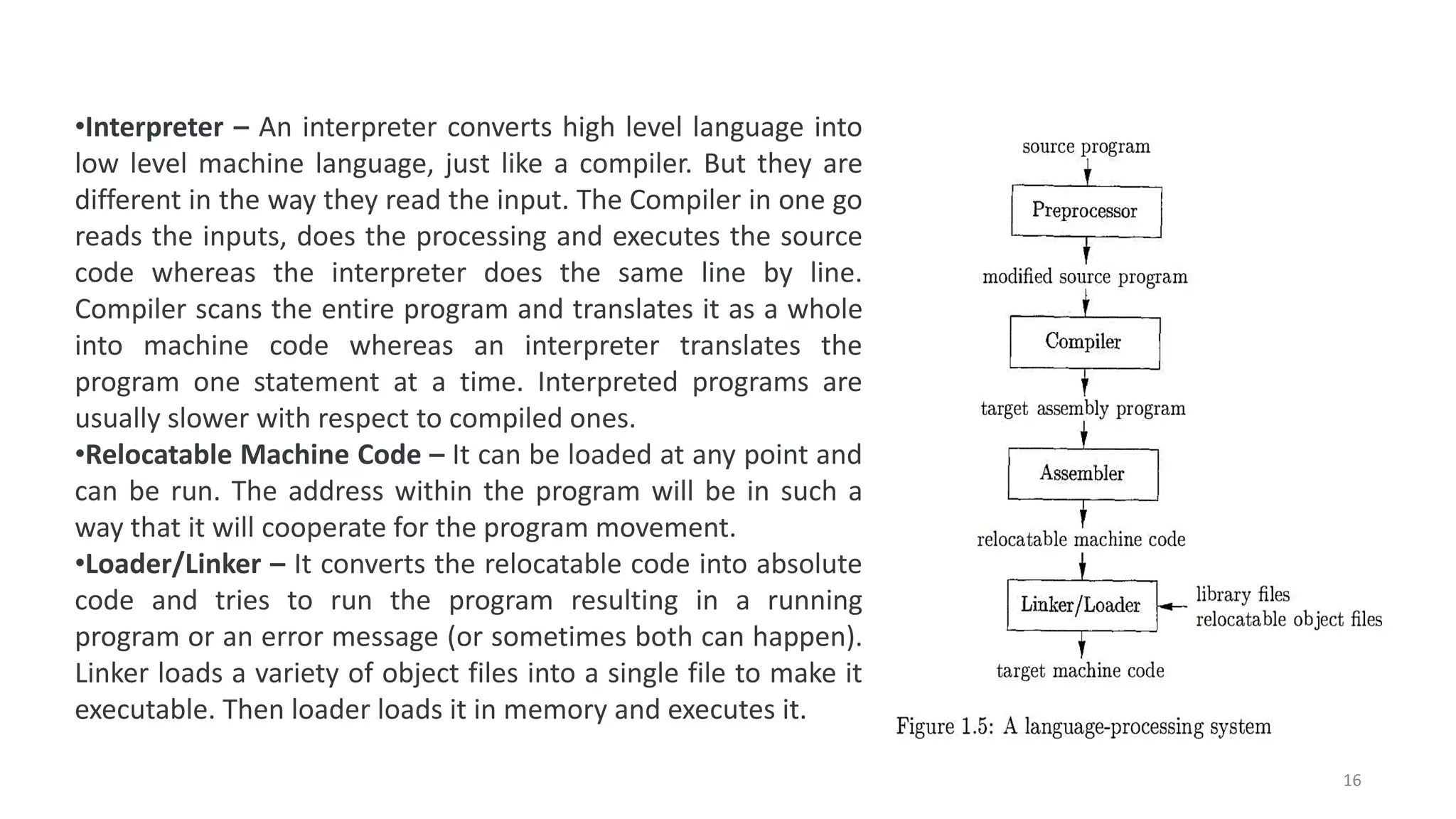
โ€ขInterpreter โ€“ An interpreter converts high level language into
low level machine language, just like a compiler. But they are
different in the way they read the input. The Compiler in one go
reads the inputs, does the processing and executes the source
code whereas the interpreter does the same line by line.
Compiler scans the entire program and translates it as a whole
into machine code whereas an interpreter translates the
program one statement at a time. Interpreted programs are
usually slower with respect to compiled ones.
โ€ขRelocatable Machine Code โ€“ It can be loaded at any point and
can be run. The address within the program will be in such a
way that it will cooperate for the program movement.
โ€ขLoader/Linker โ€“ It converts the relocatable code into absolute
code and tries to run the program resulting in a running
program or an error message (or sometimes both can happen).
Linker loads a variety of object files into a single file to make it
executable. Then loader loads it in memory and executes it.
16
THANK YOU
17

Language processing system.pdf

  • 1.
  • 2.
    Compiler โ€ข Programming languagesare notations for describing computations to people and to machines. The world as we know it depends on programming languages, because all the software running on all the computers was written in some programming language. But, before a program can be run, it first must be translated into a form in which it can be executed by a computer. The software systems that do this translation are called compilers. โ€ข A compiler is a program that can read a program in one language - the source language - and translate it into an equivalent program in another language - the target language; An important role of the compiler is to report any errors in the source program that it detects during the translation process. 2
  • 3.
  • 4.
    โ€ข If thetarget program is an executable machine-language program, it can then be called by the user to process inputs and produce outputs. 4
  • 5.
    Interpreter An interpreter isanother common kind of language processor. Instead of producing a target program as a translation, an interpreter appears to directly execute the operations specified in the source program on inputs supplied by the user. 5
  • 6.
    โ€ข The machine-languagetarget program produced by a compiler is usually much faster than an interpreter at mapping inputs to outputs . An interpreter, however, can usually give better error diagnostics than a compiler, because it executes the source program statement by statement. โ€ข Java language processors combine compilation and interpretation, as shown in Fig. 1.4. A Java source program may first be compiled into an intermediate form called bytecodes. The bytecodes are then interpreted by a virtual machine. A benefit of this arrangement is that bytecodes compiled on one machine can be interpreted on another machine , perhaps across a network. 6
  • 7.
  • 8.
  • 9.
  • 10.
    Interpreter Compiler Translates programone statement at a time. Scans the entire program and translates it as a whole into machine code. It takes less amount of time to analyze the source code but the overall execution time is slower. It takes a large amount of time to analyze the source code but the overall execution time is comparatively faster. No intermediate object code is generated, hence are memory efficient. Generates intermediate object code which further requires linking, hence requires more memory. Interpreter Compiler Continues translating the program until the first error is met, in which case it stops. Hence debugging is easy. It generates the error message only after scanning the whole program. Hence debugging is comparatively hard. Programming languages like Python, Ruby use interpreters. Programming languages like C, C++, Java use compilers. Difference between Interpreter and Compiler 10
  • 11.
    Key Differences BetweenCompiler and Interpreter Letโ€™s look at major differences between Compiler and Interpreter: 1. The compiler takes a program as a whole and translates it, but interpreter translates a program statement by statement. 2. Intermediate code or target code is generated in case of a compiler. As against interpreter doesnโ€™t create intermediate code. 3. A compiler is comparatively faster than Interpreter as the compiler take the whole program at one go whereas interpreters compile each line of code after the other. 4. The compiler requires more memory than interpreter because of the generation of object code. 5. Compiler presents all errors concurrently, and itโ€™s difficult to detect the errors in contrast interpreter display errors of each statement one by one, and itโ€™s easier to detect errors. 6. In compiler when an error occurs in the program, it stops its translation and after removing error whole program is translated again. On the contrary, when an error takes place in the interpreter, it prevents its translation and after removing the error, translation resumes. 11
  • 12.
    7. In acompiler, the process requires two steps in which firstly source code is translated to target program then executed. While in Interpreter Itโ€™s a one-step process in which Source code is compiled and executed at the same time. 8. The compiler is used in programming languages like C, C++, C#, Scala, etc. On the other Interpreter is employed in languages like PHP, Ruby, Python, etc. 12
  • 13.
    We know acomputer is a logical assembly of Software and Hardware. The hardware knows a language, that is hard for us to understand, consequently we tend to write programs in high-level language, that is much less complicated for us to comprehend and maintain in thoughts. Now these programs go through a series of transformation so that they can readily be used in machines. This is where language procedure systems come handy. 13 Language Processing System
  • 14.
  • 15.
    โ€ขHigh Level Languageโ€“ If a program contains #define or #include directives such as #include or #define it is called HLL. They are closer to humans but far from machines. These (#) tags are called pre-processor directives. They direct the pre- processor about what to do. โ€ขPre-Processor โ€“ The pre-processor removes all the #include directives by including the files called file inclusion and all the #define directives using macro expansion. It performs file inclusion, augmentation, macro-processing etc. โ€ขAssembly Language โ€“ Its neither in binary form nor high level. It is an intermediate state that is a combination of machine instructions and some other useful data needed for execution. โ€ขAssembler โ€“ For every platform (Hardware + OS) we will have a assembler. They are not universal since for each platform we have one. The output of assembler is called object file. Its translates assembly language to machine code. 15
  • 16.
    โ€ขInterpreter โ€“ Aninterpreter converts high level language into low level machine language, just like a compiler. But they are different in the way they read the input. The Compiler in one go reads the inputs, does the processing and executes the source code whereas the interpreter does the same line by line. Compiler scans the entire program and translates it as a whole into machine code whereas an interpreter translates the program one statement at a time. Interpreted programs are usually slower with respect to compiled ones. โ€ขRelocatable Machine Code โ€“ It can be loaded at any point and can be run. The address within the program will be in such a way that it will cooperate for the program movement. โ€ขLoader/Linker โ€“ It converts the relocatable code into absolute code and tries to run the program resulting in a running program or an error message (or sometimes both can happen). Linker loads a variety of object files into a single file to make it executable. Then loader loads it in memory and executes it. 16
  • 17.