Optimization of DFA
By: Kiran Acharya
Three Methods to Optimize
• Directly build DFA from regular expression.
• Minimize states.
• Compact transition tables
Constructing Direct DFA
• First we augment the given regular expression
by concatenating it with a special symbol #.
• r will be (r)# augmented regular expression.
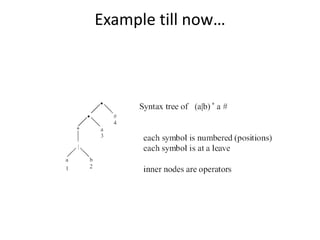
• Secondly we create a syntax tree for this
augmented regular expression.
• In this syntax tree, all alphabet symbols (plus #
and the empty string) in the augmented regular
expression will be on the leaves,
• all inner nodes will be the operators in that
augmented regular expression
Example till now…
Followpos, Firstpos,Lastpos
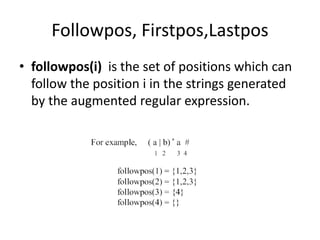
• followpos(i) is the set of positions which can
follow the position i in the strings generated
by the augmented regular expression.
• firstpos(n) the set of the positions of the first
symbols of strings generated by the sub-
expression rooted by n.
• lastpos(n) the set of the positions of the last
symbols of strings generated by the sub-
expression rooted by n
• nullable(n)true if the empty string is a
member of strings generated by the sub-
expression rooted by n false otherwise.
Calculating Firstpos and Lastpos &
nullable
Evaluating Followpos
• If n is concatenation-node with left child c1 and
right child c2,and i is a position in lastpos(c1),
then all positions in firstpos(c2) are in
followpos(i).
• If n is a star-node, and I is a position in
lastpos(n), then all positions in firstpos(n) are in
followpos(i).
example
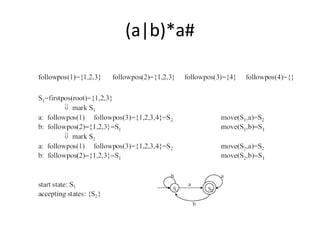
(a|b)*a#
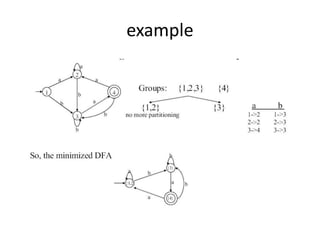
Minimizing number of states of DFA
partition the set of states into two groups:
• G 1 : set of accepting states
• G2 : set of non-accepting states
For each new group G
partition G into subgroups such that states s1 and s 2 are in the same
group iff for all input symbols a, states s1and s2 have transitions to states
in the same group.
• Start state of the minimized DFA is the group containing the start state of
the original DFA.
• Accepting states of the minimized DFA are the groups containing the
accepting states of the original DFA.
example
Compacting Transition Tables
• transition function of a DFA two dimensional
table indexed by states and characters
• typical lexical analyzer has hundreds of states
ASCII alphabet of 128 input characters < 1 MB
• compilers “live” in small devices too 1 MB could
be too much
Alternate Representations
• list of character-state pairs
• ending by a default state
1. chosen for any input character not on the list
2. the most frequently occurring next state
• thus, the table is reduced by a large factor

Optimization of dfa

  • 1.
  • 2.
    Three Methods toOptimize • Directly build DFA from regular expression. • Minimize states. • Compact transition tables
  • 3.
    Constructing Direct DFA •First we augment the given regular expression by concatenating it with a special symbol #. • r will be (r)# augmented regular expression. • Secondly we create a syntax tree for this augmented regular expression. • In this syntax tree, all alphabet symbols (plus # and the empty string) in the augmented regular expression will be on the leaves, • all inner nodes will be the operators in that augmented regular expression
  • 4.
  • 5.
    Followpos, Firstpos,Lastpos • followpos(i)is the set of positions which can follow the position i in the strings generated by the augmented regular expression.
  • 6.
    • firstpos(n) theset of the positions of the first symbols of strings generated by the sub- expression rooted by n. • lastpos(n) the set of the positions of the last symbols of strings generated by the sub- expression rooted by n • nullable(n)true if the empty string is a member of strings generated by the sub- expression rooted by n false otherwise.
  • 7.
    Calculating Firstpos andLastpos & nullable
  • 8.
    Evaluating Followpos • Ifn is concatenation-node with left child c1 and right child c2,and i is a position in lastpos(c1), then all positions in firstpos(c2) are in followpos(i). • If n is a star-node, and I is a position in lastpos(n), then all positions in firstpos(n) are in followpos(i).
  • 9.
  • 10.
  • 11.
    Minimizing number ofstates of DFA partition the set of states into two groups: • G 1 : set of accepting states • G2 : set of non-accepting states For each new group G partition G into subgroups such that states s1 and s 2 are in the same group iff for all input symbols a, states s1and s2 have transitions to states in the same group. • Start state of the minimized DFA is the group containing the start state of the original DFA. • Accepting states of the minimized DFA are the groups containing the accepting states of the original DFA.
  • 12.
  • 13.
    Compacting Transition Tables •transition function of a DFA two dimensional table indexed by states and characters • typical lexical analyzer has hundreds of states ASCII alphabet of 128 input characters < 1 MB • compilers “live” in small devices too 1 MB could be too much
  • 14.
    Alternate Representations • listof character-state pairs • ending by a default state 1. chosen for any input character not on the list 2. the most frequently occurring next state • thus, the table is reduced by a large factor