

Optimization of DFA
Subject: Compiler design
CE-B
 Maulik Togadiya 130240107090
Introduction
 Minimization/optimization of a deterministic finite automaton refers to the
detection of those states of a DFA, whose presence or absence in a DFA does
not affect the language accepted by the automata.
 The states that can be eliminated from automata, without affecting the
language accepted
by automata, are:
▪Unreachable or inaccessible states.
▪Dead states.
▪Non-distinguishable or indistinguishable state or equivalent states.
Minimizing DFA’s
 Lots of methods
 All involve finding equivalent states:
 States that go to equivalent states under all inputs
Minimizing DFA’s by Partitioning
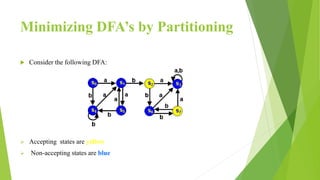
 Consider the following DFA:
 Accepting states are yellow
 Non-accepting states are blue
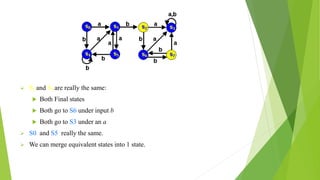
 S2 and S7 are really the same:
 Both Final states
 Both go to S6 under input b
 Both go to S3 under an a
 S0 and S5 really the same.
 We can merge equivalent states into 1 state.
Partitioning Algorithm
 First
Divide the set of states into
 Final and
 Non-final states
Partition I
Partition II
a b
S0 S1 S4
S1 S5 S2
S3 S3 S3
S4 S1 S4
S5 S1 S4
S6 S3 S7
*S2 S3 S6
*S7 S3 S6
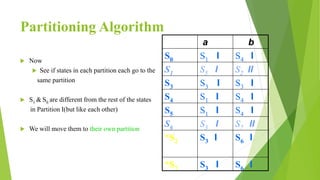
Partitioning Algorithm
 Now
 See if states in each partition each go to the
same partition
 S1 & S6 are different from the rest of the states
in Partition I(but like each other)
 We will move them to their own partition
a b
S0 S1 I S4 I
S1 S5 I S2 II
S3 S3 I S3 I
S4 S1 I S4 I
S5 S1 I S4 I
S6 S3 I S7 II
*S2 S3 I S6 I
*S7 S3 I S6 I
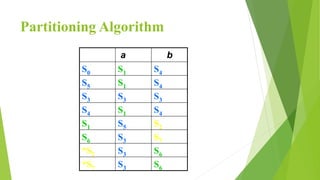
Partitioning Algorithm
a b
S0 S1 S4
S5 S1 S4
S3 S3 S3
S4 S1 S4
S1 S5 S2
S6 S3 S7
*S2 S3 S6
*S7 S3 S6
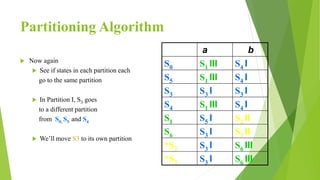
Partitioning Algorithm
 Now again
 See if states in each partition each
go to the same partition
 In Partition I, S3 goes
to a different partition
from S0, S5 and S4
 We’ll move S3 to its own partition
a b
S0 S1 III S4 I
S5 S1 III S4 I
S3 S3 I S3 I
S4 S1 III S4 I
S1 S5 I S2 II
S6 S3 I S7 II
*S2 S3 I S6 III
*S7 S3 I S6 III
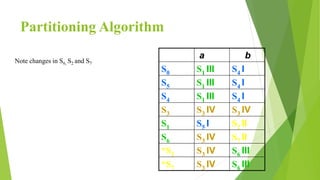
Partitioning Algorithm
Note changes in S6, S2 and S7
a b
S0 S1 III S4 I
S5 S1 III S4 I
S4 S1 III S4 I
S3 S3 IV S3 IV
S1 S5 I S2 II
S6 S3 IV S7 II
*S2 S3 IV S6 III
*S7 S3 IV S6 III
Partitioning Algorithm
 Now S6 goes to a different partition on an
a from S1
 S6 gets its own partition.
 We now have 5 partitions
 Note changes in S2 and S7
a b
S0 S1 III S4 I
S5 S1 III S4 I
S4 S1 III S4 I
S3 S3 IV S3 IV
S1 S5 I S2 II
S6 S3 IV S7 II
*S2 S3 IV S6 V
*S7 S3 IV S6 V
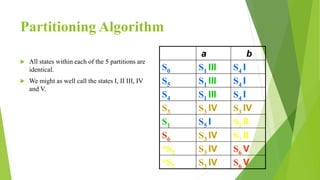
Partitioning Algorithm
 All states within each of the 5 partitions are
identical.
 We might as well call the states I, II III, IV
and V.
a b
S0 S1 III S4 I
S5 S1 III S4 I
S4 S1 III S4 I
S3 S3 IV S3 IV
S1 S5 I S2 II
S6 S3 IV S7 II
*S2 S3 IV S6 V
*S7 S3 IV S6 V
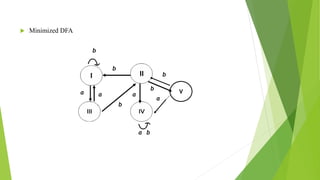
Partitioning Algorithm
 Here we are
a b
I III I
*II IV V
III I II
IV IV IV
V IV II
 Minimized DFA
V
a
a
aa a
b
b
b
b
b
b
Myphill-Nerode Theorem
Step 1 Draw a table for all pairs of states (Qi, Qj) not
necessarily connected directly [All are
unmarked initially]
Step 2 Consider every state pair (Qi, Qj) in the DFA
where Qi ∈ F and Qj ∉ F or vice versa and
mark them. [Here F is the set of final states].
Step 3 Repeat this step until we cannot mark
anymore states −
If there is an unmarked pair (Qi, Qj), mark it
if the pair {δ(Qi, A), δ (Qi, A)} is marked for
some input alphabet.
Step 4 Combine all the unmarked pair (Qi, Qj) and
make them a single state in the reduced DFA.
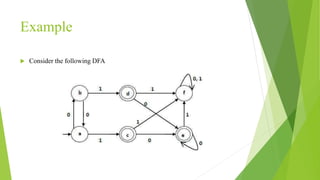
Example
 Consider the following DFA
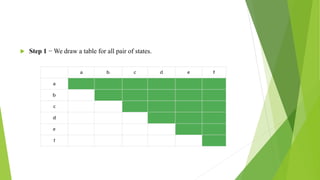
 Step 1 − We draw a table for all pair of states.
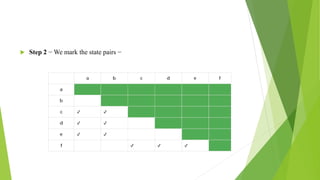
 Step 2 − We mark the state pairs −
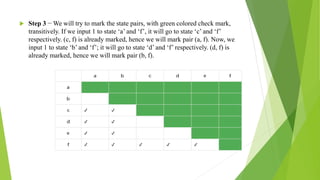
 Step 3 − We will try to mark the state pairs, with green colored check mark,
transitively. If we input 1 to state ‘a’ and ‘f’, it will go to state ‘c’ and ‘f’
respectively. (c, f) is already marked, hence we will mark pair (a, f). Now, we
input 1 to state ‘b’ and ‘f’; it will go to state ‘d’ and ‘f’ respectively. (d, f) is
already marked, hence we will mark pair (b, f).
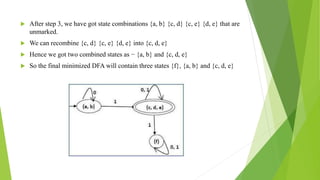
 After step 3, we have got state combinations {a, b} {c, d} {c, e} {d, e} that are
unmarked.
 We can recombine {c, d} {c, e} {d, e} into {c, d, e}
 Hence we got two combined states as − {a, b} and {c, d, e}
 So the final minimized DFA will contain three states {f}, {a, b} and {c, d, e}
optimization of DFA

optimization of DFA

  • 1.
    Optimization of DFA Subject:Compiler design CE-B  Maulik Togadiya 130240107090
  • 2.
    Introduction  Minimization/optimization ofa deterministic finite automaton refers to the detection of those states of a DFA, whose presence or absence in a DFA does not affect the language accepted by the automata.  The states that can be eliminated from automata, without affecting the language accepted by automata, are: ▪Unreachable or inaccessible states. ▪Dead states. ▪Non-distinguishable or indistinguishable state or equivalent states.
  • 3.
    Minimizing DFA’s  Lotsof methods  All involve finding equivalent states:  States that go to equivalent states under all inputs
  • 4.
    Minimizing DFA’s byPartitioning  Consider the following DFA:  Accepting states are yellow  Non-accepting states are blue
  • 5.
     S2 andS7 are really the same:  Both Final states  Both go to S6 under input b  Both go to S3 under an a  S0 and S5 really the same.  We can merge equivalent states into 1 state.
  • 6.
    Partitioning Algorithm  First Dividethe set of states into  Final and  Non-final states Partition I Partition II a b S0 S1 S4 S1 S5 S2 S3 S3 S3 S4 S1 S4 S5 S1 S4 S6 S3 S7 *S2 S3 S6 *S7 S3 S6
  • 7.
    Partitioning Algorithm  Now See if states in each partition each go to the same partition  S1 & S6 are different from the rest of the states in Partition I(but like each other)  We will move them to their own partition a b S0 S1 I S4 I S1 S5 I S2 II S3 S3 I S3 I S4 S1 I S4 I S5 S1 I S4 I S6 S3 I S7 II *S2 S3 I S6 I *S7 S3 I S6 I
  • 8.
    Partitioning Algorithm a b S0S1 S4 S5 S1 S4 S3 S3 S3 S4 S1 S4 S1 S5 S2 S6 S3 S7 *S2 S3 S6 *S7 S3 S6
  • 9.
    Partitioning Algorithm  Nowagain  See if states in each partition each go to the same partition  In Partition I, S3 goes to a different partition from S0, S5 and S4  We’ll move S3 to its own partition a b S0 S1 III S4 I S5 S1 III S4 I S3 S3 I S3 I S4 S1 III S4 I S1 S5 I S2 II S6 S3 I S7 II *S2 S3 I S6 III *S7 S3 I S6 III
  • 10.
    Partitioning Algorithm Note changesin S6, S2 and S7 a b S0 S1 III S4 I S5 S1 III S4 I S4 S1 III S4 I S3 S3 IV S3 IV S1 S5 I S2 II S6 S3 IV S7 II *S2 S3 IV S6 III *S7 S3 IV S6 III
  • 11.
    Partitioning Algorithm  NowS6 goes to a different partition on an a from S1  S6 gets its own partition.  We now have 5 partitions  Note changes in S2 and S7 a b S0 S1 III S4 I S5 S1 III S4 I S4 S1 III S4 I S3 S3 IV S3 IV S1 S5 I S2 II S6 S3 IV S7 II *S2 S3 IV S6 V *S7 S3 IV S6 V
  • 12.
    Partitioning Algorithm  Allstates within each of the 5 partitions are identical.  We might as well call the states I, II III, IV and V. a b S0 S1 III S4 I S5 S1 III S4 I S4 S1 III S4 I S3 S3 IV S3 IV S1 S5 I S2 II S6 S3 IV S7 II *S2 S3 IV S6 V *S7 S3 IV S6 V
  • 13.
    Partitioning Algorithm  Herewe are a b I III I *II IV V III I II IV IV IV V IV II
  • 14.
  • 15.
    Myphill-Nerode Theorem Step 1Draw a table for all pairs of states (Qi, Qj) not necessarily connected directly [All are unmarked initially] Step 2 Consider every state pair (Qi, Qj) in the DFA where Qi ∈ F and Qj ∉ F or vice versa and mark them. [Here F is the set of final states]. Step 3 Repeat this step until we cannot mark anymore states − If there is an unmarked pair (Qi, Qj), mark it if the pair {δ(Qi, A), δ (Qi, A)} is marked for some input alphabet. Step 4 Combine all the unmarked pair (Qi, Qj) and make them a single state in the reduced DFA.
  • 16.
  • 17.
     Step 1− We draw a table for all pair of states.
  • 18.
     Step 2− We mark the state pairs −
  • 19.
     Step 3− We will try to mark the state pairs, with green colored check mark, transitively. If we input 1 to state ‘a’ and ‘f’, it will go to state ‘c’ and ‘f’ respectively. (c, f) is already marked, hence we will mark pair (a, f). Now, we input 1 to state ‘b’ and ‘f’; it will go to state ‘d’ and ‘f’ respectively. (d, f) is already marked, hence we will mark pair (b, f).
  • 20.
     After step3, we have got state combinations {a, b} {c, d} {c, e} {d, e} that are unmarked.  We can recombine {c, d} {c, e} {d, e} into {c, d, e}  Hence we got two combined states as − {a, b} and {c, d, e}  So the final minimized DFA will contain three states {f}, {a, b} and {c, d, e}