VINAY AND DALBERNETS
MODEL
By: Waheedah Naz
• Since 1950s there has been a wide
variety of linguistics approaches to the
analysis of translation that has proposed
a detailed list of taxonomies to
categories the translation process.
•
• The book has presented a small number
of best known and most representative
models.
i. Vinay and Darblenet’s taxonomy in
Stylistique
ii. Catford’s linguitics approach.
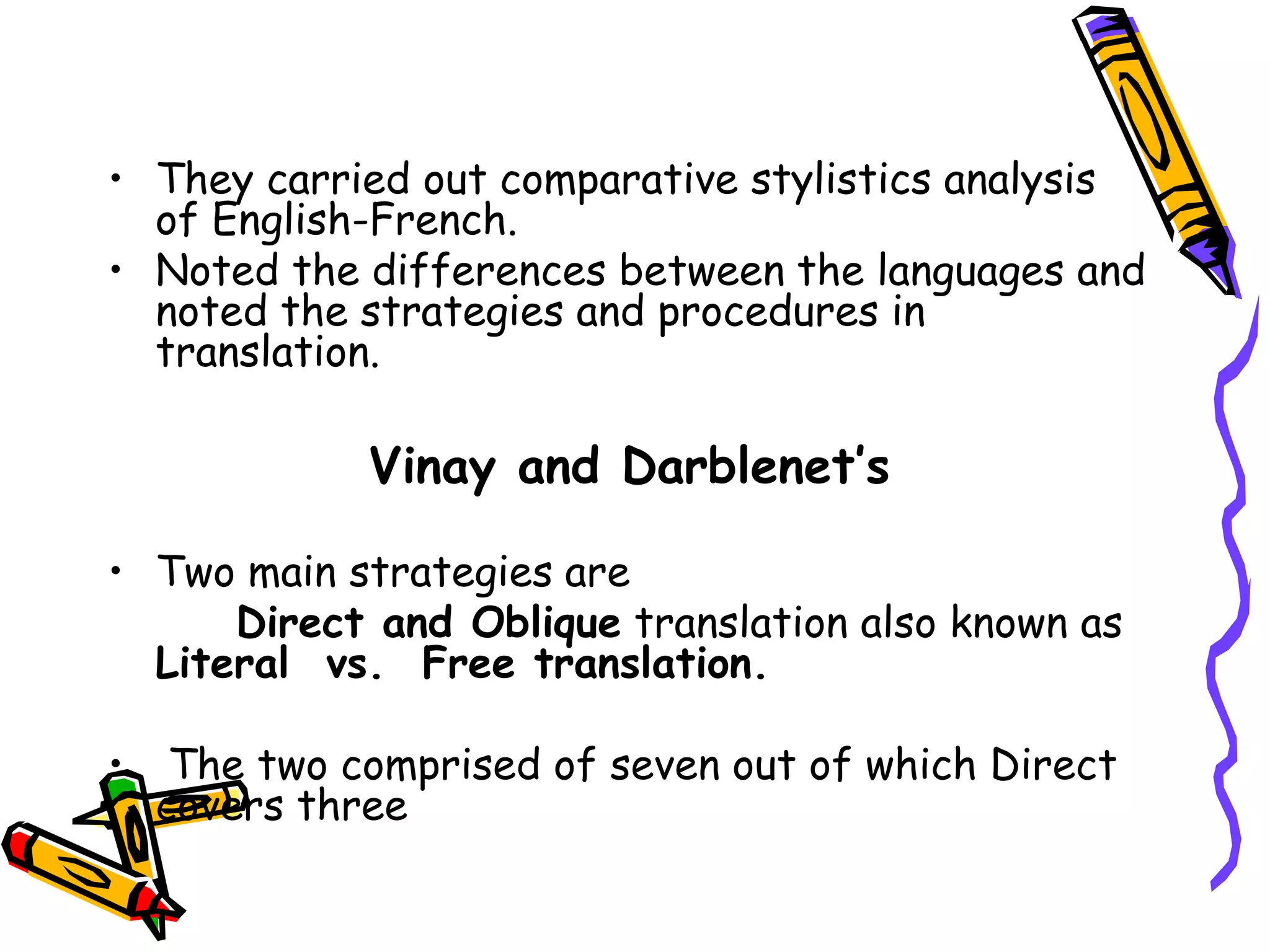
• They carried out comparative stylistics analysis
of English-French.
• Noted the differences between the languages and
noted the strategies and procedures in
translation.
Vinay and Darblenet’s
• Two main strategies are
Direct and Oblique translation also known as
Literal vs. Free translation.
• The two comprised of seven out of which Direct
covers three
Literal Translation.
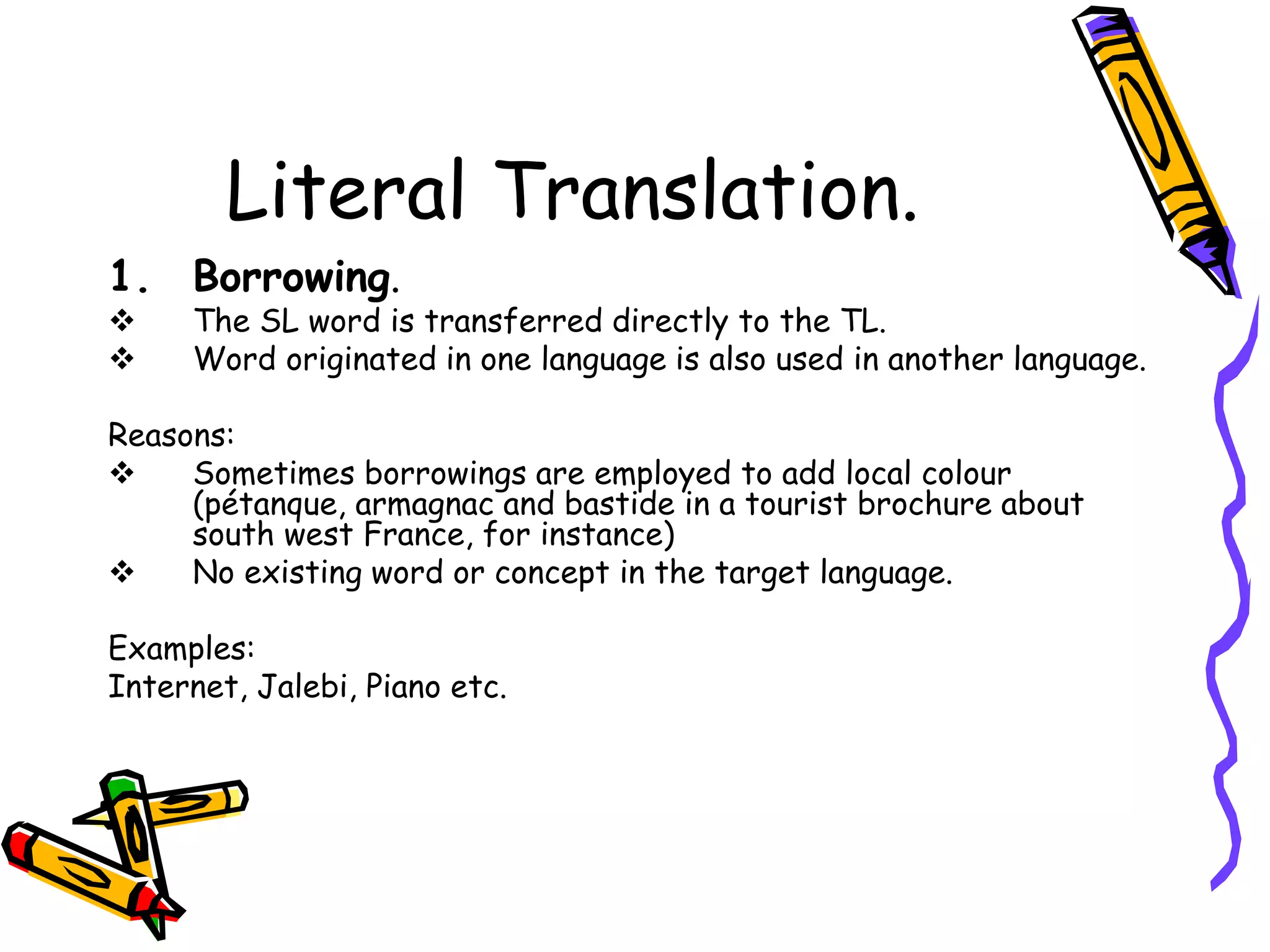
1. Borrowing.
 The SL word is transferred directly to the TL.
 Word originated in one language is also used in another language.
Reasons:
 Sometimes borrowings are employed to add local colour
(pétanque, armagnac and bastide in a tourist brochure about
south west France, for instance)
 No existing word or concept in the target language.
Examples:
Internet, Jalebi, Piano etc.
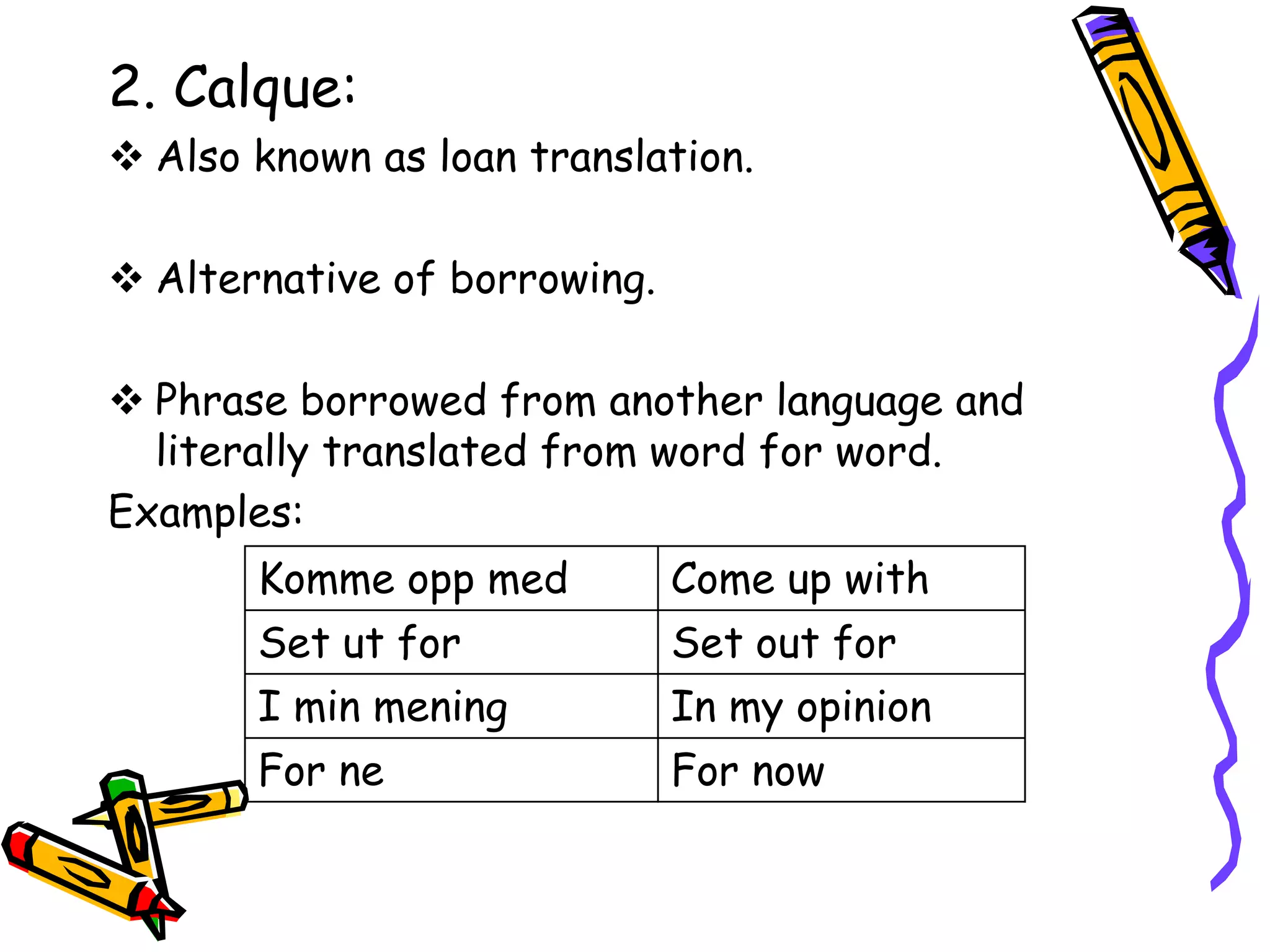
2. Calque:
 Also known as loan translation.
 Alternative of borrowing.
 Phrase borrowed from another language and
literally translated from word for word.
Examples:
Komme opp med Come up with
Set ut for Set out for
I min mening In my opinion
For ne For now
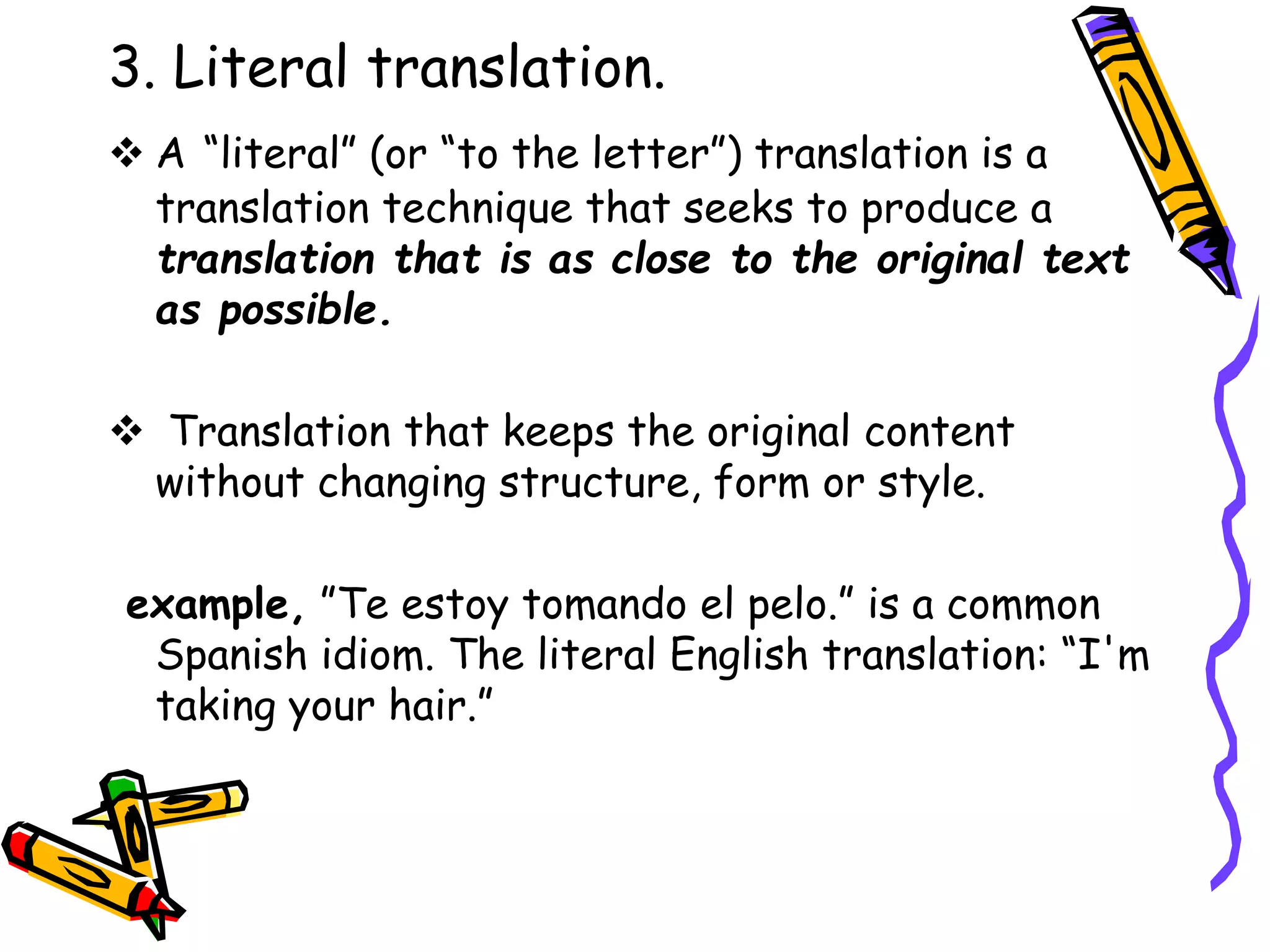
3. Literal translation.
 A “literal” (or “to the letter”) translation is a
translation technique that seeks to produce a
translation that is as close to the original text
as possible.
 Translation that keeps the original content
without changing structure, form or style.
example, ”Te estoy tomando el pelo.” is a common
Spanish idiom. The literal English translation: “I'm
taking your hair.”
Oblique translation
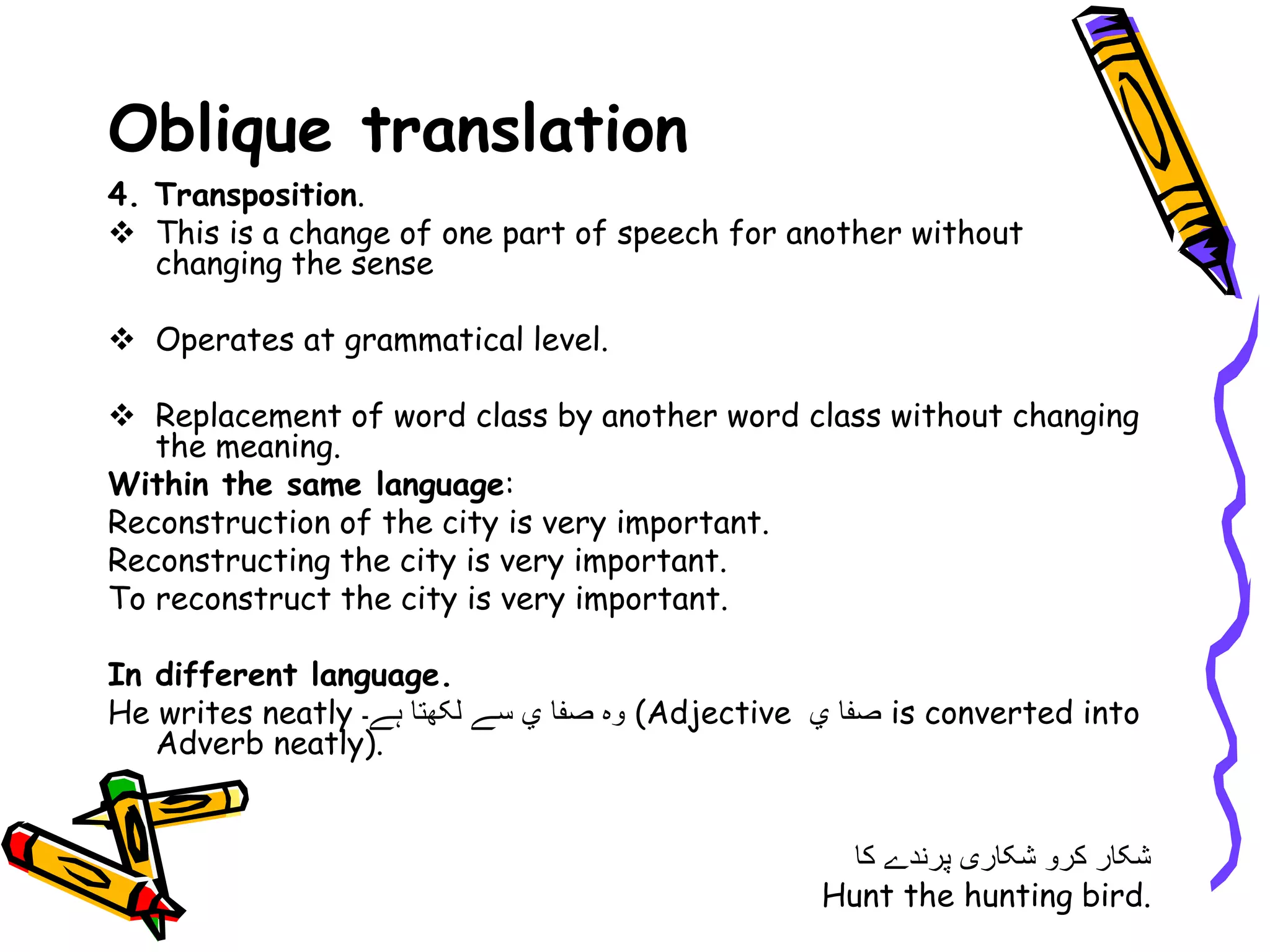
4. Transposition.
 This is a change of one part of speech for another without
changing the sense
 Operates at grammatical level.
 Replacement of word class by another word class without changing
the meaning.
Within the same language:
Reconstruction of the city is very important.
Reconstructing the city is very important.
To reconstruct the city is very important.
In different language.
He writes neatly ‫ہے۔‬ ‫لکھتا‬ ‫سے‬ ‫ي‬ ‫صفا‬ ‫وہ‬ (Adjective ‫ي‬ ‫صفا‬ is converted into
Adverb neatly).
‫کا‬ ‫پرندے‬ ‫شکاری‬ ‫کرو‬ ‫شکار‬
Hunt the hunting bird.
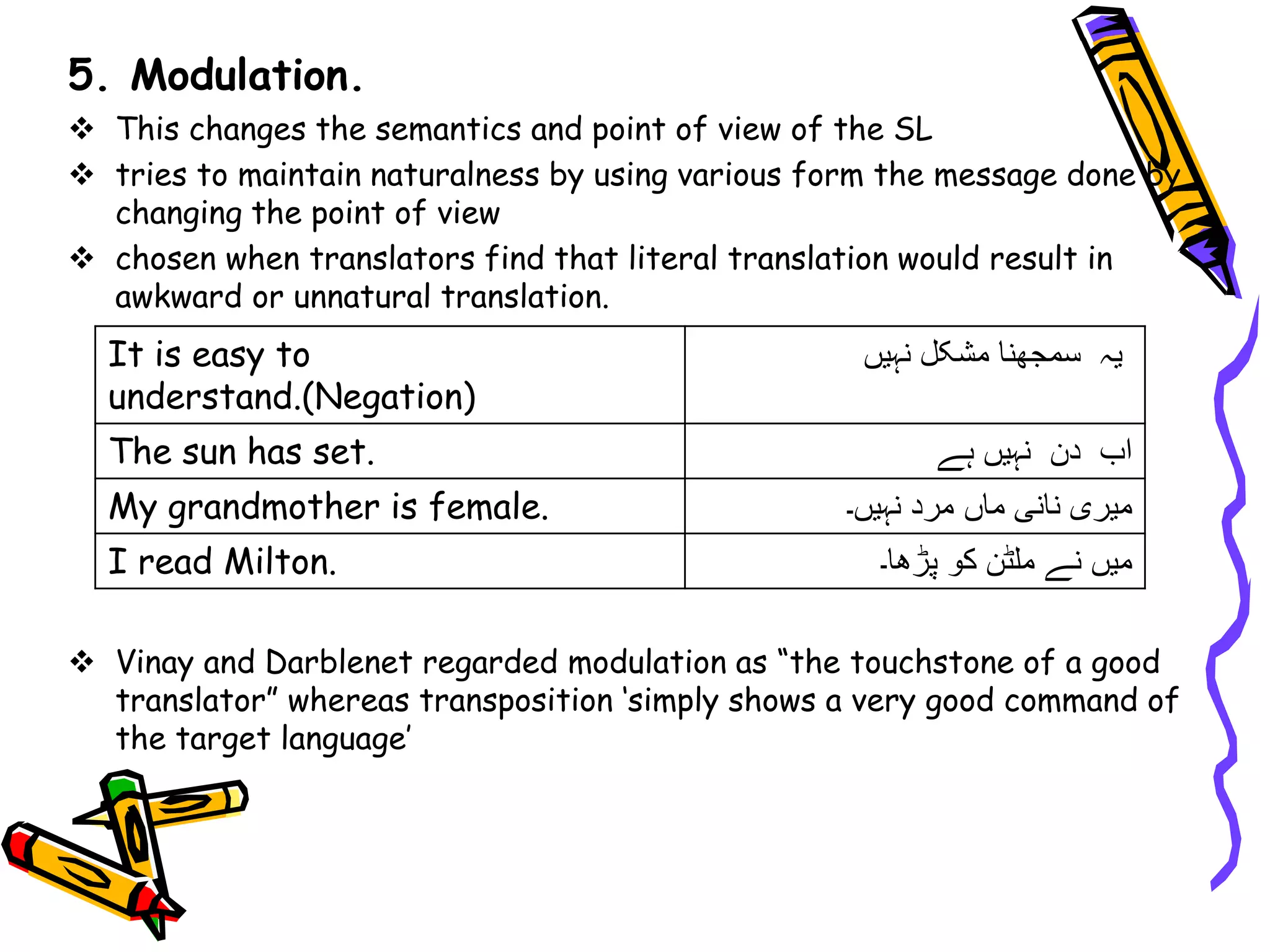
5. Modulation.
 This changes the semantics and point of view of the SL
 tries to maintain naturalness by using various form the message done by
changing the point of view
 chosen when translators find that literal translation would result in
awkward or unnatural translation.
 Vinay and Darblenet regarded modulation as “the touchstone of a good
translator” whereas transposition ‘simply shows a very good command of
the target language’
It is easy to
understand.(Negation)
‫یہ‬
‫نہیں‬ ‫مشکل‬ ‫سمجھنا‬
The sun has set. ‫اب‬
‫دن‬
‫نہیں‬
‫ہے‬
My grandmother is female. ‫مرد‬
‫نہیں۔‬ ‫میری‬
‫ماں‬ ‫نانی‬
I read Milton. ‫میں‬
‫نے‬
‫ملٹن‬
‫کو‬
‫پڑھا۔‬
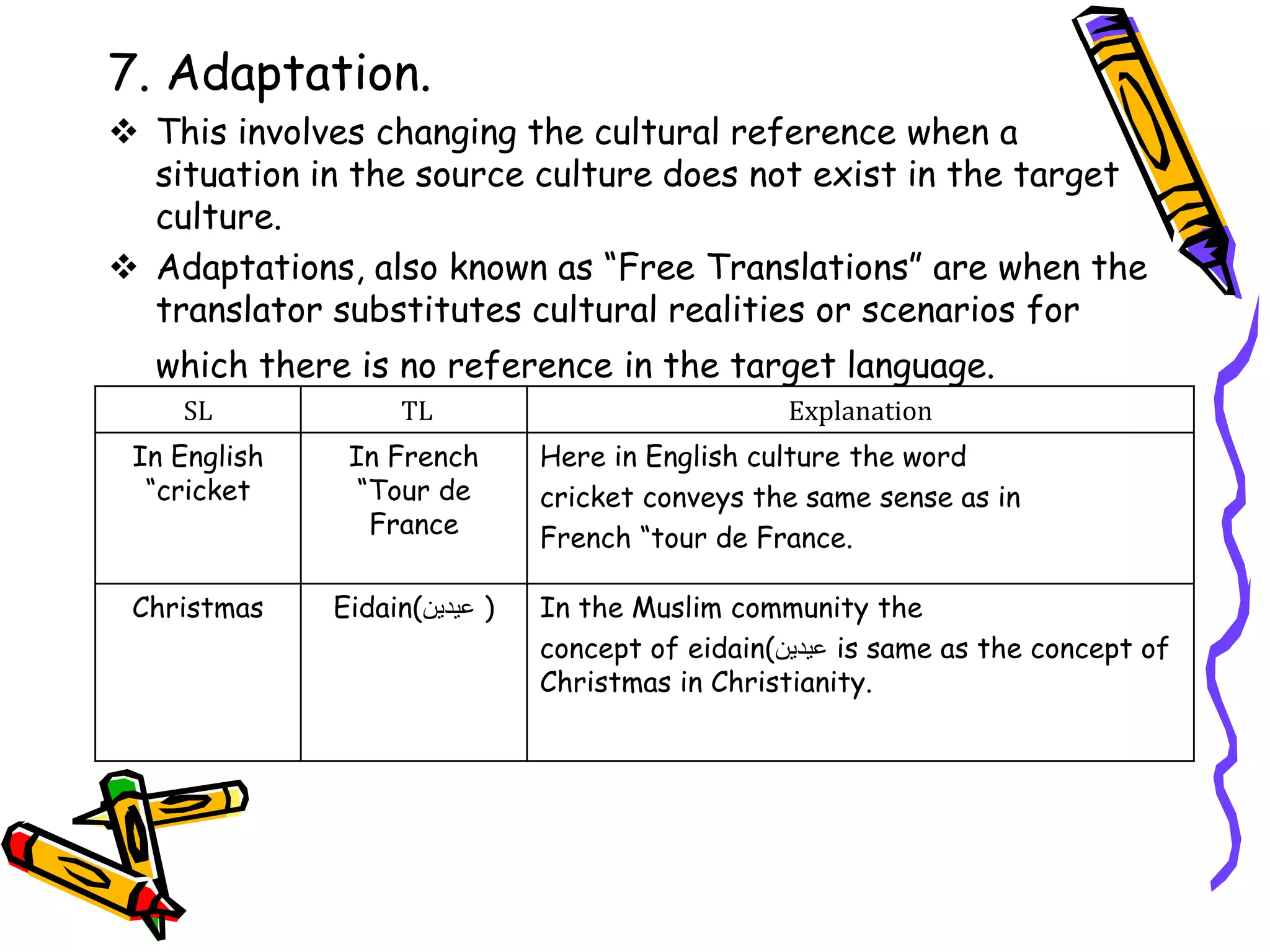
7. Adaptation.
 This involves changing the cultural reference when a
situation in the source culture does not exist in the target
culture.
 Adaptations, also known as “Free Translations” are when the
translator substitutes cultural realities or scenarios for
which there is no reference in the target language.
SL TL Explanation
In English
“cricket
In French
“Tour de
France
Here in English culture the word
cricket conveys the same sense as in
French “tour de France.
Christmas Eidain(‫عیدین‬ ) In the Muslim community the
concept of eidain(‫عیدین‬ is same as the concept of
Christmas in Christianity.
Vinay and Darblernet's Model of Translation.ppt

Vinay and Darblernet's Model of Translation.ppt

  • 1.
  • 2.
    • Since 1950sthere has been a wide variety of linguistics approaches to the analysis of translation that has proposed a detailed list of taxonomies to categories the translation process. • • The book has presented a small number of best known and most representative models. i. Vinay and Darblenet’s taxonomy in Stylistique ii. Catford’s linguitics approach.
  • 3.
    • They carriedout comparative stylistics analysis of English-French. • Noted the differences between the languages and noted the strategies and procedures in translation. Vinay and Darblenet’s • Two main strategies are Direct and Oblique translation also known as Literal vs. Free translation. • The two comprised of seven out of which Direct covers three
  • 4.
    Literal Translation. 1. Borrowing. The SL word is transferred directly to the TL.  Word originated in one language is also used in another language. Reasons:  Sometimes borrowings are employed to add local colour (pétanque, armagnac and bastide in a tourist brochure about south west France, for instance)  No existing word or concept in the target language. Examples: Internet, Jalebi, Piano etc.
  • 5.
    2. Calque:  Alsoknown as loan translation.  Alternative of borrowing.  Phrase borrowed from another language and literally translated from word for word. Examples: Komme opp med Come up with Set ut for Set out for I min mening In my opinion For ne For now
  • 6.
    3. Literal translation. A “literal” (or “to the letter”) translation is a translation technique that seeks to produce a translation that is as close to the original text as possible.  Translation that keeps the original content without changing structure, form or style. example, ”Te estoy tomando el pelo.” is a common Spanish idiom. The literal English translation: “I'm taking your hair.”
  • 7.
    Oblique translation 4. Transposition. This is a change of one part of speech for another without changing the sense  Operates at grammatical level.  Replacement of word class by another word class without changing the meaning. Within the same language: Reconstruction of the city is very important. Reconstructing the city is very important. To reconstruct the city is very important. In different language. He writes neatly ‫ہے۔‬ ‫لکھتا‬ ‫سے‬ ‫ي‬ ‫صفا‬ ‫وہ‬ (Adjective ‫ي‬ ‫صفا‬ is converted into Adverb neatly). ‫کا‬ ‫پرندے‬ ‫شکاری‬ ‫کرو‬ ‫شکار‬ Hunt the hunting bird.
  • 8.
    5. Modulation.  Thischanges the semantics and point of view of the SL  tries to maintain naturalness by using various form the message done by changing the point of view  chosen when translators find that literal translation would result in awkward or unnatural translation.  Vinay and Darblenet regarded modulation as “the touchstone of a good translator” whereas transposition ‘simply shows a very good command of the target language’ It is easy to understand.(Negation) ‫یہ‬ ‫نہیں‬ ‫مشکل‬ ‫سمجھنا‬ The sun has set. ‫اب‬ ‫دن‬ ‫نہیں‬ ‫ہے‬ My grandmother is female. ‫مرد‬ ‫نہیں۔‬ ‫میری‬ ‫ماں‬ ‫نانی‬ I read Milton. ‫میں‬ ‫نے‬ ‫ملٹن‬ ‫کو‬ ‫پڑھا۔‬
  • 9.
    7. Adaptation.  Thisinvolves changing the cultural reference when a situation in the source culture does not exist in the target culture.  Adaptations, also known as “Free Translations” are when the translator substitutes cultural realities or scenarios for which there is no reference in the target language. SL TL Explanation In English “cricket In French “Tour de France Here in English culture the word cricket conveys the same sense as in French “tour de France. Christmas Eidain(‫عیدین‬ ) In the Muslim community the concept of eidain(‫عیدین‬ is same as the concept of Christmas in Christianity.