What is Transistor?
Ans: A transistor consists of two pn junctions formed by sandwiching
either p-type semiconductor between a pair of opposite types.
Accordingly, There are two types of transistors:
i)P-N-P transistor ii) N-P-N transistor
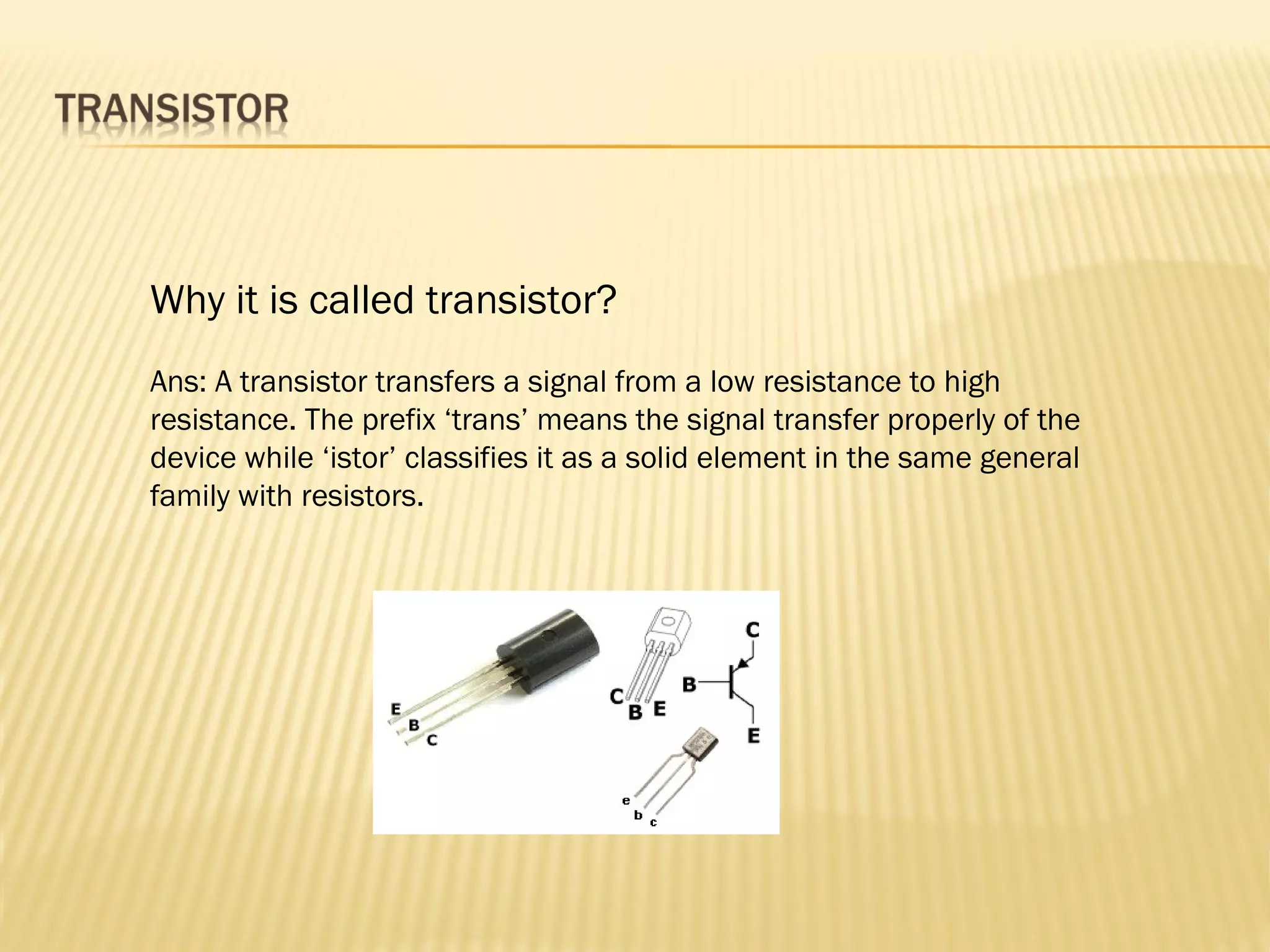
Why it is called transistor?
Ans: A transistor transfers a signal from a low resistance to high
resistance. The prefix ‘trans’ means the signal transfer properly of the
device while ‘istor’ classifies it as a solid element in the same general
family with resistors.
Constracting of transistor:
A transistor (pnp or npn) has three sections of doped semiconductors.
The section is, i) Emitter ii) Collector iii) Base
a) Figure: pnp transistor b) Figure: npn transistor
i) Emitter: The section on one the side that supplies charge carries is called
the emitter . The emitter is always forward biased base so that it can supply
a large number of majority carries. In fig (a) the emitter (p-type) of pnp
transistor
is forward biased and supplies hole charge to its junction with the base.
Similarly, in fig (b) the emitter (n-type) of npn transistor has a forward bias and
spplies free electrons to its junction with the base.
ii) Collector: The section on the other side that collects the charges is called the
collector. The collector is always reverse biased. Its function is to remove charges
from its junction with the base. In fig (a) the collector (p-type) of pnp transistor has
a reverse bias and receives hole charges that flow in the output circuit. Similarly,
in fig (b) the collector (n-type) of npn transistor has reverse bias and receives
electron
iii) Base: The middle section which forms two pn-junction between the emitter and
collector is called the base. The base-emitter junction is forward biased, allowing
low resistance for the emitter circuit. The base-collector junction is reverse biased
and provides high resistance in the collector circuit.
Working of npn transistor:
The npn transistor with forward bias to emitter-base junction and reverse bias to
collector-base junction. The forward bias causes the electrons in the n-type emitter
to flow towards the base. This constitutes the emitter current IB. As these electrons
flow through the p-type base, they tend to combine with holes. As the base is lightly
doped and very thin, therefore, only a few electrons (less than 5%) combine with
holes to constitute base current IB. The remainder (more than 95%) cross over into
the collector region to constitute collector current IC. In this way, almost the entire
emitter current flows in the collector circuit. It is clear that emitter current is the sum of
collector and base currents i.e.
Transistor

Transistor

  • 2.
    What is Transistor? Ans:A transistor consists of two pn junctions formed by sandwiching either p-type semiconductor between a pair of opposite types. Accordingly, There are two types of transistors: i)P-N-P transistor ii) N-P-N transistor
  • 3.
    Why it iscalled transistor? Ans: A transistor transfers a signal from a low resistance to high resistance. The prefix ‘trans’ means the signal transfer properly of the device while ‘istor’ classifies it as a solid element in the same general family with resistors.
  • 4.
    Constracting of transistor: Atransistor (pnp or npn) has three sections of doped semiconductors. The section is, i) Emitter ii) Collector iii) Base a) Figure: pnp transistor b) Figure: npn transistor
  • 5.
    i) Emitter: Thesection on one the side that supplies charge carries is called the emitter . The emitter is always forward biased base so that it can supply a large number of majority carries. In fig (a) the emitter (p-type) of pnp transistor is forward biased and supplies hole charge to its junction with the base. Similarly, in fig (b) the emitter (n-type) of npn transistor has a forward bias and spplies free electrons to its junction with the base. ii) Collector: The section on the other side that collects the charges is called the collector. The collector is always reverse biased. Its function is to remove charges from its junction with the base. In fig (a) the collector (p-type) of pnp transistor has a reverse bias and receives hole charges that flow in the output circuit. Similarly, in fig (b) the collector (n-type) of npn transistor has reverse bias and receives electron
  • 6.
    iii) Base: Themiddle section which forms two pn-junction between the emitter and collector is called the base. The base-emitter junction is forward biased, allowing low resistance for the emitter circuit. The base-collector junction is reverse biased and provides high resistance in the collector circuit.
  • 7.
    Working of npntransistor: The npn transistor with forward bias to emitter-base junction and reverse bias to collector-base junction. The forward bias causes the electrons in the n-type emitter to flow towards the base. This constitutes the emitter current IB. As these electrons flow through the p-type base, they tend to combine with holes. As the base is lightly doped and very thin, therefore, only a few electrons (less than 5%) combine with holes to constitute base current IB. The remainder (more than 95%) cross over into the collector region to constitute collector current IC. In this way, almost the entire emitter current flows in the collector circuit. It is clear that emitter current is the sum of collector and base currents i.e.