AECD
Different Signals
• Analog, Digital and Mixed Signals
Passive components
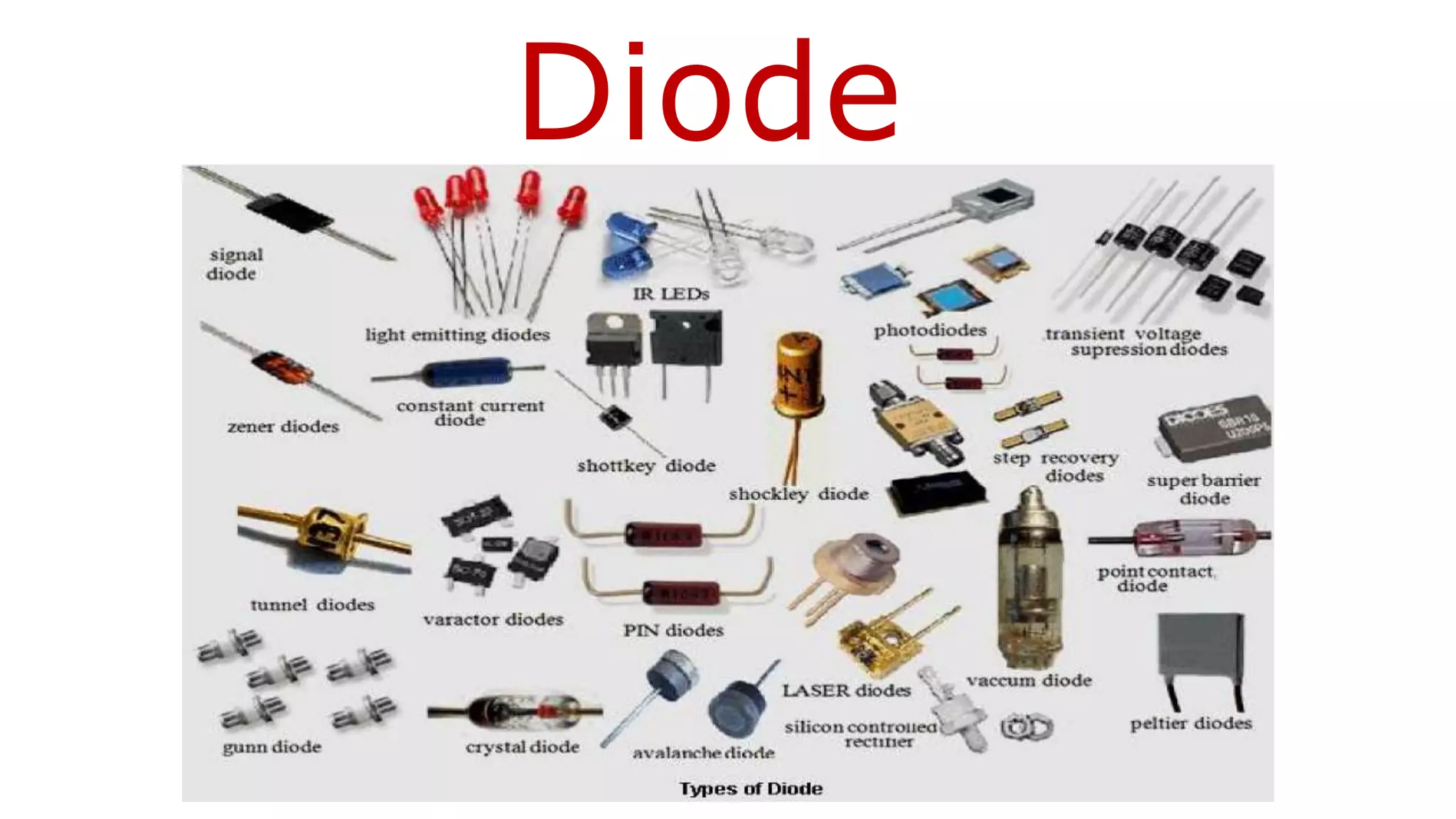
Resistors, Capacitors, Inductors, Transformers, Diodes etc.
Circuits
Circuit analysis, voltage sources, current sources
Analog Electronics
Transistors, Opamps, Simple analog Electronics circuits
Digital Electronics
Basic Logic Gates and basic ICs, uPs, RAMs, ROMs, ADCs, DACs, PALs
etc.
Basic Electronics
Fundamentals of Electronics
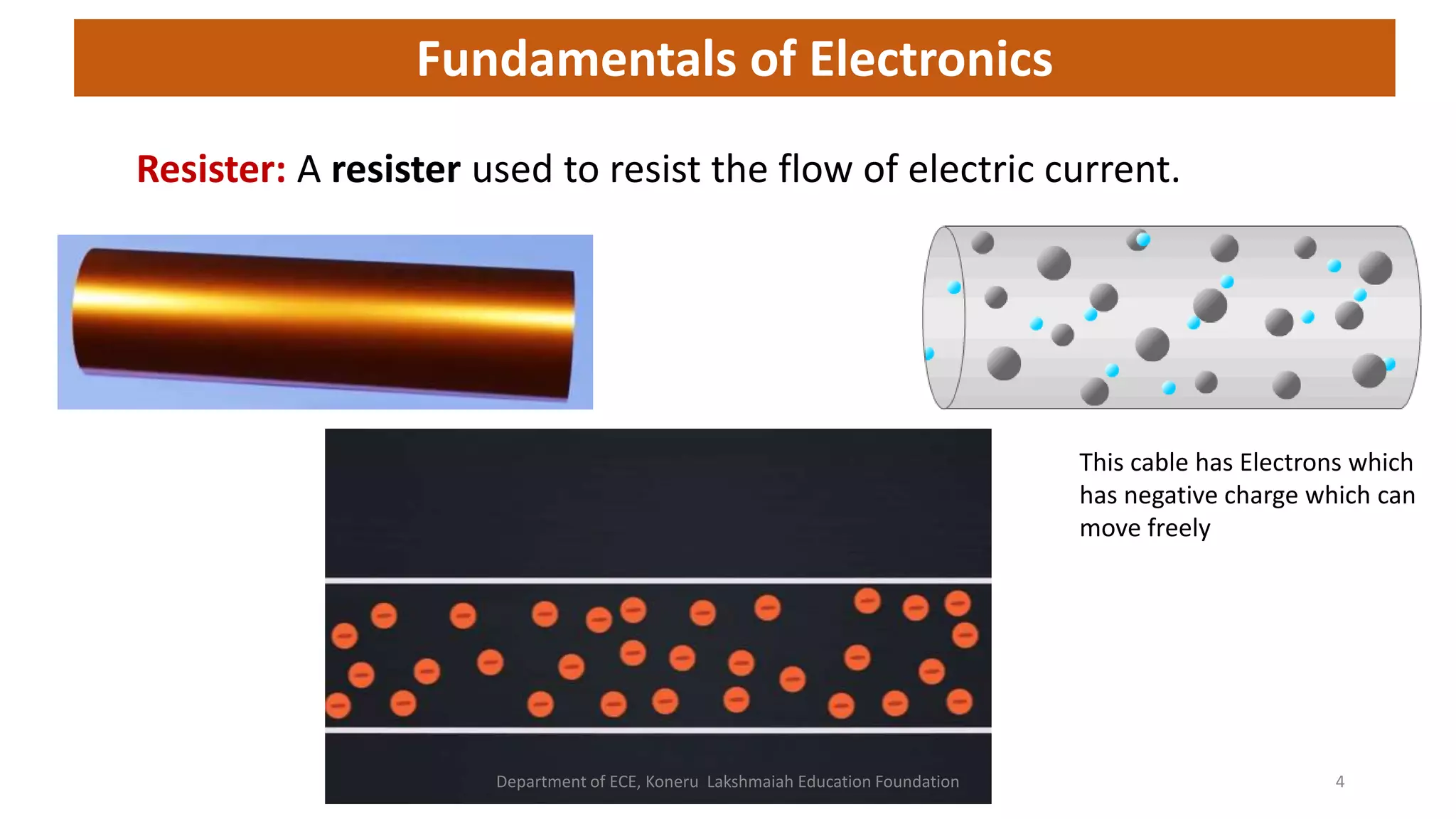
Resister: A resister used to resist the flow of electric current.
This cable has Electrons which
has negative charge which can
move freely
Department of ECE, Koneru Lakshmaiah Education Foundation 4
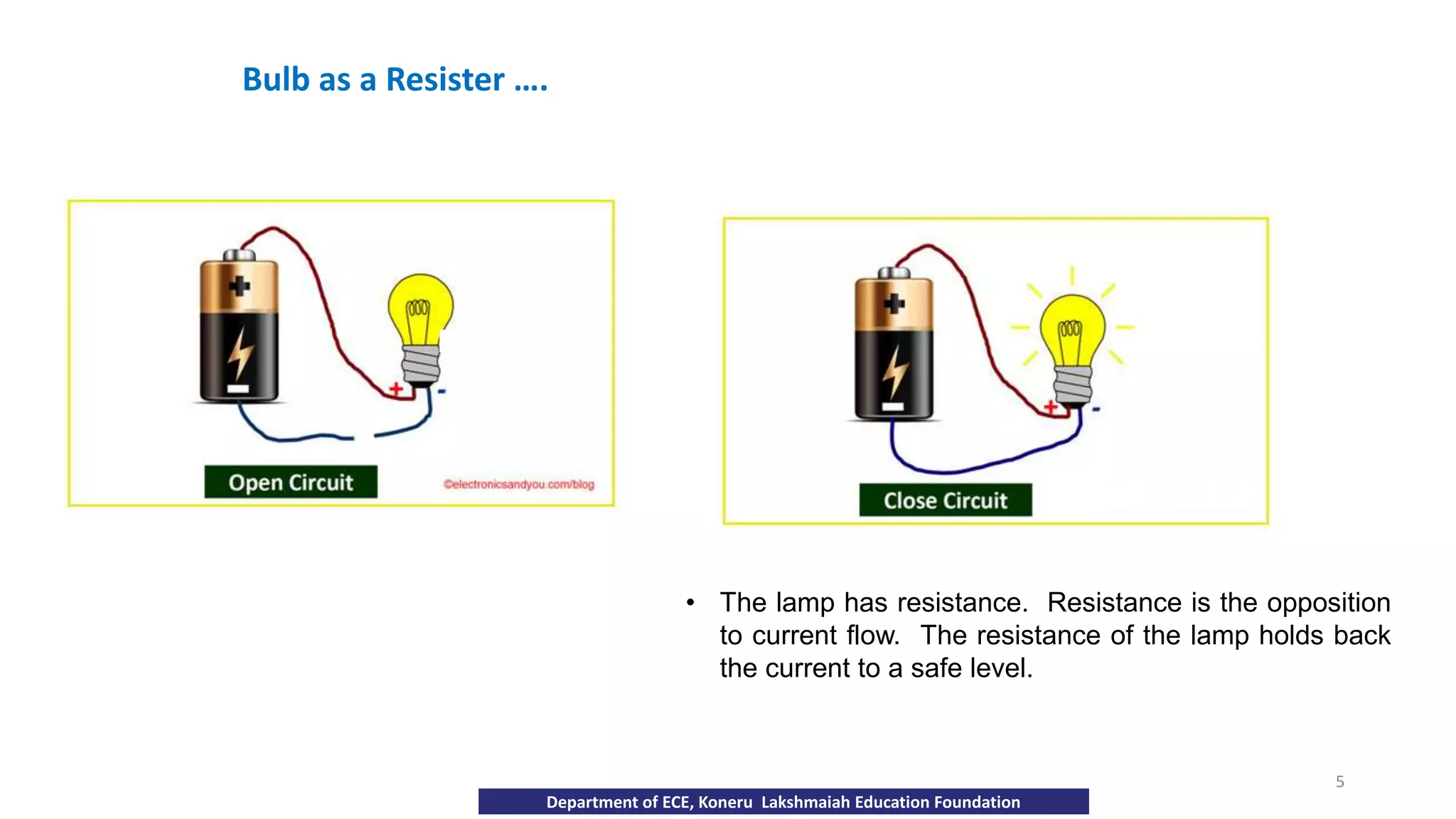
• The lamp has resistance. Resistance is the opposition
to current flow. The resistance of the lamp holds back
the current to a safe level.
Department of ECE, Koneru Lakshmaiah Education Foundation
Bulb as a Resister ….
5
Department of ECE, Koneru Lakshmaiah Education Foundation
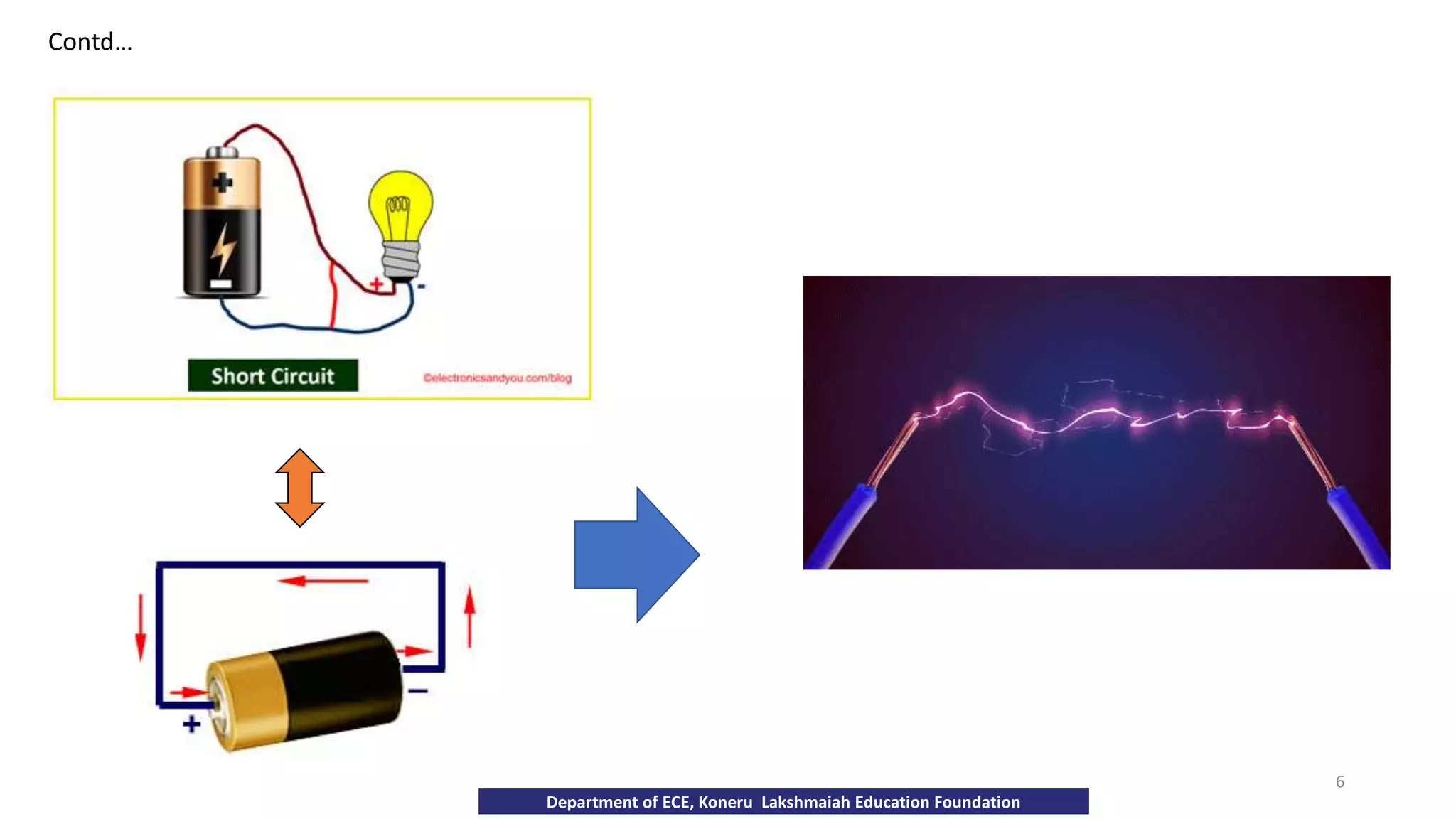
Contd…
6
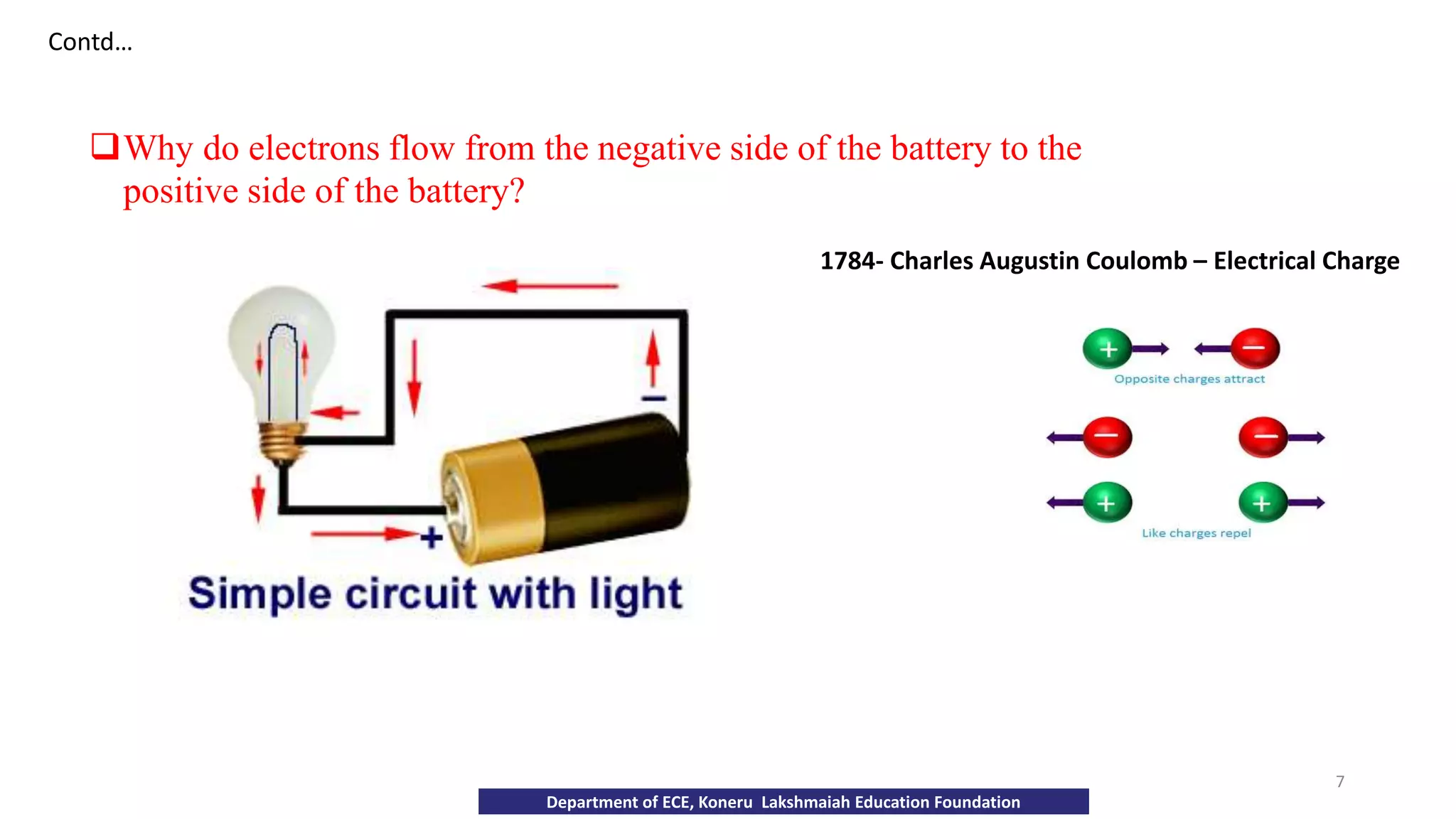
Why do electrons flow from the negative side of the battery to the
positive side of the battery?
Department of ECE, Koneru Lakshmaiah Education Foundation
Contd…
1784- Charles Augustin Coulomb – Electrical Charge
7
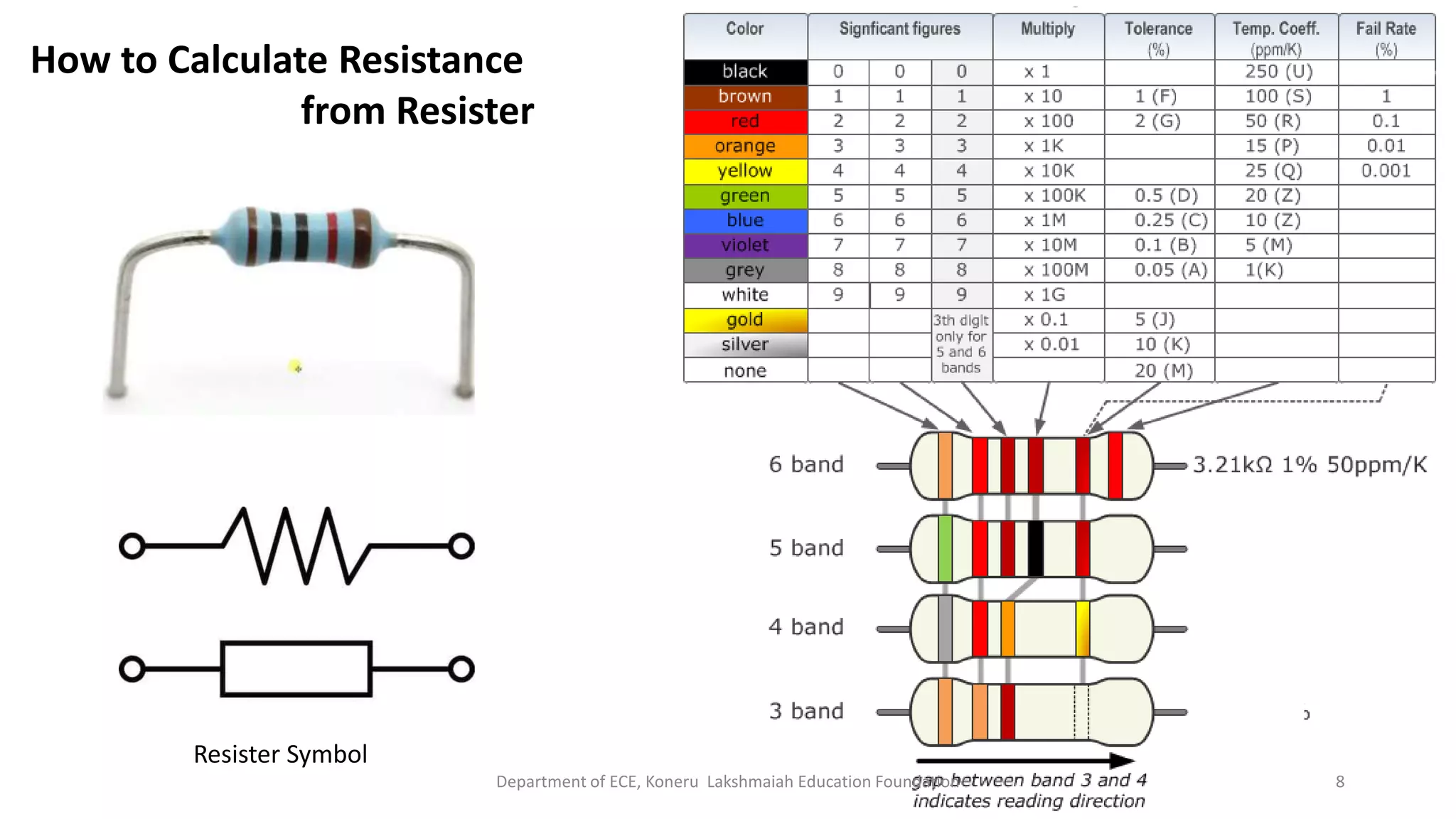
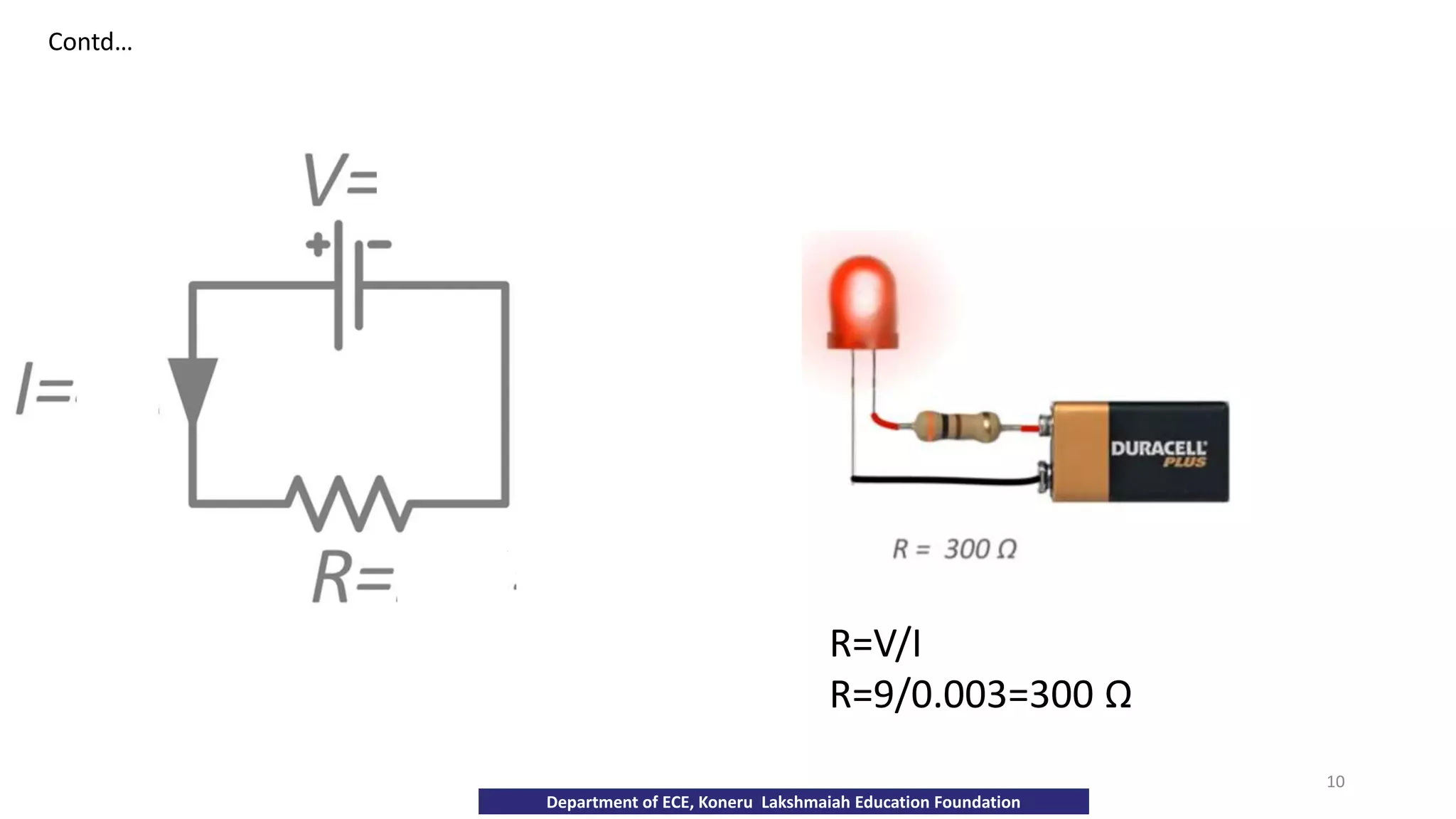
How to Calculate Resistance
from Resister
Resister Symbol
Department of ECE, Koneru Lakshmaiah Education Foundation 8
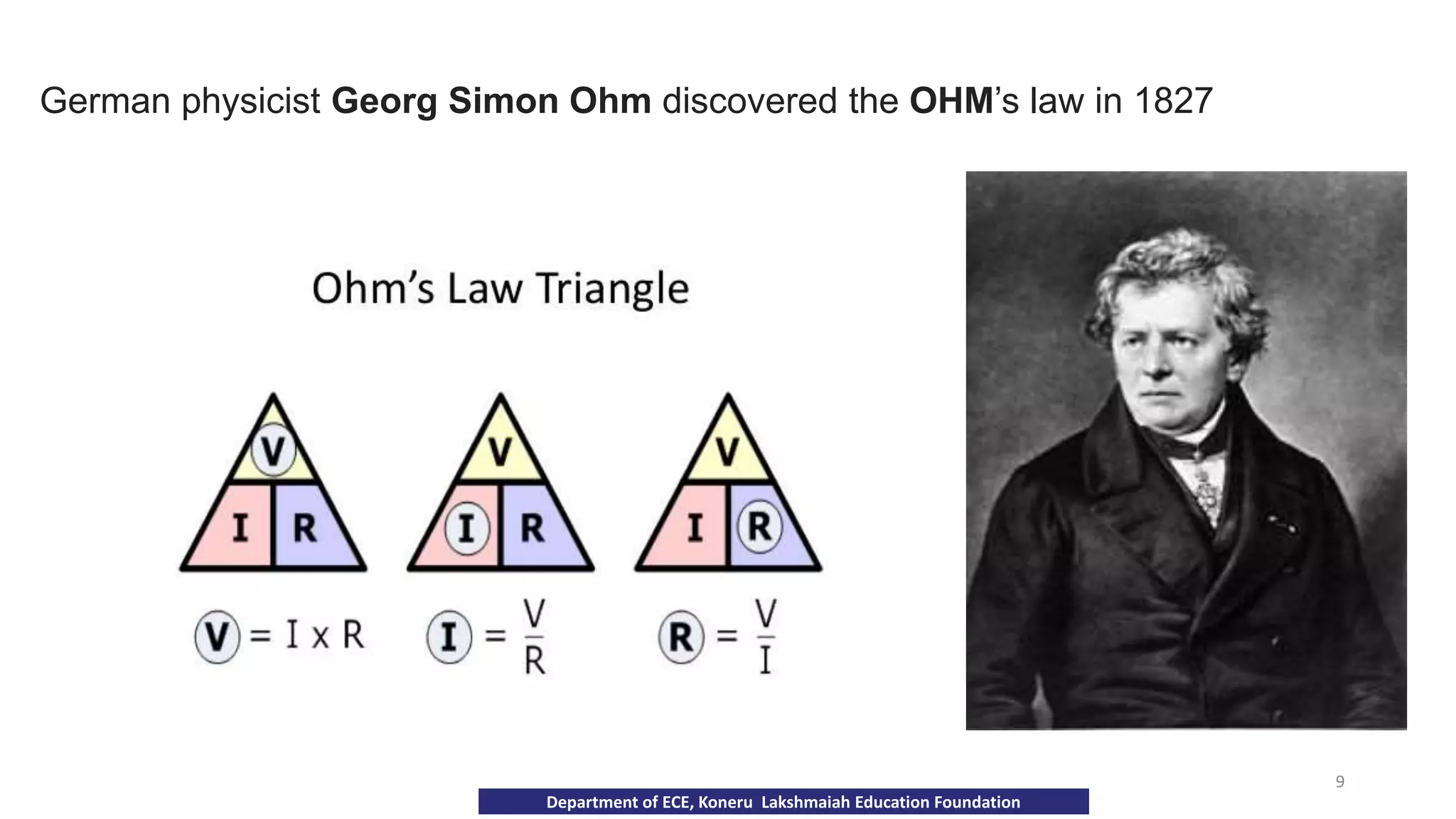
German physicist Georg Simon Ohm discovered the OHM’s law in 1827
Department of ECE, Koneru Lakshmaiah Education Foundation
9
R=V/I
R=9/0.003=300 Ω
Department of ECE, Koneru Lakshmaiah Education Foundation
Contd…
10
Diode
• P-type and N-type semiconductors, taken separately are of very limited
use.
• If we join a piece of P type material to a piece of N type material such
that the crystal structure remains continuous at the boundary to form
a PN JUNCTION.
PN JUNCTION
 Rectifier ,
 Amplifier ,
 Switching
 And other operations in electronic circuits.
PN Junction can function as:
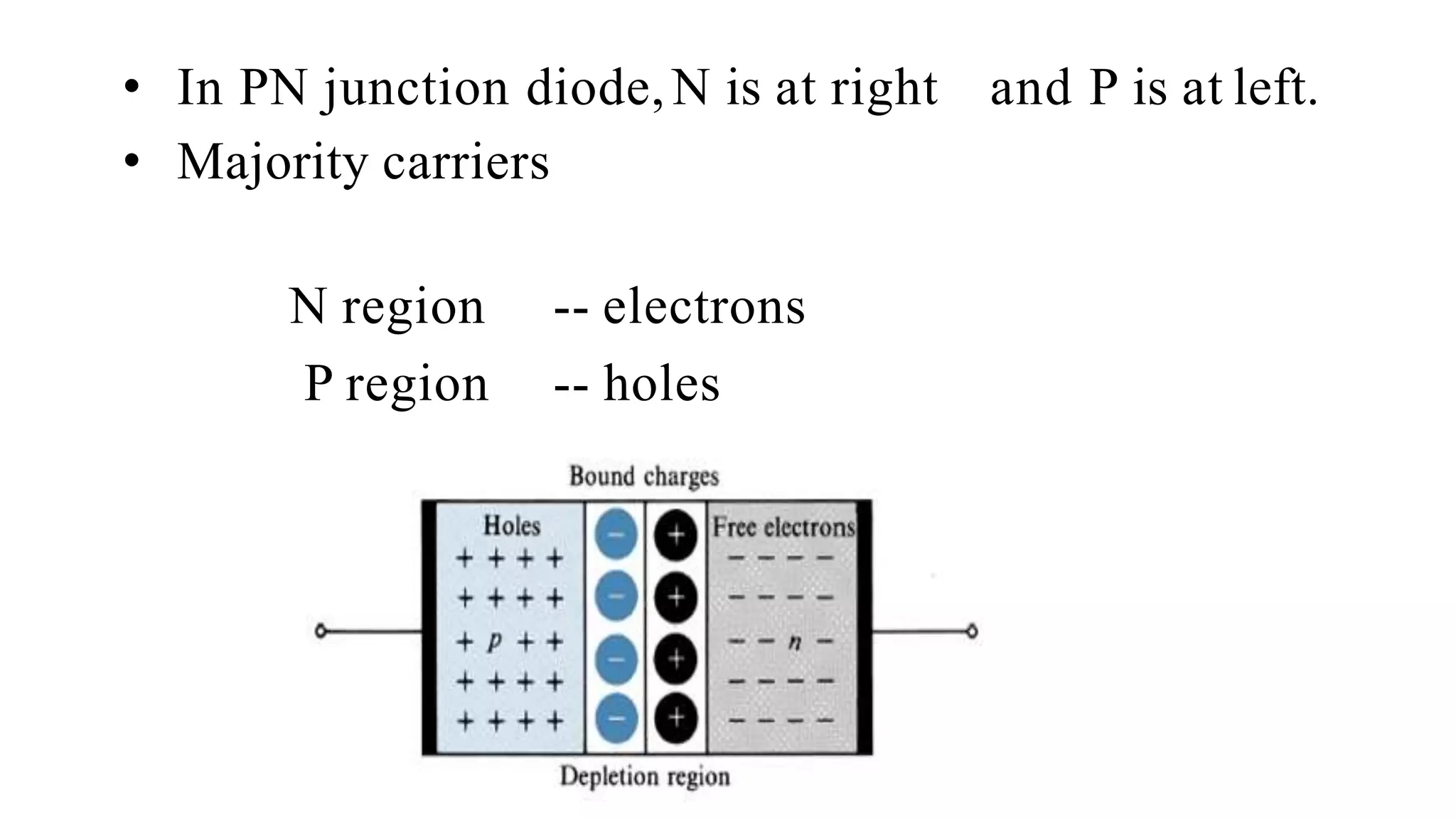
• In PN junction diode,N is at right and P is at left.
• Majority carriers
N region -- electrons
P region -- holes
Formation of depletionlayer
NO external connections:
The excess electrons in the N region cross the junction and combine
with the excess holes in the P region.
N region loses its electrons becomes positively charged
P region accepts the electrons and becomes negatively charged
At one point , the migratory action is stopped.
• The depletion layer contains no free and mobile charge carriers but
only fixed and immobile ions.
• Its width depends upon the doping level..
• Heavy doped……..thin depletion layer
• lightly doped……..thick depletion layer
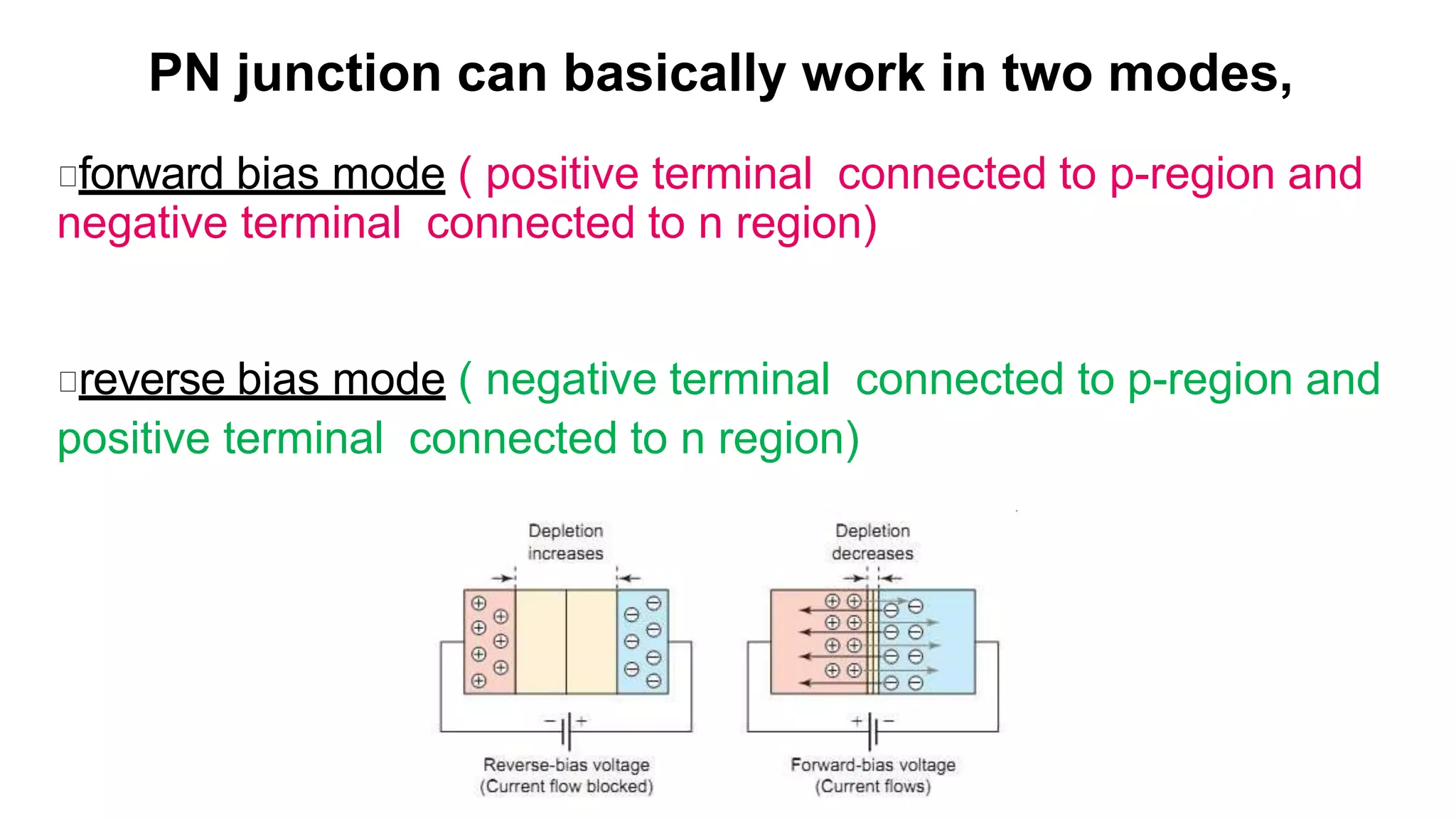
PN junction can basically work in two modes,
forward bias mode ( positive terminal connected to p-region and
negative terminal connected to n region)
reverse bias mode ( negative terminal connected to p-region and
positive terminal connected to n region)
Forward biased PN junction
• It forces the majority charge carriers to move across
the junction ….decreasing the width of the depletion
layer.
Once the junction is crossed, a number of electrons and
the holes will recombine .
For each hole in the P section that combines with an
electron from the N section, a covalent bond breaks and
an electron is liberated which enters the positive terminal
Thus creating an electron hole pair.
Current in the N region is carried by ….electrons
Current in the P region is carried by ….Holes.
Reverse biased pn junction
If the + of the battery is connected to the n-type and the
– terminal to the p-type,
the free electrons and free holes are attracted back towards the
battery, hence back from the depletion layer, hence the depletion
layer grows.
Thus a reverse biased pn junction does not conduct current
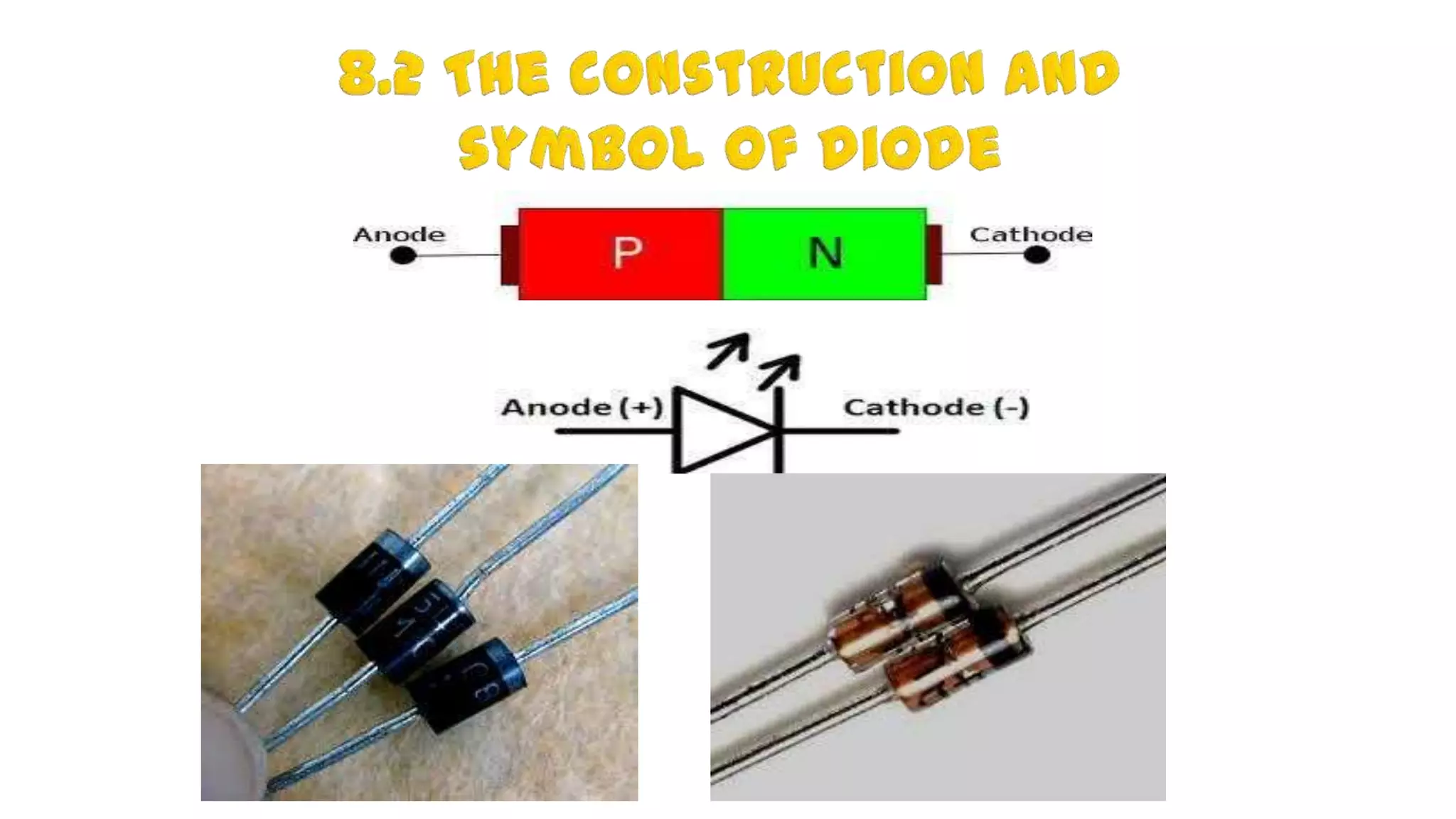
Made from a combination of 2 extrinsic semiconductors, P-type ad N-type material.
The joint between the P-type and N-type material is called PN junction.
Have 2 terminal( anode and cathode).
Produced from the silicon wafer
Inventedin1904byJohnAmbrose Fleming.
Was constructedwith2 electrodesintheformofa vacuumtube.
In 1906, Lee Dee Forest added a 3rd electrode called a control grid and the
triode,whichis usedas amplifier, switch..
The application of triode created a new era in broadcasting withtheinventionof
thecrystalradiosensor by Pickard,1912.
Commonly usedinDC powersupply unitsas arectifiers andvoltage
regulators,clipper,clampercircuit.
Comes indifferentshapeand sizes
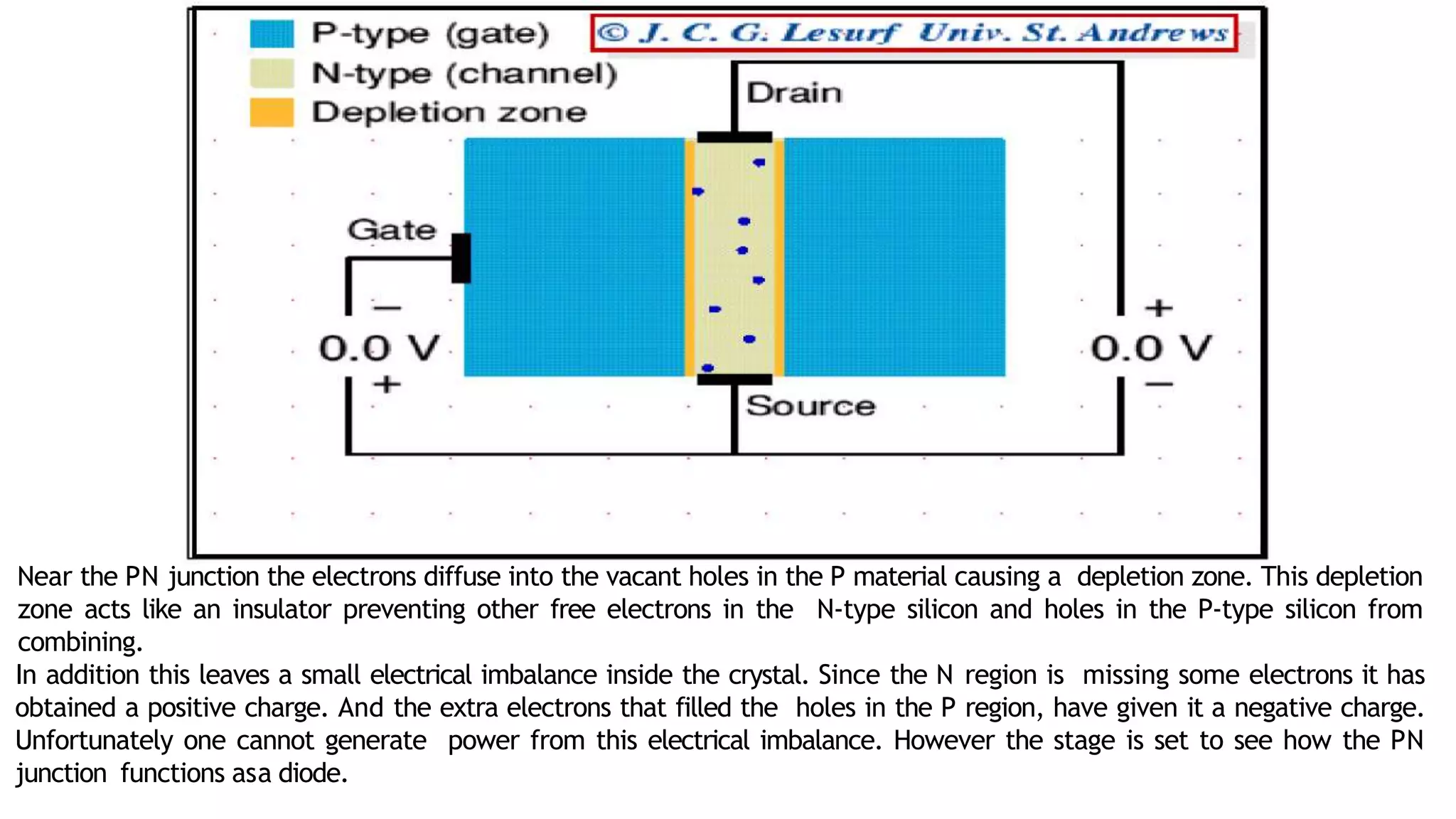
Near the PN junction the electrons diffuse into the vacant holes in the P material causing a depletion zone. This depletion
zone acts like an insulator preventing other free electrons in the N-type silicon and holes in the P-type silicon from
combining.
In addition this leaves a small electrical imbalance inside the crystal. Since the N region is missing some electrons it has
obtained a positive charge. And the extra electrons that filled the holes in the P region, have given it a negative charge.
Unfortunately one cannot generate power from this electrical imbalance. However the stage is set to see how the PN
junction functions asa diode.

Analog electrons introduction

  • 1.
  • 2.
    Different Signals • Analog,Digital and Mixed Signals
  • 3.
    Passive components Resistors, Capacitors,Inductors, Transformers, Diodes etc. Circuits Circuit analysis, voltage sources, current sources Analog Electronics Transistors, Opamps, Simple analog Electronics circuits Digital Electronics Basic Logic Gates and basic ICs, uPs, RAMs, ROMs, ADCs, DACs, PALs etc. Basic Electronics
  • 4.
    Fundamentals of Electronics Resister:A resister used to resist the flow of electric current. This cable has Electrons which has negative charge which can move freely Department of ECE, Koneru Lakshmaiah Education Foundation 4
  • 5.
    • The lamphas resistance. Resistance is the opposition to current flow. The resistance of the lamp holds back the current to a safe level. Department of ECE, Koneru Lakshmaiah Education Foundation Bulb as a Resister …. 5
  • 6.
    Department of ECE,Koneru Lakshmaiah Education Foundation Contd… 6
  • 7.
    Why do electronsflow from the negative side of the battery to the positive side of the battery? Department of ECE, Koneru Lakshmaiah Education Foundation Contd… 1784- Charles Augustin Coulomb – Electrical Charge 7
  • 8.
    How to CalculateResistance from Resister Resister Symbol Department of ECE, Koneru Lakshmaiah Education Foundation 8
  • 9.
    German physicist GeorgSimon Ohm discovered the OHM’s law in 1827 Department of ECE, Koneru Lakshmaiah Education Foundation 9
  • 10.
    R=V/I R=9/0.003=300 Ω Department ofECE, Koneru Lakshmaiah Education Foundation Contd… 10
  • 11.
  • 12.
    • P-type andN-type semiconductors, taken separately are of very limited use. • If we join a piece of P type material to a piece of N type material such that the crystal structure remains continuous at the boundary to form a PN JUNCTION. PN JUNCTION
  • 13.
     Rectifier , Amplifier ,  Switching  And other operations in electronic circuits. PN Junction can function as:
  • 15.
    • In PNjunction diode,N is at right and P is at left. • Majority carriers N region -- electrons P region -- holes
  • 16.
    Formation of depletionlayer NOexternal connections: The excess electrons in the N region cross the junction and combine with the excess holes in the P region. N region loses its electrons becomes positively charged P region accepts the electrons and becomes negatively charged At one point , the migratory action is stopped.
  • 17.
    • The depletionlayer contains no free and mobile charge carriers but only fixed and immobile ions. • Its width depends upon the doping level.. • Heavy doped……..thin depletion layer • lightly doped……..thick depletion layer
  • 18.
    PN junction canbasically work in two modes, forward bias mode ( positive terminal connected to p-region and negative terminal connected to n region) reverse bias mode ( negative terminal connected to p-region and positive terminal connected to n region)
  • 19.
    Forward biased PNjunction • It forces the majority charge carriers to move across the junction ….decreasing the width of the depletion layer.
  • 20.
    Once the junctionis crossed, a number of electrons and the holes will recombine . For each hole in the P section that combines with an electron from the N section, a covalent bond breaks and an electron is liberated which enters the positive terminal Thus creating an electron hole pair. Current in the N region is carried by ….electrons Current in the P region is carried by ….Holes.
  • 21.
    Reverse biased pnjunction If the + of the battery is connected to the n-type and the – terminal to the p-type, the free electrons and free holes are attracted back towards the battery, hence back from the depletion layer, hence the depletion layer grows. Thus a reverse biased pn junction does not conduct current
  • 22.
    Made from acombination of 2 extrinsic semiconductors, P-type ad N-type material. The joint between the P-type and N-type material is called PN junction. Have 2 terminal( anode and cathode). Produced from the silicon wafer
  • 25.
    Inventedin1904byJohnAmbrose Fleming. Was constructedwith2electrodesintheformofa vacuumtube. In 1906, Lee Dee Forest added a 3rd electrode called a control grid and the triode,whichis usedas amplifier, switch.. The application of triode created a new era in broadcasting withtheinventionof thecrystalradiosensor by Pickard,1912. Commonly usedinDC powersupply unitsas arectifiers andvoltage regulators,clipper,clampercircuit. Comes indifferentshapeand sizes
  • 26.
    Near the PNjunction the electrons diffuse into the vacant holes in the P material causing a depletion zone. This depletion zone acts like an insulator preventing other free electrons in the N-type silicon and holes in the P-type silicon from combining. In addition this leaves a small electrical imbalance inside the crystal. Since the N region is missing some electrons it has obtained a positive charge. And the extra electrons that filled the holes in the P region, have given it a negative charge. Unfortunately one cannot generate power from this electrical imbalance. However the stage is set to see how the PN junction functions asa diode.