INTRODUCTION
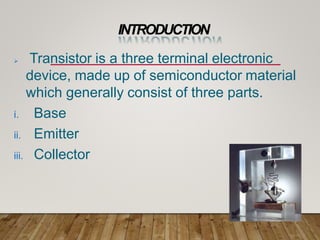
 Transistor is a three terminal electronic
device, made up of semiconductor material
which generally consist of three parts.
i. Base
ii. Emitter
iii. Collector
PARTSOFTRANSISTOR
 Emitter:-It is of moderate size and it’s heavily
doped. it’s main function is to supply majority
charge carriers.
 Collector:-It is larger in size and it’s moderately
doped. It’s main function is to collect majority
charge carriers.
 Base:-It’s the middle section of the transistor
and very lightly doped,thin in size.It’s main
function is to reduce the recombination of
charge carriers within base.
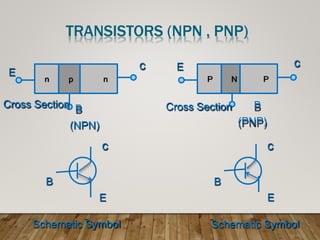
TRANSISTORS (NPN , PNP)
n p n
E
c
Cross Section B
P N P
Cross Section
(NPN)
E
B
(PNP)
c
Schematic Symbol Schematic Symbol
E
E
B
B
c
c
TRANSISTOR WORKING PRINCIPLE
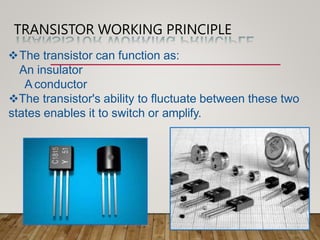
The transistor can function as:
An insulator
A conductor
The transistor's ability to fluctuate between these two
states enables it to switch or amplify.
 Biased transistor:-A biased transistor
means a transistor which is connected with
external voltage source.
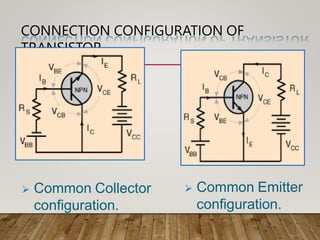
CONNECTION CONFIGURATION OF TRANSISTOR
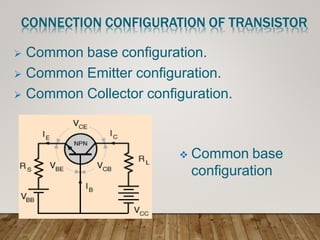
 Common base configuration.
 Common Emitter configuration.
 Common Collector configuration.
 Common base
configuration
CONNECTION CONFIGURATION OF
TRANSISTOR
 Common Emitter
configuration.
 Common Collector
configuration.
WORKING REGION OF TRANSISTOR
Region Emitter Base Junction Collector Base
Junction
Active Forward biased Reverse biased
Cut-off Reverse biased Reverse biased
Saturation Forward biased Forward biased
 A biased transistor works in three region:-
OPERATION OF N-P-N TRANSISTOR
 Base to Emitter junction is forward biased
by the dc sourcBeE v .
 Collector to base junction is reverse
biased by the dc CsEource v .
 The forward biased EB junction causes
the n type emitter electrons to flow
towards base.This constitute emitter
current.
 Some electrons combine in base region
and constitute base current.
 Remaining electrons cross base region
and move through collector region and it
constitute collector current.
OPERATION OF P-N-P TRANSISTOR
 Base to Emitter junction is forward
biased by the dc sourceBvE .
 Collector to base junction is
reverse biased by the dcCEsource v
.
 The forward biased EB junction
causes the p type emitter hole to
flow towards base.This constitute
emitter current.
 Some hole combine in base region
and constitute base current.
 Remaining hole cross base region
and move through collector region
and it constitute collector current.
TRANSISTOR CURRENT
I
IB
IB
IE
IC
IC
E
npn
IE = IB + IC
pnp
IE = IB + IC
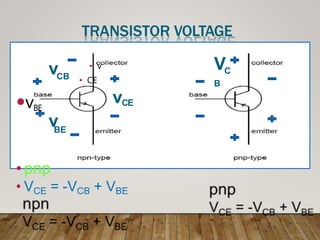
TRANSISTOR VOLTAGE
v
v
CB
BE
vCE
VC
B
• v
• CE
•vBE
•pnp
• VCE = -VCB + VBE
CURRENT GAIN
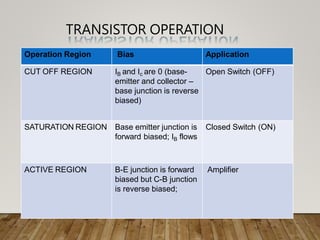
TRANSISTOR OPERATION
Operation Region Bias Application
CUT OFF REGION IB and Ic are 0 (base-
emitter and collector –
base junction is reverse
biased)
Open Switch (OFF)
SATURATION REGION Base emitter junction is
forward biased; IB flows
Closed Switch (ON)
ACTIVE REGION B-E junction is forward
biased but C-B junction
is reverse biased;
Amplifier
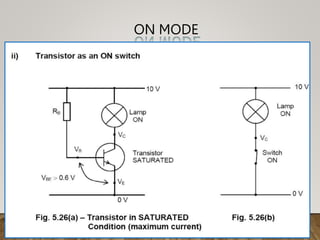
TRANSISTOR AS A SWITCH
ON MODE
Topic 4- Transistors.pptx

Topic 4- Transistors.pptx

  • 2.
    INTRODUCTION  Transistor isa three terminal electronic device, made up of semiconductor material which generally consist of three parts. i. Base ii. Emitter iii. Collector
  • 3.
    PARTSOFTRANSISTOR  Emitter:-It isof moderate size and it’s heavily doped. it’s main function is to supply majority charge carriers.  Collector:-It is larger in size and it’s moderately doped. It’s main function is to collect majority charge carriers.  Base:-It’s the middle section of the transistor and very lightly doped,thin in size.It’s main function is to reduce the recombination of charge carriers within base.
  • 4.
    TRANSISTORS (NPN ,PNP) n p n E c Cross Section B P N P Cross Section (NPN) E B (PNP) c Schematic Symbol Schematic Symbol E E B B c c
  • 5.
    TRANSISTOR WORKING PRINCIPLE Thetransistor can function as: An insulator A conductor The transistor's ability to fluctuate between these two states enables it to switch or amplify.
  • 6.
     Biased transistor:-Abiased transistor means a transistor which is connected with external voltage source.
  • 7.
    CONNECTION CONFIGURATION OFTRANSISTOR  Common base configuration.  Common Emitter configuration.  Common Collector configuration.  Common base configuration
  • 8.
    CONNECTION CONFIGURATION OF TRANSISTOR Common Emitter configuration.  Common Collector configuration.
  • 9.
    WORKING REGION OFTRANSISTOR Region Emitter Base Junction Collector Base Junction Active Forward biased Reverse biased Cut-off Reverse biased Reverse biased Saturation Forward biased Forward biased  A biased transistor works in three region:-
  • 10.
    OPERATION OF N-P-NTRANSISTOR  Base to Emitter junction is forward biased by the dc sourcBeE v .  Collector to base junction is reverse biased by the dc CsEource v .  The forward biased EB junction causes the n type emitter electrons to flow towards base.This constitute emitter current.  Some electrons combine in base region and constitute base current.  Remaining electrons cross base region and move through collector region and it constitute collector current.
  • 11.
    OPERATION OF P-N-PTRANSISTOR  Base to Emitter junction is forward biased by the dc sourceBvE .  Collector to base junction is reverse biased by the dcCEsource v .  The forward biased EB junction causes the p type emitter hole to flow towards base.This constitute emitter current.  Some hole combine in base region and constitute base current.  Remaining hole cross base region and move through collector region and it constitute collector current.
  • 12.
  • 13.
    TRANSISTOR VOLTAGE v v CB BE vCE VC B • v •CE •vBE •pnp • VCE = -VCB + VBE
  • 14.
  • 15.
    TRANSISTOR OPERATION Operation RegionBias Application CUT OFF REGION IB and Ic are 0 (base- emitter and collector – base junction is reverse biased) Open Switch (OFF) SATURATION REGION Base emitter junction is forward biased; IB flows Closed Switch (ON) ACTIVE REGION B-E junction is forward biased but C-B junction is reverse biased; Amplifier
  • 16.
  • 17.