BY
B. GOPINATH
AP/EEE, CKEC
UNIT 2: Transistor
1. Introduction
2.Objectives
3.Transistor
4.Transistor history
5.Transistor construction
6.Comparison of transistor connection
7.Transistor biasing
8.Transistor types
• Bipolar Junction Transistor
(BJT)
• Unipolar Junction Transistor
(UJT)
• Field Effect Transistor (FET)
9. Construction, working, and
characteristic of various types of
transistors
10. Application of various types of
Content
Objectives
After studying this unit, you should be able to-
1.Evolution of transistor
2.Importance of transistor
3.Definition & transistor types
4.Transistor symbol & operation
5. Get knowledge about various types of transistors; UJT, BJT, FET,
MOS FET, CMOSFET
6. Understand construction, working, and characteristic of various
types of transistors
7. Comparison of transistor connection
8. Comparison of various types of transistors
9. Application of various types of transistor
10. Some useful links
Transistor: Introduction
 Beside diodes, the most popular semiconductor devices is transistors.
Transistors are often said to be the most significant invention of the 20th Century.
If cells are the building blocks of life, transistors are the building blocks of the digital
revolution. Without transistors, the technological wonders you use every day -- cell phones,
computers, cars -- would be vastly different, if they existed at all.
 Transistors are more complex and can be used in many ways.
 Most important feature: can amplify signals and as switch.
 Amplification can make weak signal strong (make sounds louder and signal levels
greater),
in general, provide function called Gain.
•In the mid 1940’s a team of scientists working for Bell Telephone Labs in Murray Hill, New
Jersey, were working to discover a device to replace the then present vacuum tube technology.
Vacuum tubes were the only technology available at the time to amplify signals or serve as
switching devices in electronics. The problem was that they were expensive, consumed a lot of
power, gave off too much heat, and were unreliable, causing a great deal of maintenance.
•The scientists that were responsible for the 1947 invention of the transistor were: John
Bardeen, Walter Brattain, and William Shockley. Bardeen, with a Ph.D. in mathematics and
physics from Princeton University, was a specialist in the electron conducting properties of
semiconductors. Brattain, Ph.D., was an expert in the nature of the atomic structure of solids at
their surface level and solid-state physics. Shockley, Ph.D., was the director of transistor
research for Bell Labs.
•Their original patent name for the transistor was: “Semiconductor amplifier; Three-electrode
circuit element utilizing semi conductive materials.”
•In 1956, the group was awarded the Noble Prize in Physics for their invention of the
transistor. In 1977, John Bardeen was awarded the Presidential Medal of Freedom.
Transistor History
In 1947, John
Bardeen and
Walter Brattain
devised - the
first "point
contact"
transistor.
The first transistor
Transistor is an electronic device made of three layers of semiconductor material that can
act as an insulator and a conductor.
The three layered transistor is also known as the bipolar junction transistor.
Transistor Definition
A transistor has three doped regions.
• For both types, the base is a narrow region sandwiched between the larger collector and
emitter regions.
The emitter region is heavily doped and its
job is to emit carriers into the
base.
The base region is very
thin and lightly doped.
Most of the current carriers injected into
the
base pass on to the collector.
The collector region is moderately doped
and
is the largest of all three regions.
Transistor Structure
BJT is bipolar because both holes (+) and electrons (-)
will take part in the
current flow through the device
– N-type regions contains free electrons (negative
carriers)
– P-type regions contains free holes (positive
carriers)
• 2 types of BJT
– NPN transistor
– PNP transistor
• The transistor regions are:
–Emitter (E) – send the carriers into the base region and
then on to the
collector
– Base (B) – acts as control region. It can allow
none,some or many
carriers to flow
– Collector (C) –
Transistor Construction
NPN Transistor Structure
The collector is lightly doped.
The base is thin and is lightly doped.
The emitter is heavily doped.
The base-emitter (BE) junction is forward
biased
The base-collector (BC) junction is reverse
biased.
Transistor biasing
IE=IB+IC
Transistor Types
• The transistor is a three-layer semiconductor device consisting of either two n- and one ptype
layers of material or two p- and one ntype layers of material.
• The former is called an npn transistor, while the latter is called a pnp transistor
• So, there are two types of BJT
i) pnp transistor ii) npn transistor
Bipolar Junction Transistors
In each transistor following points to be noted
i) There are two junction, so transistor can be considered as two diode connected back
to
back.
ii) There are three terminals.
iii)The middle section is thin than other. Transistor symbol
Transistor has three section of doped semiconductor.
• The section one side is called “emitter” and the opposite side is called “collector”.
• The middle section is called “base”.
1) Emitter:
The section of one side that supplies carriers is called emitter.
Emitter is always forward biased wr to base so it can supply carrier.
For “npn transistor” emitter supply holes to its junction.
For “pnp transistor” emitter supply electrons to its junction.
2) Collector:
The section on the other side that collects carrier is called collector.
The collector is always reversed biased wrt to base.
For “npn transistor” collector receives holes to its junction.
For “pnp transistor” collector receives electrons to its junction.
3) Base:
The middle section which forms two pn junction between emitter
and collector is
called Base.
Transistor Operation
1) Working of npn transistor:
Forward bias Is applied to emitter base junction and reverse bias is
applied to collector base junction.
The forward bias in the emitter-base junction causes electrons to move toward
base. This constitute emitter current, IE
As this electrons flow toward p-type base, they try to recombine with holes. As
base
is
lightly doped only few electrons recombine with holes within the base.
These recombined electrons constitute small base current.
The remainder electrons crosses base and constitute collector current.
UOU, Haldwani
2) Working of pnp transistor: .
Forward bias is applied to emitter base
junction and reverse bias is applied to collector base junction.
The forward bias in the emitter-base junction causes holes to move toward base. This
constitute emitter current, IE
As this holes flow toward n-type base, they try to recombine with electrons. As base is
lightly
doped only few holes recombine with electrons within the base.
These recombined holes constitute small base current.
The remainder holes crosses base and constitute collector current.
Transistor Operation
Transistor Symbols
Transistor Operating Modes
• Active Mode
Base- Emitter junction is forward and Base-Collector junction is reverse biased.
• Saturation Mode
Base- Emitter junction is forward and Base-Collector junction is forward biased.
• Cut-off Mode
Both junctions are reverse biased.
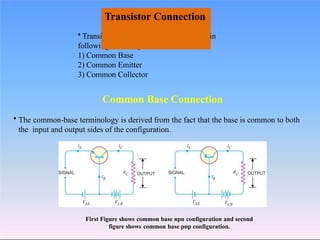
• Transistor can be connected in a circuit in
following three ways-
1) Common Base
2) Common Emitter
3) Common Collector
Transistor Connection
Common Base Connection
• The common-base terminology is derived from the fact that the base is common to both
the input and output sides of the configuration.
First Figure shows common base npn configuration and second
figure shows common base pnp configuration.
Current amplification factor (α) :
The ratio of change in collector current to the change in emitter current at constant
VCB is known as current amplification factor,
Practical value of is less than unity, but in the range of 0.9 to 0.99
Expression for Collector Current
Total emitter current does not reach the collector terminal, because a small portion of
it constitute base current. So,
Also, collector diode is reverse biased, so very few minority carrier passes the collector-base
junction which actually constitute leakage current.
So, collector current constitute of portion of emitter current αIE and leakage current ICBO.
IE=IB+IC
IC=αIE+ICBO
Characteristics of common base
configuration
Input Characteristics
VBE vs IE characteristics is called input characteristics.
IE increases rapidly with VBE . It means input resistance is very
small.
IE almost independent of VCB.
Output Characteristics
VBc vs Ic characteristics is called output characteristics.
IC varies linearly with VBc ,only when VBc is very small.
As, VBc increases, Ic becomes constant.
Input Resistance: The ratio of change in emitter-base voltage to the change in emitter current is
called Input Resistance.
Input and Output Resistance of common base configuration
Output Resistance: The ratio of change in collector-base voltage to the change in collector
current is called Output Resistance.
Common Emitter Connection
The common-emitter terminology is derived from the fact that the emitter is common to
both the input and output sides of the configuration.
First Figure shows common emitter npn configuration and second figure shows common emitter
pnp configuration.
Base Current amplification factor ( β) :
• In common emitter connection input current is base current and output current is collector
current.
• The ratio of change in collector current to the β change in base current is known as base
current
amplification factor,
Dr. Meenakshi
Rana
Deptt- Physics
UOU, Haldwani
Normally only 5% of emitter current flows to base, so amplification factor is greater than
20. Usually this range varies from 20 to 500.
Relation Between α and β
Expression for collector current
Dr. Meenakshi
Rana
Deptt- Physics
UOU, Haldwani
Characteristics of common emitter configuration
VBE vs IB characteristics is called input characteristics.
 IB increases rapidly with VBE . It means input resistance is
very small.
 IE almost independent of VCE.
 IB is of the range of micro amps.
Input Characteristics
Output Characteristics
VCE vs Ic characteristics is called output characteristics.
IC varies linearly with VCE ,only when VCE is very small.
 As, VCE increases, IC becomes constant.
Dr. Meenakshi
Rana
De
UOU, Haldwani
Input Resistance: The ratio of change in emitter-base voltage to the change in base current is
called Input Resistance.
Input and Output Resistance of common emitter configuration ptt- Physics
Output Resistance: The ratio of change in collector-emitter voltage to the change in collector
current is called Output Resistance.
Dr. Meenakshi
Rana
Deptt- Physics
UOU, Haldwani
• The common-collector terminology is derived from the fact that the collector is common to
both the input and output sides of the configuration.
Common Collector Configuration
First Figure shows common collector npn configuration and second figure shows common
collector pnp configuration.
Current amplification factor (γ):
• In common emitter connection input current is base current and output current is emitter
current.
• The ratio of change in emitter current to the change in base current is known as current
amplification factor in common collector configuration.
Dr. Meenakshi
Rana
Deptt- Physics
UOU, Haldwani
Relation between γ and α
Expression for collector current
Dr. Meenakshi
Rana
Deptt- Physics
UOU, Haldwani
Comparison of Transistor Connection
Dr. Meenakshi
Rana
Deptt- Physics
UOU, Haldwani
When used as an electronic switch, the transistor is normally operated
alternately in cut-off and saturation regions.
Transistor applications
Transistor as a switch
Dr. Meenakshi
Rana
Deptt- Physics
UOU, Haldwani
Due to the small changes in base current the
collector current will mimic the input with
greater
amplitude.
Transistor as amplifier
Figure shows CE amplifier for npn transistor
• Battery VBB is connected with base in-order to make base forward biased, regardless of input ac
polarity.
• Output is taken across Load R
Dr. Meenakshi
Rana
Deptt- Physics
UOU, Haldwani
During positive half cycle input ac will keep the emitter base junction more forward biased. So,
more carrier will be emitted by emitter, this huge current will flow through load and we will
find output amplified signal.
• During negative half cycle input ac will keep the emitter-base junction less forward biased. So,
less carrier will be emitted by emitter. Hence collector current decreases.
• This results in decreased output voltage (In opposite direction).
Dr. Meenakshi
Rana
Deptt- Physics
Transistor Load line analysis
UOU, Haldwani
Consider common emitter npn transistor circuit shown in figure.
There is no input signal.
Apply KVL in the output circuit
Dr. Meenakshi
Rana
Deptt- Physics
UOU, Haldwani
Operating Point
•It is called operating point because variation of IC
takes place about this point.
•It is also called quiescent point or Q-point.
Dr. Meenakshi
Rana
Deptt- Physics
UOU, Haldwani
Field Effect Transistor
Field effect Transistor is a semiconductor device which depends for its operation on
the control of current by an electric field
FET has several advantages over BJT
1.Current flow is due to majority carriers only
2.Immune to radiation
3.High input resistance
4.Less noisy than BJT
5.No offset voltages at zero drain current
6.High thermal stability
JFET Symbol
Dr. Meenakshi
Rana
Deptt- Physics
UOU, Haldwani
Classification of FET
Based on the construction JFETS are of two types
1.N Channel FET
2.P Channel FET
Dr. Meenakshi
Rana
Deptt- Physics
UOU, Haldwani
Construction of N Channel FET
Source: The source is the terminal
through which majority carriers enter the
Silicon Bar Drain: Terminalthrough which
majority carriers leave the bar
Gate: controls Drain current and is
always reverse biased
The operation of FET can be compared to the water flow through a flexible pipe
When one end is pressed the cross sectional area decreases hence water flow decreases
In a FET drain is similar to outlet.
Principle: To control the drain current FET makes use of channel formed in by Space charge
region between Gate and the bar. By increasing the reverse bias the width of space charge
region decreases. As a result the channel Resistance increases The Drain current decreases
Operation of FET
Dr. Meenakshi
Rana
Deptt- Physics
UOU, Haldwani
•As we increase the reverse bias on gate
(VGS)
•The channel width decreases
•Gate is reverse biased by battery 2
•The Bias voltage at which drain current
becomes zero is known as pinch off
voltage
Working of FET
Working of n channel FET and p channel FET
Dr. Meenakshi
Rana
Deptt- Physics
UOU, Haldwani
1.When Voltage is applied between source and Drain majority carriers move through the
channel between depletion region.
2. The value of Drain current is maximum when no external voltage is applied between gate and
source.
3.When gate to source reverse bias increases the depletion region widens and channel width
decreases hence Drain current decreases.
4. Hence Drain current decreases.
5. When gate to source voltage is increased further The channel completely closes.
6. This is called pinch off region.
7. This reduces Drain current to zero.
8. The Gate to source voltage at which the Drain current is zero is called “ Pinch off Voltage”
Working of FET
Dr. Meenakshi
Rana
Deptt- Physics
UOU, Haldwani
Electrical behavior is described in terms of the parameters of the Device. They are
obtained from the characteristics. Important Parameters for FET are
1.DC Drain resistance
2.AC drain Resistance
3.Transconductance
JFET Parameters
Difference between N channel FET and P channel FET
Dr. Meenakshi
Rana
Deptt- Physics
UOU, Haldwani
DC Drain resistance: Defined as ratio of Drain to source Voltage VDS to Drain current ID.
Also called static or Ohmic Resistance
Mathematically
JFET Parameters
AC Drain resistance: Defined as the resistance between Drain to source when JFET is operating
in Pinch off Region or saturation Region
2. Mathematically
Transconductance (gm): It is given by the ratio of small change in drain current to the
Corresponding change in the Gate to source Voltage VGS. Also known as Forward Transmittance
Mathematically
Dr. Meenakshi
Rana
Deptt- Physics
UOU, Haldwani
Difference between FET and BJT
Dr. Meenakshi
Rana
Deptt- Physics
UOU, Haldwani
Drain Characteristics
Drain characteristics show the relation between the drain to source voltage
and VDS and drain current ID.
•At the Drain to source Voltage corresponding to point B Channel width reduces to a
minimum value and is known as pinch off
Drain current ID is given by
•The device gets damaged due to avalanche Breakdown mechanism.
Dr. Meenakshi
Rana
Deptt- Physics
FET Applications
UOU, Haldwani
Phase shift oscillators: The high input impedance of FET is especially valuable in
phase
shift oscillator to minimize the loading effect.
In voltmeters: The high input impedance of FET is useful in voltmeters to act as an
input stage.
As a buffer amplifier which isolates the preceding stage from the following stage.
FET has low noise operation. So it is used in RF amplifiers in FM tuners and
communication equipment.
FET has low input capacitance, so it is used in cascade amplifiers in measuring and test
equipment.
Since FET is a voltage controlled device, it is used as a voltage variable resistor in
operational amplifiers and tone controls.
FET has low inner modulation distortion. So it is used in mixer circuits in FM and TV
receivers, and communication equipment.
Since it is low-frequency drifts, it is used in oscillator circuits.
DISADVANTAGES OF FET OVER BJT
FETs have a drawback of smaller gain bandwidth product compared to BJT.
The high input impedance, low output impedance and low noise level make FET
for
Dr. Meenakshi
Rana
Deptt- Physics
UOU, Haldwani
Classification of MOSFETs
Metal oxide semiconductor field effect
transistor (MOSFET)
MOSFET is an important semiconductor device and is widely used in many circuit application.
The input impedance of a MOSFET is much more than that if a FET because of very small
leakage current.
 MOSFETs has much greater commercial Importance than JFET.
The MOSFET can be used in any of the circuits covered for the FET.
Therefore all the equations apply equally well to the MOSFET and FET in
amplifier
connections.
MOSFETs uses a metal gate electrode (instead of p-n junction in JFET), separated from the
semi conductor by an Insulating thin layer SiO2 to modulate the resistance of the conduction
Dr. Meenakshi
Rana
Deptt- Physics
Metal oxide semiconductor field effect transistor (MOSFET)
UOU, Haldwan•i It is also called as insulated gate FET (IGFET)
• MOSFETs operates both in the depletion mode as well as an the enhancement
mode
Circuit symbols of MOSFET
Differences between MOSFET and FET
 There is only a single p-region. This is called substrate.
A thin layer of metal oxide is deposited over the left side of the channel. A metallic gate is
deposited over the oxide layer. As silicon dioxide is an insulator, therefore a gate is insulated
from the channel. For this reason MOSFET is some times called insulated gate FET.
Dr. Meenakshi
Rana
Deptt- Physics
UOU, Haldwani
P channel Enhancement MOSFET
symbols
Enhancement MOSFET
A p-channel MOSFET consists of lightly
doped n-substrate into which two heavily
doped p+ regions act as the source and the
drain.
A thin layer of SiO2 is grown over the
surface of the entire assembly.
P channel Enhancement MOSFET
Dr. Meenakshi
Rana
Deptt- Physics
UOU, Haldwani
Construction of P channel Enhancement MOSFET
Holes are cut into this SiO2 layer for making contact with p+ source and drain regions.
 On the SiO2 layer, a metal (aluminum) layer is overlaid covering the
entire channel region from source to drain.
 This aluminum layer constitutes the gate.
The area of MOSFET is typically 5 square mills or less.
This area is extremely small being only about 5% of the area required for a bipolar
junction
transistor.
A parallel plate capacitor is formed with the metal areas of the gate and the semiconductor
channel acting as the electrodes of the capacitor.
The oxide layer acts as the dielectric between the electrodes.
Dr. Meenakshi
Rana
Deptt- Physics
UOU, Haldwani
The substrate will be connected to the common terminal i.e., to the ground terminal.
A negative potential will be applied to the gate.
This results in the formation of an electric field normal the SiO2.
This electric field originates from the induced positive charges on the semiconductor side on
the lower surface of the SiO2 layer.
 The induced positive charge become minority carriers in the n-type of substrate.
Working P channel Enhancement MOSFET
Dr. Meenakshi
Rana
Deptt- Physics
UOU, Haldwani
n channel Enhancement MOSFET
•It consists of a lightly doped p type substrate in to which two heavily doped n type
material are diffused.
• The surface is coated with a layer of silicon dioxide (SiO2).
• Holes are cut through the SiO2 to make contact with n-type blocks.
•Metal (Al) is deposited through the Holes to form drain and source terminals.
•The surface area between drain and source a metal plate is deposited from which gate terminal
is taken out.
Working of n channel Enhancement MOSFET
Dr. Meenakshi
Rana
Deptt- Physics
UOU, Haldwani
Gate is insulated from the body of FET so it is called insulated gate FET(IGFET).
•Structurally there exits no channel between source and drain so MOSFET some times
called as N-channel enhancement type
•Because a thin layer of P-type substrate touching the metal oxide film provides channel for
electrons and hence acts like N-type material.
Drain is made positive with respect to the source and no potential is applied to the gate
as
shown in figure.
•The two n-blocks and p-type substrate form back to back pn junctions connected by the
Resistance of the p-type material.
• Both the junctions cannot be forwarded at the Same time so small drain current order of few
Workin
g
Dr. Meenakshi
Rana
Deptt- Physics
UOU, Haldwani
•So MOSFET is cut off when gate source voltage is zero.
• That is why it is called normally- OFF MOSFET.
• The gate is made positive with respect to source substrate as shown in figure.
• A channel of electrons (n channel) is formed in between the source and drain regions.
•Behaves as a capacitor with gate metal acting as one electrode, upper surface of the
substrate as other electrode and sio2 layer as dielectric medium.
•When positive voltage is applied to gate the capacitor begin to charge.
•Consequently positive charges appears on the gate and negative charges appears
in the substrate between the drain and source.
•The n-channel thus formed is called induced n-channel or n-type inversion layer.
•As VGS increases, no. electrons in the channel increases, ID increases.
•The minimum gate source voltage which produces then induced n-channel is called
threshold voltage VGS(th).when VGS < VGS (th), ID=0.
•Drain current starts only VGS >VGS (th).
•For a given value of VDS as VGS is increased , more and more electrons accumulate
under the gate and ID increases.
•So the conductivity of the channel is enhanced by the positive bias on the gate, the device
is known as enhancement mode MOSFET.
•The n-channel MOSFET can never operate with a negative gate voltage.
Workin
g
Dr. Meenakshi
Rana
Deptt- Physics
UOU, Haldwani
Drain characteristics
It is observed that the drain current has been enhanced on
application of negative gate voltage.
•This is the reason for calling it as
enhancement MOSFET.
•By increasing the gate potential, pinch off voltage and
drain currents are increased.
•The curves are similar to drain characteristics of
JFET.
Dr. Meenakshi
Rana
Deptt- Physics
UOU, Haldwani
Depletion type MOSFET
Circuit symbols of n channel depletion type MOSFET
•Depletion MOSFET may be fabricated from the basic
MOSFET structure.
•An n-type channel is obtained by diffusion between n+ type
source and drain in an n-channel
MOSFET.
•In depletion MOSFET a lightly doped n-type channel has
been introduced between to heavily doped source& drain
blocks,.
Construction of n channel depletion type MOSFET
Dr. Meenakshi
Rana
Deptt- Physics
UOU, Haldwani
Circuit symbols of p channel depletion type MOSFET
Construction of p channel depletion type MOSFET
•Depletion MOSFET may be fabricated from the basic
MOSFET structure.
•An p-type channel is obtained by diffusion between p+
type source and drain in an p channel MOSFET.
•In p-channel depletion MOSFETs are made by using n-
type substrate and diffusing a lightly doped p-type
channel between two heavily doped P-type source &
drain blocks
Dr. Meenakshi
Rana
Deptt- Physics
UOU, Haldwani
Working
•Negative gate operation of a depletion MOSFET is called
Its depletion mode Operation
•When Vgs =0 electrons can flow freely from source to
drain through the conducting channel. since a channel
exists between drain & source, Id flows even when Vgs=0.
• It is also known as normally –ON MOSFET.
•When negative voltage is applied to the gate as shown
•in Fig positive charges are induced in the channel by
capacitor action.
•The induced positive charges make the channel less
conductive and drain current decreases as VGS is made
more negative.
•With negative voltage a depletion MOSFET behave like JFET.
•When positive voltage is applied to the gate free electrons are Induced channel.
•This enhances the conductivity of the channel so increasing amount of current between terminals
• Since the action of negative voltage on gate is to deplete the channel of free n-type charge
carriers so named as depletion MOSFET.
Dr. Meenakshi
Rana
Deptt- Physics
UOU, Haldwani
Drain Characteristics of depletion MOSFET
•When the gate source voltage is zero considerable drain current flows.
•When the gate is applied with negative voltage, positive charge are induced in the n
channel through the SiO2 layer of the gate capacitor.
Dr. Meenakshi
Rana
Deptt- Physics
UOU, Haldwani
 The conduction in n channel FET is due to electrons i.e., the majority carriers.
 Therefore the induced positive charges make the n-channel less conductive.
 The drain current therefore gets reduced with increase in the gate bias voltage
 The distribution of charges in the channel results in depletion of majority carriers.
 That is why this type of FET is called depletion MOSFET.
 The voltage drop due to the drain current causes the channel region nearer to the drain to
be more depleted than the region due to the source.
 The depletion MOSFET can also be operated in enhancement mode simply by applying
a positive voltage to the gate
Drain Characteristics of depletion MOSFET
Dr. Meenakshi
Rana
Deptt- Physics
UOU, Haldwani
Comparison of MOSFET and JFET
• The insulated gate in MOSFET s result in much greater input impedance than that of JFET
•Inter electrode capacitance are independent of bia voltage and these capacitances are smaller
incase of MOSFETs than JEFT.
• It is easier to fabricate MOSFET than JFET.
• MOSFET has no gate diode. This makes it possible to operate with +ve or –ve gate voltages
Advantages of MOSFET Over JFET
Dr. Meenakshi
Rana
Deptt- Physics
UOU, Haldwani
• Because of higher input resistance ,the enhancement type MOS devices have been used as
micro-resistor in integrated micro-circuits.
• For electrometer circuits where exceptionally low currents are to be measured MOSFETs
are
most nearly ideal.
• MOSFET s are very small in size .which make them suitable for highly complex digital
arrays.
•MOSFET is used for switching and amplifying electronics signals in the electronic
devices.
•It is used as an inverter.
•It can be used in digital circuit.
•MOSFET can be used as a high frequency amplifier.
•It can be used as a passive element e.g. resistor, capacitor and inductor.
•It can be used in brushless DC motor drive.
•It can be used in electronic DC relay.
Application of MOSFETs
Dr. Meenakshi
Rana
Deptt- Physics
UOU, Haldwani
COMPLEMENTARY MOSFET(CMOS)
CONSTUCTION OF COMPLEMENTARY MOSFET(CMOS)
•In this device two MOSFETs that are complementary to each other are used
•The drains of both the MOSFETs are combined and single terminal is taken.
•Similarly the gates of both the transistors are combined and a single gate terminal is taken out.
•Here the input is applied at the input terminal vi.
Dr. Meenakshi
Rana
Deptt- Physics
UOU, Haldwani
Working principle of CMOSFET
•When vi is high i.e., equal to –VDD then Q1 is turned ON and Q2 is turned OFF. The output
VO is zero.
•Similarly when the input voltage Vi is low i.e., equal to 0v, the Q2 turned ON and Q1 turned
OFF.
•So the output voltage Vo lies at –V dd level i.e., high.
•Thus the CMOSFET in this configuration works as an Inverter.
•The key advantage of using CMOS design is this extremely low power consumption
usually of the order of 50mv
Dr. Meenakshi
Rana
Deptt- Physics
UOU, Haldwani
•The UJT as the name implies, is characterized by a single pn
junction.
•It exhibits negative resistance characteristic that makes it useful in
oscillator circuits.
•With only one p-n junction, the device is really a form of diode
because two base terminal are taken from one section of the diode this
device is also called double-based diode
•The emitter is heavily doped the n-region, is lightly doped for this
reason the resistance between the base terminals is very high (5to10
kohms) when emitter lead is open.
Uni Junction Transistor (UJT)
Circuit Symbol Device
Dr. Meenakshi
Rana
Deptt- Physics
Equivalent circuit of UJT
UOU, Haldwani
The PN junction behaves like a diode
The lightly doped silicon bar has high resistance can be
represented by two resistors connected in series RB1 and
RB2.
The Resistance offered by N-type bar between Base-1
and Emitter is referred as RB1.
The Resistance offered by N-type bar between Base-2
and Emitter is referred as RB2.
bar is known as Base
The Resistance of N-
type spreading resistance
RBB.
RBB = RB1 + RB2
Intrinsic stand of ratio
The intrinsic stand-off ratio is denoted by η.
η = RB1 /(RB1 + RB2)
The intrinsic stand-off ratio is the property of a UJT is
always less than unity.
Typical range of η is lies between 0.5 to 0.8.
Dr. Meenakshi
Rana
Deptt- Physics
UOU, Haldwani
Applications of UJT
Phase control.
Relaxation oscillator.
Timing circuits.
Switching
Pulse generation.
Sine wave generator.
Voltage or current regulator supplies.
A stable triggering voltage i.e., a fixed fraction of applied inter base voltage
VBB
A very low value of triggering current.
•A high pulse current capability.
• A negative resistance characteristic.
• Low cost.
Features of UJT
Dr. Meenakshi
Rana
Deptt- Physics
UOU, Haldwani
Transistors, How do they work ?
https://www.youtube.com/watch?v=7ukDKVHn
ac4
Bipolar Junction Transistor (BJT)
https://www.youtube.com/watch?v=dTx9VKV0hj
o
https://www.youtube.com/watch?v=d2lmY-AM
s24
Field Effect Transistor (FET)
https://www.youtube.com/watch?v=PMOaS967Yus
https://www.youtube.com/watch?v=Q0nhtmYT6
uA
MOSFET
Dr. Meenakshi
Rana
Deptt- Physics
UOU, Haldwani

Unit 2 (Transistor - Trans - resistor).pptx

  • 1.
  • 2.
    1. Introduction 2.Objectives 3.Transistor 4.Transistor history 5.Transistorconstruction 6.Comparison of transistor connection 7.Transistor biasing 8.Transistor types • Bipolar Junction Transistor (BJT) • Unipolar Junction Transistor (UJT) • Field Effect Transistor (FET) 9. Construction, working, and characteristic of various types of transistors 10. Application of various types of Content
  • 3.
    Objectives After studying thisunit, you should be able to- 1.Evolution of transistor 2.Importance of transistor 3.Definition & transistor types 4.Transistor symbol & operation 5. Get knowledge about various types of transistors; UJT, BJT, FET, MOS FET, CMOSFET 6. Understand construction, working, and characteristic of various types of transistors 7. Comparison of transistor connection 8. Comparison of various types of transistors 9. Application of various types of transistor 10. Some useful links
  • 4.
    Transistor: Introduction  Besidediodes, the most popular semiconductor devices is transistors. Transistors are often said to be the most significant invention of the 20th Century. If cells are the building blocks of life, transistors are the building blocks of the digital revolution. Without transistors, the technological wonders you use every day -- cell phones, computers, cars -- would be vastly different, if they existed at all.  Transistors are more complex and can be used in many ways.  Most important feature: can amplify signals and as switch.  Amplification can make weak signal strong (make sounds louder and signal levels greater), in general, provide function called Gain.
  • 5.
    •In the mid1940’s a team of scientists working for Bell Telephone Labs in Murray Hill, New Jersey, were working to discover a device to replace the then present vacuum tube technology. Vacuum tubes were the only technology available at the time to amplify signals or serve as switching devices in electronics. The problem was that they were expensive, consumed a lot of power, gave off too much heat, and were unreliable, causing a great deal of maintenance. •The scientists that were responsible for the 1947 invention of the transistor were: John Bardeen, Walter Brattain, and William Shockley. Bardeen, with a Ph.D. in mathematics and physics from Princeton University, was a specialist in the electron conducting properties of semiconductors. Brattain, Ph.D., was an expert in the nature of the atomic structure of solids at their surface level and solid-state physics. Shockley, Ph.D., was the director of transistor research for Bell Labs. •Their original patent name for the transistor was: “Semiconductor amplifier; Three-electrode circuit element utilizing semi conductive materials.” •In 1956, the group was awarded the Noble Prize in Physics for their invention of the transistor. In 1977, John Bardeen was awarded the Presidential Medal of Freedom. Transistor History
  • 6.
    In 1947, John Bardeenand Walter Brattain devised - the first "point contact" transistor. The first transistor Transistor is an electronic device made of three layers of semiconductor material that can act as an insulator and a conductor. The three layered transistor is also known as the bipolar junction transistor. Transistor Definition
  • 7.
    A transistor hasthree doped regions. • For both types, the base is a narrow region sandwiched between the larger collector and emitter regions. The emitter region is heavily doped and its job is to emit carriers into the base. The base region is very thin and lightly doped. Most of the current carriers injected into the base pass on to the collector. The collector region is moderately doped and is the largest of all three regions. Transistor Structure
  • 8.
    BJT is bipolarbecause both holes (+) and electrons (-) will take part in the current flow through the device – N-type regions contains free electrons (negative carriers) – P-type regions contains free holes (positive carriers) • 2 types of BJT – NPN transistor – PNP transistor • The transistor regions are: –Emitter (E) – send the carriers into the base region and then on to the collector – Base (B) – acts as control region. It can allow none,some or many carriers to flow – Collector (C) – Transistor Construction
  • 9.
    NPN Transistor Structure Thecollector is lightly doped. The base is thin and is lightly doped. The emitter is heavily doped.
  • 10.
    The base-emitter (BE)junction is forward biased The base-collector (BC) junction is reverse biased. Transistor biasing IE=IB+IC Transistor Types
  • 11.
    • The transistoris a three-layer semiconductor device consisting of either two n- and one ptype layers of material or two p- and one ntype layers of material. • The former is called an npn transistor, while the latter is called a pnp transistor • So, there are two types of BJT i) pnp transistor ii) npn transistor Bipolar Junction Transistors In each transistor following points to be noted i) There are two junction, so transistor can be considered as two diode connected back to back. ii) There are three terminals. iii)The middle section is thin than other. Transistor symbol
  • 12.
    Transistor has threesection of doped semiconductor. • The section one side is called “emitter” and the opposite side is called “collector”. • The middle section is called “base”. 1) Emitter: The section of one side that supplies carriers is called emitter. Emitter is always forward biased wr to base so it can supply carrier. For “npn transistor” emitter supply holes to its junction. For “pnp transistor” emitter supply electrons to its junction. 2) Collector: The section on the other side that collects carrier is called collector. The collector is always reversed biased wrt to base. For “npn transistor” collector receives holes to its junction. For “pnp transistor” collector receives electrons to its junction. 3) Base: The middle section which forms two pn junction between emitter and collector is called Base.
  • 13.
    Transistor Operation 1) Workingof npn transistor: Forward bias Is applied to emitter base junction and reverse bias is applied to collector base junction. The forward bias in the emitter-base junction causes electrons to move toward base. This constitute emitter current, IE As this electrons flow toward p-type base, they try to recombine with holes. As base is lightly doped only few electrons recombine with holes within the base. These recombined electrons constitute small base current. The remainder electrons crosses base and constitute collector current.
  • 14.
    UOU, Haldwani 2) Workingof pnp transistor: . Forward bias is applied to emitter base junction and reverse bias is applied to collector base junction. The forward bias in the emitter-base junction causes holes to move toward base. This constitute emitter current, IE As this holes flow toward n-type base, they try to recombine with electrons. As base is lightly doped only few holes recombine with electrons within the base. These recombined holes constitute small base current. The remainder holes crosses base and constitute collector current. Transistor Operation
  • 15.
    Transistor Symbols Transistor OperatingModes • Active Mode Base- Emitter junction is forward and Base-Collector junction is reverse biased. • Saturation Mode Base- Emitter junction is forward and Base-Collector junction is forward biased. • Cut-off Mode Both junctions are reverse biased.
  • 16.
    • Transistor canbe connected in a circuit in following three ways- 1) Common Base 2) Common Emitter 3) Common Collector Transistor Connection Common Base Connection • The common-base terminology is derived from the fact that the base is common to both the input and output sides of the configuration. First Figure shows common base npn configuration and second figure shows common base pnp configuration.
  • 17.
    Current amplification factor(α) : The ratio of change in collector current to the change in emitter current at constant VCB is known as current amplification factor, Practical value of is less than unity, but in the range of 0.9 to 0.99 Expression for Collector Current Total emitter current does not reach the collector terminal, because a small portion of it constitute base current. So, Also, collector diode is reverse biased, so very few minority carrier passes the collector-base junction which actually constitute leakage current. So, collector current constitute of portion of emitter current αIE and leakage current ICBO. IE=IB+IC IC=αIE+ICBO
  • 18.
    Characteristics of commonbase configuration Input Characteristics VBE vs IE characteristics is called input characteristics. IE increases rapidly with VBE . It means input resistance is very small. IE almost independent of VCB. Output Characteristics VBc vs Ic characteristics is called output characteristics. IC varies linearly with VBc ,only when VBc is very small. As, VBc increases, Ic becomes constant.
  • 19.
    Input Resistance: Theratio of change in emitter-base voltage to the change in emitter current is called Input Resistance. Input and Output Resistance of common base configuration Output Resistance: The ratio of change in collector-base voltage to the change in collector current is called Output Resistance.
  • 20.
    Common Emitter Connection Thecommon-emitter terminology is derived from the fact that the emitter is common to both the input and output sides of the configuration. First Figure shows common emitter npn configuration and second figure shows common emitter pnp configuration. Base Current amplification factor ( β) : • In common emitter connection input current is base current and output current is collector current. • The ratio of change in collector current to the β change in base current is known as base current amplification factor,
  • 21.
    Dr. Meenakshi Rana Deptt- Physics UOU,Haldwani Normally only 5% of emitter current flows to base, so amplification factor is greater than 20. Usually this range varies from 20 to 500. Relation Between α and β Expression for collector current
  • 22.
    Dr. Meenakshi Rana Deptt- Physics UOU,Haldwani Characteristics of common emitter configuration VBE vs IB characteristics is called input characteristics.  IB increases rapidly with VBE . It means input resistance is very small.  IE almost independent of VCE.  IB is of the range of micro amps. Input Characteristics Output Characteristics VCE vs Ic characteristics is called output characteristics. IC varies linearly with VCE ,only when VCE is very small.  As, VCE increases, IC becomes constant.
  • 23.
    Dr. Meenakshi Rana De UOU, Haldwani InputResistance: The ratio of change in emitter-base voltage to the change in base current is called Input Resistance. Input and Output Resistance of common emitter configuration ptt- Physics Output Resistance: The ratio of change in collector-emitter voltage to the change in collector current is called Output Resistance.
  • 24.
    Dr. Meenakshi Rana Deptt- Physics UOU,Haldwani • The common-collector terminology is derived from the fact that the collector is common to both the input and output sides of the configuration. Common Collector Configuration First Figure shows common collector npn configuration and second figure shows common collector pnp configuration. Current amplification factor (γ): • In common emitter connection input current is base current and output current is emitter current. • The ratio of change in emitter current to the change in base current is known as current amplification factor in common collector configuration.
  • 25.
    Dr. Meenakshi Rana Deptt- Physics UOU,Haldwani Relation between γ and α Expression for collector current
  • 26.
    Dr. Meenakshi Rana Deptt- Physics UOU,Haldwani Comparison of Transistor Connection
  • 27.
    Dr. Meenakshi Rana Deptt- Physics UOU,Haldwani When used as an electronic switch, the transistor is normally operated alternately in cut-off and saturation regions. Transistor applications Transistor as a switch
  • 28.
    Dr. Meenakshi Rana Deptt- Physics UOU,Haldwani Due to the small changes in base current the collector current will mimic the input with greater amplitude. Transistor as amplifier Figure shows CE amplifier for npn transistor • Battery VBB is connected with base in-order to make base forward biased, regardless of input ac polarity. • Output is taken across Load R
  • 29.
    Dr. Meenakshi Rana Deptt- Physics UOU,Haldwani During positive half cycle input ac will keep the emitter base junction more forward biased. So, more carrier will be emitted by emitter, this huge current will flow through load and we will find output amplified signal. • During negative half cycle input ac will keep the emitter-base junction less forward biased. So, less carrier will be emitted by emitter. Hence collector current decreases. • This results in decreased output voltage (In opposite direction).
  • 30.
    Dr. Meenakshi Rana Deptt- Physics TransistorLoad line analysis UOU, Haldwani Consider common emitter npn transistor circuit shown in figure. There is no input signal. Apply KVL in the output circuit
  • 31.
    Dr. Meenakshi Rana Deptt- Physics UOU,Haldwani Operating Point •It is called operating point because variation of IC takes place about this point. •It is also called quiescent point or Q-point.
  • 32.
    Dr. Meenakshi Rana Deptt- Physics UOU,Haldwani Field Effect Transistor Field effect Transistor is a semiconductor device which depends for its operation on the control of current by an electric field FET has several advantages over BJT 1.Current flow is due to majority carriers only 2.Immune to radiation 3.High input resistance 4.Less noisy than BJT 5.No offset voltages at zero drain current 6.High thermal stability JFET Symbol
  • 33.
    Dr. Meenakshi Rana Deptt- Physics UOU,Haldwani Classification of FET Based on the construction JFETS are of two types 1.N Channel FET 2.P Channel FET
  • 34.
    Dr. Meenakshi Rana Deptt- Physics UOU,Haldwani Construction of N Channel FET Source: The source is the terminal through which majority carriers enter the Silicon Bar Drain: Terminalthrough which majority carriers leave the bar Gate: controls Drain current and is always reverse biased The operation of FET can be compared to the water flow through a flexible pipe When one end is pressed the cross sectional area decreases hence water flow decreases In a FET drain is similar to outlet. Principle: To control the drain current FET makes use of channel formed in by Space charge region between Gate and the bar. By increasing the reverse bias the width of space charge region decreases. As a result the channel Resistance increases The Drain current decreases Operation of FET
  • 35.
    Dr. Meenakshi Rana Deptt- Physics UOU,Haldwani •As we increase the reverse bias on gate (VGS) •The channel width decreases •Gate is reverse biased by battery 2 •The Bias voltage at which drain current becomes zero is known as pinch off voltage Working of FET Working of n channel FET and p channel FET
  • 36.
    Dr. Meenakshi Rana Deptt- Physics UOU,Haldwani 1.When Voltage is applied between source and Drain majority carriers move through the channel between depletion region. 2. The value of Drain current is maximum when no external voltage is applied between gate and source. 3.When gate to source reverse bias increases the depletion region widens and channel width decreases hence Drain current decreases. 4. Hence Drain current decreases. 5. When gate to source voltage is increased further The channel completely closes. 6. This is called pinch off region. 7. This reduces Drain current to zero. 8. The Gate to source voltage at which the Drain current is zero is called “ Pinch off Voltage” Working of FET
  • 37.
    Dr. Meenakshi Rana Deptt- Physics UOU,Haldwani Electrical behavior is described in terms of the parameters of the Device. They are obtained from the characteristics. Important Parameters for FET are 1.DC Drain resistance 2.AC drain Resistance 3.Transconductance JFET Parameters Difference between N channel FET and P channel FET
  • 38.
    Dr. Meenakshi Rana Deptt- Physics UOU,Haldwani DC Drain resistance: Defined as ratio of Drain to source Voltage VDS to Drain current ID. Also called static or Ohmic Resistance Mathematically JFET Parameters AC Drain resistance: Defined as the resistance between Drain to source when JFET is operating in Pinch off Region or saturation Region 2. Mathematically Transconductance (gm): It is given by the ratio of small change in drain current to the Corresponding change in the Gate to source Voltage VGS. Also known as Forward Transmittance Mathematically
  • 39.
    Dr. Meenakshi Rana Deptt- Physics UOU,Haldwani Difference between FET and BJT
  • 40.
    Dr. Meenakshi Rana Deptt- Physics UOU,Haldwani Drain Characteristics Drain characteristics show the relation between the drain to source voltage and VDS and drain current ID. •At the Drain to source Voltage corresponding to point B Channel width reduces to a minimum value and is known as pinch off Drain current ID is given by •The device gets damaged due to avalanche Breakdown mechanism.
  • 41.
    Dr. Meenakshi Rana Deptt- Physics FETApplications UOU, Haldwani Phase shift oscillators: The high input impedance of FET is especially valuable in phase shift oscillator to minimize the loading effect. In voltmeters: The high input impedance of FET is useful in voltmeters to act as an input stage. As a buffer amplifier which isolates the preceding stage from the following stage. FET has low noise operation. So it is used in RF amplifiers in FM tuners and communication equipment. FET has low input capacitance, so it is used in cascade amplifiers in measuring and test equipment. Since FET is a voltage controlled device, it is used as a voltage variable resistor in operational amplifiers and tone controls. FET has low inner modulation distortion. So it is used in mixer circuits in FM and TV receivers, and communication equipment. Since it is low-frequency drifts, it is used in oscillator circuits. DISADVANTAGES OF FET OVER BJT FETs have a drawback of smaller gain bandwidth product compared to BJT. The high input impedance, low output impedance and low noise level make FET for
  • 42.
    Dr. Meenakshi Rana Deptt- Physics UOU,Haldwani Classification of MOSFETs Metal oxide semiconductor field effect transistor (MOSFET) MOSFET is an important semiconductor device and is widely used in many circuit application. The input impedance of a MOSFET is much more than that if a FET because of very small leakage current.  MOSFETs has much greater commercial Importance than JFET. The MOSFET can be used in any of the circuits covered for the FET. Therefore all the equations apply equally well to the MOSFET and FET in amplifier connections. MOSFETs uses a metal gate electrode (instead of p-n junction in JFET), separated from the semi conductor by an Insulating thin layer SiO2 to modulate the resistance of the conduction
  • 43.
    Dr. Meenakshi Rana Deptt- Physics Metaloxide semiconductor field effect transistor (MOSFET) UOU, Haldwan•i It is also called as insulated gate FET (IGFET) • MOSFETs operates both in the depletion mode as well as an the enhancement mode Circuit symbols of MOSFET Differences between MOSFET and FET  There is only a single p-region. This is called substrate. A thin layer of metal oxide is deposited over the left side of the channel. A metallic gate is deposited over the oxide layer. As silicon dioxide is an insulator, therefore a gate is insulated from the channel. For this reason MOSFET is some times called insulated gate FET.
  • 44.
    Dr. Meenakshi Rana Deptt- Physics UOU,Haldwani P channel Enhancement MOSFET symbols Enhancement MOSFET A p-channel MOSFET consists of lightly doped n-substrate into which two heavily doped p+ regions act as the source and the drain. A thin layer of SiO2 is grown over the surface of the entire assembly. P channel Enhancement MOSFET
  • 45.
    Dr. Meenakshi Rana Deptt- Physics UOU,Haldwani Construction of P channel Enhancement MOSFET Holes are cut into this SiO2 layer for making contact with p+ source and drain regions.  On the SiO2 layer, a metal (aluminum) layer is overlaid covering the entire channel region from source to drain.  This aluminum layer constitutes the gate. The area of MOSFET is typically 5 square mills or less. This area is extremely small being only about 5% of the area required for a bipolar junction transistor. A parallel plate capacitor is formed with the metal areas of the gate and the semiconductor channel acting as the electrodes of the capacitor. The oxide layer acts as the dielectric between the electrodes.
  • 46.
    Dr. Meenakshi Rana Deptt- Physics UOU,Haldwani The substrate will be connected to the common terminal i.e., to the ground terminal. A negative potential will be applied to the gate. This results in the formation of an electric field normal the SiO2. This electric field originates from the induced positive charges on the semiconductor side on the lower surface of the SiO2 layer.  The induced positive charge become minority carriers in the n-type of substrate. Working P channel Enhancement MOSFET
  • 47.
    Dr. Meenakshi Rana Deptt- Physics UOU,Haldwani n channel Enhancement MOSFET •It consists of a lightly doped p type substrate in to which two heavily doped n type material are diffused. • The surface is coated with a layer of silicon dioxide (SiO2). • Holes are cut through the SiO2 to make contact with n-type blocks. •Metal (Al) is deposited through the Holes to form drain and source terminals. •The surface area between drain and source a metal plate is deposited from which gate terminal is taken out. Working of n channel Enhancement MOSFET
  • 48.
    Dr. Meenakshi Rana Deptt- Physics UOU,Haldwani Gate is insulated from the body of FET so it is called insulated gate FET(IGFET). •Structurally there exits no channel between source and drain so MOSFET some times called as N-channel enhancement type •Because a thin layer of P-type substrate touching the metal oxide film provides channel for electrons and hence acts like N-type material. Drain is made positive with respect to the source and no potential is applied to the gate as shown in figure. •The two n-blocks and p-type substrate form back to back pn junctions connected by the Resistance of the p-type material. • Both the junctions cannot be forwarded at the Same time so small drain current order of few Workin g
  • 49.
    Dr. Meenakshi Rana Deptt- Physics UOU,Haldwani •So MOSFET is cut off when gate source voltage is zero. • That is why it is called normally- OFF MOSFET. • The gate is made positive with respect to source substrate as shown in figure. • A channel of electrons (n channel) is formed in between the source and drain regions. •Behaves as a capacitor with gate metal acting as one electrode, upper surface of the substrate as other electrode and sio2 layer as dielectric medium. •When positive voltage is applied to gate the capacitor begin to charge. •Consequently positive charges appears on the gate and negative charges appears in the substrate between the drain and source. •The n-channel thus formed is called induced n-channel or n-type inversion layer. •As VGS increases, no. electrons in the channel increases, ID increases. •The minimum gate source voltage which produces then induced n-channel is called threshold voltage VGS(th).when VGS < VGS (th), ID=0. •Drain current starts only VGS >VGS (th). •For a given value of VDS as VGS is increased , more and more electrons accumulate under the gate and ID increases. •So the conductivity of the channel is enhanced by the positive bias on the gate, the device is known as enhancement mode MOSFET. •The n-channel MOSFET can never operate with a negative gate voltage. Workin g
  • 50.
    Dr. Meenakshi Rana Deptt- Physics UOU,Haldwani Drain characteristics It is observed that the drain current has been enhanced on application of negative gate voltage. •This is the reason for calling it as enhancement MOSFET. •By increasing the gate potential, pinch off voltage and drain currents are increased. •The curves are similar to drain characteristics of JFET.
  • 51.
    Dr. Meenakshi Rana Deptt- Physics UOU,Haldwani Depletion type MOSFET Circuit symbols of n channel depletion type MOSFET •Depletion MOSFET may be fabricated from the basic MOSFET structure. •An n-type channel is obtained by diffusion between n+ type source and drain in an n-channel MOSFET. •In depletion MOSFET a lightly doped n-type channel has been introduced between to heavily doped source& drain blocks,. Construction of n channel depletion type MOSFET
  • 52.
    Dr. Meenakshi Rana Deptt- Physics UOU,Haldwani Circuit symbols of p channel depletion type MOSFET Construction of p channel depletion type MOSFET •Depletion MOSFET may be fabricated from the basic MOSFET structure. •An p-type channel is obtained by diffusion between p+ type source and drain in an p channel MOSFET. •In p-channel depletion MOSFETs are made by using n- type substrate and diffusing a lightly doped p-type channel between two heavily doped P-type source & drain blocks
  • 53.
    Dr. Meenakshi Rana Deptt- Physics UOU,Haldwani Working •Negative gate operation of a depletion MOSFET is called Its depletion mode Operation •When Vgs =0 electrons can flow freely from source to drain through the conducting channel. since a channel exists between drain & source, Id flows even when Vgs=0. • It is also known as normally –ON MOSFET. •When negative voltage is applied to the gate as shown •in Fig positive charges are induced in the channel by capacitor action. •The induced positive charges make the channel less conductive and drain current decreases as VGS is made more negative. •With negative voltage a depletion MOSFET behave like JFET. •When positive voltage is applied to the gate free electrons are Induced channel. •This enhances the conductivity of the channel so increasing amount of current between terminals • Since the action of negative voltage on gate is to deplete the channel of free n-type charge carriers so named as depletion MOSFET.
  • 54.
    Dr. Meenakshi Rana Deptt- Physics UOU,Haldwani Drain Characteristics of depletion MOSFET •When the gate source voltage is zero considerable drain current flows. •When the gate is applied with negative voltage, positive charge are induced in the n channel through the SiO2 layer of the gate capacitor.
  • 55.
    Dr. Meenakshi Rana Deptt- Physics UOU,Haldwani  The conduction in n channel FET is due to electrons i.e., the majority carriers.  Therefore the induced positive charges make the n-channel less conductive.  The drain current therefore gets reduced with increase in the gate bias voltage  The distribution of charges in the channel results in depletion of majority carriers.  That is why this type of FET is called depletion MOSFET.  The voltage drop due to the drain current causes the channel region nearer to the drain to be more depleted than the region due to the source.  The depletion MOSFET can also be operated in enhancement mode simply by applying a positive voltage to the gate Drain Characteristics of depletion MOSFET
  • 56.
    Dr. Meenakshi Rana Deptt- Physics UOU,Haldwani Comparison of MOSFET and JFET • The insulated gate in MOSFET s result in much greater input impedance than that of JFET •Inter electrode capacitance are independent of bia voltage and these capacitances are smaller incase of MOSFETs than JEFT. • It is easier to fabricate MOSFET than JFET. • MOSFET has no gate diode. This makes it possible to operate with +ve or –ve gate voltages Advantages of MOSFET Over JFET
  • 57.
    Dr. Meenakshi Rana Deptt- Physics UOU,Haldwani • Because of higher input resistance ,the enhancement type MOS devices have been used as micro-resistor in integrated micro-circuits. • For electrometer circuits where exceptionally low currents are to be measured MOSFETs are most nearly ideal. • MOSFET s are very small in size .which make them suitable for highly complex digital arrays. •MOSFET is used for switching and amplifying electronics signals in the electronic devices. •It is used as an inverter. •It can be used in digital circuit. •MOSFET can be used as a high frequency amplifier. •It can be used as a passive element e.g. resistor, capacitor and inductor. •It can be used in brushless DC motor drive. •It can be used in electronic DC relay. Application of MOSFETs
  • 58.
    Dr. Meenakshi Rana Deptt- Physics UOU,Haldwani COMPLEMENTARY MOSFET(CMOS) CONSTUCTION OF COMPLEMENTARY MOSFET(CMOS) •In this device two MOSFETs that are complementary to each other are used •The drains of both the MOSFETs are combined and single terminal is taken. •Similarly the gates of both the transistors are combined and a single gate terminal is taken out. •Here the input is applied at the input terminal vi.
  • 59.
    Dr. Meenakshi Rana Deptt- Physics UOU,Haldwani Working principle of CMOSFET •When vi is high i.e., equal to –VDD then Q1 is turned ON and Q2 is turned OFF. The output VO is zero. •Similarly when the input voltage Vi is low i.e., equal to 0v, the Q2 turned ON and Q1 turned OFF. •So the output voltage Vo lies at –V dd level i.e., high. •Thus the CMOSFET in this configuration works as an Inverter. •The key advantage of using CMOS design is this extremely low power consumption usually of the order of 50mv
  • 60.
    Dr. Meenakshi Rana Deptt- Physics UOU,Haldwani •The UJT as the name implies, is characterized by a single pn junction. •It exhibits negative resistance characteristic that makes it useful in oscillator circuits. •With only one p-n junction, the device is really a form of diode because two base terminal are taken from one section of the diode this device is also called double-based diode •The emitter is heavily doped the n-region, is lightly doped for this reason the resistance between the base terminals is very high (5to10 kohms) when emitter lead is open. Uni Junction Transistor (UJT) Circuit Symbol Device
  • 61.
    Dr. Meenakshi Rana Deptt- Physics Equivalentcircuit of UJT UOU, Haldwani The PN junction behaves like a diode The lightly doped silicon bar has high resistance can be represented by two resistors connected in series RB1 and RB2. The Resistance offered by N-type bar between Base-1 and Emitter is referred as RB1. The Resistance offered by N-type bar between Base-2 and Emitter is referred as RB2. bar is known as Base The Resistance of N- type spreading resistance RBB. RBB = RB1 + RB2 Intrinsic stand of ratio The intrinsic stand-off ratio is denoted by η. η = RB1 /(RB1 + RB2) The intrinsic stand-off ratio is the property of a UJT is always less than unity. Typical range of η is lies between 0.5 to 0.8.
  • 62.
    Dr. Meenakshi Rana Deptt- Physics UOU,Haldwani Applications of UJT Phase control. Relaxation oscillator. Timing circuits. Switching Pulse generation. Sine wave generator. Voltage or current regulator supplies. A stable triggering voltage i.e., a fixed fraction of applied inter base voltage VBB A very low value of triggering current. •A high pulse current capability. • A negative resistance characteristic. • Low cost. Features of UJT
  • 63.
    Dr. Meenakshi Rana Deptt- Physics UOU,Haldwani Transistors, How do they work ? https://www.youtube.com/watch?v=7ukDKVHn ac4 Bipolar Junction Transistor (BJT) https://www.youtube.com/watch?v=dTx9VKV0hj o https://www.youtube.com/watch?v=d2lmY-AM s24 Field Effect Transistor (FET) https://www.youtube.com/watch?v=PMOaS967Yus https://www.youtube.com/watch?v=Q0nhtmYT6 uA MOSFET
  • 64.