Final Year Defense
Presented by Supervised by
PERFORMANCE ANALYSIS AND PREVENTATION
OF SECURITY ATTACKS IN ROUTING PROTOCLOS
OF VEHICULAR AD-HOC NETWORK (VANET)
Md. Fahim Rahman
Id: 133-19-1518
Al-Amin Prince
Id: 141-19-1539
Md. Jakir Hossain
Id: 141-19-1545
Md. Taslim Arefin
Associate Professor
Department Of ETE
Daffodil International
University
26th December 2017
Final Year Defense
Presentation Outline
 Title Slide
 Introduction
 Aims and Objectives
 Problem Definition
 Methodology
 Simulation
 Result and Analysis
 Conclusion and future work.
2
Final Year Defense
Introduction
3
Wireless Ad-hoc:
-frequency hopping network.
- no pre-existing infrastructure
-nodes are free to move.
- application: MANET, VANET.
VANET
-3 types of communication.
-uses: safety management,
traffic controlling etc.
-internet services.
Final Year Defense
Aims and Objectives
4
• To establish an algorithm for stated problem of VANET.
• To simulate two real life scenario based on the problem.
• To apply the proposed algorithm along with another
routing protocols(AODV,DSR,B-AODV) in both scenario.
• To compare the resuts of both scenario.
• To find the advantage of proposed algorithm.
Final Year Defense
Problem Definition
5
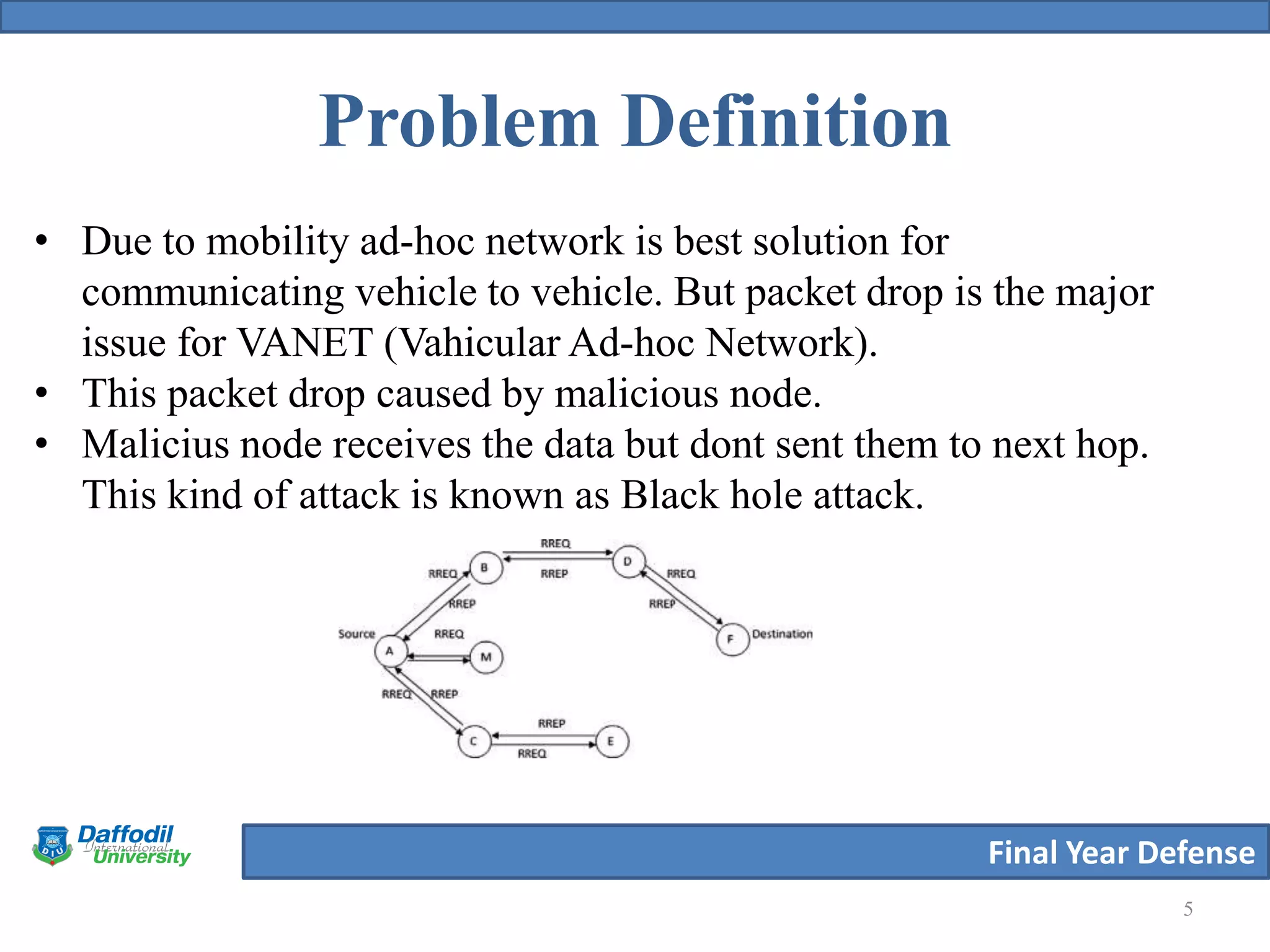
• Due to mobility ad-hoc network is best solution for
communicating vehicle to vehicle. But packet drop is the major
issue for VANET (Vahicular Ad-hoc Network).
• This packet drop caused by malicious node.
• Malicius node receives the data but dont sent them to next hop.
This kind of attack is known as Black hole attack.
Final Year Defense
Methodology
6
Fig: Flowchart of proposed algorithm.
Final Year Defense
Methodology
7
• We establish an algorithm to determine malicious node and minimize the black hole
attack.
Pseudo Reply Packet (PRREP) {
t0 = get (current time value)
t1 = t0 + STR_Dur
while (CURRENT_TIME <= t1) {
Store P.Dest_Seq_No and P.NODE_ID In
RREP_Tab table
}
while (RREP_Tab is not empty) {
if (Dest_Seq_No >>>= Src_Seq_No) {
Mali_Node=Node_Id
discard entry from M_ table
}
}
select Packet q for Node_Id having
highest value of Dest_Seq_No
ReceiveReply(Packet q)
}
Final Year Defense
Methodology
8
• OMNeT++ is used for the simulation work.
• Here we will simulate two real life scenario of
highway.
• Scenario 1: A free highway. So the vehicle density
will be low and speed will be high.
• scenario 2: A busy highway . So the vehicle density
high and speed will be low.
Final Year Defense
Simulation
9
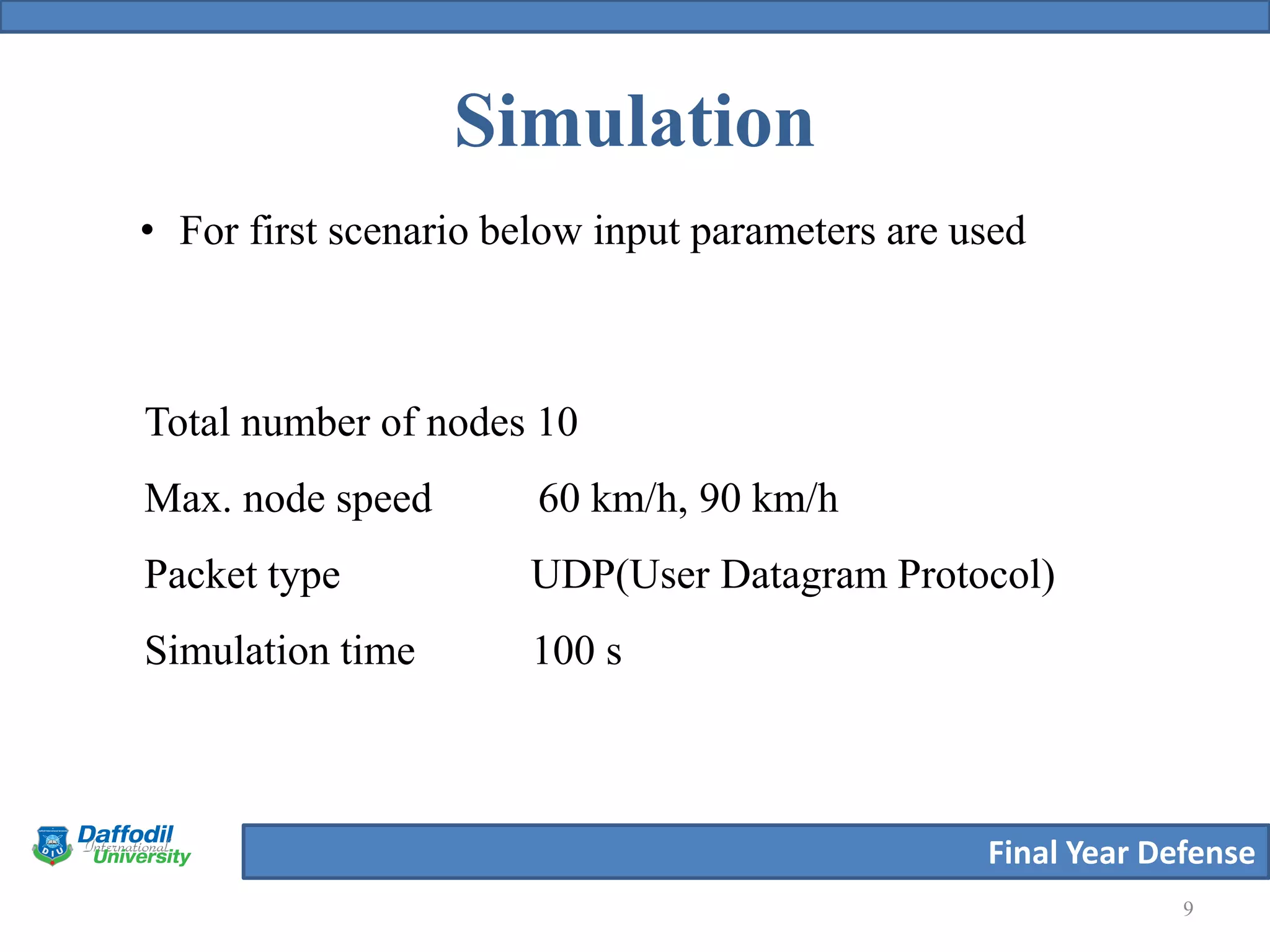
• For first scenario below input parameters are used
Total number of nodes 10
Max. node speed 60 km/h, 90 km/h
Packet type UDP(User Datagram Protocol)
Simulation time 100 s
Final Year Defense
Simulation
10
Final Year Defense
Simulation
11
Final Year Defense
Simulation
12
Final Year Defense
Simulation
13
Final Year Defense
Simulation
14
For first scenario below input parameters are used
Total number of nodes 20
No. of radio obstacles 4
Attenuation provided 20 dBm
Max. node speed 20 km/h, 40km/h
Packet type UDP (User Datagram Protocol)
Simulation time 100
Final Year Defense
Simulation
15
Final Year Defense
Simulation
16
Final Year Defense
Simulation
17
Final Year Defense
Simulation
18
Final Year Defense
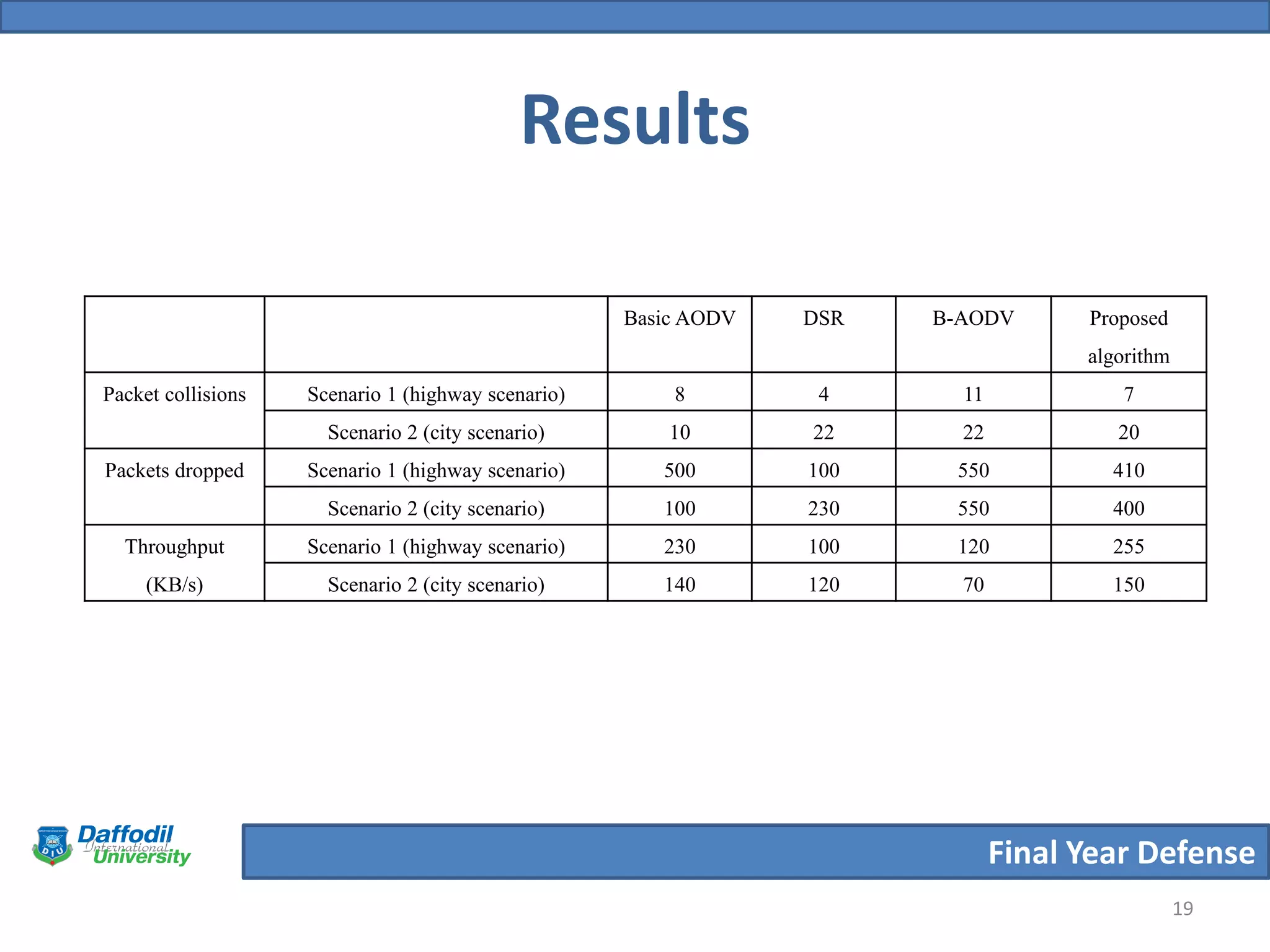
Results
19
Basic AODV DSR B-AODV Proposed
algorithm
Packet collisions Scenario 1 (highway scenario) 8 4 11 7
Scenario 2 (city scenario) 10 22 22 20
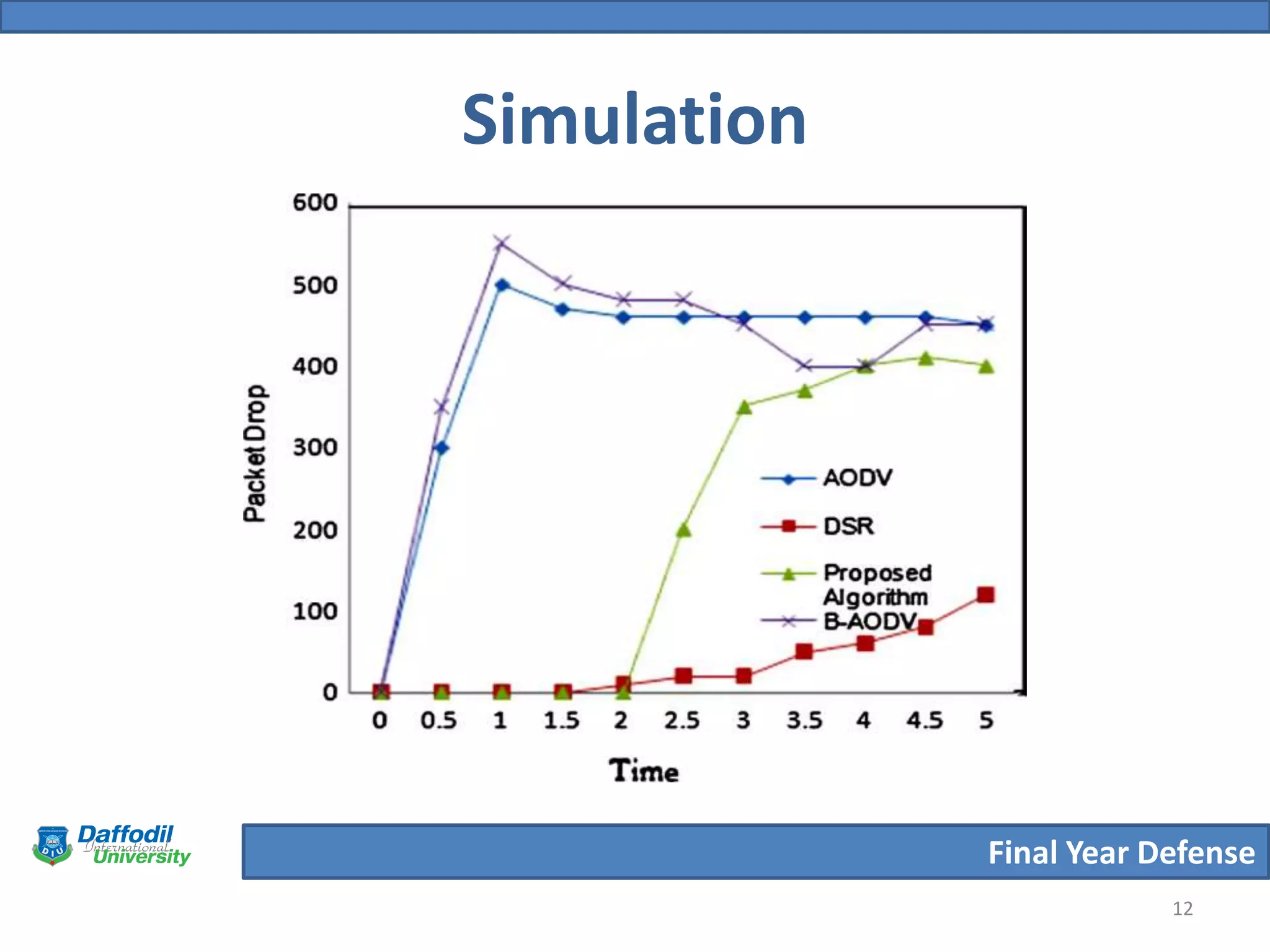
Packets dropped Scenario 1 (highway scenario) 500 100 550 410
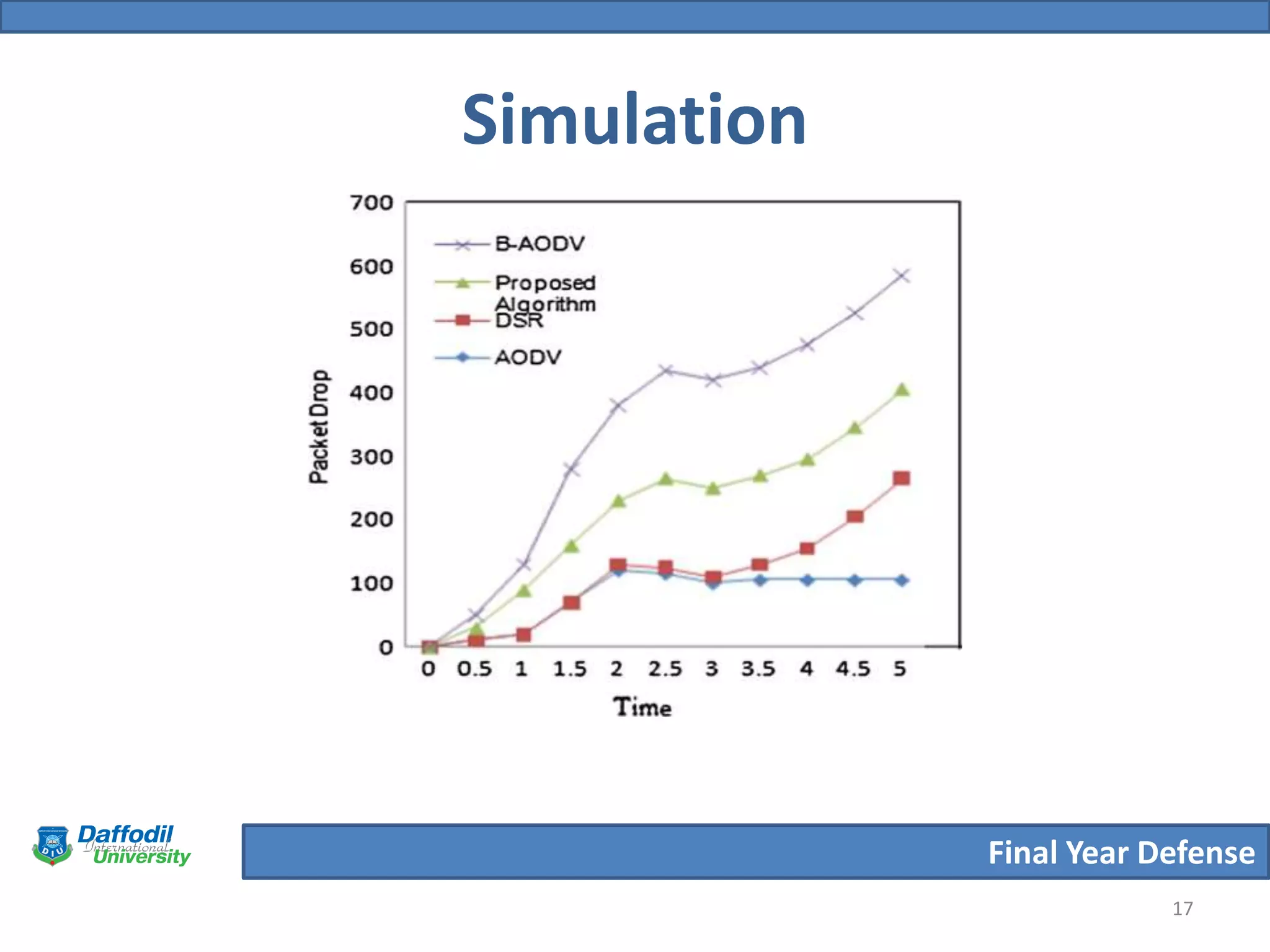
Scenario 2 (city scenario) 100 230 550 400
Throughput
(KB/s)
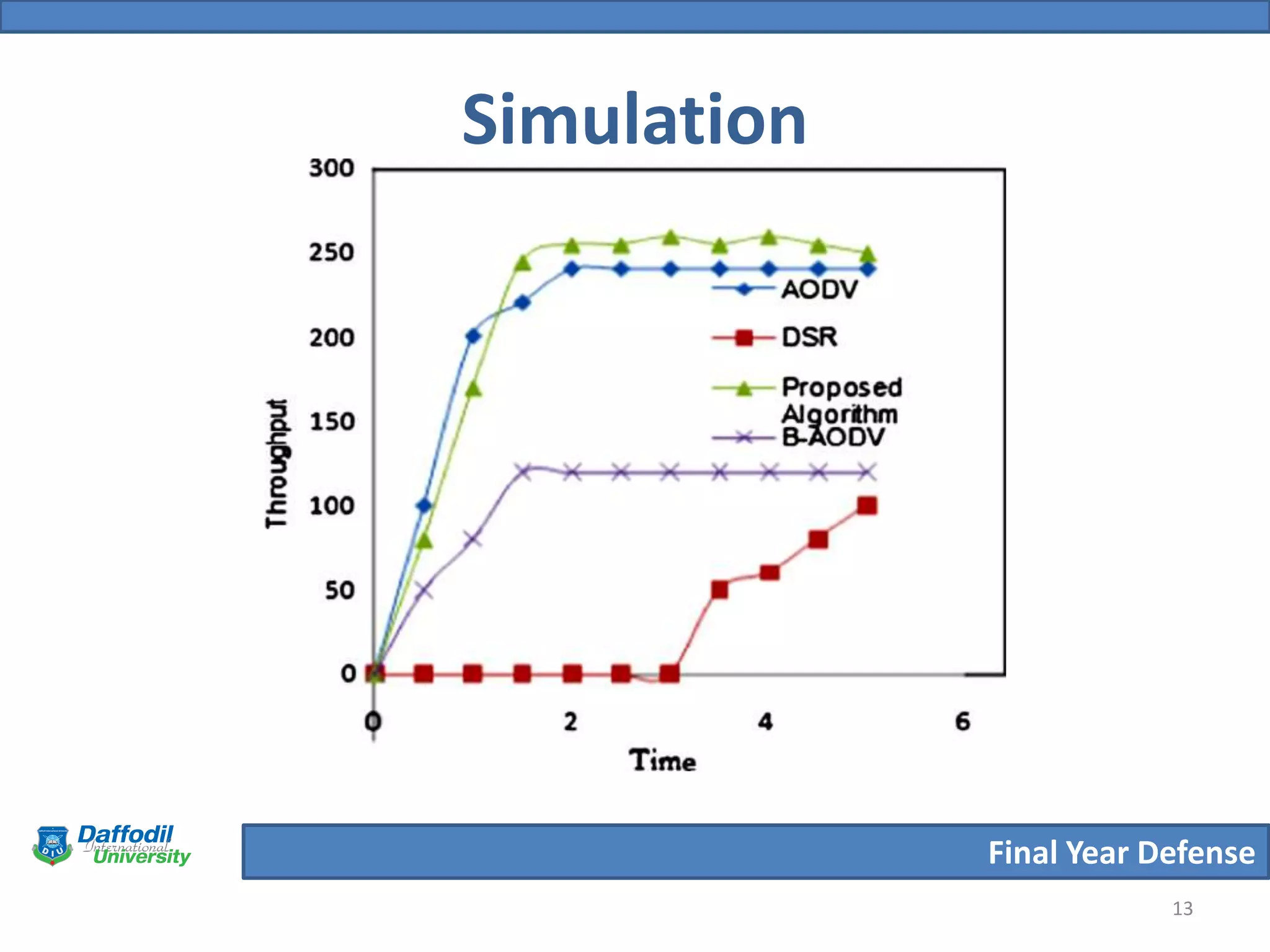
Scenario 1 (highway scenario) 230 100 120 255
Scenario 2 (city scenario) 140 120 70 150
Final Year Defense
Result analysis
20
0
5
10
15
20
25
Basic AODV DSR B-AODV Proposed algorithm
packet collisions for scenario 1 packet collisions for scenario 2
Packet collisions comparison scenario 1 vs scenario 2
Packetcollisions
Final Year Defense
21
0
100
200
300
400
500
600
Basic AODV DSR B-AODV Proposed
Algorithm
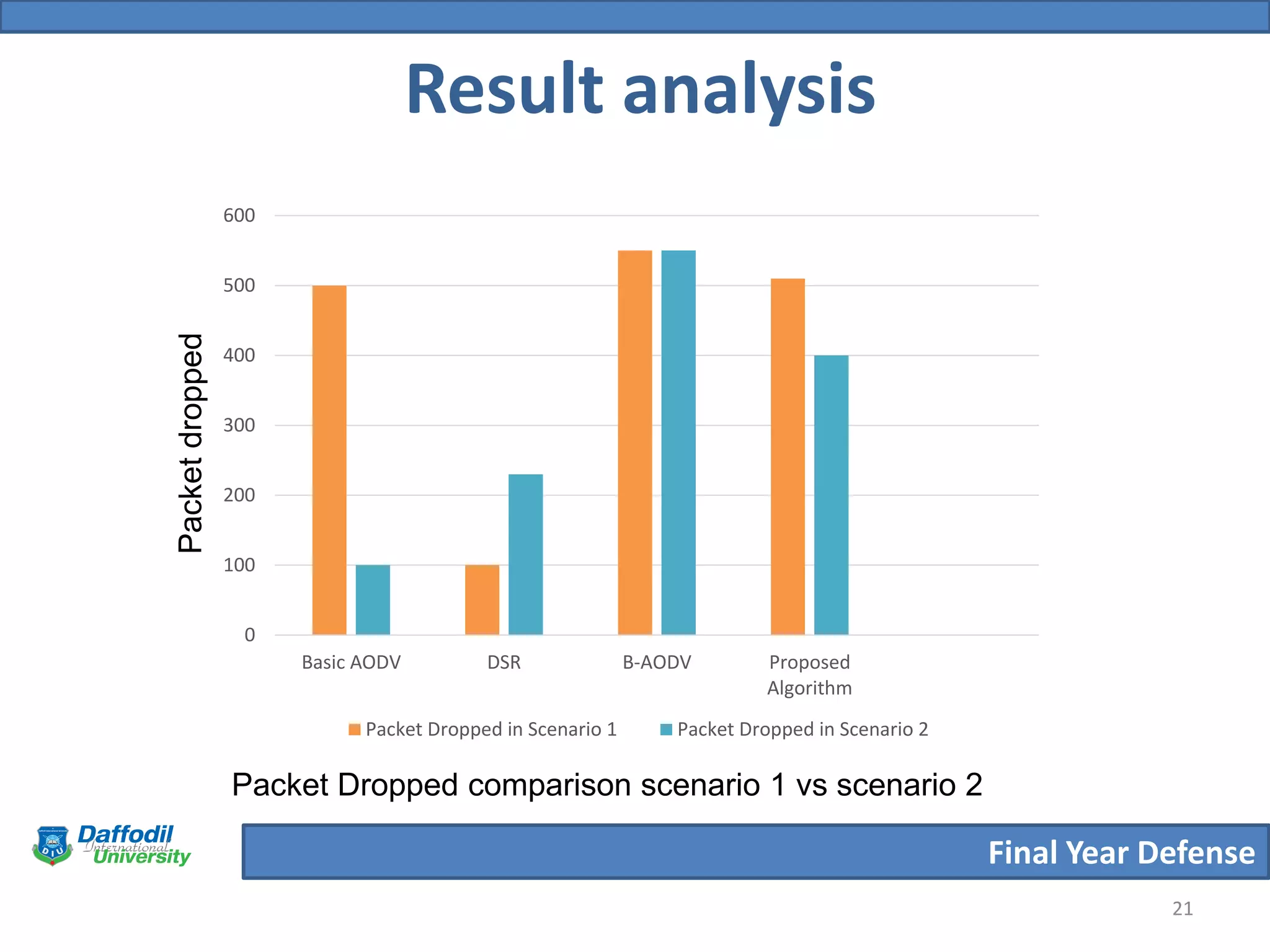
Packet Dropped in Scenario 1 Packet Dropped in Scenario 2
Result analysis
Packet Dropped comparison scenario 1 vs scenario 2
Packetdropped
Final Year Defense
22
Result analysis
0
50
100
150
200
250
300
Basic AODV DSR B-AODV Proposed Algorithm
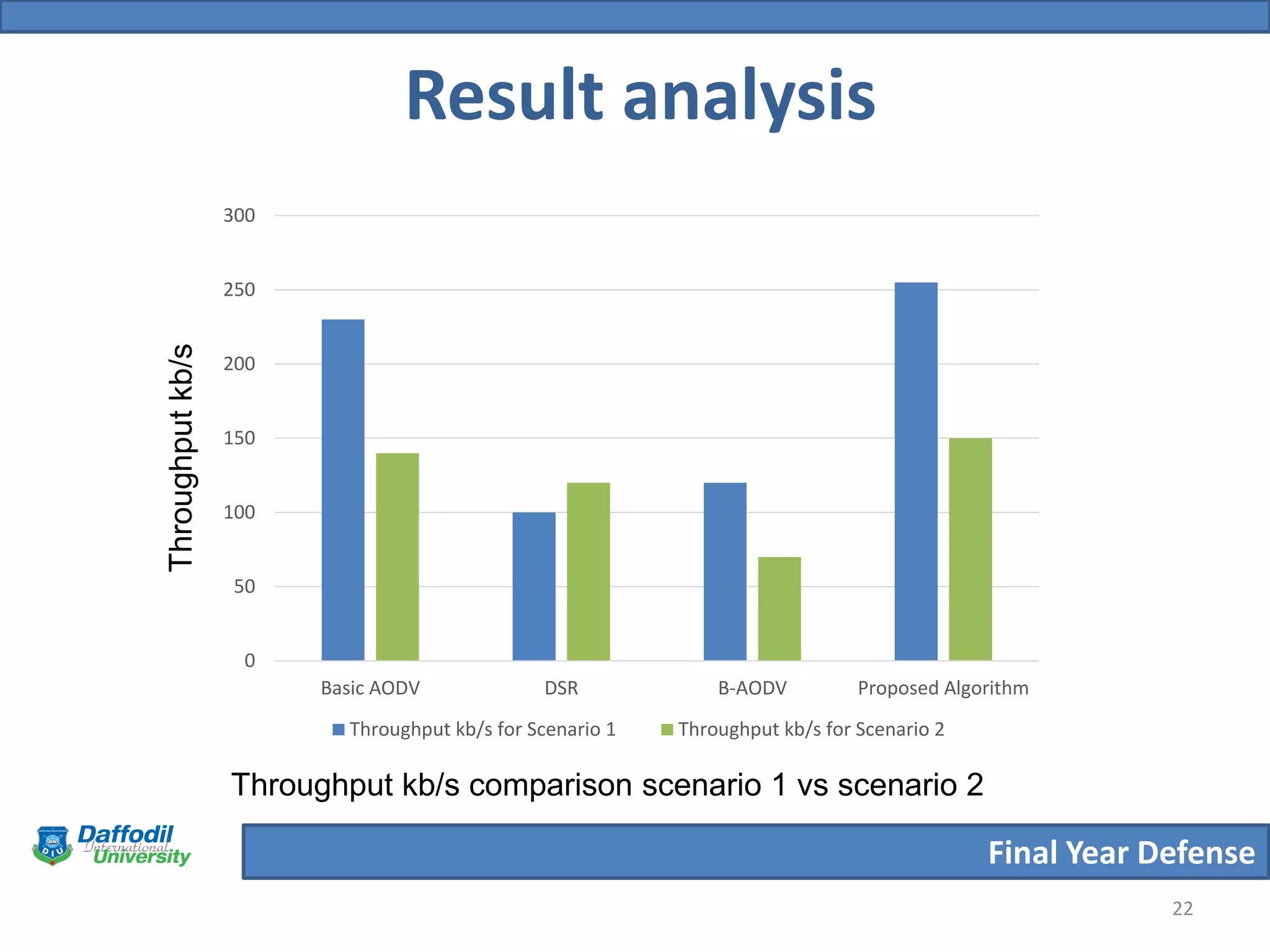
Throughput kb/s for Scenario 1 Throughput kb/s for Scenario 2
Throughput kb/s comparison scenario 1 vs scenario 2
Throughputkb/s
Final Year Defense
23
Conclusion
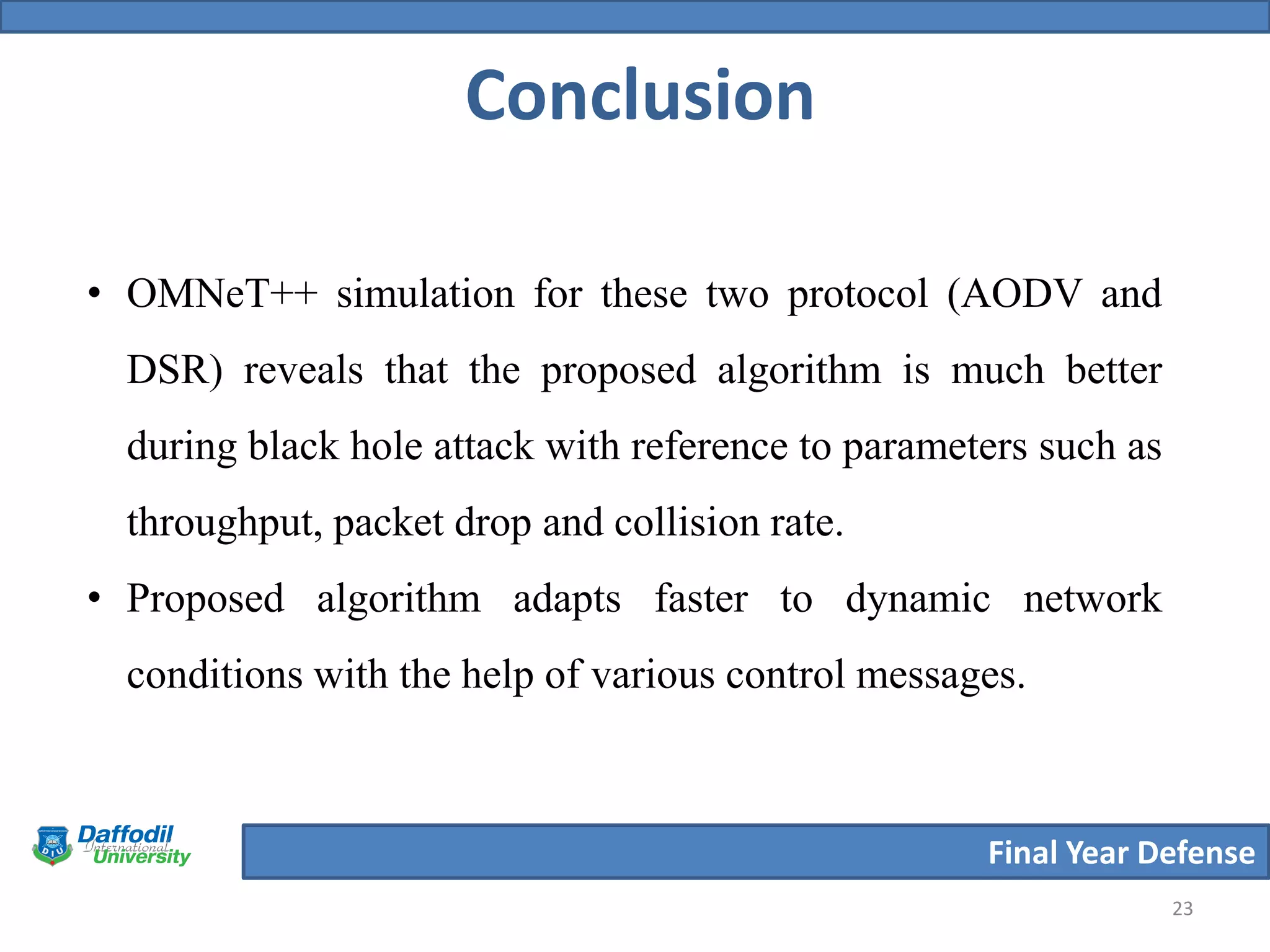
• OMNeT++ simulation for these two protocol (AODV and
DSR) reveals that the proposed algorithm is much better
during black hole attack with reference to parameters such as
throughput, packet drop and collision rate.
• Proposed algorithm adapts faster to dynamic network
conditions with the help of various control messages.
Final Year Defense
Future work
24
The future work would be to make the network completely immune to
Black Hole Attacks using AODV routing protocol.

PERFORMANCE VEHICULAR AD-HOC NETWORK (VANET)

  • 1.
    Final Year Defense Presentedby Supervised by PERFORMANCE ANALYSIS AND PREVENTATION OF SECURITY ATTACKS IN ROUTING PROTOCLOS OF VEHICULAR AD-HOC NETWORK (VANET) Md. Fahim Rahman Id: 133-19-1518 Al-Amin Prince Id: 141-19-1539 Md. Jakir Hossain Id: 141-19-1545 Md. Taslim Arefin Associate Professor Department Of ETE Daffodil International University 26th December 2017
  • 2.
    Final Year Defense PresentationOutline  Title Slide  Introduction  Aims and Objectives  Problem Definition  Methodology  Simulation  Result and Analysis  Conclusion and future work. 2
  • 3.
    Final Year Defense Introduction 3 WirelessAd-hoc: -frequency hopping network. - no pre-existing infrastructure -nodes are free to move. - application: MANET, VANET. VANET -3 types of communication. -uses: safety management, traffic controlling etc. -internet services.
  • 4.
    Final Year Defense Aimsand Objectives 4 • To establish an algorithm for stated problem of VANET. • To simulate two real life scenario based on the problem. • To apply the proposed algorithm along with another routing protocols(AODV,DSR,B-AODV) in both scenario. • To compare the resuts of both scenario. • To find the advantage of proposed algorithm.
  • 5.
    Final Year Defense ProblemDefinition 5 • Due to mobility ad-hoc network is best solution for communicating vehicle to vehicle. But packet drop is the major issue for VANET (Vahicular Ad-hoc Network). • This packet drop caused by malicious node. • Malicius node receives the data but dont sent them to next hop. This kind of attack is known as Black hole attack.
  • 6.
    Final Year Defense Methodology 6 Fig:Flowchart of proposed algorithm.
  • 7.
    Final Year Defense Methodology 7 •We establish an algorithm to determine malicious node and minimize the black hole attack. Pseudo Reply Packet (PRREP) { t0 = get (current time value) t1 = t0 + STR_Dur while (CURRENT_TIME <= t1) { Store P.Dest_Seq_No and P.NODE_ID In RREP_Tab table } while (RREP_Tab is not empty) { if (Dest_Seq_No >>>= Src_Seq_No) { Mali_Node=Node_Id discard entry from M_ table } } select Packet q for Node_Id having highest value of Dest_Seq_No ReceiveReply(Packet q) }
  • 8.
    Final Year Defense Methodology 8 •OMNeT++ is used for the simulation work. • Here we will simulate two real life scenario of highway. • Scenario 1: A free highway. So the vehicle density will be low and speed will be high. • scenario 2: A busy highway . So the vehicle density high and speed will be low.
  • 9.
    Final Year Defense Simulation 9 •For first scenario below input parameters are used Total number of nodes 10 Max. node speed 60 km/h, 90 km/h Packet type UDP(User Datagram Protocol) Simulation time 100 s
  • 10.
  • 11.
  • 12.
  • 13.
  • 14.
    Final Year Defense Simulation 14 Forfirst scenario below input parameters are used Total number of nodes 20 No. of radio obstacles 4 Attenuation provided 20 dBm Max. node speed 20 km/h, 40km/h Packet type UDP (User Datagram Protocol) Simulation time 100
  • 15.
  • 16.
  • 17.
  • 18.
  • 19.
    Final Year Defense Results 19 BasicAODV DSR B-AODV Proposed algorithm Packet collisions Scenario 1 (highway scenario) 8 4 11 7 Scenario 2 (city scenario) 10 22 22 20 Packets dropped Scenario 1 (highway scenario) 500 100 550 410 Scenario 2 (city scenario) 100 230 550 400 Throughput (KB/s) Scenario 1 (highway scenario) 230 100 120 255 Scenario 2 (city scenario) 140 120 70 150
  • 20.
    Final Year Defense Resultanalysis 20 0 5 10 15 20 25 Basic AODV DSR B-AODV Proposed algorithm packet collisions for scenario 1 packet collisions for scenario 2 Packet collisions comparison scenario 1 vs scenario 2 Packetcollisions
  • 21.
    Final Year Defense 21 0 100 200 300 400 500 600 BasicAODV DSR B-AODV Proposed Algorithm Packet Dropped in Scenario 1 Packet Dropped in Scenario 2 Result analysis Packet Dropped comparison scenario 1 vs scenario 2 Packetdropped
  • 22.
    Final Year Defense 22 Resultanalysis 0 50 100 150 200 250 300 Basic AODV DSR B-AODV Proposed Algorithm Throughput kb/s for Scenario 1 Throughput kb/s for Scenario 2 Throughput kb/s comparison scenario 1 vs scenario 2 Throughputkb/s
  • 23.
    Final Year Defense 23 Conclusion •OMNeT++ simulation for these two protocol (AODV and DSR) reveals that the proposed algorithm is much better during black hole attack with reference to parameters such as throughput, packet drop and collision rate. • Proposed algorithm adapts faster to dynamic network conditions with the help of various control messages.
  • 24.
    Final Year Defense Futurework 24 The future work would be to make the network completely immune to Black Hole Attacks using AODV routing protocol.