DELIVERING INNOVATIVE TRAINING SOLUTIONS®

Transforming your Training with Simulations

© 2010- 2014 CapitalWave, Inc. | All rights reserved.
Simulations & Technology

© 2010-2014 CapitalWave, Inc. | All rights reserved.

Page 1
Points of Discussion

1

Why use Simulations?

2
3
5
6

© 2010-2014 CapitalWave, Inc. | All rights reserved.

Simulation benefits

Simulations in Online Learning

Simulation Components

Evaluating Simulations

Page 2
Simulators

© 2010-2014 CapitalWave, Inc. | All rights reserved.

Page 3
Simulators

© 2010-2014 CapitalWave, Inc. | All rights reserved.

Page 4
Simulators

© 2010-2014 CapitalWave, Inc. | All rights reserved.

Page 5
Simulators

© 2010-2014 CapitalWave, Inc. | All rights reserved.

Page 6
Simulators

© 2010-2014 CapitalWave, Inc. | All rights reserved.

Page 7
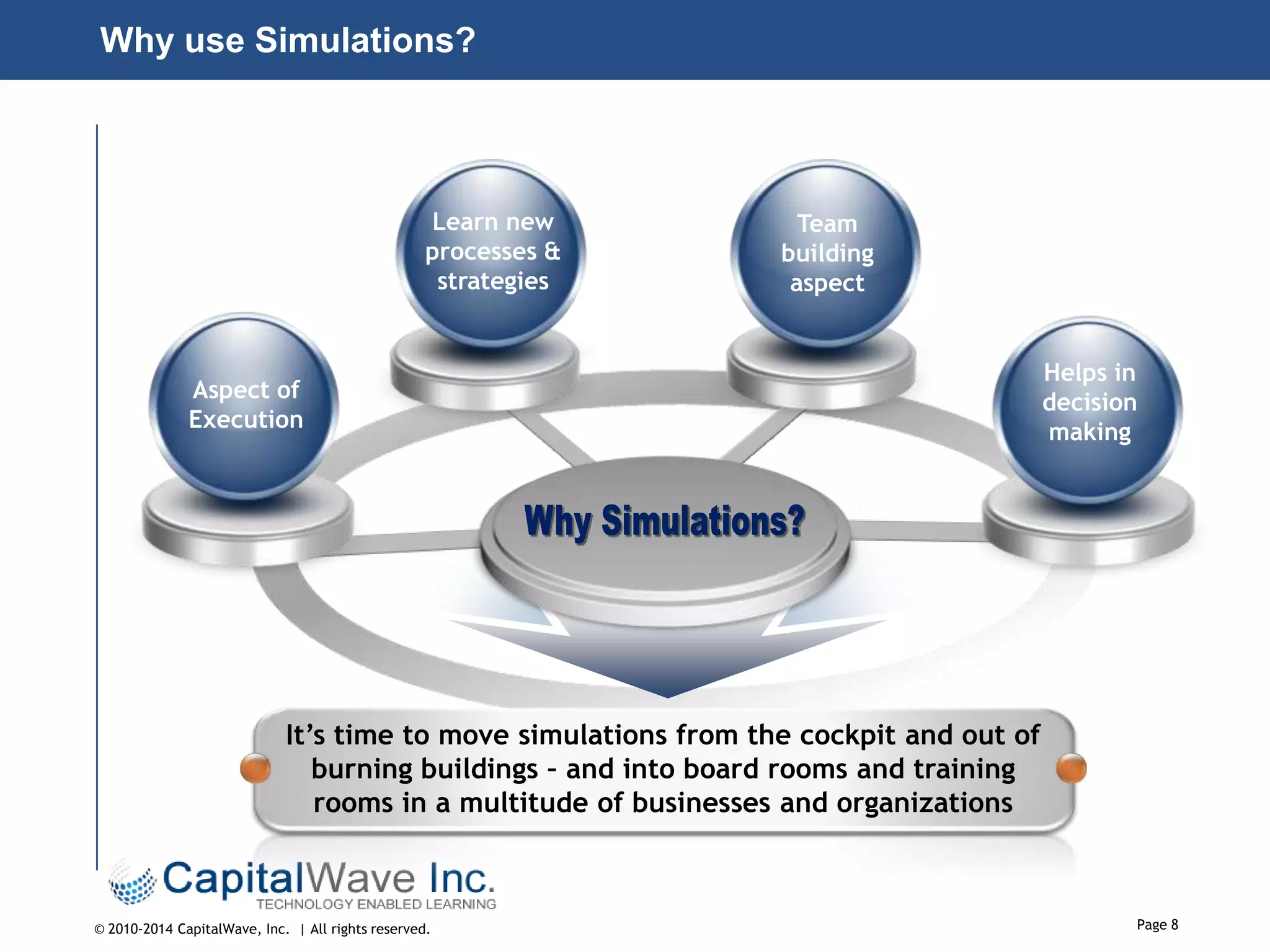
Why use Simulations?

Learn new
processes &
strategies

Team
building
aspect

Aspect of
Execution

Helps in
decision
making

It’s time to move simulations from the cockpit and out of
burning buildings – and into board rooms and training
rooms in a multitude of businesses and organizations

© 2010-2014 CapitalWave, Inc. | All rights reserved.

Page 8
Simulators

© 2010-2014 CapitalWave, Inc. | All rights reserved.

Page 9
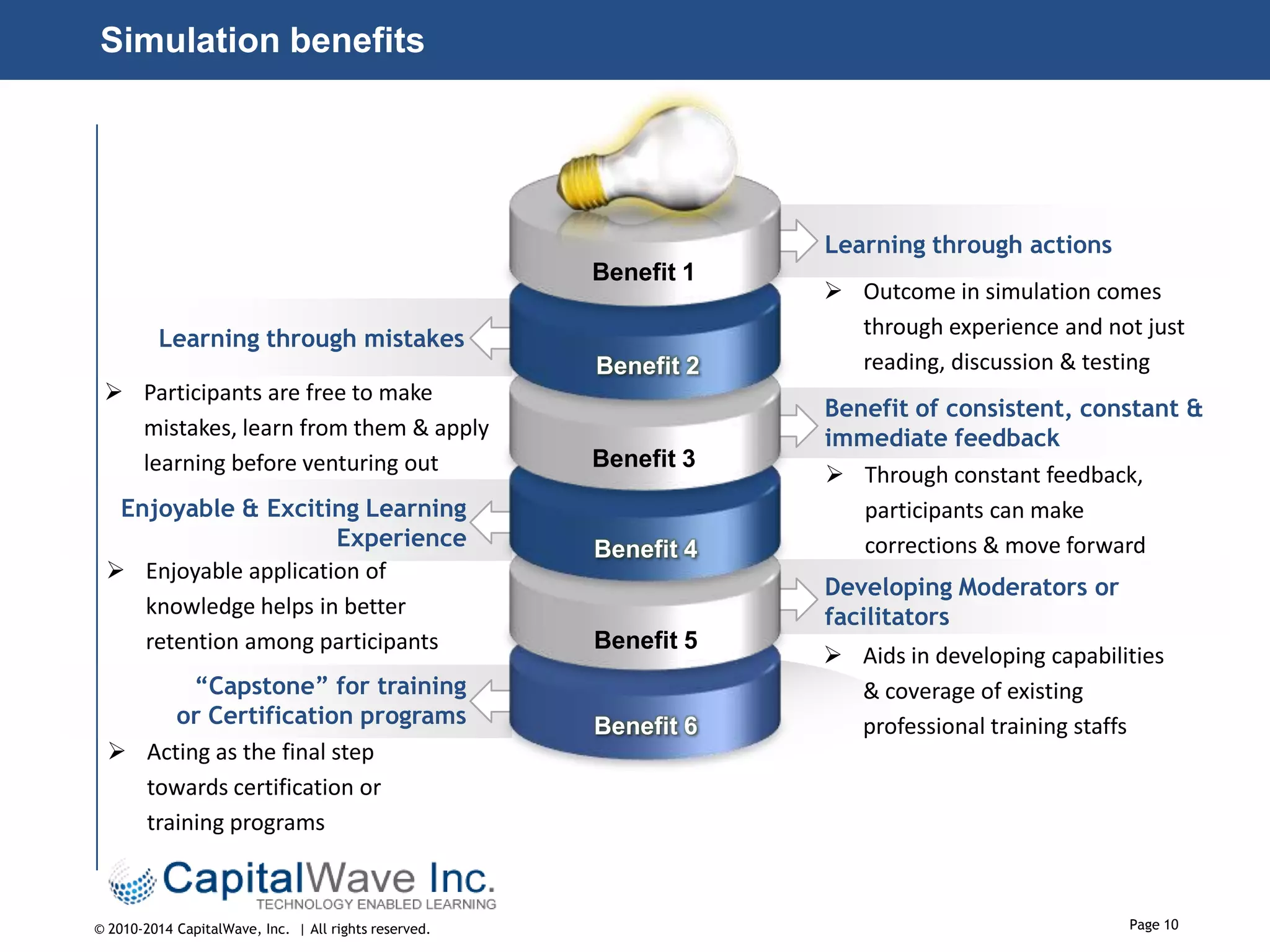
Simulation benefits

Learning through actions

Benefit 1
Learning through mistakes
 Participants are free to make
mistakes, learn from them & apply
learning before venturing out
Enjoyable & Exciting Learning
Experience
 Enjoyable application of
knowledge helps in better
retention among participants
“Capstone” for training
or Certification programs
 Acting as the final step
towards certification or
training programs

© 2010-2014 CapitalWave, Inc. | All rights reserved.

Benefit 2

Benefit 3

Benefit 4

 Outcome in simulation comes
through experience and not just
reading, discussion & testing

Benefit of consistent, constant &
immediate feedback
 Through constant feedback,
participants can make
corrections & move forward
Developing Moderators or
facilitators

Benefit 5

Benefit 6

 Aids in developing capabilities
& coverage of existing
professional training staffs

Page 10
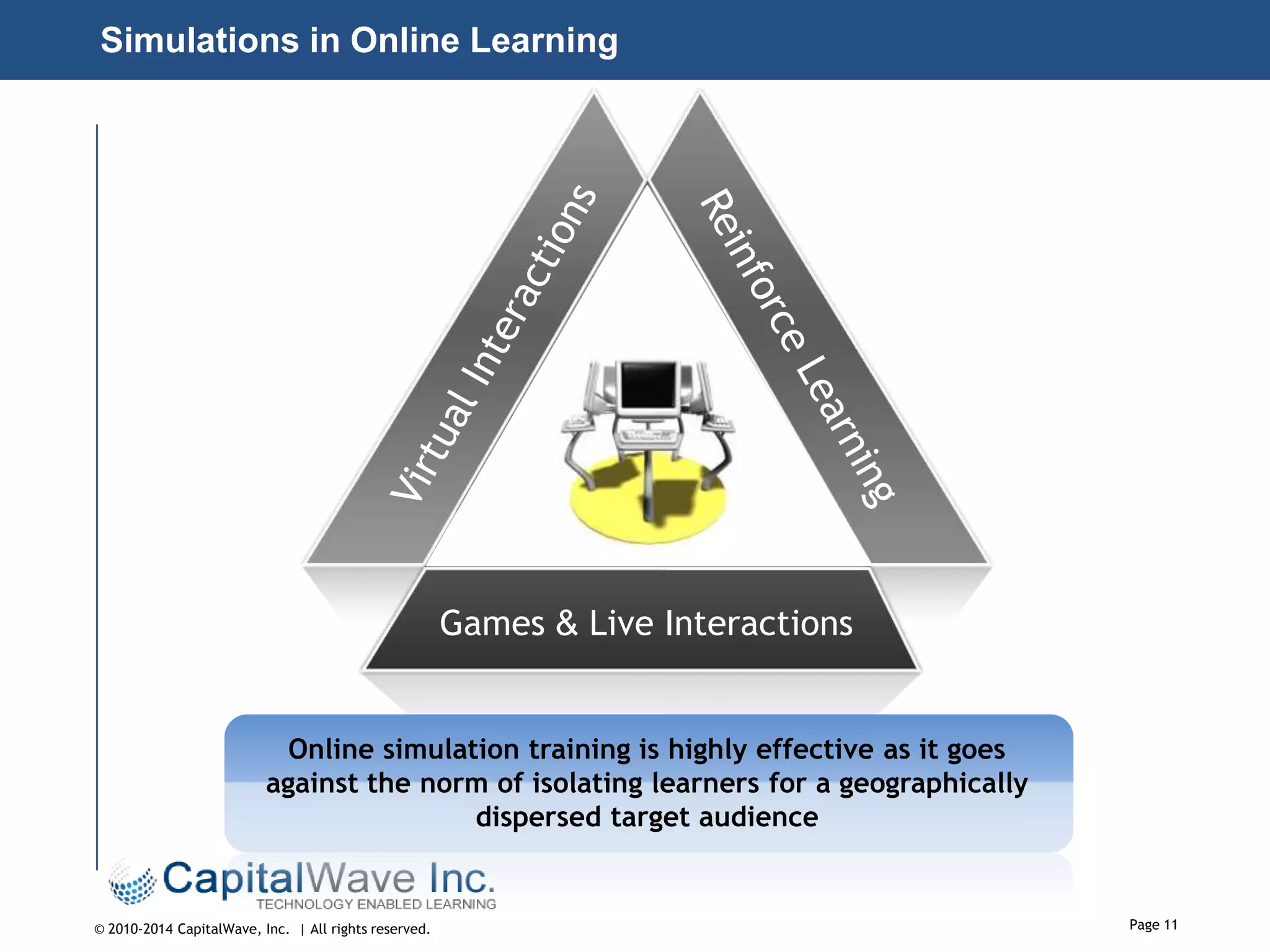
Simulations in Online Learning

Games & Live Interactions

Online simulation training is highly effective as it goes
against the norm of isolating learners for a geographically
dispersed target audience

© 2010-2014 CapitalWave, Inc. | All rights reserved.

Page 11
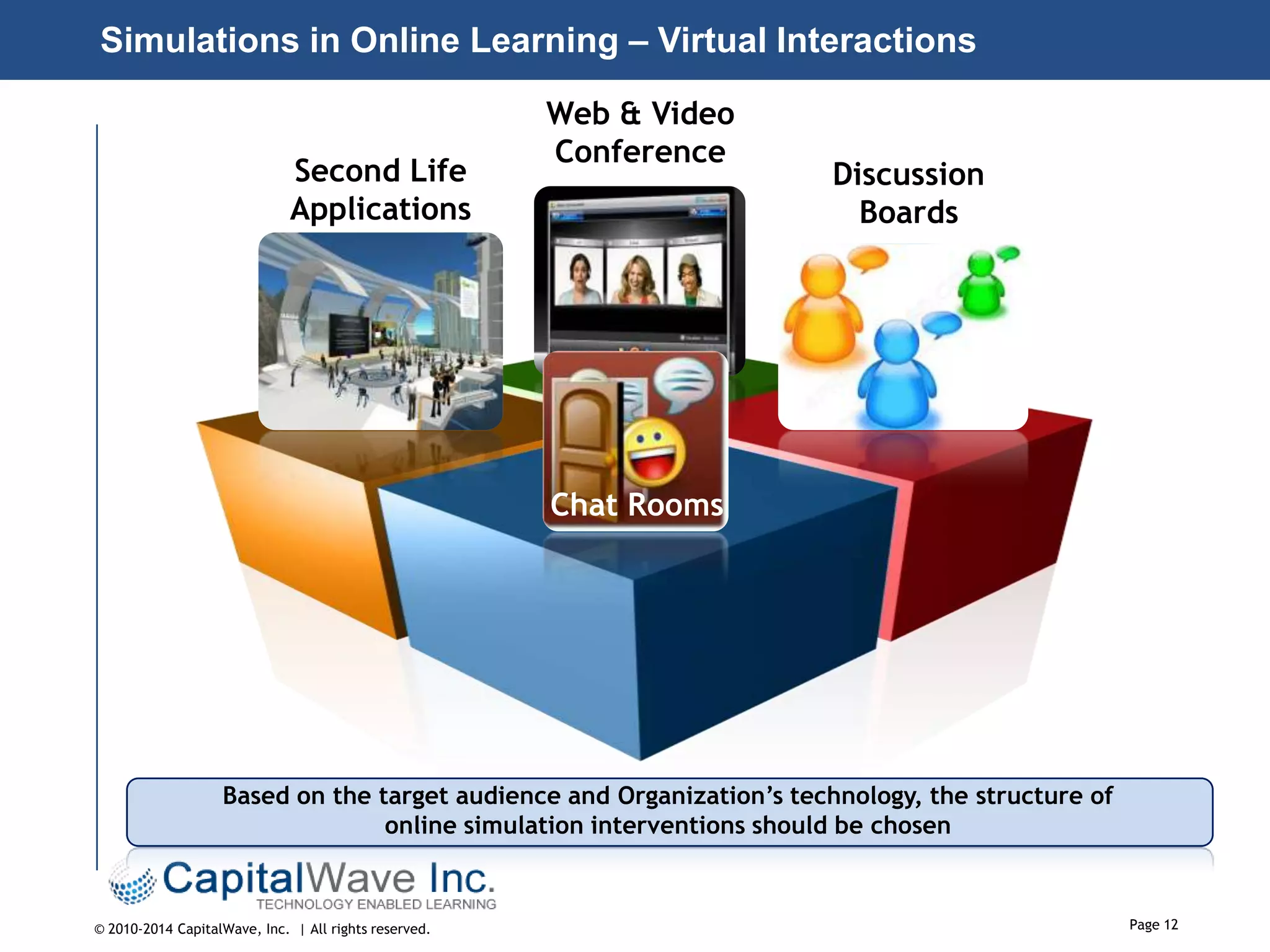
Simulations in Online Learning – Virtual Interactions

Second Life
Applications

Web & Video
Conference

Discussion
Boards

Chat Rooms

Based on the target audience and Organization’s technology, the structure of
online simulation interventions should be chosen

© 2010-2014 CapitalWave, Inc. | All rights reserved.

Page 12
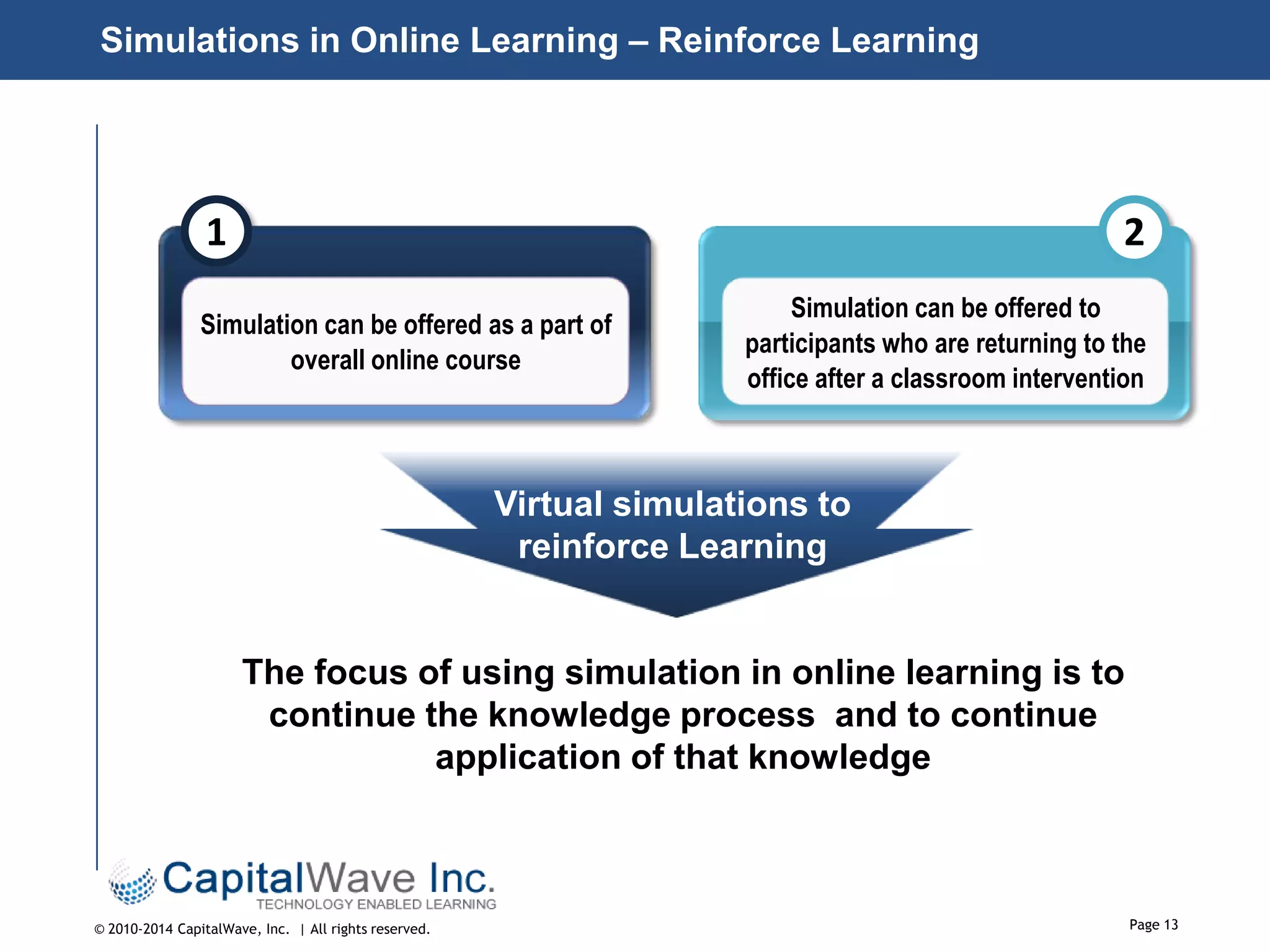
Simulations in Online Learning – Reinforce Learning

1

2

Simulation can be offered as a part of
overall online course

Simulation can be offered to
participants who are returning to the
office after a classroom intervention

Virtual simulations to
reinforce Learning

The focus of using simulation in online learning is to
continue the knowledge process and to continue
application of that knowledge

© 2010-2014 CapitalWave, Inc. | All rights reserved.

Page 13
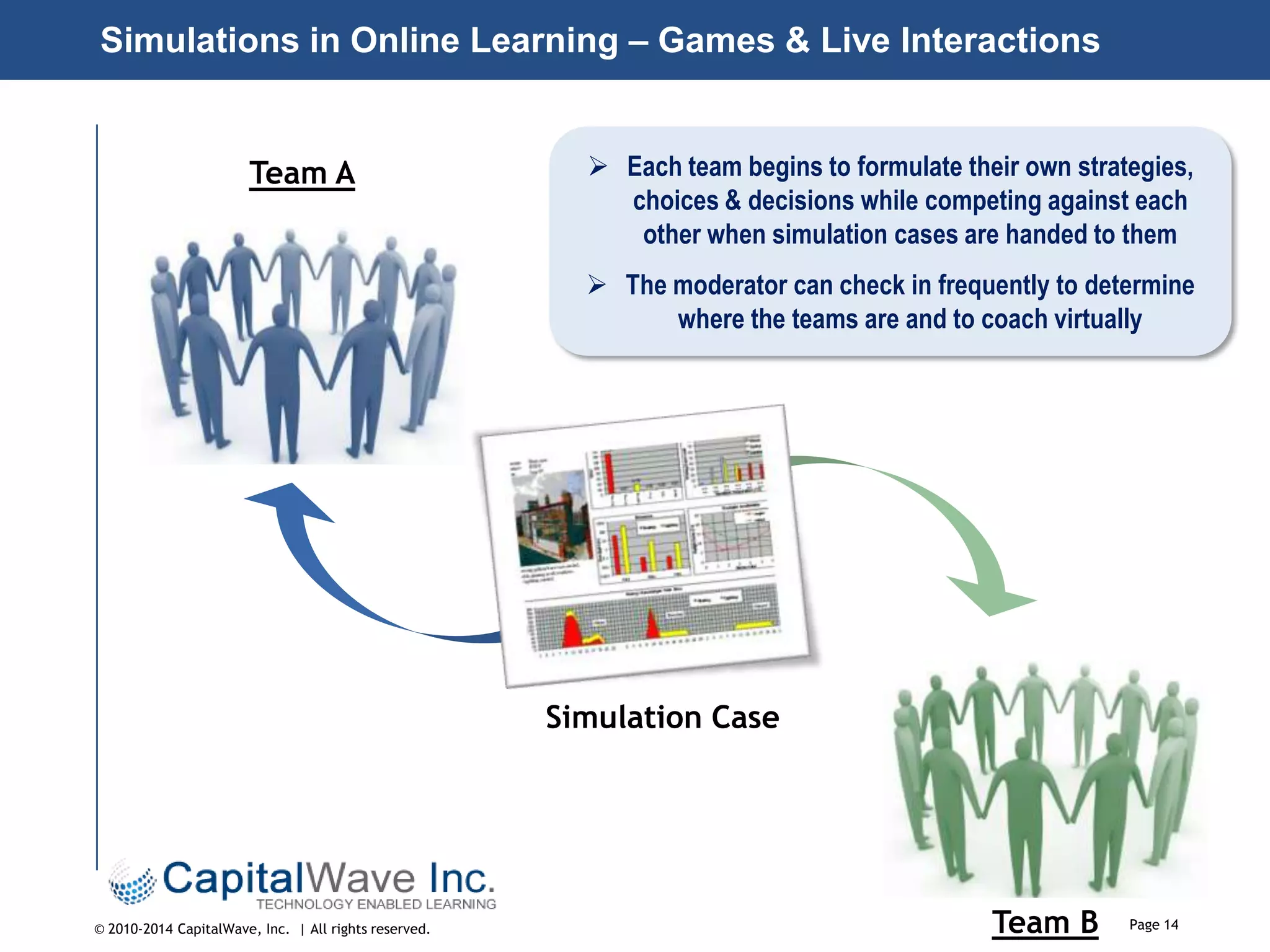
Simulations in Online Learning – Games & Live Interactions

Team A

 Each team begins to formulate their own strategies,
choices & decisions while competing against each
other when simulation cases are handed to them
 The moderator can check in frequently to determine
where the teams are and to coach virtually

Simulation Case

© 2010-2014 CapitalWave, Inc. | All rights reserved.

Team B

Page 14
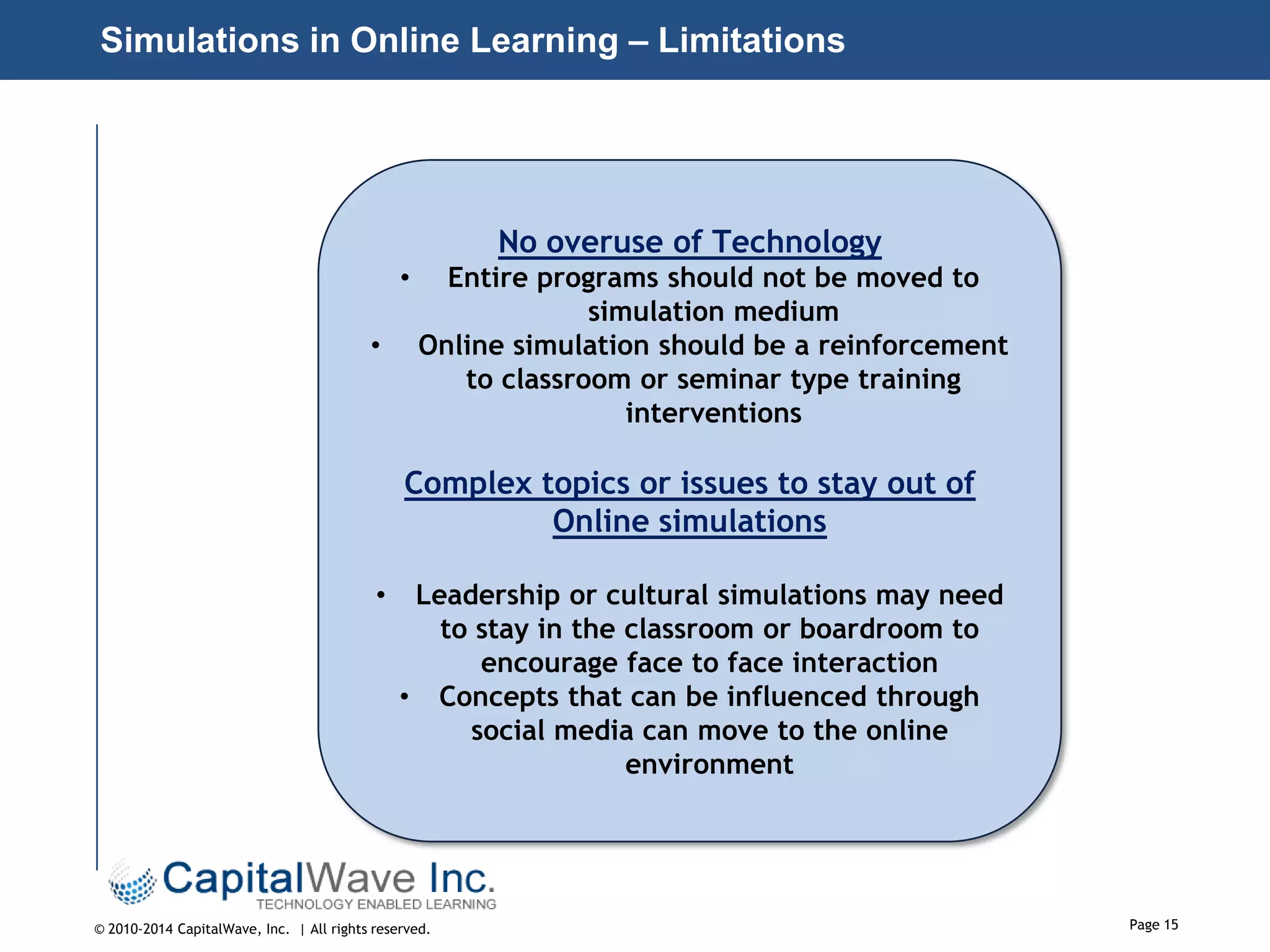
Simulations in Online Learning – Limitations

No overuse of Technology
•
•

Entire programs should not be moved to
simulation medium
Online simulation should be a reinforcement
to classroom or seminar type training
interventions

Complex topics or issues to stay out of
Online simulations
•

Leadership or cultural simulations may need
to stay in the classroom or boardroom to
encourage face to face interaction
• Concepts that can be influenced through
social media can move to the online
environment

© 2010-2014 CapitalWave, Inc. | All rights reserved.

Page 15
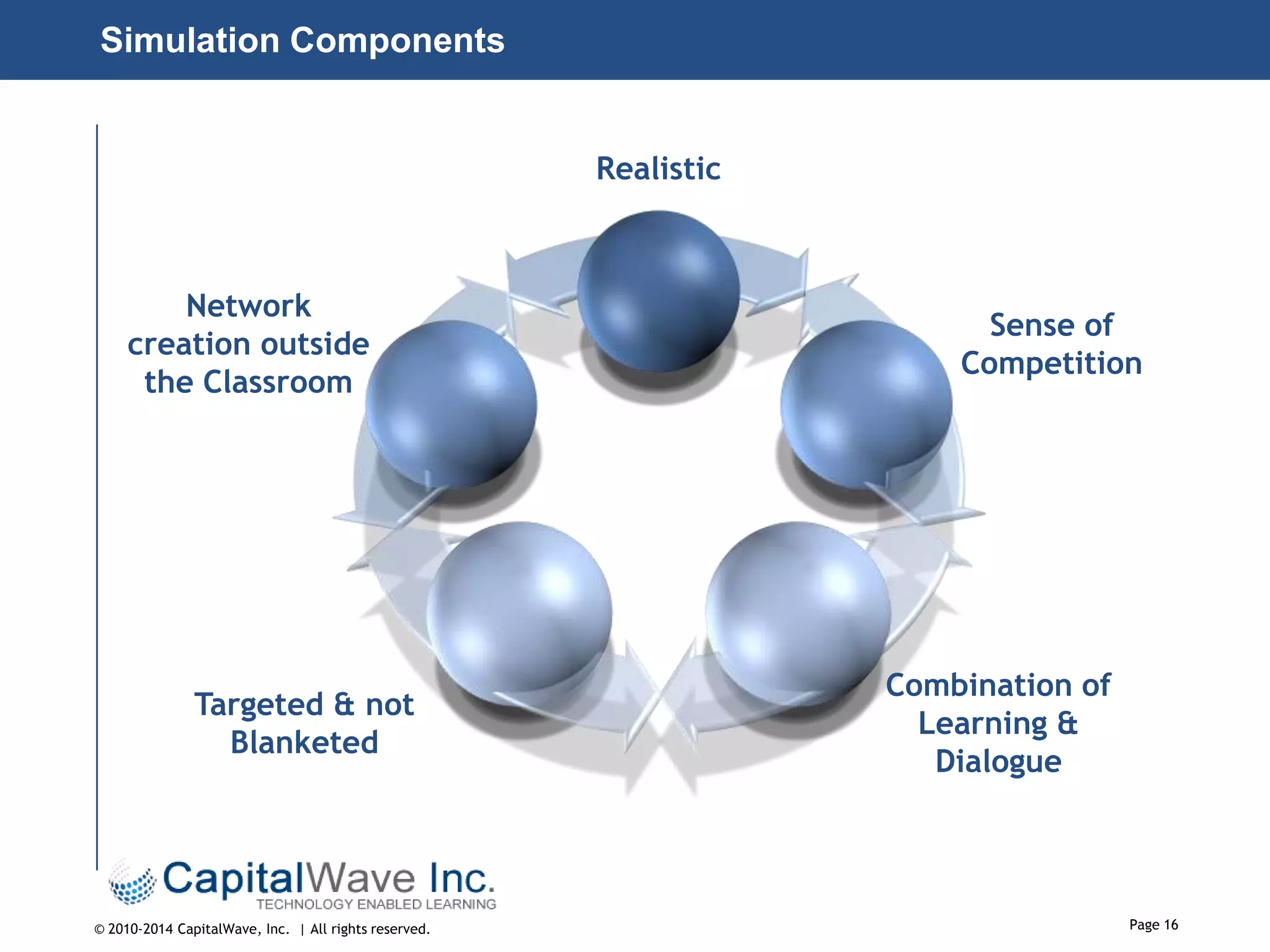
Simulation Components

Realistic

Network
creation outside
the Classroom

Targeted & not
Blanketed

© 2010-2014 CapitalWave, Inc. | All rights reserved.

Sense of
Competition

Combination of
Learning &
Dialogue

Page 16
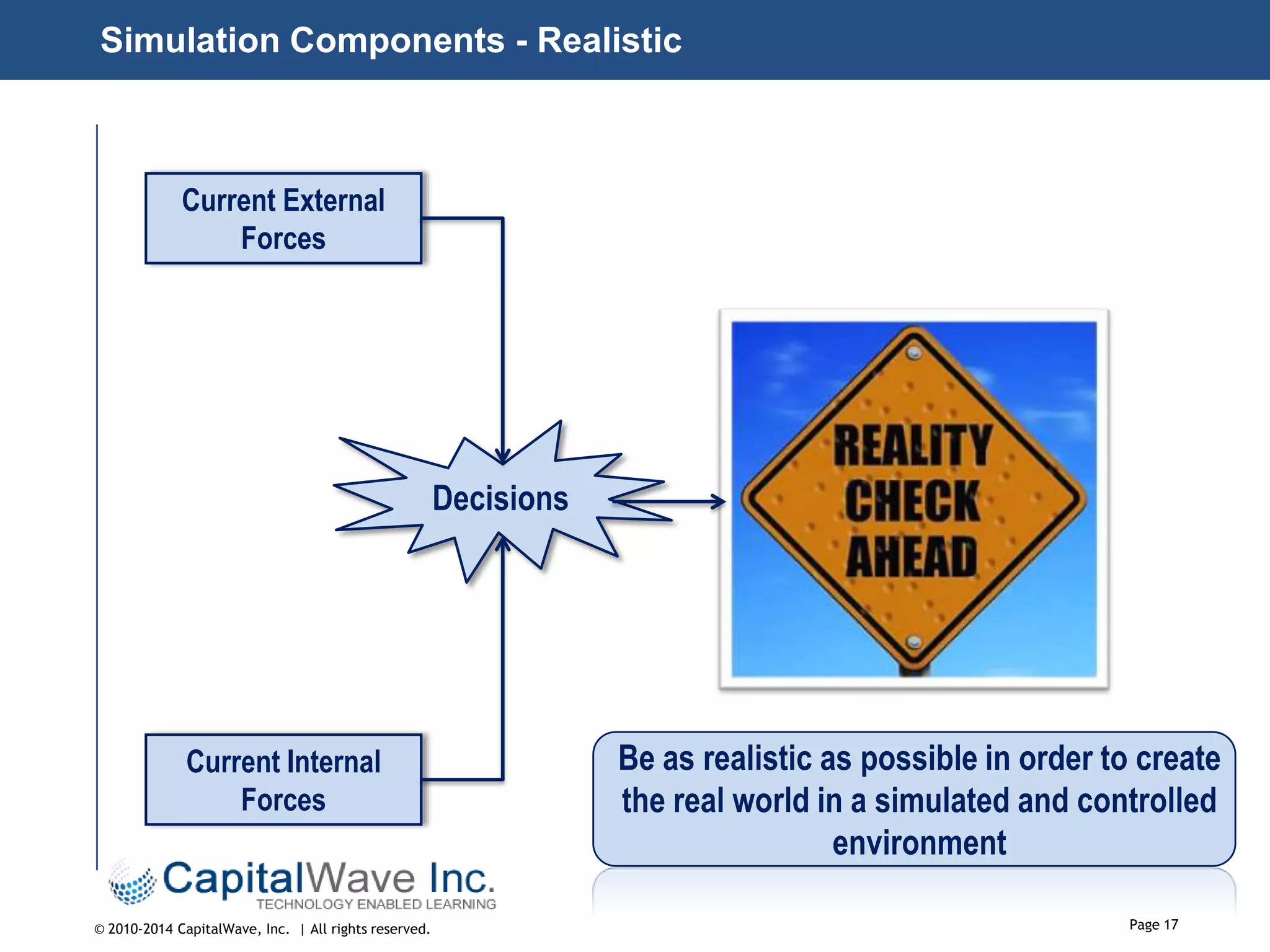
Simulation Components - Realistic

Current External
Forces

Decisions

Current Internal
Forces

© 2010-2014 CapitalWave, Inc. | All rights reserved.

Be as realistic as possible in order to create
the real world in a simulated and controlled
environment
Page 17
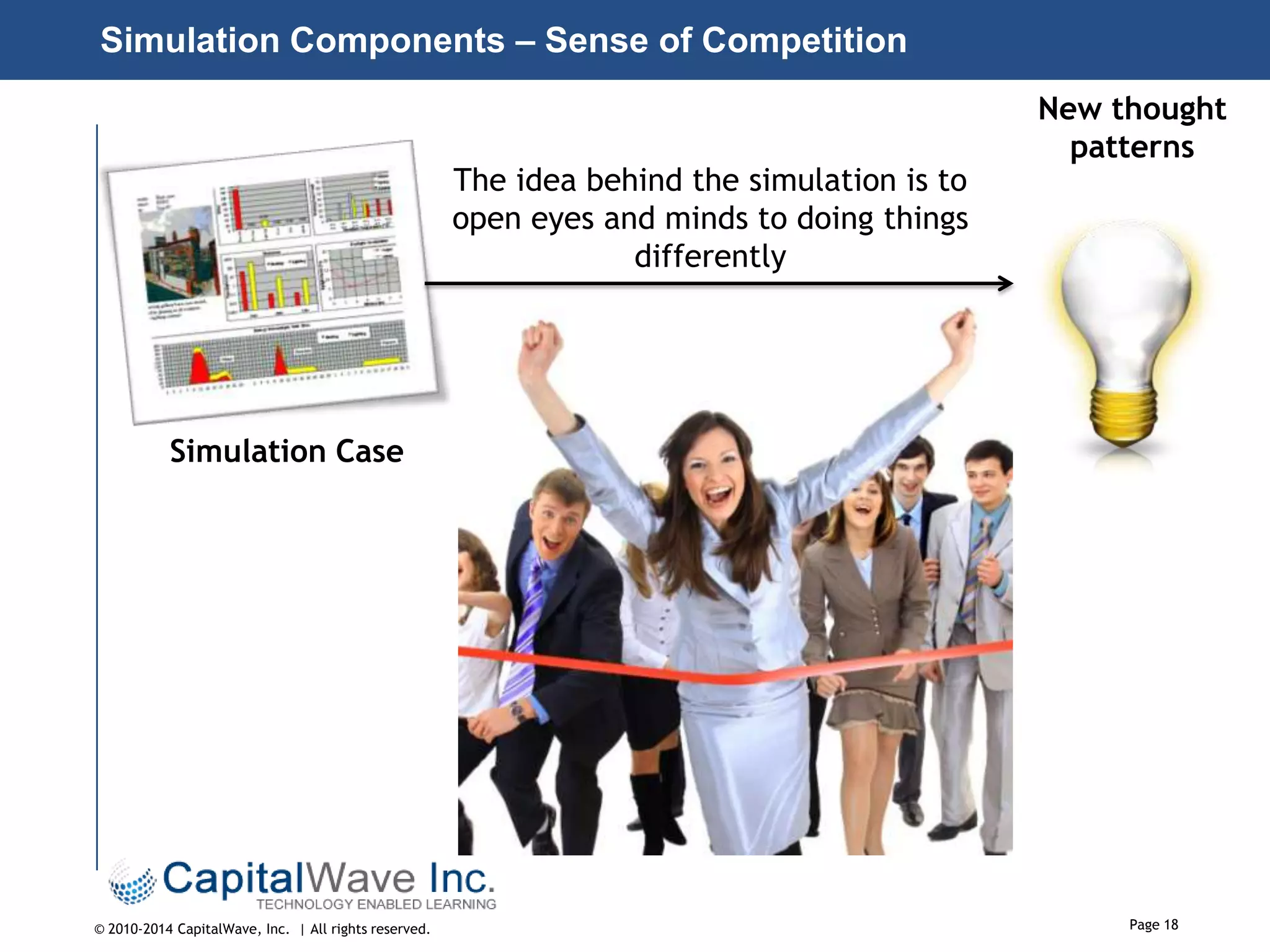
Simulation Components – Sense of Competition

The idea behind the simulation is to
open eyes and minds to doing things
differently

New thought
patterns

Simulation Case

© 2010-2014 CapitalWave, Inc. | All rights reserved.

Page 18
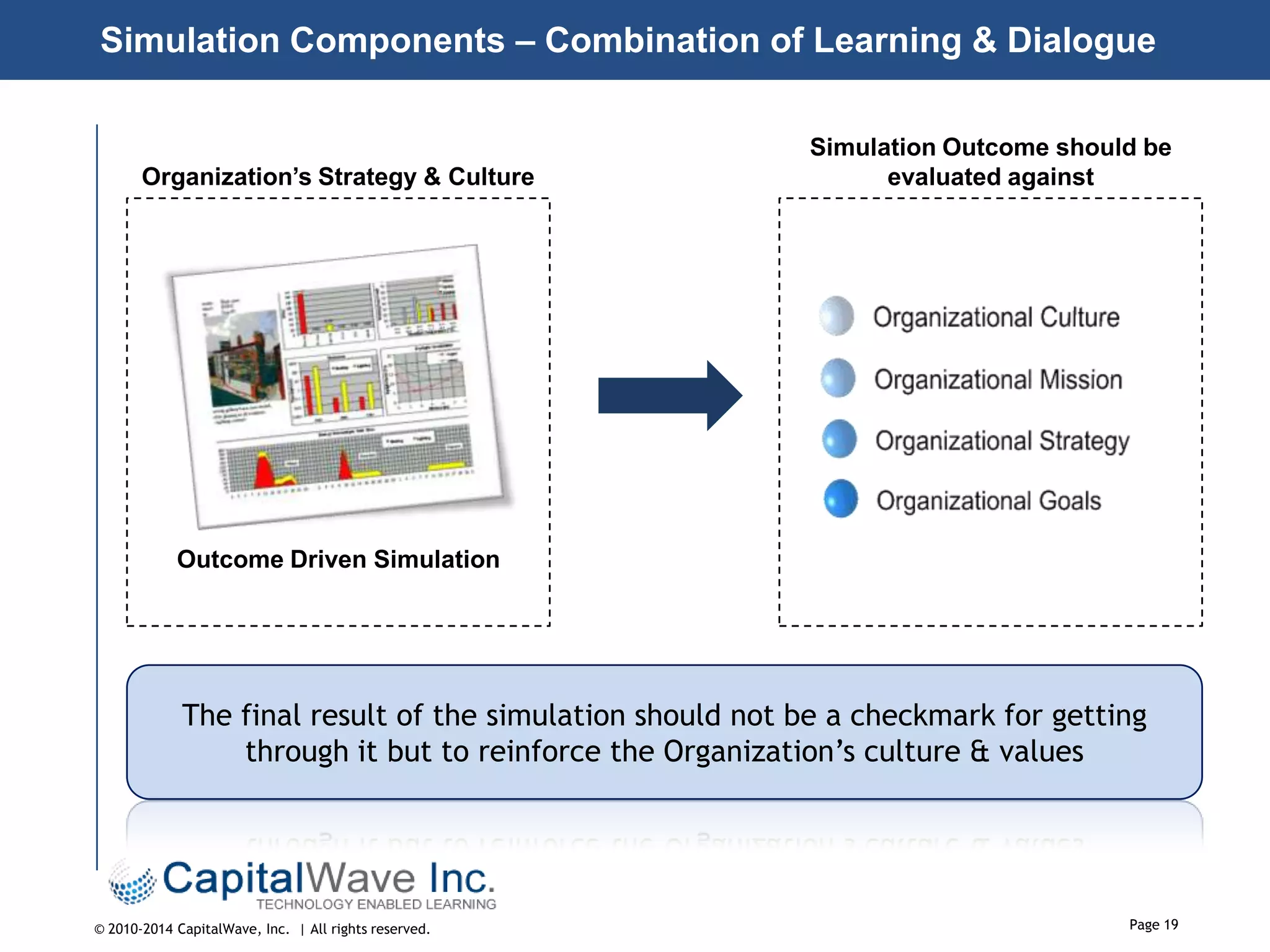
Simulation Components – Combination of Learning & Dialogue

Organization’s Strategy & Culture

Simulation Outcome should be
evaluated against

Outcome Driven Simulation

The final result of the simulation should not be a checkmark for getting
through it but to reinforce the Organization’s culture & values

© 2010-2014 CapitalWave, Inc. | All rights reserved.

Page 19
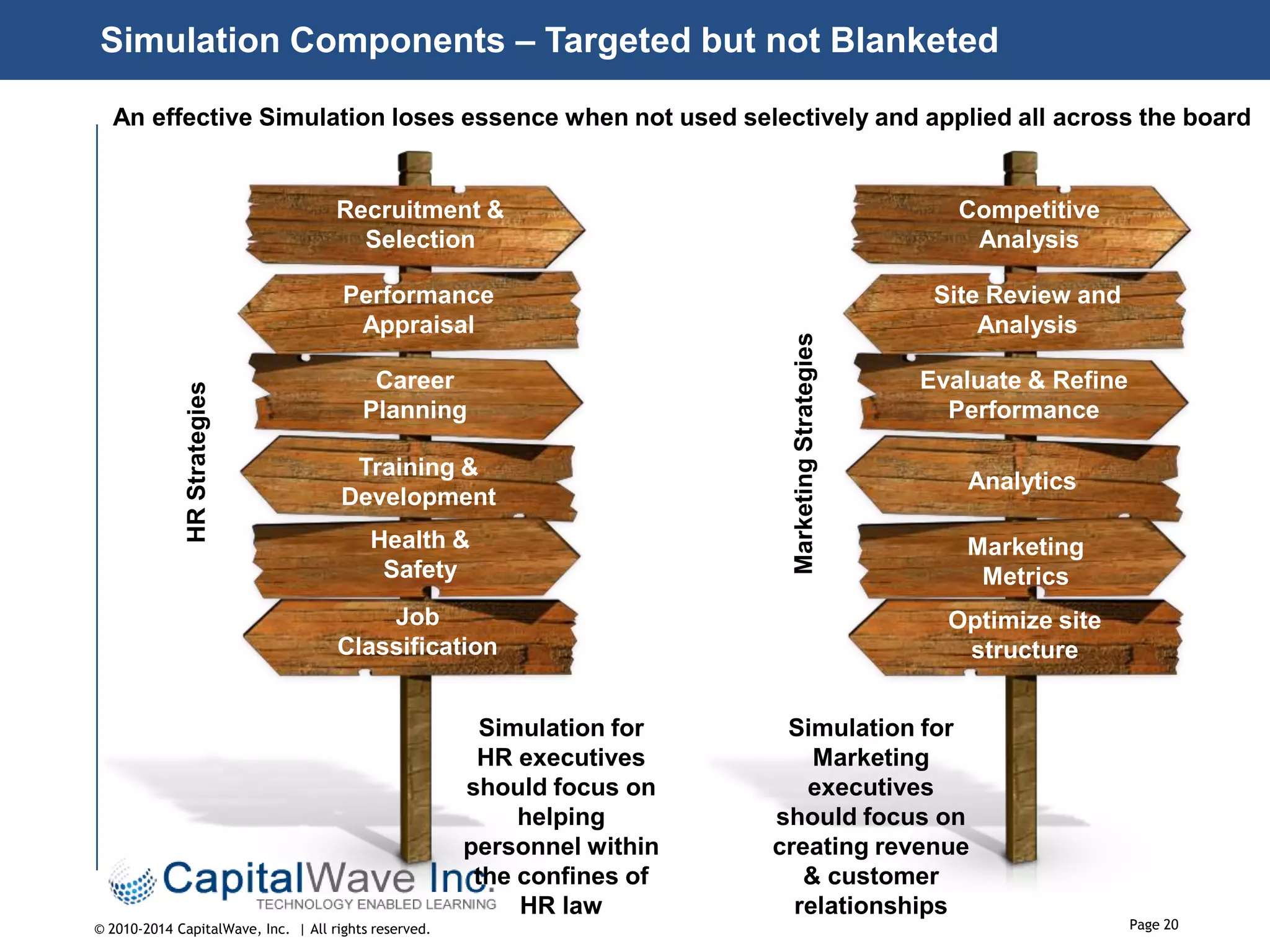
Simulation Components – Targeted but not Blanketed
An effective Simulation loses essence when not used selectively and applied all across the board

Site Review and
Analysis

Career
Planning
Training &
Development
Health &
Safety
Job
Classification
Simulation for
HR executives
should focus on
helping
personnel within
the confines of
HR law

© 2010-2014 CapitalWave, Inc. | All rights reserved.

Marketing Strategies

Competitive
Analysis

Performance
Appraisal
HR Strategies

Recruitment &
Selection

Evaluate & Refine
Performance
Analytics
Marketing
Metrics
Optimize site
structure

Simulation for
Marketing
executives
should focus on
creating revenue
& customer
relationships

Page 20
Simulators

© 2010-2014 CapitalWave, Inc. | All rights reserved.

Page 21
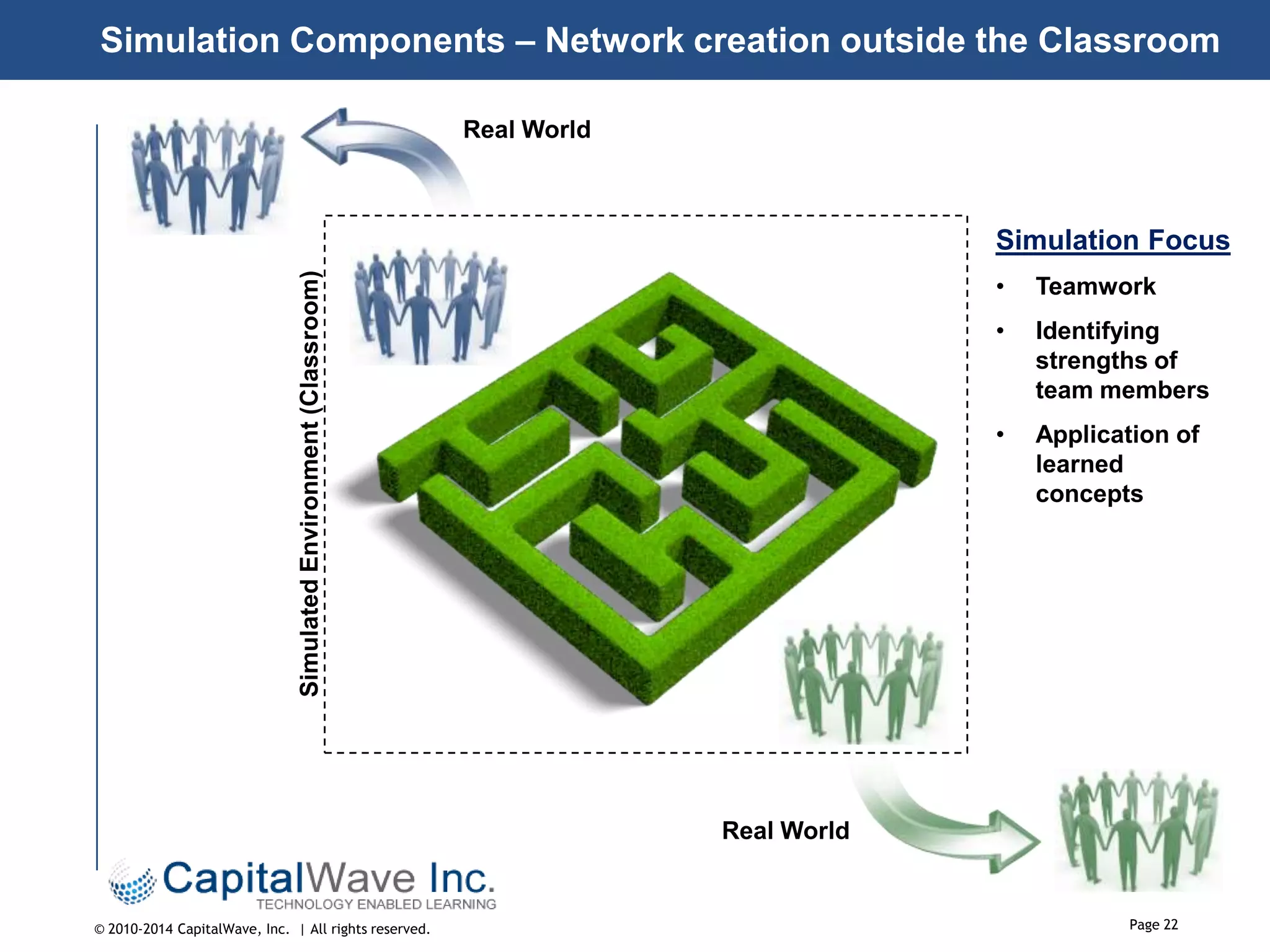
Simulation Components – Network creation outside the Classroom
Real World

Simulated Environment (Classroom)

Simulation Focus
•

Teamwork

•

Identifying
strengths of
team members

•

Application of
learned
concepts

Real World

© 2010-2014 CapitalWave, Inc. | All rights reserved.

Page 22
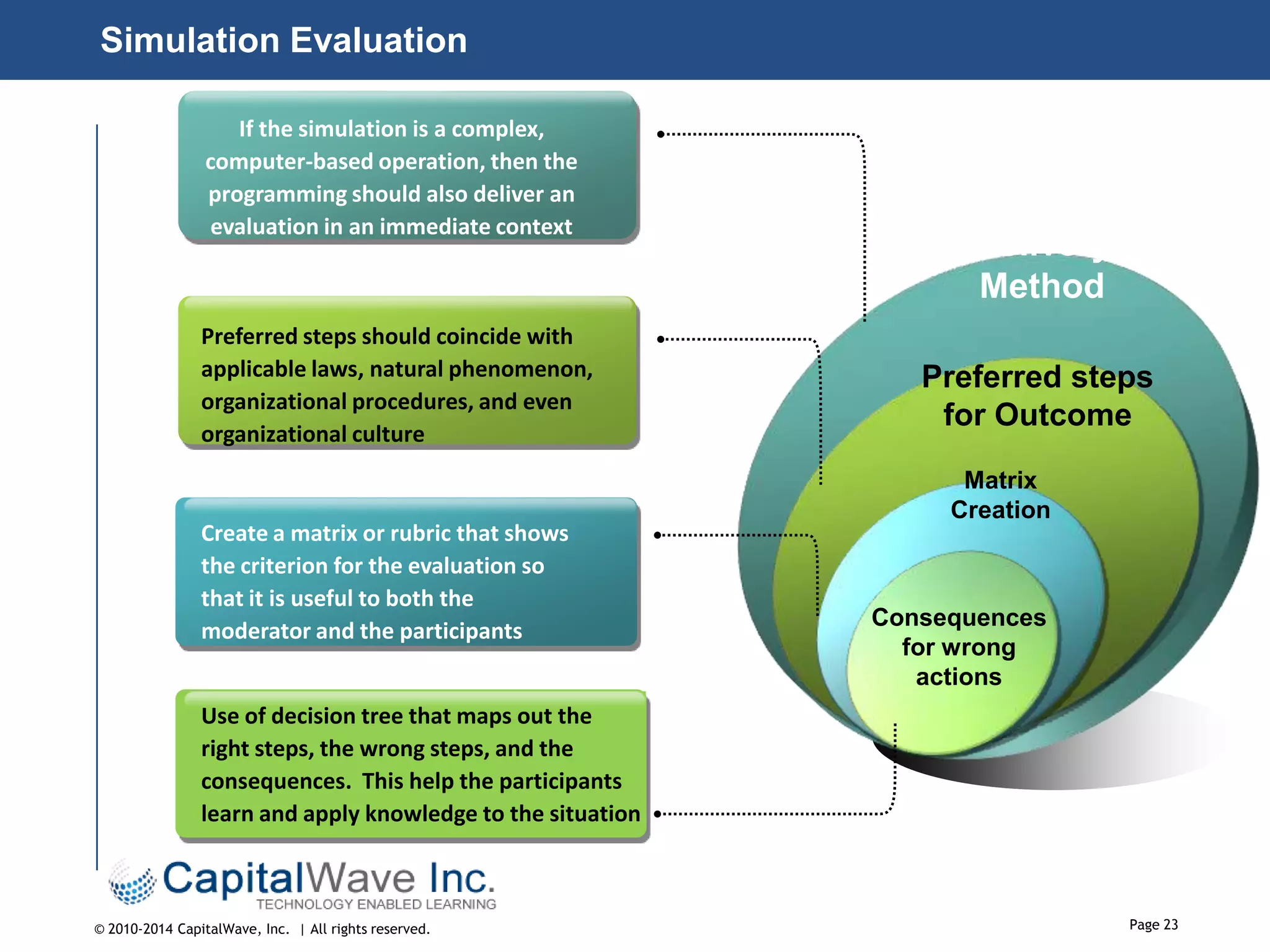
Simulation Evaluation
If the simulation is a complex,
computer-based operation, then the
programming should also deliver an
evaluation in an immediate context

Preferred steps should coincide with
applicable laws, natural phenomenon,
organizational procedures, and even
organizational culture

Create a matrix or rubric that shows
the criterion for the evaluation so
that it is useful to both the
moderator and the participants

Delivery
Method
Preferred steps
for Outcome
Matrix
Creation

Consequences
for wrong
actions

Use of decision tree that maps out the
right steps, the wrong steps, and the
consequences. This help the participants
learn and apply knowledge to the situation

© 2010-2014 CapitalWave, Inc. | All rights reserved.

Page 23
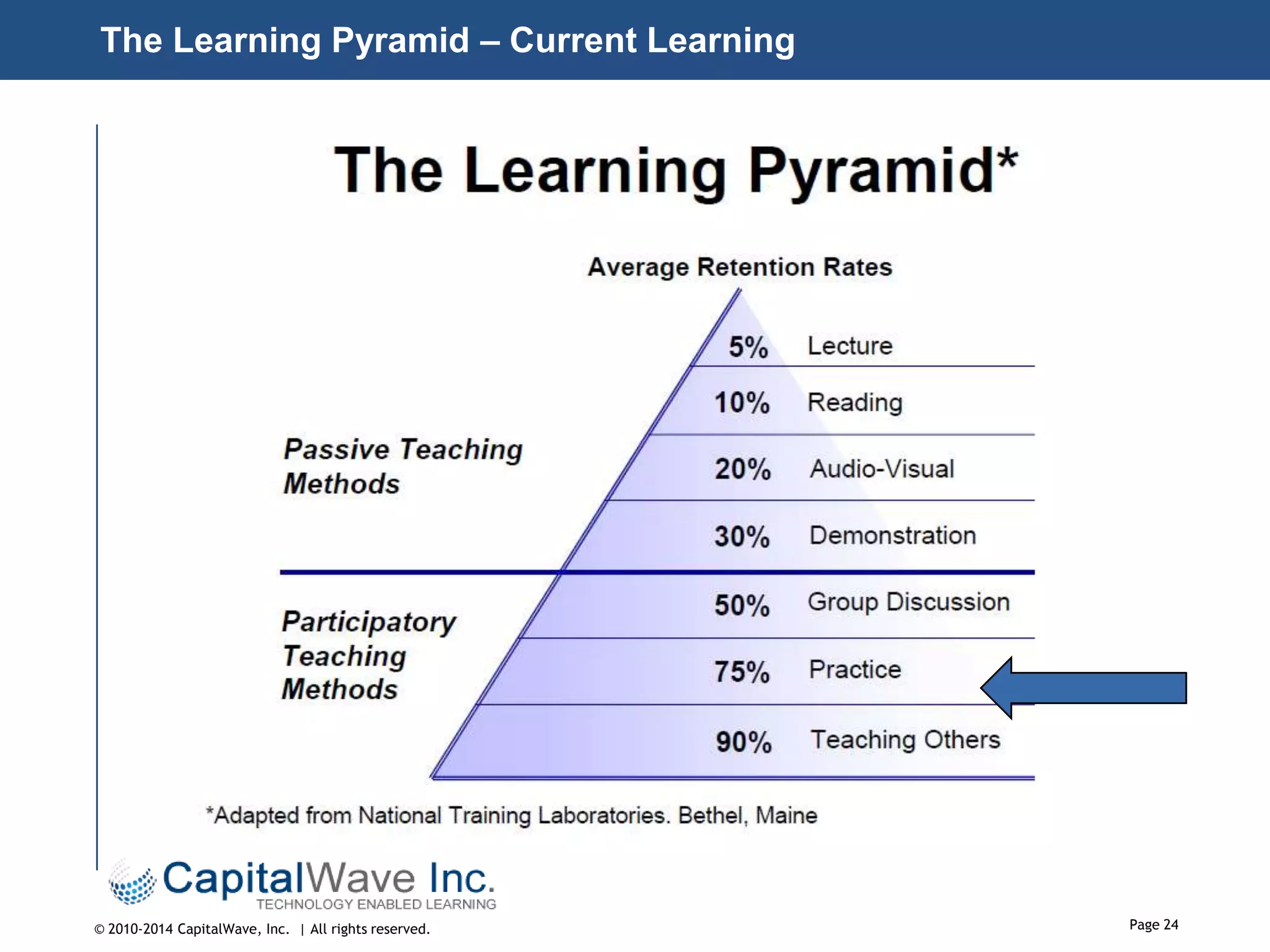
The Learning Pyramid – Current Learning

© 2010-2014 CapitalWave, Inc. | All rights reserved.

Page 24
Engagement

“You don’t learn because your
engaged. You’re engaged because
you’re learning.”
– Nick deKanter

© 2010-2014 CapitalWave, Inc. | All rights reserved.

Page 25
Bryant Nielson, CEO & Managing Director

http://www.linkedin.com/in/bryantnielson

http://www.facebook/capitalwave

http://twitter.com/#!/capitalwave

Bryant Nielson
CEO & Managing Director.
bryant.nielson@capitalwave.com

http://www.yourtrainingedge.com

http://www.CapitalWave.com
bryant.nielson

© 2010-2014 CapitalWave, Inc. | All rights reserved.

Page 26
The Learning Pyramid – Current Learning

Questions?
Bryant Nielson, bryant.nielson@CapitalWave.com t: (212) 672-1944

© 2010-2014 CapitalWave, Inc. | All rights reserved.

Page 27

Transform your training with simulations January 2014

  • 1.
    DELIVERING INNOVATIVE TRAININGSOLUTIONS® Transforming your Training with Simulations © 2010- 2014 CapitalWave, Inc. | All rights reserved.
  • 2.
    Simulations & Technology ©2010-2014 CapitalWave, Inc. | All rights reserved. Page 1
  • 3.
    Points of Discussion 1 Whyuse Simulations? 2 3 5 6 © 2010-2014 CapitalWave, Inc. | All rights reserved. Simulation benefits Simulations in Online Learning Simulation Components Evaluating Simulations Page 2
  • 4.
    Simulators © 2010-2014 CapitalWave,Inc. | All rights reserved. Page 3
  • 5.
    Simulators © 2010-2014 CapitalWave,Inc. | All rights reserved. Page 4
  • 6.
    Simulators © 2010-2014 CapitalWave,Inc. | All rights reserved. Page 5
  • 7.
    Simulators © 2010-2014 CapitalWave,Inc. | All rights reserved. Page 6
  • 8.
    Simulators © 2010-2014 CapitalWave,Inc. | All rights reserved. Page 7
  • 9.
    Why use Simulations? Learnnew processes & strategies Team building aspect Aspect of Execution Helps in decision making It’s time to move simulations from the cockpit and out of burning buildings – and into board rooms and training rooms in a multitude of businesses and organizations © 2010-2014 CapitalWave, Inc. | All rights reserved. Page 8
  • 10.
    Simulators © 2010-2014 CapitalWave,Inc. | All rights reserved. Page 9
  • 11.
    Simulation benefits Learning throughactions Benefit 1 Learning through mistakes  Participants are free to make mistakes, learn from them & apply learning before venturing out Enjoyable & Exciting Learning Experience  Enjoyable application of knowledge helps in better retention among participants “Capstone” for training or Certification programs  Acting as the final step towards certification or training programs © 2010-2014 CapitalWave, Inc. | All rights reserved. Benefit 2 Benefit 3 Benefit 4  Outcome in simulation comes through experience and not just reading, discussion & testing Benefit of consistent, constant & immediate feedback  Through constant feedback, participants can make corrections & move forward Developing Moderators or facilitators Benefit 5 Benefit 6  Aids in developing capabilities & coverage of existing professional training staffs Page 10
  • 12.
    Simulations in OnlineLearning Games & Live Interactions Online simulation training is highly effective as it goes against the norm of isolating learners for a geographically dispersed target audience © 2010-2014 CapitalWave, Inc. | All rights reserved. Page 11
  • 13.
    Simulations in OnlineLearning – Virtual Interactions Second Life Applications Web & Video Conference Discussion Boards Chat Rooms Based on the target audience and Organization’s technology, the structure of online simulation interventions should be chosen © 2010-2014 CapitalWave, Inc. | All rights reserved. Page 12
  • 14.
    Simulations in OnlineLearning – Reinforce Learning 1 2 Simulation can be offered as a part of overall online course Simulation can be offered to participants who are returning to the office after a classroom intervention Virtual simulations to reinforce Learning The focus of using simulation in online learning is to continue the knowledge process and to continue application of that knowledge © 2010-2014 CapitalWave, Inc. | All rights reserved. Page 13
  • 15.
    Simulations in OnlineLearning – Games & Live Interactions Team A  Each team begins to formulate their own strategies, choices & decisions while competing against each other when simulation cases are handed to them  The moderator can check in frequently to determine where the teams are and to coach virtually Simulation Case © 2010-2014 CapitalWave, Inc. | All rights reserved. Team B Page 14
  • 16.
    Simulations in OnlineLearning – Limitations No overuse of Technology • • Entire programs should not be moved to simulation medium Online simulation should be a reinforcement to classroom or seminar type training interventions Complex topics or issues to stay out of Online simulations • Leadership or cultural simulations may need to stay in the classroom or boardroom to encourage face to face interaction • Concepts that can be influenced through social media can move to the online environment © 2010-2014 CapitalWave, Inc. | All rights reserved. Page 15
  • 17.
    Simulation Components Realistic Network creation outside theClassroom Targeted & not Blanketed © 2010-2014 CapitalWave, Inc. | All rights reserved. Sense of Competition Combination of Learning & Dialogue Page 16
  • 18.
    Simulation Components -Realistic Current External Forces Decisions Current Internal Forces © 2010-2014 CapitalWave, Inc. | All rights reserved. Be as realistic as possible in order to create the real world in a simulated and controlled environment Page 17
  • 19.
    Simulation Components –Sense of Competition The idea behind the simulation is to open eyes and minds to doing things differently New thought patterns Simulation Case © 2010-2014 CapitalWave, Inc. | All rights reserved. Page 18
  • 20.
    Simulation Components –Combination of Learning & Dialogue Organization’s Strategy & Culture Simulation Outcome should be evaluated against Outcome Driven Simulation The final result of the simulation should not be a checkmark for getting through it but to reinforce the Organization’s culture & values © 2010-2014 CapitalWave, Inc. | All rights reserved. Page 19
  • 21.
    Simulation Components –Targeted but not Blanketed An effective Simulation loses essence when not used selectively and applied all across the board Site Review and Analysis Career Planning Training & Development Health & Safety Job Classification Simulation for HR executives should focus on helping personnel within the confines of HR law © 2010-2014 CapitalWave, Inc. | All rights reserved. Marketing Strategies Competitive Analysis Performance Appraisal HR Strategies Recruitment & Selection Evaluate & Refine Performance Analytics Marketing Metrics Optimize site structure Simulation for Marketing executives should focus on creating revenue & customer relationships Page 20
  • 22.
    Simulators © 2010-2014 CapitalWave,Inc. | All rights reserved. Page 21
  • 23.
    Simulation Components –Network creation outside the Classroom Real World Simulated Environment (Classroom) Simulation Focus • Teamwork • Identifying strengths of team members • Application of learned concepts Real World © 2010-2014 CapitalWave, Inc. | All rights reserved. Page 22
  • 24.
    Simulation Evaluation If thesimulation is a complex, computer-based operation, then the programming should also deliver an evaluation in an immediate context Preferred steps should coincide with applicable laws, natural phenomenon, organizational procedures, and even organizational culture Create a matrix or rubric that shows the criterion for the evaluation so that it is useful to both the moderator and the participants Delivery Method Preferred steps for Outcome Matrix Creation Consequences for wrong actions Use of decision tree that maps out the right steps, the wrong steps, and the consequences. This help the participants learn and apply knowledge to the situation © 2010-2014 CapitalWave, Inc. | All rights reserved. Page 23
  • 25.
    The Learning Pyramid– Current Learning © 2010-2014 CapitalWave, Inc. | All rights reserved. Page 24
  • 26.
    Engagement “You don’t learnbecause your engaged. You’re engaged because you’re learning.” – Nick deKanter © 2010-2014 CapitalWave, Inc. | All rights reserved. Page 25
  • 27.
    Bryant Nielson, CEO& Managing Director http://www.linkedin.com/in/bryantnielson http://www.facebook/capitalwave http://twitter.com/#!/capitalwave Bryant Nielson CEO & Managing Director. bryant.nielson@capitalwave.com http://www.yourtrainingedge.com http://www.CapitalWave.com bryant.nielson © 2010-2014 CapitalWave, Inc. | All rights reserved. Page 26
  • 28.
    The Learning Pyramid– Current Learning Questions? Bryant Nielson, bryant.nielson@CapitalWave.com t: (212) 672-1944 © 2010-2014 CapitalWave, Inc. | All rights reserved. Page 27

Editor's Notes

  • #3 CapitalWave is an innovate training company specializing in “Instructor-led-training” for the financial markets and delivering “technical solutions” for the corporate learning & development markets. In short we are a company that seeks to leverage our tools, products and skills as a full service corporate training company.So what is my message to you here today:Simulations create an environment that enables structured learning and analysis. Resulting with individuals (and firms) transforming skill awareness into skill mastery.
  • #4 Why use Simulations?What are the benefits of Simulations?What about Simulations in online learning?What makes a quality Simulation?Evaluating the results of a Simulation.
  • #5 NASA… the governmental agency that is more simulation than any other.We all have see movies like Apollo 13, and the Right Stuff, and Space Cowboys.We have seen that NASA simulates everything from:Shuttle LaunchSpace Station DockingRepairing things in SpaceShuttle LandingThey use simulations because they are CHEAPER than making errors with multi-billion dollar space vehicles.
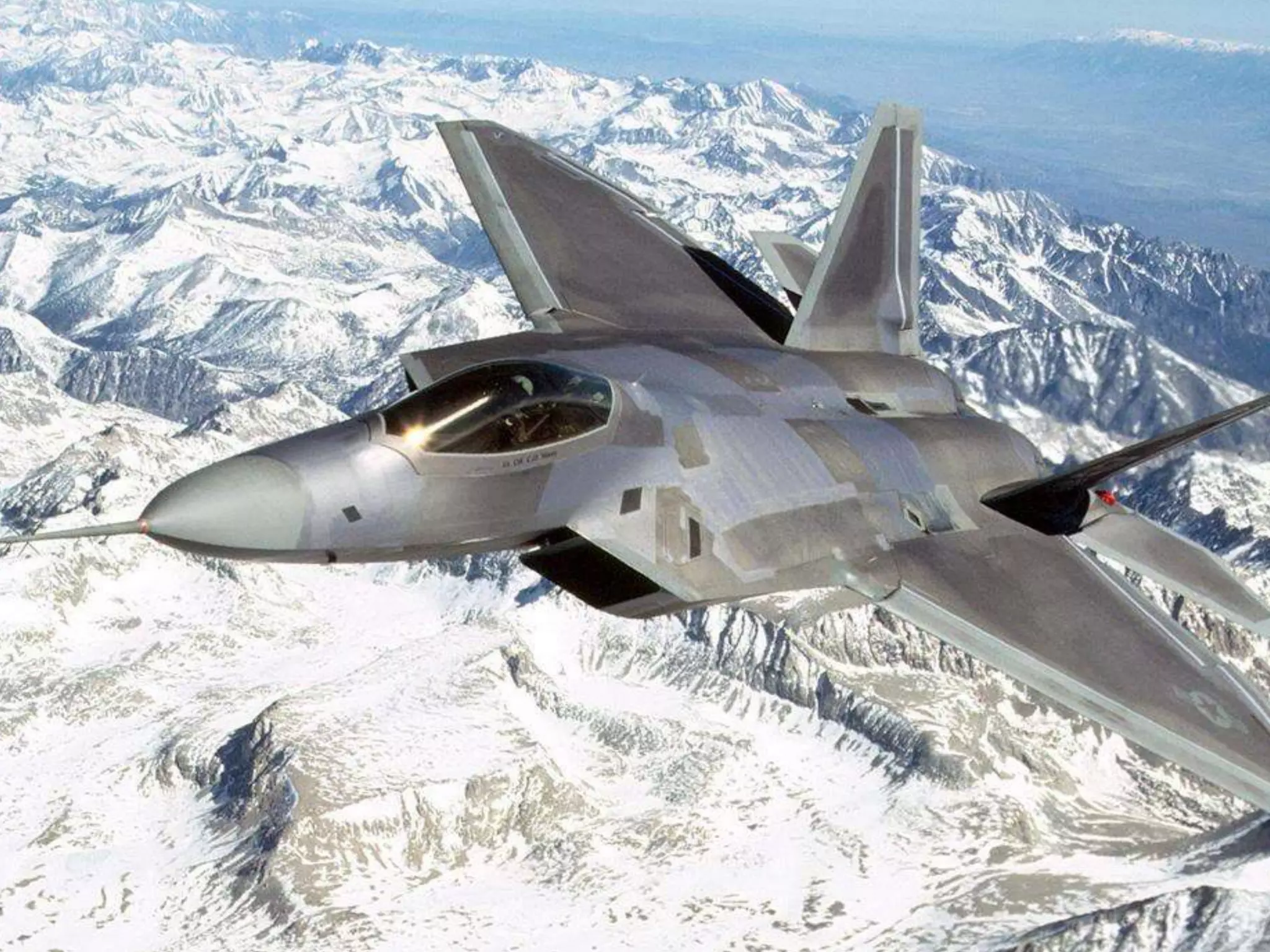
  • #6 Multi-Million dollar airplanes.The military uses simulation to re-create aircraft flight and the flight environment.Including how to fly.Flight controls and aircraft systems.Responding to external environments such as Air Density, Turbulence, Clouds, Precipitation, payloads, etc…Replica cockpits, to FAMILARIZE pilots with working controls and outside visual systems.QUALIFICATION.
  • #7 Fire Engineering… They have a name for it.Firefighter Drills.Startegy DeterminationRoadway Safety ZonesAlarm InvestigationTypes of Fires,Chemical, propellent, Roof styles,Search methods,Ventilations methods.
  • #8 Earthquakes,Risk Management, Life saving logisticsImpact on other coastlines Impact on communities, roads, buildings, bridges, dams, electric grid, nuclear reactors.Creating response rates and First Responder choices and decisions.
  • #9 Tsunami Simulators….Impact on our coast lines, buildings, etc…..Why should we consider using simulations in various aspects of business training, strategy, operations or even leadership?
  • #10 ExperientialUser directed, providing a dynamic and interactive engagement with subject matterPurpose built and relevantDemonstrate real world eventsFun and interactiveFreedom to: Fail, Interpretation and experimentPractical, visual and purpose drivenCreate discussion, explain complicated processes, provide procedural experience, creates collaborationDISCUSS THE VARIOUS ATTRIBUTES OF THE SLIDE.
  • #11 Aligns staff with business objectives…A simulation compresses months/years of experience into a shorten 1-2 days.Creates TEAM BUILDING.Identifies individual strengths and weaknesses.
  • #12 Simulations create experience.Allows for mistakes, and to learn from them… the cost for simulated mistakes? ZERO.Knowledge retention is higher with experience. 3. Creates constant feedback – make corrections, experience different outcomes, identify strategies. 4. Assist in knowledge retention among participants.5. Assist in developing capabilities6. Sometimes they act as the final step of a certification process.
  • #13 Online simulations can teach geographically disbursed staff to work together as teams.Assisting individuals who ALONE with NO INTERACTION with other into INTERACTIVE DISCUSSIONS with other program particpantsThey collectively work together to deal with a
  • #14 Online tools that you can use to reinforce learning.SPEAK ABOUT THE SLIDE.People are already plaing games online, World of Warcraft, and games on Wii and X-Box.
  • #15 REFER TO SLIDE CONTENT
  • #17 Best Practices:Not to over use technology --- seek a balance between technology and classroom or boardroom face-2-face interaction and networking.
  • #18 Realistic: Mirror of Real world events and situationsCompetition: make it FUN and INTERACTIVECommunication: Focused:Networking:
  • #23 Networking… is a valued component for team building and group interactions.
  • #24 TR Example… one of the purposes of their programs was to introduce geo-diverse staff to each other.Creating multiple networking possibilities.
  • #25 Also known as the DEBRIEF.