
TECHNOLOGYENABLEDLEARNINGSOLUTIONS®
© 2010-2014 CapitalWave, Inc. | All rights reserved.
Gamification through Simulation
Page 1
© 2010-2014 CapitalWave, Inc. | All rights reserved.
Game ON
Page 2
© 2010-2014 CapitalWave, Inc. | All rights reserved.
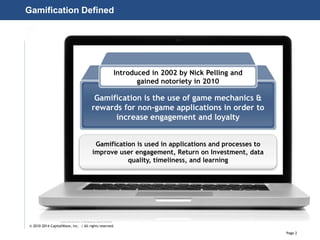
Gamification Defined
Introduced in 2002 by Nick Pelling and
gained notoriety in 2010
Gamification is the use of game mechanics &
rewards for non-game applications in order to
increase engagement and loyalty
Gamification is used in applications and processes to
improve user engagement, Return on Investment, data
quality, timeliness, and learning
Page 3
© 2010-2014 CapitalWave, Inc. | All rights reserved.
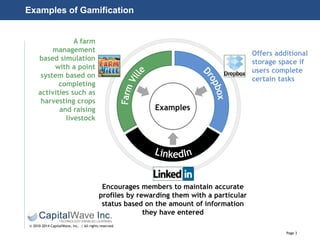
Examples of Gamification
Examples
Offers additional
storage space if
users complete
certain tasks
A farm
management
based simulation
with a point
system based on
completing
activities such as
harvesting crops
and raising
livestock
Encourages members to maintain accurate
profiles by rewarding them with a particular
status based on the amount of information
they have entered
Page 4
© 2010-2014 CapitalWave, Inc. | All rights reserved.
Gamification & Simulations
 Simulations allow for flexibility around the learners needs
 By utilizing simulation one does not have to turn to boring traditional learning methods
 Adds a level of interactivity
 Immersion within the learning environment
 Presentation of a challenge and reward-based system
 Higher retention than traditional training methods
 Interactive design elements, such as: audio, graphics, storytelling etc.
Gamification and simulations go hand in hand
Page 5
© 2010-2014 CapitalWave, Inc. | All rights reserved.
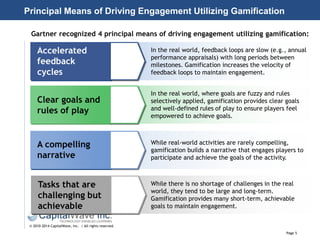
Accelerated
feedback
cycles
In the real world, feedback loops are slow (e.g., annual
performance appraisals) with long periods between
milestones. Gamification increases the velocity of
feedback loops to maintain engagement.
Clear goals and
rules of play
A compelling
narrative
Principal Means of Driving Engagement Utilizing Gamification
Tasks that are
challenging but
achievable
In the real world, where goals are fuzzy and rules
selectively applied, gamification provides clear goals
and well-defined rules of play to ensure players feel
empowered to achieve goals.
While real-world activities are rarely compelling,
gamification builds a narrative that engages players to
participate and achieve the goals of the activity.
While there is no shortage of challenges in the real
world, they tend to be large and long-term.
Gamification provides many short-term, achievable
goals to maintain engagement.
Gartner recognized 4 principal means of driving engagement utilizing gamification:
Page 6
© 2010-2014 CapitalWave, Inc. | All rights reserved.
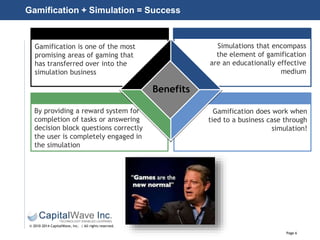
Gamification + Simulation = Success
Benefits
Simulations that encompass
the element of gamification
are an educationally effective
medium
Gamification does work when
tied to a business case through
simulation!
Gamification is one of the most
promising areas of gaming that
has transferred over into the
simulation business
By providing a reward system for
completion of tasks or answering
decision block questions correctly
the user is completely engaged in
the simulation
Page 7
© 2010-2014 CapitalWave, Inc. | All rights reserved.
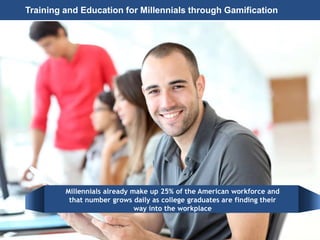
Training and Education for Millennials through Gamification
Millennials already make up 25% of the American workforce and
that number grows daily as college graduates are finding their
way into the workplace
Page 8
© 2010-2014 CapitalWave, Inc. | All rights reserved.
Millennials in the Workplace
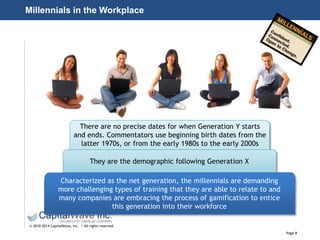
There are no precise dates for when Generation Y starts
and ends. Commentators use beginning birth dates from the
latter 1970s, or from the early 1980s to the early 2000s
They are the demographic following Generation X
Characterized as the net generation, the millennials are demanding
more challenging types of training that they are able to relate to and
many companies are embracing the process of gamification to entice
this generation into their workforce
Page 9
© 2010-2014 CapitalWave, Inc. | All rights reserved.
Expectations of Millennials
Generation Y’ers typically have greater
expectations of the workplace and are found
to switch jobs more often than those of
Generation X due to the fact that they do not
find the job challenging and rewarding enough
Because of the internet and games,
millennials have different attitudes and
behaviors from previous generations
Page 10
© 2010-2014 CapitalWave, Inc. | All rights reserved.
Expectations of Millennials
This so called ‘net generation’ has grown up
with video games, they are highly proficient
with technology and see games as a tool (not a
just a game)
The millennials work ethic is motivated in a
different way than that of previous
generations; they seek instant gratification
and are looking to be employed by a company
that has embraced new technologies and
allows them to utilize their multi-tasking skills
Page 11
© 2010-2014 CapitalWave, Inc. | All rights reserved.
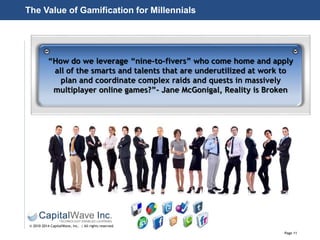
“How do we leverage “nine-to-fivers” who come home and apply
all of the smarts and talents that are underutilized at work to
plan and coordinate complex raids and quests in massively
multiplayer online games?”- Jane McGonigal, Reality is Broken
The Value of Gamification for Millennials
Page 12
© 2010-2014 CapitalWave, Inc. | All rights reserved.
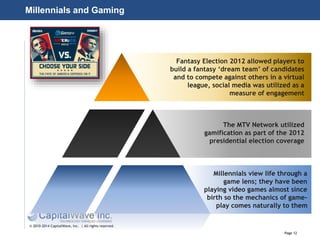
The MTV Network utilized
gamification as part of the 2012
presidential election coverage
Fantasy Election 2012 allowed players to
build a fantasy ‘dream team’ of candidates
and to compete against others in a virtual
league, social media was utilized as a
measure of engagement
Millennials and Gaming
Millennials view life through a
game lens; they have been
playing video games almost since
birth so the mechanics of game-
play comes naturally to them
Page 13
© 2010-2014 CapitalWave, Inc. | All rights reserved.
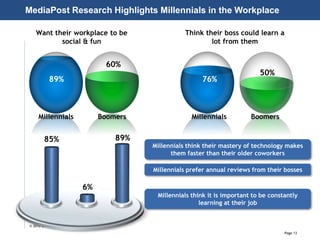
MediaPost Research Highlights Millennials in the Workplace
89%
60%
Millennials Boomers
Want their workplace to be
social & fun
76%
85%
Millennials Boomers
Think their boss could learn a
lot from them
6%
89%
Millennials think their mastery of technology makes
them faster than their older coworkers
Millennials prefer annual reviews from their bosses
Millennials think it is important to be constantly
learning at their job
50%
Page 14
© 2010-2014 CapitalWave, Inc. | All rights reserved.
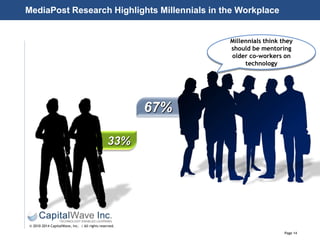
Millennials think they
should be mentoring
older co-workers on
technology
67%
33%
MediaPost Research Highlights Millennials in the Workplace
Page 15
© 2010-2014 CapitalWave, Inc. | All rights reserved.
MediaPost Research Highlights Millennials in the Workplace
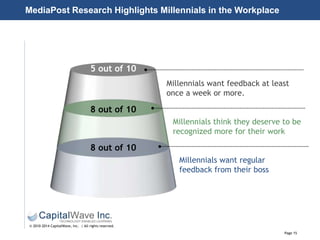
Millennials want feedback at least
once a week or more.
Millennials think they deserve to be
recognized more for their work
Millennials want regular
feedback from their boss
8 out of 10
8 out of 10
5 out of 10
Page 16
© 2010-2014 CapitalWave, Inc. | All rights reserved.
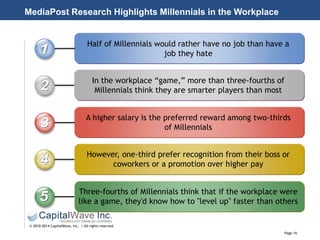
MediaPost Research Highlights Millennials in the Workplace
Half of Millennials would rather have no job than have a
job they hate
In the workplace “game,” more than three-fourths of
Millennials think they are smarter players than most
A higher salary is the preferred reward among two-thirds
of Millennials
However, one-third prefer recognition from their boss or
coworkers or a promotion over higher pay
Three-fourths of Millennials think that if the workplace were
like a game, they'd know how to "level up" faster than others
Page 17
© 2010-2014 CapitalWave, Inc. | All rights reserved.
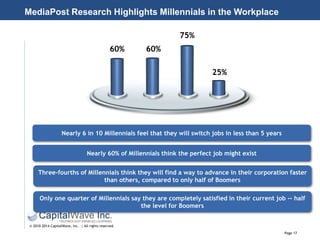
60%
Nearly 6 in 10 Millennials feel that they will switch jobs in less than 5 years
Nearly 60% of Millennials think the perfect job might exist
Three-fourths of Millennials think they will find a way to advance in their corporation faster
than others, compared to only half of Boomers
Only one quarter of Millennials say they are completely satisfied in their current job -- half
the level for Boomers
MediaPost Research Highlights Millennials in the Workplace
60%
75%
25%
Page 18
© 2010-2014 CapitalWave, Inc. | All rights reserved.
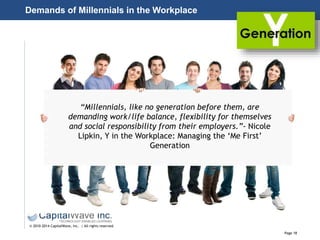
“Millennials, like no generation before them, are
demanding work/life balance, flexibility for themselves
and social responsibility from their employers.”- Nicole
Lipkin, Y in the Workplace: Managing the ‘Me First’
Generation
Demands of Millennials in the Workplace
Page 19
© 2010-2014 CapitalWave, Inc. | All rights reserved.
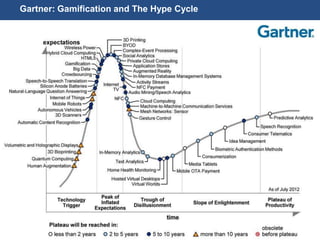
Gartner: Gamification and The Hype Cycle
Page 20
© 2010-2014 CapitalWave, Inc. | All rights reserved.
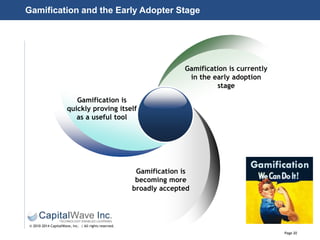
Gamification and the Early Adopter Stage
Gamification is
quickly proving itself
as a useful tool
Gamification is currently
in the early adoption
stage
Gamification is
becoming more
broadly accepted
Page 21
© 2010-2014 CapitalWave, Inc. | All rights reserved.
Early adopter organizations are claiming success, sighting
better user engagement and higher retention of material
presented; than that of traditional training methods.
Early Adopters of Gamification
Page 22
© 2010-2014 CapitalWave, Inc. | All rights reserved.
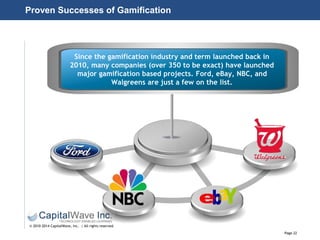
Since the gamification industry and term launched back in
2010, many companies (over 350 to be exact) have launched
major gamification based projects. Ford, eBay, NBC, and
Walgreens are just a few on the list.
Proven Successes of Gamification
Page 23
© 2010-2014 CapitalWave, Inc. | All rights reserved.
Gamification According to Gartner
Gamification is the use
of game design and game
mechanics to engage a
target audience to
change behaviors, learn
new skills or engage in
innovation.
The target audience may
be customers, employees
or the general public, but
first and foremost, they
are people with needs
and desires who will
respond to stimuli.
It is important to think
of the people in these
target audiences as
"players" in gamified
applications.
Page 24
© 2010-2014 CapitalWave, Inc. | All rights reserved.
While game mechanics such as points and badges are the hallmarks of
gamification, the real challenge is to design player-centric applications that
focus on the motivations and rewards that truly engage players more fully.
Game mechanics like points, badges and leader boards are simply the tools
that implement the underlying engagement models.
Gamification According to Gartner- Cont’d
Page 25
© 2010-2014 CapitalWave, Inc. | All rights reserved.
Gamification According to Gartner- Cont’d
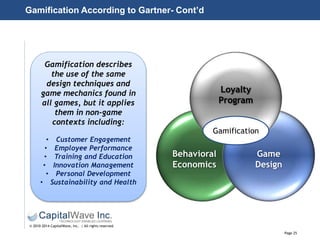
Gamification describes
the use of the same
design techniques and
game mechanics found in
all games, but it applies
them in non-game
contexts including:
• Customer Engagement
• Employee Performance
• Training and Education
• Innovation Management
• Personal Development
• Sustainability and Health
Behavioral
Economics
Game
Design
Loyalty
Program
Gamification
Page 26
© 2010-2014 CapitalWave, Inc. | All rights reserved.
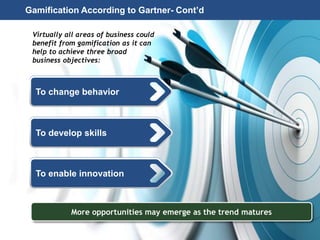
To change behavior
Gamification According to Gartner- Cont’d
To develop skills
To enable innovation
Virtually all areas of business could
benefit from gamification as it can
help to achieve three broad
business objectives:
More opportunities may emerge as the trend matures
Page 27
© 2010-2014 CapitalWave, Inc. | All rights reserved.
A gamification program will be a key organizational enabler for 75% of
enterprise-oriented DevOps initiatives by 2016, up from less than 1% today
More than 15% of games produced in 2017 will have been developed by
workers on a gamification platform.
Gamification Predictions from Gartner
By 2017, 50% of Global 1000 organizations will use gamification in learning
and/or recruitment processes
By 2016, early utility adopters will use gamification to drive end-user,
energy-efficiency improvements of 1% to 3%.
By 2016, gamification will be an essential element for brands and retailers to
drive customer marketing and loyalty
By 2015, 40% of Global 1000 organizations will use gamification as the
primary mechanism to transform business operations
Page 28
© 2010-2014 CapitalWave, Inc. | All rights reserved.
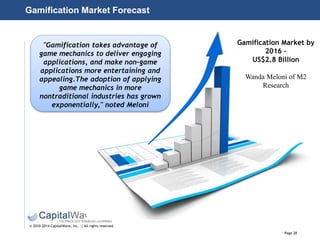
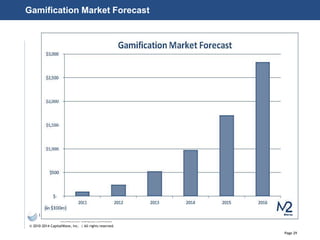
Gamification Market by
2016 –
US$2.8 Billion
Wanda Meloni of M2
Research
"Gamification takes advantage of
game mechanics to deliver engaging
applications, and make non‐game
applications more entertaining and
appealing.The adoption of applying
game mechanics in more
nontraditional industries has grown
exponentially," noted Meloni
Gamification Market Forecast
Page 29
© 2010-2014 CapitalWave, Inc. | All rights reserved.
Gamification Market Forecast
Page 30
© 2010-2014 CapitalWave, Inc. | All rights reserved.
Pew Internet on Gamification
“Overall, a modest majority of the
top tech experts participating in this
survey believe game elements in
some form will continue to play a
role of gathering importance in the
everyday activities of many of the
people who are actively using
communications networks.”
“The development of ‘serious games’
applied productively to a wide scope
of human activities will accelerate
simply because playing is more fun
than working.”
Page 31
© 2010-2014 CapitalWave, Inc. | All rights reserved.
Gamification through Simulation
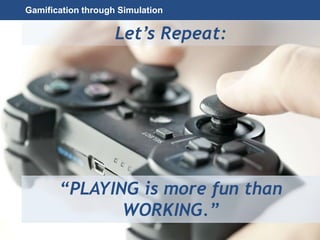
Let’s Repeat:
“PLAYING is more fun than
WORKING.”
Page 32
© 2010-2014 CapitalWave, Inc. | All rights reserved.
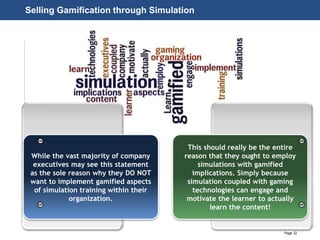
Selling Gamification through Simulation
While the vast majority of company
executives may see this statement
as the sole reason why they DO NOT
want to implement gamified aspects
of simulation training within their
organization.
This should really be the entire
reason that they ought to employ
simulations with gamified
implications. Simply because
simulation coupled with gaming
technologies can engage and
motivate the learner to actually
learn the content!
Page 33
© 2010-2014 CapitalWave, Inc. | All rights reserved.
Jane McGonigal, Reality is Broken
“Games enrich us with intrinsic rewards. They actively engage us in
satisfying work that we have the chance to be successful at. They give us
a highly structured way to spend time and build bonds with people we
like. And if we play a game long enough, with a big enough network of
players, we feel a part of something bigger than ourselves—part of an epic
story, an important project, or a global community.”
Developing Skills Through Simulation
Page 34
© 2010-2014 CapitalWave, Inc. | All rights reserved.
Developing Skills Through Simulation
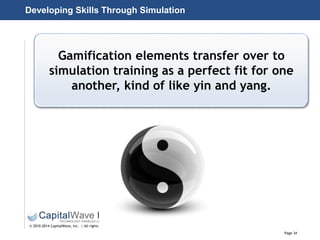
Gamification elements transfer over to
simulation training as a perfect fit for one
another, kind of like yin and yang.
Page 35
© 2010-2014 CapitalWave, Inc. | All rights reserved.
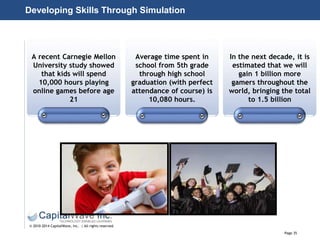
In the next decade, it is
estimated that we will
gain 1 billion more
gamers throughout the
world, bringing the total
to 1.5 billion
Average time spent in
school from 5th grade
through high school
graduation (with perfect
attendance of course) is
10,080 hours.
A recent Carnegie Mellon
University study showed
that kids will spend
10,000 hours playing
online games before age
21
Developing Skills Through Simulation
Page 36
© 2010-2014 CapitalWave, Inc. | All rights reserved.
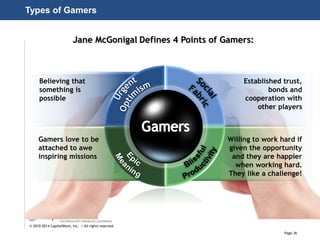
Types of Gamers
Believing that
something is
possible
Gamers love to be
attached to awe
inspiring missions
Established trust,
bonds and
cooperation with
other players
Willing to work hard if
given the opportunity
and they are happier
when working hard.
They like a challenge!
Jane McGonigal Defines 4 Points of Gamers:
Page 37
© 2010-2014 CapitalWave, Inc. | All rights reserved.
What Gamers Can Achieve?
Gamers can achieve more in an online world than in the real world. If
we make the real world more like a game then this generation of gamers
will be more successful in their work practices.
Page 38
© 2010-2014 CapitalWave, Inc. | All rights reserved.
Defining Success by Gamification
Online gamers are now in today’s workforce driving company training
and education
Gamification + Simulation Training =
Training Success for any Organization
Page 39
© 2010-2014 CapitalWave, Inc. | All rights reserved.
12 Startling
Gamification
Statistics (from Jane
McConigal’s Reality is
Broken book)…
Gamification Statistics
Page 40
© 2010-2014 CapitalWave, Inc. | All rights reserved.
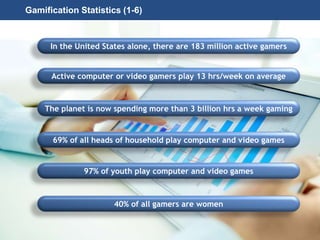
In the United States alone, there are 183 million active gamers
Active computer or video gamers play 13 hrs/week on average
The planet is now spending more than 3 billion hrs a week gaming
69% of all heads of household play computer and video games
97% of youth play computer and video games
40% of all gamers are women
Gamification Statistics (1-6)
Page 41
© 2010-2014 CapitalWave, Inc. | All rights reserved.
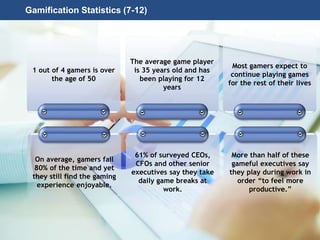
Gamification Statistics (7-12)
Most gamers expect to
continue playing games
for the rest of their lives
The average game player
is 35 years old and has
been playing for 12
years
1 out of 4 gamers is over
the age of 50
More than half of these
gameful executives say
they play during work in
order “to feel more
productive.”
61% of surveyed CEOs,
CFOs and other senior
executives say they take
daily game breaks at
work.
On average, gamers fail
80% of the time and yet
they still find the gaming
experience enjoyable.
Page 42
© 2010-2014 CapitalWave, Inc. | All rights reserved.
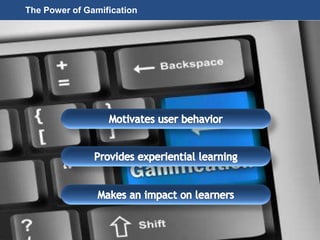
The Power of Gamification
Page 43
© 2010-2014 CapitalWave, Inc. | All rights reserved.
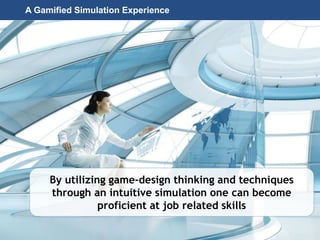
By utilizing game-design thinking and techniques
through an intuitive simulation one can become
proficient at job related skills
A Gamified Simulation Experience
Page 44
© 2010-2014 CapitalWave, Inc. | All rights reserved.
Game Design in the Twenty-First-Century
“Game design isn’t just a
technological craft. It’s a twenty-
first-century way of thinking and
leading.”
-Jane McGonigal, Reality is Broken
Page 45
© 2010-2014 CapitalWave, Inc. | All rights reserved.
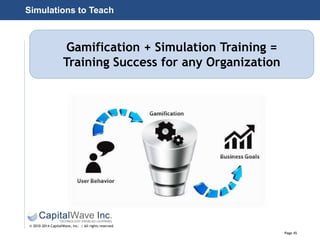
Gamification + Simulation Training =
Training Success for any Organization
Simulations to Teach
Page 46
© 2010-2014 CapitalWave, Inc. | All rights reserved.
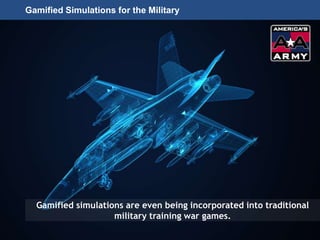
Gamified simulations are even being incorporated into traditional
military training war games.
Gamified Simulations for the Military
Page 47
© 2010-2014 CapitalWave, Inc. | All rights reserved.
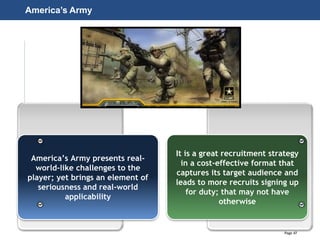
America’s Army presents real-
world-like challenges to the
player; yet brings an element of
seriousness and real-world
applicability
It is a great recruitment strategy
in a cost-effective format that
captures its target audience and
leads to more recruits signing up
for duty; that may not have
otherwise
America’s Army
Page 48
© 2010-2014 CapitalWave, Inc. | All rights reserved.
Gamfication and Design Elements
Page 49
© 2010-2014 CapitalWave, Inc. | All rights reserved.
“While some people dismiss gamification as a fad, neuroscientists are discovering
more and more about the ways in which humans react to such interactive design
elements. They say such elements can cause feel-good chemical reactions, alter
human responses to stimuli—increasing reaction times, for instance—and in
certain situations can improve learning, participation, and motivation.”
- 2012 Pew Internet Research Report
Proven Success of Gamification
Page 50
© 2010-2014 CapitalWave, Inc. | All rights reserved.
So many of us lead digital lives and have become accustomed
to being ‘plugged-in’ all of the time whether that be by a
wireless internet connection and iPad or through a Smartphone
When playing through simulations it’s just second nature and
an extremely compelling way to present material that may
otherwise be bland and boring
We tend to look for instant gratification in our work; by
providing user feedback (through a point system, etc.) the
simulation medium provides for direct response
Gamification in the Digital Age
Page 51
© 2010-2014 CapitalWave, Inc. | All rights reserved.
Gaming Functions
Gaming technologies are making
training and education far more
effective than traditional
methods and gamification has
many applications within the
training arena
Gaming functionality allows for
people to understand more
complex topics quicker and with
more nuances involved. We are
able to present problem-solving
strategies and a challenge that
meets the skill level of any and
all players
Page 52
© 2010-2014 CapitalWave, Inc. | All rights reserved.
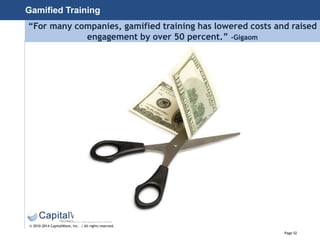
“For many companies, gamified training has lowered costs and raised
engagement by over 50 percent.” -Gigaom
Gamified Training
Page 53
© 2010-2014 CapitalWave, Inc. | All rights reserved.
By integrating gamification into the workplace, employees are
encouraged to engage in desired behaviors
They get the instant gratification that they are seeking through their
efforts and receive immediate feedback
The employer sees increased socialization and personal satisfaction from
the employee all as a result of the gamification program
Companies should take measures to tap into the millennials innovation,
by weaving gamification into the corporate culture the organization will
recognize enhanced communication and collaboration all employees
Gamification in the Workplace
Page 54
© 2010-2014 CapitalWave, Inc. | All rights reserved.
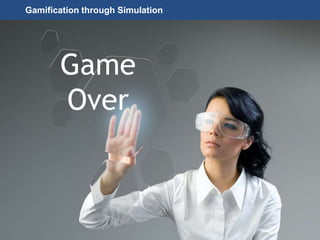
Gamification through Simulation
Game
Over

Gamification through Simulation

  • 1.
    TECHNOLOGYENABLEDLEARNINGSOLUTIONS® © 2010-2014 CapitalWave,Inc. | All rights reserved. Gamification through Simulation
  • 2.
    Page 1 © 2010-2014CapitalWave, Inc. | All rights reserved. Game ON
  • 3.
    Page 2 © 2010-2014CapitalWave, Inc. | All rights reserved. Gamification Defined Introduced in 2002 by Nick Pelling and gained notoriety in 2010 Gamification is the use of game mechanics & rewards for non-game applications in order to increase engagement and loyalty Gamification is used in applications and processes to improve user engagement, Return on Investment, data quality, timeliness, and learning
  • 4.
    Page 3 © 2010-2014CapitalWave, Inc. | All rights reserved. Examples of Gamification Examples Offers additional storage space if users complete certain tasks A farm management based simulation with a point system based on completing activities such as harvesting crops and raising livestock Encourages members to maintain accurate profiles by rewarding them with a particular status based on the amount of information they have entered
  • 5.
    Page 4 © 2010-2014CapitalWave, Inc. | All rights reserved. Gamification & Simulations  Simulations allow for flexibility around the learners needs  By utilizing simulation one does not have to turn to boring traditional learning methods  Adds a level of interactivity  Immersion within the learning environment  Presentation of a challenge and reward-based system  Higher retention than traditional training methods  Interactive design elements, such as: audio, graphics, storytelling etc. Gamification and simulations go hand in hand
  • 6.
    Page 5 © 2010-2014CapitalWave, Inc. | All rights reserved. Accelerated feedback cycles In the real world, feedback loops are slow (e.g., annual performance appraisals) with long periods between milestones. Gamification increases the velocity of feedback loops to maintain engagement. Clear goals and rules of play A compelling narrative Principal Means of Driving Engagement Utilizing Gamification Tasks that are challenging but achievable In the real world, where goals are fuzzy and rules selectively applied, gamification provides clear goals and well-defined rules of play to ensure players feel empowered to achieve goals. While real-world activities are rarely compelling, gamification builds a narrative that engages players to participate and achieve the goals of the activity. While there is no shortage of challenges in the real world, they tend to be large and long-term. Gamification provides many short-term, achievable goals to maintain engagement. Gartner recognized 4 principal means of driving engagement utilizing gamification:
  • 7.
    Page 6 © 2010-2014CapitalWave, Inc. | All rights reserved. Gamification + Simulation = Success Benefits Simulations that encompass the element of gamification are an educationally effective medium Gamification does work when tied to a business case through simulation! Gamification is one of the most promising areas of gaming that has transferred over into the simulation business By providing a reward system for completion of tasks or answering decision block questions correctly the user is completely engaged in the simulation
  • 8.
    Page 7 © 2010-2014CapitalWave, Inc. | All rights reserved. Training and Education for Millennials through Gamification Millennials already make up 25% of the American workforce and that number grows daily as college graduates are finding their way into the workplace
  • 9.
    Page 8 © 2010-2014CapitalWave, Inc. | All rights reserved. Millennials in the Workplace There are no precise dates for when Generation Y starts and ends. Commentators use beginning birth dates from the latter 1970s, or from the early 1980s to the early 2000s They are the demographic following Generation X Characterized as the net generation, the millennials are demanding more challenging types of training that they are able to relate to and many companies are embracing the process of gamification to entice this generation into their workforce
  • 10.
    Page 9 © 2010-2014CapitalWave, Inc. | All rights reserved. Expectations of Millennials Generation Y’ers typically have greater expectations of the workplace and are found to switch jobs more often than those of Generation X due to the fact that they do not find the job challenging and rewarding enough Because of the internet and games, millennials have different attitudes and behaviors from previous generations
  • 11.
    Page 10 © 2010-2014CapitalWave, Inc. | All rights reserved. Expectations of Millennials This so called ‘net generation’ has grown up with video games, they are highly proficient with technology and see games as a tool (not a just a game) The millennials work ethic is motivated in a different way than that of previous generations; they seek instant gratification and are looking to be employed by a company that has embraced new technologies and allows them to utilize their multi-tasking skills
  • 12.
    Page 11 © 2010-2014CapitalWave, Inc. | All rights reserved. “How do we leverage “nine-to-fivers” who come home and apply all of the smarts and talents that are underutilized at work to plan and coordinate complex raids and quests in massively multiplayer online games?”- Jane McGonigal, Reality is Broken The Value of Gamification for Millennials
  • 13.
    Page 12 © 2010-2014CapitalWave, Inc. | All rights reserved. The MTV Network utilized gamification as part of the 2012 presidential election coverage Fantasy Election 2012 allowed players to build a fantasy ‘dream team’ of candidates and to compete against others in a virtual league, social media was utilized as a measure of engagement Millennials and Gaming Millennials view life through a game lens; they have been playing video games almost since birth so the mechanics of game- play comes naturally to them
  • 14.
    Page 13 © 2010-2014CapitalWave, Inc. | All rights reserved. MediaPost Research Highlights Millennials in the Workplace 89% 60% Millennials Boomers Want their workplace to be social & fun 76% 85% Millennials Boomers Think their boss could learn a lot from them 6% 89% Millennials think their mastery of technology makes them faster than their older coworkers Millennials prefer annual reviews from their bosses Millennials think it is important to be constantly learning at their job 50%
  • 15.
    Page 14 © 2010-2014CapitalWave, Inc. | All rights reserved. Millennials think they should be mentoring older co-workers on technology 67% 33% MediaPost Research Highlights Millennials in the Workplace
  • 16.
    Page 15 © 2010-2014CapitalWave, Inc. | All rights reserved. MediaPost Research Highlights Millennials in the Workplace Millennials want feedback at least once a week or more. Millennials think they deserve to be recognized more for their work Millennials want regular feedback from their boss 8 out of 10 8 out of 10 5 out of 10
  • 17.
    Page 16 © 2010-2014CapitalWave, Inc. | All rights reserved. MediaPost Research Highlights Millennials in the Workplace Half of Millennials would rather have no job than have a job they hate In the workplace “game,” more than three-fourths of Millennials think they are smarter players than most A higher salary is the preferred reward among two-thirds of Millennials However, one-third prefer recognition from their boss or coworkers or a promotion over higher pay Three-fourths of Millennials think that if the workplace were like a game, they'd know how to "level up" faster than others
  • 18.
    Page 17 © 2010-2014CapitalWave, Inc. | All rights reserved. 60% Nearly 6 in 10 Millennials feel that they will switch jobs in less than 5 years Nearly 60% of Millennials think the perfect job might exist Three-fourths of Millennials think they will find a way to advance in their corporation faster than others, compared to only half of Boomers Only one quarter of Millennials say they are completely satisfied in their current job -- half the level for Boomers MediaPost Research Highlights Millennials in the Workplace 60% 75% 25%
  • 19.
    Page 18 © 2010-2014CapitalWave, Inc. | All rights reserved. “Millennials, like no generation before them, are demanding work/life balance, flexibility for themselves and social responsibility from their employers.”- Nicole Lipkin, Y in the Workplace: Managing the ‘Me First’ Generation Demands of Millennials in the Workplace
  • 20.
    Page 19 © 2010-2014CapitalWave, Inc. | All rights reserved. Gartner: Gamification and The Hype Cycle
  • 21.
    Page 20 © 2010-2014CapitalWave, Inc. | All rights reserved. Gamification and the Early Adopter Stage Gamification is quickly proving itself as a useful tool Gamification is currently in the early adoption stage Gamification is becoming more broadly accepted
  • 22.
    Page 21 © 2010-2014CapitalWave, Inc. | All rights reserved. Early adopter organizations are claiming success, sighting better user engagement and higher retention of material presented; than that of traditional training methods. Early Adopters of Gamification
  • 23.
    Page 22 © 2010-2014CapitalWave, Inc. | All rights reserved. Since the gamification industry and term launched back in 2010, many companies (over 350 to be exact) have launched major gamification based projects. Ford, eBay, NBC, and Walgreens are just a few on the list. Proven Successes of Gamification
  • 24.
    Page 23 © 2010-2014CapitalWave, Inc. | All rights reserved. Gamification According to Gartner Gamification is the use of game design and game mechanics to engage a target audience to change behaviors, learn new skills or engage in innovation. The target audience may be customers, employees or the general public, but first and foremost, they are people with needs and desires who will respond to stimuli. It is important to think of the people in these target audiences as "players" in gamified applications.
  • 25.
    Page 24 © 2010-2014CapitalWave, Inc. | All rights reserved. While game mechanics such as points and badges are the hallmarks of gamification, the real challenge is to design player-centric applications that focus on the motivations and rewards that truly engage players more fully. Game mechanics like points, badges and leader boards are simply the tools that implement the underlying engagement models. Gamification According to Gartner- Cont’d
  • 26.
    Page 25 © 2010-2014CapitalWave, Inc. | All rights reserved. Gamification According to Gartner- Cont’d Gamification describes the use of the same design techniques and game mechanics found in all games, but it applies them in non-game contexts including: • Customer Engagement • Employee Performance • Training and Education • Innovation Management • Personal Development • Sustainability and Health Behavioral Economics Game Design Loyalty Program Gamification
  • 27.
    Page 26 © 2010-2014CapitalWave, Inc. | All rights reserved. To change behavior Gamification According to Gartner- Cont’d To develop skills To enable innovation Virtually all areas of business could benefit from gamification as it can help to achieve three broad business objectives: More opportunities may emerge as the trend matures
  • 28.
    Page 27 © 2010-2014CapitalWave, Inc. | All rights reserved. A gamification program will be a key organizational enabler for 75% of enterprise-oriented DevOps initiatives by 2016, up from less than 1% today More than 15% of games produced in 2017 will have been developed by workers on a gamification platform. Gamification Predictions from Gartner By 2017, 50% of Global 1000 organizations will use gamification in learning and/or recruitment processes By 2016, early utility adopters will use gamification to drive end-user, energy-efficiency improvements of 1% to 3%. By 2016, gamification will be an essential element for brands and retailers to drive customer marketing and loyalty By 2015, 40% of Global 1000 organizations will use gamification as the primary mechanism to transform business operations
  • 29.
    Page 28 © 2010-2014CapitalWave, Inc. | All rights reserved. Gamification Market by 2016 – US$2.8 Billion Wanda Meloni of M2 Research "Gamification takes advantage of game mechanics to deliver engaging applications, and make non‐game applications more entertaining and appealing.The adoption of applying game mechanics in more nontraditional industries has grown exponentially," noted Meloni Gamification Market Forecast
  • 30.
    Page 29 © 2010-2014CapitalWave, Inc. | All rights reserved. Gamification Market Forecast
  • 31.
    Page 30 © 2010-2014CapitalWave, Inc. | All rights reserved. Pew Internet on Gamification “Overall, a modest majority of the top tech experts participating in this survey believe game elements in some form will continue to play a role of gathering importance in the everyday activities of many of the people who are actively using communications networks.” “The development of ‘serious games’ applied productively to a wide scope of human activities will accelerate simply because playing is more fun than working.”
  • 32.
    Page 31 © 2010-2014CapitalWave, Inc. | All rights reserved. Gamification through Simulation Let’s Repeat: “PLAYING is more fun than WORKING.”
  • 33.
    Page 32 © 2010-2014CapitalWave, Inc. | All rights reserved. Selling Gamification through Simulation While the vast majority of company executives may see this statement as the sole reason why they DO NOT want to implement gamified aspects of simulation training within their organization. This should really be the entire reason that they ought to employ simulations with gamified implications. Simply because simulation coupled with gaming technologies can engage and motivate the learner to actually learn the content!
  • 34.
    Page 33 © 2010-2014CapitalWave, Inc. | All rights reserved. Jane McGonigal, Reality is Broken “Games enrich us with intrinsic rewards. They actively engage us in satisfying work that we have the chance to be successful at. They give us a highly structured way to spend time and build bonds with people we like. And if we play a game long enough, with a big enough network of players, we feel a part of something bigger than ourselves—part of an epic story, an important project, or a global community.” Developing Skills Through Simulation
  • 35.
    Page 34 © 2010-2014CapitalWave, Inc. | All rights reserved. Developing Skills Through Simulation Gamification elements transfer over to simulation training as a perfect fit for one another, kind of like yin and yang.
  • 36.
    Page 35 © 2010-2014CapitalWave, Inc. | All rights reserved. In the next decade, it is estimated that we will gain 1 billion more gamers throughout the world, bringing the total to 1.5 billion Average time spent in school from 5th grade through high school graduation (with perfect attendance of course) is 10,080 hours. A recent Carnegie Mellon University study showed that kids will spend 10,000 hours playing online games before age 21 Developing Skills Through Simulation
  • 37.
    Page 36 © 2010-2014CapitalWave, Inc. | All rights reserved. Types of Gamers Believing that something is possible Gamers love to be attached to awe inspiring missions Established trust, bonds and cooperation with other players Willing to work hard if given the opportunity and they are happier when working hard. They like a challenge! Jane McGonigal Defines 4 Points of Gamers:
  • 38.
    Page 37 © 2010-2014CapitalWave, Inc. | All rights reserved. What Gamers Can Achieve? Gamers can achieve more in an online world than in the real world. If we make the real world more like a game then this generation of gamers will be more successful in their work practices.
  • 39.
    Page 38 © 2010-2014CapitalWave, Inc. | All rights reserved. Defining Success by Gamification Online gamers are now in today’s workforce driving company training and education Gamification + Simulation Training = Training Success for any Organization
  • 40.
    Page 39 © 2010-2014CapitalWave, Inc. | All rights reserved. 12 Startling Gamification Statistics (from Jane McConigal’s Reality is Broken book)… Gamification Statistics
  • 41.
    Page 40 © 2010-2014CapitalWave, Inc. | All rights reserved. In the United States alone, there are 183 million active gamers Active computer or video gamers play 13 hrs/week on average The planet is now spending more than 3 billion hrs a week gaming 69% of all heads of household play computer and video games 97% of youth play computer and video games 40% of all gamers are women Gamification Statistics (1-6)
  • 42.
    Page 41 © 2010-2014CapitalWave, Inc. | All rights reserved. Gamification Statistics (7-12) Most gamers expect to continue playing games for the rest of their lives The average game player is 35 years old and has been playing for 12 years 1 out of 4 gamers is over the age of 50 More than half of these gameful executives say they play during work in order “to feel more productive.” 61% of surveyed CEOs, CFOs and other senior executives say they take daily game breaks at work. On average, gamers fail 80% of the time and yet they still find the gaming experience enjoyable.
  • 43.
    Page 42 © 2010-2014CapitalWave, Inc. | All rights reserved. The Power of Gamification
  • 44.
    Page 43 © 2010-2014CapitalWave, Inc. | All rights reserved. By utilizing game-design thinking and techniques through an intuitive simulation one can become proficient at job related skills A Gamified Simulation Experience
  • 45.
    Page 44 © 2010-2014CapitalWave, Inc. | All rights reserved. Game Design in the Twenty-First-Century “Game design isn’t just a technological craft. It’s a twenty- first-century way of thinking and leading.” -Jane McGonigal, Reality is Broken
  • 46.
    Page 45 © 2010-2014CapitalWave, Inc. | All rights reserved. Gamification + Simulation Training = Training Success for any Organization Simulations to Teach
  • 47.
    Page 46 © 2010-2014CapitalWave, Inc. | All rights reserved. Gamified simulations are even being incorporated into traditional military training war games. Gamified Simulations for the Military
  • 48.
    Page 47 © 2010-2014CapitalWave, Inc. | All rights reserved. America’s Army presents real- world-like challenges to the player; yet brings an element of seriousness and real-world applicability It is a great recruitment strategy in a cost-effective format that captures its target audience and leads to more recruits signing up for duty; that may not have otherwise America’s Army
  • 49.
    Page 48 © 2010-2014CapitalWave, Inc. | All rights reserved. Gamfication and Design Elements
  • 50.
    Page 49 © 2010-2014CapitalWave, Inc. | All rights reserved. “While some people dismiss gamification as a fad, neuroscientists are discovering more and more about the ways in which humans react to such interactive design elements. They say such elements can cause feel-good chemical reactions, alter human responses to stimuli—increasing reaction times, for instance—and in certain situations can improve learning, participation, and motivation.” - 2012 Pew Internet Research Report Proven Success of Gamification
  • 51.
    Page 50 © 2010-2014CapitalWave, Inc. | All rights reserved. So many of us lead digital lives and have become accustomed to being ‘plugged-in’ all of the time whether that be by a wireless internet connection and iPad or through a Smartphone When playing through simulations it’s just second nature and an extremely compelling way to present material that may otherwise be bland and boring We tend to look for instant gratification in our work; by providing user feedback (through a point system, etc.) the simulation medium provides for direct response Gamification in the Digital Age
  • 52.
    Page 51 © 2010-2014CapitalWave, Inc. | All rights reserved. Gaming Functions Gaming technologies are making training and education far more effective than traditional methods and gamification has many applications within the training arena Gaming functionality allows for people to understand more complex topics quicker and with more nuances involved. We are able to present problem-solving strategies and a challenge that meets the skill level of any and all players
  • 53.
    Page 52 © 2010-2014CapitalWave, Inc. | All rights reserved. “For many companies, gamified training has lowered costs and raised engagement by over 50 percent.” -Gigaom Gamified Training
  • 54.
    Page 53 © 2010-2014CapitalWave, Inc. | All rights reserved. By integrating gamification into the workplace, employees are encouraged to engage in desired behaviors They get the instant gratification that they are seeking through their efforts and receive immediate feedback The employer sees increased socialization and personal satisfaction from the employee all as a result of the gamification program Companies should take measures to tap into the millennials innovation, by weaving gamification into the corporate culture the organization will recognize enhanced communication and collaboration all employees Gamification in the Workplace
  • 55.
    Page 54 © 2010-2014CapitalWave, Inc. | All rights reserved. Gamification through Simulation Game Over