Learning Simulators
October 2011 / White paper


Make the most of your energy   SM
Summary

Executive summary ................................................................................... p	 1

Introduction ............................................................................................... p 	2

Application benefits ................................................................................... p 	4

Methodology, participants, and technical development .............................. p 	5

Application areas by sector . ...................................................................... p 	6

Schneider Electric success stories ............................................................. p 	8

Conclusion ................................................................................................ p 	10
Learning Simulators


Executive summary

Learning simulators reflect the expertise of software programmers, technical
experts and learning professionals in creating real-life workplace scenarios
that require decision making on the part of the training employee. Not to
be confused with e-learning or laboratory practice, these simulators offer
the flexibility to address the aptitudes, tools and motivations specific for the
employee’s role. By actively involving trainees and exposing them to the
consequences and results of their decisions, learning is improved significantly
compared to training that does not involve interactivity. This approach also
improves the trainee’s motivation and confidence. Organizations benefit not only
from more comprehensive employee knowledge but also heightened on-the-job
employee engagement – all with less training cost and time invested.


Business sectors that see particular advantage to learning simulators are public
utilities, industrial machinery, transportation, education, social services, and
hotel and restaurant services. Beyond learning the processes and procedures
involved and the relevant regulations and safety guidelines for the specific
sector, the employee gains appropriate customer interaction skills through
real-world scenarios requiring decision making and evaluation of the results of
those decisions.


Schneider Electric has developed learning simulators that have proven highly
successful for Ministry-level programs and for industry federations in Spain;
for risk prevention programs in regional governments; and socially and
environmentally sustainable practices in construction work. In these projects,
Schneider Electric provided comprehensive definition, design, and technical
development and production expertise to help clients realize the benefits of
effective learning simulation.


The benefits of effective learning simulation


                                                                                   White paper on Learning Simulators | 01
Learning Simulators


Introduction

Learning simulators enable the recreation of scenarios for carrying out decision
making in the same way as real life. By means of software that utilizes the
same recreational component employed in video games, simulators become
an educational resource yielding unlimited expansion of contents intended for
training, troubleshooting, decision-making, and fulfilling conceptual, procedural
and learning objectives (knowledge, power, and drive).


In terms of work positions, simulators offer the possibility of incorporating new
updates. They also provide different responses to diverse situations, and can
address all required aptitudes, tools and motivations.


As in real life, simulator-based decision making prompts a set of
consequences — as in the case of changes in scenarios and variables —
which enables learning based on real experience. This can yield significant
benefits for users and higher profitability for organizations, such as:


•	   Application of knowledge to the real environment
•	   High degree of interactivity, allowing users to explore the space, options
     and limits of a problem
•	   Various types of feedback after decisions are made
•	   Improved working performance in professional practice
•	   Increased motivation and engagement of workers and students —
     fostering personal and professional development
•	   Simulation of reality — minimizing costs
•	   Transfer of knowledge to the work domain, which is both rapid —
     increasing speed in knowledge comprehension by 30 percent — and
     constant, given that learning lasts over time


                                                                                    White paper on Learning Simulators | 02
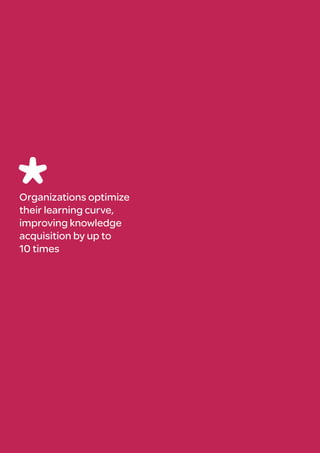
Organizations optimize
their learning curve,
improving knowledge
acquisition by up to
10 times
Learning Simulators


The benefits of effective
learning simulation
Application benefits

Utilization of simulators for learning purposes,
which should not be confused with e-learning,
offers numerous advantages to both users
and organizations that apply them in their
training processes.


Simulators enable users to:


•	   Learn by making decisions: simulators are
     based on Dewey’s learning by discovery
     theory, whereby the user becomes the
     protagonist in his or her training process,
     as opposed to the traditional model which
     positions the user as a passive subject
•	   Practice and train: employees become aware
     of the consequences of their decisions and
     errors in situations that reconstruct reality,
     helping them to gain confidence in performing
     specific actions, take on more risks, and act
     more quickly
•	   Increase their level of motivation: as a product
                                                        •	   Drive down costs: reducing training time and
     of the recreational component, it is suitable
                                                             minimizing the costs of displacement and
     for both digital natives and people with
                                                             attendance-based training for environments
     more experience who wish to swiftly transfer
                                                             that are distributed geographically and in time
     learning to real situations
                                                        •	   Apply a scalable training model: enabling
                                                             shorter training time with respect to the
Organizations, in turn:
                                                             traditional method involving laboratory practice

•	   Optimize the learning curve: improving
     knowledge acquisition and implementation by
     up to 10 times, thereby increasing employee
     motivation and engagement
•	   Integrate learning into the productive process:
     becoming part of an employee’s working
     experience instead of being confined to a
     specially-designated time outside of the
     productive process. The user can also turn to
     the online platform at any time


                                                                                                         White paper on Learning Simulators | 04
Learning Simulators


Methodology, participants, and
technical development
Simulator development methodology is defined by
five correlative stages:


1.	 Project definition
2.	 Knowledge engineering
3.	 Scripting
4.	 Technical development
5.	 Pilot testing


Likewise, there is a series of participants —
experts and technicians — who are involved in the
different stages as teaching, content and learning
specialists, in addition to 2-D and 3-D designers,
Flash programmers, and Unity programmers.


Finally, technical development consists of five
key aspects:


•	   SCORM 2004 packaging
•	   LMS platform compatibility
•	   Flash or flex programming language for 2-D
     graphic design or chrome videos
•	   Studio 3-D for 3-D modeling of avatars
     and scenarios
•	   Unity programming language for real-time 3-D


                                                     White paper on Learning Simulators | 05
Learning Simulators


Application areas by sector

The areas and sub-areas for applying learning            •	   Risk management: working protocol
simulators are numerous, with simulators yielding             in accordance with occupational risk
significant benefits in all of them:                          management and for dealing with factory
                                                              situations entailing risk
1.	 Utilities sector: there are simulators that help     •	   Machinery configuration and management:
     companies increase the efficiency of commercial          working process using plaster production
     contacts, lower the number of errors in field            machines via the control panel
     decisions, make the right decisions in critical     •	   PLC (a production indicator reading) monitoring:
     situations, and meet good practice standards.            mechanism for reading and monitoring machine
     Areas for application are as follows:                    reading results, such as speed, parts per
                                                              minute, heating times or errors
•	   Customer service situations: processes
     involving new customer sales                        3.	 Transportation sector: the chief
•	   Consumption measurement: gas meter reading               advantages simulators bring to this sector,
•	   Incident management: protocol for                        which is characterized by a high degree of
     reporting information involving customer                 personnel turnover, are training speed and
     breakdown resolution                                     ease, option for simple procedural consultation,
•	   Waste treatment and associated good practices            access to infrequent critical processes, a drop
•	   Plant and station working processes: water               in downtime; and easy adaptation to
     treatment plant and purifying station operation          multiple languages.
     or water pump level monitoring
                                                         The main areas for application are as follows:
2.	 Industrial sector: in this sector, simulators
     enable the elimination of the costs of training     •	   Package handling: protocol for shipment,
     machinery utilization, as well as instruction            handling and palletizing
     time of experienced personnel. In addition,         •	   Receiving and delivery processes: freight
     personnel in training learn through simulation           delivery validation or stock updating in
     of costly and dangerous heavy machinery,                 unloading and receiving freight goods
     without exposure to harm due to the virtual         •	   Safety norms and guidelines: course of
     environment — allowing them to resolve                   action in situations involving risk, as well as
     customer conflicts in different situations. Areas        transport and handling of packages containing
     for application are as follows:                          hazardous freight
                                                         •	   Operating special modes of transport:
•	   Working processes that include heavy                     mechanism for unloading freight using
     machinery: work procedures in using                      heavy equipment
     packing machines                                    •	   Driving under adverse conditions: accident
•	   Course of action for customer service, sales,            prevention in situations entailing risk
     after-sales or call center situations: protocols
     for handling customer queries
•	   Waste treatment and associated good practices


                                                                                                          White paper on Learning Simulators | 06
Learning Simulators


Application areas by sector

4.	 Public administration (education): in the              •	   Raising awareness of groups at risk of social
     case of public entities and administrations                exclusion: training processes for foster parents
     in charge of education, simulators provide            •	   Personal autonomy-related skills training:
     benefits that include unification of electronic            carrying out daily activities
     management for all government employees,              •	   Professionals working with risk groups: people
     management model awareness, reduced                        with AIDS, the mentally ill, delinquents, minors,
     downtime, easy procedural self-checks,                     and the chemically dependent
     appropriate decision making in critical situations,   •	   Training professionals in community social
     and compliance with good practice standards.               assistance: supporting local and autonomous
     The main areas for application are as follows:             administrations with regard to application and
                                                                implementation of the new law on dependency
•	   New worker training: documentation
     management in public administration                   6.	 Hotel and restaurant industry: in this sector,
•	   Training in working tools and methodologies:               the simulator application translates into greater
     good practices in file management                          ease and speed in training, given that it is
•	   Raising awareness in serving citizens                      also a sector with a high degree of personnel
     appropriately: proper manners for citizen                  turnover. It provides management model
     services and in addressing citizens from                   awareness, in-depth knowledge of processes
     other cultures                                             involved in preparing certain dishes, higher
•	   Basic administrative legislation and sectorial             efficiency in operational processes, and training
     standards: assessment of environmental                     and message unification for all company
     impact on infrastructures and economic and                 restaurants. Areas for application are as follows:
     budgetary management
•	   Functional skill development: preparation and         •	   Customer service procedures: steps to be
     presentation of written reports and working                taken in making a reservation and providing
     team management                                            table service
•	   Occupational risk prevention: avoiding posture        •	   Maintenance operations: room
     and stress related risks                                   cleaning processes
                                                           •	   Food preparation: sauce preparation or
5.	 Public administration (social services):                    service branding
     here simulators allow the possibility of working      •	   Procedures for receiving goods: protocol for
     under real conditions with people entailing risk,          receiving valid food products
     facilitate communication of new regulations,          •	   Waste treatment
     favor training that is accessible to people           •	   Safety and security norms and guidelines for
     from different social strata, and achieve cost             situations entailing risk
     reduction by unifying training for different
     entities. Areas for application are as follows:


•	   Skills training: working with
     high-performance teams
•	   Conduct and attitude orientation: civility and
     proper conduct, work and performance
     guidance, in accordance with road safety norms


                                                                                                               White paper on Learning Simulators | 07
Learning Simulators


Schneider Electric success stories

Success stories in developing and creating
learning simulators
Ministry of Education and the FIAB
Creation of a simulator for learning food
product sealing and packaging operations for
the Ministry of Education and the FIAB (Spanish
Federation of Food and Drink Industries, as per
the Spanish acronym).


Ministry of Education and the FEHR
Creation of a variety of simulators for learning
to analyze hazards and critical control points in
situations involving supply, handling, cleanliness
and disinfection for the Ministry of Education
and the FEHR (Spanish Federation of Hotels and
Restaurants, as per the Spanish acronym).


Ministry of Industry, Tourism, and 	
Commerce and red.es
Creation of learning simulators for operational
processes involving the creation of cooking
sauces for the Ministry of Industry, Tourism and
Commerce and red.es.
                                                         Regional Government of Castile and León
                                                         Development of a variety of occupational risk
In each one of the three projects,
                                                         prevention learning simulators for the Regional
Schneider Electric conducted the following activities:
                                                         Occupational Risk Prevention Service of the
                                                         Regional Government of Castile and León.
•	   Methodology design for information extraction,
     architecture, and the development model
                                                         Autonomous Government of Galicia: Office of
•	   Gathering information from material experts
                                                         the Environment and Sustainable Development
     and specialists in teaching contents
                                                         Development of a serious game of strategic
•	   Transformation of extracted contents into a
                                                         environmental assessment intended for seasoned
     multimedia script coupled with didactic and
                                                         developers and future developers. It was built for
     pedagogical support
                                                         the Galician territory, taking into account the
•	   Development of architecture contents
                                                         social and environmental effects of the
•	   Development of contents from the
                                                         construction work involved.
     development model
•	   Multimedia production in 3-D format


                                                                                                       White paper on Learning Simulators | 08
Learning Simulators


Schneider Electric success stories

Endesa
Development of a working occupational
risk prevention simulator for learning meter
replacement procedures.


In executing these three projects, Schneider Electric
carried out the following:


•	   Content definition in conjunction with the
     linguistics expert
•	   Content scripting and adaptation to
     simulator format
•	   Graphic design rendering
•	   Multimedia production
•	   Pilot testing and implementation


                                                        White paper on Learning Simulators | 09
Learning Simulators


Conclusion

Learning Simulators in a nutshell:

• Simulator-based training for employees provokes decision-making related
  
  to actual experiences specific to their business and allows participants to
  assess the real-life consequences of those decisions.


• This active training engagement results not only in improved
  
  comprehension of learning material but also in increased employee
  confidence and motivation.


• The employer benefits from reduced training time and costs and improved
  
  employee performance.


• Learning simulators have shown to be highly effective in many business
  
  sectors, including private and government sectors where appropriate
  customer interface and support is key to successful business.


• Schneider Electric offers expertise in delivering effective learning
  
  simulator solutions.


Simulators enable users to learn by
making decisions


                                                                                White paper on Learning Simulators | 10
© 2012 Schneider Electric. All rights reserved.


Schneider Electric
   C/ Valgrande, 6,
   28108 - Alcobendas (Madrid) (Spain)
   Telephone: 34-902-33-55-99
   Fax: 34-91-714-70-05
   http://www.schneider-electric.com
                                         July 2012

Learning simulators

  • 1.
    Learning Simulators October 2011/ White paper Make the most of your energy SM
  • 2.
    Summary Executive summary ...................................................................................p 1 Introduction ............................................................................................... p 2 Application benefits ................................................................................... p 4 Methodology, participants, and technical development .............................. p 5 Application areas by sector . ...................................................................... p 6 Schneider Electric success stories ............................................................. p 8 Conclusion ................................................................................................ p 10
  • 3.
    Learning Simulators Executive summary Learningsimulators reflect the expertise of software programmers, technical experts and learning professionals in creating real-life workplace scenarios that require decision making on the part of the training employee. Not to be confused with e-learning or laboratory practice, these simulators offer the flexibility to address the aptitudes, tools and motivations specific for the employee’s role. By actively involving trainees and exposing them to the consequences and results of their decisions, learning is improved significantly compared to training that does not involve interactivity. This approach also improves the trainee’s motivation and confidence. Organizations benefit not only from more comprehensive employee knowledge but also heightened on-the-job employee engagement – all with less training cost and time invested. Business sectors that see particular advantage to learning simulators are public utilities, industrial machinery, transportation, education, social services, and hotel and restaurant services. Beyond learning the processes and procedures involved and the relevant regulations and safety guidelines for the specific sector, the employee gains appropriate customer interaction skills through real-world scenarios requiring decision making and evaluation of the results of those decisions. Schneider Electric has developed learning simulators that have proven highly successful for Ministry-level programs and for industry federations in Spain; for risk prevention programs in regional governments; and socially and environmentally sustainable practices in construction work. In these projects, Schneider Electric provided comprehensive definition, design, and technical development and production expertise to help clients realize the benefits of effective learning simulation. The benefits of effective learning simulation White paper on Learning Simulators | 01
  • 4.
    Learning Simulators Introduction Learning simulatorsenable the recreation of scenarios for carrying out decision making in the same way as real life. By means of software that utilizes the same recreational component employed in video games, simulators become an educational resource yielding unlimited expansion of contents intended for training, troubleshooting, decision-making, and fulfilling conceptual, procedural and learning objectives (knowledge, power, and drive). In terms of work positions, simulators offer the possibility of incorporating new updates. They also provide different responses to diverse situations, and can address all required aptitudes, tools and motivations. As in real life, simulator-based decision making prompts a set of consequences — as in the case of changes in scenarios and variables — which enables learning based on real experience. This can yield significant benefits for users and higher profitability for organizations, such as: • Application of knowledge to the real environment • High degree of interactivity, allowing users to explore the space, options and limits of a problem • Various types of feedback after decisions are made • Improved working performance in professional practice • Increased motivation and engagement of workers and students — fostering personal and professional development • Simulation of reality — minimizing costs • Transfer of knowledge to the work domain, which is both rapid — increasing speed in knowledge comprehension by 30 percent — and constant, given that learning lasts over time White paper on Learning Simulators | 02
  • 5.
    Organizations optimize their learningcurve, improving knowledge acquisition by up to 10 times
  • 6.
    Learning Simulators The benefitsof effective learning simulation Application benefits Utilization of simulators for learning purposes, which should not be confused with e-learning, offers numerous advantages to both users and organizations that apply them in their training processes. Simulators enable users to: • Learn by making decisions: simulators are based on Dewey’s learning by discovery theory, whereby the user becomes the protagonist in his or her training process, as opposed to the traditional model which positions the user as a passive subject • Practice and train: employees become aware of the consequences of their decisions and errors in situations that reconstruct reality, helping them to gain confidence in performing specific actions, take on more risks, and act more quickly • Increase their level of motivation: as a product • Drive down costs: reducing training time and of the recreational component, it is suitable minimizing the costs of displacement and for both digital natives and people with attendance-based training for environments more experience who wish to swiftly transfer that are distributed geographically and in time learning to real situations • Apply a scalable training model: enabling shorter training time with respect to the Organizations, in turn: traditional method involving laboratory practice • Optimize the learning curve: improving knowledge acquisition and implementation by up to 10 times, thereby increasing employee motivation and engagement • Integrate learning into the productive process: becoming part of an employee’s working experience instead of being confined to a specially-designated time outside of the productive process. The user can also turn to the online platform at any time White paper on Learning Simulators | 04
  • 7.
    Learning Simulators Methodology, participants,and technical development Simulator development methodology is defined by five correlative stages: 1. Project definition 2. Knowledge engineering 3. Scripting 4. Technical development 5. Pilot testing Likewise, there is a series of participants — experts and technicians — who are involved in the different stages as teaching, content and learning specialists, in addition to 2-D and 3-D designers, Flash programmers, and Unity programmers. Finally, technical development consists of five key aspects: • SCORM 2004 packaging • LMS platform compatibility • Flash or flex programming language for 2-D graphic design or chrome videos • Studio 3-D for 3-D modeling of avatars and scenarios • Unity programming language for real-time 3-D White paper on Learning Simulators | 05
  • 8.
    Learning Simulators Application areasby sector The areas and sub-areas for applying learning • Risk management: working protocol simulators are numerous, with simulators yielding in accordance with occupational risk significant benefits in all of them: management and for dealing with factory situations entailing risk 1. Utilities sector: there are simulators that help • Machinery configuration and management: companies increase the efficiency of commercial working process using plaster production contacts, lower the number of errors in field machines via the control panel decisions, make the right decisions in critical • PLC (a production indicator reading) monitoring: situations, and meet good practice standards. mechanism for reading and monitoring machine Areas for application are as follows: reading results, such as speed, parts per minute, heating times or errors • Customer service situations: processes involving new customer sales 3. Transportation sector: the chief • Consumption measurement: gas meter reading advantages simulators bring to this sector, • Incident management: protocol for which is characterized by a high degree of reporting information involving customer personnel turnover, are training speed and breakdown resolution ease, option for simple procedural consultation, • Waste treatment and associated good practices access to infrequent critical processes, a drop • Plant and station working processes: water in downtime; and easy adaptation to treatment plant and purifying station operation multiple languages. or water pump level monitoring The main areas for application are as follows: 2. Industrial sector: in this sector, simulators enable the elimination of the costs of training • Package handling: protocol for shipment, machinery utilization, as well as instruction handling and palletizing time of experienced personnel. In addition, • Receiving and delivery processes: freight personnel in training learn through simulation delivery validation or stock updating in of costly and dangerous heavy machinery, unloading and receiving freight goods without exposure to harm due to the virtual • Safety norms and guidelines: course of environment — allowing them to resolve action in situations involving risk, as well as customer conflicts in different situations. Areas transport and handling of packages containing for application are as follows: hazardous freight • Operating special modes of transport: • Working processes that include heavy mechanism for unloading freight using machinery: work procedures in using heavy equipment packing machines • Driving under adverse conditions: accident • Course of action for customer service, sales, prevention in situations entailing risk after-sales or call center situations: protocols for handling customer queries • Waste treatment and associated good practices White paper on Learning Simulators | 06
  • 9.
    Learning Simulators Application areasby sector 4. Public administration (education): in the • Raising awareness of groups at risk of social case of public entities and administrations exclusion: training processes for foster parents in charge of education, simulators provide • Personal autonomy-related skills training: benefits that include unification of electronic carrying out daily activities management for all government employees, • Professionals working with risk groups: people management model awareness, reduced with AIDS, the mentally ill, delinquents, minors, downtime, easy procedural self-checks, and the chemically dependent appropriate decision making in critical situations, • Training professionals in community social and compliance with good practice standards. assistance: supporting local and autonomous The main areas for application are as follows: administrations with regard to application and implementation of the new law on dependency • New worker training: documentation management in public administration 6. Hotel and restaurant industry: in this sector, • Training in working tools and methodologies: the simulator application translates into greater good practices in file management ease and speed in training, given that it is • Raising awareness in serving citizens also a sector with a high degree of personnel appropriately: proper manners for citizen turnover. It provides management model services and in addressing citizens from awareness, in-depth knowledge of processes other cultures involved in preparing certain dishes, higher • Basic administrative legislation and sectorial efficiency in operational processes, and training standards: assessment of environmental and message unification for all company impact on infrastructures and economic and restaurants. Areas for application are as follows: budgetary management • Functional skill development: preparation and • Customer service procedures: steps to be presentation of written reports and working taken in making a reservation and providing team management table service • Occupational risk prevention: avoiding posture • Maintenance operations: room and stress related risks cleaning processes • Food preparation: sauce preparation or 5. Public administration (social services): service branding here simulators allow the possibility of working • Procedures for receiving goods: protocol for under real conditions with people entailing risk, receiving valid food products facilitate communication of new regulations, • Waste treatment favor training that is accessible to people • Safety and security norms and guidelines for from different social strata, and achieve cost situations entailing risk reduction by unifying training for different entities. Areas for application are as follows: • Skills training: working with high-performance teams • Conduct and attitude orientation: civility and proper conduct, work and performance guidance, in accordance with road safety norms White paper on Learning Simulators | 07
  • 10.
    Learning Simulators Schneider Electricsuccess stories Success stories in developing and creating learning simulators Ministry of Education and the FIAB Creation of a simulator for learning food product sealing and packaging operations for the Ministry of Education and the FIAB (Spanish Federation of Food and Drink Industries, as per the Spanish acronym). Ministry of Education and the FEHR Creation of a variety of simulators for learning to analyze hazards and critical control points in situations involving supply, handling, cleanliness and disinfection for the Ministry of Education and the FEHR (Spanish Federation of Hotels and Restaurants, as per the Spanish acronym). Ministry of Industry, Tourism, and Commerce and red.es Creation of learning simulators for operational processes involving the creation of cooking sauces for the Ministry of Industry, Tourism and Commerce and red.es. Regional Government of Castile and León Development of a variety of occupational risk In each one of the three projects, prevention learning simulators for the Regional Schneider Electric conducted the following activities: Occupational Risk Prevention Service of the Regional Government of Castile and León. • Methodology design for information extraction, architecture, and the development model Autonomous Government of Galicia: Office of • Gathering information from material experts the Environment and Sustainable Development and specialists in teaching contents Development of a serious game of strategic • Transformation of extracted contents into a environmental assessment intended for seasoned multimedia script coupled with didactic and developers and future developers. It was built for pedagogical support the Galician territory, taking into account the • Development of architecture contents social and environmental effects of the • Development of contents from the construction work involved. development model • Multimedia production in 3-D format White paper on Learning Simulators | 08
  • 11.
    Learning Simulators Schneider Electricsuccess stories Endesa Development of a working occupational risk prevention simulator for learning meter replacement procedures. In executing these three projects, Schneider Electric carried out the following: • Content definition in conjunction with the linguistics expert • Content scripting and adaptation to simulator format • Graphic design rendering • Multimedia production • Pilot testing and implementation White paper on Learning Simulators | 09
  • 12.
    Learning Simulators Conclusion Learning Simulatorsin a nutshell: • Simulator-based training for employees provokes decision-making related to actual experiences specific to their business and allows participants to assess the real-life consequences of those decisions. • This active training engagement results not only in improved comprehension of learning material but also in increased employee confidence and motivation. • The employer benefits from reduced training time and costs and improved employee performance. • Learning simulators have shown to be highly effective in many business sectors, including private and government sectors where appropriate customer interface and support is key to successful business. • Schneider Electric offers expertise in delivering effective learning simulator solutions. Simulators enable users to learn by making decisions White paper on Learning Simulators | 10
  • 13.
    © 2012 SchneiderElectric. All rights reserved. Schneider Electric C/ Valgrande, 6, 28108 - Alcobendas (Madrid) (Spain) Telephone: 34-902-33-55-99 Fax: 34-91-714-70-05 http://www.schneider-electric.com July 2012