Online Simulation in Higher Education  Kumiko Borman  WRIT 671 November 18, 2009
What is simulation?  “ The act of imitating the behavior of a  situation ,  problem , or  process  by means of something suitably analogous.  The technique of  representing the real world . ”   Simulation should imitate the  internal processes  and not merely the results of the thing being simulated  Group or Meeting  or Facility Simulation  v.s Virtual Simulation   -  Branching stories , Game-based,  Virtual lab s   Simple  to  highly complex PBL (Problem Based Learning) Teachers are no longer just a presenter of information. Students become participants.
Brief History 1955 - Simulation exercise for the U.S. Air Force logistics system was developed  1956 - The first widely known business game TOP MANAGEMENT SYSTEM for management seminars 1957 - BUSINESS MANAGEMENT GAME was developed for a consulting firm 1957 - MANAGEMENT DECISION GAME was used in a business policy class at the University of Washington By 1961, more than 100 business games were in existence and more than 30,000 executives had played at least one
Why Simulation?  Realistic opportunities to practice skills & apply knowledge - connecting theory to practice  Interactive, dynamic  More engaging learning environment Motivate students  Foster independent learning and critical thinking  Offers opportunities to develop communication, collaboration, leadership skills  Students “create knowledge” by trial and error
Who uses simulation?  Wide range of disciplines Nursing, Public Health Care, Dental Health  Business , Marketing, Management  Finance, Accounting, Economics,  Mathematics, Statistics  Computer Science, Programming, Networking Engineering  Education Administration  History  Communication, Language  Philosophy
How are they used? Some examples:  Students are assigned to run a company against each other Teaching children asthma management  Replaying history  Students use certain programming syntax to smoothly run traffic lights  Teaching nurse anesthesia in a operating room  Students play stakeholder roles and learn the effects of proposed engineering development project  Students create the best-performing portfolio using trading simulation Stock market game
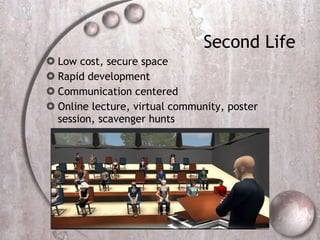
Second Life  Low cost, secure space Rapid development Communication centered Online lecture, virtual community, poster session, scavenger hunts
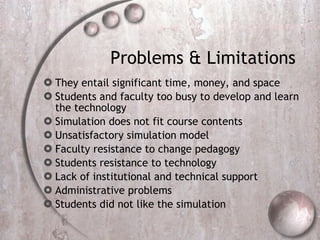
Problems & Limitations  They entail significant time, money, and space Students and faculty too busy to develop and learn the technology  Simulation does not fit course contents  Unsatisfactory simulation model  Faculty resistance to change pedagogy Students resistance to technology Lack of institutional and technical support  Administrative problems  Students did not like the simulation
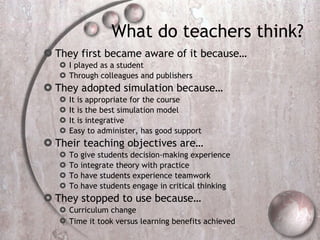
What do teachers think?  They first became aware of it because… I played as a student  Through colleagues and publishers  They adopted simulation because…  It is appropriate for the course  It is the best simulation model  It is integrative  Easy to administer, has good support  Their teaching objectives are…  To give students decision-making experience To integrate theory with practice To have students experience teamwork  To have students engage in critical thinking  They stopped to use because…  Curriculum change  Time it took versus learning benefits achieved
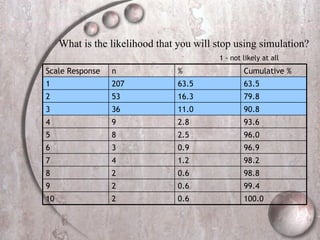
1 - not likely at all   What is the likelihood that you will stop using simulation?  Scale Response n % Cumulative % 1 207 63.5 63.5 2 53 16.3 79.8 3 36 11.0 90.8 4 9 2.8 93.6 5 8 2.5 96.0 6 3 0.9 96.9 7 4 1.2 98.2 8 2 0.6 98.8 9 2 0.6 99.4 10 2 0.6 100.0
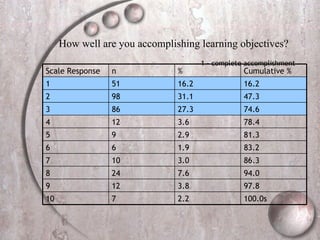
1 - complete accomplishment   How well are you accomplishing learning objectives?  Scale Response n % Cumulative % 1 51 16.2 16.2 2 98 31.1 47.3 3 86 27.3 74.6 4 12 3.6 78.4 5 9 2.9 81.3 6 6 1.9 83.2 7 10 3.0 86.3 8 24 7.6 94.0 9 12 3.8 97.8 10 7 2.2 100.0s
What did students think?  Spent more time on assignments  It was motivating It forced me to make better decisions The visual helped me tremendously. I don’t think it could ever be as good as a live class.  I had more freedom to explore various answers and scenarios, and go back to change answers It was nice to have unlimited time to ponder a topic before you respond. http://www.smg2000.org/teachers_page2.html
Evaluation  Qualitative Survey Interviews Focus Group Observation Quantitative  Test Performance  Survey
Tips for Success  Get colleagues recommendations for software Simulation is directly connected to the course textbook  Explicit learning objectives  Deals with realistic and down-to-earth problems Simulation is easy to learn  Start with simple examples  Provide orientation session at the beginning   Understand the program   Incorporating reflective component Immediate and frequent feedback
Conclusion Simulation can greatly enhance students’ learning experience if properly implemented.  Instructors need to be fully committed and willing to spend time learning the software, preparing the students, setting objectives, and developing content.  Simulation is a great tool in teaching procedures, decision making, critical thinking, and teamwork.  If used well, both students and instructors are satisfied with the results and experience.

Using Simulations in Higher Education

  • 1.
    Online Simulation inHigher Education Kumiko Borman WRIT 671 November 18, 2009
  • 2.
    What is simulation? “ The act of imitating the behavior of a situation , problem , or process by means of something suitably analogous. The technique of representing the real world . ” Simulation should imitate the internal processes and not merely the results of the thing being simulated Group or Meeting or Facility Simulation v.s Virtual Simulation - Branching stories , Game-based, Virtual lab s Simple to highly complex PBL (Problem Based Learning) Teachers are no longer just a presenter of information. Students become participants.
  • 3.
    Brief History 1955- Simulation exercise for the U.S. Air Force logistics system was developed 1956 - The first widely known business game TOP MANAGEMENT SYSTEM for management seminars 1957 - BUSINESS MANAGEMENT GAME was developed for a consulting firm 1957 - MANAGEMENT DECISION GAME was used in a business policy class at the University of Washington By 1961, more than 100 business games were in existence and more than 30,000 executives had played at least one
  • 4.
    Why Simulation? Realistic opportunities to practice skills & apply knowledge - connecting theory to practice Interactive, dynamic More engaging learning environment Motivate students Foster independent learning and critical thinking Offers opportunities to develop communication, collaboration, leadership skills Students “create knowledge” by trial and error
  • 5.
    Who uses simulation? Wide range of disciplines Nursing, Public Health Care, Dental Health Business , Marketing, Management Finance, Accounting, Economics, Mathematics, Statistics Computer Science, Programming, Networking Engineering Education Administration History Communication, Language Philosophy
  • 6.
    How are theyused? Some examples: Students are assigned to run a company against each other Teaching children asthma management Replaying history Students use certain programming syntax to smoothly run traffic lights Teaching nurse anesthesia in a operating room Students play stakeholder roles and learn the effects of proposed engineering development project Students create the best-performing portfolio using trading simulation Stock market game
  • 7.
    Second Life Low cost, secure space Rapid development Communication centered Online lecture, virtual community, poster session, scavenger hunts
  • 8.
    Problems & Limitations They entail significant time, money, and space Students and faculty too busy to develop and learn the technology Simulation does not fit course contents Unsatisfactory simulation model Faculty resistance to change pedagogy Students resistance to technology Lack of institutional and technical support Administrative problems Students did not like the simulation
  • 9.
    What do teachersthink? They first became aware of it because… I played as a student Through colleagues and publishers They adopted simulation because… It is appropriate for the course It is the best simulation model It is integrative Easy to administer, has good support Their teaching objectives are… To give students decision-making experience To integrate theory with practice To have students experience teamwork To have students engage in critical thinking They stopped to use because… Curriculum change Time it took versus learning benefits achieved
  • 10.
    1 - notlikely at all What is the likelihood that you will stop using simulation? Scale Response n % Cumulative % 1 207 63.5 63.5 2 53 16.3 79.8 3 36 11.0 90.8 4 9 2.8 93.6 5 8 2.5 96.0 6 3 0.9 96.9 7 4 1.2 98.2 8 2 0.6 98.8 9 2 0.6 99.4 10 2 0.6 100.0
  • 11.
    1 - completeaccomplishment How well are you accomplishing learning objectives? Scale Response n % Cumulative % 1 51 16.2 16.2 2 98 31.1 47.3 3 86 27.3 74.6 4 12 3.6 78.4 5 9 2.9 81.3 6 6 1.9 83.2 7 10 3.0 86.3 8 24 7.6 94.0 9 12 3.8 97.8 10 7 2.2 100.0s
  • 12.
    What did studentsthink? Spent more time on assignments It was motivating It forced me to make better decisions The visual helped me tremendously. I don’t think it could ever be as good as a live class. I had more freedom to explore various answers and scenarios, and go back to change answers It was nice to have unlimited time to ponder a topic before you respond. http://www.smg2000.org/teachers_page2.html
  • 13.
    Evaluation QualitativeSurvey Interviews Focus Group Observation Quantitative Test Performance Survey
  • 14.
    Tips for Success Get colleagues recommendations for software Simulation is directly connected to the course textbook Explicit learning objectives Deals with realistic and down-to-earth problems Simulation is easy to learn Start with simple examples Provide orientation session at the beginning Understand the program Incorporating reflective component Immediate and frequent feedback
  • 15.
    Conclusion Simulation cangreatly enhance students’ learning experience if properly implemented. Instructors need to be fully committed and willing to spend time learning the software, preparing the students, setting objectives, and developing content. Simulation is a great tool in teaching procedures, decision making, critical thinking, and teamwork. If used well, both students and instructors are satisfied with the results and experience.

Editor's Notes

  • #3 http://en.wikipedia.org/wiki/Simulation#Simulation_in_education_and_training
  • #4 Dates back to the mid-50th, since then the use has grown Business schools have been using more than 50 years
  • #5 manage complex situations They are “ hands-on ” More fun, suitable for younger generations Provide a global environment without the travel cost
  • #6 Procedural type Humanity courses - Virtual professor replicate the Socratic method stems from a classic lifeboat Current users tend to have a higher academic rank, more years of experience Young teachers developed own program for teacher education
  • #7 business courses is a popular method for providing students with experiences similar to those they might encounter n the business world. Decision-making, team building Design competitive strategy Global cooperation Transfer of knowledge, In-depth processing of knowledge a virtual cash account of $100,000, students strive to create the best-performing portfolio using a live trading simulation. They work together in teams, practicing leadership, organization, negotiation, and cooperation as they compete for the top spot.
  • #9 Though there are many successful cases Not all simulation are expensive Institution does not offer support - instructors are left on their own to figure out and answer questions (need to master)
  • #10 Enjoyed as students found them valuable and want to continue to use them. Implications for the further spread Teaching environment change - nothing to do with simulation Second category - dissatisfaction with with certain aspects of simulation Too complex, students didn’t like, lack of support, admin problems
  • #11 High satisfaction rate - More than 90% of current users Commitment level high - likely to stick
  • #14 Students who used outperformed their counterparts (Networking Visio vs.. simulation) they could actually build and test the different components of a net work and try different configurations. Visio -no way to verify In general students had positive feedback. Long-term studies … sample very small.
  • #15 Blending Reflect on experiences beyond classroom/simulation games Avoid overwhelmingly difficult technical details. restricting the number of concepts taught. Be ready to answer student questions by fully understanding the program Graphics and animations can make simulation fun, but too much focus on them can ruin the course. Have students understand that the simulation should be run several times student should find it enjoyable and helpful!