-by Shashank Vaidya.
What is a Transducer????
 It is a one, which converts one form of energy into
another form. Ex- microphone(electrical ->
sound),solar cell, lamp etc.
 Transducers are devices which for the purpose of
measurement convert physical input quantities into an
electrical output signal.
Transduction principle
 Resistive, Capacitive, Inductive
 Primary Input quantity
 Voltage, current, temperature, force, pressure etc..
 Material and technology
 SMT (Silicon Micro technology), MEMS(micro
electromechanical system)
RESISTIVE TRANSDUCERS
 Major types of Resistive transducers
• Potentiometers
• Resistive position transducer
• Resistive pressure transducer
• Strain Gauges
• Thermistors
• Light Dependent Resistor (LDR)
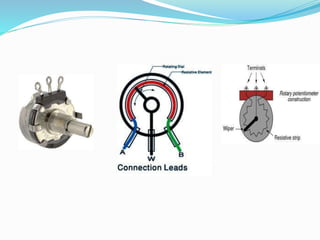
Potentiometers(POTs)
 Passive transducer.
 Resistive element.(graphite)
 Sliding contact-wiper.
 Motion of the sliding contact – translatory / rotational
movement or combination of both(helipots)
 Translatory-Used to vary the voltage levels.
 Rotational-angular displacement.
 Advantages
 Less cost
 Simple to operate
 More effeciency.
 Disadvantages
 Large force required to
move sliding contacts
 Wear n tear of sliding
contacts.
RESISTIVE POSITION
TRANSDUCER.
 Operating principle-a quantity to be measured causes
a resistance change in the sensing element.
Queries ?
 Thank you……………!!!!!!!!

TransducersTypes

  • 1.
  • 2.
    What is aTransducer????  It is a one, which converts one form of energy into another form. Ex- microphone(electrical -> sound),solar cell, lamp etc.  Transducers are devices which for the purpose of measurement convert physical input quantities into an electrical output signal.
  • 3.
    Transduction principle  Resistive,Capacitive, Inductive  Primary Input quantity  Voltage, current, temperature, force, pressure etc..  Material and technology  SMT (Silicon Micro technology), MEMS(micro electromechanical system)
  • 4.
    RESISTIVE TRANSDUCERS  Majortypes of Resistive transducers • Potentiometers • Resistive position transducer • Resistive pressure transducer • Strain Gauges • Thermistors • Light Dependent Resistor (LDR)
  • 5.
    Potentiometers(POTs)  Passive transducer. Resistive element.(graphite)  Sliding contact-wiper.  Motion of the sliding contact – translatory / rotational movement or combination of both(helipots)  Translatory-Used to vary the voltage levels.  Rotational-angular displacement.
  • 9.
     Advantages  Lesscost  Simple to operate  More effeciency.  Disadvantages  Large force required to move sliding contacts  Wear n tear of sliding contacts.
  • 10.
    RESISTIVE POSITION TRANSDUCER.  Operatingprinciple-a quantity to be measured causes a resistance change in the sensing element.
  • 12.
    Queries ?  Thankyou……………!!!!!!!!