LOAD CELL
TRANSDUCER
LOAD CELL:
Definition:
 A load cell is a transducer that is used to create an electrical signal whose
magnitude is directly proportional to the force being measured.
 Types:
The various types of load cells are as follows
Resistive Load Cells
 The strain gauge measures the deformation (strain) as a change in
electrical resistance, which is a measure of the strain and hence the
applied forces
 Working Principle
 Where
R: Initial resistance of the strain gauge
 ΔR: Resistance change caused by elongation or contraction
 K: Proportional constant (called the “gauge factor”)
 ε: Strain
Types
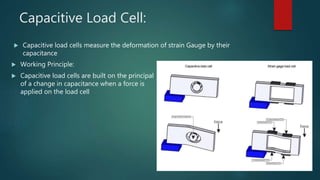
Capacitive Load Cell:
 Capacitive load cells measure the deformation of strain Gauge by their
capacitance
 Working Principle:
 Capacitive load cells are built on the principal
of a change in capacitance when a force is
applied on the load cell
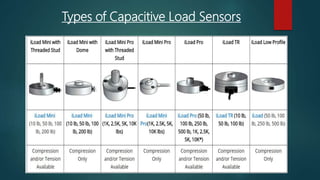
Types of Capacitive Load Sensors
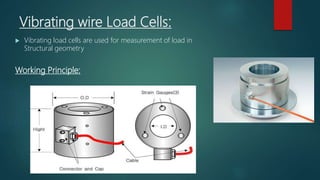
Vibrating wire Load Cells:
 Vibrating load cells are used for measurement of load in
Structural geometry
Working Principle:
Vibrating wire Load Cells:
 Advantages and Limitations:
 Advantages:
 An efficient way to monitor the load in structural elements
 High accuracy and Long-term performance
 Multiple gage system allowing to account for eccentric loading effects
 Limitations:
 Not suitable for dynamic loading
 Special manufacturing technologies required to minimize the zero drift
 Need to lightning protection should be evaluated
 Zero drift
 Gradual change in the scale zero of a measuring instrument.
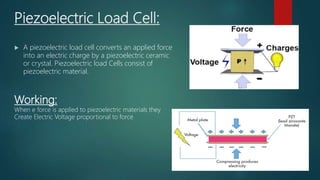
Piezoelectric Load Cell:
 A piezoelectric load cell converts an applied force
into an electric charge by a piezoelectric ceramic
or crystal. Piezoelectric load Cells consist of
piezoelectric material.
Working:
When e force is applied to piezoelectric materials they
Create Electric Voltage proportional to force
Piezoelectric Load Cell:
 Advantages and Limitations:
 Advantages
 No need of external force.
 Easy to handle and use as it has small dimensions.
 High frequency response it means the parameters change very rapidly.
 Limitations:
 It is not suitable for measurement in static condition.
 It is affected by temperatures.
 Output is low so some external circuit is attached to it.
 It is very difficult to give desired shape to this material and also desired strength.
Hydraulic Load Cell:
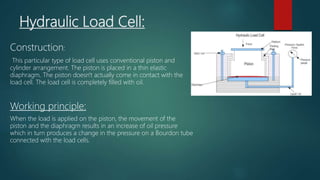
Construction:
This particular type of load cell uses conventional piston and
cylinder arrangement. The piston is placed in a thin elastic
diaphragm. The piston doesn't actually come in contact with the
load cell. The load cell is completely filled with oil.
Working principle:
When the load is applied on the piston, the movement of the
piston and the diaphragm results in an increase of oil pressure
which in turn produces a change in the pressure on a Bourdon tube
connected with the load cells.
Hydraulic Load Cell:
Limitations:
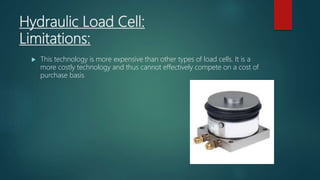
 This technology is more expensive than other types of load cells. It is a
more costly technology and thus cannot effectively compete on a cost of
purchase basis
Pneumatic load cell:
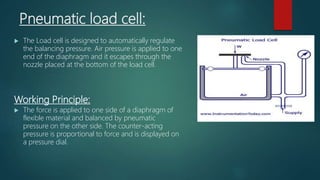
 The Load cell is designed to automatically regulate
the balancing pressure. Air pressure is applied to one
end of the diaphragm and it escapes through the
nozzle placed at the bottom of the load cell.
 The force is applied to one side of a diaphragm of
flexible material and balanced by pneumatic
pressure on the other side. The counter-acting
pressure is proportional to force and is displayed on
a pressure dial.
Working Principle:
Pneumatic load cell:
Advantages and Limitations:
 Advantages:
 The advantages of this type is that they are explosion proof.
 They are not sensitive to temperature variations.
 They contain no fluids like other type that might contaminate the process
if diaphragm destroyed.
 Limitations:
 They are relatively slow speed of response.
 They need for clean, dry, regulated air or
Load cell-transducer

Load cell-transducer

  • 1.
  • 3.
    LOAD CELL: Definition:  Aload cell is a transducer that is used to create an electrical signal whose magnitude is directly proportional to the force being measured.  Types: The various types of load cells are as follows
  • 4.
    Resistive Load Cells The strain gauge measures the deformation (strain) as a change in electrical resistance, which is a measure of the strain and hence the applied forces  Working Principle  Where R: Initial resistance of the strain gauge  ΔR: Resistance change caused by elongation or contraction  K: Proportional constant (called the “gauge factor”)  ε: Strain
  • 5.
  • 6.
    Capacitive Load Cell: Capacitive load cells measure the deformation of strain Gauge by their capacitance  Working Principle:  Capacitive load cells are built on the principal of a change in capacitance when a force is applied on the load cell
  • 7.
    Types of CapacitiveLoad Sensors
  • 8.
    Vibrating wire LoadCells:  Vibrating load cells are used for measurement of load in Structural geometry Working Principle:
  • 9.
    Vibrating wire LoadCells:  Advantages and Limitations:  Advantages:  An efficient way to monitor the load in structural elements  High accuracy and Long-term performance  Multiple gage system allowing to account for eccentric loading effects  Limitations:  Not suitable for dynamic loading  Special manufacturing technologies required to minimize the zero drift  Need to lightning protection should be evaluated  Zero drift  Gradual change in the scale zero of a measuring instrument.
  • 10.
    Piezoelectric Load Cell: A piezoelectric load cell converts an applied force into an electric charge by a piezoelectric ceramic or crystal. Piezoelectric load Cells consist of piezoelectric material. Working: When e force is applied to piezoelectric materials they Create Electric Voltage proportional to force
  • 11.
    Piezoelectric Load Cell: Advantages and Limitations:  Advantages  No need of external force.  Easy to handle and use as it has small dimensions.  High frequency response it means the parameters change very rapidly.  Limitations:  It is not suitable for measurement in static condition.  It is affected by temperatures.  Output is low so some external circuit is attached to it.  It is very difficult to give desired shape to this material and also desired strength.
  • 12.
    Hydraulic Load Cell: Construction: Thisparticular type of load cell uses conventional piston and cylinder arrangement. The piston is placed in a thin elastic diaphragm. The piston doesn't actually come in contact with the load cell. The load cell is completely filled with oil. Working principle: When the load is applied on the piston, the movement of the piston and the diaphragm results in an increase of oil pressure which in turn produces a change in the pressure on a Bourdon tube connected with the load cells.
  • 13.
    Hydraulic Load Cell: Limitations: This technology is more expensive than other types of load cells. It is a more costly technology and thus cannot effectively compete on a cost of purchase basis
  • 14.
    Pneumatic load cell: The Load cell is designed to automatically regulate the balancing pressure. Air pressure is applied to one end of the diaphragm and it escapes through the nozzle placed at the bottom of the load cell.  The force is applied to one side of a diaphragm of flexible material and balanced by pneumatic pressure on the other side. The counter-acting pressure is proportional to force and is displayed on a pressure dial. Working Principle:
  • 15.
    Pneumatic load cell: Advantagesand Limitations:  Advantages:  The advantages of this type is that they are explosion proof.  They are not sensitive to temperature variations.  They contain no fluids like other type that might contaminate the process if diaphragm destroyed.  Limitations:  They are relatively slow speed of response.  They need for clean, dry, regulated air or